DNA Replication
By: Laura Keller
DNA
• The DNA double helix refers to the
shape of the DNA molecule, or the
twisted ladder. It has two intertwining
strands made of sugar and phosphate
with links across the middle. The
rungs of the ladder are base pairs
made of four different bases,
represented by the letters A, T, G, and
C.
5’

3’

The Enzyme DNA
helicase “unzips” or
unwinds the double
stranded DNA at the
origin of replication
by breaking hydrogen
bonds between
complementary
strands.

Key
= Phosphate
= Sugar
= Adenine
= Thymine
= Guanine

Hydrogen Bond
3’

5’

= Cytosine
DNA Helicase

Key
= Phosphate
= Sugar
= Adenine
= Thymine
= Guanine
= Cytosine
DNA Helicase

Key
= Phosphate
= Sugar
= Adenine
= Thymine
= Guanine
= Cytosine
DNA Helicase

Key
= Phosphate
= Sugar
= Adenine
= Thymine
= Guanine
= Cytosine
DNA Helicase

Key
= Phosphate
= Sugar
= Adenine
= Thymine
= Guanine
= Cytosine
DNA Helicase

Key
= Phosphate
= Sugar
= Adenine

= Thymine
= Guanine
= Cytosine
Key

DNA Helicase

= Phosphate
= Sugar
= Adenine
= Thymine
= Guanine
= Cytosine
Key
= Phosphate
DNA Helicase

= Sugar
= Adenine
= Thymine
= Guanine
= Cytosine
Key
= Phosphate
= Sugar
DNA Helicase

= Adenine
= Thymine
= Guanine
= Cytosine
Key
= Phosphate
= Sugar
= Adenine
DNA Helicase

= Thymine
= Guanine
= Cytosine
Key
= Phosphate
= Sugar
= Adenine
= Thymine
Helicase

= Guanine
= Cytosine
Key
= Phosphate
= Sugar
= Adenine
= Thymine

licase

= Guanine
= Cytosine
Key
= Phosphate
= Sugar
= Adenine
= Thymine
= Guanine
= Cytosine
Key
= Phosphate
= Sugar
= Adenine
= Thymine
= Guanine
= Cytosine
Lagging Strand

Leading Strand

Then, on the leading strand, DNA
Polymerase III adds the 5’ phosphate
end of a free floating nucleotide to the
exposed 3’ OH ends on the single
stranded DNA in a continuous fashion.
The leading strand elongates toward the
replication fork.

Key
= Phosphate
= Sugar
= Adenine
= Thymine
= Guanine
= Cytosine
DNA Polymerase III

Lagging Strand

Leading Strand

Then, on the leading strand, DNA
Polymerase III adds the 5’ phosphate
end of a free floating nucleotide to the
exposed 3’ OH ends on the single
stranded DNA in a continuous fashion.
The leading strand elongates toward the
replication fork.

Key
= Phosphate
= Sugar
= Adenine
= Thymine
= Guanine
= Cytosine
DNA Polymerase III

Lagging Strand

Leading Strand

Then, on the leading strand, DNA
Polymerase III adds the 5’ phosphate
end of a free floating nucleotide to the
exposed 3’ OH ends on the single
stranded DNA in a continuous fashion.
The leading strand elongates toward the
replication fork.

Key
= Phosphate
= Sugar
= Adenine
= Thymine
= Guanine
= Cytosine
DNA Polymerase III

Lagging Strand

Leading Strand

Then, on the leading strand, DNA
Polymerase III adds the 5’ phosphate
end of a free floating nucleotide to the
exposed 3’ OH ends on the single
stranded DNA in a continuous fashion.
The leading strand elongates toward the
replication fork.

Key
= Phosphate
= Sugar
= Adenine
= Thymine
= Guanine
= Cytosine
DNA Polymerase III

Lagging Strand

Leading Strand

Then, on the leading strand, DNA
Polymerase III adds the 5’ phosphate
end of a free floating nucleotide to the
exposed 3’ OH ends on the single
stranded DNA in a continuous fashion.
The leading strand elongates toward the
replication fork.

Key
= Phosphate
= Sugar
= Adenine
= Thymine
= Guanine
= Cytosine
DNA Polymerase III

Lagging Strand

Leading Strand

Then, on the leading strand, DNA
Polymerase III adds the 5’ phosphate
end of a free floating nucleotide to the
exposed 3’ OH ends on the single
stranded DNA in a continuous fashion.
The leading strand elongates toward the
replication fork.

Key
= Phosphate
= Sugar
= Adenine
= Thymine
= Guanine
= Cytosine
Then, on the leading strand, DNA
Polymerase III adds the 5’ phosphate
end of a free floating nucleotide to the
exposed 3’ OH ends on the single
stranded DNA in a continuous fashion.
The leading strand elongates toward the
replication fork.

Leading Strand

Lagging Strand

Key
= Phosphate
= Sugar
= Adenine

lymerase III

= Thymine
= Guanine
= Cytosine
Then, on the leading strand, DNA
Polymerase III adds the 5’ phosphate
end of a free floating nucleotide to the
exposed 3’ OH ends on the single
stranded DNA in a continuous fashion.
The leading strand elongates toward the
replication fork.

Leading Strand

Lagging Strand

Key
= Phosphate
= Sugar
= Adenine
= Thymine
= Guanine

e III

= Cytosine
Lagging Strand

Leading Strand

Then, on the leading strand, DNA
Polymerase III adds the 5’ phosphate
end of a free floating nucleotide to the
exposed 3’ OH ends on the single
stranded DNA in a continuous fashion.
The leading strand elongates toward the
replication fork.

Key
= Phosphate
= Sugar
= Adenine
= Thymine
= Guanine
= Cytosine
DNA Primase

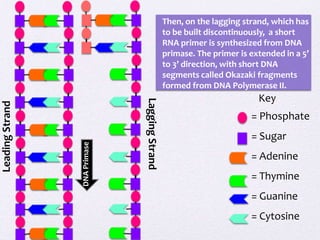
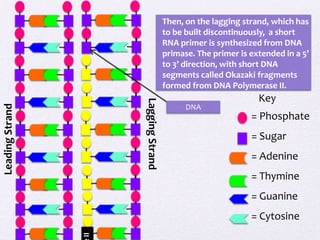
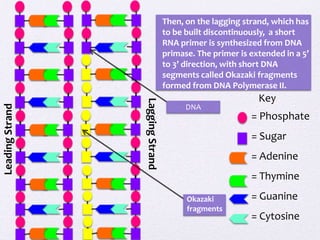
Then, on the lagging strand, which has
to be built discontinuously, a short
RNA primer is synthesized from DNA
primase. The primer is extended in a 5’
to 3’ direction, with short DNA
segments called Okazaki fragments
formed from DNA Polymerase II.

Lagging Strand

Leading Strand

`

Key
= Phosphate
= Sugar
= Adenine
= Thymine
= Guanine
= Cytosine
Lagging Strand

Leading Strand

DNA Primase

Then, on the lagging strand, which has
to be built discontinuously, a short
RNA primer is synthesized from DNA
primase. The primer is extended in a 5’
to 3’ direction, with short DNA
segments called Okazaki fragments
formed from DNA Polymerase II.

Key
= Phosphate
= Sugar
= Adenine
= Thymine
= Guanine
= Cytosine
Lagging Strand

Leading Strand

DNA Primase

Then, on the lagging strand, which has
to be built discontinuously, a short
RNA primer is synthesized from DNA
primase. The primer is extended in a 5’
to 3’ direction, with short DNA
segments called Okazaki fragments
formed from DNA Polymerase II.

Key
= Phosphate
= Sugar
= Adenine
= Thymine
= Guanine
= Cytosine
DNA Primase

Lagging Strand

Leading Strand

Then, on the lagging strand, which has
to be built discontinuously, a short
RNA primer is synthesized from DNA
primase. The primer is extended in a 5’
to 3’ direction, with short DNA
segments called Okazaki fragments
formed from DNA Polymerase II.

Key
= Phosphate
= Sugar
= Adenine
= Thymine
= Guanine
= Cytosine
3’
Then, on the lagging strand, which has
to be built discontinuously, a short
RNA primer is synthesized from DNA
primase. The primer is extended in a 5’
to 3’ direction, with short DNA
segments called Okazaki fragments
formed from DNA Polymerase II.

Lagging Strand

DNA Primase

3’ 5’

Leading Strand

5’

Key
= Phosphate
= Sugar
= Adenine
= Thymine
= Guanine
= Cytosine

3’

5’

5’
DNA Primase

Lagging Strand

Leading Strand

Then, on the lagging strand, which has
to be built discontinuously, a short
RNA primer is synthesized from DNA
primase. The primer is extended in a 5’
to 3’ direction, with short DNA
segments called Okazaki fragments
formed from DNA Polymerase II.

Key
= Phosphate
= Sugar
= Adenine
= Thymine
= Guanine
= Cytosine
DNA Primase

Lagging Strand

Leading Strand

Then, on the lagging strand, which has
to be built discontinuously, a short
RNA primer is synthesized from DNA
primase. The primer is extended in a 5’
to 3’ direction, with short DNA
segments called Okazaki fragments
formed from DNA Polymerase II.

Key
= Phosphate
= Sugar
= Adenine
= Thymine
= Guanine
= Cytosine
DNA Primase

Lagging Strand

Leading Strand

Then, on the lagging strand, which has
to be built discontinuously, a short
RNA primer is synthesized from DNA
primase. The primer is extended in a 5’
to 3’ direction, with short DNA
segments called Okazaki fragments
formed from DNA Polymerase II.

Key
= Phosphate
= Sugar
= Adenine
= Thymine
= Guanine
= Cytosine
DNA Primase

Lagging Strand

Leading Strand

Then, on the lagging strand, which has
to be built discontinuously, a short
RNA primer is synthesized from DNA
primase. The primer is extended in a 5’
to 3’ direction, with short DNA
segments called Okazaki fragments
formed from DNA Polymerase II.

Key
= Phosphate
= Sugar
= Adenine
= Thymine
= Guanine
= Cytosine
DNA Primase

Lagging Strand

Leading Strand

Then, on the lagging strand, which has
to be built discontinuously, a short
RNA primer is synthesized from DNA
primase. The primer is extended in a 5’
to 3’ direction, with short DNA
segments called Okazaki fragments
formed from DNA Polymerase II.

Key
= Phosphate
= Sugar
= Adenine
= Thymine
= Guanine
= Cytosine
Then, on the lagging strand, which has
to be built discontinuously, a short
RNA primer is synthesized from DNA
primase. The primer is extended in a 5’
to 3’ direction, with short DNA
segments called Okazaki fragments
formed from DNA Polymerase II.

DNA Primase

Leading Strand

Lagging Strand

Key
= Phosphate
= Sugar
= Adenine
= Thymine
= Guanine
= Cytosine
Then, on the lagging strand, which has
to be built discontinuously, a short
RNA primer is synthesized from DNA
primase. The primer is extended in a 5’
to 3’ direction, with short DNA
segments called Okazaki fragments
formed from DNA Polymerase II.

Leading Strand

Lagging Strand

Key
= Phosphate
= Sugar
= Adenine

DNA Primase

= Thymine
= Guanine
= Cytosine
Then, on the lagging strand, which has
to be built discontinuously, a short
RNA primer is synthesized from DNA
primase. The primer is extended in a 5’
to 3’ direction, with short DNA
segments called Okazaki fragments
formed from DNA Polymerase II.

Leading Strand

Lagging Strand

Key
= Phosphate
= Sugar
= Adenine
= Thymine

Primase

= Guanine
= Cytosine
Lagging Strand

Leading Strand

Then, on the lagging strand, which has
to be built discontinuously, a short
RNA primer is synthesized from DNA
primase. The primer is extended in a 5’
to 3’ direction, with short DNA
segments called Okazaki fragments
formed from DNA Polymerase II.
RNA Primer

Key
= Phosphate
= Sugar
= Adenine
= Thymine
= Guanine
= Cytosine
Lagging Strand

Leading Strand

DNA Polymerase II

Then, on the lagging strand, which has
to be built discontinuously, a short
RNA primer is synthesized from DNA
primase. The primer is extended in a 5’
to 3’ direction, with short DNA
segments called Okazaki fragments
formed from DNA Polymerase II.
RNA Primer

Key
= Phosphate
= Sugar
= Adenine
= Thymine
= Guanine
= Cytosine
DNA Polymerase II

Lagging Strand

Leading Strand

Then, on the lagging strand, which has
to be built discontinuously, a short
RNA primer is synthesized from DNA
primase. The primer is extended in a 5’
to 3’ direction, with short DNA
segments called Okazaki fragments
formed from DNA Polymerase II.
RNA Primer

Key
= Phosphate
= Sugar
= Adenine
= Thymine
= Guanine
= Cytosine
DNA Polymerase II

Lagging Strand

Leading Strand

Then, on the lagging strand, which has
to be built discontinuously, a short
RNA primer is synthesized from DNA
primase. The primer is extended in a 5’
to 3’ direction, with short DNA
segments called Okazaki fragments
formed from DNA Polymerase II.
DNA
When the
DNA
Polymerase II
reaches the
RNA primer,
it turns into
DNA.

Key
= Phosphate
= Sugar
= Adenine
= Thymine
= Guanine
= Cytosine
DNA Polymerase II

Lagging Strand

Leading Strand

Then, on the lagging strand, which has
to be built discontinuously, a short
RNA primer is synthesized from DNA
primase. The primer is extended in a 5’
to 3’ direction, with short DNA
segments called Okazaki fragments
formed from DNA Polymerase II.
DNA
When the
DNA
Polymerase II
reaches the
RNA primer,
it turns into
DNA.

Key
= Phosphate
= Sugar
= Adenine
= Thymine
= Guanine
= Cytosine
DNA Polymerase II

Lagging Strand

Leading Strand

Then, on the lagging strand, which has
to be built discontinuously, a short
RNA primer is synthesized from DNA
primase. The primer is extended in a 5’
to 3’ direction, with short DNA
segments called Okazaki fragments
formed from DNA Polymerase II.
DNA

Key
= Phosphate
= Sugar
= Adenine
= Thymine
= Guanine
= Cytosine
Then, on the lagging strand, which has
to be built discontinuously, a short
RNA primer is synthesized from DNA
primase. The primer is extended in a 5’
to 3’ direction, with short DNA
segments called Okazaki fragments
formed from DNA Polymerase II.

Leading Strand

Lagging Strand

DNA

Key
= Phosphate
= Sugar
= Adenine
= Thymine

erase II

= Guanine
= Cytosine
Then, on the lagging strand, which has
to be built discontinuously, a short
RNA primer is synthesized from DNA
primase. The primer is extended in a 5’
to 3’ direction, with short DNA
segments called Okazaki fragments
formed from DNA Polymerase II.

Leading Strand

Lagging Strand

DNA

Key
= Phosphate
= Sugar
= Adenine
= Thymine
= Guanine

II

= Cytosine
Lagging Strand

Leading Strand

Then, on the lagging strand, which has
to be built discontinuously, a short
RNA primer is synthesized from DNA
primase. The primer is extended in a 5’
to 3’ direction, with short DNA
segments called Okazaki fragments
formed from DNA Polymerase II.
DNA

Key
= Phosphate
= Sugar
= Adenine
= Thymine

Okazaki
fragments

= Guanine
= Cytosine
Lagging Strand

Leading Strand

DNA Ligase

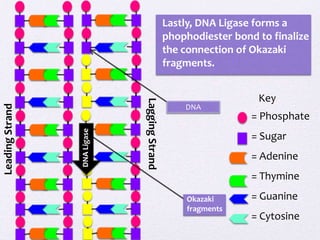
Lastly, DNA Ligase forms a
phophodiester bond to finalize
the connection of Okazaki
fragments.

DNA

Key
= Phosphate
= Sugar
= Adenine
= Thymine

Okazaki
fragments

= Guanine
= Cytosine
DNA Ligase

Lagging Strand

Leading Strand

Lastly, DNA Ligase forms a
phophodiester bond to finalize
the connection of Okazaki
fragments.

DNA

Key
= Phosphate
= Sugar
= Adenine
= Thymine

Okazaki
fragments

= Guanine
= Cytosine
DNA Ligase

Lagging Strand

Leading Strand

Lastly, DNA Ligase forms a
phophodiester bond to finalize
the connection of Okazaki
fragments.

DNA

Key
= Phosphate
= Sugar
= Adenine
= Thymine

Okazaki
fragments

= Guanine
= Cytosine
DNA Ligase

Lagging Strand

Leading Strand

Lastly, DNA Ligase forms a
phophodiester bond to finalize
the connection of Okazaki
fragments.

DNA

Key
= Phosphate
= Sugar
= Adenine
= Thymine

Okazaki
fragments

= Guanine
= Cytosine
DNA Ligase

Lagging Strand

Leading Strand

Lastly, DNA Ligase forms a
phophodiester bond to finalize
the connection of Okazaki
fragments.

DNA

Key
= Phosphate
= Sugar
= Adenine
= Thymine

Okazaki
fragments

= Guanine
= Cytosine
DNA Ligase

Lagging Strand

Leading Strand

Lastly, DNA Ligase forms a
phophodiester bond to finalize
the connection of Okazaki
fragments.

DNA

Key
= Phosphate
= Sugar
= Adenine
= Thymine

Okazaki
fragments

= Guanine
= Cytosine
DNA Ligase

Lagging Strand

Leading Strand

Lastly, DNA Ligase forms a
phophodiester bond to finalize
the connection of Okazaki
fragments.

DNA

Key
= Phosphate
= Sugar
= Adenine
= Thymine

Okazaki
fragments

= Guanine
= Cytosine
Lastly, DNA Ligase forms a
phophodiester bond to finalize
the connection of Okazaki
fragments.

Leading Strand

Lagging Strand

DNA

Key
= Phosphate
= Sugar
= Adenine

DNA Ligase

= Thymine
Okazaki
fragments

= Guanine
= Cytosine
Lastly, DNA Ligase forms a
phophodiester bond to finalize
the connection of Okazaki
fragments.

Leading Strand

Lagging Strand

DNA

Key
= Phosphate
= Sugar
= Adenine

A Ligase

= Thymine

5’

Okazaki
fragments

= Guanine
= Cytosine
Lastly, DNA Ligase forms a
phophodiester bond to finalize
the connection of Okazaki
fragments.

Leading Strand

Lagging Strand

DNA

Key
= Phosphate
= Sugar
= Adenine
= Thymine

ase

Okazaki
fragments

5’

= Guanine
= Cytosine
5’

3’5’

3’

Lastly, DNA Ligase forms a
phophodiester bond to finalize
the connection of Okazaki
fragments.

Leading Strand

Lagging Strand

DNA

= Phosphate
= Sugar
= Adenine
= Thymine

Okazaki
fragments
3’

Key

5’ 3’

5’

= Guanine
= Cytosine
Why Does DNA Need to
Replicate?
• DNA needs to replicate because when a cell in
your body divides, in order for your body to grow
or repair itself it must also duplicate the cell's
DNA. This is so the cell will then have it's own set
of directions to know how to continue
replicating.
In My Own Words...
• Telomeres- keep chromosomes from
becoming attached to each other accidentally.
• Okazaki Fragment- a section of complimentary
strands of DNA formed when the enzyme DNA
Ligase is present.
• DNA Ligase- an enzyme that “stitches” a new
complimentary strand of DNA called an
okazaki fragment.
• Telomerase- an enzyme that helps a cell
maintain the length of their telomeres.
In My Own Words… (Continued)
• Cancer- expresses the enzyme telomerase,
which helps a tumor to grow.
• Transplanted Cells- cells that have been taken,
added to, and then given back
• Cloning- taking a piece of something and
making another copy
• Aging- the steady shrinking of cells in the body
Mutations (Mistakes)
• If there are any mistakes while replicating
DNA, it will result in the mutation of a gene. An
organism can only have up to 3 mutations, or it
cannot live. Sometimes, mutations are minor,
while other times, they can change one’s
whole genetic makeup. For example, a
mutation can result in the crossing over of a
21st chromosome, resulting in one having
Down’s Syndrome.
Where in Mitosis Does
DNA Replication
Happen?
• DNA replication happens in S Phase
and also in cytokinesis, or the last
phase of mitosis.
Where in the Cell?
•DNA replication happens in the
nucleus of a cell.
Works Cited
• http://wiki.answers.com/Q/What_happens_if_there_
is_a_error_in_DNA_replication?#slide=6
• http://www.nature.com/scitable/topicpage/dnareplication-and-causes-of-mutation-409
• http://www.chemguide.co.uk/organicprops/aminoac
ids/dna6.html
• http://www.biology.ewu.edu/aHerr/Genetics/Bio310/
Pages/ch13pges/ch13note.html
• http://www.astrochem.org/sci/Nucleobases.php
The End

DNA Model

  • 1.
  • 2.
    DNA • The DNAdouble helix refers to the shape of the DNA molecule, or the twisted ladder. It has two intertwining strands made of sugar and phosphate with links across the middle. The rungs of the ladder are base pairs made of four different bases, represented by the letters A, T, G, and C.
  • 3.
    5’ 3’ The Enzyme DNA helicase“unzips” or unwinds the double stranded DNA at the origin of replication by breaking hydrogen bonds between complementary strands. Key = Phosphate = Sugar = Adenine = Thymine = Guanine Hydrogen Bond 3’ 5’ = Cytosine
  • 4.
    DNA Helicase Key = Phosphate =Sugar = Adenine = Thymine = Guanine = Cytosine
  • 5.
    DNA Helicase Key = Phosphate =Sugar = Adenine = Thymine = Guanine = Cytosine
  • 6.
    DNA Helicase Key = Phosphate =Sugar = Adenine = Thymine = Guanine = Cytosine
  • 7.
    DNA Helicase Key = Phosphate =Sugar = Adenine = Thymine = Guanine = Cytosine
  • 8.
    DNA Helicase Key = Phosphate =Sugar = Adenine = Thymine = Guanine = Cytosine
  • 9.
    Key DNA Helicase = Phosphate =Sugar = Adenine = Thymine = Guanine = Cytosine
  • 10.
    Key = Phosphate DNA Helicase =Sugar = Adenine = Thymine = Guanine = Cytosine
  • 11.
    Key = Phosphate = Sugar DNAHelicase = Adenine = Thymine = Guanine = Cytosine
  • 12.
    Key = Phosphate = Sugar =Adenine DNA Helicase = Thymine = Guanine = Cytosine
  • 13.
    Key = Phosphate = Sugar =Adenine = Thymine Helicase = Guanine = Cytosine
  • 14.
    Key = Phosphate = Sugar =Adenine = Thymine licase = Guanine = Cytosine
  • 15.
    Key = Phosphate = Sugar =Adenine = Thymine = Guanine = Cytosine
  • 16.
    Key = Phosphate = Sugar =Adenine = Thymine = Guanine = Cytosine
  • 17.
    Lagging Strand Leading Strand Then,on the leading strand, DNA Polymerase III adds the 5’ phosphate end of a free floating nucleotide to the exposed 3’ OH ends on the single stranded DNA in a continuous fashion. The leading strand elongates toward the replication fork. Key = Phosphate = Sugar = Adenine = Thymine = Guanine = Cytosine
  • 18.
    DNA Polymerase III LaggingStrand Leading Strand Then, on the leading strand, DNA Polymerase III adds the 5’ phosphate end of a free floating nucleotide to the exposed 3’ OH ends on the single stranded DNA in a continuous fashion. The leading strand elongates toward the replication fork. Key = Phosphate = Sugar = Adenine = Thymine = Guanine = Cytosine
  • 19.
    DNA Polymerase III LaggingStrand Leading Strand Then, on the leading strand, DNA Polymerase III adds the 5’ phosphate end of a free floating nucleotide to the exposed 3’ OH ends on the single stranded DNA in a continuous fashion. The leading strand elongates toward the replication fork. Key = Phosphate = Sugar = Adenine = Thymine = Guanine = Cytosine
  • 20.
    DNA Polymerase III LaggingStrand Leading Strand Then, on the leading strand, DNA Polymerase III adds the 5’ phosphate end of a free floating nucleotide to the exposed 3’ OH ends on the single stranded DNA in a continuous fashion. The leading strand elongates toward the replication fork. Key = Phosphate = Sugar = Adenine = Thymine = Guanine = Cytosine
  • 21.
    DNA Polymerase III LaggingStrand Leading Strand Then, on the leading strand, DNA Polymerase III adds the 5’ phosphate end of a free floating nucleotide to the exposed 3’ OH ends on the single stranded DNA in a continuous fashion. The leading strand elongates toward the replication fork. Key = Phosphate = Sugar = Adenine = Thymine = Guanine = Cytosine
  • 22.
    DNA Polymerase III LaggingStrand Leading Strand Then, on the leading strand, DNA Polymerase III adds the 5’ phosphate end of a free floating nucleotide to the exposed 3’ OH ends on the single stranded DNA in a continuous fashion. The leading strand elongates toward the replication fork. Key = Phosphate = Sugar = Adenine = Thymine = Guanine = Cytosine
  • 23.
    Then, on theleading strand, DNA Polymerase III adds the 5’ phosphate end of a free floating nucleotide to the exposed 3’ OH ends on the single stranded DNA in a continuous fashion. The leading strand elongates toward the replication fork. Leading Strand Lagging Strand Key = Phosphate = Sugar = Adenine lymerase III = Thymine = Guanine = Cytosine
  • 24.
    Then, on theleading strand, DNA Polymerase III adds the 5’ phosphate end of a free floating nucleotide to the exposed 3’ OH ends on the single stranded DNA in a continuous fashion. The leading strand elongates toward the replication fork. Leading Strand Lagging Strand Key = Phosphate = Sugar = Adenine = Thymine = Guanine e III = Cytosine
  • 25.
    Lagging Strand Leading Strand Then,on the leading strand, DNA Polymerase III adds the 5’ phosphate end of a free floating nucleotide to the exposed 3’ OH ends on the single stranded DNA in a continuous fashion. The leading strand elongates toward the replication fork. Key = Phosphate = Sugar = Adenine = Thymine = Guanine = Cytosine
  • 26.
    DNA Primase Then, onthe lagging strand, which has to be built discontinuously, a short RNA primer is synthesized from DNA primase. The primer is extended in a 5’ to 3’ direction, with short DNA segments called Okazaki fragments formed from DNA Polymerase II. Lagging Strand Leading Strand ` Key = Phosphate = Sugar = Adenine = Thymine = Guanine = Cytosine
  • 27.
    Lagging Strand Leading Strand DNAPrimase Then, on the lagging strand, which has to be built discontinuously, a short RNA primer is synthesized from DNA primase. The primer is extended in a 5’ to 3’ direction, with short DNA segments called Okazaki fragments formed from DNA Polymerase II. Key = Phosphate = Sugar = Adenine = Thymine = Guanine = Cytosine
  • 28.
    Lagging Strand Leading Strand DNAPrimase Then, on the lagging strand, which has to be built discontinuously, a short RNA primer is synthesized from DNA primase. The primer is extended in a 5’ to 3’ direction, with short DNA segments called Okazaki fragments formed from DNA Polymerase II. Key = Phosphate = Sugar = Adenine = Thymine = Guanine = Cytosine
  • 29.
    DNA Primase Lagging Strand LeadingStrand Then, on the lagging strand, which has to be built discontinuously, a short RNA primer is synthesized from DNA primase. The primer is extended in a 5’ to 3’ direction, with short DNA segments called Okazaki fragments formed from DNA Polymerase II. Key = Phosphate = Sugar = Adenine = Thymine = Guanine = Cytosine
  • 30.
    3’ Then, on thelagging strand, which has to be built discontinuously, a short RNA primer is synthesized from DNA primase. The primer is extended in a 5’ to 3’ direction, with short DNA segments called Okazaki fragments formed from DNA Polymerase II. Lagging Strand DNA Primase 3’ 5’ Leading Strand 5’ Key = Phosphate = Sugar = Adenine = Thymine = Guanine = Cytosine 3’ 5’ 5’
  • 31.
    DNA Primase Lagging Strand LeadingStrand Then, on the lagging strand, which has to be built discontinuously, a short RNA primer is synthesized from DNA primase. The primer is extended in a 5’ to 3’ direction, with short DNA segments called Okazaki fragments formed from DNA Polymerase II. Key = Phosphate = Sugar = Adenine = Thymine = Guanine = Cytosine
  • 32.
    DNA Primase Lagging Strand LeadingStrand Then, on the lagging strand, which has to be built discontinuously, a short RNA primer is synthesized from DNA primase. The primer is extended in a 5’ to 3’ direction, with short DNA segments called Okazaki fragments formed from DNA Polymerase II. Key = Phosphate = Sugar = Adenine = Thymine = Guanine = Cytosine
  • 33.
    DNA Primase Lagging Strand LeadingStrand Then, on the lagging strand, which has to be built discontinuously, a short RNA primer is synthesized from DNA primase. The primer is extended in a 5’ to 3’ direction, with short DNA segments called Okazaki fragments formed from DNA Polymerase II. Key = Phosphate = Sugar = Adenine = Thymine = Guanine = Cytosine
  • 34.
    DNA Primase Lagging Strand LeadingStrand Then, on the lagging strand, which has to be built discontinuously, a short RNA primer is synthesized from DNA primase. The primer is extended in a 5’ to 3’ direction, with short DNA segments called Okazaki fragments formed from DNA Polymerase II. Key = Phosphate = Sugar = Adenine = Thymine = Guanine = Cytosine
  • 35.
    DNA Primase Lagging Strand LeadingStrand Then, on the lagging strand, which has to be built discontinuously, a short RNA primer is synthesized from DNA primase. The primer is extended in a 5’ to 3’ direction, with short DNA segments called Okazaki fragments formed from DNA Polymerase II. Key = Phosphate = Sugar = Adenine = Thymine = Guanine = Cytosine
  • 36.
    Then, on thelagging strand, which has to be built discontinuously, a short RNA primer is synthesized from DNA primase. The primer is extended in a 5’ to 3’ direction, with short DNA segments called Okazaki fragments formed from DNA Polymerase II. DNA Primase Leading Strand Lagging Strand Key = Phosphate = Sugar = Adenine = Thymine = Guanine = Cytosine
  • 37.
    Then, on thelagging strand, which has to be built discontinuously, a short RNA primer is synthesized from DNA primase. The primer is extended in a 5’ to 3’ direction, with short DNA segments called Okazaki fragments formed from DNA Polymerase II. Leading Strand Lagging Strand Key = Phosphate = Sugar = Adenine DNA Primase = Thymine = Guanine = Cytosine
  • 38.
    Then, on thelagging strand, which has to be built discontinuously, a short RNA primer is synthesized from DNA primase. The primer is extended in a 5’ to 3’ direction, with short DNA segments called Okazaki fragments formed from DNA Polymerase II. Leading Strand Lagging Strand Key = Phosphate = Sugar = Adenine = Thymine Primase = Guanine = Cytosine
  • 39.
    Lagging Strand Leading Strand Then,on the lagging strand, which has to be built discontinuously, a short RNA primer is synthesized from DNA primase. The primer is extended in a 5’ to 3’ direction, with short DNA segments called Okazaki fragments formed from DNA Polymerase II. RNA Primer Key = Phosphate = Sugar = Adenine = Thymine = Guanine = Cytosine
  • 40.
    Lagging Strand Leading Strand DNAPolymerase II Then, on the lagging strand, which has to be built discontinuously, a short RNA primer is synthesized from DNA primase. The primer is extended in a 5’ to 3’ direction, with short DNA segments called Okazaki fragments formed from DNA Polymerase II. RNA Primer Key = Phosphate = Sugar = Adenine = Thymine = Guanine = Cytosine
  • 41.
    DNA Polymerase II LaggingStrand Leading Strand Then, on the lagging strand, which has to be built discontinuously, a short RNA primer is synthesized from DNA primase. The primer is extended in a 5’ to 3’ direction, with short DNA segments called Okazaki fragments formed from DNA Polymerase II. RNA Primer Key = Phosphate = Sugar = Adenine = Thymine = Guanine = Cytosine
  • 42.
    DNA Polymerase II LaggingStrand Leading Strand Then, on the lagging strand, which has to be built discontinuously, a short RNA primer is synthesized from DNA primase. The primer is extended in a 5’ to 3’ direction, with short DNA segments called Okazaki fragments formed from DNA Polymerase II. DNA When the DNA Polymerase II reaches the RNA primer, it turns into DNA. Key = Phosphate = Sugar = Adenine = Thymine = Guanine = Cytosine
  • 43.
    DNA Polymerase II LaggingStrand Leading Strand Then, on the lagging strand, which has to be built discontinuously, a short RNA primer is synthesized from DNA primase. The primer is extended in a 5’ to 3’ direction, with short DNA segments called Okazaki fragments formed from DNA Polymerase II. DNA When the DNA Polymerase II reaches the RNA primer, it turns into DNA. Key = Phosphate = Sugar = Adenine = Thymine = Guanine = Cytosine
  • 44.
    DNA Polymerase II LaggingStrand Leading Strand Then, on the lagging strand, which has to be built discontinuously, a short RNA primer is synthesized from DNA primase. The primer is extended in a 5’ to 3’ direction, with short DNA segments called Okazaki fragments formed from DNA Polymerase II. DNA Key = Phosphate = Sugar = Adenine = Thymine = Guanine = Cytosine
  • 45.
    Then, on thelagging strand, which has to be built discontinuously, a short RNA primer is synthesized from DNA primase. The primer is extended in a 5’ to 3’ direction, with short DNA segments called Okazaki fragments formed from DNA Polymerase II. Leading Strand Lagging Strand DNA Key = Phosphate = Sugar = Adenine = Thymine erase II = Guanine = Cytosine
  • 46.
    Then, on thelagging strand, which has to be built discontinuously, a short RNA primer is synthesized from DNA primase. The primer is extended in a 5’ to 3’ direction, with short DNA segments called Okazaki fragments formed from DNA Polymerase II. Leading Strand Lagging Strand DNA Key = Phosphate = Sugar = Adenine = Thymine = Guanine II = Cytosine
  • 47.
    Lagging Strand Leading Strand Then,on the lagging strand, which has to be built discontinuously, a short RNA primer is synthesized from DNA primase. The primer is extended in a 5’ to 3’ direction, with short DNA segments called Okazaki fragments formed from DNA Polymerase II. DNA Key = Phosphate = Sugar = Adenine = Thymine Okazaki fragments = Guanine = Cytosine
  • 48.
    Lagging Strand Leading Strand DNALigase Lastly, DNA Ligase forms a phophodiester bond to finalize the connection of Okazaki fragments. DNA Key = Phosphate = Sugar = Adenine = Thymine Okazaki fragments = Guanine = Cytosine
  • 49.
    DNA Ligase Lagging Strand LeadingStrand Lastly, DNA Ligase forms a phophodiester bond to finalize the connection of Okazaki fragments. DNA Key = Phosphate = Sugar = Adenine = Thymine Okazaki fragments = Guanine = Cytosine
  • 50.
    DNA Ligase Lagging Strand LeadingStrand Lastly, DNA Ligase forms a phophodiester bond to finalize the connection of Okazaki fragments. DNA Key = Phosphate = Sugar = Adenine = Thymine Okazaki fragments = Guanine = Cytosine
  • 51.
    DNA Ligase Lagging Strand LeadingStrand Lastly, DNA Ligase forms a phophodiester bond to finalize the connection of Okazaki fragments. DNA Key = Phosphate = Sugar = Adenine = Thymine Okazaki fragments = Guanine = Cytosine
  • 52.
    DNA Ligase Lagging Strand LeadingStrand Lastly, DNA Ligase forms a phophodiester bond to finalize the connection of Okazaki fragments. DNA Key = Phosphate = Sugar = Adenine = Thymine Okazaki fragments = Guanine = Cytosine
  • 53.
    DNA Ligase Lagging Strand LeadingStrand Lastly, DNA Ligase forms a phophodiester bond to finalize the connection of Okazaki fragments. DNA Key = Phosphate = Sugar = Adenine = Thymine Okazaki fragments = Guanine = Cytosine
  • 54.
    DNA Ligase Lagging Strand LeadingStrand Lastly, DNA Ligase forms a phophodiester bond to finalize the connection of Okazaki fragments. DNA Key = Phosphate = Sugar = Adenine = Thymine Okazaki fragments = Guanine = Cytosine
  • 55.
    Lastly, DNA Ligaseforms a phophodiester bond to finalize the connection of Okazaki fragments. Leading Strand Lagging Strand DNA Key = Phosphate = Sugar = Adenine DNA Ligase = Thymine Okazaki fragments = Guanine = Cytosine
  • 56.
    Lastly, DNA Ligaseforms a phophodiester bond to finalize the connection of Okazaki fragments. Leading Strand Lagging Strand DNA Key = Phosphate = Sugar = Adenine A Ligase = Thymine 5’ Okazaki fragments = Guanine = Cytosine
  • 57.
    Lastly, DNA Ligaseforms a phophodiester bond to finalize the connection of Okazaki fragments. Leading Strand Lagging Strand DNA Key = Phosphate = Sugar = Adenine = Thymine ase Okazaki fragments 5’ = Guanine = Cytosine
  • 58.
    5’ 3’5’ 3’ Lastly, DNA Ligaseforms a phophodiester bond to finalize the connection of Okazaki fragments. Leading Strand Lagging Strand DNA = Phosphate = Sugar = Adenine = Thymine Okazaki fragments 3’ Key 5’ 3’ 5’ = Guanine = Cytosine
  • 59.
    Why Does DNANeed to Replicate? • DNA needs to replicate because when a cell in your body divides, in order for your body to grow or repair itself it must also duplicate the cell's DNA. This is so the cell will then have it's own set of directions to know how to continue replicating.
  • 60.
    In My OwnWords... • Telomeres- keep chromosomes from becoming attached to each other accidentally. • Okazaki Fragment- a section of complimentary strands of DNA formed when the enzyme DNA Ligase is present. • DNA Ligase- an enzyme that “stitches” a new complimentary strand of DNA called an okazaki fragment. • Telomerase- an enzyme that helps a cell maintain the length of their telomeres.
  • 61.
    In My OwnWords… (Continued) • Cancer- expresses the enzyme telomerase, which helps a tumor to grow. • Transplanted Cells- cells that have been taken, added to, and then given back • Cloning- taking a piece of something and making another copy • Aging- the steady shrinking of cells in the body
  • 62.
    Mutations (Mistakes) • Ifthere are any mistakes while replicating DNA, it will result in the mutation of a gene. An organism can only have up to 3 mutations, or it cannot live. Sometimes, mutations are minor, while other times, they can change one’s whole genetic makeup. For example, a mutation can result in the crossing over of a 21st chromosome, resulting in one having Down’s Syndrome.
  • 63.
    Where in MitosisDoes DNA Replication Happen? • DNA replication happens in S Phase and also in cytokinesis, or the last phase of mitosis.
  • 64.
    Where in theCell? •DNA replication happens in the nucleus of a cell.
  • 65.
    Works Cited • http://wiki.answers.com/Q/What_happens_if_there_ is_a_error_in_DNA_replication?#slide=6 •http://www.nature.com/scitable/topicpage/dnareplication-and-causes-of-mutation-409 • http://www.chemguide.co.uk/organicprops/aminoac ids/dna6.html • http://www.biology.ewu.edu/aHerr/Genetics/Bio310/ Pages/ch13pges/ch13note.html • http://www.astrochem.org/sci/Nucleobases.php
  • 66.