BINARY OPERATION
DEFINITIONS AND EXAMPLES
Definition 2.1
• A binary operation on a set S is a
rule that assigns to each ordered pair
of elements of S some element of S.
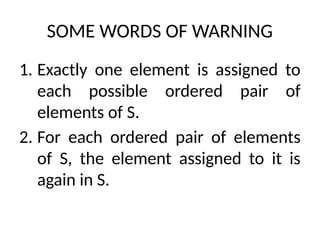
SOME WORDS OF WARNING
1. Exactly one element is assigned to
each possible ordered pair of
elements of S.
2. For each ordered pair of elements
of S, the element assigned to it is
again in S.
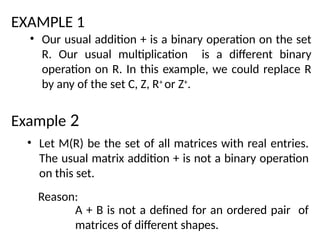
EXAMPLE 1
• Our usual addition + is a binary operation on the set
R. Our usual multiplication is a different binary
operation on R. In this example, we could replace R
by any of the set C, Z, R+
or Z+
.
Example 2
• Let M(R) be the set of all matrices with real entries.
The usual matrix addition + is not a binary operation
on this set.
A + B is not a defined for an ordered pair of
matrices of different shapes.
Reason:
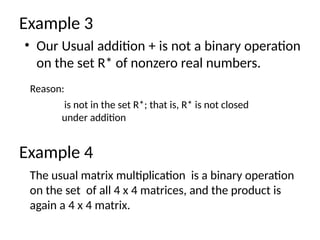
Example 3
• Our Usual addition + is not a binary operation
on the set R* of nonzero real numbers.
is not in the set R*; that is, R* is not closed
under addition
Reason:
Example 4
The usual matrix multiplication is a binary operation
on the set of all 4 x 4 matrices, and the product is
again a 4 x 4 matrix.
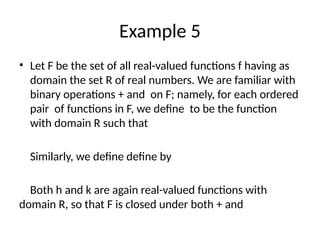
Example 5
• Let F be the set of all real-valued functions f having as
domain the set R of real numbers. We are familiar with
binary operations + and on F; namely, for each ordered
pair of functions in F, we define to be the function
with domain R such that
Similarly, we define define by
Both h and k are again real-valued functions with
domain R, so that F is closed under both + and
Example 6
• On we define a binary operation by equals
the smaller of or or the common value if .
Thus
Example 7
• On define a binary operation by
Thus
Example 8
• On define a binary operation by where is
defined in example 6.
Thus
Commutative and Associative Operation
• A binary operation on a set S is
commutative if for all
• A binary operation on a set S is
associative if for all
Example 9
• Table 1.1 defines the binary operation on by the
following rule:
Thus and so is not commutative.
Table 1.1
a b C
a b c b
b a c b
c c b a
Example 10
• Complete table 1.2 so that is a commutative
binary operation on the set
Table 1.1
* a b c D
a b
b d a
c a c d
d a b b c
Example 11
Determine whether the definition of * does gives a
binary operation on the set.
1. On Q, define * by a*b = a/b
2. On Q+
define * by a*b = a/b
3. On Z+
,define * by a*b = a/b
4. Let F be the set of all real-valued functions with
domain R. Suppose we “define” * to give the
usual quotient of f by g, that is, f*g=h, where
h(x)=f(x)/g(x)

BINARY OPERATION-1.pptxsjdfjsjsjwxkssjfks

  • 1.
  • 2.
    Definition 2.1 • Abinary operation on a set S is a rule that assigns to each ordered pair of elements of S some element of S.
  • 3.
    SOME WORDS OFWARNING 1. Exactly one element is assigned to each possible ordered pair of elements of S. 2. For each ordered pair of elements of S, the element assigned to it is again in S.
  • 4.
    EXAMPLE 1 • Ourusual addition + is a binary operation on the set R. Our usual multiplication is a different binary operation on R. In this example, we could replace R by any of the set C, Z, R+ or Z+ . Example 2 • Let M(R) be the set of all matrices with real entries. The usual matrix addition + is not a binary operation on this set. A + B is not a defined for an ordered pair of matrices of different shapes. Reason:
  • 5.
    Example 3 • OurUsual addition + is not a binary operation on the set R* of nonzero real numbers. is not in the set R*; that is, R* is not closed under addition Reason: Example 4 The usual matrix multiplication is a binary operation on the set of all 4 x 4 matrices, and the product is again a 4 x 4 matrix.
  • 6.
    Example 5 • LetF be the set of all real-valued functions f having as domain the set R of real numbers. We are familiar with binary operations + and on F; namely, for each ordered pair of functions in F, we define to be the function with domain R such that Similarly, we define define by Both h and k are again real-valued functions with domain R, so that F is closed under both + and
  • 7.
    Example 6 • Onwe define a binary operation by equals the smaller of or or the common value if . Thus
  • 8.
    Example 7 • Ondefine a binary operation by Thus
  • 9.
    Example 8 • Ondefine a binary operation by where is defined in example 6. Thus
  • 10.
    Commutative and AssociativeOperation • A binary operation on a set S is commutative if for all • A binary operation on a set S is associative if for all
  • 11.
    Example 9 • Table1.1 defines the binary operation on by the following rule: Thus and so is not commutative. Table 1.1 a b C a b c b b a c b c c b a
  • 12.
    Example 10 • Completetable 1.2 so that is a commutative binary operation on the set Table 1.1 * a b c D a b b d a c a c d d a b b c
  • 13.
    Example 11 Determine whetherthe definition of * does gives a binary operation on the set. 1. On Q, define * by a*b = a/b 2. On Q+ define * by a*b = a/b 3. On Z+ ,define * by a*b = a/b 4. Let F be the set of all real-valued functions with domain R. Suppose we “define” * to give the usual quotient of f by g, that is, f*g=h, where h(x)=f(x)/g(x)