Functions
Function:
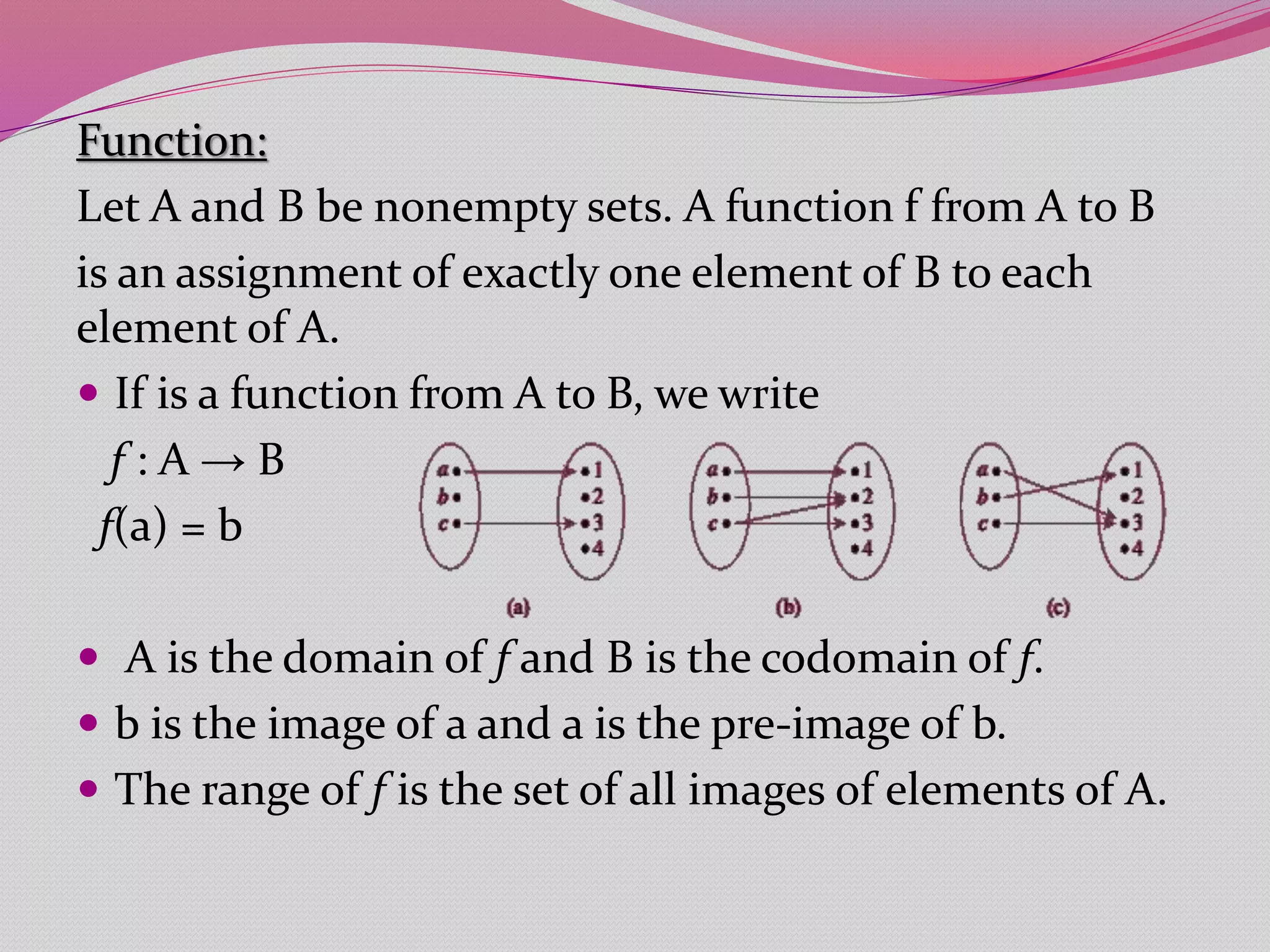
Let A and B be nonempty sets. A function f from A to B
is an assignment of exactly one element of B to each
element of A.
 If is a function from A to B, we write
f : A → B
f(a) = b
 A is the domain of f and B is the codomain of f.
 b is the image of a and a is the pre-image of b.
 The range of f is the set of all images of elements of A.
Injective Function:
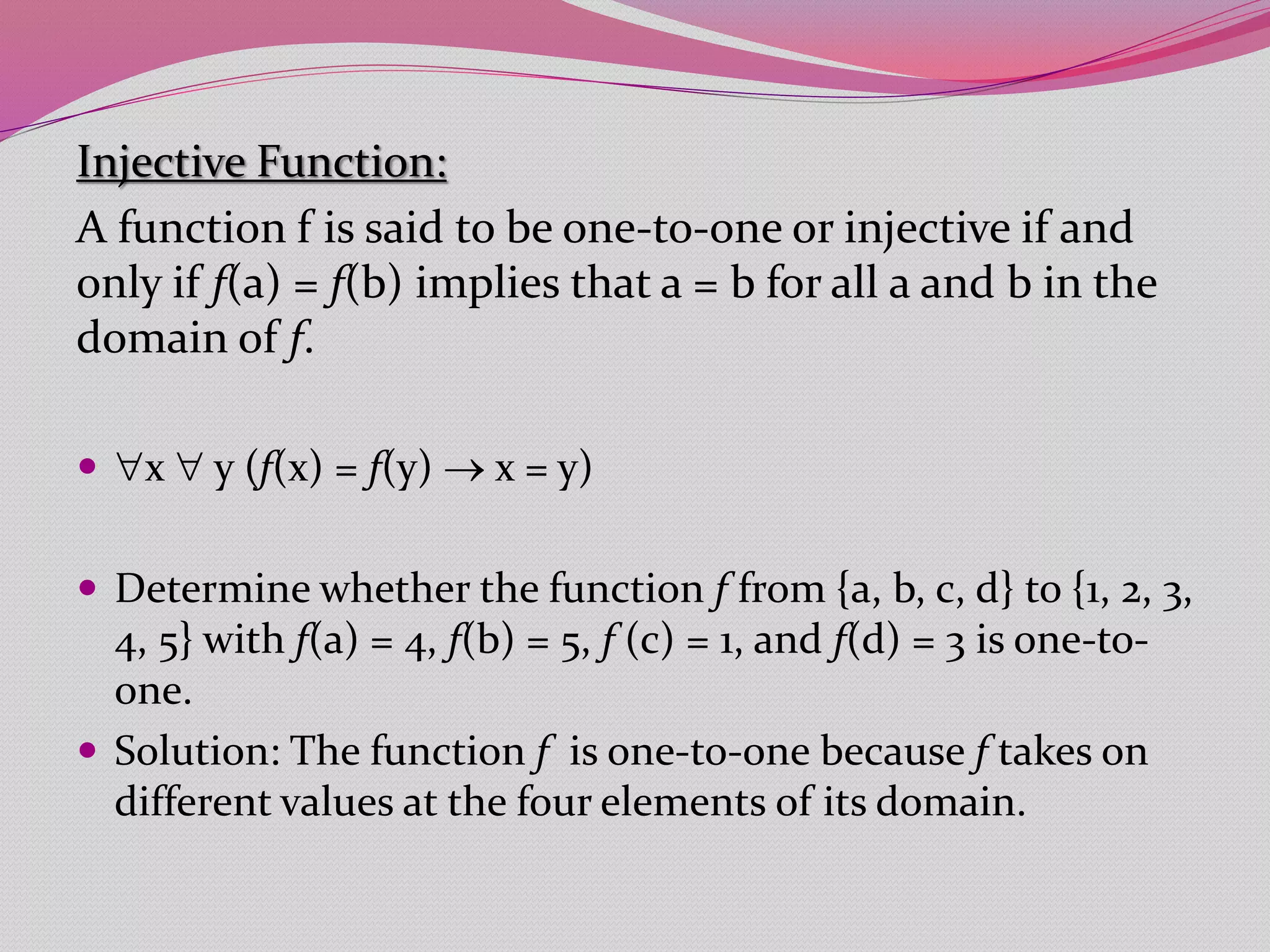
A function f is said to be one-to-one or injective if and
only if f(a) = f(b) implies that a = b for all a and b in the
domain of f.
 x  y (f(x) = f(y)  x = y)
 Determine whether the function f from {a, b, c, d} to {1, 2, 3,
4, 5} with f(a) = 4, f(b) = 5, f (c) = 1, and f(d) = 3 is one-to-
one.
 Solution: The function f is one-to-one because f takes on
different values at the four elements of its domain.
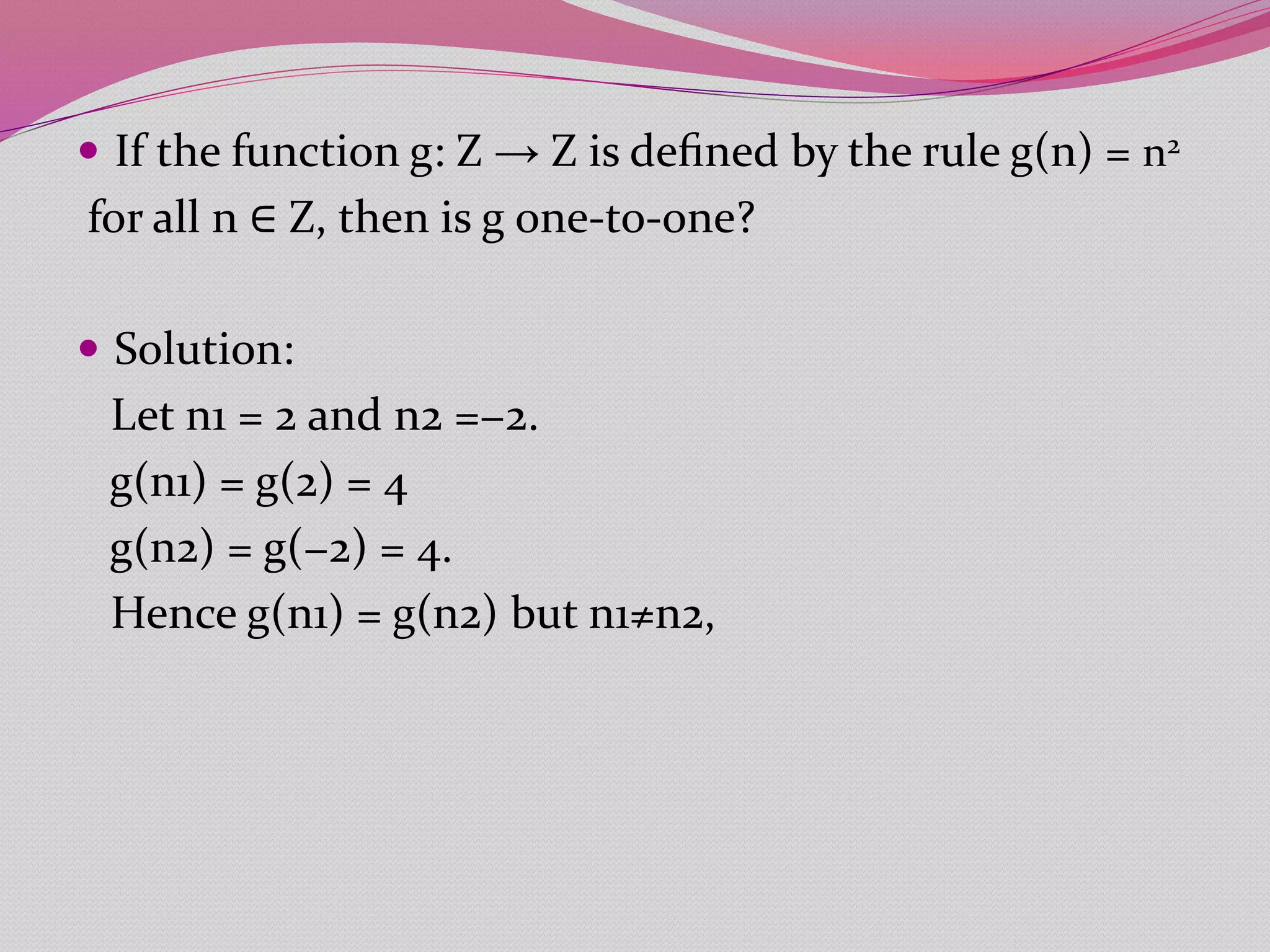
 If the function g: Z → Z is defined by the rule g(n) = n2
for all n ∈ Z, then is g one-to-one?
 Solution:
Let n1 = 2 and n2 =−2.
g(n1) = g(2) = 4
g(n2) = g(−2) = 4.
Hence g(n1) = g(n2) but n1≠n2,
 If the function f : R → R is defined by the rule
f(x)=4x−1, for all real numbers x, then is f one-to-one?
 Solution:
Suppose x and y are real numbers such that f(x)=f(y).
[We must show that x = y.]
By definition of f , 4 x − 1 = 4 y − 1.
4 x = 4 y
x = y
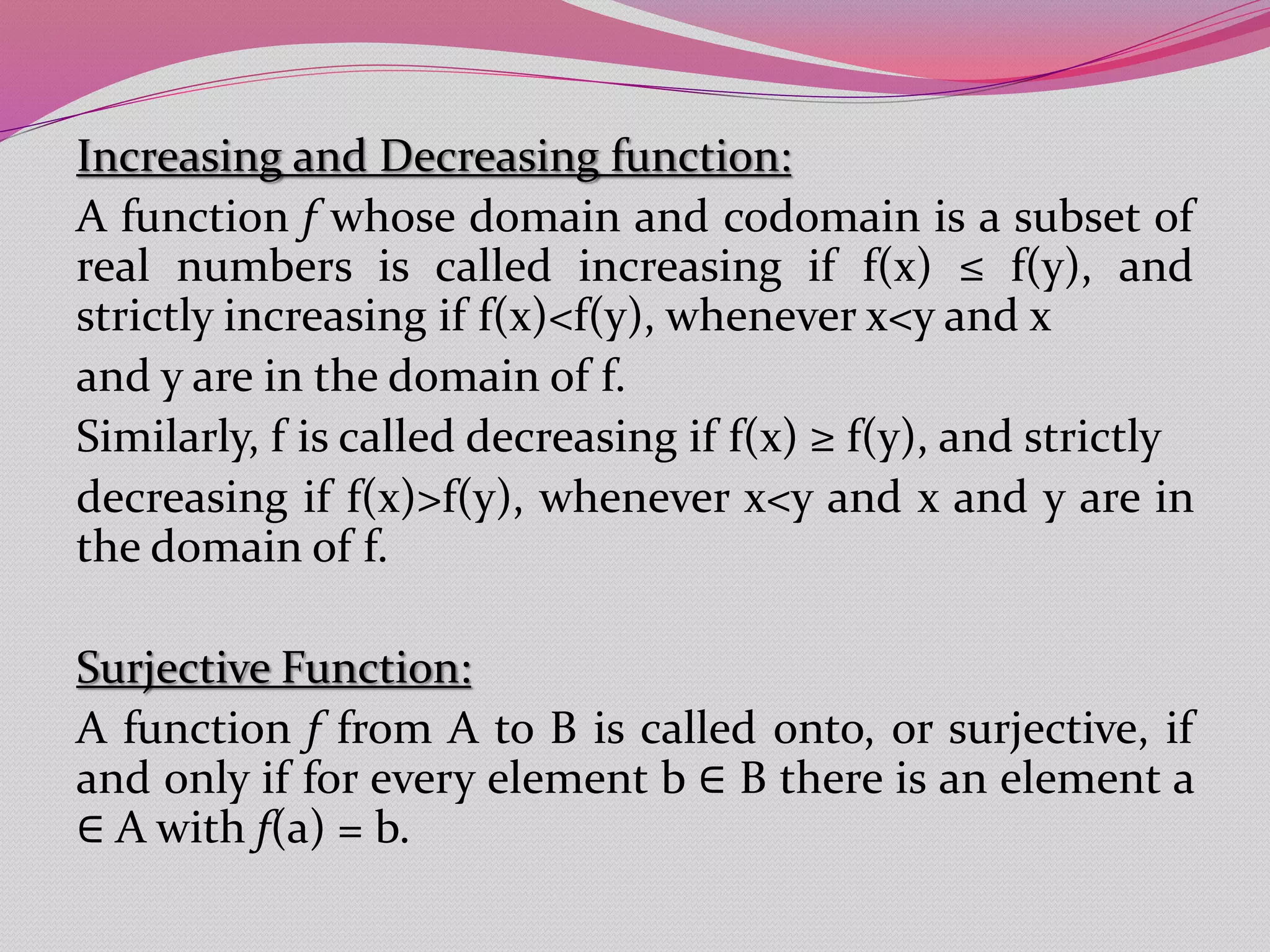
Increasing and Decreasing function:
A function f whose domain and codomain is a subset of
real numbers is called increasing if f(x) ≤ f(y), and
strictly increasing if f(x)<f(y), whenever x<y and x
and y are in the domain of f.
Similarly, f is called decreasing if f(x) ≥ f(y), and strictly
decreasing if f(x)>f(y), whenever x<y and x and y are in
the domain of f.
Surjective Function:
A function f from A to B is called onto, or surjective, if
and only if for every element b ∈ B there is an element a
∈ A with f(a) = b.
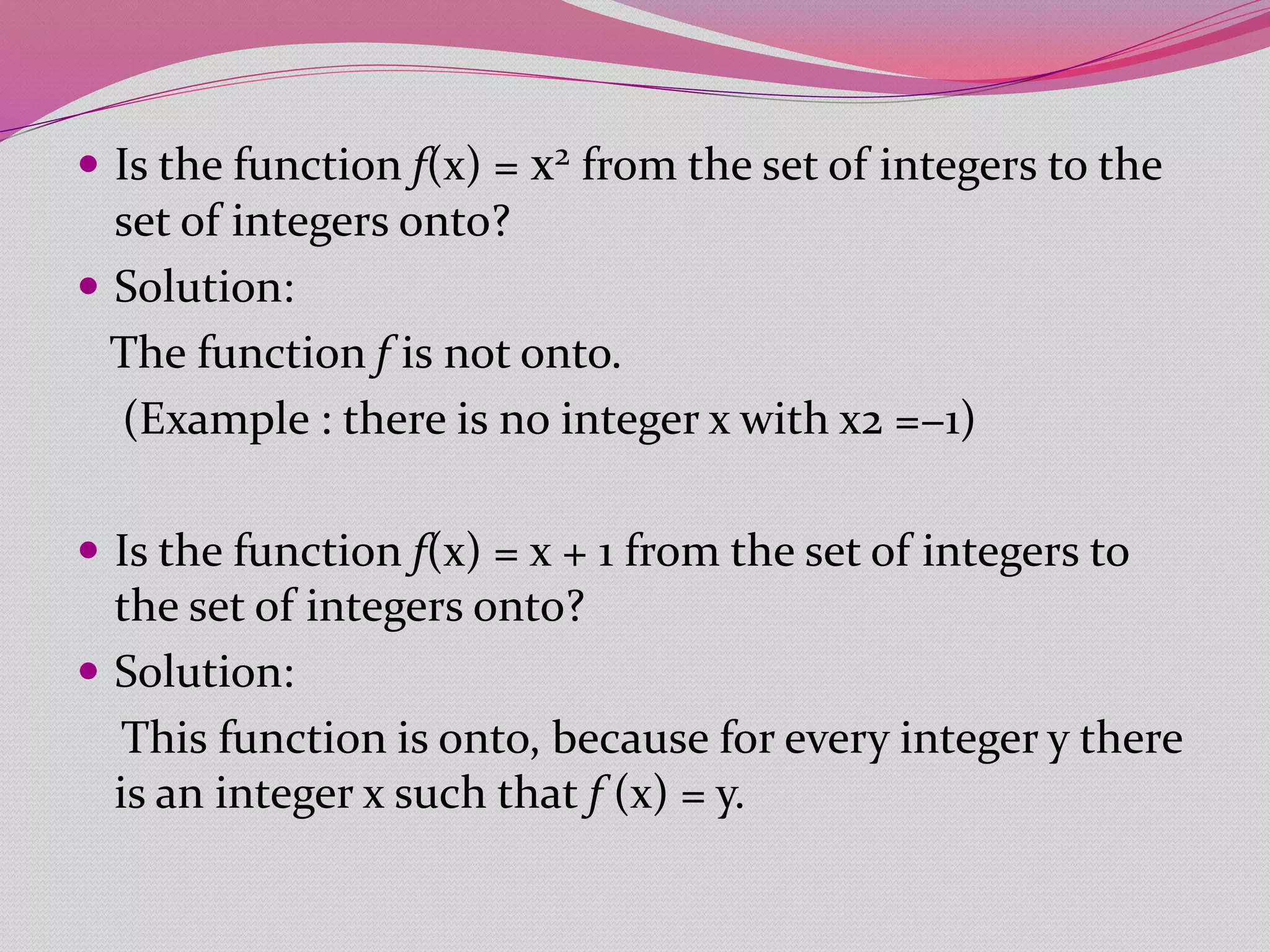
 Is the function f(x) = x2 from the set of integers to the
set of integers onto?
 Solution:
The function f is not onto.
(Example : there is no integer x with x2 =−1)
 Is the function f(x) = x + 1 from the set of integers to
the set of integers onto?
 Solution:
This function is onto, because for every integer y there
is an integer x such that f (x) = y.
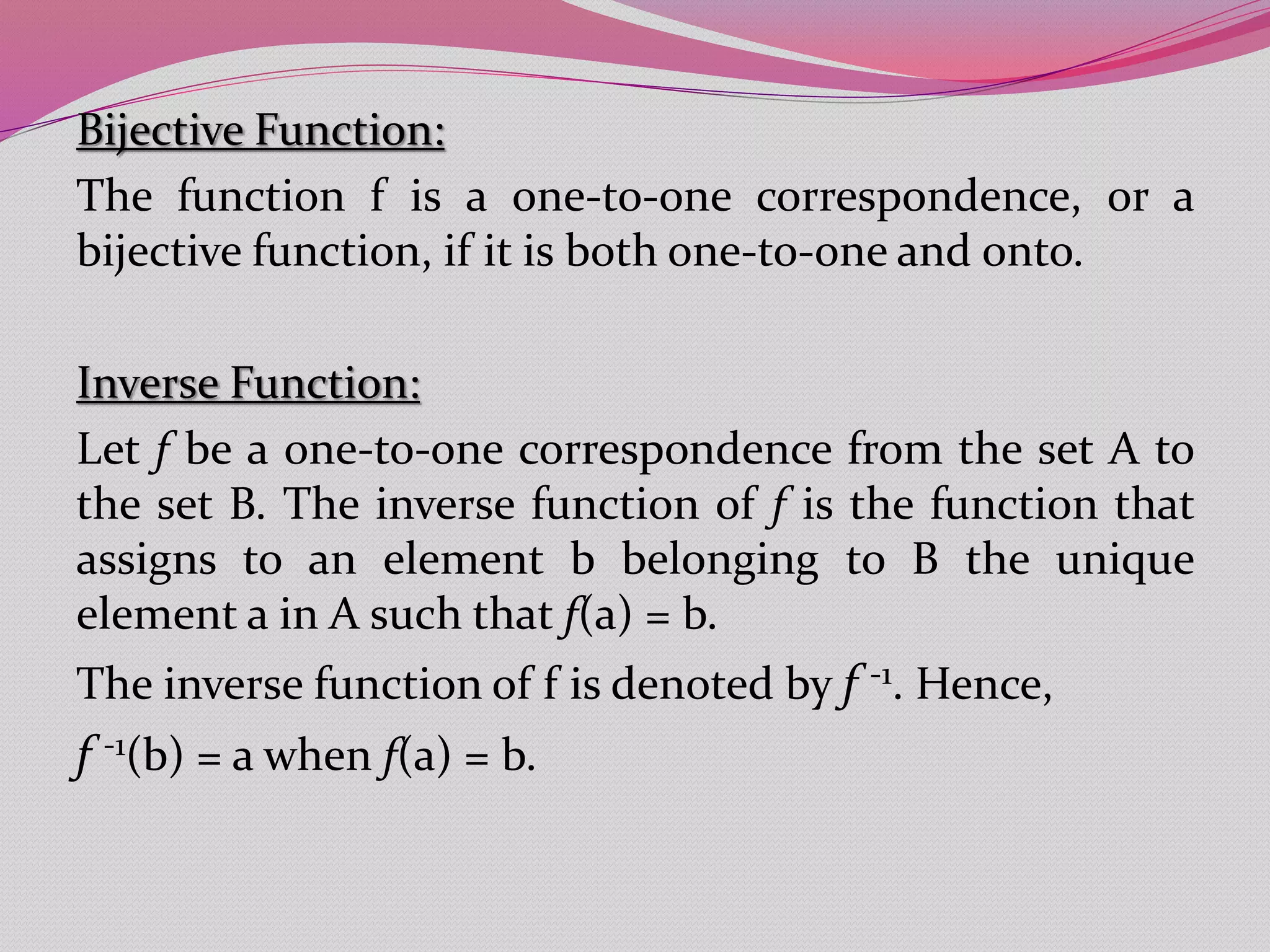
Bijective Function:
The function f is a one-to-one correspondence, or a
bijective function, if it is both one-to-one and onto.
Inverse Function:
Let f be a one-to-one correspondence from the set A to
the set B. The inverse function of f is the function that
assigns to an element b belonging to B the unique
element a in A such that f(a) = b.
The inverse function of f is denoted by f -1. Hence,
f -1(b) = a when f(a) = b.
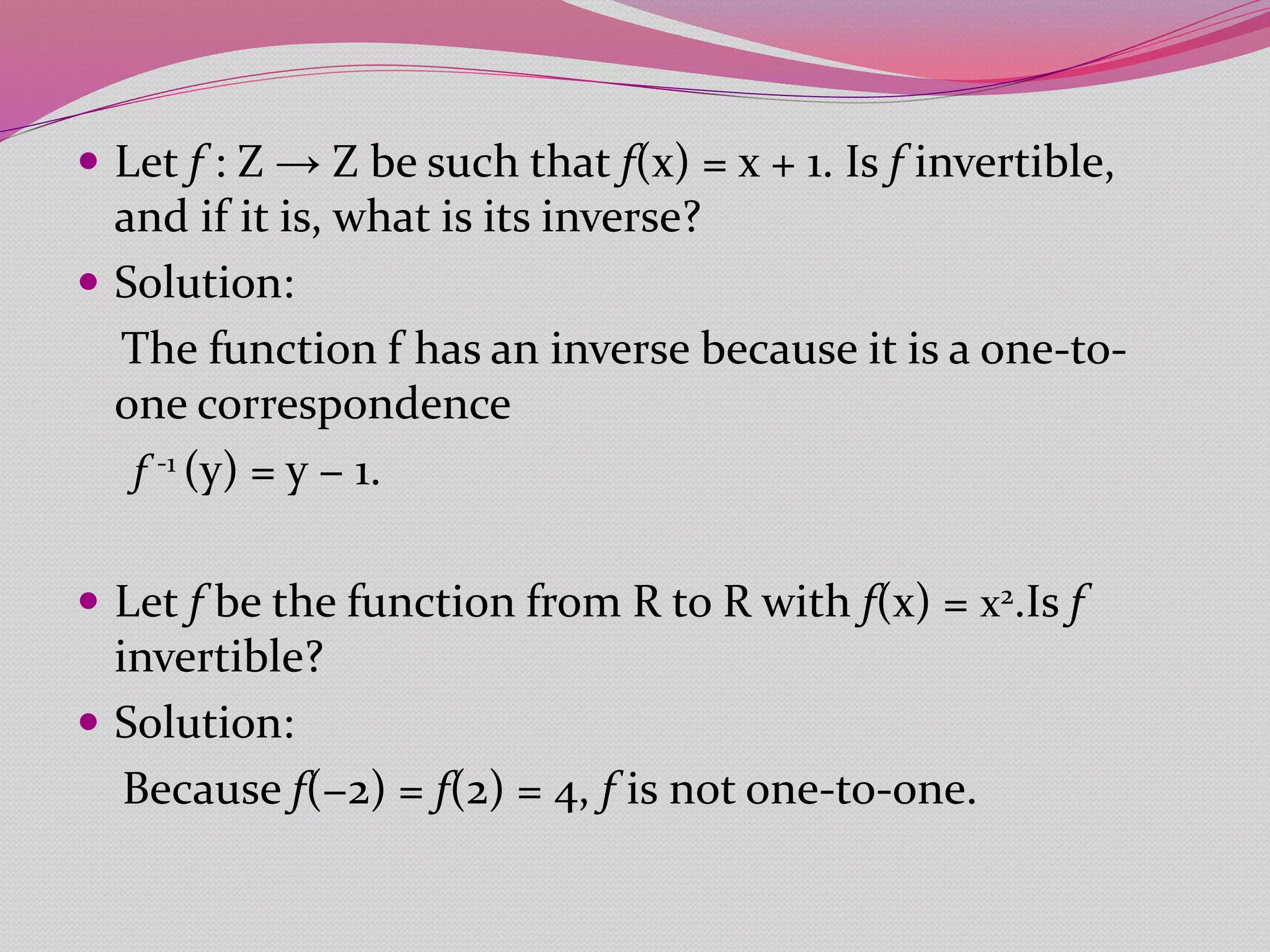
 Let f : Z → Z be such that f(x) = x + 1. Is f invertible,
and if it is, what is its inverse?
 Solution:
The function f has an inverse because it is a one-to-
one correspondence
f -1 (y) = y − 1.
 Let f be the function from R to R with f(x) = x2.Is f
invertible?
 Solution:
Because f(−2) = f(2) = 4, f is not one-to-one.
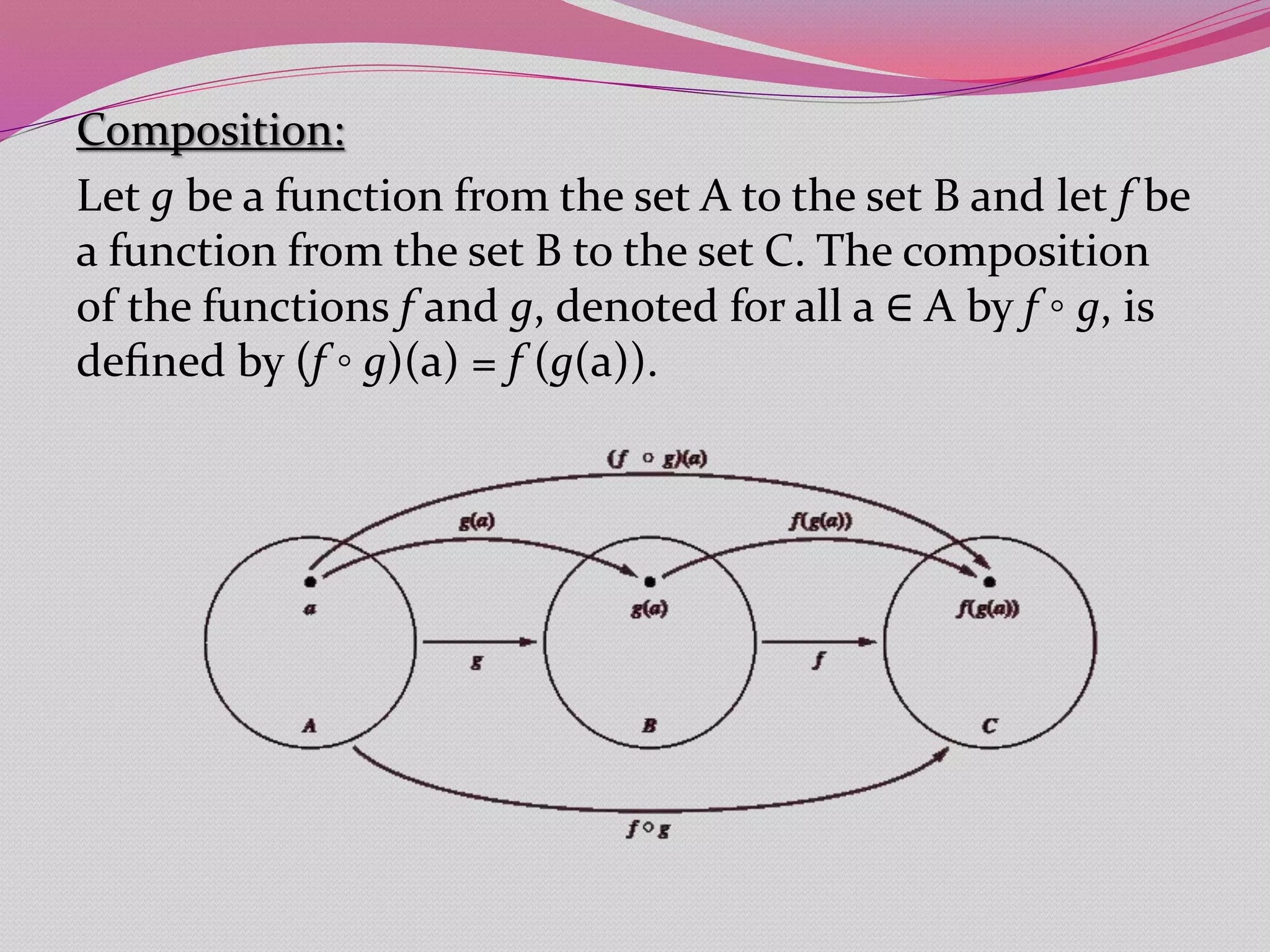
Composition:
Let g be a function from the set A to the set B and let f be
a function from the set B to the set C. The composition
of the functions f and g, denoted for all a ∈ A by f ◦ g, is
defined by (f ◦ g)(a) = f (g(a)).
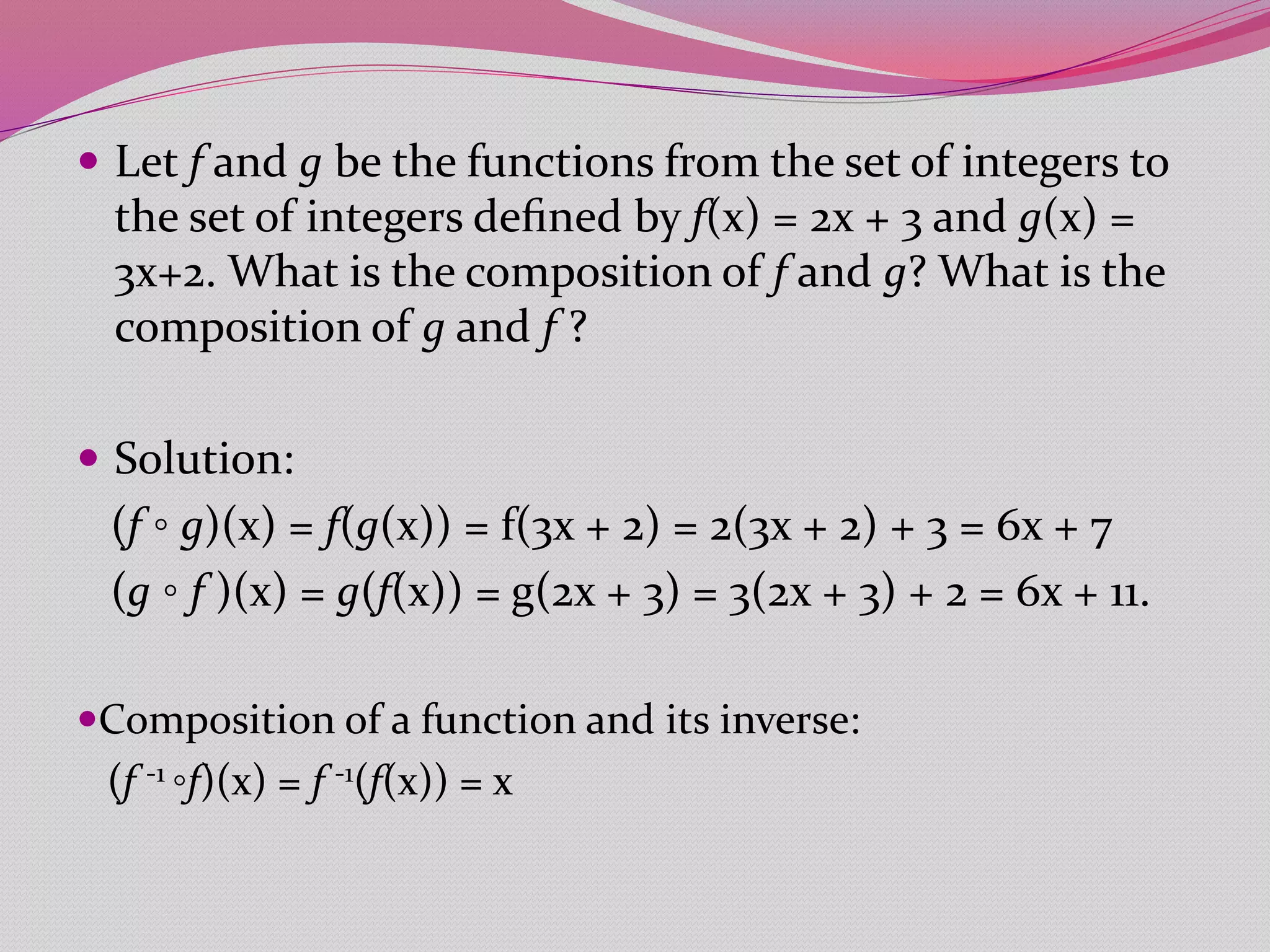
 Let f and g be the functions from the set of integers to
the set of integers defined by f(x) = 2x + 3 and g(x) =
3x+2. What is the composition of f and g? What is the
composition of g and f ?
 Solution:
(f ◦ g)(x) = f(g(x)) = f(3x + 2) = 2(3x + 2) + 3 = 6x + 7
(g ◦ f )(x) = g(f(x)) = g(2x + 3) = 3(2x + 3) + 2 = 6x + 11.
Composition of a function and its inverse:
(f -1 ◦f)(x) = f -1(f(x)) = x
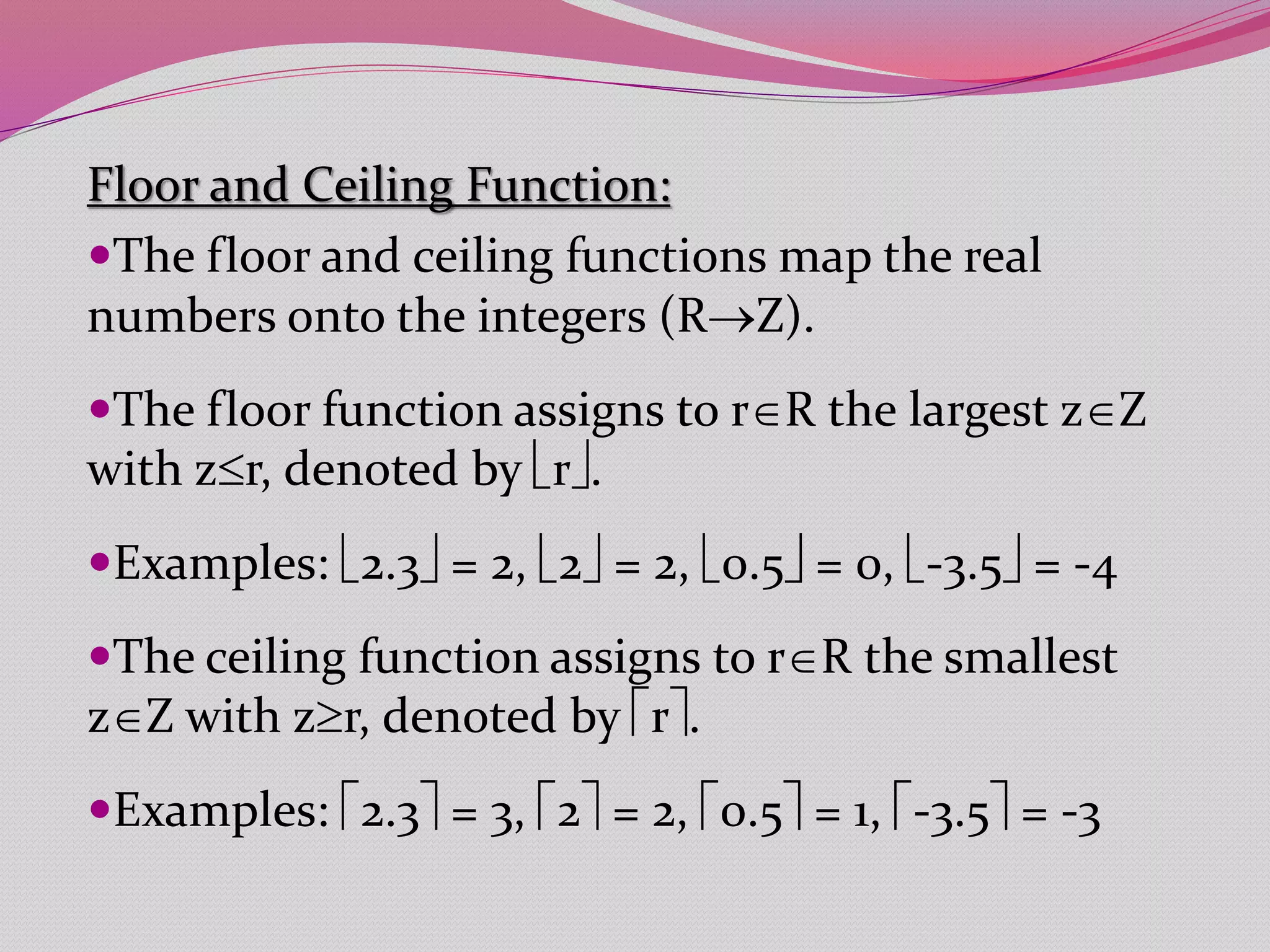
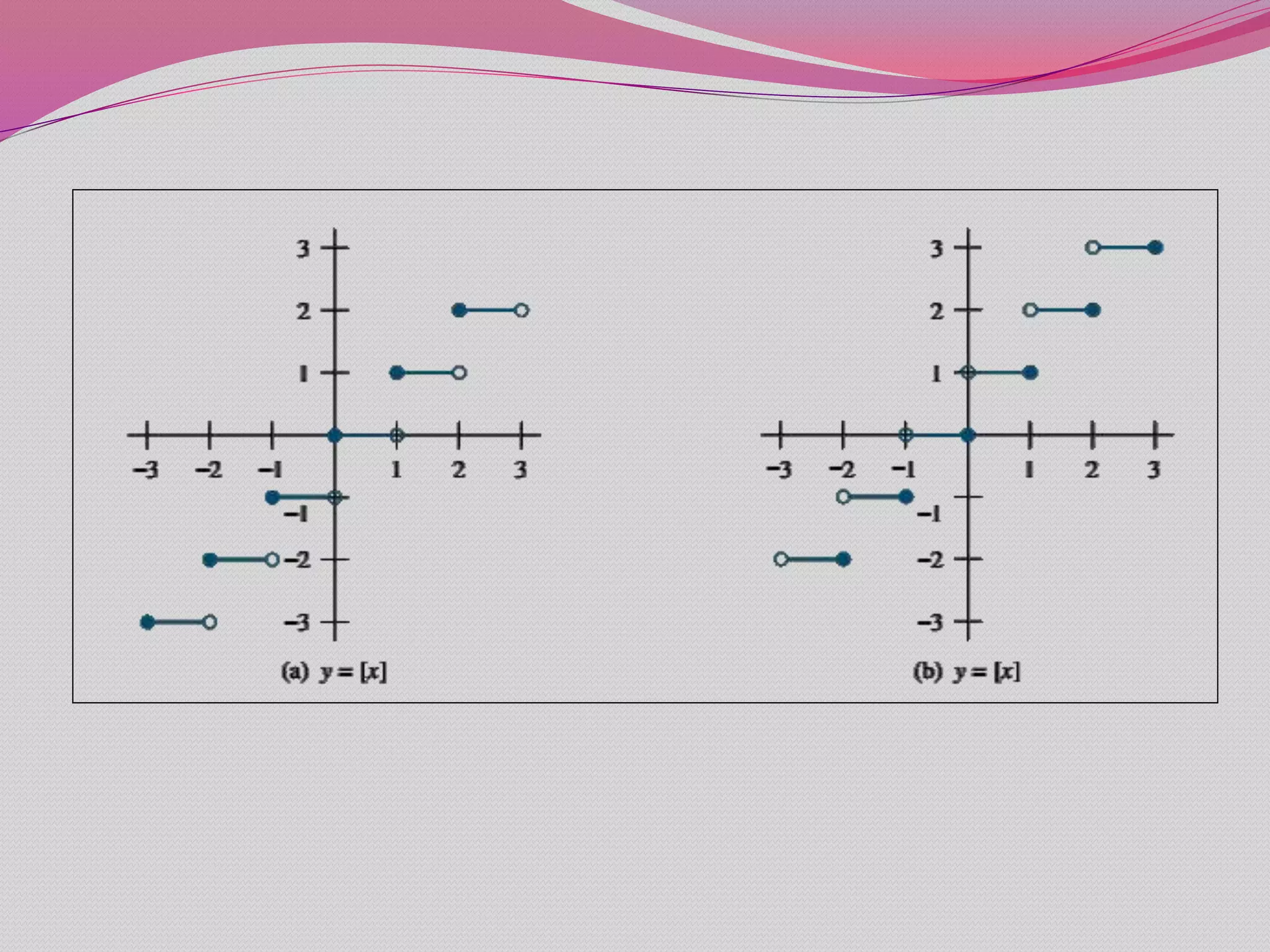
Floor and Ceiling Function:
The floor and ceiling functions map the real
numbers onto the integers (RZ).
The floor function assigns to rR the largest zZ
with zr, denoted by r.
Examples: 2.3 = 2, 2 = 2, 0.5 = 0, -3.5 = -4
The ceiling function assigns to rR the smallest
zZ with zr, denoted by r.
Examples: 2.3 = 3, 2 = 2, 0.5 = 1, -3.5 = -3
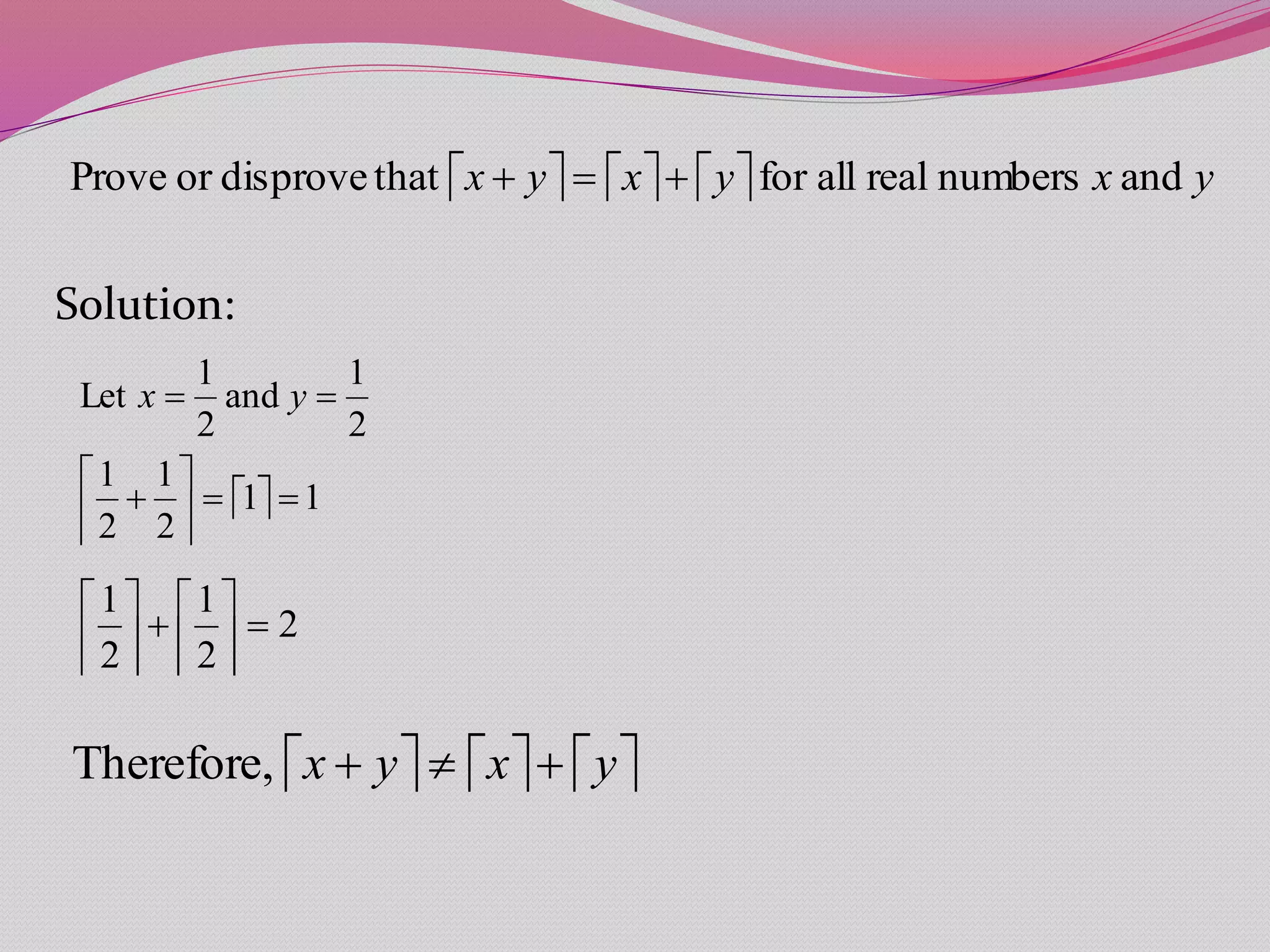
Solution:
      yxyxyx andnumbersrealallforthatdisproveorProve 
  11
2
1
2
1
2
1
and
2
1
Let





 yx
2
2
1
2
1












     yxyx Therefore,

Functions

  • 1.
  • 2.
    Function: Let A andB be nonempty sets. A function f from A to B is an assignment of exactly one element of B to each element of A.  If is a function from A to B, we write f : A → B f(a) = b  A is the domain of f and B is the codomain of f.  b is the image of a and a is the pre-image of b.  The range of f is the set of all images of elements of A.
  • 3.
    Injective Function: A functionf is said to be one-to-one or injective if and only if f(a) = f(b) implies that a = b for all a and b in the domain of f.  x  y (f(x) = f(y)  x = y)  Determine whether the function f from {a, b, c, d} to {1, 2, 3, 4, 5} with f(a) = 4, f(b) = 5, f (c) = 1, and f(d) = 3 is one-to- one.  Solution: The function f is one-to-one because f takes on different values at the four elements of its domain.
  • 4.
     If thefunction g: Z → Z is defined by the rule g(n) = n2 for all n ∈ Z, then is g one-to-one?  Solution: Let n1 = 2 and n2 =−2. g(n1) = g(2) = 4 g(n2) = g(−2) = 4. Hence g(n1) = g(n2) but n1≠n2,
  • 5.
     If thefunction f : R → R is defined by the rule f(x)=4x−1, for all real numbers x, then is f one-to-one?  Solution: Suppose x and y are real numbers such that f(x)=f(y). [We must show that x = y.] By definition of f , 4 x − 1 = 4 y − 1. 4 x = 4 y x = y
  • 6.
    Increasing and Decreasingfunction: A function f whose domain and codomain is a subset of real numbers is called increasing if f(x) ≤ f(y), and strictly increasing if f(x)<f(y), whenever x<y and x and y are in the domain of f. Similarly, f is called decreasing if f(x) ≥ f(y), and strictly decreasing if f(x)>f(y), whenever x<y and x and y are in the domain of f. Surjective Function: A function f from A to B is called onto, or surjective, if and only if for every element b ∈ B there is an element a ∈ A with f(a) = b.
  • 7.
     Is thefunction f(x) = x2 from the set of integers to the set of integers onto?  Solution: The function f is not onto. (Example : there is no integer x with x2 =−1)  Is the function f(x) = x + 1 from the set of integers to the set of integers onto?  Solution: This function is onto, because for every integer y there is an integer x such that f (x) = y.
  • 8.
    Bijective Function: The functionf is a one-to-one correspondence, or a bijective function, if it is both one-to-one and onto. Inverse Function: Let f be a one-to-one correspondence from the set A to the set B. The inverse function of f is the function that assigns to an element b belonging to B the unique element a in A such that f(a) = b. The inverse function of f is denoted by f -1. Hence, f -1(b) = a when f(a) = b.
  • 9.
     Let f: Z → Z be such that f(x) = x + 1. Is f invertible, and if it is, what is its inverse?  Solution: The function f has an inverse because it is a one-to- one correspondence f -1 (y) = y − 1.  Let f be the function from R to R with f(x) = x2.Is f invertible?  Solution: Because f(−2) = f(2) = 4, f is not one-to-one.
  • 10.
    Composition: Let g bea function from the set A to the set B and let f be a function from the set B to the set C. The composition of the functions f and g, denoted for all a ∈ A by f ◦ g, is defined by (f ◦ g)(a) = f (g(a)).
  • 11.
     Let fand g be the functions from the set of integers to the set of integers defined by f(x) = 2x + 3 and g(x) = 3x+2. What is the composition of f and g? What is the composition of g and f ?  Solution: (f ◦ g)(x) = f(g(x)) = f(3x + 2) = 2(3x + 2) + 3 = 6x + 7 (g ◦ f )(x) = g(f(x)) = g(2x + 3) = 3(2x + 3) + 2 = 6x + 11. Composition of a function and its inverse: (f -1 ◦f)(x) = f -1(f(x)) = x
  • 12.
    Floor and CeilingFunction: The floor and ceiling functions map the real numbers onto the integers (RZ). The floor function assigns to rR the largest zZ with zr, denoted by r. Examples: 2.3 = 2, 2 = 2, 0.5 = 0, -3.5 = -4 The ceiling function assigns to rR the smallest zZ with zr, denoted by r. Examples: 2.3 = 3, 2 = 2, 0.5 = 1, -3.5 = -3
  • 14.
    Solution:      yxyxyx andnumbersrealallforthatdisproveorProve    11 2 1 2 1 2 1 and 2 1 Let       yx 2 2 1 2 1                  yxyx Therefore,