Discrete Structures
Functions
Dr. Muhammad Humayoun
Assistant Professor
COMSATS Institute of Computer Science, Lahore.
mhumayoun@ciitlahore.edu.pk
https://sites.google.com/a/ciitlahore.edu.pk/dstruct/
A lot of material is taken from the slides of Dr. Atif and Dr. Mudassir
1
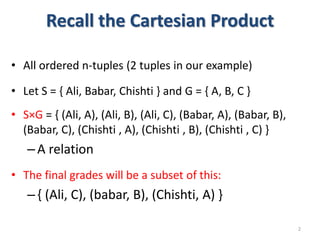
Recall the Cartesian Product
• All ordered n-tuples (2 tuples in our example)
• Let S = { Ali, Babar, Chishti } and G = { A, B, C }
• S×G = { (Ali, A), (Ali, B), (Ali, C), (Babar, A), (Babar, B),
(Babar, C), (Chishti , A), (Chishti , B), (Chishti , C) }
–A relation
• The final grades will be a subset of this:
–{ (Ali, C), (babar, B), (Chishti, A) }
2
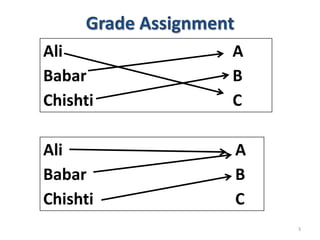
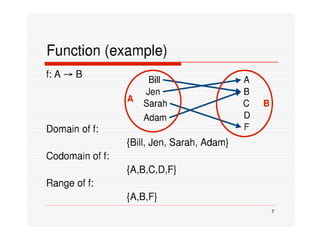
Grade Assignment
Ali A
Babar B
Chishti C
3
Ali A
Babar B
Chishti C
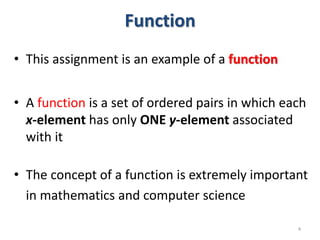
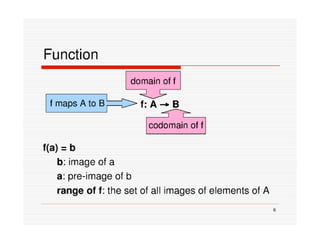
Function
• This assignment is an example of a function
• A function is a set of ordered pairs in which each
x-element has only ONE y-element associated
with it
• The concept of a function is extremely important
in mathematics and computer science
4
Definition 1
Let A and B be nonempty sets. A function f from A
to B is an assignment of exactly one element of B
to each element of A.
We write f (a) = b if b is the unique element of B
assigned by the function f to the element a of A.
If f is a function from A to B, we write f : A → B.
5
Specifying a Function
Many different ways:
• Sometimes we explicitly state the assignments,
as in previous figure
• Often we give a formula, such as f (x) = x + 1, to
define a function
• Other times we use a computer program to
specify a function
6
7
8
Definition 2
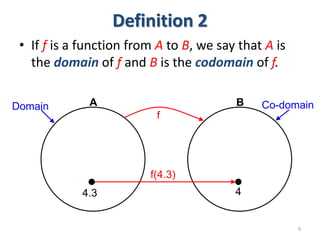
• If f is a function from A to B, we say that A is
the domain of f and B is the codomain of f.
9
A B
f
4.3 4
Domain Co-domain
f(4.3)
Definition 2
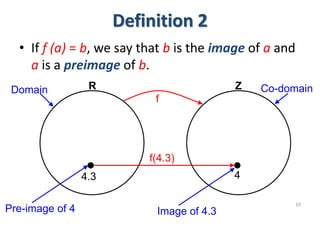
• If f (a) = b, we say that b is the image of a and
a is a preimage of b.
10
R Z
f
4.3 4
Domain Co-domain
Pre-image of 4 Image of 4.3
f(4.3)
Definition 2
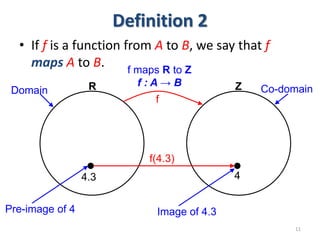
• If f is a function from A to B, we say that f
maps A to B.
11
R Z
f
4.3 4
Domain Co-domain
Pre-image of 4 Image of 4.3
f maps R to Z
f : A → B
f(4.3)
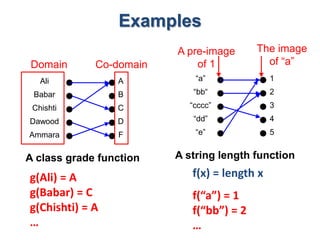
Examples
1
2
3
4
5
“a”
“bb“
“cccc”
“dd”
“e”
A string length function
A
B
C
D
F
Ali
Babar
Chishti
Dawood
Ammara
A class grade function
Domain Co-domain
A pre-image
of 1
The image
of “a”
g(Ali) = A
g(Babar) = C
g(Chishti) = A
…
f(x) = length x
f(“a”) = 1
f(“bb”) = 2
…
Definition 2
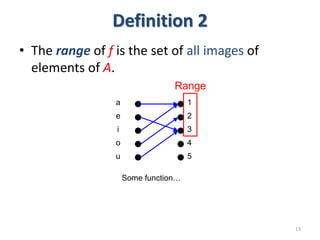
• The range of f is the set of all images of
elements of A.
13
1
2
3
4
5
a
e
i
o
u
Some function…
Range
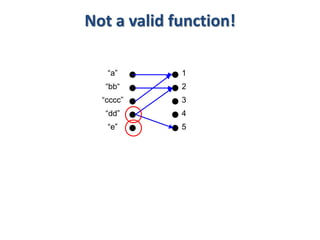
Not a valid function!
1
2
3
4
5
“a”
“bb“
“cccc”
“dd”
“e”
EXAMPLE 1
at Page# 140
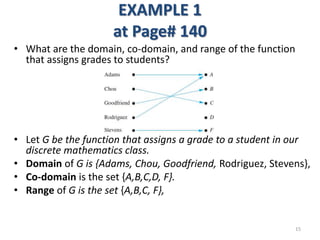
• What are the domain, co-domain, and range of the function
that assigns grades to students?
• Let G be the function that assigns a grade to a student in our
discrete mathematics class.
• Domain of G is {Adams, Chou, Goodfriend, Rodriguez, Stevens},
• Co-domain is the set {A,B,C,D, F}.
• Range of G is the set {A,B,C, F},
15
EXAMPLE 2
at Page# 140
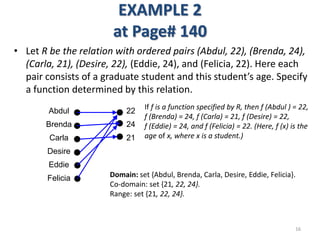
• Let R be the relation with ordered pairs (Abdul, 22), (Brenda, 24),
(Carla, 21), (Desire, 22), (Eddie, 24), and (Felicia, 22). Here each
pair consists of a graduate student and this student’s age. Specify
a function determined by this relation.
16
22
24
21
Abdul
Brenda
Carla
Desire
Eddie
Felicia
If f is a function specified by R, then f (Abdul ) = 22,
f (Brenda) = 24, f (Carla) = 21, f (Desire) = 22,
f (Eddie) = 24, and f (Felicia) = 22. (Here, f (x) is the
age of x, where x is a student.)
Domain: set {Abdul, Brenda, Carla, Desire, Eddie, Felicia}.
Co-domain: set {21, 22, 24}.
Range: set {21, 22, 24}.
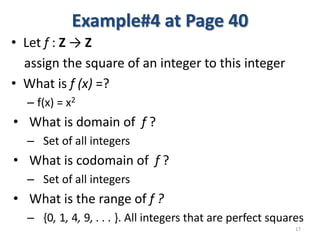
Example#4 at Page 40
• Let f : Z → Z
assign the square of an integer to this integer
• What is f (x) =?
– f(x) = x2
• What is domain of f ?
– Set of all integers
• What is codomain of f ?
– Set of all integers
• What is the range of f ?
– {0, 1, 4, 9, . . . }. All integers that are perfect squares
17
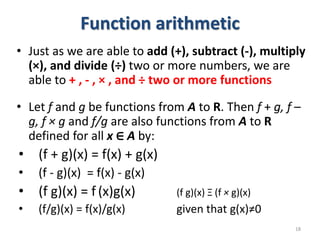
Function arithmetic
• Just as we are able to add (+), subtract (-), multiply
(×), and divide (÷) two or more numbers, we are
able to + , - , × , and ÷ two or more functions
• Let f and g be functions from A to R. Then f + g, f –
g, f × g and f/g are also functions from A to R
defined for all x ∈ A by:
• (f + g)(x) = f(x) + g(x)
• (f - g)(x) = f(x) - g(x)
• (f g)(x) = f (x)g(x) (f g)(x) Ξ (f × g)(x)
• (f/g)(x) = f(x)/g(x) given that g(x)≠0
18
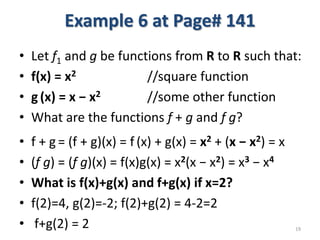
Example 6 at Page# 141
• Let f1 and g be functions from R to R such that:
• f(x) = x2 //square function
• g (x) = x − x2 //some other function
• What are the functions f + g and f g?
• f + g = (f + g)(x) = f (x) + g(x) = x2 + (x − x2) = x
• (f g) = (f g)(x) = f(x)g(x) = x2(x − x2) = x3 − x4
• What is f(x)+g(x) and f+g(x) if x=2?
• f(2)=4, g(2)=-2; f(2)+g(2) = 4-2=2
• f+g(2) = 2 19
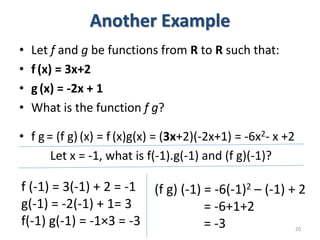
Another Example
• Let f and g be functions from R to R such that:
• f (x) = 3x+2
• g (x) = -2x + 1
• What is the function f g?
• f g= (f g)(x) = f (x)g(x) = (3x+2)(-2x+1) = -6x2- x +2
Let x = -1, what is f(-1).g(-1) and (f g)(-1)?
20
f (-1) = 3(-1) + 2 = -1
g(-1) = -2(-1) + 1= 3
f(-1) g(-1) = -1×3 = -3
(f g) (-1) = -6(-1)2 – (-1) + 2
= -6+1+2
= -3
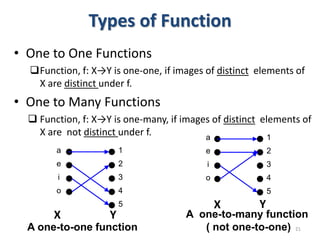
Types of Function
• One to One Functions
Function, f: X→Y is one-one, if images of distinct elements of
X are distinct under f.
• One to Many Functions
 Function, f: X→Y is one-many, if images of distinct elements of
X are not distinct under f.
21
1
2
3
4
5
a
e
i
o
A one-to-one function
1
2
3
4
5
a
e
i
o
A one-to-many function
( not one-to-one)
X Y
X Y
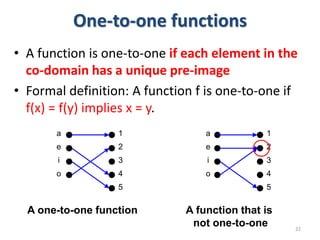
One-to-one functions
• A function is one-to-one if each element in the
co-domain has a unique pre-image
• Formal definition: A function f is one-to-one if
f(x) = f(y) implies x = y.
22
1
2
3
4
5
a
e
i
o
A one-to-one function
1
2
3
4
5
a
e
i
o
A function that is
not one-to-one
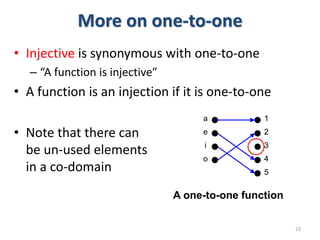
More on one-to-one
• Injective is synonymous with one-to-one
– “A function is injective”
• A function is an injection if it is one-to-one
• Note that there can
be un-used elements
in a co-domain
23
1
2
3
4
5
a
e
i
o
A one-to-one function
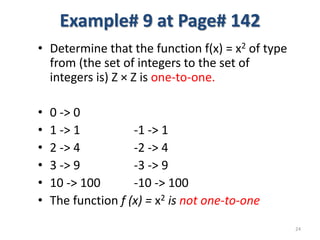
Example# 9 at Page# 142
• Determine that the function f(x) = x2 of type
from (the set of integers to the set of
integers is) Z × Z is one-to-one.
• 0 -> 0
• 1 -> 1 -1 -> 1
• 2 -> 4 -2 -> 4
• 3 -> 9 -3 -> 9
• 10 -> 100 -10 -> 100
• The function f (x) = x2 is not one-to-one
24
Example# 10 at Page# 142
• Determine whether the function f (x) = x + 1 from
the set of real numbers to itself is one-to one.
• 0 -> 1
• 1 -> 2
• 2 -> 3
• 3 -> 4
• 10 -> 11
• The function f (x) = x + 1 is a one-to-one function.
25
• Next Class
26
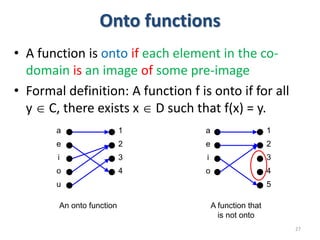
Onto functions
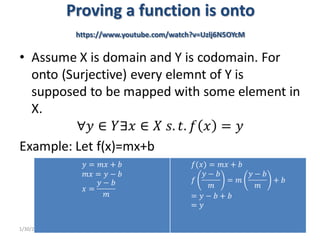
• A function is onto if each element in the co-
domain is an image of some pre-image
• Formal definition: A function f is onto if for all
y  C, there exists x  D such that f(x) = y.
27
1
2
3
4
5
a
e
i
o
A function that
is not onto
1
2
3
4
a
e
i
o
u
An onto function
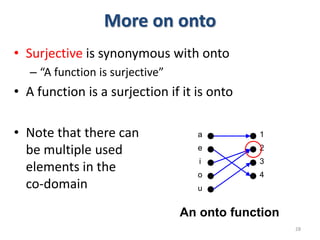
More on onto
• Surjective is synonymous with onto
– “A function is surjective”
• A function is a surjection if it is onto
• Note that there can
be multiple used
elements in the
co-domain
28
1
2
3
4
a
e
i
o
u
An onto function
Example # 12 at Page# 143
• Let f be the function from {a, b, c, d} to {1, 2, 3}
defined by f (a) = 3, f (b) = 2, f (c) = 1, and f (d) =
3. Is f an onto function?
• f (a) = 3
• f (b) = 2
• f (c) = 1
• f (d) = 3
• Yes, f is an onto function
29
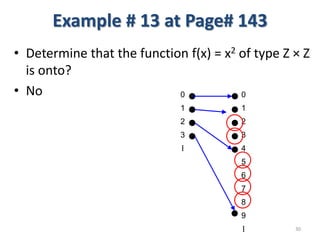
Example # 13 at Page# 143
• Determine that the function f(x) = x2 of type Z × Z
is onto?
• No
30
0
1
2
3
4
5
6
7
8
9
⁞
0
1
2
3
⁞
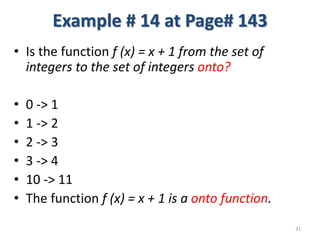
Example # 14 at Page# 143
• Is the function f (x) = x + 1 from the set of
integers to the set of integers onto?
• 0 -> 1
• 1 -> 2
• 2 -> 3
• 3 -> 4
• 10 -> 11
• The function f (x) = x + 1 is a onto function.
31
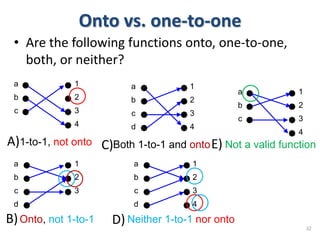
Onto vs. one-to-one
• Are the following functions onto, one-to-one,
both, or neither?
32
1
2
3
4
a
b
c
1
2
3
a
b
c
d
1
2
3
4
a
b
c
d
1
2
3
4
a
b
c
d
1
2
3
4
a
b
c
1-to-1, not onto
Onto, not 1-to-1
Both 1-to-1 and onto Not a valid function
Neither 1-to-1 nor onto
A)
B)
C)
D)
E)
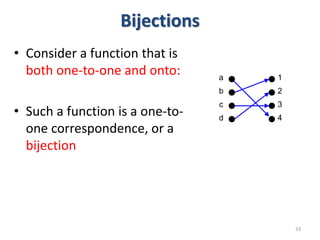
Bijections
• Consider a function that is
both one-to-one and onto:
• Such a function is a one-to-
one correspondence, or a
bijection
33
1
2
3
4
a
b
c
d
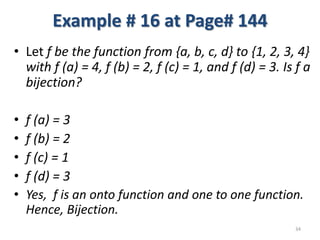
Example # 16 at Page# 144
• Let f be the function from {a, b, c, d} to {1, 2, 3, 4}
with f (a) = 4, f (b) = 2, f (c) = 1, and f (d) = 3. Is f a
bijection?
• f (a) = 3
• f (b) = 2
• f (c) = 1
• f (d) = 3
• Yes, f is an onto function and one to one function.
Hence, Bijection.
34
Identity functions
• A function such that the image and the pre-
image are ALWAYS equal
• f(x) = 1*x
• f(x) = x + 0
• The domain and the co-domain must be the
same set
35
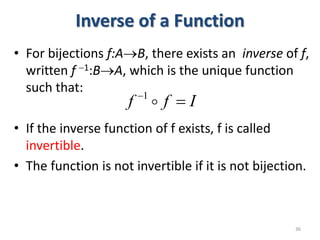
Inverse of a Function
• For bijections f:AB, there exists an inverse of f,
written f 1:BA, which is the unique function
such that:
• If the inverse function of f exists, f is called
invertible.
• The function is not invertible if it is not bijection.
36
I
f
f 


1
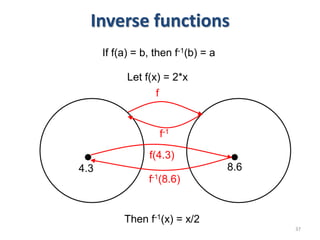
Inverse functions
37
f
4.3 8.6
Let f(x) = 2*x
f-1
f(4.3)
f-1(8.6)
Then f-1(x) = x/2
If f(a) = b, then f-1(b) = a
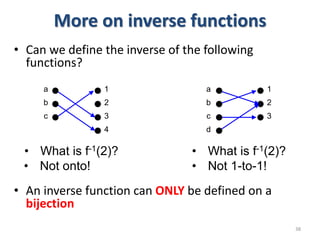
More on inverse functions
• Can we define the inverse of the following
functions?
• An inverse function can ONLY be defined on a
bijection
38
1
2
3
4
a
b
c
1
2
3
a
b
c
d
• What is f-1(2)?
• Not onto!
• What is f-1(2)?
• Not 1-to-1!
Example 18
at Page #146
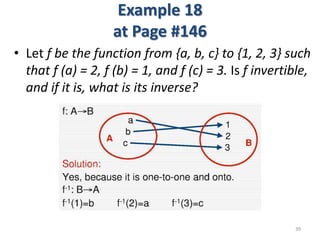
• Let f be the function from {a, b, c} to {1, 2, 3} such
that f (a) = 2, f (b) = 1, and f (c) = 3. Is f invertible,
and if it is, what is its inverse?
39
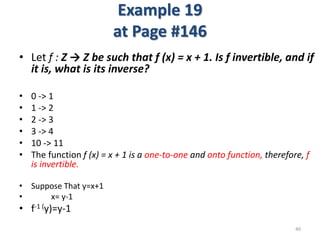
Example 19
at Page #146
• Let f : Z → Z be such that f (x) = x + 1. Is f invertible, and if
it is, what is its inverse?
• 0 -> 1
• 1 -> 2
• 2 -> 3
• 3 -> 4
• 10 -> 11
• The function f (x) = x + 1 is a one-to-one and onto function, therefore, f
is invertible.
• Suppose That y=x+1
• x= y-1
• f-1 (y)=y-1
40
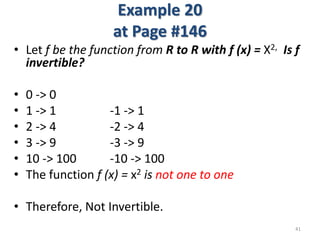
Example 20
at Page #146
• Let f be the function from R to R with f (x) = X2, Is f
invertible?
• 0 -> 0
• 1 -> 1 -1 -> 1
• 2 -> 4 -2 -> 4
• 3 -> 9 -3 -> 9
• 10 -> 100 -10 -> 100
• The function f (x) = x2 is not one to one
• Therefore, Not Invertible.
41
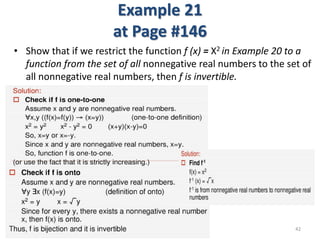
Example 21
at Page #146
• Show that if we restrict the function f (x) = X2 in Example 20 to a
function from the set of all nonnegative real numbers to the set of
all nonnegative real numbers, then f is invertible.
42
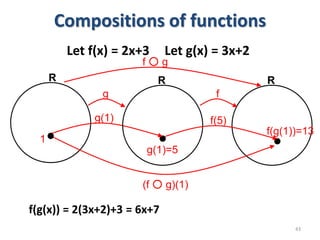
Compositions of functions
43
g f
f ○ g
g(1) f(5)
(f ○ g)(1)
g(1)=5
f(g(1))=13
1
R R R
Let f(x) = 2x+3 Let g(x) = 3x+2
f(g(x)) = 2(3x+2)+3 = 6x+7
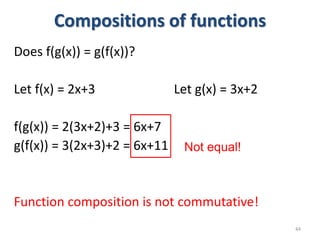
Compositions of functions
Does f(g(x)) = g(f(x))?
Let f(x) = 2x+3 Let g(x) = 3x+2
f(g(x)) = 2(3x+2)+3 = 6x+7
g(f(x)) = 3(2x+3)+2 = 6x+11
Function composition is not commutative!
44
Not equal!
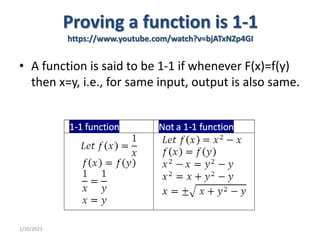
Proving a function is 1-1
https://www.youtube.com/watch?v=bjATxNZp4GI
• A function is said to be 1-1 if whenever F(x)=f(y)
then x=y, i.e., for same input, output is also same.
1/30/2023
Proving a function is onto
https://www.youtube.com/watch?v=Uzlj6N5OYcM
1/30/2023
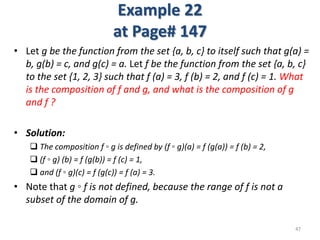
Example 22
at Page# 147
• Let g be the function from the set {a, b, c} to itself such that g(a) =
b, g(b) = c, and g(c) = a. Let f be the function from the set {a, b, c}
to the set {1, 2, 3} such that f (a) = 3, f (b) = 2, and f (c) = 1. What
is the composition of f and g, and what is the composition of g
and f ?
• Solution:
 The composition f ◦ g is defined by (f ◦ g)(a) = f (g(a)) = f (b) = 2,
 (f ◦ g) (b) = f (g(b)) = f (c) = 1,
 and (f ◦ g)(c) = f (g(c)) = f (a) = 3.
• Note that g ◦ f is not defined, because the range of f is not a
subset of the domain of g.
47
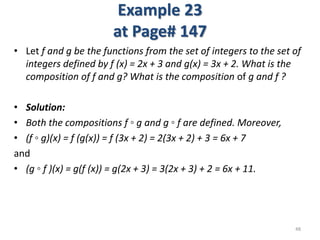
Example 23
at Page# 147
• Let f and g be the functions from the set of integers to the set of
integers defined by f (x) = 2x + 3 and g(x) = 3x + 2. What is the
composition of f and g? What is the composition of g and f ?
• Solution:
• Both the compositions f ◦ g and g ◦ f are defined. Moreover,
• (f ◦ g)(x) = f (g(x)) = f (3x + 2) = 2(3x + 2) + 3 = 6x + 7
and
• (g ◦ f )(x) = g(f (x)) = g(2x + 3) = 3(2x + 3) + 2 = 6x + 11.
48
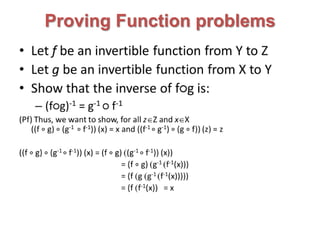
Proving Function problems
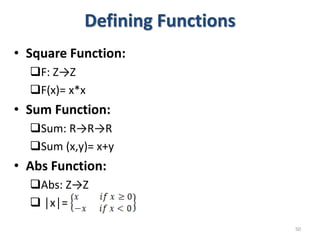
Defining Functions
• Square Function:
F: Z→Z
F(x)= x*x
• Sum Function:
Sum: R→R→R
Sum (x,y)= x+y
• Abs Function:
Abs: Z→Z
 │x│=
50
Defining Functions …
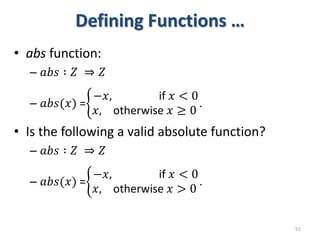
• abs function:
– 𝑎𝑏𝑠 ∶ 𝑍 ⇒ 𝑍
– 𝑎𝑏𝑠(𝑥) =
−𝑥, if 𝑥 < 0
𝑥, otherwise 𝑥 ≥ 0
.
• Is the following a valid absolute function?
– 𝑎𝑏𝑠 ∶ 𝑍 ⇒ 𝑍
– 𝑎𝑏𝑠(𝑥) =
−𝑥, if 𝑥 < 0
𝑥, otherwise 𝑥 > 0
.
51
Defining Recursive Function
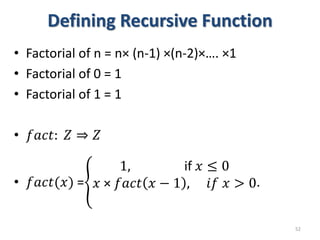
• Factorial of n = n× (n-1) ×(n-2)×…. ×1
• Factorial of 0 = 1
• Factorial of 1 = 1
• 𝑓𝑎𝑐𝑡: 𝑍 ⇒ 𝑍
• 𝑓𝑎𝑐𝑡(𝑥) =
1, if 𝑥 ≤ 0
𝑥 × 𝑓𝑎𝑐𝑡 𝑥 − 1 , 𝑖𝑓 𝑥 > 0.
52
Another Example
• Suppose that 𝑓 is defined recursively by
• 𝑓(0) = 100,
• 𝑓(𝑥 + 1) = 𝑓(𝑥) + 3
• Find 𝑓 2 .
• To find f(2), we also need to find f(1):
• f(1) = f(0) + 3 = 100 + 3 = 103
• f(2) = f(1) + 3 = 103 + 3 = 106
• What is f(5)?
• F(5) = f(4)+3 = [f(3)+3] +3 = [[f(2)+3]+3]+3
• = [[[f(1)+3]+3]+3]+3 = [[[[f(0)+3]+3]+3]+3]+3 53
54

9-Functions.pptx

  • 1.
    Discrete Structures Functions Dr. MuhammadHumayoun Assistant Professor COMSATS Institute of Computer Science, Lahore. mhumayoun@ciitlahore.edu.pk https://sites.google.com/a/ciitlahore.edu.pk/dstruct/ A lot of material is taken from the slides of Dr. Atif and Dr. Mudassir 1
  • 2.
    Recall the CartesianProduct • All ordered n-tuples (2 tuples in our example) • Let S = { Ali, Babar, Chishti } and G = { A, B, C } • S×G = { (Ali, A), (Ali, B), (Ali, C), (Babar, A), (Babar, B), (Babar, C), (Chishti , A), (Chishti , B), (Chishti , C) } –A relation • The final grades will be a subset of this: –{ (Ali, C), (babar, B), (Chishti, A) } 2
  • 3.
    Grade Assignment Ali A BabarB Chishti C 3 Ali A Babar B Chishti C
  • 4.
    Function • This assignmentis an example of a function • A function is a set of ordered pairs in which each x-element has only ONE y-element associated with it • The concept of a function is extremely important in mathematics and computer science 4
  • 5.
    Definition 1 Let Aand B be nonempty sets. A function f from A to B is an assignment of exactly one element of B to each element of A. We write f (a) = b if b is the unique element of B assigned by the function f to the element a of A. If f is a function from A to B, we write f : A → B. 5
  • 6.
    Specifying a Function Manydifferent ways: • Sometimes we explicitly state the assignments, as in previous figure • Often we give a formula, such as f (x) = x + 1, to define a function • Other times we use a computer program to specify a function 6
  • 7.
  • 8.
  • 9.
    Definition 2 • Iff is a function from A to B, we say that A is the domain of f and B is the codomain of f. 9 A B f 4.3 4 Domain Co-domain f(4.3)
  • 10.
    Definition 2 • Iff (a) = b, we say that b is the image of a and a is a preimage of b. 10 R Z f 4.3 4 Domain Co-domain Pre-image of 4 Image of 4.3 f(4.3)
  • 11.
    Definition 2 • Iff is a function from A to B, we say that f maps A to B. 11 R Z f 4.3 4 Domain Co-domain Pre-image of 4 Image of 4.3 f maps R to Z f : A → B f(4.3)
  • 12.
    Examples 1 2 3 4 5 “a” “bb“ “cccc” “dd” “e” A string lengthfunction A B C D F Ali Babar Chishti Dawood Ammara A class grade function Domain Co-domain A pre-image of 1 The image of “a” g(Ali) = A g(Babar) = C g(Chishti) = A … f(x) = length x f(“a”) = 1 f(“bb”) = 2 …
  • 13.
    Definition 2 • Therange of f is the set of all images of elements of A. 13 1 2 3 4 5 a e i o u Some function… Range
  • 14.
    Not a validfunction! 1 2 3 4 5 “a” “bb“ “cccc” “dd” “e”
  • 15.
    EXAMPLE 1 at Page#140 • What are the domain, co-domain, and range of the function that assigns grades to students? • Let G be the function that assigns a grade to a student in our discrete mathematics class. • Domain of G is {Adams, Chou, Goodfriend, Rodriguez, Stevens}, • Co-domain is the set {A,B,C,D, F}. • Range of G is the set {A,B,C, F}, 15
  • 16.
    EXAMPLE 2 at Page#140 • Let R be the relation with ordered pairs (Abdul, 22), (Brenda, 24), (Carla, 21), (Desire, 22), (Eddie, 24), and (Felicia, 22). Here each pair consists of a graduate student and this student’s age. Specify a function determined by this relation. 16 22 24 21 Abdul Brenda Carla Desire Eddie Felicia If f is a function specified by R, then f (Abdul ) = 22, f (Brenda) = 24, f (Carla) = 21, f (Desire) = 22, f (Eddie) = 24, and f (Felicia) = 22. (Here, f (x) is the age of x, where x is a student.) Domain: set {Abdul, Brenda, Carla, Desire, Eddie, Felicia}. Co-domain: set {21, 22, 24}. Range: set {21, 22, 24}.
  • 17.
    Example#4 at Page40 • Let f : Z → Z assign the square of an integer to this integer • What is f (x) =? – f(x) = x2 • What is domain of f ? – Set of all integers • What is codomain of f ? – Set of all integers • What is the range of f ? – {0, 1, 4, 9, . . . }. All integers that are perfect squares 17
  • 18.
    Function arithmetic • Justas we are able to add (+), subtract (-), multiply (×), and divide (÷) two or more numbers, we are able to + , - , × , and ÷ two or more functions • Let f and g be functions from A to R. Then f + g, f – g, f × g and f/g are also functions from A to R defined for all x ∈ A by: • (f + g)(x) = f(x) + g(x) • (f - g)(x) = f(x) - g(x) • (f g)(x) = f (x)g(x) (f g)(x) Ξ (f × g)(x) • (f/g)(x) = f(x)/g(x) given that g(x)≠0 18
  • 19.
    Example 6 atPage# 141 • Let f1 and g be functions from R to R such that: • f(x) = x2 //square function • g (x) = x − x2 //some other function • What are the functions f + g and f g? • f + g = (f + g)(x) = f (x) + g(x) = x2 + (x − x2) = x • (f g) = (f g)(x) = f(x)g(x) = x2(x − x2) = x3 − x4 • What is f(x)+g(x) and f+g(x) if x=2? • f(2)=4, g(2)=-2; f(2)+g(2) = 4-2=2 • f+g(2) = 2 19
  • 20.
    Another Example • Letf and g be functions from R to R such that: • f (x) = 3x+2 • g (x) = -2x + 1 • What is the function f g? • f g= (f g)(x) = f (x)g(x) = (3x+2)(-2x+1) = -6x2- x +2 Let x = -1, what is f(-1).g(-1) and (f g)(-1)? 20 f (-1) = 3(-1) + 2 = -1 g(-1) = -2(-1) + 1= 3 f(-1) g(-1) = -1×3 = -3 (f g) (-1) = -6(-1)2 – (-1) + 2 = -6+1+2 = -3
  • 21.
    Types of Function •One to One Functions Function, f: X→Y is one-one, if images of distinct elements of X are distinct under f. • One to Many Functions  Function, f: X→Y is one-many, if images of distinct elements of X are not distinct under f. 21 1 2 3 4 5 a e i o A one-to-one function 1 2 3 4 5 a e i o A one-to-many function ( not one-to-one) X Y X Y
  • 22.
    One-to-one functions • Afunction is one-to-one if each element in the co-domain has a unique pre-image • Formal definition: A function f is one-to-one if f(x) = f(y) implies x = y. 22 1 2 3 4 5 a e i o A one-to-one function 1 2 3 4 5 a e i o A function that is not one-to-one
  • 23.
    More on one-to-one •Injective is synonymous with one-to-one – “A function is injective” • A function is an injection if it is one-to-one • Note that there can be un-used elements in a co-domain 23 1 2 3 4 5 a e i o A one-to-one function
  • 24.
    Example# 9 atPage# 142 • Determine that the function f(x) = x2 of type from (the set of integers to the set of integers is) Z × Z is one-to-one. • 0 -> 0 • 1 -> 1 -1 -> 1 • 2 -> 4 -2 -> 4 • 3 -> 9 -3 -> 9 • 10 -> 100 -10 -> 100 • The function f (x) = x2 is not one-to-one 24
  • 25.
    Example# 10 atPage# 142 • Determine whether the function f (x) = x + 1 from the set of real numbers to itself is one-to one. • 0 -> 1 • 1 -> 2 • 2 -> 3 • 3 -> 4 • 10 -> 11 • The function f (x) = x + 1 is a one-to-one function. 25
  • 26.
  • 27.
    Onto functions • Afunction is onto if each element in the co- domain is an image of some pre-image • Formal definition: A function f is onto if for all y  C, there exists x  D such that f(x) = y. 27 1 2 3 4 5 a e i o A function that is not onto 1 2 3 4 a e i o u An onto function
  • 28.
    More on onto •Surjective is synonymous with onto – “A function is surjective” • A function is a surjection if it is onto • Note that there can be multiple used elements in the co-domain 28 1 2 3 4 a e i o u An onto function
  • 29.
    Example # 12at Page# 143 • Let f be the function from {a, b, c, d} to {1, 2, 3} defined by f (a) = 3, f (b) = 2, f (c) = 1, and f (d) = 3. Is f an onto function? • f (a) = 3 • f (b) = 2 • f (c) = 1 • f (d) = 3 • Yes, f is an onto function 29
  • 30.
    Example # 13at Page# 143 • Determine that the function f(x) = x2 of type Z × Z is onto? • No 30 0 1 2 3 4 5 6 7 8 9 ⁞ 0 1 2 3 ⁞
  • 31.
    Example # 14at Page# 143 • Is the function f (x) = x + 1 from the set of integers to the set of integers onto? • 0 -> 1 • 1 -> 2 • 2 -> 3 • 3 -> 4 • 10 -> 11 • The function f (x) = x + 1 is a onto function. 31
  • 32.
    Onto vs. one-to-one •Are the following functions onto, one-to-one, both, or neither? 32 1 2 3 4 a b c 1 2 3 a b c d 1 2 3 4 a b c d 1 2 3 4 a b c d 1 2 3 4 a b c 1-to-1, not onto Onto, not 1-to-1 Both 1-to-1 and onto Not a valid function Neither 1-to-1 nor onto A) B) C) D) E)
  • 33.
    Bijections • Consider afunction that is both one-to-one and onto: • Such a function is a one-to- one correspondence, or a bijection 33 1 2 3 4 a b c d
  • 34.
    Example # 16at Page# 144 • Let f be the function from {a, b, c, d} to {1, 2, 3, 4} with f (a) = 4, f (b) = 2, f (c) = 1, and f (d) = 3. Is f a bijection? • f (a) = 3 • f (b) = 2 • f (c) = 1 • f (d) = 3 • Yes, f is an onto function and one to one function. Hence, Bijection. 34
  • 35.
    Identity functions • Afunction such that the image and the pre- image are ALWAYS equal • f(x) = 1*x • f(x) = x + 0 • The domain and the co-domain must be the same set 35
  • 36.
    Inverse of aFunction • For bijections f:AB, there exists an inverse of f, written f 1:BA, which is the unique function such that: • If the inverse function of f exists, f is called invertible. • The function is not invertible if it is not bijection. 36 I f f    1
  • 37.
    Inverse functions 37 f 4.3 8.6 Letf(x) = 2*x f-1 f(4.3) f-1(8.6) Then f-1(x) = x/2 If f(a) = b, then f-1(b) = a
  • 38.
    More on inversefunctions • Can we define the inverse of the following functions? • An inverse function can ONLY be defined on a bijection 38 1 2 3 4 a b c 1 2 3 a b c d • What is f-1(2)? • Not onto! • What is f-1(2)? • Not 1-to-1!
  • 39.
    Example 18 at Page#146 • Let f be the function from {a, b, c} to {1, 2, 3} such that f (a) = 2, f (b) = 1, and f (c) = 3. Is f invertible, and if it is, what is its inverse? 39
  • 40.
    Example 19 at Page#146 • Let f : Z → Z be such that f (x) = x + 1. Is f invertible, and if it is, what is its inverse? • 0 -> 1 • 1 -> 2 • 2 -> 3 • 3 -> 4 • 10 -> 11 • The function f (x) = x + 1 is a one-to-one and onto function, therefore, f is invertible. • Suppose That y=x+1 • x= y-1 • f-1 (y)=y-1 40
  • 41.
    Example 20 at Page#146 • Let f be the function from R to R with f (x) = X2, Is f invertible? • 0 -> 0 • 1 -> 1 -1 -> 1 • 2 -> 4 -2 -> 4 • 3 -> 9 -3 -> 9 • 10 -> 100 -10 -> 100 • The function f (x) = x2 is not one to one • Therefore, Not Invertible. 41
  • 42.
    Example 21 at Page#146 • Show that if we restrict the function f (x) = X2 in Example 20 to a function from the set of all nonnegative real numbers to the set of all nonnegative real numbers, then f is invertible. 42
  • 43.
    Compositions of functions 43 gf f ○ g g(1) f(5) (f ○ g)(1) g(1)=5 f(g(1))=13 1 R R R Let f(x) = 2x+3 Let g(x) = 3x+2 f(g(x)) = 2(3x+2)+3 = 6x+7
  • 44.
    Compositions of functions Doesf(g(x)) = g(f(x))? Let f(x) = 2x+3 Let g(x) = 3x+2 f(g(x)) = 2(3x+2)+3 = 6x+7 g(f(x)) = 3(2x+3)+2 = 6x+11 Function composition is not commutative! 44 Not equal!
  • 45.
    Proving a functionis 1-1 https://www.youtube.com/watch?v=bjATxNZp4GI • A function is said to be 1-1 if whenever F(x)=f(y) then x=y, i.e., for same input, output is also same. 1/30/2023
  • 46.
    Proving a functionis onto https://www.youtube.com/watch?v=Uzlj6N5OYcM 1/30/2023
  • 47.
    Example 22 at Page#147 • Let g be the function from the set {a, b, c} to itself such that g(a) = b, g(b) = c, and g(c) = a. Let f be the function from the set {a, b, c} to the set {1, 2, 3} such that f (a) = 3, f (b) = 2, and f (c) = 1. What is the composition of f and g, and what is the composition of g and f ? • Solution:  The composition f ◦ g is defined by (f ◦ g)(a) = f (g(a)) = f (b) = 2,  (f ◦ g) (b) = f (g(b)) = f (c) = 1,  and (f ◦ g)(c) = f (g(c)) = f (a) = 3. • Note that g ◦ f is not defined, because the range of f is not a subset of the domain of g. 47
  • 48.
    Example 23 at Page#147 • Let f and g be the functions from the set of integers to the set of integers defined by f (x) = 2x + 3 and g(x) = 3x + 2. What is the composition of f and g? What is the composition of g and f ? • Solution: • Both the compositions f ◦ g and g ◦ f are defined. Moreover, • (f ◦ g)(x) = f (g(x)) = f (3x + 2) = 2(3x + 2) + 3 = 6x + 7 and • (g ◦ f )(x) = g(f (x)) = g(2x + 3) = 3(2x + 3) + 2 = 6x + 11. 48
  • 49.
  • 50.
    Defining Functions • SquareFunction: F: Z→Z F(x)= x*x • Sum Function: Sum: R→R→R Sum (x,y)= x+y • Abs Function: Abs: Z→Z  │x│= 50
  • 51.
    Defining Functions … •abs function: – 𝑎𝑏𝑠 ∶ 𝑍 ⇒ 𝑍 – 𝑎𝑏𝑠(𝑥) = −𝑥, if 𝑥 < 0 𝑥, otherwise 𝑥 ≥ 0 . • Is the following a valid absolute function? – 𝑎𝑏𝑠 ∶ 𝑍 ⇒ 𝑍 – 𝑎𝑏𝑠(𝑥) = −𝑥, if 𝑥 < 0 𝑥, otherwise 𝑥 > 0 . 51
  • 52.
    Defining Recursive Function •Factorial of n = n× (n-1) ×(n-2)×…. ×1 • Factorial of 0 = 1 • Factorial of 1 = 1 • 𝑓𝑎𝑐𝑡: 𝑍 ⇒ 𝑍 • 𝑓𝑎𝑐𝑡(𝑥) = 1, if 𝑥 ≤ 0 𝑥 × 𝑓𝑎𝑐𝑡 𝑥 − 1 , 𝑖𝑓 𝑥 > 0. 52
  • 53.
    Another Example • Supposethat 𝑓 is defined recursively by • 𝑓(0) = 100, • 𝑓(𝑥 + 1) = 𝑓(𝑥) + 3 • Find 𝑓 2 . • To find f(2), we also need to find f(1): • f(1) = f(0) + 3 = 100 + 3 = 103 • f(2) = f(1) + 3 = 103 + 3 = 106 • What is f(5)? • F(5) = f(4)+3 = [f(3)+3] +3 = [[f(2)+3]+3]+3 • = [[[f(1)+3]+3]+3]+3 = [[[[f(0)+3]+3]+3]+3]+3 53
  • 54.