Relational Algebra
X
⋈
• Relational algebra is a widely used procedural query
language.
• It collects instances of relations as input and gives
occurrences of relations as output.
• It uses various operation to perform this action.
• Relational algebra operations are performed recursively
on a relation.
• The output of these operations is a new relation, which
might be formed from one or more input relations.
X
⋈
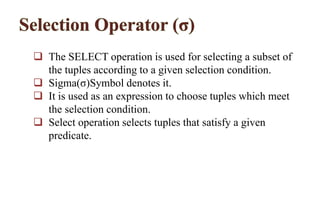
 The SELECT operation is used for selecting a subset of
the tuples according to a given selection condition.
 Sigma(σ)Symbol denotes it.
 It is used as an expression to choose tuples which meet
the selection condition.
 Select operation selects tuples that satisfy a given
predicate.
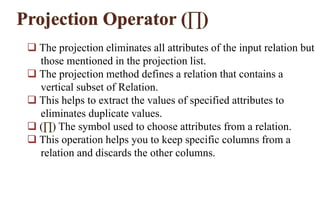
 The projection eliminates all attributes of the input relation but
those mentioned in the projection list.
 The projection method defines a relation that contains a
vertical subset of Relation.
 This helps to extract the values of specified attributes to
eliminates duplicate values.
 ( ) The symbol used to choose attributes from a relation.
 This operation helps you to keep specific columns from a
relation and discards the other columns.
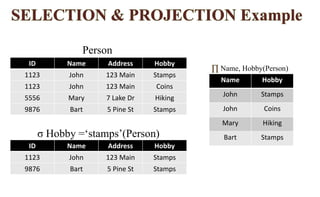
ID Name Address Hobby
1123 John 123 Main Stamps
1123 John 123 Main Coins
5556 Mary 7 Lake Dr Hiking
9876 Bart 5 Pine St Stamps
ID Name Address Hobby
1123 John 123 Main Stamps
9876 Bart 5 Pine St Stamps
Name Hobby
John Stamps
John Coins
Mary Hiking
Bart Stamps
Person
σ Hobby =‘stamps’(Person)
Name, Hobby(Person)
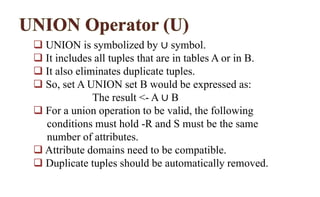
 UNION is symbolized by ∪ symbol.
 It includes all tuples that are in tables A or in B.
 It also eliminates duplicate tuples.
 So, set A UNION set B would be expressed as:
The result <- A ∪ B
 For a union operation to be valid, the following
conditions must hold -R and S must be the same
number of attributes.
 Attribute domains need to be compatible.
 Duplicate tuples should be automatically removed.
A 1
B 2
D 3
F 4
E 5
A 1
C 2
D 3
E 4
A 1
B 2
C 2
D 3
E 5
F 4
E 4
A
B
A U B
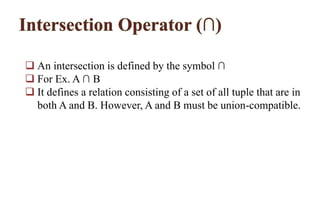
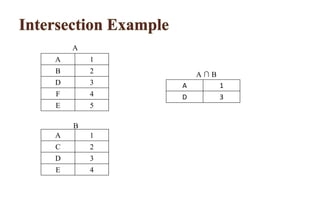
 An intersection is defined by the symbol ∩
 For Ex. A ∩ B
 It defines a relation consisting of a set of all tuple that are in
both A and B. However, A and B must be union-compatible.
A
A 1
B 2
D 3
F 4
E 5
A 1
C 2
D 3
E 4
B
A ∩ B
A 1
D 3
X
 This type of operation is helpful to merge columns from two
relations.
 Generally, a Cartesian product is never a meaningful operation
when it performs alone.
 However, it becomes meaningful when it is followed by other
operations.
 Cartesian Product operation denoted by X.
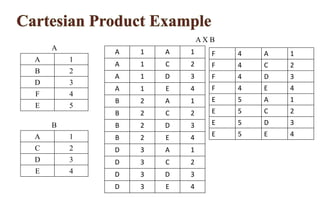
A
A 1
B 2
D 3
F 4
E 5
A 1
C 2
D 3
E 4
B
A 1 A 1
A 1 C 2
A 1 D 3
A 1 E 4
B 2 A 1
B 2 C 2
B 2 D 3
B 2 E 4
D 3 A 1
D 3 C 2
D 3 D 3
D 3 E 4
A X B
F 4 A 1
F 4 C 2
F 4 D 3
F 4 E 4
E 5 A 1
E 5 C 2
E 5 D 3
E 5 E 4
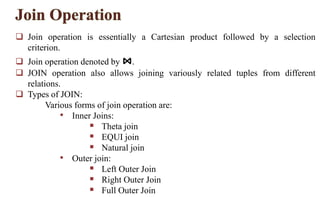
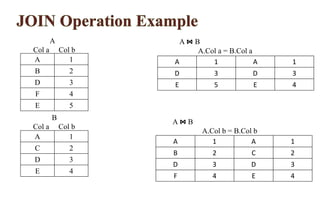
 Join operation is essentially a Cartesian product followed by a selection
criterion.
 Join operation denoted by ⋈.
 JOIN operation also allows joining variously related tuples from different
relations.
 Types of JOIN:
Various forms of join operation are:
• Inner Joins:
 Theta join
 EQUI join
 Natural join
• Outer join:
 Left Outer Join
 Right Outer Join
 Full Outer Join
A
Col a Col b
A 1
B 2
D 3
F 4
E 5
A 1
C 2
D 3
E 4
B
Col a Col b
A ⋈ B
A.Col a = B.Col a
A ⋈ B
A.Col b = B.Col b
A 1 A 1
D 3 D 3
E 5 E 4
A 1 A 1
B 2 C 2
D 3 D 3
F 4 E 4
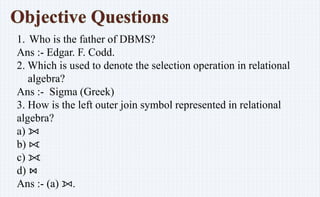
1. Who is the father of DBMS?
Ans :- Edgar. F. Codd.
2. Which is used to denote the selection operation in relational
algebra?
Ans :- Sigma (Greek)
3. How is the left outer join symbol represented in relational
algebra?
a) ⟕
b) ⟖
c) ⟗
d) ⋈
Ans :- (a) ⟕.
Relational algebra ppt

Relational algebra ppt

  • 1.
  • 2.
  • 3.
    • Relational algebrais a widely used procedural query language. • It collects instances of relations as input and gives occurrences of relations as output. • It uses various operation to perform this action. • Relational algebra operations are performed recursively on a relation. • The output of these operations is a new relation, which might be formed from one or more input relations.
  • 4.
  • 5.
     The SELECToperation is used for selecting a subset of the tuples according to a given selection condition.  Sigma(σ)Symbol denotes it.  It is used as an expression to choose tuples which meet the selection condition.  Select operation selects tuples that satisfy a given predicate.
  • 6.
     The projectioneliminates all attributes of the input relation but those mentioned in the projection list.  The projection method defines a relation that contains a vertical subset of Relation.  This helps to extract the values of specified attributes to eliminates duplicate values.  ( ) The symbol used to choose attributes from a relation.  This operation helps you to keep specific columns from a relation and discards the other columns.
  • 7.
    ID Name AddressHobby 1123 John 123 Main Stamps 1123 John 123 Main Coins 5556 Mary 7 Lake Dr Hiking 9876 Bart 5 Pine St Stamps ID Name Address Hobby 1123 John 123 Main Stamps 9876 Bart 5 Pine St Stamps Name Hobby John Stamps John Coins Mary Hiking Bart Stamps Person σ Hobby =‘stamps’(Person) Name, Hobby(Person)
  • 8.
     UNION issymbolized by ∪ symbol.  It includes all tuples that are in tables A or in B.  It also eliminates duplicate tuples.  So, set A UNION set B would be expressed as: The result <- A ∪ B  For a union operation to be valid, the following conditions must hold -R and S must be the same number of attributes.  Attribute domains need to be compatible.  Duplicate tuples should be automatically removed.
  • 9.
    A 1 B 2 D3 F 4 E 5 A 1 C 2 D 3 E 4 A 1 B 2 C 2 D 3 E 5 F 4 E 4 A B A U B
  • 10.
     An intersectionis defined by the symbol ∩  For Ex. A ∩ B  It defines a relation consisting of a set of all tuple that are in both A and B. However, A and B must be union-compatible.
  • 11.
    A A 1 B 2 D3 F 4 E 5 A 1 C 2 D 3 E 4 B A ∩ B A 1 D 3
  • 12.
    X  This typeof operation is helpful to merge columns from two relations.  Generally, a Cartesian product is never a meaningful operation when it performs alone.  However, it becomes meaningful when it is followed by other operations.  Cartesian Product operation denoted by X.
  • 13.
    A A 1 B 2 D3 F 4 E 5 A 1 C 2 D 3 E 4 B A 1 A 1 A 1 C 2 A 1 D 3 A 1 E 4 B 2 A 1 B 2 C 2 B 2 D 3 B 2 E 4 D 3 A 1 D 3 C 2 D 3 D 3 D 3 E 4 A X B F 4 A 1 F 4 C 2 F 4 D 3 F 4 E 4 E 5 A 1 E 5 C 2 E 5 D 3 E 5 E 4
  • 14.
     Join operationis essentially a Cartesian product followed by a selection criterion.  Join operation denoted by ⋈.  JOIN operation also allows joining variously related tuples from different relations.  Types of JOIN: Various forms of join operation are: • Inner Joins:  Theta join  EQUI join  Natural join • Outer join:  Left Outer Join  Right Outer Join  Full Outer Join
  • 15.
    A Col a Colb A 1 B 2 D 3 F 4 E 5 A 1 C 2 D 3 E 4 B Col a Col b A ⋈ B A.Col a = B.Col a A ⋈ B A.Col b = B.Col b A 1 A 1 D 3 D 3 E 5 E 4 A 1 A 1 B 2 C 2 D 3 D 3 F 4 E 4
  • 16.
    1. Who isthe father of DBMS? Ans :- Edgar. F. Codd. 2. Which is used to denote the selection operation in relational algebra? Ans :- Sigma (Greek) 3. How is the left outer join symbol represented in relational algebra? a) ⟕ b) ⟖ c) ⟗ d) ⋈ Ans :- (a) ⟕.