Application of
Heap Data
Structure
Heapsort
and it’s application
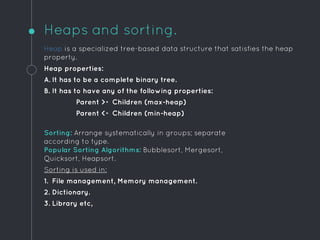
Heaps and sorting.
Sorting: Arrange systematically in groups; separate
according to type.
Popular Sorting Algorithms: Bubblesort, Mergesort,
Quicksort, Heapsort.
Sorting is used in:
1. File management, Memory management.
2. Dictionary.
3. Library etc,
Heap is a specialized tree-based data structure that satisfies the heap
property.
Heap properties:
A. It has to be a complete binary tree.
B. It has to have any of the following properties:
Parent >= Children (max-heap)
Parent <= Children (min-heap)
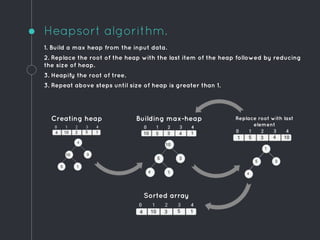
Heapsort algorithm.
1. Build a max heap from the input data.
2. Replace the root of the heap with the last item of the heap followed by reducing
the size of heap.
3. Heapify the root of tree.
3. Repeat above steps until size of heap is greater than 1.
Creating heap Building max-heap Replace root with last
element
Sorted array
void heapSort(int arr[], int n)
{
for(int i = n/2 - 1; i >= 0; i--)
for(int i = n - 1; i >= 0; i--)
{
}
}
#
Heapsort Code:
Creating max- heap
heapify(arr, n, i);
swap(arr[0], arr[i]);
heapify(arr,i,0);
Creates max heap on
reduced array
Swaps the first and last
node
Heap in
Memory
Management
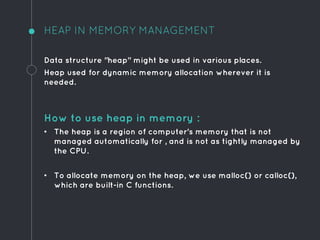
HEAP IN MEMORY MANAGEMENT
Data structure "heap" might be used in various places.
Heap used for dynamic memory allocation wherever it is
needed.
How to use heap in memory :
• The heap is a region of computer's memory that is not
managed automatically for , and is not as tightly managed by
the CPU.
• To allocate memory on the heap, we use malloc() or calloc(),
which are built-in C functions.
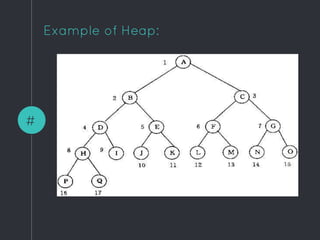
Example of Heap:
#
Why use heap in memory:
• Variables can be accessed globally
• No limit on memory size
• No guaranteed efficient use of space, memory
may become fragmented over time as blocks
of memory are allocated, then free’d
• User must manage memory
• Variables can be resized using realloc()
Why use heap in memory:
• Variables can be accessed globally
• No limit on memory size
• No guaranteed efficient use of space, memory
may become fragmented over time as blocks
of memory are allocated, then free’d
• User must manage memory
• Variables can be resized using realloc()
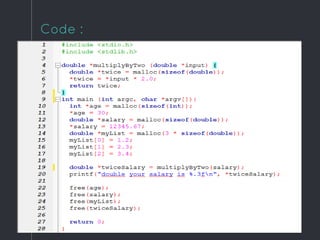
Code :
Selection
algorithm
• Selection algorithm is an algorithm for
finding the kth smallest number in
a list or array.
Selection algorithm
Selection algorithm
• The idea of the quick select is quite
simple: just like with quicksort, select a
random element from the list, and
place every item that is smaller to the
first half of the array, and every
element that is equal to or greater
than the pivot, in the second half.
Selection algorithm
• Working with large datasets is always
painful, especially when it needs to be
displayed in a ‘human readable’
format. It is a very frequent task to
display only the largest, newest, most
expensive etc.
Priority
Queue
What Is Priority Queue: ?
◦Priority Queue:
A priority queue is an abstract concept like
"a list" or "a map"; just as a list can be
implemented with a linked list or an array .
Priority queues can be efficiently
implemented using Binary Heap because it
supports insert(), delete() and extractmax(),
decreaseKey() operations.
◦There are two kinds of priority queue
max-priority queue
min-priority queue
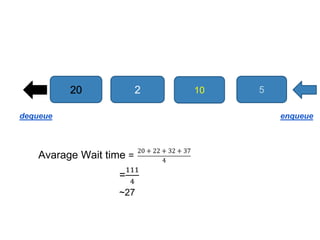
220 10 5
dequeue enqueue
Avarage Wait time =
20 + 22 + 32 + 37
4
=
111
4
~27
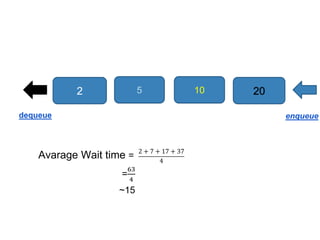
2 20105
dequeue enqueue
Avarage Wait time =
2 + 7 + 17 + 37
4
=
63
4
~15
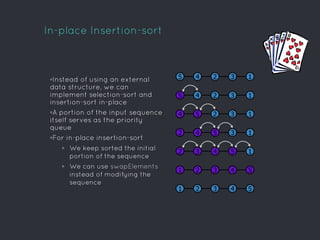
In-place Insertion-sort
◦Instead of using an external
data structure, we can
implement selection-sort and
insertion-sort in-place
◦A portion of the input sequence
itself serves as the priority
queue
◦For in-place insertion-sort
▫ We keep sorted the initial
portion of the sequence
▫ We can use swapElements
instead of modifying the
sequence
5 4 2 3 1
5 4 2 3 1
4 5 2 3 1
2 4 5 3 1
2 3 4 5 1
1 2 3 4 5
1 2 3 4 5
Other
uses of
heap
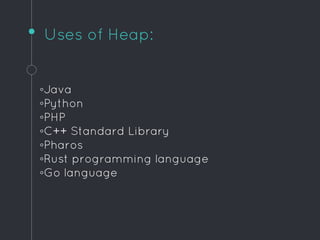
Uses of Heap:
◦Java
◦Python
◦PHP
◦C++ Standard Library
◦Pharos
◦Rust programming language
◦Go language

Presentation on Heap Sort

  • 1.
  • 2.
  • 3.
    Heaps and sorting. Sorting:Arrange systematically in groups; separate according to type. Popular Sorting Algorithms: Bubblesort, Mergesort, Quicksort, Heapsort. Sorting is used in: 1. File management, Memory management. 2. Dictionary. 3. Library etc, Heap is a specialized tree-based data structure that satisfies the heap property. Heap properties: A. It has to be a complete binary tree. B. It has to have any of the following properties: Parent >= Children (max-heap) Parent <= Children (min-heap)
  • 4.
    Heapsort algorithm. 1. Builda max heap from the input data. 2. Replace the root of the heap with the last item of the heap followed by reducing the size of heap. 3. Heapify the root of tree. 3. Repeat above steps until size of heap is greater than 1. Creating heap Building max-heap Replace root with last element Sorted array
  • 5.
    void heapSort(int arr[],int n) { for(int i = n/2 - 1; i >= 0; i--) for(int i = n - 1; i >= 0; i--) { } } # Heapsort Code: Creating max- heap heapify(arr, n, i); swap(arr[0], arr[i]); heapify(arr,i,0); Creates max heap on reduced array Swaps the first and last node
  • 6.
  • 7.
    HEAP IN MEMORYMANAGEMENT Data structure "heap" might be used in various places. Heap used for dynamic memory allocation wherever it is needed. How to use heap in memory : • The heap is a region of computer's memory that is not managed automatically for , and is not as tightly managed by the CPU. • To allocate memory on the heap, we use malloc() or calloc(), which are built-in C functions.
  • 8.
  • 9.
    Why use heapin memory: • Variables can be accessed globally • No limit on memory size • No guaranteed efficient use of space, memory may become fragmented over time as blocks of memory are allocated, then free’d • User must manage memory • Variables can be resized using realloc()
  • 10.
    Why use heapin memory: • Variables can be accessed globally • No limit on memory size • No guaranteed efficient use of space, memory may become fragmented over time as blocks of memory are allocated, then free’d • User must manage memory • Variables can be resized using realloc()
  • 11.
  • 12.
  • 13.
    • Selection algorithmis an algorithm for finding the kth smallest number in a list or array. Selection algorithm
  • 14.
    Selection algorithm • Theidea of the quick select is quite simple: just like with quicksort, select a random element from the list, and place every item that is smaller to the first half of the array, and every element that is equal to or greater than the pivot, in the second half.
  • 15.
    Selection algorithm • Workingwith large datasets is always painful, especially when it needs to be displayed in a ‘human readable’ format. It is a very frequent task to display only the largest, newest, most expensive etc.
  • 16.
  • 17.
    What Is PriorityQueue: ? ◦Priority Queue: A priority queue is an abstract concept like "a list" or "a map"; just as a list can be implemented with a linked list or an array . Priority queues can be efficiently implemented using Binary Heap because it supports insert(), delete() and extractmax(), decreaseKey() operations. ◦There are two kinds of priority queue max-priority queue min-priority queue
  • 18.
    220 10 5 dequeueenqueue Avarage Wait time = 20 + 22 + 32 + 37 4 = 111 4 ~27
  • 19.
    2 20105 dequeue enqueue AvarageWait time = 2 + 7 + 17 + 37 4 = 63 4 ~15
  • 20.
    In-place Insertion-sort ◦Instead ofusing an external data structure, we can implement selection-sort and insertion-sort in-place ◦A portion of the input sequence itself serves as the priority queue ◦For in-place insertion-sort ▫ We keep sorted the initial portion of the sequence ▫ We can use swapElements instead of modifying the sequence 5 4 2 3 1 5 4 2 3 1 4 5 2 3 1 2 4 5 3 1 2 3 4 5 1 1 2 3 4 5 1 2 3 4 5
  • 21.
  • 22.
    Uses of Heap: ◦Java ◦Python ◦PHP ◦C++Standard Library ◦Pharos ◦Rust programming language ◦Go language