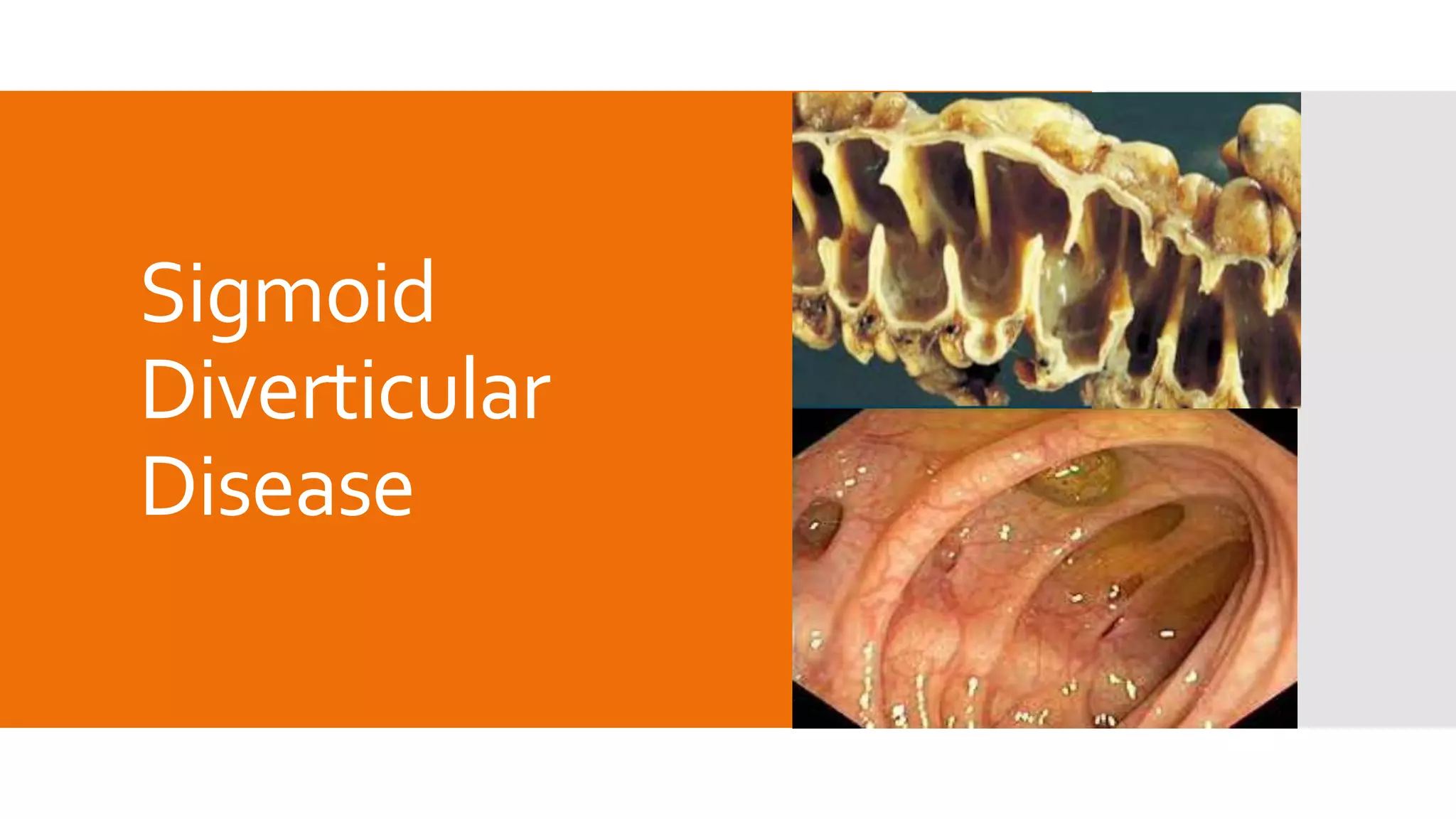
Sigmoid
Diverticular
Disease
Contents
• Introduction
• Classification
• Pathophysiology
• Symptoms
• Diagnosis
• Management
Introduction
 Formation of colonic diverticula - responsible for the
development of diverticulosis.
 When symptomatic - it becomes diverticular disease.
 Associated with numerous abdominal symptoms (Pain,
bloating, nausea, diarrhea and constipation).
Telling WHM. Discussion on diverticulitis. Proc R Soc Med 1920; 13: 55-64
Introduction
 Common inWestern and industrialized countries
 Diverticular disease - first described in the early 20th Century
 Prevalence - increased
 5%-10% in 1930
 35%-50% in 1969 as per autopsy series
Painter NS, Burkitt DP. Diverticular disease of the colon: a deficiency disease of Western civilization. Br Med J 1971; 2:450-454
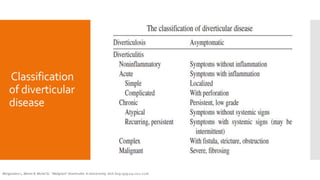
Classification
of diverticular
disease
Morganstern L, Weiner R, Michel SL. “Malignant” diverticulitis. A clinical entity. Arch Surg 1979;114:1112–1126.
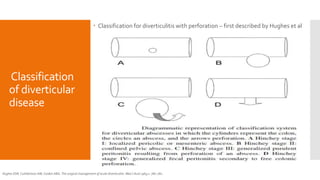
Classification
of diverticular
disease
 Classification for diverticulitis with perforation – first described by Hughes et al
Hughes ESR, Cuthbertson AM, Carden ABG. The surgical management of acute diverticulitis. Med J Aust 1963;1: 780–782.
Pathophysiology
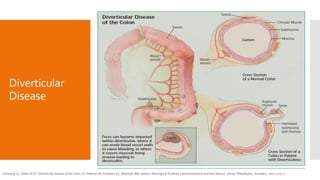
 Diverticula formation - high intraluminal pressures
 As high as 90 mm Hg during peak contraction
 Fiber-deficient diet - change in the colonic microflora -increase
in pathogenic bacteria
 Reduced immune response of the host
 Decreased bacterial production of short chain fatty acids
 Degradation of soluble fibre.
 Permit chronic inflammation and epithelial cell proliferation
Tursi A, Brandimarte G, Elisei W, Inchingolo CD, Aiello F. Epithelial cell proliferation of the colonic mucosa in different degrees of colonic diverticular disease. J Clin Gastroenterol 2006; 40: 306-311
Diverticular
Disease
Simmang CL, Shires III GT. Diverticular disease of the colon. In: Feldman M, Friedman LS, Sleisinger MH, editors. Sleisinger & Fordtran’s gastrointestinal and liver disease. 7th ed. Philadephia: Saunders, 2002:2100-2.
Presenting
Symptoms
 Left lower quadrant abdominal pain
 Radiation to back, ipsilateral flank, groin and even down the leg
 Episodes of constipation or diarrhea
 Secondary ileus with abdominal distention
 Dysuria or urgency - possible bladder involvement
Polk HC, Tuckson WB, Miller FB. The atypical presentations of diverticulitis. In: Welch JP, Cohen JL, Sardella WV, Vignati PV, eds. Diverticular Disease, Management of the Difficult Surgical Case. Baltimore: Williams & Wilkins;
1998:384–393.
Presenting
Symptoms
 Pneumaturia, fecaluria, or gas and stool through the vagina
 Colovesical or colovaginal fistula
 Fever - proportional to inflammatory response
 High fever - perforation with abscess or peritonitis
 Fournier’s gangrene - Rare
Polk HC, Tuckson WB, Miller FB. The atypical presentations of diverticulitis. In: Welch JP, Cohen JL, Sardella WV, Vignati PV, eds. Diverticular Disease, Management of the Difficult Surgical Case. Baltimore: Williams & Wilkins;
1998:384–393.
Physical
Findings
 Tender to palpation - left lower quadrant and left iliac region
 Rigidity/guarding – on deeper palpation
 A positive psoas sign and/or obturator sign
 Reflect retroperitoneal and/or pelvic involvement of the inflammatory
process
 Gross perforation with peritonitis – tenderness spread to
abdomen
Polk HC, Tuckson WB, Miller FB. The atypical presentations of diverticulitis. In: Welch JP, Cohen JL, Sardella WV, Vignati PV, eds. Diverticular Disease, Management of the Difficult Surgical Case. Baltimore: Williams & Wilkins;
1998:384–393.
Diagnostic
Tests
 Endoscopy -
 With extreme caution - risk of gross perforation
 Provide important information
 May change acute management in <1% of cases
 If no urgent indication - should be delayed until resolution
acute episode
Sakhnini E, Lahat A, Melzer E, et al. Early colonoscopy in patients with acute diverticulitis: results of a prospective pilot study. Endoscopy 2004;36:504–507.
Diagnostic
Tests
 Abdominal X-rays -
 Plain films of the abdomen
 Supine and upright/left lateral decubitus
 To rule out pneumoperitoneum
 To assess for obstruction.
 Rarely used now
Sakhnini E, Lahat A, Melzer E, et al. Early colonoscopy in patients with acute diverticulitis: results of a prospective pilot study. Endoscopy 2004;36:504–507.
Diagnostic
Tests
 CT scan - preferred imaging study
 Also if clinical suspicion of an abscess or other complicating
feature
 Used in a limited manner to evaluate the anatomy of the colon
Hachigian MP, Honickman S, Eisenstat TE, et al. Computed tomography in the initial management of acute left-sided diverticulitis. Dis Colon Rectum 1992;35:1123–1129.
CT
Manifestations
of Diverticulitis
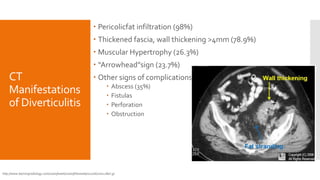
 Pericolicfat infiltration (98%)
 Thickened fascia, wall thickening >4mm (78.9%)
 Muscular Hypertrophy (26.3%)
 “Arrowhead”sign (23.7%)
 Other signs of complications
 Abscess (35%)
 Fistulas
 Perforation
 Obstruction
http://www.learningradiology.com/caseofweek/caseoftheweekpix2006/cow228arr.jp
Diagnostic
Tests
 CT scan -
 Document diverticulitis, even if uncomplicated
 Recognize and stratify patients according to the severity
 Distinguish uncomplicated from complicated disease
 Early CT-guided drainage of abscesses – down staging of complicated
diverticulitis
Hachigian MP, Honickman S, Eisenstat TE, et al. Computed tomography in the initial management of acute left-sided diverticulitis. Dis Colon Rectum 1992;35:1123–1129.
Diagnostic
Tests
 Ultrasonography -
 Transrectal ultrasound (TRUS) - evaluate diverticular disease in
conjunction with transabdominal ultrasound (TAUS)
 CombiningTRUS withTAUS -
 Reveals complications not visualized onTAUS alone
 TRUS -
 Accurate adjunct for confirming clinically suspected acute colonic
diverticulitis
Hollerweger A, Rettenbacher T, Macheiner P, et al. Sigmoid diverticulitis: value of transrectal sonography in addition to transabdominal sonography. AJR Am J Roentgenol 2000;175: 1155–1160.
Diagnostic
Tests
 Avoid false-negative results
 Defines the severity of disease - better thanTAUS alone.
 TRUS - useful adjunct in selected cases of recto sigmoid
diverticulitis
Hollerweger A, Rettenbacher T, Macheiner P, et al. Sigmoid diverticulitis: value of transrectal sonography in addition to transabdominal sonography. AJR Am J Roentgenol 2000;175: 1155–1160.
Diagnostic
Tests
 Magnetic Resonance Imaging (MRI) -
 MRI Colonography - high correlation with CT findings in diverticular
disease
 No exposure to ionizing radiation.
 Three-dimensional rendered models and virtual colonoscopy - only in
the nonacute setting.
Schreyer AG, Furst A, Agha A, et al. Magnetic resonance imaging based colonography for diagnosis and assessment of diverticulosis and diverticulitis. Int J Colorectal Dis 2004;19: 474–480.
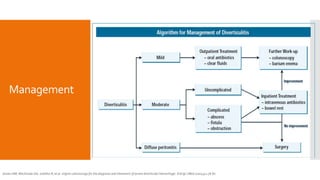
Management
 Medical therapy:
 The main objectives -
 To improve symptoms
 To resolve any infection or consequences of inflammation
 To prevent recurrence of symptoms
 Limiting serious complications
 Surgical approach:
 For treating acute, recurrent diverticulitis
 Two or more prior episodes
Aydin HN, Remzi FH. Diverticulitis: when and how to operate? Dig Liver Dis 2004; 36: 435-445
Management
 Dietary Fiber:
 Increasing dietary fibre
 To increase stool weight
 Increase transit time
 Lower intracolonic pressure
 More insoluble fibre, especially whole wheat cereals, breads.
 Commercially available fibre supplements
Gear JSS, Ware A, Fursdon, et al. Symptomless diverticular disease and intake of dietary fibre. Lancet 1979;1:511-4.
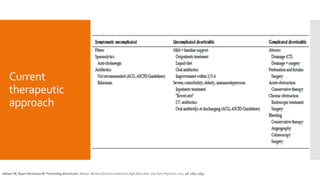
Current
therapeutic
approach
Aldoori W, Ryan-Harshman M. Preventing diverticular disease. Review of recent evidence on high-fibre diets. Can Fam Physician 2002; 48: 1632-1637
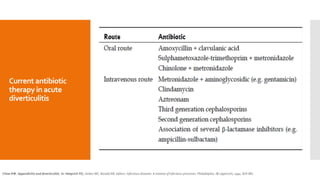
Current antibiotic
therapy in acute
diverticulitis
Chow AW. Appendicitis and diverticulitis. In: Hoeprich PD, Jordan MC, Ronald AR, editors. Infectious diseases: A treatise of infectious processes. Philadelphia: JB Lippincott, 1994: 878-881
Management
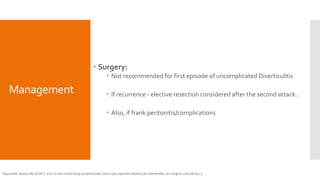
 5-ASA:
 Primary therapy - induction and maintenance of remission
 Acts topically on the colonic mucosa to reduce inflammation
 Newer non-sulphur-containing therapies – preferred
(eg. mesalazine)
 Improved side-effect profiles
Carter MJ, Lobo AJ, Travis SP. Guidelines for the management of inflammatory bowel disease in adults. Gut 2004; 53 Suppl 5: V1-V16
Management
 Probiotics:
 Bacteria Bifidobacterium spp., Lactobacillus spp. and certain
strains of E. Coli and budding yeast Saccharomyces cerevisiae
 Causes –
 Inhibition of pathogen adherence
 Stimulation of immunoglobulinA secretion in Peyer’s patches
 Enhancement of immune system activity
 Controls balance of pro- and anti-inflammatory cytokines
Gionchetti P, Amadini C, Rizzello F, Venturi A, Palmonari V, Morselli C, Romagnoli R, Campieri M. Probiotics--role in inflammatory bowel disease. Dig Liver Dis 2002; 34 Suppl 2: S58-S62
Management
Carter MJ, Lobo AJ, Travis SP. Guidelines for the management of inflammatory bowel disease in adults. Gut 2004; 53 Suppl 5: V1-V16
Management
 Surgery:
 Not recommended for first episode of uncomplicated Diverticulitis
 If recurrence - elective resection considered after the second attack.
 Also, if frank peritonitis/complications
Faynsod M, Stamos MJ, Arnell T, et al. A case-control study of laparoscopic versus open sigmoid colectomy for diverticulitis. Am Surgeon 2000;66:841-3.
Management
Jensen DM, Machicado GA, Jutabha R, et al. Urgent colonoscopy for the diagnosis and treatment of severe diverticular hemorrhage. N Engl J Med 2000;342:78-82.
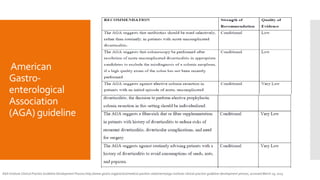
American
Gastro-
enterological
Association
(AGA) guideline
AGA Institute Clinical Practice Guideline Development Process:http://www.gastro.org/practice/medical-position-statements/aga-institute-clinical-practice-guideline-development-process, accessed March 29, 2015.
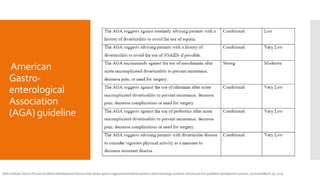
American
Gastro-
enterological
Association
(AGA) guideline
AGA Institute Clinical Practice Guideline Development Process:http://www.gastro.org/practice/medical-position-statements/aga-institute-clinical-practice-guideline-development-process, accessed March 29, 2015.
Complications
 Bleeding
 Perforation
 Abscess
 Fistula
 Stricture
 Obstruction
 Ureteral Obstruction
 Phlegmon (Inflammatory mass)
 Saint’sTriad (Diverticulosis, cholelithiasis and hiatal hernia)
Boles RS, Jordan SM. The clinical significance of diverticulosis. Gastroenterology 1958;35:579–581.
Summary
 The management of diverticulitis - undergone meaningful
change including antibiotics and surgery.
 Ongoing investigations into medical therapies decrease
symptoms and reduce recurrences.
 Areas that should be priorities for future research:
 Identifying patients who will benefit from antibiotics and those in
whom it can safely be withheld.
 Evaluating medical therapies, such as anti-inflammatories, antibiotics
or probiotics, and dietary interventions
 Identifying risk factors for recurrent diverticulitis
 Quantifying the yield, risks and timing of colonoscopy after an episode
of acute diverticulitis.
Strate L, Peery A, Neumann I, et al. American Gastroenterological Association technical review on the management of acute diverticulitis. Gastroenterology 2015;(In press).
Thank you

Sigmoid diverticular disease

  • 1.
  • 2.
    Contents • Introduction • Classification •Pathophysiology • Symptoms • Diagnosis • Management
  • 3.
    Introduction  Formation ofcolonic diverticula - responsible for the development of diverticulosis.  When symptomatic - it becomes diverticular disease.  Associated with numerous abdominal symptoms (Pain, bloating, nausea, diarrhea and constipation). Telling WHM. Discussion on diverticulitis. Proc R Soc Med 1920; 13: 55-64
  • 4.
    Introduction  Common inWesternand industrialized countries  Diverticular disease - first described in the early 20th Century  Prevalence - increased  5%-10% in 1930  35%-50% in 1969 as per autopsy series Painter NS, Burkitt DP. Diverticular disease of the colon: a deficiency disease of Western civilization. Br Med J 1971; 2:450-454
  • 5.
    Classification of diverticular disease Morganstern L,Weiner R, Michel SL. “Malignant” diverticulitis. A clinical entity. Arch Surg 1979;114:1112–1126.
  • 6.
    Classification of diverticular disease  Classificationfor diverticulitis with perforation – first described by Hughes et al Hughes ESR, Cuthbertson AM, Carden ABG. The surgical management of acute diverticulitis. Med J Aust 1963;1: 780–782.
  • 7.
    Pathophysiology  Diverticula formation- high intraluminal pressures  As high as 90 mm Hg during peak contraction  Fiber-deficient diet - change in the colonic microflora -increase in pathogenic bacteria  Reduced immune response of the host  Decreased bacterial production of short chain fatty acids  Degradation of soluble fibre.  Permit chronic inflammation and epithelial cell proliferation Tursi A, Brandimarte G, Elisei W, Inchingolo CD, Aiello F. Epithelial cell proliferation of the colonic mucosa in different degrees of colonic diverticular disease. J Clin Gastroenterol 2006; 40: 306-311
  • 8.
    Diverticular Disease Simmang CL, ShiresIII GT. Diverticular disease of the colon. In: Feldman M, Friedman LS, Sleisinger MH, editors. Sleisinger & Fordtran’s gastrointestinal and liver disease. 7th ed. Philadephia: Saunders, 2002:2100-2.
  • 9.
    Presenting Symptoms  Left lowerquadrant abdominal pain  Radiation to back, ipsilateral flank, groin and even down the leg  Episodes of constipation or diarrhea  Secondary ileus with abdominal distention  Dysuria or urgency - possible bladder involvement Polk HC, Tuckson WB, Miller FB. The atypical presentations of diverticulitis. In: Welch JP, Cohen JL, Sardella WV, Vignati PV, eds. Diverticular Disease, Management of the Difficult Surgical Case. Baltimore: Williams & Wilkins; 1998:384–393.
  • 10.
    Presenting Symptoms  Pneumaturia, fecaluria,or gas and stool through the vagina  Colovesical or colovaginal fistula  Fever - proportional to inflammatory response  High fever - perforation with abscess or peritonitis  Fournier’s gangrene - Rare Polk HC, Tuckson WB, Miller FB. The atypical presentations of diverticulitis. In: Welch JP, Cohen JL, Sardella WV, Vignati PV, eds. Diverticular Disease, Management of the Difficult Surgical Case. Baltimore: Williams & Wilkins; 1998:384–393.
  • 11.
    Physical Findings  Tender topalpation - left lower quadrant and left iliac region  Rigidity/guarding – on deeper palpation  A positive psoas sign and/or obturator sign  Reflect retroperitoneal and/or pelvic involvement of the inflammatory process  Gross perforation with peritonitis – tenderness spread to abdomen Polk HC, Tuckson WB, Miller FB. The atypical presentations of diverticulitis. In: Welch JP, Cohen JL, Sardella WV, Vignati PV, eds. Diverticular Disease, Management of the Difficult Surgical Case. Baltimore: Williams & Wilkins; 1998:384–393.
  • 12.
    Diagnostic Tests  Endoscopy - With extreme caution - risk of gross perforation  Provide important information  May change acute management in <1% of cases  If no urgent indication - should be delayed until resolution acute episode Sakhnini E, Lahat A, Melzer E, et al. Early colonoscopy in patients with acute diverticulitis: results of a prospective pilot study. Endoscopy 2004;36:504–507.
  • 13.
    Diagnostic Tests  Abdominal X-rays-  Plain films of the abdomen  Supine and upright/left lateral decubitus  To rule out pneumoperitoneum  To assess for obstruction.  Rarely used now Sakhnini E, Lahat A, Melzer E, et al. Early colonoscopy in patients with acute diverticulitis: results of a prospective pilot study. Endoscopy 2004;36:504–507.
  • 14.
    Diagnostic Tests  CT scan- preferred imaging study  Also if clinical suspicion of an abscess or other complicating feature  Used in a limited manner to evaluate the anatomy of the colon Hachigian MP, Honickman S, Eisenstat TE, et al. Computed tomography in the initial management of acute left-sided diverticulitis. Dis Colon Rectum 1992;35:1123–1129.
  • 15.
    CT Manifestations of Diverticulitis  Pericolicfatinfiltration (98%)  Thickened fascia, wall thickening >4mm (78.9%)  Muscular Hypertrophy (26.3%)  “Arrowhead”sign (23.7%)  Other signs of complications  Abscess (35%)  Fistulas  Perforation  Obstruction http://www.learningradiology.com/caseofweek/caseoftheweekpix2006/cow228arr.jp
  • 16.
    Diagnostic Tests  CT scan-  Document diverticulitis, even if uncomplicated  Recognize and stratify patients according to the severity  Distinguish uncomplicated from complicated disease  Early CT-guided drainage of abscesses – down staging of complicated diverticulitis Hachigian MP, Honickman S, Eisenstat TE, et al. Computed tomography in the initial management of acute left-sided diverticulitis. Dis Colon Rectum 1992;35:1123–1129.
  • 17.
    Diagnostic Tests  Ultrasonography - Transrectal ultrasound (TRUS) - evaluate diverticular disease in conjunction with transabdominal ultrasound (TAUS)  CombiningTRUS withTAUS -  Reveals complications not visualized onTAUS alone  TRUS -  Accurate adjunct for confirming clinically suspected acute colonic diverticulitis Hollerweger A, Rettenbacher T, Macheiner P, et al. Sigmoid diverticulitis: value of transrectal sonography in addition to transabdominal sonography. AJR Am J Roentgenol 2000;175: 1155–1160.
  • 18.
    Diagnostic Tests  Avoid false-negativeresults  Defines the severity of disease - better thanTAUS alone.  TRUS - useful adjunct in selected cases of recto sigmoid diverticulitis Hollerweger A, Rettenbacher T, Macheiner P, et al. Sigmoid diverticulitis: value of transrectal sonography in addition to transabdominal sonography. AJR Am J Roentgenol 2000;175: 1155–1160.
  • 19.
    Diagnostic Tests  Magnetic ResonanceImaging (MRI) -  MRI Colonography - high correlation with CT findings in diverticular disease  No exposure to ionizing radiation.  Three-dimensional rendered models and virtual colonoscopy - only in the nonacute setting. Schreyer AG, Furst A, Agha A, et al. Magnetic resonance imaging based colonography for diagnosis and assessment of diverticulosis and diverticulitis. Int J Colorectal Dis 2004;19: 474–480.
  • 20.
    Management  Medical therapy: The main objectives -  To improve symptoms  To resolve any infection or consequences of inflammation  To prevent recurrence of symptoms  Limiting serious complications  Surgical approach:  For treating acute, recurrent diverticulitis  Two or more prior episodes Aydin HN, Remzi FH. Diverticulitis: when and how to operate? Dig Liver Dis 2004; 36: 435-445
  • 21.
    Management  Dietary Fiber: Increasing dietary fibre  To increase stool weight  Increase transit time  Lower intracolonic pressure  More insoluble fibre, especially whole wheat cereals, breads.  Commercially available fibre supplements Gear JSS, Ware A, Fursdon, et al. Symptomless diverticular disease and intake of dietary fibre. Lancet 1979;1:511-4.
  • 22.
    Current therapeutic approach Aldoori W, Ryan-HarshmanM. Preventing diverticular disease. Review of recent evidence on high-fibre diets. Can Fam Physician 2002; 48: 1632-1637
  • 23.
    Current antibiotic therapy inacute diverticulitis Chow AW. Appendicitis and diverticulitis. In: Hoeprich PD, Jordan MC, Ronald AR, editors. Infectious diseases: A treatise of infectious processes. Philadelphia: JB Lippincott, 1994: 878-881
  • 24.
    Management  5-ASA:  Primarytherapy - induction and maintenance of remission  Acts topically on the colonic mucosa to reduce inflammation  Newer non-sulphur-containing therapies – preferred (eg. mesalazine)  Improved side-effect profiles Carter MJ, Lobo AJ, Travis SP. Guidelines for the management of inflammatory bowel disease in adults. Gut 2004; 53 Suppl 5: V1-V16
  • 25.
    Management  Probiotics:  BacteriaBifidobacterium spp., Lactobacillus spp. and certain strains of E. Coli and budding yeast Saccharomyces cerevisiae  Causes –  Inhibition of pathogen adherence  Stimulation of immunoglobulinA secretion in Peyer’s patches  Enhancement of immune system activity  Controls balance of pro- and anti-inflammatory cytokines Gionchetti P, Amadini C, Rizzello F, Venturi A, Palmonari V, Morselli C, Romagnoli R, Campieri M. Probiotics--role in inflammatory bowel disease. Dig Liver Dis 2002; 34 Suppl 2: S58-S62
  • 26.
    Management Carter MJ, LoboAJ, Travis SP. Guidelines for the management of inflammatory bowel disease in adults. Gut 2004; 53 Suppl 5: V1-V16
  • 27.
    Management  Surgery:  Notrecommended for first episode of uncomplicated Diverticulitis  If recurrence - elective resection considered after the second attack.  Also, if frank peritonitis/complications Faynsod M, Stamos MJ, Arnell T, et al. A case-control study of laparoscopic versus open sigmoid colectomy for diverticulitis. Am Surgeon 2000;66:841-3.
  • 28.
    Management Jensen DM, MachicadoGA, Jutabha R, et al. Urgent colonoscopy for the diagnosis and treatment of severe diverticular hemorrhage. N Engl J Med 2000;342:78-82.
  • 29.
    American Gastro- enterological Association (AGA) guideline AGA InstituteClinical Practice Guideline Development Process:http://www.gastro.org/practice/medical-position-statements/aga-institute-clinical-practice-guideline-development-process, accessed March 29, 2015.
  • 30.
    American Gastro- enterological Association (AGA) guideline AGA InstituteClinical Practice Guideline Development Process:http://www.gastro.org/practice/medical-position-statements/aga-institute-clinical-practice-guideline-development-process, accessed March 29, 2015.
  • 31.
    Complications  Bleeding  Perforation Abscess  Fistula  Stricture  Obstruction  Ureteral Obstruction  Phlegmon (Inflammatory mass)  Saint’sTriad (Diverticulosis, cholelithiasis and hiatal hernia) Boles RS, Jordan SM. The clinical significance of diverticulosis. Gastroenterology 1958;35:579–581.
  • 32.
    Summary  The managementof diverticulitis - undergone meaningful change including antibiotics and surgery.  Ongoing investigations into medical therapies decrease symptoms and reduce recurrences.  Areas that should be priorities for future research:  Identifying patients who will benefit from antibiotics and those in whom it can safely be withheld.  Evaluating medical therapies, such as anti-inflammatories, antibiotics or probiotics, and dietary interventions  Identifying risk factors for recurrent diverticulitis  Quantifying the yield, risks and timing of colonoscopy after an episode of acute diverticulitis. Strate L, Peery A, Neumann I, et al. American Gastroenterological Association technical review on the management of acute diverticulitis. Gastroenterology 2015;(In press).
  • 33.

Editor's Notes

  • #4 Telling WHM. Discussion on diverticulitis. Proc R Soc Med 1920; 13: 55-64
  • #5 Painter NS, Burkitt DP. Diverticular disease of the colon: a deficiency disease of Western civilization. Br Med J 1971; 2:450-454
  • #6 Morganstern L, Weiner R, Michel SL. “Malignant” diverticulitis. A clinical entity. Arch Surg 1979;114:1112–1126.
  • #7 Hughes ESR, Cuthbertson AM, Carden ABG. The surgical management of acute diverticulitis. Med J Aust 1963;1: 780–782.
  • #8 Tursi A, Brandimarte G, Elisei W, Inchingolo CD, Aiello F. Epithelial cell proliferation of the colonic mucosa in different degrees of colonic diverticular disease. J Clin Gastroenterol 2006; 40: 306-311
  • #9 Simmang CL, Shires III GT. Diverticular disease of the colon. In: Feldman M, Friedman LS, Sleisinger MH, editors. Sleisinger & Fordtran’s gastrointestinal and liver disease. 7th ed. Philadephia: Saunders, 2002:2100-2.
  • #10 Polk HC, Tuckson WB, Miller FB. The atypical presentations of diverticulitis. In: Welch JP, Cohen JL, Sardella WV, Vignati PV, eds. Diverticular Disease, Management of the Difficult Surgical Case. Baltimore: Williams & Wilkins; 1998:384–393.
  • #11 Polk HC, Tuckson WB, Miller FB. The atypical presentations of diverticulitis. In: Welch JP, Cohen JL, Sardella WV, Vignati PV, eds. Diverticular Disease, Management of the Difficult Surgical Case. Baltimore: Williams & Wilkins; 1998:384–393.
  • #12 Polk HC, Tuckson WB, Miller FB. The atypical presentations of diverticulitis. In: Welch JP, Cohen JL, Sardella WV, Vignati PV, eds. Diverticular Disease, Management of the Difficult Surgical Case. Baltimore: Williams & Wilkins; 1998:384–393.
  • #13 Sakhnini E, Lahat A, Melzer E, et al. Early colonoscopy in patients with acute diverticulitis: results of a prospective pilot study. Endoscopy 2004;36:504–507.
  • #14 Sakhnini E, Lahat A, Melzer E, et al. Early colonoscopy in patients with acute diverticulitis: results of a prospective pilot study. Endoscopy 2004;36:504–507.
  • #15 Hachigian MP, Honickman S, Eisenstat TE, et al. Computed tomography in the initial management of acute left-sided diverticulitis. Dis Colon Rectum 1992;35:1123–1129.
  • #16 http://www.learningradiology.com/caseofweek/caseoftheweekpix2006/cow228arr.jp
  • #17 Hachigian MP, Honickman S, Eisenstat TE, et al. Computed tomography in the initial management of acute left-sided diverticulitis. Dis Colon Rectum 1992;35:1123–1129.
  • #18 Hollerweger A, Rettenbacher T, Macheiner P, et al. Sigmoid diverticulitis: value of transrectal sonography in addition to transabdominal sonography. AJR Am J Roentgenol 2000;175: 1155–1160.
  • #19 Hollerweger A, Rettenbacher T, Macheiner P, et al. Sigmoid diverticulitis: value of transrectal sonography in addition to transabdominal sonography. AJR Am J Roentgenol 2000;175: 1155–1160.
  • #20 Schreyer AG, Furst A, Agha A, et al. Magnetic resonance imaging based colonography for diagnosis and assessment of diverticulosis and diverticulitis. Int J Colorectal Dis 2004;19: 474–480.
  • #21 Aydin HN, Remzi FH. Diverticulitis: when and how to operate? Dig Liver Dis 2004; 36: 435-445
  • #22 Gear JSS, Ware A, Fursdon, et al. Symptomless diverticular disease and intake of dietary fibre. Lancet 1979;1:511-4.
  • #23 Aldoori W, Ryan-Harshman M. Preventing diverticular disease. Review of recent evidence on high-fibre diets. Can Fam Physician 2002; 48: 1632-1637
  • #24 Chow AW. Appendicitis and diverticulitis. In: Hoeprich PD, Jordan MC, Ronald AR, editors. Infectious diseases: A treatise of infectious processes. Philadelphia: JB Lippincott, 1994: 878-881
  • #25 Carter MJ, Lobo AJ, Travis SP. Guidelines for the management of inflammatory bowel disease in adults. Gut 2004; 53 Suppl 5: V1-V16
  • #26 Gionchetti P, Amadini C, Rizzello F, Venturi A, Palmonari V, Morselli C, Romagnoli R, Campieri M. Probiotics--role in inflammatory bowel disease. Dig Liver Dis 2002; 34 Suppl 2: S58-S62
  • #27 Carter MJ, Lobo AJ, Travis SP. Guidelines for the management of inflammatory bowel disease in adults. Gut 2004; 53 Suppl 5: V1-V16
  • #28 Faynsod M, Stamos MJ, Arnell T, et al. A case-control study of laparoscopic versus open sigmoid colectomy for diverticulitis. Am Surgeon 2000;66:841-3.
  • #29 Jensen DM, Machicado GA, Jutabha R, et al. Urgent colonoscopy for the diagnosis and treatment of severe diverticular hemorrhage. N Engl J Med 2000;342:78-82.
  • #30 AGA Institute Clinical Practice Guideline Development Process:http://www.gastro.org/practice/medical-position-statements/aga-institute-clinical-practice-guideline-development-process, accessed March 29, 2015.
  • #31 AGA Institute Clinical Practice Guideline Development Process:http://www.gastro.org/practice/medical-position-statements/aga-institute-clinical-practice-guideline-development-process, accessed March 29, 2015.
  • #32 Boles RS, Jordan SM. The clinical significance of diverticulosis. Gastroenterology 1958;35:579–581.
  • #33 Strate L, Peery A, Neumann I, et al. American Gastroenterological Association technical review on the management of acute diverticulitis. Gastroenterology 2015;(In press).