Challenging Cases in Acute Heart Failure
Diuretic Resistance
Kevin Damman, MD, PhD
University Medical Center Groningen
Groningen, The Netherlands
k.damman@umcg.nl
Disclosures
Supported by the Netherlands Heart Institute (ICIN) and a HFA
Research Grant
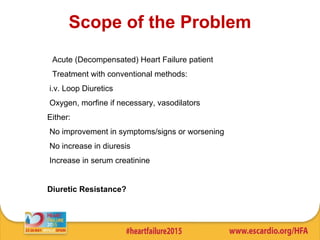
Scope of the Problem
• Acute (Decompensated) Heart Failure patient
• Treatment with conventional methods:
i.v. Loop Diuretics
Oxygen, morfine if necessary, vasodilators
Either:
No improvement in symptoms/signs or worsening
No increase in diuresis
Increase in serum creatinine
Diuretic Resistance?
Contents
Diuretic Resistance
• Definition
• Epidemiology
• Pathyphysiology
• Possible treatments and caveats
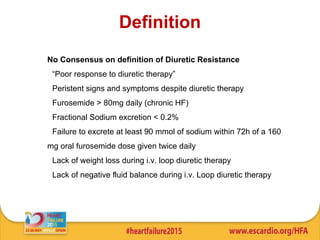
Definition
No Consensus on definition of Diuretic Resistance
• “Poor response to diuretic therapy”
• Peristent signs and symptoms despite diuretic therapy
• Furosemide > 80mg daily (chronic HF)
• Fractional Sodium excretion < 0.2%
• Failure to excrete at least 90 mmol of sodium within 72h of a 160
mg oral furosemide dose given twice daily
• Lack of weight loss during i.v. loop diuretic therapy
• Lack of negative fluid balance during i.v. Loop diuretic therapy
Diuretic Response
No Consensus on definition of Diuretic Resistance
• It might be better to speak of the relative response to diuretics
Diuretic Response
Diuretic Efficacy
• Overcomes the problem of estalishing a ‘cut off’
• Highlights the importance of response to diuretics on a continuous
scale
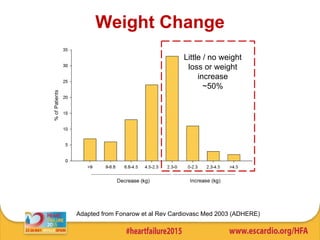
Weight Change
Adapted from Fonarow et al Rev Cardiovasc Med 2003 (ADHERE)
Little / no weight
loss or weight
increase
~50%
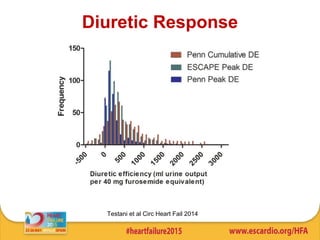
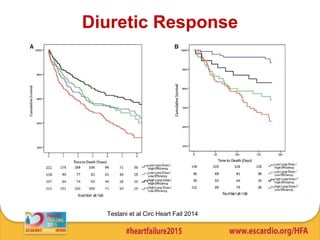
Diuretic Response
Testani et al Circ Heart Fail 2014
Diuretic Response
Testani et al Circ Heart Fail 2014
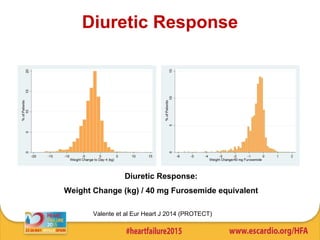
Diuretic Response
Valente et al Eur Heart J 2014 (PROTECT)
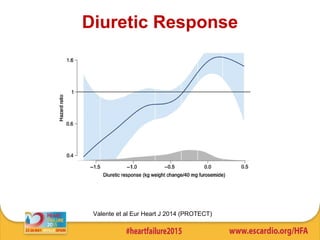
Diuretic Response:
Weight Change (kg) / 40 mg Furosemide equivalent
Diuretic Response
Valente et al Eur Heart J 2014 (PROTECT)
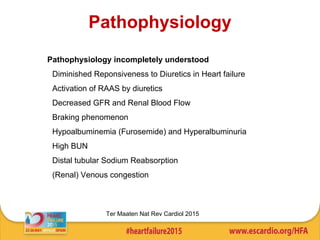
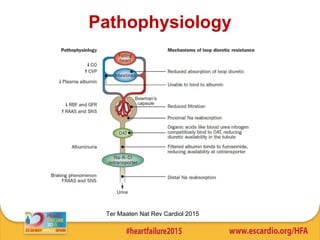
Pathophysiology
Pathophysiology incompletely understood
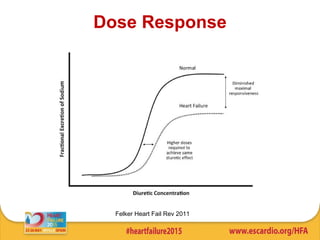
• Diminished Reponsiveness to Diuretics in Heart failure
• Activation of RAAS by diuretics
• Decreased GFR and Renal Blood Flow
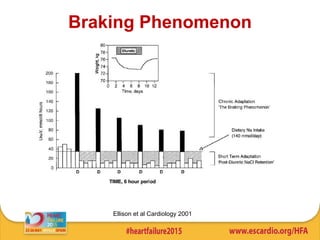
• Braking phenomenon
• Hypoalbuminemia (Furosemide) and Hyperalbuminuria
• High BUN
• Distal tubular Sodium Reabsorption
• (Renal) Venous congestion
Ter Maaten Nat Rev Cardiol 2015
Braking Phenomenon
Ellison et al Cardiology 2001
Dose Response
Felker Heart Fail Rev 2011
Pathophysiology
Ter Maaten Nat Rev Cardiol 2015
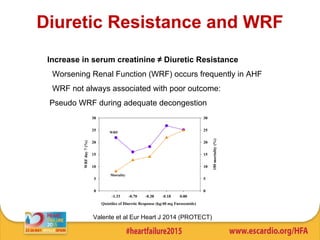
Diuretic Resistance and WRF
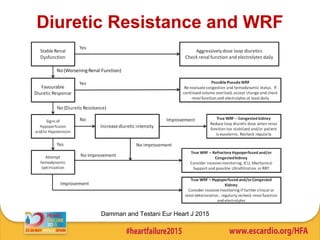
Increase in serum creatinine ≠ Diuretic Resistance
• Worsening Renal Function (WRF) occurs frequently in AHF
• WRF not always associated with poor outcome:
Pseudo WRF during adequate decongestion
Valente et al Eur Heart J 2014 (PROTECT)
Treatment
Most importantly: Identify patients experiencing poor diuretic
response early
If using only oral loop diuretics:
Dose appropriately (eGFR)
Consider changing loop diuretic:
Furosemide  Bumetanide -> Torsemide
Add Thiazide
Add Mineralocorticoid receptor antagonist
Switch to intravenous loop diuretic
Treatment
Intravenous Loop Diuretics:
• Furosemide
be aware of albumin levels
consider switch to Bumetanide/Torsemide
• Dose properly: High dose in patients with low eGFR
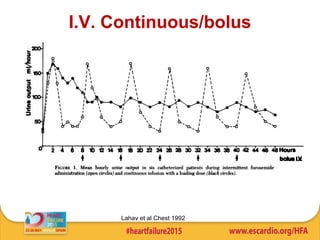
I.V. Continuous/bolus
Lahav et al Chest 1992
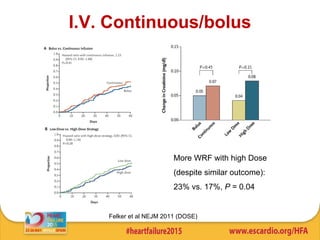
I.V. Continuous/bolus
Felker et al NEJM 2011 (DOSE)
More WRF with high Dose
(despite similar outcome):
23% vs. 17%, P = 0.04
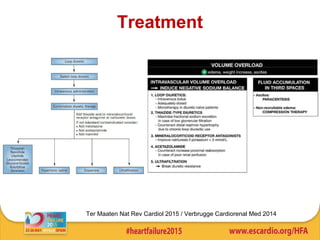
Treatment
Ter Maaten Nat Rev Cardiol 2015 / Verbrugge Cardiorenal Med 2014
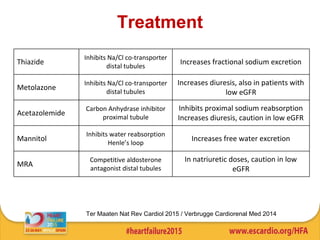
Treatment
Thiazide
Inhibits Na/Cl co-transporter
distal tubules
Increases fractional sodium excretion
Metolazone
Inhibits Na/Cl co-transporter
distal tubules
Increases diuresis, also in patients with
low eGFR
Acetazolemide
Carbon Anhydrase inhibitor
proximal tubule
Inhibits proximal sodium reabsorption
Increases diuresis, caution in low eGFR
Mannitol
Inhibits water reabsorption
Henle’s loop
Increases free water excretion
MRA
Competitive aldosterone
antagonist distal tubules
In natriuretic doses, caution in low
eGFR
Ter Maaten Nat Rev Cardiol 2015 / Verbrugge Cardiorenal Med 2014
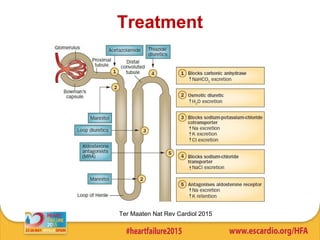
Treatment
Ter Maaten Nat Rev Cardiol 2015
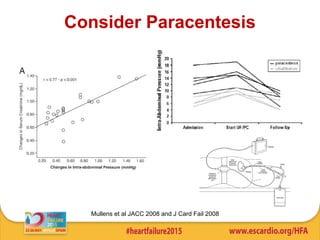
Consider Paracentesis
Mullens et al JACC 2008 and J Card Fail 2008
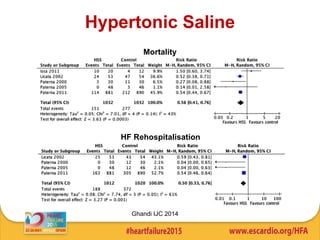
Hypertonic Saline
Ghandi IJC 2014
Mortality
HF Rehospitalisation
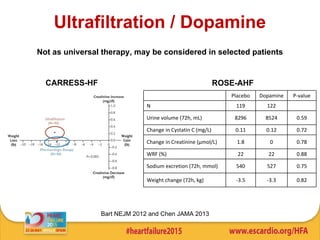
Ultrafiltration / Dopamine
Bart NEJM 2012 and Chen JAMA 2013
Not as universal therapy, may be considered in selected patients
Placebo Dopamine P-value
N 119 122
Urine volume (72h, mL) 8296 8524 0.59
Change in Cystatin C (mg/L) 0.11 0.12 0.72
Change in Creatinine (µmol/L) 1.8 0 0.78
WRF (%) 22 22 0.88
Sodium excretion (72h, mmol) 540 527 0.75
Weight change (72h, kg) -3.5 -3.3 0.82
CARRESS-HF ROSE-AHF
Diuretic Resistance and WRF
Damman and Testani Eur Heart J 2015
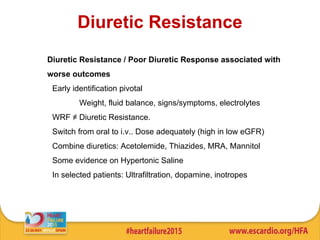
Diuretic Resistance
Diuretic Resistance / Poor Diuretic Response associated with
worse outcomes
• Early identification pivotal
Weight, fluid balance, signs/symptoms, electrolytes
• WRF ≠ Diuretic Resistance.
• Switch from oral to i.v.. Dose adequately (high in low eGFR)
• Combine diuretics: Acetolemide, Thiazides, MRA, Mannitol
• Some evidence on Hypertonic Saline
• In selected patients: Ultrafiltration, dopamine, inotropes
Thank you for your attention!
k.damman@umcg.nl

Diuretic resistance

  • 1.
    Challenging Cases inAcute Heart Failure Diuretic Resistance Kevin Damman, MD, PhD University Medical Center Groningen Groningen, The Netherlands k.damman@umcg.nl
  • 2.
    Disclosures Supported by theNetherlands Heart Institute (ICIN) and a HFA Research Grant
  • 3.
    Scope of theProblem • Acute (Decompensated) Heart Failure patient • Treatment with conventional methods: i.v. Loop Diuretics Oxygen, morfine if necessary, vasodilators Either: No improvement in symptoms/signs or worsening No increase in diuresis Increase in serum creatinine Diuretic Resistance?
  • 4.
    Contents Diuretic Resistance • Definition •Epidemiology • Pathyphysiology • Possible treatments and caveats
  • 5.
    Definition No Consensus ondefinition of Diuretic Resistance • “Poor response to diuretic therapy” • Peristent signs and symptoms despite diuretic therapy • Furosemide > 80mg daily (chronic HF) • Fractional Sodium excretion < 0.2% • Failure to excrete at least 90 mmol of sodium within 72h of a 160 mg oral furosemide dose given twice daily • Lack of weight loss during i.v. loop diuretic therapy • Lack of negative fluid balance during i.v. Loop diuretic therapy
  • 6.
    Diuretic Response No Consensuson definition of Diuretic Resistance • It might be better to speak of the relative response to diuretics Diuretic Response Diuretic Efficacy • Overcomes the problem of estalishing a ‘cut off’ • Highlights the importance of response to diuretics on a continuous scale
  • 7.
    Weight Change Adapted fromFonarow et al Rev Cardiovasc Med 2003 (ADHERE) Little / no weight loss or weight increase ~50%
  • 8.
    Diuretic Response Testani etal Circ Heart Fail 2014
  • 9.
    Diuretic Response Testani etal Circ Heart Fail 2014
  • 10.
    Diuretic Response Valente etal Eur Heart J 2014 (PROTECT) Diuretic Response: Weight Change (kg) / 40 mg Furosemide equivalent
  • 11.
    Diuretic Response Valente etal Eur Heart J 2014 (PROTECT)
  • 12.
    Pathophysiology Pathophysiology incompletely understood •Diminished Reponsiveness to Diuretics in Heart failure • Activation of RAAS by diuretics • Decreased GFR and Renal Blood Flow • Braking phenomenon • Hypoalbuminemia (Furosemide) and Hyperalbuminuria • High BUN • Distal tubular Sodium Reabsorption • (Renal) Venous congestion Ter Maaten Nat Rev Cardiol 2015
  • 13.
  • 14.
  • 15.
  • 16.
    Diuretic Resistance andWRF Increase in serum creatinine ≠ Diuretic Resistance • Worsening Renal Function (WRF) occurs frequently in AHF • WRF not always associated with poor outcome: Pseudo WRF during adequate decongestion Valente et al Eur Heart J 2014 (PROTECT)
  • 17.
    Treatment Most importantly: Identifypatients experiencing poor diuretic response early If using only oral loop diuretics: Dose appropriately (eGFR) Consider changing loop diuretic: Furosemide  Bumetanide -> Torsemide Add Thiazide Add Mineralocorticoid receptor antagonist Switch to intravenous loop diuretic
  • 18.
    Treatment Intravenous Loop Diuretics: •Furosemide be aware of albumin levels consider switch to Bumetanide/Torsemide • Dose properly: High dose in patients with low eGFR
  • 19.
  • 20.
    I.V. Continuous/bolus Felker etal NEJM 2011 (DOSE) More WRF with high Dose (despite similar outcome): 23% vs. 17%, P = 0.04
  • 21.
    Treatment Ter Maaten NatRev Cardiol 2015 / Verbrugge Cardiorenal Med 2014
  • 22.
    Treatment Thiazide Inhibits Na/Cl co-transporter distaltubules Increases fractional sodium excretion Metolazone Inhibits Na/Cl co-transporter distal tubules Increases diuresis, also in patients with low eGFR Acetazolemide Carbon Anhydrase inhibitor proximal tubule Inhibits proximal sodium reabsorption Increases diuresis, caution in low eGFR Mannitol Inhibits water reabsorption Henle’s loop Increases free water excretion MRA Competitive aldosterone antagonist distal tubules In natriuretic doses, caution in low eGFR Ter Maaten Nat Rev Cardiol 2015 / Verbrugge Cardiorenal Med 2014
  • 23.
    Treatment Ter Maaten NatRev Cardiol 2015
  • 24.
    Consider Paracentesis Mullens etal JACC 2008 and J Card Fail 2008
  • 25.
    Hypertonic Saline Ghandi IJC2014 Mortality HF Rehospitalisation
  • 26.
    Ultrafiltration / Dopamine BartNEJM 2012 and Chen JAMA 2013 Not as universal therapy, may be considered in selected patients Placebo Dopamine P-value N 119 122 Urine volume (72h, mL) 8296 8524 0.59 Change in Cystatin C (mg/L) 0.11 0.12 0.72 Change in Creatinine (µmol/L) 1.8 0 0.78 WRF (%) 22 22 0.88 Sodium excretion (72h, mmol) 540 527 0.75 Weight change (72h, kg) -3.5 -3.3 0.82 CARRESS-HF ROSE-AHF
  • 27.
    Diuretic Resistance andWRF Damman and Testani Eur Heart J 2015
  • 28.
    Diuretic Resistance Diuretic Resistance/ Poor Diuretic Response associated with worse outcomes • Early identification pivotal Weight, fluid balance, signs/symptoms, electrolytes • WRF ≠ Diuretic Resistance. • Switch from oral to i.v.. Dose adequately (high in low eGFR) • Combine diuretics: Acetolemide, Thiazides, MRA, Mannitol • Some evidence on Hypertonic Saline • In selected patients: Ultrafiltration, dopamine, inotropes
  • 29.
    Thank you foryour attention! k.damman@umcg.nl