Approach to CKD Pateint
By
Mostafa Abd_Elsalam,MD
MUH,MNDU
Definitions
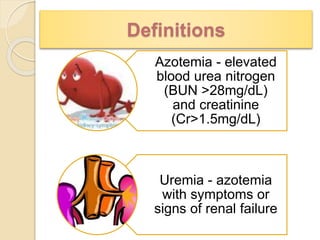
Azotemia - elevated
blood urea nitrogen
(BUN >28mg/dL)
and creatinine
(Cr>1.5mg/dL)
Uremia - azotemia
with symptoms or
signs of renal failure
End Stage Renal
Disease (ESRD) -
uremia requiring
transplantation or
dialysis
Chronic Renal
Failure (CRF) -
irreversible kidney
dysfunction with
azotemia >3 months
Creatinine Clearance
(CCr) - the rate of
filtration of creatinine
by the kidney (GFR
marker)
Glomerular Filtration
Rate (GFR) - the
total rate of filtration
of blood by the
kidney
Unfortunately,
chronic kidney
disease is ‘‘under-
diagnosed’’ and
‘‘under-treated’’ in
the United States
K/DOQI, 2002
Chronic kidney disease
progressive loss of
nephrons and function
due to multiple etiologies
and frequently leading to
end stage renal disease
(ESRD).
presence
of
following
for three
months
or more
GFR less than 60
ml/min/1.73 m2
with or without
kidney damage.
Structural
and
functional
abnormalities
of the kidney
Pathological abnormalities.
Clinical markers of renal damage in the form of
proteinuria
Abnormal imaging studies
Tubular syndromes.
Kidney transplant recipient.
Epidemiology of chronic
kidney disease
CKD affects almost 14–15% of
the adult United States (U.S)
population.
The prevalence of CKD is highest
in the elderly population
especially those above the age of
65 years.
Not all patients with
CKD progress to
ESRD.
Significant
proportion of
patients with CKD
die before reaching
dialysis.
Currently almost
600000 people in
U.S are undergoing
hemodialysis for
ESRD
. U.S. Renal Data System (2013) USRDS 2013 Annual Data Report: Atlas of Chronic Kidney Disease and End-Stage
Renal Disease
CKD as a Public Health Issue
26 million American affected
Prevalence is 11-13% of adult
population in the US
28% of Medicare budget in
2013, up from 6.9% in 1993
$42 billion in 2013
1. NKF Fact Sheets.
http://www.kidney.org/news/newsroom/factsheets/FastFac
ts. Accessed Nov 5, 2014.
2. USRDS. www.usrds.org. Accessed Nov 5, 2014.
3. Coresh et al. JAMA. 2007. 298:2038-2047.
ESRD, end stage renal disease
Increases risk for all-cause
mortality, CV mortality, kidney
failure (ESRD), and other
adverse outcomes.
6 fold increase in mortality rate
with DM + CKD
Disproportionately affects
African Americans and
Hispanics
100 patients with eGFR < 60
(Tomorrow morning in Outpatients)
1 year later: 1 patient needs RRT, 10 patients have
died (> 50% CV death)
10 years later: 8 patients need RRT, 65 patients
have died, 27 have ongoing CKD
Why?
ageing of the general population
rising incidence of obesity
type 2 diabetes mellitus
improved survival from
cancer as well as major
cardiovascular accidents
Major causes of CKD
hypertension
diabetes mellitus
Glomerulonephritis
cystic kidney disease
urinary tract obstruction
interstitial nephritis
vesico-ureteric reflux
nephrolithiasis and recurrent kidney infection.
natural physiological reduction in glomerular filtration
rate (GFR) with aging which behaves differently from
the various etiologies mentioned above in terms of
progression of the disease
The renal prognosis is favorable in most patients
who demonstrate age related drop in GFR, BUT
associated with increased risk of cardiovascular
morbidity and mortality
Nitta K, Okada K, Yanai M, Takahashi S (2013) Aging and chronic kidney disease. Kidney Blood Press
Res 38: 109- 120.
Pathophysiology of Chronic
Kidney Disease
The pathophysiology of
CKD involves initiating
mechanisms specific to
the underlying etiology
As well as a set of progressive
mechanisms, glomerulosclerosis
and tubulo interstitial fibrosis that
are common consequences
following long term reduction in
renal mass, irrespective of the
etiology.
Structural and functional
changes in surviving nephrons
lead to hypertrophy and hyper
filtration of the surviving
nephrons.
This compensatory hypertrophy
mediated by vasoactive molecules,
cytokines, growth factors and renin
angiotensin axis mediators
eventually lead to intra-glomerular
hypertension and accelerated
sclerosis of surviving nephrons.
Raised intra-glomerular hypertension will lead to
reduction of glomerular permeability and filtration surface
area resulting in decreased GFR
Tubulointerstitial injury manifested by
tubular dilatation and interstitial
fibrosis.
The degree of tubulointerstitial disease
is a better predictor of glomerular
filtration rate decline and long term
prognosis than the severity of injury.
Other factors that play a role in the
initiation and pathogenesis of
fibrosis in CKD include :
1) Upregulation of profibrotic factors
such as transforming growth factor
beta 1 (TGF-β1), platelet derived
growth factor, fibroblast growth
factor, osteopontin and endothelin.
2) Down regulation of anti-fibrotic factors like
hepatocyte growth factor and bone
morphogenic protein.
3) Dysregulation of vasoactive factors with
an increase in vasoconstrictors such as
angiotensin II, and a decrease in
vasodilators such as nitric oxide (NO).
4) Microvascular injury and obliteration (due to
hypoxia)
5) Disruption of normal homeostatic interactions
between adjacent cell populations, especially
the one between tubular epithelial cells and
interstitial fibroblasts.
Role of renin angiotensin-
aldosterone system in CKD
The renin-angiotensin-
aldosterone system (RAAS)
plays a major role in maintaining
the blood volume and salt-water
balance. It has effect on the
blood pressure and tissue
perfusion through a number of
multiple complex actions
including vasoconstriction and
sodium retention.
.
Despite its role in maintaining
homeostasis, long-lasting
stimulation of RAAS can lead to
development of kidney lesions
and progression of CKD.
An excess of angiotensin II
increases intraglomerular
pressure by preferentially
constricting the efferent
arterioles, thus promoting
glomerular hypertension
Additionally angiotensin II can
stimulate aldosterone production
which triggers the activation
of a cascade of profibrotic
cytokines resulting in glomerular
sclerosis and tubulointerstitial
fibrosis.
Prorenin and renin can stimulate TGF-
β1 production via the activation of
p42/p44 mitogen-activated protein
kinase (p42/p44MAPK), which
sub¬sequently result in the
upregulation of profibrotic and
prothrombotic molecules, such as
fibronectin, collagen-1, and
plasminogen activator inhibitor-1 (PAI-
1) inducing renal fibrosis.
A high prorenin
level =
micro¬albuminuria,
and development
of nephropathy
especially in
diabetic patients
Role of proteinuria in CKD
Proteinuria is an
important risk factor for
the progression of CKD.
Increased protein
filtration results in
excess reabsorption of
filtered proteins by
proximal tubular cells.
The reabsorbed proteins eventually leak into the
renal tubular interstitium through focal breaks in
tubular basement membrane attracting
macrophages.
These macrophages can promote
tubulointerstitial fibrosis by release
of proinflammatory mediators
Role of sympathetic system in progression
of chronic kidney disease
Hyperactivity of the
sympathetic nervous
system has been found to
have considerable adverse
consequences on
progression of CKD and
cardiovascular disease.
hypertension
Proteinuria
accelerated atherosclerosis
vasoconstriction
and proliferation
of smooth
muscle cells as
well as
adventitial
fibroblasts in the
vessel wall
Ischemic nephropathy and
chronic kidney disease
Ischemic nephropathy
is a common cause of
renal disease
especially in the
elderly population.
It is defined by the gradual
reduction of the GFR or a
loss of renal parenchyma
resulting from vascular
occlusion and not explained
by other etiologies.
The pathogenesis of this
disease involves not only
the narrowing of the major
renal artery due to
atherosclerosis but also
renal microvascular
disease.
The role of microvascular disease
is supported by the fact that the
severity of renal vascular disease
on imaging has not been found to
correlate with the onset or
progression or time to reach ESRD
in patients with atherosclerotic
renal vascular disease
. Microvascular involvement
can result from vascular
rarefaction within
interstitium increased
vascular wall to lumen ratio
and atheroembolic renal
vascular disease.
Induction of hypoxia secondary
to these, results in activation of
renin-angiotensin system, growth
factors, different cytokines and
chemokines playing a major role
in the pathogenesis of ischemic
nephropathy.
Hypoxia additionally
promotes fibrosis by up
regulating extracellular matrix
production, suppressing
turnover of collagen and
promoting epithelial-to
mesenchymal transition.
The other mechanisms responsible for
renal injury in ischemic nephropathy aldosterone–mediated damage
sympathetic over activity
increased release of reactive oxygen species
reduction in NO activity.
leading to endothelial dysfunction.
Role of genetics in chronic
kidney disease
Monogenic inheritance like polycystic kidney
disease, focal segmental glomerulosclerosis
(FSGS), congenital nephrotic syndrome, Fabry’s
disease, Alport disease, nephronophthisis as
well as medullary cystic kidney disease
Polygenic inheritance like diabetic nephropathy
and hypertensive nephropathy.
Polycystic kidney disease
(PKD) is the best-known
and most easily
recognizable inherited
kidney disease. There are
mainly two genetic variants
of PKD-PKD1 and PKD2.
 Point mutations in the Alpha-actinin-4
(ACTN4), Transient Receptor Potential
Cation Channel Type 6 (TRPC6), and
Inverted Formin 2 (INF2) genes can
lead to phenotypes characterized by
injury to glomerular podocyte
associated filtration barrier and cause
progressive deterioration in renal
filtration function resulting in FSGS
Recent genomewide association
studies have identified several
genetic loci that may affect renal
function. UMOD gene is the
most important among them
which is strongly linked to
effects on CKD and GFR.
The other major genetic
locus associated with
progression of kidney
disease especially in the
African American
population is the APOL-1
Who should be screened for
CKD?
(KDOQI)
guidelines
Diabetes
cardiovascular disease
hypertension,
hyperlipidemia
Obesity
metabolic syndrome
Smoking
HIV
hepatitis C virus infection
KDIGO malignancy,
family history of kidney disease
treatment with potentially
nephrotoxic drugs
should be screened.
KDIGO)
Controversies
Conference
suggested
screening all
patients over
age 60 years.
By
urine
albumin/creatinine ratio
estimated GFR
creatinine clearance)
CKD Risk Factors*
Modifiable
 Diabetes
 Hypertension
 History of AKI
 Frequent NSAID
use
Non-Modifiable
• Family history of kidney
disease, diabetes, or
hypertension
• Age 60 or older (GFR
declines normally with
age)
• Race/U.S. ethnic
minority status
*Partial list
AKI, acute kidney injury
Effective
management
should
include the
following
steps:
1) History, physical examination and laboratory
studies to establish the diagnosis of CKD.
2) Modification of risk factors.
3) Treatment of complications.
4) Preparation for renal replacement
therapy.
5) Patient education
History and physical examination
History
RISK
FACTORS
Diabetes
Hypertension
systemic inflammatory disorders
nephron/urolithiasi
metabolic diseases
History exposure to drugs as well as toxins
exposure to intravenous
contrast
herbal medications
exposure to phosphatecontaining enema
family history of renal diseases (polycystic
kidney disease)and urologic disorders.
Smoking
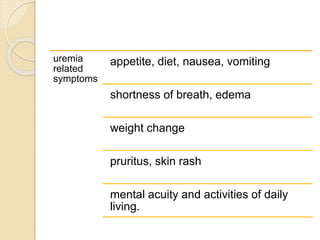
uremia
related
symptoms
appetite, diet, nausea, vomiting
shortness of breath, edema
weight change
pruritus, skin rash
mental acuity and activities of daily
living.
Physical
examination blood pressure
Fundoscopy (hypertensive retinopathy
and diabetic retinopathy)
precordial examination (fourth heart
sound, murmurs, pericardial rub)
abdomen (renal bruit, aortic bruit,
palpable masses)
Edema
Physical
examination peripheral pulses
central nervous system (asterixis,
muscle weakness, neuropathy),
rectum (prostate size) and vagina
(pelvic masses)
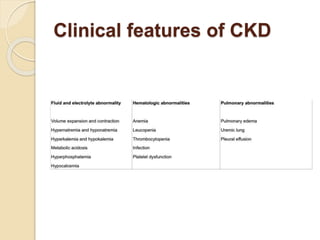
Clinical features of CKD
Methods of estimating GFR
The most reliable
markers of GFR
estimation include
inulin clearance and
use of radionuclides
like iothalamate and
iodohexol
The most commonly used
methods for estimating GFR
is based on creatinine.
Creatinine is a protein
derived from metabolism of
creatine in skeletal muscle
and dietary meat intake
Levels can be altered by medications interfering with
measurement (cephalosporin, ketone) or reduced
secretion by medications (cimetidine, Bactrim).
It can also be altered by factors like variability in
muscle mass
presence of liver disease, age, sex, race and weight,
chronic illness, and consumption of cooked meat
Creatinine
based
formula
for
estimating
GFR
include
Modification of Diet in Renal Disease (MDRD) formula
(takes into account age, gender and race).
Chronic Kidney Disease Epidemiology Collaboration
(CKD-EPI) formula (takes into account age, gender and
race).
Cockcroft-Gault (CG) equation (takes into account the
age, weight and gender).
24 hour urine estimation of creatinine clearance.
The MDRD equation was found to be less accurate than
CKD-EPI in predicting risk for those with GFR more than 45-
60 ml/min/1.73 m2
But at the same time CKD –EPI was not superior in
estimating GFR in the elderly or those with extreme body
mass.
MDRD and CKD-EPI are more accurate in young compared
to CG equation.
In terms of gender, CKD-EPI was most accurate in women
whereas MDRD was most accurate in men
Creatinine does not fulfill the
criteria of an ideal marker for
estimating GFR
Cystatin
C
freely filtered
reabsorbed
metabolized by proximal
tubules
no urinary excretion.
The use of cystatin C also has its own
limitations
• Among patients with a GFR <60 ml/min/ 1.73 m2, cystatin
C offers only a moderate gain over creatinine for
approximating renal function.
A combined serum cystatin C and creatinine
based formula is sometimes used in practice
Role of proteinuria in the
classification of CKD
Biomarkers in CKD
• Accurate
• non-invasive
indicators
• reflect the
pathophysiologic
mechanisms
underlying CKD.
Effective
CKD
screening
and
management
should
ideally
involve
Neutrophil gelatinase
associated lipocalin (NGAL)
Asymmetric dimethylarginine
(ADMA)
liver-type fatty acidbinding
protein (L-FABP)
Other
investigations Urea
electrolytes (sodium, potassium, chloride,
bicarbonate)
calcium, phosphorus, alkaline
phosphatase, PTH, 25-hydroxy vitamin D
Hemoglobin
Urine
analysis
urine dipstick (pH, specific gravity, blood,
leucocyte esterase, nitrates, glucose and
protein),
urine protein to urine creatinine ratio,
urine albumin to creatinine ratio
urine microscopy (dysmorphic red blood
cells, white blood cells, white blood cell
casts, red blood cell casts, broad casts,
cellular casts and granular casts).
workup related to
the aetiology and
risk factors
Ultrasound of renal system.
Estimate size of the kidneys
Assess echogenicity
Corticomedullary differentiation
Extent of intact cortex
Rule out renal masses
Obstructive nephropathy.
Others renal duplex sonography of renal
vessels
radionuclide scintigraphy
magnetic resonance angiography
spiral computed tomography
scan
Renal
biopsy
Special Circumstances
Human
immunodeficiency
virus and CKD
CKD can range
between 2.4% and
10%
HIV associated
nephropathy (almost
50%).
CKD in
elderly Between 1988 and 1994
National Health and Nutrition
Examination Survey (NHANES)
study and the 2003–2006
NHANES study, the prevalence
of CKD in peopleages 60 and
older increased from 18.8 to
24.5 percent.
Evaluation and Management of Patients
with CKD Care of CKD patients
 Patients with CKD should receive
multidisciplinary comprehensive
clinical management by kidney
disease professionals for at least 6
months before requiring renal
replacement therapy (RRT).
Co-Management Model
 Collaborative care
◦ Formal arrangement
◦ Curbside consult
 Care coordination
 Clinical decision
support
 Population health
◦ Development of
treatment protocols
When to refer patients
Referral to
nephrology
1) Acute kidney injury or abrupt sustained
fall in glomerular filtration rate (GFR).
2) GFR <30 ml/min/1.73 m2.
3) A consistent finding of significant
albuminuria
Referral to
nephrology
4) Rapid progression of CKD.
5) Presence of microscopic hematuria.
6) CKD and hypertension refractory to treatment with 4 or more
antihypertensive agents.
7) Persistent abnormalities of serum potassium.
8) Recurrent or extensive nephrolithiasis.
9) Hereditary kidney disease.
10) Abnormal structural findings in kidney on imaging.
NB
 Ambulatory blood pressure (particularly
nighttime blood pressure) has been found to
be a significant and an independent predictor
of renal function in both cross-sectional and
longitudinal studies.
 The other factors found to have association
with impaired renal function include elevated
nighttime blood pressure, non-dipping and
decreased circadian variation.
 Additionally, the risk for micro-
albuminuria was 70% lower in dippers
(night/day blood pressure ratio ≤ 0.90)
compared with non-dippers which
means that lowering nighttime blood
pressure in patients with CKD is
associated with decreased urinary
protein excretion and improvement in
renal function.
Nighttime blood
pressure also seems to
be a good predictor of
adverse cardiovascular
events in patients with
hypertension and CKD
NB
KDIGO guidelines suggest
measurement of serum total
calcium, phosphorus, 25-
hydroxyvitamin D, PTH, and
bone alkaline phosphatase as
baseline values if patients are
diagnosed with stage 3 CKD
(GFR 30-59 mL/min).
Measurement of
alkaline
phosphatase
should be done on
a regular basis
 Metabolic bone disease and laboratory
monitoring
a) For GFR categories G3a & G3b, serum
calcium, phosphorus every 6-12 mos and PTH
based on baseline level and CKD progression.
b) For GFR categories G4, serum calcium,
phosphorus every 3-6 mos and PTH every 6-12
months.
c) For GFR categories G5 (including dialysis),
serum calcium, phosphorus every 1-3 mos
and PTH every 3-6 months.
 Albuminuria
a) Assess Albuminuria at least annually
irrespective of the stage of kidney disease.
b) Assess albuminuria more often for individuals
at higher risk of progression, and/or
where measurement will impact therapeutic
decisions.
 Hemoglobin
a) CKD and GFR categories G1 &2 when
clinically indicated.
b) For GFR categories G3a & G3b: annually.
c) For GFR categories G4 &G5 twice per year.
 Key Question 1. In asymptomatic
adults with or without recognized risk
factors for CKD incidence,
progression, or complications, what
direct evidence is there that
systematic CKD screening improves
clinical outcomes?
 Key Question 2. What harms result
from systematic CKD screening in
asymptomatic adults with or without
recognized risk factors for CKD
incidence, progression, or
complications?
 Key Question 3. Among adults with
CKD stages 1–3, whether detected by
systematic screening or as part of
routine care, what direct evidence is
there that monitoring for worsening
kidney function and/or kidney damage
improves clinical outcomes?
 Key Question 4. Among adults with
CKD stages 1–3, whether detected by
systematic screening or as part of
routine care, what harms result from
monitoring for worsening kidney
function and/or kidney damage?
 Key Question 5. Among adults with
CKD stages 1–3, whether detected by
systematic screening or as part of
routine care, what direct evidence is
there that treatment improves clinical
outcomes?
 Key Question 6. Among adults with
CKD stages 1–3, whether detected by
systematic screening or as part of
routine care, what harms result from
treatment?
Consider discussion with nephrologist by
phone or letter if you feel clinic referral may
not be necessary
Single clinic visit with agreed management
plan and specified criteria for re-referral may
be all that is necessary
Approach to CKD

Approach to CKD

  • 1.
    Approach to CKDPateint By Mostafa Abd_Elsalam,MD MUH,MNDU
  • 2.
    Definitions Azotemia - elevated bloodurea nitrogen (BUN >28mg/dL) and creatinine (Cr>1.5mg/dL) Uremia - azotemia with symptoms or signs of renal failure
  • 3.
    End Stage Renal Disease(ESRD) - uremia requiring transplantation or dialysis Chronic Renal Failure (CRF) - irreversible kidney dysfunction with azotemia >3 months
  • 4.
    Creatinine Clearance (CCr) -the rate of filtration of creatinine by the kidney (GFR marker) Glomerular Filtration Rate (GFR) - the total rate of filtration of blood by the kidney
  • 5.
    Unfortunately, chronic kidney disease is‘‘under- diagnosed’’ and ‘‘under-treated’’ in the United States K/DOQI, 2002
  • 6.
    Chronic kidney disease progressiveloss of nephrons and function due to multiple etiologies and frequently leading to end stage renal disease (ESRD).
  • 7.
    presence of following for three months or more GFRless than 60 ml/min/1.73 m2 with or without kidney damage.
  • 8.
    Structural and functional abnormalities of the kidney Pathologicalabnormalities. Clinical markers of renal damage in the form of proteinuria Abnormal imaging studies Tubular syndromes. Kidney transplant recipient.
  • 10.
    Epidemiology of chronic kidneydisease CKD affects almost 14–15% of the adult United States (U.S) population. The prevalence of CKD is highest in the elderly population especially those above the age of 65 years.
  • 11.
    Not all patientswith CKD progress to ESRD. Significant proportion of patients with CKD die before reaching dialysis. Currently almost 600000 people in U.S are undergoing hemodialysis for ESRD . U.S. Renal Data System (2013) USRDS 2013 Annual Data Report: Atlas of Chronic Kidney Disease and End-Stage Renal Disease
  • 12.
    CKD as aPublic Health Issue 26 million American affected Prevalence is 11-13% of adult population in the US 28% of Medicare budget in 2013, up from 6.9% in 1993 $42 billion in 2013 1. NKF Fact Sheets. http://www.kidney.org/news/newsroom/factsheets/FastFac ts. Accessed Nov 5, 2014. 2. USRDS. www.usrds.org. Accessed Nov 5, 2014. 3. Coresh et al. JAMA. 2007. 298:2038-2047. ESRD, end stage renal disease
  • 13.
    Increases risk forall-cause mortality, CV mortality, kidney failure (ESRD), and other adverse outcomes. 6 fold increase in mortality rate with DM + CKD Disproportionately affects African Americans and Hispanics
  • 14.
    100 patients witheGFR < 60 (Tomorrow morning in Outpatients)
  • 15.
    1 year later:1 patient needs RRT, 10 patients have died (> 50% CV death)
  • 16.
    10 years later:8 patients need RRT, 65 patients have died, 27 have ongoing CKD
  • 17.
    Why? ageing of thegeneral population rising incidence of obesity
  • 18.
    type 2 diabetesmellitus improved survival from cancer as well as major cardiovascular accidents
  • 19.
    Major causes ofCKD hypertension diabetes mellitus Glomerulonephritis cystic kidney disease urinary tract obstruction interstitial nephritis vesico-ureteric reflux nephrolithiasis and recurrent kidney infection.
  • 22.
    natural physiological reductionin glomerular filtration rate (GFR) with aging which behaves differently from the various etiologies mentioned above in terms of progression of the disease
  • 23.
    The renal prognosisis favorable in most patients who demonstrate age related drop in GFR, BUT associated with increased risk of cardiovascular morbidity and mortality Nitta K, Okada K, Yanai M, Takahashi S (2013) Aging and chronic kidney disease. Kidney Blood Press Res 38: 109- 120.
  • 26.
    Pathophysiology of Chronic KidneyDisease The pathophysiology of CKD involves initiating mechanisms specific to the underlying etiology
  • 27.
    As well asa set of progressive mechanisms, glomerulosclerosis and tubulo interstitial fibrosis that are common consequences following long term reduction in renal mass, irrespective of the etiology.
  • 28.
    Structural and functional changesin surviving nephrons lead to hypertrophy and hyper filtration of the surviving nephrons.
  • 29.
    This compensatory hypertrophy mediatedby vasoactive molecules, cytokines, growth factors and renin angiotensin axis mediators eventually lead to intra-glomerular hypertension and accelerated sclerosis of surviving nephrons.
  • 30.
    Raised intra-glomerular hypertensionwill lead to reduction of glomerular permeability and filtration surface area resulting in decreased GFR
  • 32.
    Tubulointerstitial injury manifestedby tubular dilatation and interstitial fibrosis. The degree of tubulointerstitial disease is a better predictor of glomerular filtration rate decline and long term prognosis than the severity of injury.
  • 33.
    Other factors thatplay a role in the initiation and pathogenesis of fibrosis in CKD include : 1) Upregulation of profibrotic factors such as transforming growth factor beta 1 (TGF-β1), platelet derived growth factor, fibroblast growth factor, osteopontin and endothelin.
  • 34.
    2) Down regulationof anti-fibrotic factors like hepatocyte growth factor and bone morphogenic protein. 3) Dysregulation of vasoactive factors with an increase in vasoconstrictors such as angiotensin II, and a decrease in vasodilators such as nitric oxide (NO).
  • 35.
    4) Microvascular injuryand obliteration (due to hypoxia) 5) Disruption of normal homeostatic interactions between adjacent cell populations, especially the one between tubular epithelial cells and interstitial fibroblasts.
  • 36.
    Role of reninangiotensin- aldosterone system in CKD The renin-angiotensin- aldosterone system (RAAS) plays a major role in maintaining the blood volume and salt-water balance. It has effect on the blood pressure and tissue perfusion through a number of multiple complex actions including vasoconstriction and sodium retention. .
  • 37.
    Despite its rolein maintaining homeostasis, long-lasting stimulation of RAAS can lead to development of kidney lesions and progression of CKD.
  • 38.
    An excess ofangiotensin II increases intraglomerular pressure by preferentially constricting the efferent arterioles, thus promoting glomerular hypertension
  • 39.
    Additionally angiotensin IIcan stimulate aldosterone production which triggers the activation of a cascade of profibrotic cytokines resulting in glomerular sclerosis and tubulointerstitial fibrosis.
  • 40.
    Prorenin and renincan stimulate TGF- β1 production via the activation of p42/p44 mitogen-activated protein kinase (p42/p44MAPK), which sub¬sequently result in the upregulation of profibrotic and prothrombotic molecules, such as fibronectin, collagen-1, and plasminogen activator inhibitor-1 (PAI- 1) inducing renal fibrosis.
  • 41.
    A high prorenin level= micro¬albuminuria, and development of nephropathy especially in diabetic patients
  • 42.
    Role of proteinuriain CKD Proteinuria is an important risk factor for the progression of CKD. Increased protein filtration results in excess reabsorption of filtered proteins by proximal tubular cells.
  • 43.
    The reabsorbed proteinseventually leak into the renal tubular interstitium through focal breaks in tubular basement membrane attracting macrophages.
  • 44.
    These macrophages canpromote tubulointerstitial fibrosis by release of proinflammatory mediators
  • 45.
    Role of sympatheticsystem in progression of chronic kidney disease Hyperactivity of the sympathetic nervous system has been found to have considerable adverse consequences on progression of CKD and cardiovascular disease.
  • 46.
    hypertension Proteinuria accelerated atherosclerosis vasoconstriction and proliferation ofsmooth muscle cells as well as adventitial fibroblasts in the vessel wall
  • 47.
    Ischemic nephropathy and chronickidney disease Ischemic nephropathy is a common cause of renal disease especially in the elderly population.
  • 48.
    It is definedby the gradual reduction of the GFR or a loss of renal parenchyma resulting from vascular occlusion and not explained by other etiologies.
  • 49.
    The pathogenesis ofthis disease involves not only the narrowing of the major renal artery due to atherosclerosis but also renal microvascular disease.
  • 50.
    The role ofmicrovascular disease is supported by the fact that the severity of renal vascular disease on imaging has not been found to correlate with the onset or progression or time to reach ESRD in patients with atherosclerotic renal vascular disease
  • 51.
    . Microvascular involvement canresult from vascular rarefaction within interstitium increased vascular wall to lumen ratio and atheroembolic renal vascular disease.
  • 52.
    Induction of hypoxiasecondary to these, results in activation of renin-angiotensin system, growth factors, different cytokines and chemokines playing a major role in the pathogenesis of ischemic nephropathy.
  • 53.
    Hypoxia additionally promotes fibrosisby up regulating extracellular matrix production, suppressing turnover of collagen and promoting epithelial-to mesenchymal transition.
  • 54.
    The other mechanismsresponsible for renal injury in ischemic nephropathy aldosterone–mediated damage sympathetic over activity increased release of reactive oxygen species reduction in NO activity. leading to endothelial dysfunction.
  • 55.
    Role of geneticsin chronic kidney disease Monogenic inheritance like polycystic kidney disease, focal segmental glomerulosclerosis (FSGS), congenital nephrotic syndrome, Fabry’s disease, Alport disease, nephronophthisis as well as medullary cystic kidney disease Polygenic inheritance like diabetic nephropathy and hypertensive nephropathy.
  • 56.
    Polycystic kidney disease (PKD)is the best-known and most easily recognizable inherited kidney disease. There are mainly two genetic variants of PKD-PKD1 and PKD2.
  • 57.
     Point mutationsin the Alpha-actinin-4 (ACTN4), Transient Receptor Potential Cation Channel Type 6 (TRPC6), and Inverted Formin 2 (INF2) genes can lead to phenotypes characterized by injury to glomerular podocyte associated filtration barrier and cause progressive deterioration in renal filtration function resulting in FSGS
  • 58.
    Recent genomewide association studieshave identified several genetic loci that may affect renal function. UMOD gene is the most important among them which is strongly linked to effects on CKD and GFR.
  • 59.
    The other majorgenetic locus associated with progression of kidney disease especially in the African American population is the APOL-1
  • 60.
    Who should bescreened for CKD? (KDOQI) guidelines Diabetes cardiovascular disease hypertension, hyperlipidemia Obesity metabolic syndrome Smoking HIV hepatitis C virus infection
  • 61.
    KDIGO malignancy, family historyof kidney disease treatment with potentially nephrotoxic drugs should be screened.
  • 62.
    KDIGO) Controversies Conference suggested screening all patients over age60 years. By urine albumin/creatinine ratio estimated GFR creatinine clearance)
  • 63.
    CKD Risk Factors* Modifiable Diabetes  Hypertension  History of AKI  Frequent NSAID use Non-Modifiable • Family history of kidney disease, diabetes, or hypertension • Age 60 or older (GFR declines normally with age) • Race/U.S. ethnic minority status *Partial list AKI, acute kidney injury
  • 64.
    Effective management should include the following steps: 1) History,physical examination and laboratory studies to establish the diagnosis of CKD. 2) Modification of risk factors. 3) Treatment of complications. 4) Preparation for renal replacement therapy. 5) Patient education
  • 65.
    History and physicalexamination History RISK FACTORS Diabetes Hypertension systemic inflammatory disorders nephron/urolithiasi metabolic diseases
  • 66.
    History exposure todrugs as well as toxins exposure to intravenous contrast herbal medications exposure to phosphatecontaining enema family history of renal diseases (polycystic kidney disease)and urologic disorders. Smoking
  • 67.
    uremia related symptoms appetite, diet, nausea,vomiting shortness of breath, edema weight change pruritus, skin rash mental acuity and activities of daily living.
  • 68.
    Physical examination blood pressure Fundoscopy(hypertensive retinopathy and diabetic retinopathy) precordial examination (fourth heart sound, murmurs, pericardial rub) abdomen (renal bruit, aortic bruit, palpable masses) Edema
  • 69.
    Physical examination peripheral pulses centralnervous system (asterixis, muscle weakness, neuropathy), rectum (prostate size) and vagina (pelvic masses)
  • 70.
  • 73.
    Methods of estimatingGFR The most reliable markers of GFR estimation include inulin clearance and use of radionuclides like iothalamate and iodohexol
  • 74.
    The most commonlyused methods for estimating GFR is based on creatinine. Creatinine is a protein derived from metabolism of creatine in skeletal muscle and dietary meat intake
  • 75.
    Levels can bealtered by medications interfering with measurement (cephalosporin, ketone) or reduced secretion by medications (cimetidine, Bactrim). It can also be altered by factors like variability in muscle mass presence of liver disease, age, sex, race and weight, chronic illness, and consumption of cooked meat
  • 76.
    Creatinine based formula for estimating GFR include Modification of Dietin Renal Disease (MDRD) formula (takes into account age, gender and race). Chronic Kidney Disease Epidemiology Collaboration (CKD-EPI) formula (takes into account age, gender and race). Cockcroft-Gault (CG) equation (takes into account the age, weight and gender). 24 hour urine estimation of creatinine clearance.
  • 77.
    The MDRD equationwas found to be less accurate than CKD-EPI in predicting risk for those with GFR more than 45- 60 ml/min/1.73 m2 But at the same time CKD –EPI was not superior in estimating GFR in the elderly or those with extreme body mass. MDRD and CKD-EPI are more accurate in young compared to CG equation. In terms of gender, CKD-EPI was most accurate in women whereas MDRD was most accurate in men
  • 78.
    Creatinine does notfulfill the criteria of an ideal marker for estimating GFR
  • 79.
    Cystatin C freely filtered reabsorbed metabolized byproximal tubules no urinary excretion.
  • 80.
    The use ofcystatin C also has its own limitations • Among patients with a GFR <60 ml/min/ 1.73 m2, cystatin C offers only a moderate gain over creatinine for approximating renal function. A combined serum cystatin C and creatinine based formula is sometimes used in practice
  • 83.
    Role of proteinuriain the classification of CKD
  • 84.
    Biomarkers in CKD •Accurate • non-invasive indicators • reflect the pathophysiologic mechanisms underlying CKD. Effective CKD screening and management should ideally involve
  • 85.
    Neutrophil gelatinase associated lipocalin(NGAL) Asymmetric dimethylarginine (ADMA) liver-type fatty acidbinding protein (L-FABP)
  • 86.
    Other investigations Urea electrolytes (sodium,potassium, chloride, bicarbonate) calcium, phosphorus, alkaline phosphatase, PTH, 25-hydroxy vitamin D Hemoglobin
  • 87.
    Urine analysis urine dipstick (pH,specific gravity, blood, leucocyte esterase, nitrates, glucose and protein), urine protein to urine creatinine ratio, urine albumin to creatinine ratio urine microscopy (dysmorphic red blood cells, white blood cells, white blood cell casts, red blood cell casts, broad casts, cellular casts and granular casts).
  • 88.
    workup related to theaetiology and risk factors
  • 89.
    Ultrasound of renalsystem. Estimate size of the kidneys Assess echogenicity Corticomedullary differentiation Extent of intact cortex Rule out renal masses Obstructive nephropathy.
  • 90.
    Others renal duplexsonography of renal vessels radionuclide scintigraphy magnetic resonance angiography spiral computed tomography scan
  • 91.
  • 92.
    Special Circumstances Human immunodeficiency virus andCKD CKD can range between 2.4% and 10% HIV associated nephropathy (almost 50%).
  • 93.
    CKD in elderly Between1988 and 1994 National Health and Nutrition Examination Survey (NHANES) study and the 2003–2006 NHANES study, the prevalence of CKD in peopleages 60 and older increased from 18.8 to 24.5 percent.
  • 94.
    Evaluation and Managementof Patients with CKD Care of CKD patients  Patients with CKD should receive multidisciplinary comprehensive clinical management by kidney disease professionals for at least 6 months before requiring renal replacement therapy (RRT).
  • 95.
    Co-Management Model  Collaborativecare ◦ Formal arrangement ◦ Curbside consult  Care coordination  Clinical decision support  Population health ◦ Development of treatment protocols
  • 96.
    When to referpatients Referral to nephrology 1) Acute kidney injury or abrupt sustained fall in glomerular filtration rate (GFR). 2) GFR <30 ml/min/1.73 m2. 3) A consistent finding of significant albuminuria
  • 97.
    Referral to nephrology 4) Rapidprogression of CKD. 5) Presence of microscopic hematuria. 6) CKD and hypertension refractory to treatment with 4 or more antihypertensive agents. 7) Persistent abnormalities of serum potassium. 8) Recurrent or extensive nephrolithiasis. 9) Hereditary kidney disease. 10) Abnormal structural findings in kidney on imaging.
  • 98.
    NB  Ambulatory bloodpressure (particularly nighttime blood pressure) has been found to be a significant and an independent predictor of renal function in both cross-sectional and longitudinal studies.  The other factors found to have association with impaired renal function include elevated nighttime blood pressure, non-dipping and decreased circadian variation.
  • 99.
     Additionally, therisk for micro- albuminuria was 70% lower in dippers (night/day blood pressure ratio ≤ 0.90) compared with non-dippers which means that lowering nighttime blood pressure in patients with CKD is associated with decreased urinary protein excretion and improvement in renal function.
  • 100.
    Nighttime blood pressure alsoseems to be a good predictor of adverse cardiovascular events in patients with hypertension and CKD
  • 101.
    NB KDIGO guidelines suggest measurementof serum total calcium, phosphorus, 25- hydroxyvitamin D, PTH, and bone alkaline phosphatase as baseline values if patients are diagnosed with stage 3 CKD (GFR 30-59 mL/min).
  • 102.
  • 103.
     Metabolic bonedisease and laboratory monitoring a) For GFR categories G3a & G3b, serum calcium, phosphorus every 6-12 mos and PTH based on baseline level and CKD progression. b) For GFR categories G4, serum calcium, phosphorus every 3-6 mos and PTH every 6-12 months. c) For GFR categories G5 (including dialysis), serum calcium, phosphorus every 1-3 mos and PTH every 3-6 months.
  • 105.
     Albuminuria a) AssessAlbuminuria at least annually irrespective of the stage of kidney disease. b) Assess albuminuria more often for individuals at higher risk of progression, and/or where measurement will impact therapeutic decisions.  Hemoglobin a) CKD and GFR categories G1 &2 when clinically indicated. b) For GFR categories G3a & G3b: annually. c) For GFR categories G4 &G5 twice per year.
  • 106.
     Key Question1. In asymptomatic adults with or without recognized risk factors for CKD incidence, progression, or complications, what direct evidence is there that systematic CKD screening improves clinical outcomes?
  • 107.
     Key Question2. What harms result from systematic CKD screening in asymptomatic adults with or without recognized risk factors for CKD incidence, progression, or complications?
  • 108.
     Key Question3. Among adults with CKD stages 1–3, whether detected by systematic screening or as part of routine care, what direct evidence is there that monitoring for worsening kidney function and/or kidney damage improves clinical outcomes?
  • 109.
     Key Question4. Among adults with CKD stages 1–3, whether detected by systematic screening or as part of routine care, what harms result from monitoring for worsening kidney function and/or kidney damage?
  • 110.
     Key Question5. Among adults with CKD stages 1–3, whether detected by systematic screening or as part of routine care, what direct evidence is there that treatment improves clinical outcomes?
  • 111.
     Key Question6. Among adults with CKD stages 1–3, whether detected by systematic screening or as part of routine care, what harms result from treatment?
  • 113.
    Consider discussion withnephrologist by phone or letter if you feel clinic referral may not be necessary Single clinic visit with agreed management plan and specified criteria for re-referral may be all that is necessary