DISTRIBUTION CHANNEL AND LOGISTICS MANAGEMENT Presented by: Dr. Prashant Mehta Assistant Professor National Law University, Jodhpur
AGENDA Definitions Characteristics of Channel of Distribution Functions of Channel of Distribution Classification / Types of Channel of Distribution Channel Systems Channel Design Decisions  Channel Management Decisions Physical Distribution and Logistics Management Distribution Channel in Pharmaceutical industry
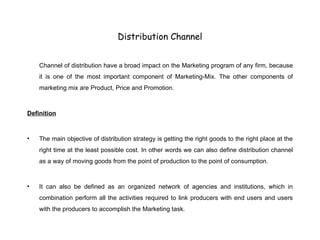
Distribution Channel Channel of distribution have a broad impact on the Marketing program of any firm, because it is one of the most important component of Marketing-Mix. The other components of marketing mix are Product, Price and Promotion. Definition The main objective of distribution strategy is getting the right goods to the right place at the right time at the least possible cost. In other words we can also define distribution channel as a way of moving goods from the point of production to the point of consumption. It can also be defined as an organized network of agencies and institutions, which in combination perform all the activities required to link producers with end users and users with the producers to accomplish the Marketing task.
Characteristics of Channel of Distribution Characteristics of distribution channel cannot be over emphasized by any stretch of our imagination because without distribution channel marketing task would have remained incomplete. Following are few main characteristics of distribution channel: Characteristics It requires a minimum of buyer and a seller. Besides this it may include other middleman. A basic transaction in distribution channel is the exchange of ownership / title of goods. Middlemen play an very important role in transfer of ownership / title of goods. Distribution channel creates transactional efficiency. A distribution channel may be simple or complex. (Handshake agreement or large contracts) Distribution channel may be long or short depending on the company’s marketing requirements as well as the product of the company.
Functions of Channel of Distribution Assorting  Accumulation Allocation  Buying   Contact Distribution Financing  Market information  New Products  Product Planning Promotion Pricing  Physical Possession   Risk Taking Service Sorting
Classification/Types of Channel of Distribution Direct Channels    Own Retail shops Personal selling (door to door) Mail order selling Automatic vending Franchised shops Telephone selling (Telemarketing) Exclusive Stores/Specialty Stores E-marketing
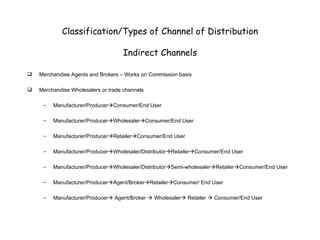
Classification/Types of Channel of Distribution Indirect Channels Merchandise Agents and Brokers – Works on Commission basis   Merchandise Wholesalers or trade channels   Manufacturer/Producer  Consumer/End User Manufacturer/Producer  Wholesaler  Consumer/End User Manufacturer/Producer  Retailer  Consumer/End User Manufacturer/Producer  Wholesaler/Distributor  Retailer  Consumer/End User  Manufacturer/Producer  Wholesaler/Distributor  Semi-wholesaler  Retailer  Consumer/End User Manufacturer/Producer  Agent/Broker  Retailer  Consumer/ End User  Manufacturer/Producer   Agent/Broker    Wholesaler   Retailer    Consumer/End User
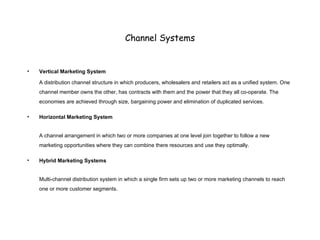
Channel Systems Vertical Marketing System A distribution channel structure in which producers, wholesalers and retailers act as a unified system. One channel member owns the other, has contracts with them and the power that they all co-operate. The economies are achieved through size, bargaining power and elimination of duplicated services. Horizontal Marketing System A channel arrangement in which two or more companies at one level join together to follow a new marketing opportunities where they can combine there resources and use they optimally. Hybrid Marketing Systems Multi-channel distribution system in which a single firm sets up two or more marketing channels to reach one or more customer segments.
Channel Design Decisions   In designing marketing channels, a manufacturer struggles between what is ideal and what is practical.Therefore the design aspects should involve the following.   Analyzing the consumer needs   The designing of the channel starts with finding out what values consumers in various target segments are looking from the channel. Setting the channel objectives   It must be effective and efficient It must have low cost of implementation It must have better control It must have wide coverage  It must contribute to maximum overall profit
Channel Design Decisions Factors affecting choice of Distribution channel Market Factors:  Nature of Market Number of Potential Customers Geographic Concentration Order Size Product Factors: Unit value Perishable Goods Technical Nature of Products Company Factors:  Financial Resources Managerial Capability Desire for Channel Control Service provided by the seller
Channel Design Decisions Middleman Factors: Product launch Promotional scheme Market Information  Environmental Factors:  Economic conditions Technological inventions Socio-cultural developments Political and Legal  Ethical factors and Rival/Competitors channel Identifying the major alternatives:   Types of intermediaries Number of intermediaries (Intensive / Exclusive / Selective)  Responsibilities of each channel member Evaluating the major alternatives : Economic criteria Control criteria Adaptive criteria
Channel Management Decisions Selecting the Channel Members Motivating the Channel Members Evaluating the Channel Members
Physical Distribution and Logistics Management   Marketing logistics involves planning, implementing and controlling the physical flow of materials, final goods and related information from the point of origin to the point of consumption to meet the customer requirements at the profit. Logistics goal is to provide customer satisfaction and customer service, speedy and flexible delivery system, presorting and pre-tagging of merchandise, order tracking information and willingness to take back or replace defective goods. Main objective of logistics system is to provide customer satisfaction at the least cost.
Major Logistics Functions Order Processing It includes checking customers credit, checking of stock, order to ship, bills to customers, update inventory records and send production order for new stocks  Warehousing Owned / Rented Types/ Number of Warehouses Location of Warehouses Inventory  Inventory Management (Ordering cost and Carrying cost) Just in time inventory Transportation Rail Trucks Ships Pipeline Air
Distribution Channel in Pharmaceutical Industry A Profile Pharmaceutical Industry – Indian v/s Multinationals Product Profile – Medicines, Vaccines, IV Fluids, Disposables etc Channel of Distribution – Direct, Indirect and Others

Distribution & Logistics (Channel Management)

  • 1.
    DISTRIBUTION CHANNEL ANDLOGISTICS MANAGEMENT Presented by: Dr. Prashant Mehta Assistant Professor National Law University, Jodhpur
  • 2.
    AGENDA Definitions Characteristicsof Channel of Distribution Functions of Channel of Distribution Classification / Types of Channel of Distribution Channel Systems Channel Design Decisions Channel Management Decisions Physical Distribution and Logistics Management Distribution Channel in Pharmaceutical industry
  • 3.
    Distribution Channel Channelof distribution have a broad impact on the Marketing program of any firm, because it is one of the most important component of Marketing-Mix. The other components of marketing mix are Product, Price and Promotion. Definition The main objective of distribution strategy is getting the right goods to the right place at the right time at the least possible cost. In other words we can also define distribution channel as a way of moving goods from the point of production to the point of consumption. It can also be defined as an organized network of agencies and institutions, which in combination perform all the activities required to link producers with end users and users with the producers to accomplish the Marketing task.
  • 4.
    Characteristics of Channelof Distribution Characteristics of distribution channel cannot be over emphasized by any stretch of our imagination because without distribution channel marketing task would have remained incomplete. Following are few main characteristics of distribution channel: Characteristics It requires a minimum of buyer and a seller. Besides this it may include other middleman. A basic transaction in distribution channel is the exchange of ownership / title of goods. Middlemen play an very important role in transfer of ownership / title of goods. Distribution channel creates transactional efficiency. A distribution channel may be simple or complex. (Handshake agreement or large contracts) Distribution channel may be long or short depending on the company’s marketing requirements as well as the product of the company.
  • 5.
    Functions of Channelof Distribution Assorting Accumulation Allocation Buying   Contact Distribution Financing Market information  New Products  Product Planning Promotion Pricing  Physical Possession   Risk Taking Service Sorting
  • 6.
    Classification/Types of Channelof Distribution Direct Channels   Own Retail shops Personal selling (door to door) Mail order selling Automatic vending Franchised shops Telephone selling (Telemarketing) Exclusive Stores/Specialty Stores E-marketing
  • 7.
    Classification/Types of Channelof Distribution Indirect Channels Merchandise Agents and Brokers – Works on Commission basis Merchandise Wholesalers or trade channels Manufacturer/Producer  Consumer/End User Manufacturer/Producer  Wholesaler  Consumer/End User Manufacturer/Producer  Retailer  Consumer/End User Manufacturer/Producer  Wholesaler/Distributor  Retailer  Consumer/End User  Manufacturer/Producer  Wholesaler/Distributor  Semi-wholesaler  Retailer  Consumer/End User Manufacturer/Producer  Agent/Broker  Retailer  Consumer/ End User  Manufacturer/Producer  Agent/Broker  Wholesaler  Retailer  Consumer/End User
  • 8.
    Channel Systems VerticalMarketing System A distribution channel structure in which producers, wholesalers and retailers act as a unified system. One channel member owns the other, has contracts with them and the power that they all co-operate. The economies are achieved through size, bargaining power and elimination of duplicated services. Horizontal Marketing System A channel arrangement in which two or more companies at one level join together to follow a new marketing opportunities where they can combine there resources and use they optimally. Hybrid Marketing Systems Multi-channel distribution system in which a single firm sets up two or more marketing channels to reach one or more customer segments.
  • 9.
    Channel Design Decisions In designing marketing channels, a manufacturer struggles between what is ideal and what is practical.Therefore the design aspects should involve the following.   Analyzing the consumer needs The designing of the channel starts with finding out what values consumers in various target segments are looking from the channel. Setting the channel objectives It must be effective and efficient It must have low cost of implementation It must have better control It must have wide coverage It must contribute to maximum overall profit
  • 10.
    Channel Design DecisionsFactors affecting choice of Distribution channel Market Factors: Nature of Market Number of Potential Customers Geographic Concentration Order Size Product Factors: Unit value Perishable Goods Technical Nature of Products Company Factors: Financial Resources Managerial Capability Desire for Channel Control Service provided by the seller
  • 11.
    Channel Design DecisionsMiddleman Factors: Product launch Promotional scheme Market Information Environmental Factors: Economic conditions Technological inventions Socio-cultural developments Political and Legal Ethical factors and Rival/Competitors channel Identifying the major alternatives: Types of intermediaries Number of intermediaries (Intensive / Exclusive / Selective) Responsibilities of each channel member Evaluating the major alternatives : Economic criteria Control criteria Adaptive criteria
  • 12.
    Channel Management DecisionsSelecting the Channel Members Motivating the Channel Members Evaluating the Channel Members
  • 13.
    Physical Distribution andLogistics Management Marketing logistics involves planning, implementing and controlling the physical flow of materials, final goods and related information from the point of origin to the point of consumption to meet the customer requirements at the profit. Logistics goal is to provide customer satisfaction and customer service, speedy and flexible delivery system, presorting and pre-tagging of merchandise, order tracking information and willingness to take back or replace defective goods. Main objective of logistics system is to provide customer satisfaction at the least cost.
  • 14.
    Major Logistics FunctionsOrder Processing It includes checking customers credit, checking of stock, order to ship, bills to customers, update inventory records and send production order for new stocks Warehousing Owned / Rented Types/ Number of Warehouses Location of Warehouses Inventory Inventory Management (Ordering cost and Carrying cost) Just in time inventory Transportation Rail Trucks Ships Pipeline Air
  • 15.
    Distribution Channel inPharmaceutical Industry A Profile Pharmaceutical Industry – Indian v/s Multinationals Product Profile – Medicines, Vaccines, IV Fluids, Disposables etc Channel of Distribution – Direct, Indirect and Others

Editor's Notes

  • #5 Channels of Distribution   Channel of distribution have a broad impact on the Marketing program of any firm, because it is one of the most important component of Marketing-Mix. The other components of marketing mix are Product, Price and Promotion.   The main objective of distribution strategy is getting the right goods to the right place at the right time at the least possible cost. In other words we can also define distribution channel as a way of moving goods from the point of production to the point of consumption.   It can also be defined as an organized network of agencies and institutions, which in combination perform all the activities required to link producers with end users and users with the producers to accomplish the Marketing task.