Distribution Strategy
                            Peter Angele
                    Ileana Szczepanski
                       Niklas Reissinger


              Overview
Definition
Distribution Channels
Channel Strategy
Channel Management
Physical Distribution
Physical Distribution System
Ethical Issues

                Distribution Strategy      2
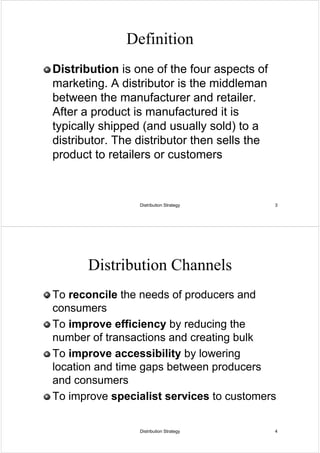
Definition
Distribution is one of the four aspects of
marketing. A distributor is the middleman
between the manufacturer and retailer.
After a product is manufactured it is
typically shipped (and usually sold) to a
distributor. The distributor then sells the
product to retailers or customers


                 Distribution Strategy        3


       Distribution Channels
To reconcile the needs of producers and
consumers
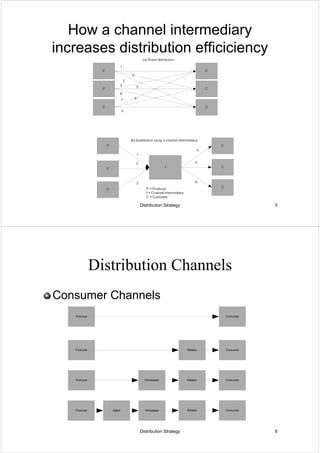
To improve efficiency by reducing the
number of transactions and creating bulk
To improve accessibility by lowering
location and time gaps between producers
and consumers
To improve specialist services to customers

                 Distribution Strategy        4
How a channel intermediary
increases distribution efficiciency


              Distribution Strategy   5


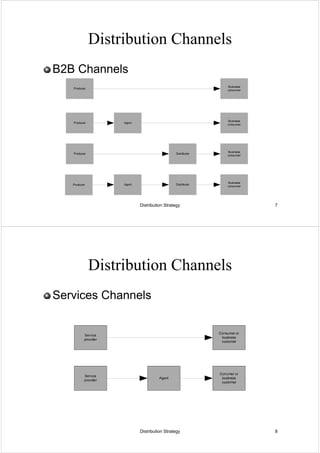
     Distribution Channels
Consumer Channels


              Distribution Strategy   6
Distribution Channels
B2B Channels


               Distribution Strategy   7


      Distribution Channels
Services Channels


               Distribution Strategy   8
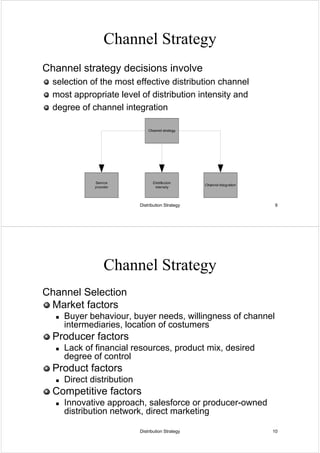
Channel Strategy
Channel strategy decisions involve
  selection of the most effective distribution channel
  most appropriate level of distribution intensity and
  degree of channel integration


                           Distribution Strategy            9


               Channel Strategy
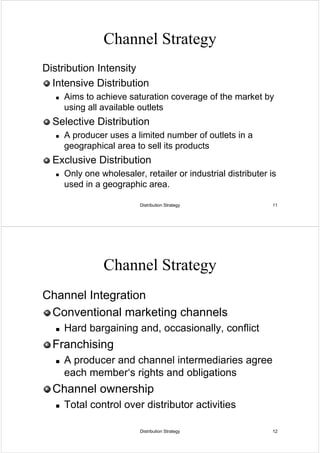
Channel Selection
 Market factors
     Buyer behaviour, buyer needs, willingness of channel
     intermediaries, location of costumers
  Producer factors
     Lack of financial resources, product mix, desired
     degree of control
  Product factors
     Direct distribution
  Competitive factors
     Innovative approach, salesforce or producer-owned
     distribution network, direct marketing

                           Distribution Strategy         10
Channel Strategy
Distribution Intensity
  Intensive Distribution
    Aims to achieve saturation coverage of the market by
    using all available outlets
  Selective Distribution
    A producer uses a limited number of outlets in a
    geographical area to sell its products
  Exclusive Distribution
    Only one wholesaler, retailer or industrial distributer is
    used in a geographic area.

                        Distribution Strategy                11


              Channel Strategy
Channel Integration
 Conventional marketing channels
    Hard bargaining and, occasionally, conflict
  Franchising
    A producer and channel intermediaries agree
    each member‘s rights and obligations
  Channel ownership
    Total control over distributor activities

                        Distribution Strategy                12
Channel Management
 Channel management is an effective
 implementation of the key channel
 strategy decisions
                                  Channel
                                 management


                                                                   Managing
   Selection     Motivation        Training           Evaluation
                                                                    conflict


                              Distribution Strategy                            13


               Channel Management
Managing conflict

Sources of channel conflict
 Differences in goals
 Differences in desired product line
 Multiple distribution channels
 Inadequacies in performance

                              Distribution Strategy                            14
Channel Management
Managing Conflict

Avoiding and resolving conflict
  Developing a partnership approach
  Training in conflict handeling
  Market partitioning
  Improving performance
  Channel ownership
  Coercion

                    Distribution Strategy       15


         Physical Distribution
Definition

  Physical Distribution defined as a set of
  activities concered with the physical flows
  with materials, components and finished
  goods from producer to channel
  intermediaries and consumers‘


                    Distribution Strategy       16
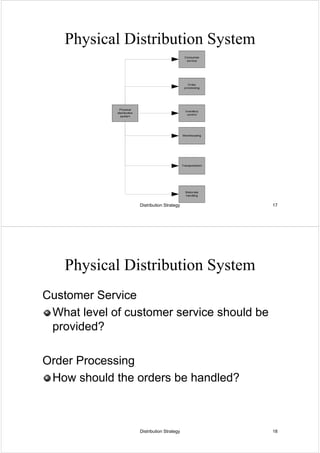
Physical Distribution System


                 Distribution Strategy      17


    Physical Distribution System
Customer Service
 What level of customer service should be
 provided?

Order Processing
 How should the orders be handled?


                 Distribution Strategy      18
Physical Distribution System
Inventory Control
  How much inventory should be held?


Warehousing
 Where should the inventory be located
 and how many warehouses should be
 used?
                  Distribution Strategy    19


    Physical Distribution System
Transportation
  How will the products be transported?


Materials handling
 How will the products be handled during
 transportation?

                  Distribution Strategy    20
Ethical Issues
Slotting allowances
Grey markets
Exclusive dealing
Restriction in supply


                 Distribution Strategy   21


    Thank you for your
        attention!
Sources
„Principles and Practice of Marketing“ 5th
edition, David Jobber
www.wikipedia.org


                Distribution Strategy        23

Distribution strategy

  • 1.
    Distribution Strategy Peter Angele Ileana Szczepanski Niklas Reissinger Overview Definition Distribution Channels Channel Strategy Channel Management Physical Distribution Physical Distribution System Ethical Issues Distribution Strategy 2
  • 2.
    Definition Distribution is oneof the four aspects of marketing. A distributor is the middleman between the manufacturer and retailer. After a product is manufactured it is typically shipped (and usually sold) to a distributor. The distributor then sells the product to retailers or customers Distribution Strategy 3 Distribution Channels To reconcile the needs of producers and consumers To improve efficiency by reducing the number of transactions and creating bulk To improve accessibility by lowering location and time gaps between producers and consumers To improve specialist services to customers Distribution Strategy 4
  • 3.
    How a channelintermediary increases distribution efficiciency Distribution Strategy 5 Distribution Channels Consumer Channels Distribution Strategy 6
  • 4.
    Distribution Channels B2B Channels Distribution Strategy 7 Distribution Channels Services Channels Distribution Strategy 8
  • 5.
    Channel Strategy Channel strategydecisions involve selection of the most effective distribution channel most appropriate level of distribution intensity and degree of channel integration Distribution Strategy 9 Channel Strategy Channel Selection Market factors Buyer behaviour, buyer needs, willingness of channel intermediaries, location of costumers Producer factors Lack of financial resources, product mix, desired degree of control Product factors Direct distribution Competitive factors Innovative approach, salesforce or producer-owned distribution network, direct marketing Distribution Strategy 10
  • 6.
    Channel Strategy Distribution Intensity Intensive Distribution Aims to achieve saturation coverage of the market by using all available outlets Selective Distribution A producer uses a limited number of outlets in a geographical area to sell its products Exclusive Distribution Only one wholesaler, retailer or industrial distributer is used in a geographic area. Distribution Strategy 11 Channel Strategy Channel Integration Conventional marketing channels Hard bargaining and, occasionally, conflict Franchising A producer and channel intermediaries agree each member‘s rights and obligations Channel ownership Total control over distributor activities Distribution Strategy 12
  • 7.
    Channel Management Channelmanagement is an effective implementation of the key channel strategy decisions Channel management Managing Selection Motivation Training Evaluation conflict Distribution Strategy 13 Channel Management Managing conflict Sources of channel conflict Differences in goals Differences in desired product line Multiple distribution channels Inadequacies in performance Distribution Strategy 14
  • 8.
    Channel Management Managing Conflict Avoidingand resolving conflict Developing a partnership approach Training in conflict handeling Market partitioning Improving performance Channel ownership Coercion Distribution Strategy 15 Physical Distribution Definition Physical Distribution defined as a set of activities concered with the physical flows with materials, components and finished goods from producer to channel intermediaries and consumers‘ Distribution Strategy 16
  • 9.
    Physical Distribution System Distribution Strategy 17 Physical Distribution System Customer Service What level of customer service should be provided? Order Processing How should the orders be handled? Distribution Strategy 18
  • 10.
    Physical Distribution System InventoryControl How much inventory should be held? Warehousing Where should the inventory be located and how many warehouses should be used? Distribution Strategy 19 Physical Distribution System Transportation How will the products be transported? Materials handling How will the products be handled during transportation? Distribution Strategy 20
  • 11.
    Ethical Issues Slotting allowances Greymarkets Exclusive dealing Restriction in supply Distribution Strategy 21 Thank you for your attention!
  • 12.
    Sources „Principles and Practiceof Marketing“ 5th edition, David Jobber www.wikipedia.org Distribution Strategy 23