MARKETING CHANNELS AND
SUPPLY CHAIN MANAGEMENT
Supply Chains and the Value Delivery Network
• Producing a product or service and making it
avilable to buyers requires building relationships
not just with customers, but also with key suppliers
and resellers in the company’s supply chain.
• This supply chain consist of upstreams and
downstreams partners, including suppliers,
intermediaries, and even intermediary’s customers.
• Value delivery network
– The network made up of the company, suppliers,
distributors, and ultimately customers who “partner” with
each other to improve the performance of the entire
system
The nature and Importance of marketing Channels
• Marketing channel
– A set of interdependent organizations involved in the process of making a product or
service available for use or consumption by the consumer or business user
• How channel members add value
– Information: gathering and distributing marketing research and intelligence information
about actors and forces in the marketing environment needed for planning and aiding
exchange
– Promotion: Developing and communicating persuasive communications about an offer
– Contact: Finding and communicating with prospective buyers
– Matching: shaping and fitting the offer to the buyer’s needs, including activities such as
manufacturing, grading, assembling, and packaging
– Negotiation: Reaching an agreement on price and other terms of the offer so that
ownership or possesion can be transferred
– Physical distribution: transporting and storing goods
– Financing: Acquiring and using funds to cover the costs of the channel work
– Risk taking: Assuming the risks of carrying out the channel work
Number of Channel Levels
• Channel level
– A layer of intermediaries that performs some work in
bringing the product and its ownership closer to the
final buyer
• Direct marketing channel
– A marketing channel that has no intermediary
• Indirect marketing channel
– Channel containing one or more intermediary levels
Channel Behavior and Organization
• A marketing channel consists of firms that have banded
together for their common good.
• Each channel member depends on the others.
• Channel conflict
– Disagreement among marketing channel members on goals and
roles- who should do what and for what rewards
– Horizontal conflict: occurs among firms at the same level of the
channel
– Vertical conflict: conflicts between different levels of the same
channel
Vertical Marketing Systems
• Convetional distribution channel
– A channel consisting of one or more
independent producers, wholesalers,
and retailers, each separate
business seeking to maximize its
own profits, even at the expense of
profits for the system as a whole
• Vertical marketing system
– A distribution channel structure in
which producers, wholesalers, and
retailers act as a unified system.
– One channel member owns the
others, has contracts with them, or
has so much power that they all
cooperate
• Corporate VMS
– A vertical marketing system that
combines successive stages of
production and distribution under
single owner-ship- channel
leadership is established through
common ownership
• Contractual VMS
– A vertical marketing system in which
independent firms at different levels
of production and distribution join
together through contracts to obtain
more economies or sales impact than
they could achieve alone
– Franchise organization
• A contractual vertical marketing
system in which a channel member,
called a franchiser, links several
stages in the production-distribution
process
• Administered VMS
– A vertical marketing system that
coordinates successive stages of
production and distribution, not
through common ownership or
contractual ties, but through the size
and power of one of the parties
• Horizontal Marketing Systems
– A channel arrangement in which two or more
companies at one level join together to follow a new
marketing opportunity
• Multichannel distribution systems
– A distribution system in which a single firm sets up two
or more marketing channels to reach one or more
customer segments
• Changing channel organization
– Disintermediation:
• The displacement of traditonal resellers from a marketing
channel by radically new types of intermediaries
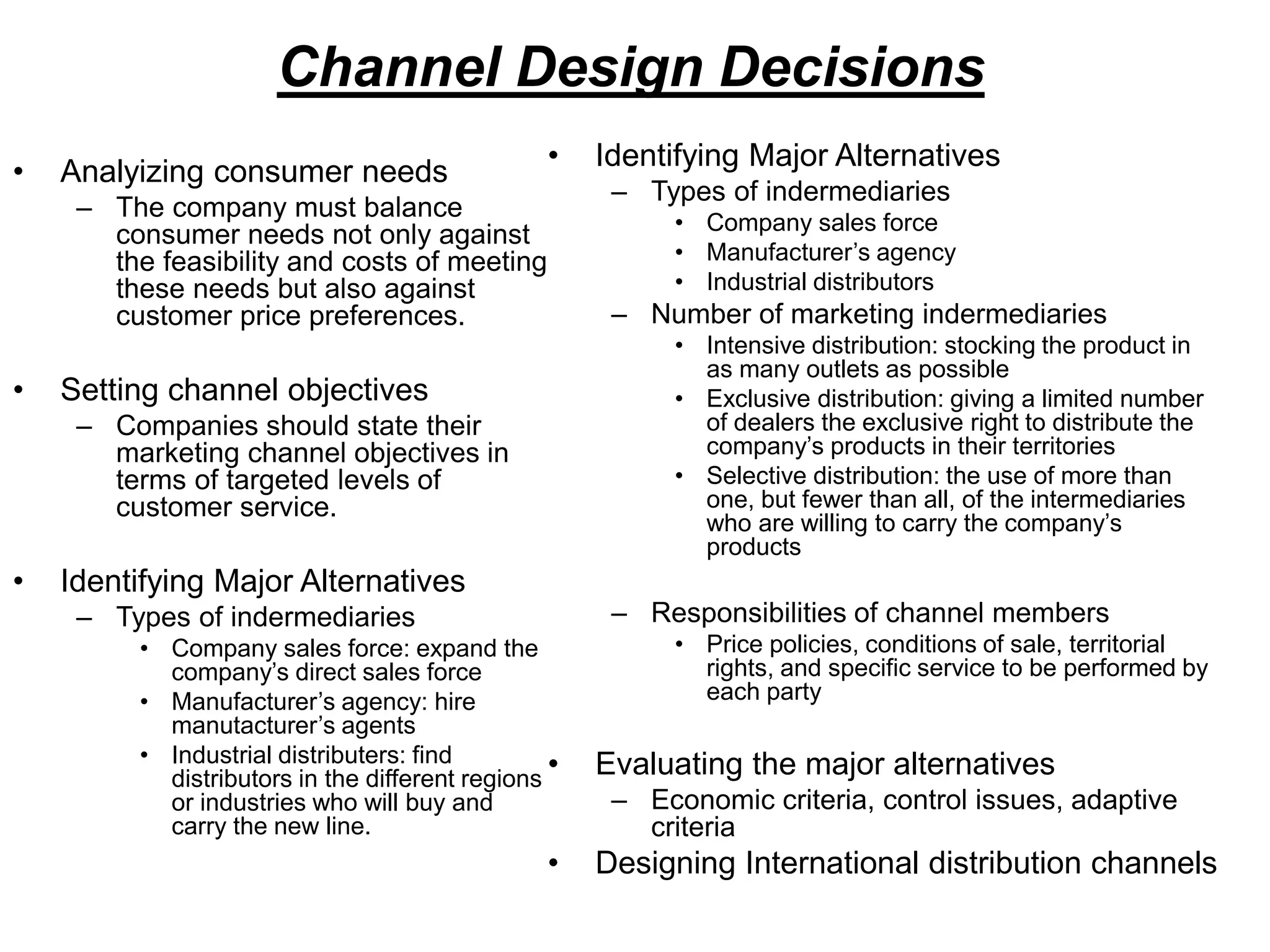
Channel Design Decisions
• Analyizing consumer needs
– The company must balance
consumer needs not only against
the feasibility and costs of meeting
these needs but also against
customer price preferences.
• Setting channel objectives
– Companies should state their
marketing channel objectives in
terms of targeted levels of
customer service.
• Identifying Major Alternatives
– Types of indermediaries
• Company sales force: expand the
company’s direct sales force
• Manufacturer’s agency: hire
manutacturer’s agents
• Industrial distributers: find
distributors in the different regions
or industries who will buy and
carry the new line.
• Identifying Major Alternatives
– Types of indermediaries
• Company sales force
• Manufacturer’s agency
• Industrial distributors
– Number of marketing indermediaries
• Intensive distribution: stocking the product in
as many outlets as possible
• Exclusive distribution: giving a limited number
of dealers the exclusive right to distribute the
company’s products in their territories
• Selective distribution: the use of more than
one, but fewer than all, of the intermediaries
who are willing to carry the company’s
products
– Responsibilities of channel members
• Price policies, conditions of sale, territorial
rights, and specific service to be performed by
each party
• Evaluating the major alternatives
– Economic criteria, control issues, adaptive
criteria
• Designing International distribution channels
Channel Management Decisions
• Selecting channel members
– Producers vary in their ability to attrack qualified
marketing intermediaries.
• Managing and Motivating Channel Members
– Channel members must be continously managed and
motivated to do their best.
• Evaluating channel members
– The producer must regularly check member performance
against standards such as sales quotas, avarage
inventory levels, customer delivery time, treatment of
damaged and lost goods, cooperation in company
promotion, and services to the customer.
Marketing Logistics and Supply Chain
Management
• The nature and importance of marketing logistics
– Marketing logistics (physical distribution)
• The tasks involved in planning, implementing, and controlling the
physical flow of materails, final goods, and realted information from
points of origin to points of consumption to meet customer
requirements
– Supply chain management
• Managing upstream and downstream value-added flows of
materails, final goods, and related information among suppliers, the
company, resellers, and final consumers.
– Goals of the logistic system
• Provide maximum customer service at the least cost
Major Logistics Functions
• Warehousing
– Production and consumption cycles rarely match.
– So must companies must store their tangible goods while they wait to be sold.
– Distribution center: a large, highly automated warehouse designed to recieve goods
from various plants and suppliers, take orders, fill them efficiently, and deliver goods to
customers as quickly as possible
• Inventory management
– Managers must maintain the delicate balance between carrying too little inventory and
carrying too much.
– With too little stock, the firm risks not having products when customers want to buy.
– Carrying too much inventory results in -higher than necessary inventory- carrying
costs and stock obsolescence
• Transportation
– The choice of transportation carriers affects the pricing of products, delivery
performance, and conditions of the goods when they arrive.
• Logistics Information Management
– Information flows such as customer orders, billing, inventory levels, and even
customer data are closley linked channel peroformance.
Integrated Logistics Management
• The logistics concept that emphasizes teamwork,
both inside the company and among all the
marketing channel organizations, to maximize the
performance of the entire distribution system.
– Cross-functional teamwork inside the company
– Building logistic partners
– Third-party logistics

MARKETİNG CHANNELS

  • 1.
  • 2.
    Supply Chains andthe Value Delivery Network • Producing a product or service and making it avilable to buyers requires building relationships not just with customers, but also with key suppliers and resellers in the company’s supply chain. • This supply chain consist of upstreams and downstreams partners, including suppliers, intermediaries, and even intermediary’s customers. • Value delivery network – The network made up of the company, suppliers, distributors, and ultimately customers who “partner” with each other to improve the performance of the entire system
  • 3.
    The nature andImportance of marketing Channels • Marketing channel – A set of interdependent organizations involved in the process of making a product or service available for use or consumption by the consumer or business user • How channel members add value – Information: gathering and distributing marketing research and intelligence information about actors and forces in the marketing environment needed for planning and aiding exchange – Promotion: Developing and communicating persuasive communications about an offer – Contact: Finding and communicating with prospective buyers – Matching: shaping and fitting the offer to the buyer’s needs, including activities such as manufacturing, grading, assembling, and packaging – Negotiation: Reaching an agreement on price and other terms of the offer so that ownership or possesion can be transferred – Physical distribution: transporting and storing goods – Financing: Acquiring and using funds to cover the costs of the channel work – Risk taking: Assuming the risks of carrying out the channel work
  • 4.
    Number of ChannelLevels • Channel level – A layer of intermediaries that performs some work in bringing the product and its ownership closer to the final buyer • Direct marketing channel – A marketing channel that has no intermediary • Indirect marketing channel – Channel containing one or more intermediary levels
  • 5.
    Channel Behavior andOrganization • A marketing channel consists of firms that have banded together for their common good. • Each channel member depends on the others. • Channel conflict – Disagreement among marketing channel members on goals and roles- who should do what and for what rewards – Horizontal conflict: occurs among firms at the same level of the channel – Vertical conflict: conflicts between different levels of the same channel
  • 6.
    Vertical Marketing Systems •Convetional distribution channel – A channel consisting of one or more independent producers, wholesalers, and retailers, each separate business seeking to maximize its own profits, even at the expense of profits for the system as a whole • Vertical marketing system – A distribution channel structure in which producers, wholesalers, and retailers act as a unified system. – One channel member owns the others, has contracts with them, or has so much power that they all cooperate • Corporate VMS – A vertical marketing system that combines successive stages of production and distribution under single owner-ship- channel leadership is established through common ownership • Contractual VMS – A vertical marketing system in which independent firms at different levels of production and distribution join together through contracts to obtain more economies or sales impact than they could achieve alone – Franchise organization • A contractual vertical marketing system in which a channel member, called a franchiser, links several stages in the production-distribution process • Administered VMS – A vertical marketing system that coordinates successive stages of production and distribution, not through common ownership or contractual ties, but through the size and power of one of the parties
  • 7.
    • Horizontal MarketingSystems – A channel arrangement in which two or more companies at one level join together to follow a new marketing opportunity • Multichannel distribution systems – A distribution system in which a single firm sets up two or more marketing channels to reach one or more customer segments • Changing channel organization – Disintermediation: • The displacement of traditonal resellers from a marketing channel by radically new types of intermediaries
  • 8.
    Channel Design Decisions •Analyizing consumer needs – The company must balance consumer needs not only against the feasibility and costs of meeting these needs but also against customer price preferences. • Setting channel objectives – Companies should state their marketing channel objectives in terms of targeted levels of customer service. • Identifying Major Alternatives – Types of indermediaries • Company sales force: expand the company’s direct sales force • Manufacturer’s agency: hire manutacturer’s agents • Industrial distributers: find distributors in the different regions or industries who will buy and carry the new line. • Identifying Major Alternatives – Types of indermediaries • Company sales force • Manufacturer’s agency • Industrial distributors – Number of marketing indermediaries • Intensive distribution: stocking the product in as many outlets as possible • Exclusive distribution: giving a limited number of dealers the exclusive right to distribute the company’s products in their territories • Selective distribution: the use of more than one, but fewer than all, of the intermediaries who are willing to carry the company’s products – Responsibilities of channel members • Price policies, conditions of sale, territorial rights, and specific service to be performed by each party • Evaluating the major alternatives – Economic criteria, control issues, adaptive criteria • Designing International distribution channels
  • 9.
    Channel Management Decisions •Selecting channel members – Producers vary in their ability to attrack qualified marketing intermediaries. • Managing and Motivating Channel Members – Channel members must be continously managed and motivated to do their best. • Evaluating channel members – The producer must regularly check member performance against standards such as sales quotas, avarage inventory levels, customer delivery time, treatment of damaged and lost goods, cooperation in company promotion, and services to the customer.
  • 10.
    Marketing Logistics andSupply Chain Management • The nature and importance of marketing logistics – Marketing logistics (physical distribution) • The tasks involved in planning, implementing, and controlling the physical flow of materails, final goods, and realted information from points of origin to points of consumption to meet customer requirements – Supply chain management • Managing upstream and downstream value-added flows of materails, final goods, and related information among suppliers, the company, resellers, and final consumers. – Goals of the logistic system • Provide maximum customer service at the least cost
  • 11.
    Major Logistics Functions •Warehousing – Production and consumption cycles rarely match. – So must companies must store their tangible goods while they wait to be sold. – Distribution center: a large, highly automated warehouse designed to recieve goods from various plants and suppliers, take orders, fill them efficiently, and deliver goods to customers as quickly as possible • Inventory management – Managers must maintain the delicate balance between carrying too little inventory and carrying too much. – With too little stock, the firm risks not having products when customers want to buy. – Carrying too much inventory results in -higher than necessary inventory- carrying costs and stock obsolescence • Transportation – The choice of transportation carriers affects the pricing of products, delivery performance, and conditions of the goods when they arrive. • Logistics Information Management – Information flows such as customer orders, billing, inventory levels, and even customer data are closley linked channel peroformance.
  • 12.
    Integrated Logistics Management •The logistics concept that emphasizes teamwork, both inside the company and among all the marketing channel organizations, to maximize the performance of the entire distribution system. – Cross-functional teamwork inside the company – Building logistic partners – Third-party logistics