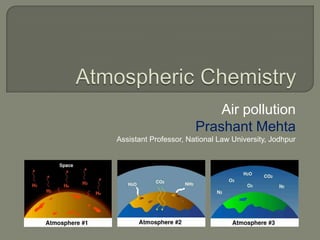
Air pollution
Prashant Mehta
Assistant Professor, National Law University, Jodhpur
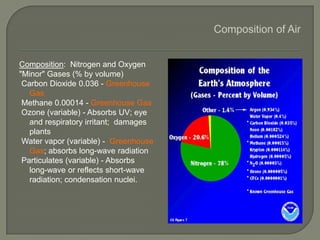
Composition: Nitrogen and Oxygen
"Minor" Gases (% by volume)
Carbon Dioxide 0.036 - Greenhouse
Gas
Methane 0.00014 - Greenhouse Gas
Ozone (variable) - Absorbs UV; eye
and respiratory irritant; damages
plants
Water vapor (variable) - Greenhouse
Gas; absorbs long-wave radiation
Particulates (variable) - Absorbs
long-wave or reflects short-wave
radiation; condensation nuclei.
 Atmosphere temperature and Chemistry is controlled by Trace Gases.
 Substances in the Lithosphere tend to become more reduced over time.
Thus biomass (CH2O) is slowly transformed through multiple steps to
substance containing no oxygen atoms and then to compounds with large
Carbon to Hydrogen ratio and then finally pure Carbon.
 Gravity prevents the gas molecules to escape from planet.
 Point Source (Stationary) – Industry
 Non Point Source (Mobile) – Transportation Vehicles
 The trace atmospheric constituents that are present in unexpectedly
high concentration or in concentrations which cause some
detrimental effect are called air pollutants.
 Air Pollution occurs when substances are released into air by human
activities in such concentrations as are sufficient to cause
detrimental effect on human health, vegetation, animals, and
property or interferes with the biosphere impacting the mankind.
 contamination of the air by noxious gases and minute particles of
solid and liquid matter (particulates) in concentrations that endanger
health
 Air pollution only occurs outdoors
1. Man Mad
(1) Industrial / Manufacturing.
(2) Mining / Metallurgical
(3) Transport etc.
2. Natural activities
(1) Biodegradation
(2) Volcanoes or anthropogenic activities
3. Combustion of gasoline and other hydrocarbon fuels in cars, trucks, and
airplanes
 Burning of fossil fuels (oil, coal, petro chemicals)
 Insecticides
 Herbicides
 Everyday radioactive fallouts
 Dust from fertilizers
 Livestock feedlots
These occur when:
 the rate of emission or formation of pollutants is greater than (>)the
rate of dispersion.
 Pollutants are dispersed through chemical destruction or removal by
winds or vertical transport via physical processes.
 London smog/Bhopal disaster are examples of this type of sever air
pollution .
 URBAN AIR POLLUTION
 Major Cause
Massive growth in size of cities, exponential growth in human
population, and rapidly growing number of automobiles especially
diesel vehicles.
1. PRIMARY POLLUTANTS 2. SECONDARY POLLUTANTS
These are directly released
/injected in the atmosphere.
 Sulfur Dioxide
 Nitrogen Oxides
 Hydrocarbons
 Carbon Monoxide
 Ground Level Ozone
 Carbon Dioxide, CFCs
 Volatile Organic Compounds
These pollutants are formed in
the atmosphere through
chemical reactions:
 Ground Level Ozone
 Photochemical Smog
 Organic Compounds
1. Primary Aerosol
These are directly released in
the air
 Soil particles
 Fly ash
 Smoke
2. Secondary Aerosols
These are formed in air via
gas to particle conversion
 Sulfate aerosols
 Nitrate aerosols
 Carbonaceous aerosols
1. BIOLOGICAL
 Seeds,
 Pollens
 Spores
 Hair
 Fragments of Plants/Animals/Insects
 Bacteria
 Fungi
 Microorganisms
 Algae
 Protozoa
 Viruses etc.
2. GEOCHEMICAL
 Directly released due to:
 Mining
 Volcanic eruptions
 Crushing
 Blasting
 Dispersion of dust through wind/human activities
3. OCEANIC
 Ocean is big source of marine salt (NaCl)
4.ANTHROPOGENIC
 Fossil fuel combustion
 Biomass burning
 Industrial activities
 Metallurgical processes
 Cement manufacture
 Automobiles, etc
5. OIHER SOURCES
 Forest fires
 Meteoritic debris
1. Inorganic Aerosols
These are inorganic compounds, Soluble: Salts like sodium
chloride, Ammonium sulfate, and Insoluble: Minerals etc.
2. Organic Aerosols
Made up of organic compounds, Carbonaceous particles, Polycyclic
Organic Compounds and Aromatic Hydrocarbons
 Creation of heat islands due to waste heat
 Lower average wind speeds
 Increase in fog frequency
 Changes in vertical structure of the lower boundary layer
 Formation of meso-scale circulation systems
 Temperature polarization
 Particulate Increase
 Less Vegetation
It affects urban temperature , moisture content and formation of
secondary pollutants.
It is unique to urban environment due to dense network of sources.
 Automobile/Transportation Exhausts
 Industrial Emissions
 Power Plant Plumes
 Domestic Heating/Cooking
 Air-conditioning
 Excess heat stored in buildings/other structures
 Lack of Plant Cover / Rapid Deforestation
Carbon Monoxide
Due to incomplete combustion of fuel. Correct air to fuel ratio is
14:6
If the mixture is rich(more fuel), there is insufficient oxygen to
completely oxidize hydrocarbons to carbon dioxide. It causes
oxygen deficiency by combining with hemoglobin to form carboxy-
hemoglobin, which is formed 250 times more than the oxy-
hemoglobin.
Un-burnt Hydrocarbons
Released by Exhaust Emissions, Evaporative Losses from Fuel
Tank.
These major sources of Toxic and Carcinogenic, Polycyclic
hydrocarbons and Volatile Organic Compounds
Odor
Due to partial oxidation of hydrocarbons into aldehydes.
Smoke / Soot
In diesel vehicles the emission of soot/smoke is most visible.
It is formed due to incomplete oxidation of carbon.
The soot particles are polymeric substances having carbon chains
Due to free valence the soot particles have sticking property.
Nitrogen oxides
High temperature of the combustion engine leads to the formation
of Nox
Petrol Engines release large amounts of CO
Diesel engines release large amounts of NOx, Smoke, Particulate,
and Odor.
Control Measures
 Proper Maintenance of the Engine
 Petrol Tank must be full to control evaporative losses.
 Catalytic converter / Fuel Injection system must be used.
 Blending fuels with bio-fuels
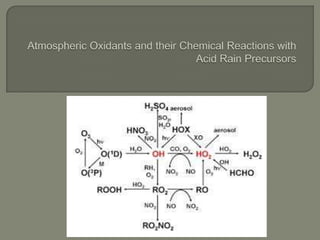
 The Earth’s Atmosphere is Basically Oxidizing in Nature.
 The Major Oxidant is Oxygen(21%) and Mostly Oxygen- Based Compounds
and Oxy – Radicals
 Other Oxidants are Cl2
-
 CO is removed by Atmospheric Oxygen
 Reactions are very slow at ambient conditions
 All reactions in atmospheric chemistry are photochemistry based as sun
provide major source of energy.
 All reactions are cyclic in nature that is they repeat indefinitely.
 These are:
Ozone
Hydrogen Peroxide
OH radical
HO2 Radical
NO3 Radical
SO4
- Radical
Organic Peroxy Radicals
 The hydroxyl radical (OH) dominates the daytime oxidation chemistry in the
troposphere, controlling the atmospheric lifetime of the majority of trace
species that are emitted natural or via man's activities.
 OH is primarily produced by the photolysis of ozone to form O(1D) followed
by reaction with H2O. It is the primary daytime oxidising species responsible
for the removal of CO, CH4 (and higher hydrocarbons), H2, NO2, H2S,
(CH3)2S, NH3, the hydrochlorofluorocarbons (HCFCs) and
hydrofluorocarbons (HFCs).
 The concentration of OH defines the oxidising capacity of the atmosphere
and hence the ability to control levels of species that contribute to global
warming, acid rain or photochemical smog. Intermediate peroxy radicals, of
which HO2 is the simplest, are generated during the oxidation of trace gases
and a fast photochemical cycle links these radicals with OH.
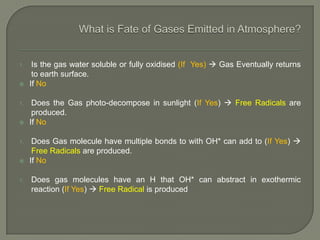
1. Is the gas water soluble or fully oxidised (If Yes)  Gas Eventually returns
to earth surface.
 If No
1. Does the Gas photo-decompose in sunlight (If Yes)  Free Radicals are
produced.
 If No
1. Does Gas molecule have multiple bonds to with OH* can add to (If Yes) 
Free Radicals are produced.
 If No
1. Does gas molecules have an H that OH* can abstract in exothermic
reaction (If Yes)  Free Radical is produced
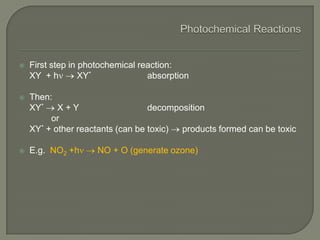
 First step in photochemical reaction:
XY + h XY* absorption
 Then:
XY* X + Y decomposition
or
XY* + other reactants (can be toxic) products formed can be toxic
 E.g. NO2 +h NO + O (generate ozone)
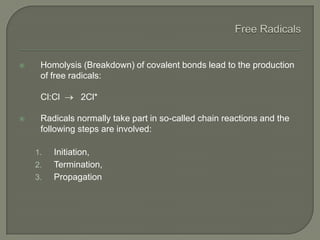
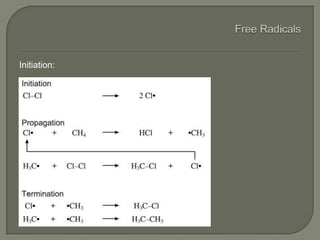
 Homolysis (Breakdown) of covalent bonds lead to the production
of free radicals:
Cl:Cl 2Cl*
 Radicals normally take part in so-called chain reactions and the
following steps are involved:
1. Initiation,
2. Termination,
3. Propagation
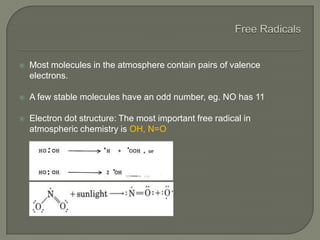
 Most molecules in the atmosphere contain pairs of valence
electrons.
 A few stable molecules have an odd number, eg. NO has 11
 Electron dot structure: The most important free radical in
atmospheric chemistry is OH, N=O
Initiation:
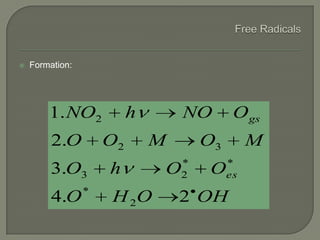
 Formation:
OHOHO
OOhO
MOMOO
ONOhNO
es
gs
2.4
.3
.2
.1
2
*
**
23
32
2
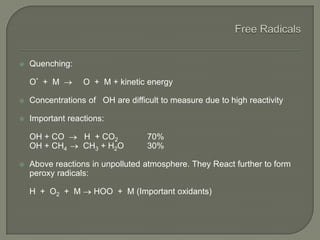
 Quenching:
O* + M O + M + kinetic energy
 Concentrations of OH are difficult to measure due to high reactivity
 Important reactions:
OH + CO H + CO2 70%
OH + CH4 CH3 + H2O 30%
 Above reactions in unpolluted atmosphere. They React further to form
peroxy radicals:
H + O2 + M HOO + M (Important oxidants)
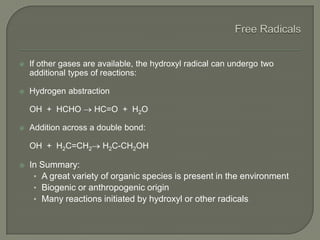
 If other gases are available, the hydroxyl radical can undergo two
additional types of reactions:
 Hydrogen abstraction
OH + HCHO HC=O + H2O
 Addition across a double bond:
OH + H2C=CH2 H2C-CH2OH
 In Summary:
• A great variety of organic species is present in the environment
• Biogenic or anthropogenic origin
• Many reactions initiated by hydroxyl or other radicals
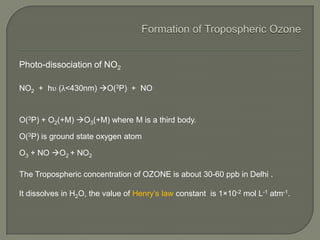
Photo-dissociation of NO2
NO2 + hυ (λ<430nm) O(3P) + NO
O(3P) + O2(+M) O3(+M) where M is a third body.
O(3P) is ground state oxygen atom
O3 + NO O2 + NO2
The Tropospheric concentration of OZONE is about 30-60 ppb in Delhi .
It dissolves in H2O, the value of Henry’s law constant is 1×10⁻² mol L-1 atm-1.
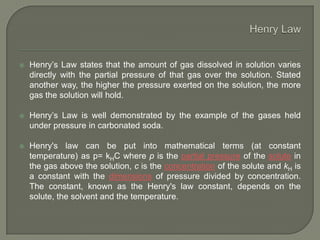
 Henry’s Law states that the amount of gas dissolved in solution varies
directly with the partial pressure of that gas over the solution. Stated
another way, the higher the pressure exerted on the solution, the more
gas the solution will hold.
 Henry’s Law is well demonstrated by the example of the gases held
under pressure in carbonated soda.
 Henry's law can be put into mathematical terms (at constant
temperature) as p= kHC where p is the partial pressure of the solute in
the gas above the solution, c is the concentration of the solute and kH is
a constant with the dimensions of pressure divided by concentration.
The constant, known as the Henry's law constant, depends on the
solute, the solvent and the temperature.
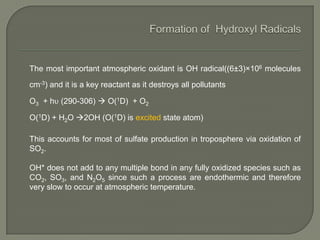
The most important atmospheric oxidant is OH radical((6±3)×106 molecules
cm-3) and it is a key reactant as it destroys all pollutants
O3 + hυ (290-306)  O(1D) + O2
O(1D) + H2O 2OH (O(1D) is excited state atom)
This accounts for most of sulfate production in troposphere via oxidation of
SO2.
OH* does not add to any multiple bond in any fully oxidized species such as
CO2, SO3, and N2O5 since such a process are endothermic and therefore
very slow to occur at atmospheric temperature.
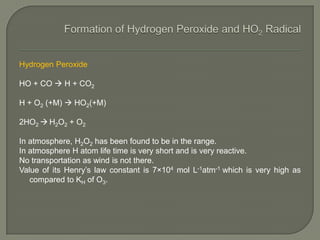
Hydrogen Peroxide
HO + CO  H + CO2
H + O2 (+M)  HO2(+M)
2HO2  H2O2 + O2
In atmosphere, H2O2 has been found to be in the range.
In atmosphere H atom life time is very short and is very reactive.
No transportation as wind is not there.
Value of its Henry’s law constant is 7×10⁴ mol L-1atm-1 which is very high as
compared to KH of O3.
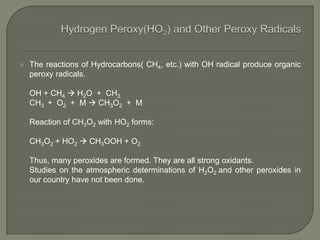
 The reactions of Hydrocarbons( CH4, etc.) with OH radical produce organic
peroxy radicals.
OH + CH4  H2O + CH3
CH3 + O2 + M  CH3O2 + M
Reaction of CH3O2 with HO2 forms:
CH3O2 + HO2  CH3OOH + O2
Thus, many peroxides are formed. They are all strong oxidants.
Studies on the atmospheric determinations of H2O2 and other peroxides in
our country have not been done.
 The importance of its chemistry has been realized over the past three
decades.
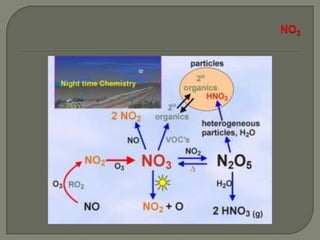
 NO3 plays an important role in both Troposphere and Stratosphere.
 Formation Reaction: NO2 + O3 NO3 + O2
 Its concentration is highest during night and lowest during the day. Its night
time concentration is ~ 109 molecule cm-3. It is easily photolyzed.
 OH radical in day and NO3 radical in night.
NO3 + hυ NO2 + O
NO3 + hυ NO + O2
It is most important oxidant during night time more than 100 times more than
OH ions but its reactivity is low.
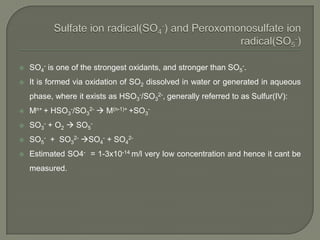
 SO4
- is one of the strongest oxidants, and stronger than SO5
-.
 It is formed via oxidation of SO2 dissolved in water or generated in aqueous
phase, where it exists as HSO3
-/SO3
2-, generally referred to as Sulfur(IV):
 Mn+ + HSO3
-/SO3
2-  M(n-1)+ +SO3
-
 SO3
- + O2  SO5
-
 SO5
- + SO3
2- SO4
- + SO4
2-
 Estimated SO4- = 1-3x10-14 m/l very low concentration and hence it cant be
measured.
 In dust – free and unpolluted atmosphere pH of rain water and other
aqueous systems is determined by following reactions:
CO2(g) + H2O ↔ CO2
.H2O; KH = 4.5x10⁻² mol L-1 atm-1
CO2
.H2O ↔H+ + HCO3
-; K1 = 3.8х10-7 mol L-1 (carbonic acid)
These Eqs. show, [H+] = ( K1KHpCO2)½ , With = pCO2 =380 ppm = 3.8 х 10-4
atm, one gets, pH = ~ 5.6
So Reference or Background pH for Rain Water = 5.6, If the pH of rain
water is less than 5.6, it is called acid rain
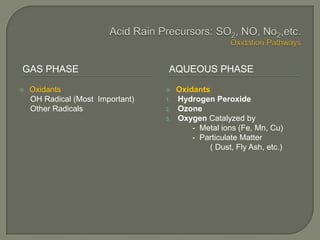
GAS PHASE AQUEOUS PHASE
 Oxidants
OH Radical (Most Important)
Other Radicals
 Oxidants
1. Hydrogen Peroxide
2. Ozone
3. Oxygen Catalyzed by
- Metal ions (Fe, Mn, Cu)
- Particulate Matter
( Dust, Fly Ash, etc.)
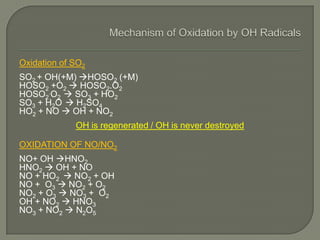
Oxidation of SO2
SO2 + OH(+M) HOSO2 (+M)
HOSO2 +O2  HOSO2.O2
HOSO2
.O2  SO3 + HO2
SO3 + H2O  H2SO4
HO2 + NO  OH + NO2
OH is regenerated / OH is never destroyed
OXIDATION OF NO/NO2
NO+ OH HNO2
HNO2  OH + NO
NO + HO2  NO2 + OH
NO + O3  NO2 + O2
NO2 + O3  NO3 + O2
OH + NO2  HNO3
NO3 + NO2  N2O5
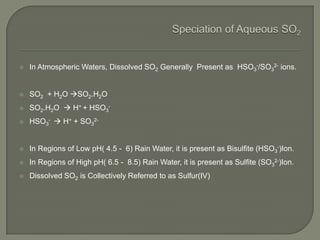
 In Atmospheric Waters, Dissolved SO2 Generally Present as HSO3
-/SO3
2- ions.
 SO2 + H2O SO2.H2O
 SO2.H2O  H+ + HSO3
-
 HSO3
-  H+ + SO3
2-
 In Regions of Low pH( 4.5 - 6) Rain Water, it is present as Bisulfite (HSO3
-)Ion.
 In Regions of High pH( 6.5 - 8.5) Rain Water, it is present as Sulfite (SO3
2-)Ion.
 Dissolved SO2 is Collectively Referred to as Sulfur(IV)
 In Absence of Transition metal Ions, Oxidation of SO2 in Aqueous
Phase is Slow.
 The Trace Transition metal Ions, Present as Impurity in All Forms of
Atmospheric Waters Strongly Catalyze the Autoxidation.
 From Atmospheric Point of View, Important Metal Ions in Order of
Decreasing Importance are:
Fe(III)/Fe(II), Mn(II),
Cu(II),
Co(II) ,Ni(II)
1. Ammonia/ Ammonium Ions
Present as Gaseous Ammonia and Ammonium Aerosols: (NH4)2SO4
2. Volatile Organic Compounds: A large number of volatile organic
compounds (VOCs), hydrocarbons, alcohols, carboxylic acids, aldehydes,
terpenes, phenols, polycyclic aromatic, hydrocarbons(PAHs)etc. are found
in trace amounts in atmosphere.
The VOCs such as ethanol, benzene, phenols are known to scavenge
the SO4
- radical and inhibit the sulfur(IV) autoxidation as in Eq.:
SO4
- + organics SO4
2- + non-chain products
2. Suspended Particulate Matter: Dust, Fly Ash, Rock and Mineral Particles,
Carbonaceous Particles, Metal Oxides
Atmospheric Oxidants

Atmospheric Oxidants

  • 1.
    Air pollution Prashant Mehta AssistantProfessor, National Law University, Jodhpur
  • 2.
    Composition: Nitrogen andOxygen "Minor" Gases (% by volume) Carbon Dioxide 0.036 - Greenhouse Gas Methane 0.00014 - Greenhouse Gas Ozone (variable) - Absorbs UV; eye and respiratory irritant; damages plants Water vapor (variable) - Greenhouse Gas; absorbs long-wave radiation Particulates (variable) - Absorbs long-wave or reflects short-wave radiation; condensation nuclei.
  • 3.
     Atmosphere temperatureand Chemistry is controlled by Trace Gases.  Substances in the Lithosphere tend to become more reduced over time. Thus biomass (CH2O) is slowly transformed through multiple steps to substance containing no oxygen atoms and then to compounds with large Carbon to Hydrogen ratio and then finally pure Carbon.  Gravity prevents the gas molecules to escape from planet.  Point Source (Stationary) – Industry  Non Point Source (Mobile) – Transportation Vehicles
  • 4.
     The traceatmospheric constituents that are present in unexpectedly high concentration or in concentrations which cause some detrimental effect are called air pollutants.  Air Pollution occurs when substances are released into air by human activities in such concentrations as are sufficient to cause detrimental effect on human health, vegetation, animals, and property or interferes with the biosphere impacting the mankind.  contamination of the air by noxious gases and minute particles of solid and liquid matter (particulates) in concentrations that endanger health  Air pollution only occurs outdoors
  • 5.
    1. Man Mad (1)Industrial / Manufacturing. (2) Mining / Metallurgical (3) Transport etc. 2. Natural activities (1) Biodegradation (2) Volcanoes or anthropogenic activities 3. Combustion of gasoline and other hydrocarbon fuels in cars, trucks, and airplanes  Burning of fossil fuels (oil, coal, petro chemicals)  Insecticides  Herbicides  Everyday radioactive fallouts  Dust from fertilizers  Livestock feedlots
  • 6.
    These occur when: the rate of emission or formation of pollutants is greater than (>)the rate of dispersion.  Pollutants are dispersed through chemical destruction or removal by winds or vertical transport via physical processes.  London smog/Bhopal disaster are examples of this type of sever air pollution .  URBAN AIR POLLUTION  Major Cause Massive growth in size of cities, exponential growth in human population, and rapidly growing number of automobiles especially diesel vehicles.
  • 7.
    1. PRIMARY POLLUTANTS2. SECONDARY POLLUTANTS These are directly released /injected in the atmosphere.  Sulfur Dioxide  Nitrogen Oxides  Hydrocarbons  Carbon Monoxide  Ground Level Ozone  Carbon Dioxide, CFCs  Volatile Organic Compounds These pollutants are formed in the atmosphere through chemical reactions:  Ground Level Ozone  Photochemical Smog  Organic Compounds
  • 8.
    1. Primary Aerosol Theseare directly released in the air  Soil particles  Fly ash  Smoke 2. Secondary Aerosols These are formed in air via gas to particle conversion  Sulfate aerosols  Nitrate aerosols  Carbonaceous aerosols
  • 9.
    1. BIOLOGICAL  Seeds, Pollens  Spores  Hair  Fragments of Plants/Animals/Insects  Bacteria  Fungi  Microorganisms  Algae  Protozoa  Viruses etc.
  • 10.
    2. GEOCHEMICAL  Directlyreleased due to:  Mining  Volcanic eruptions  Crushing  Blasting  Dispersion of dust through wind/human activities 3. OCEANIC  Ocean is big source of marine salt (NaCl)
  • 11.
    4.ANTHROPOGENIC  Fossil fuelcombustion  Biomass burning  Industrial activities  Metallurgical processes  Cement manufacture  Automobiles, etc 5. OIHER SOURCES  Forest fires  Meteoritic debris
  • 12.
    1. Inorganic Aerosols Theseare inorganic compounds, Soluble: Salts like sodium chloride, Ammonium sulfate, and Insoluble: Minerals etc. 2. Organic Aerosols Made up of organic compounds, Carbonaceous particles, Polycyclic Organic Compounds and Aromatic Hydrocarbons
  • 13.
     Creation ofheat islands due to waste heat  Lower average wind speeds  Increase in fog frequency  Changes in vertical structure of the lower boundary layer  Formation of meso-scale circulation systems  Temperature polarization  Particulate Increase  Less Vegetation
  • 14.
    It affects urbantemperature , moisture content and formation of secondary pollutants. It is unique to urban environment due to dense network of sources.  Automobile/Transportation Exhausts  Industrial Emissions  Power Plant Plumes  Domestic Heating/Cooking  Air-conditioning  Excess heat stored in buildings/other structures  Lack of Plant Cover / Rapid Deforestation
  • 15.
    Carbon Monoxide Due toincomplete combustion of fuel. Correct air to fuel ratio is 14:6 If the mixture is rich(more fuel), there is insufficient oxygen to completely oxidize hydrocarbons to carbon dioxide. It causes oxygen deficiency by combining with hemoglobin to form carboxy- hemoglobin, which is formed 250 times more than the oxy- hemoglobin. Un-burnt Hydrocarbons Released by Exhaust Emissions, Evaporative Losses from Fuel Tank. These major sources of Toxic and Carcinogenic, Polycyclic hydrocarbons and Volatile Organic Compounds
  • 16.
    Odor Due to partialoxidation of hydrocarbons into aldehydes. Smoke / Soot In diesel vehicles the emission of soot/smoke is most visible. It is formed due to incomplete oxidation of carbon. The soot particles are polymeric substances having carbon chains Due to free valence the soot particles have sticking property. Nitrogen oxides High temperature of the combustion engine leads to the formation of Nox
  • 17.
    Petrol Engines releaselarge amounts of CO Diesel engines release large amounts of NOx, Smoke, Particulate, and Odor. Control Measures  Proper Maintenance of the Engine  Petrol Tank must be full to control evaporative losses.  Catalytic converter / Fuel Injection system must be used.  Blending fuels with bio-fuels
  • 18.
     The Earth’sAtmosphere is Basically Oxidizing in Nature.  The Major Oxidant is Oxygen(21%) and Mostly Oxygen- Based Compounds and Oxy – Radicals  Other Oxidants are Cl2 -  CO is removed by Atmospheric Oxygen  Reactions are very slow at ambient conditions  All reactions in atmospheric chemistry are photochemistry based as sun provide major source of energy.  All reactions are cyclic in nature that is they repeat indefinitely.
  • 19.
     These are: Ozone HydrogenPeroxide OH radical HO2 Radical NO3 Radical SO4 - Radical Organic Peroxy Radicals
  • 20.
     The hydroxylradical (OH) dominates the daytime oxidation chemistry in the troposphere, controlling the atmospheric lifetime of the majority of trace species that are emitted natural or via man's activities.  OH is primarily produced by the photolysis of ozone to form O(1D) followed by reaction with H2O. It is the primary daytime oxidising species responsible for the removal of CO, CH4 (and higher hydrocarbons), H2, NO2, H2S, (CH3)2S, NH3, the hydrochlorofluorocarbons (HCFCs) and hydrofluorocarbons (HFCs).  The concentration of OH defines the oxidising capacity of the atmosphere and hence the ability to control levels of species that contribute to global warming, acid rain or photochemical smog. Intermediate peroxy radicals, of which HO2 is the simplest, are generated during the oxidation of trace gases and a fast photochemical cycle links these radicals with OH.
  • 21.
    1. Is thegas water soluble or fully oxidised (If Yes)  Gas Eventually returns to earth surface.  If No 1. Does the Gas photo-decompose in sunlight (If Yes)  Free Radicals are produced.  If No 1. Does Gas molecule have multiple bonds to with OH* can add to (If Yes)  Free Radicals are produced.  If No 1. Does gas molecules have an H that OH* can abstract in exothermic reaction (If Yes)  Free Radical is produced
  • 22.
     First stepin photochemical reaction: XY + h XY* absorption  Then: XY* X + Y decomposition or XY* + other reactants (can be toxic) products formed can be toxic  E.g. NO2 +h NO + O (generate ozone)
  • 23.
     Homolysis (Breakdown)of covalent bonds lead to the production of free radicals: Cl:Cl 2Cl*  Radicals normally take part in so-called chain reactions and the following steps are involved: 1. Initiation, 2. Termination, 3. Propagation
  • 24.
     Most moleculesin the atmosphere contain pairs of valence electrons.  A few stable molecules have an odd number, eg. NO has 11  Electron dot structure: The most important free radical in atmospheric chemistry is OH, N=O
  • 25.
  • 26.
  • 27.
     Quenching: O* +M O + M + kinetic energy  Concentrations of OH are difficult to measure due to high reactivity  Important reactions: OH + CO H + CO2 70% OH + CH4 CH3 + H2O 30%  Above reactions in unpolluted atmosphere. They React further to form peroxy radicals: H + O2 + M HOO + M (Important oxidants)
  • 28.
     If othergases are available, the hydroxyl radical can undergo two additional types of reactions:  Hydrogen abstraction OH + HCHO HC=O + H2O  Addition across a double bond: OH + H2C=CH2 H2C-CH2OH  In Summary: • A great variety of organic species is present in the environment • Biogenic or anthropogenic origin • Many reactions initiated by hydroxyl or other radicals
  • 29.
    Photo-dissociation of NO2 NO2+ hυ (λ<430nm) O(3P) + NO O(3P) + O2(+M) O3(+M) where M is a third body. O(3P) is ground state oxygen atom O3 + NO O2 + NO2 The Tropospheric concentration of OZONE is about 30-60 ppb in Delhi . It dissolves in H2O, the value of Henry’s law constant is 1×10⁻² mol L-1 atm-1.
  • 30.
     Henry’s Lawstates that the amount of gas dissolved in solution varies directly with the partial pressure of that gas over the solution. Stated another way, the higher the pressure exerted on the solution, the more gas the solution will hold.  Henry’s Law is well demonstrated by the example of the gases held under pressure in carbonated soda.  Henry's law can be put into mathematical terms (at constant temperature) as p= kHC where p is the partial pressure of the solute in the gas above the solution, c is the concentration of the solute and kH is a constant with the dimensions of pressure divided by concentration. The constant, known as the Henry's law constant, depends on the solute, the solvent and the temperature.
  • 31.
    The most importantatmospheric oxidant is OH radical((6±3)×106 molecules cm-3) and it is a key reactant as it destroys all pollutants O3 + hυ (290-306)  O(1D) + O2 O(1D) + H2O 2OH (O(1D) is excited state atom) This accounts for most of sulfate production in troposphere via oxidation of SO2. OH* does not add to any multiple bond in any fully oxidized species such as CO2, SO3, and N2O5 since such a process are endothermic and therefore very slow to occur at atmospheric temperature.
  • 32.
    Hydrogen Peroxide HO +CO  H + CO2 H + O2 (+M)  HO2(+M) 2HO2  H2O2 + O2 In atmosphere, H2O2 has been found to be in the range. In atmosphere H atom life time is very short and is very reactive. No transportation as wind is not there. Value of its Henry’s law constant is 7×10⁴ mol L-1atm-1 which is very high as compared to KH of O3.
  • 33.
     The reactionsof Hydrocarbons( CH4, etc.) with OH radical produce organic peroxy radicals. OH + CH4  H2O + CH3 CH3 + O2 + M  CH3O2 + M Reaction of CH3O2 with HO2 forms: CH3O2 + HO2  CH3OOH + O2 Thus, many peroxides are formed. They are all strong oxidants. Studies on the atmospheric determinations of H2O2 and other peroxides in our country have not been done.
  • 34.
     The importanceof its chemistry has been realized over the past three decades.  NO3 plays an important role in both Troposphere and Stratosphere.  Formation Reaction: NO2 + O3 NO3 + O2  Its concentration is highest during night and lowest during the day. Its night time concentration is ~ 109 molecule cm-3. It is easily photolyzed.  OH radical in day and NO3 radical in night. NO3 + hυ NO2 + O NO3 + hυ NO + O2 It is most important oxidant during night time more than 100 times more than OH ions but its reactivity is low.
  • 37.
     SO4 - isone of the strongest oxidants, and stronger than SO5 -.  It is formed via oxidation of SO2 dissolved in water or generated in aqueous phase, where it exists as HSO3 -/SO3 2-, generally referred to as Sulfur(IV):  Mn+ + HSO3 -/SO3 2-  M(n-1)+ +SO3 -  SO3 - + O2  SO5 -  SO5 - + SO3 2- SO4 - + SO4 2-  Estimated SO4- = 1-3x10-14 m/l very low concentration and hence it cant be measured.
  • 38.
     In dust– free and unpolluted atmosphere pH of rain water and other aqueous systems is determined by following reactions: CO2(g) + H2O ↔ CO2 .H2O; KH = 4.5x10⁻² mol L-1 atm-1 CO2 .H2O ↔H+ + HCO3 -; K1 = 3.8х10-7 mol L-1 (carbonic acid) These Eqs. show, [H+] = ( K1KHpCO2)½ , With = pCO2 =380 ppm = 3.8 х 10-4 atm, one gets, pH = ~ 5.6 So Reference or Background pH for Rain Water = 5.6, If the pH of rain water is less than 5.6, it is called acid rain
  • 39.
    GAS PHASE AQUEOUSPHASE  Oxidants OH Radical (Most Important) Other Radicals  Oxidants 1. Hydrogen Peroxide 2. Ozone 3. Oxygen Catalyzed by - Metal ions (Fe, Mn, Cu) - Particulate Matter ( Dust, Fly Ash, etc.)
  • 40.
    Oxidation of SO2 SO2+ OH(+M) HOSO2 (+M) HOSO2 +O2  HOSO2.O2 HOSO2 .O2  SO3 + HO2 SO3 + H2O  H2SO4 HO2 + NO  OH + NO2 OH is regenerated / OH is never destroyed OXIDATION OF NO/NO2 NO+ OH HNO2 HNO2  OH + NO NO + HO2  NO2 + OH NO + O3  NO2 + O2 NO2 + O3  NO3 + O2 OH + NO2  HNO3 NO3 + NO2  N2O5
  • 41.
     In AtmosphericWaters, Dissolved SO2 Generally Present as HSO3 -/SO3 2- ions.  SO2 + H2O SO2.H2O  SO2.H2O  H+ + HSO3 -  HSO3 -  H+ + SO3 2-  In Regions of Low pH( 4.5 - 6) Rain Water, it is present as Bisulfite (HSO3 -)Ion.  In Regions of High pH( 6.5 - 8.5) Rain Water, it is present as Sulfite (SO3 2-)Ion.  Dissolved SO2 is Collectively Referred to as Sulfur(IV)
  • 42.
     In Absenceof Transition metal Ions, Oxidation of SO2 in Aqueous Phase is Slow.  The Trace Transition metal Ions, Present as Impurity in All Forms of Atmospheric Waters Strongly Catalyze the Autoxidation.  From Atmospheric Point of View, Important Metal Ions in Order of Decreasing Importance are: Fe(III)/Fe(II), Mn(II), Cu(II), Co(II) ,Ni(II)
  • 43.
    1. Ammonia/ AmmoniumIons Present as Gaseous Ammonia and Ammonium Aerosols: (NH4)2SO4 2. Volatile Organic Compounds: A large number of volatile organic compounds (VOCs), hydrocarbons, alcohols, carboxylic acids, aldehydes, terpenes, phenols, polycyclic aromatic, hydrocarbons(PAHs)etc. are found in trace amounts in atmosphere. The VOCs such as ethanol, benzene, phenols are known to scavenge the SO4 - radical and inhibit the sulfur(IV) autoxidation as in Eq.: SO4 - + organics SO4 2- + non-chain products 2. Suspended Particulate Matter: Dust, Fly Ash, Rock and Mineral Particles, Carbonaceous Particles, Metal Oxides