
RAIN WATER
• In its purest form, rainwater is like distilled water.
• It does not have carbon dioxide (CO2) dissolved in it.
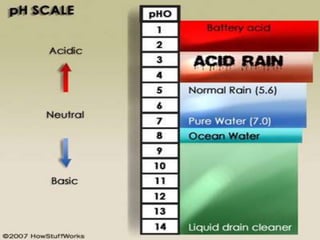
• It is neutral, with a pH level of 7. (if pH is above 7 is said to be basic
in nature and if pH below 7 said to be acidic in nature).
• As rainwater falls through the atmosphere, particles suspended in
the air are dissolved in it.
• These substances are generally dust, pollen grains and carbon
dioxide (CO2).
• Emissions of volcanoes and lightning tend to decrease the pH level
of acid rain, making it even more acidic.
FORMATION OF CARBONIC ACID
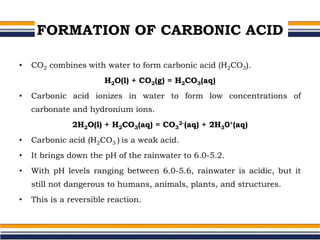
• CO2 combines with water to form carbonic acid (H2CO3).
H2O(l) + CO2(g) = H2CO3(aq)
• Carbonic acid ionizes in water to form low concentrations of
carbonate and hydronium ions.
2H2O(l) + H2CO3(aq) = CO3
2-(aq) + 2H30+(aq)
• Carbonic acid (H2CO3 ) is a weak acid.
• It brings down the pH of the rainwater to 6.0-5.2.
• With pH levels ranging between 6.0-5.6, rainwater is acidic, but it
still not dangerous to humans, animals, plants, and structures.
• This is a reversible reaction.
COMPOSITION OF ACID RAIN
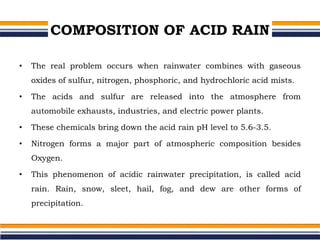
• The real problem occurs when rainwater combines with gaseous
oxides of sulfur, nitrogen, phosphoric, and hydrochloric acid mists.
• The acids and sulfur are released into the atmosphere from
automobile exhausts, industries, and electric power plants.
• These chemicals bring down the acid rain pH level to 5.6-3.5.
• Nitrogen forms a major part of atmospheric composition besides
Oxygen.
• This phenomenon of acidic rainwater precipitation, is called acid
rain. Rain, snow, sleet, hail, fog, and dew are other forms of
precipitation.
ACID RAIN - SULPHUR
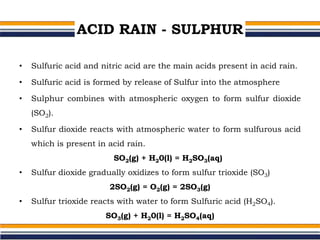
• Sulfuric acid and nitric acid are the main acids present in acid rain.
• Sulfuric acid is formed by release of Sulfur into the atmosphere
• Sulphur combines with atmospheric oxygen to form sulfur dioxide
(SO2).
• Sulfur dioxide reacts with atmospheric water to form sulfurous acid
which is present in acid rain.
SO2(g) + H20(l) = H2SO3(aq)
• Sulfur dioxide gradually oxidizes to form sulfur trioxide (SO3)
2SO2(g) = O2(g) = 2SO3(g)
• Sulfur trioxide reacts with water to form Sulfuric acid (H2SO4).
SO3(g) + H20(l) = H2SO4(aq)
ACID RAIN – NITROGEN DIOXIDE
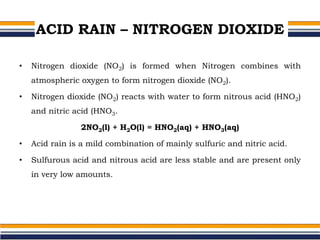
• Nitrogen dioxide (NO2) is formed when Nitrogen combines with
atmospheric oxygen to form nitrogen dioxide (NO2).
• Nitrogen dioxide (NO2) reacts with water to form nitrous acid (HNO2)
and nitric acid (HNO3.
2NO2(l) + H2O(l) = HNO2(aq) + HNO3(aq)
• Acid rain is a mild combination of mainly sulfuric and nitric acid.
• Sulfurous acid and nitrous acid are less stable and are present only
in very low amounts.
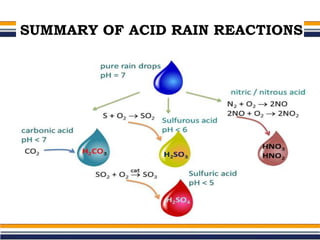
SUMMARY OF ACID RAIN REACTIONS
EFFECTS OF ACID RAIN
BUILDING & MONUMENTS
• Acid rain causes severe damage to buildings and marble statues.
• Acid rain reacts with the calcium carbonate (CaCo3) to form soluble
calcium hydrogen carbonate or calcium bicarbonate.
Ca(HCO3)2 - CaCO3 + Acid rain = Ca(HCO3)2(aq)
• Calcium bicarbonate is a powdery substance, which is easily
washed away with rainwater.
• Acid rain can destroy stained glass windows, corrode bridges made
of steel, metal, ruins the paint color, weakens leather and forms a
crust on glass surfaces. World-famous monuments like the Taj
Mahal, India, St. Paul's Cathedral, London, and the Statue of
Liberty, New York have been eroded by acid rain.
EFFECTS OF ACID RAIN
TREES & PLANTS - FORESTS
• Acid rain washes away important minerals from leaves and soil.
• Leaves of the plants have a waxy layered protection on them. The
acid rain damages this layer and causes harm to the trees.
• Acid rain also blocks the small pores on the leaves' surface, through
which they take in carbon dioxide.
• With improper functioning of leaves, the growth of trees gets
retarded. This results in a loss of leaves, stunted growth and
damaged bark.
• Such trees are more prone to attacks by fungi and insects.
• This can even result in the death of trees.
EFFECTS OF ACID RAIN
SOILS
• Soil contains many harmful minerals such as mercury (Hg) and
aluminum (Al).
• These elements can't be absorbed by plants and trees and are thus
harmless. However, upon contact with acid rain, these chemicals
undergo chemical reactions with the acids.
• As a result, compounds of aluminum, lead, and mercury are formed.
• Plants and trees can easily absorb these compounds.
• Such elements, which are extremely harmful to living forms,
ultimately affect the entire food chain.
• These chemicals not only harm the flora, but also the animals that
feed on them.
EFFECTS OF ACID RAIN
WATER BODIES
• Harmful substances like aluminum, lead and mercury are washed
away from the soil to adjoining water resources by the acid rain,
thus resulting in water pollution.
• These chemicals and their acids do not allow the flora and fauna to
grow and reproduce.
• This also results in depletion of oxygen levels in water, thereby
making it difficult for fish to respire.
• Fish die due to suffocation and poisoning caused by the presence of
these chemicals.
• Birds that feed on fish that are affected by these harmful chemicals,
accumulate these elements in their systems.
EFFECTS OF ACID RAIN
WATER BODIES
• These chemicals are then passed on to animals that feed on such
birds.
• In this manner, chemicals get introduced to each trophic level of the
food chain.
• In each trophic level, the concentration of chemicals gets multiplied.
This phenomenon is known as biomagnification.
• A high amount of sulfuric acid in the seawater interferes with the
ability of fish to take in nutrients, salt, and oxygen.
• It kills them and when they die, they decompose and remain at the
bottom of the sea. This causes further harm to the water and also to
its inhabitants.
EFFECTS OF ACID RAIN
HUMAN HEALTH
• Acid rain is harmful to human health.
• Drinking water contaminated by aluminum, mercury and lead is
highly dangerous for human health.
• Acids are very small, fine particles, and are normally in a liquid
state. When they are present in the atmosphere, they easily enter
the lungs while breathing causing respiratory problems.
• The emissions of nitrogen oxide and sulfur dioxide cause problems
like irritation of throat, nose and the eyes, headache, asthma, and
dry cough.
• Research has proven that prolonged exposure to these particles can
even lead to cancer.
SOLUTIONS TO ACID RAIN
• Acid rain is potent enough to destroy life on Earth and it damages
anything it comes in contact with.
• It ruins forests, water bodies, soil, infrastructure, and the health of
living beings.
• There is a solution to every problem, and acid rain is no exception.
• Reduce the use of fossil fuels thereby reducing emission of nitrogen
and sulfur in the environment.
• Switching over to alternative forms of energy such as geothermal,
water, wind, and solar power would help to a great extent.
• Installing Flue Gas Desulfurization e.g. wet scrubber in coal-burning
power plants to remove sulfur-containing gases.
Acid rain

Acid rain

  • 2.
    RAIN WATER • Inits purest form, rainwater is like distilled water. • It does not have carbon dioxide (CO2) dissolved in it. • It is neutral, with a pH level of 7. (if pH is above 7 is said to be basic in nature and if pH below 7 said to be acidic in nature). • As rainwater falls through the atmosphere, particles suspended in the air are dissolved in it. • These substances are generally dust, pollen grains and carbon dioxide (CO2). • Emissions of volcanoes and lightning tend to decrease the pH level of acid rain, making it even more acidic.
  • 4.
    FORMATION OF CARBONICACID • CO2 combines with water to form carbonic acid (H2CO3). H2O(l) + CO2(g) = H2CO3(aq) • Carbonic acid ionizes in water to form low concentrations of carbonate and hydronium ions. 2H2O(l) + H2CO3(aq) = CO3 2-(aq) + 2H30+(aq) • Carbonic acid (H2CO3 ) is a weak acid. • It brings down the pH of the rainwater to 6.0-5.2. • With pH levels ranging between 6.0-5.6, rainwater is acidic, but it still not dangerous to humans, animals, plants, and structures. • This is a reversible reaction.
  • 5.
    COMPOSITION OF ACIDRAIN • The real problem occurs when rainwater combines with gaseous oxides of sulfur, nitrogen, phosphoric, and hydrochloric acid mists. • The acids and sulfur are released into the atmosphere from automobile exhausts, industries, and electric power plants. • These chemicals bring down the acid rain pH level to 5.6-3.5. • Nitrogen forms a major part of atmospheric composition besides Oxygen. • This phenomenon of acidic rainwater precipitation, is called acid rain. Rain, snow, sleet, hail, fog, and dew are other forms of precipitation.
  • 6.
    ACID RAIN -SULPHUR • Sulfuric acid and nitric acid are the main acids present in acid rain. • Sulfuric acid is formed by release of Sulfur into the atmosphere • Sulphur combines with atmospheric oxygen to form sulfur dioxide (SO2). • Sulfur dioxide reacts with atmospheric water to form sulfurous acid which is present in acid rain. SO2(g) + H20(l) = H2SO3(aq) • Sulfur dioxide gradually oxidizes to form sulfur trioxide (SO3) 2SO2(g) = O2(g) = 2SO3(g) • Sulfur trioxide reacts with water to form Sulfuric acid (H2SO4). SO3(g) + H20(l) = H2SO4(aq)
  • 7.
    ACID RAIN –NITROGEN DIOXIDE • Nitrogen dioxide (NO2) is formed when Nitrogen combines with atmospheric oxygen to form nitrogen dioxide (NO2). • Nitrogen dioxide (NO2) reacts with water to form nitrous acid (HNO2) and nitric acid (HNO3. 2NO2(l) + H2O(l) = HNO2(aq) + HNO3(aq) • Acid rain is a mild combination of mainly sulfuric and nitric acid. • Sulfurous acid and nitrous acid are less stable and are present only in very low amounts.
  • 8.
    SUMMARY OF ACIDRAIN REACTIONS
  • 9.
    EFFECTS OF ACIDRAIN BUILDING & MONUMENTS • Acid rain causes severe damage to buildings and marble statues. • Acid rain reacts with the calcium carbonate (CaCo3) to form soluble calcium hydrogen carbonate or calcium bicarbonate. Ca(HCO3)2 - CaCO3 + Acid rain = Ca(HCO3)2(aq) • Calcium bicarbonate is a powdery substance, which is easily washed away with rainwater. • Acid rain can destroy stained glass windows, corrode bridges made of steel, metal, ruins the paint color, weakens leather and forms a crust on glass surfaces. World-famous monuments like the Taj Mahal, India, St. Paul's Cathedral, London, and the Statue of Liberty, New York have been eroded by acid rain.
  • 10.
    EFFECTS OF ACIDRAIN TREES & PLANTS - FORESTS • Acid rain washes away important minerals from leaves and soil. • Leaves of the plants have a waxy layered protection on them. The acid rain damages this layer and causes harm to the trees. • Acid rain also blocks the small pores on the leaves' surface, through which they take in carbon dioxide. • With improper functioning of leaves, the growth of trees gets retarded. This results in a loss of leaves, stunted growth and damaged bark. • Such trees are more prone to attacks by fungi and insects. • This can even result in the death of trees.
  • 11.
    EFFECTS OF ACIDRAIN SOILS • Soil contains many harmful minerals such as mercury (Hg) and aluminum (Al). • These elements can't be absorbed by plants and trees and are thus harmless. However, upon contact with acid rain, these chemicals undergo chemical reactions with the acids. • As a result, compounds of aluminum, lead, and mercury are formed. • Plants and trees can easily absorb these compounds. • Such elements, which are extremely harmful to living forms, ultimately affect the entire food chain. • These chemicals not only harm the flora, but also the animals that feed on them.
  • 12.
    EFFECTS OF ACIDRAIN WATER BODIES • Harmful substances like aluminum, lead and mercury are washed away from the soil to adjoining water resources by the acid rain, thus resulting in water pollution. • These chemicals and their acids do not allow the flora and fauna to grow and reproduce. • This also results in depletion of oxygen levels in water, thereby making it difficult for fish to respire. • Fish die due to suffocation and poisoning caused by the presence of these chemicals. • Birds that feed on fish that are affected by these harmful chemicals, accumulate these elements in their systems.
  • 13.
    EFFECTS OF ACIDRAIN WATER BODIES • These chemicals are then passed on to animals that feed on such birds. • In this manner, chemicals get introduced to each trophic level of the food chain. • In each trophic level, the concentration of chemicals gets multiplied. This phenomenon is known as biomagnification. • A high amount of sulfuric acid in the seawater interferes with the ability of fish to take in nutrients, salt, and oxygen. • It kills them and when they die, they decompose and remain at the bottom of the sea. This causes further harm to the water and also to its inhabitants.
  • 14.
    EFFECTS OF ACIDRAIN HUMAN HEALTH • Acid rain is harmful to human health. • Drinking water contaminated by aluminum, mercury and lead is highly dangerous for human health. • Acids are very small, fine particles, and are normally in a liquid state. When they are present in the atmosphere, they easily enter the lungs while breathing causing respiratory problems. • The emissions of nitrogen oxide and sulfur dioxide cause problems like irritation of throat, nose and the eyes, headache, asthma, and dry cough. • Research has proven that prolonged exposure to these particles can even lead to cancer.
  • 15.
    SOLUTIONS TO ACIDRAIN • Acid rain is potent enough to destroy life on Earth and it damages anything it comes in contact with. • It ruins forests, water bodies, soil, infrastructure, and the health of living beings. • There is a solution to every problem, and acid rain is no exception. • Reduce the use of fossil fuels thereby reducing emission of nitrogen and sulfur in the environment. • Switching over to alternative forms of energy such as geothermal, water, wind, and solar power would help to a great extent. • Installing Flue Gas Desulfurization e.g. wet scrubber in coal-burning power plants to remove sulfur-containing gases.