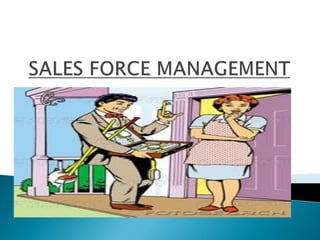
Although selling is an extremely important
function in most organizations it does have
something of a bad reputation. This has mainly
come about from the kind of hard selling
associated with door-to-door selling. This
image is quite far removed from the majority of
selling that takes place especially in the
business-to-business sector. Much of a
salesperson’s time is not actually taken up by
selling but with a variety of other tasks that they
have to undertake in order to achieve the sale.
 Sales force organization refers to the type
and size of the sales force. The type
determines the degree of controllability while
the size has profit implications. If the sales
force is large the organization has to decide
about the kind of specialization and co-
ordination to use
Recruitment:
It is the process of finding out candidates,
who are encouraged to apply. Selection is
the process of choosing some out of many
candidates. Therefore, we can say that
selection is recruitment, but recruitment is
not selection. Selection is the process of
rejection of unfits. Recruitment precedes
the selection process.
There are two types of recruitment:
 Internal Sources
 External Sources
Internal Sources:
As the name says, it means the recruitment of people within the
organization. They fill in vacancies with the existing members
within the existing organization. This can also be termed as
promotion.
Merits:
 Co-operation
 Loyalty
 Honest performance
 No training
 Same salary
Demerits:
 Limited scope
 Chances of favoritism
 Time to adjust
External Sources:
 Employment Exchange
 Competitors’ organization.
 Salesmen of non-competing firms
 Educational institutions
 Recommended cases
 Advertisement
 Unsolicited applications
QUESTIONS?
The process of selecting differs from one place
to another. Each firm has it’s own method of
selecting people. The qualities expected must
match with the job description and the person
should be qualified enough too. The steps
followed for selection is the same in all the
places.
 Application Blank
 Screening
 Reference
 Personal Interview
 Test
 Medical examination
 Final interview
Training is the continuation of selection. After
selection, the sales manager will have two options.
 Send him to the work field directly
 Send him for training program
It is always advisable to train a person before
sending him to the work floor.
Training means the process of perfecting the
salesmen for their work. It is the organized
procedure through which knowledge as well as
skill, for a particular purpose, is acquired.
It is the salesmanship that hums the wheels of
industry, turns the income and plums the
living standard of the society.
It is the art of convincing the
prospects to buy the given products and
services. It is the wit act of persuasion. It is
the ability to handle people and dandle the
product. It is the ability to convey human
needs and wants.
 Flexible and adaptability
 Minimum waste
 Acts as a feed back
 Creates lasting impression
 Pulls through logical sequence
 It is expensive
 Difficulty of getting right kind of sales man
 Stake in consumer loyalty
 More administrative problem
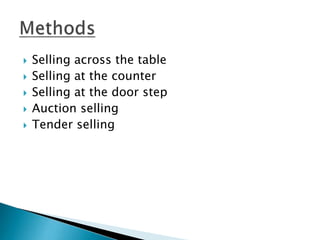
 Selling across the table
 Selling at the counter
 Selling at the door step
 Auction selling
 Tender selling
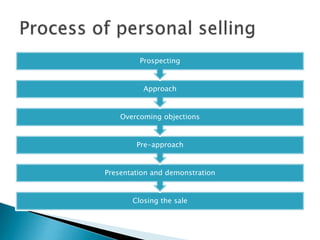
Closing the sale
Presentation and demonstration
Pre-approach
Overcoming objections
Approach
Prospecting
 Most buyers believe that the higher the
salesperson’s motivation, the greater the effort
and the resulting performance, rewards, and
satisfaction-and thus further motivation.Such
thinking is based on several assumption.
 Sales managers must be able to convince
salespeople that they can sell more by working
harder or by begun trained to work smarter
 Sales managers must be able to convince
salespeople that the rewards fro better
performance are worth the extra effort.
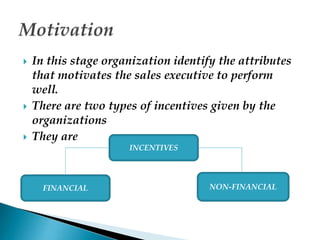
 In this stage organization identify the attributes
that motivates the sales executive to perform
well.
 There are two types of incentives given by the
organizations
 They are
FINANCIAL NON-FINANCIAL
INCENTIVES
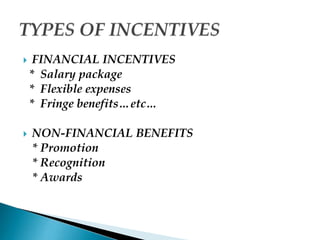
 FINANCIAL INCENTIVES
* Salary package
* Flexible expenses
* Fringe benefits…etc…
 NON-FINANCIAL BENEFITS
* Promotion
* Recognition
* Awards
 To know whether the sales executives are
achieving the quotas set for them i.e sales plans,
the reports of their performances are compared
against the set standards.
 On the basis of the information, the conclusions
are drawn and accordingly incentives are
announced.
 If required the sales executives are motivated and
trained.
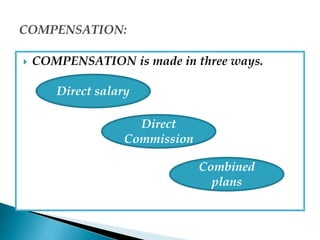
 COMPENSATION is made in three ways.
Direct salary
Direct
Commission
Combined
plans
 Direct salary:
In this method sales executives are given fixed salary
per month.
 Direct commission:
In this case the executives will be working on
commission basis…Eg : Life insurance agents.
 Combined Plans:
It is a mixture of straight salary and straight
commission plans. In this method the sales executives
are paid their regular salary plus their commission on
the sales they make.
Eg BMTC pays their conductors a fixed salary + 2%
Commission on the sale of tickets.
Sales force management (1)

Sales force management (1)

  • 2.
    Although selling isan extremely important function in most organizations it does have something of a bad reputation. This has mainly come about from the kind of hard selling associated with door-to-door selling. This image is quite far removed from the majority of selling that takes place especially in the business-to-business sector. Much of a salesperson’s time is not actually taken up by selling but with a variety of other tasks that they have to undertake in order to achieve the sale.
  • 3.
     Sales forceorganization refers to the type and size of the sales force. The type determines the degree of controllability while the size has profit implications. If the sales force is large the organization has to decide about the kind of specialization and co- ordination to use
  • 4.
    Recruitment: It is theprocess of finding out candidates, who are encouraged to apply. Selection is the process of choosing some out of many candidates. Therefore, we can say that selection is recruitment, but recruitment is not selection. Selection is the process of rejection of unfits. Recruitment precedes the selection process.
  • 5.
    There are twotypes of recruitment:  Internal Sources  External Sources Internal Sources: As the name says, it means the recruitment of people within the organization. They fill in vacancies with the existing members within the existing organization. This can also be termed as promotion. Merits:  Co-operation  Loyalty  Honest performance  No training  Same salary
  • 6.
    Demerits:  Limited scope Chances of favoritism  Time to adjust External Sources:  Employment Exchange  Competitors’ organization.  Salesmen of non-competing firms  Educational institutions  Recommended cases  Advertisement  Unsolicited applications
  • 7.
  • 8.
    The process ofselecting differs from one place to another. Each firm has it’s own method of selecting people. The qualities expected must match with the job description and the person should be qualified enough too. The steps followed for selection is the same in all the places.  Application Blank  Screening  Reference  Personal Interview  Test  Medical examination  Final interview
  • 9.
    Training is thecontinuation of selection. After selection, the sales manager will have two options.  Send him to the work field directly  Send him for training program It is always advisable to train a person before sending him to the work floor. Training means the process of perfecting the salesmen for their work. It is the organized procedure through which knowledge as well as skill, for a particular purpose, is acquired.
  • 10.
    It is thesalesmanship that hums the wheels of industry, turns the income and plums the living standard of the society. It is the art of convincing the prospects to buy the given products and services. It is the wit act of persuasion. It is the ability to handle people and dandle the product. It is the ability to convey human needs and wants.
  • 11.
     Flexible andadaptability  Minimum waste  Acts as a feed back  Creates lasting impression  Pulls through logical sequence
  • 12.
     It isexpensive  Difficulty of getting right kind of sales man  Stake in consumer loyalty  More administrative problem
  • 13.
     Selling acrossthe table  Selling at the counter  Selling at the door step  Auction selling  Tender selling
  • 14.
    Closing the sale Presentationand demonstration Pre-approach Overcoming objections Approach Prospecting
  • 16.
     Most buyersbelieve that the higher the salesperson’s motivation, the greater the effort and the resulting performance, rewards, and satisfaction-and thus further motivation.Such thinking is based on several assumption.
  • 17.
     Sales managersmust be able to convince salespeople that they can sell more by working harder or by begun trained to work smarter  Sales managers must be able to convince salespeople that the rewards fro better performance are worth the extra effort.
  • 18.
     In thisstage organization identify the attributes that motivates the sales executive to perform well.  There are two types of incentives given by the organizations  They are FINANCIAL NON-FINANCIAL INCENTIVES
  • 19.
     FINANCIAL INCENTIVES *Salary package * Flexible expenses * Fringe benefits…etc…  NON-FINANCIAL BENEFITS * Promotion * Recognition * Awards
  • 20.
     To knowwhether the sales executives are achieving the quotas set for them i.e sales plans, the reports of their performances are compared against the set standards.  On the basis of the information, the conclusions are drawn and accordingly incentives are announced.  If required the sales executives are motivated and trained.
  • 21.
     COMPENSATION ismade in three ways. Direct salary Direct Commission Combined plans
  • 22.
     Direct salary: Inthis method sales executives are given fixed salary per month.  Direct commission: In this case the executives will be working on commission basis…Eg : Life insurance agents.  Combined Plans: It is a mixture of straight salary and straight commission plans. In this method the sales executives are paid their regular salary plus their commission on the sales they make. Eg BMTC pays their conductors a fixed salary + 2% Commission on the sale of tickets.