Marketing Channels and Supply Chain Management
The Role of Marketing Channels in Marketing Strategy Channels provide the means by which the firm moves the goods and services it produces to ultimate users Facilitate the exchange process by cutting the number of contacts necessary Adjust for discrepancies in the market’s assortment of goods and services via sorting Standardize exchange transactions Facilitate searches by both buyers and sellers
Types of Marketing Channels Marketing channel :  system of marketing institutions that promotes the physical flow of goods and services, along with ownership title, from producers to consumer or business user; also called a distribution channel Marketing intermediary :  wholesaler or retailer that operates between producers and consumers or business users; also called a middleman  Wholesaler :  marketing intermediary that takes title to goods and then distributes these goods further; also called a jobber or distributor
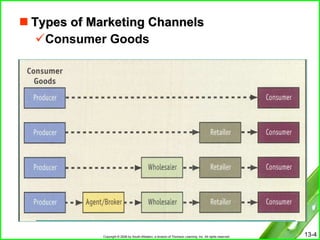
Types of Marketing Channels Consumer Goods
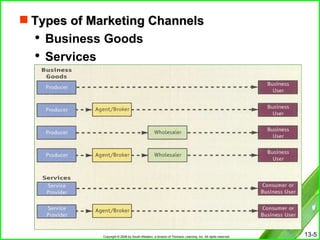
Types of Marketing Channels Business Goods Services
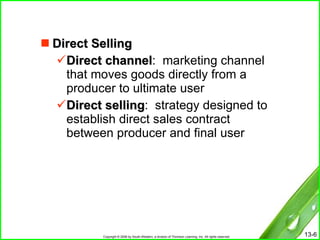
Direct Selling Direct channel :  marketing channel that moves goods directly from a producer to ultimate user Direct selling :  strategy designed to establish direct sales contract between producer and final user
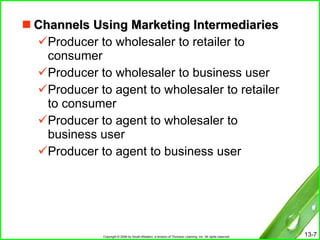
Channels Using Marketing Intermediaries Producer to wholesaler to retailer to consumer Producer to wholesaler to business user Producer to agent to wholesaler to retailer to consumer Producer to agent to wholesaler to business user Producer to agent to business user
Dual Distribution : Network that moves products to a firm’s target market through more than one marketing channel Reverse Channels : Channels designed to return goods to their producers
Channel Strategy Decisions Selection of a Marketing Channel Factors which impact  the selection of a marketing channel include: Market factors Product factors Organizational factors Competitive factors
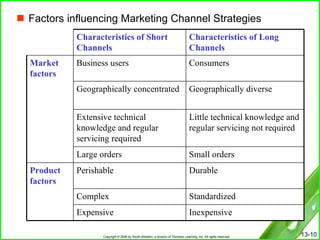
Factors influencing Marketing Channel Strategies Inexpensive Expensive Standardized Complex Durable Perishable Product factors Small orders Large orders   Little technical knowledge and regular servicing not required Extensive technical knowledge and regular servicing required Geographically diverse Geographically concentrated Consumers  Business users Market factors Characteristics of Long Channels Characteristics of Short Channels
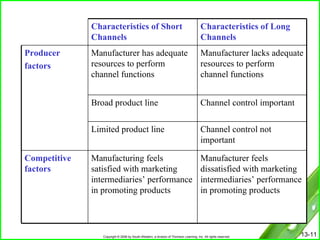
Manufacturer feels dissatisfied with marketing intermediaries’ performance in promoting products Manufacturing feels satisfied with marketing intermediaries’ performance in promoting products Competitive factors Channel control not important Limited product line Channel control important Broad product line Manufacturer lacks adequate resources to perform channel functions Manufacturer has adequate resources to perform channel functions Producer  factors Characteristics of Long Channels Characteristics of Short Channels
Determining Distribution Intensity Distribution intensity:  number of intermediaries through which a manufacturer distributes its goods
Intensive distribution :  channel policy in which a manufacturer of a convenience product attempts to saturate the market Selective distribution :  channel policy in which a firm chooses only a limited number of retailers to handle its product line Exclusive distribution :  channel policy in which a firm grants exclusive rights to a single wholesaler or retailer to sell its products in a particular geographic area
Legal problems of exclusive distribution Exclusive-dealing agreement :  arrangement between manufacturer and e-marketing intermediary that prohibits the intermediary from handling competing product lines Closed sales territories :  exclusive geographic selling region of a distributor Tying agreement :  Arrangement that requires a marketing intermediary to carry items other than those they want to sell
Who Should Perform Channel Functions? Fundamental principle that governs channel decisions Channel members can shift responsibilities for the performance of certain marketing functions, but they cannot eliminate central functions
Channel Management and Leadership Channel Captain :  a dominant and controlling member of a marketing channel Channel Conflict Horizontal Conflict Most often, horizontal conflict causes sparks between different types of marketing intermediaries that handle similar products Sometimes results from disagreements among channel members at the same level
Vertical Conflict Channel members at different levels find many reasons for disputes Example:  when retailers develop private brands to compete with producers’ brands or when producers establish their own retail outlets or WWW Sites The Gray Market Grey Good :  product made abroad under license from a U.S. firm and then sold in the U.S. market in competition with that firm’s own domestic output Viewed by producers as undesired competition
Achieving Channel Cooperation Channel Cooperation, achieved via effective cooperation among channel members, is the desired antidote to channel conflict It is Best achieved when all channel members regard themselves as components of the same organization
Vertical Marketing Systems Vertical marketing system  (VMS):  planned channel system designed to improve distribution efficiency and cost effectiveness by integrating various functions throughout the distribution chain  Forward integration Backward integration
Administered marketing system :  VMS that achieves channel coordination when a dominant channel member exercises its power Corporate marketing system :  a VMS in which a single owner operates at each stage in its marketing channel
Contractual marketing system : VMS that coordinates channel activities through formal agreements among channel members like: Wholesaler-Sponsored Voluntary Chains Retail Cooperatives Franchises
Physical Distribution A company’s physical distribution system contains the following elements: Customer Service Transportation Inventory Control Protective packaging and materials handling Order Processing Warehousing
Transportation Class Rate Commodity Rate Classes of Carriers Common carriers  move freight via all modes of transportation for the general public Contract carriers  do not serve the general public Private carriers  do not offer services for hire, but provide transportation services solely for internally generated freight
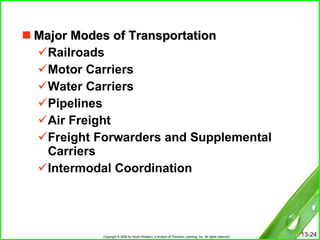
Major Modes of Transportation Railroads Motor Carriers Water Carriers Pipelines Air Freight Freight Forwarders and Supplemental Carriers Intermodal Coordination
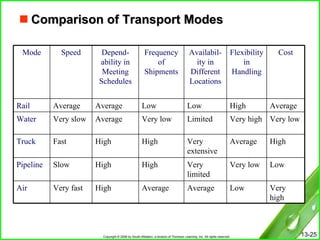
Comparison of Transport Modes Very high Low Average Average High Very fast Air Low Very low Very limited High High Slow Pipeline High Average Very extensive High High Fast Truck Very low Very high Limited Very low Average Very slow Water Average High Low Low Average Average Rail Cost Flexibility in Handling Availabil- ity in Different Locations Frequency of Shipments Depend- ability in Meeting Schedules Speed Mode

Distb

  • 1.
    Marketing Channels andSupply Chain Management
  • 2.
    The Role ofMarketing Channels in Marketing Strategy Channels provide the means by which the firm moves the goods and services it produces to ultimate users Facilitate the exchange process by cutting the number of contacts necessary Adjust for discrepancies in the market’s assortment of goods and services via sorting Standardize exchange transactions Facilitate searches by both buyers and sellers
  • 3.
    Types of MarketingChannels Marketing channel : system of marketing institutions that promotes the physical flow of goods and services, along with ownership title, from producers to consumer or business user; also called a distribution channel Marketing intermediary : wholesaler or retailer that operates between producers and consumers or business users; also called a middleman Wholesaler : marketing intermediary that takes title to goods and then distributes these goods further; also called a jobber or distributor
  • 4.
    Types of MarketingChannels Consumer Goods
  • 5.
    Types of MarketingChannels Business Goods Services
  • 6.
    Direct Selling Directchannel : marketing channel that moves goods directly from a producer to ultimate user Direct selling : strategy designed to establish direct sales contract between producer and final user
  • 7.
    Channels Using MarketingIntermediaries Producer to wholesaler to retailer to consumer Producer to wholesaler to business user Producer to agent to wholesaler to retailer to consumer Producer to agent to wholesaler to business user Producer to agent to business user
  • 8.
    Dual Distribution :Network that moves products to a firm’s target market through more than one marketing channel Reverse Channels : Channels designed to return goods to their producers
  • 9.
    Channel Strategy DecisionsSelection of a Marketing Channel Factors which impact the selection of a marketing channel include: Market factors Product factors Organizational factors Competitive factors
  • 10.
    Factors influencing MarketingChannel Strategies Inexpensive Expensive Standardized Complex Durable Perishable Product factors Small orders Large orders   Little technical knowledge and regular servicing not required Extensive technical knowledge and regular servicing required Geographically diverse Geographically concentrated Consumers Business users Market factors Characteristics of Long Channels Characteristics of Short Channels
  • 11.
    Manufacturer feels dissatisfiedwith marketing intermediaries’ performance in promoting products Manufacturing feels satisfied with marketing intermediaries’ performance in promoting products Competitive factors Channel control not important Limited product line Channel control important Broad product line Manufacturer lacks adequate resources to perform channel functions Manufacturer has adequate resources to perform channel functions Producer factors Characteristics of Long Channels Characteristics of Short Channels
  • 12.
    Determining Distribution IntensityDistribution intensity: number of intermediaries through which a manufacturer distributes its goods
  • 13.
    Intensive distribution : channel policy in which a manufacturer of a convenience product attempts to saturate the market Selective distribution : channel policy in which a firm chooses only a limited number of retailers to handle its product line Exclusive distribution : channel policy in which a firm grants exclusive rights to a single wholesaler or retailer to sell its products in a particular geographic area
  • 14.
    Legal problems ofexclusive distribution Exclusive-dealing agreement : arrangement between manufacturer and e-marketing intermediary that prohibits the intermediary from handling competing product lines Closed sales territories : exclusive geographic selling region of a distributor Tying agreement : Arrangement that requires a marketing intermediary to carry items other than those they want to sell
  • 15.
    Who Should PerformChannel Functions? Fundamental principle that governs channel decisions Channel members can shift responsibilities for the performance of certain marketing functions, but they cannot eliminate central functions
  • 16.
    Channel Management andLeadership Channel Captain : a dominant and controlling member of a marketing channel Channel Conflict Horizontal Conflict Most often, horizontal conflict causes sparks between different types of marketing intermediaries that handle similar products Sometimes results from disagreements among channel members at the same level
  • 17.
    Vertical Conflict Channelmembers at different levels find many reasons for disputes Example: when retailers develop private brands to compete with producers’ brands or when producers establish their own retail outlets or WWW Sites The Gray Market Grey Good : product made abroad under license from a U.S. firm and then sold in the U.S. market in competition with that firm’s own domestic output Viewed by producers as undesired competition
  • 18.
    Achieving Channel CooperationChannel Cooperation, achieved via effective cooperation among channel members, is the desired antidote to channel conflict It is Best achieved when all channel members regard themselves as components of the same organization
  • 19.
    Vertical Marketing SystemsVertical marketing system (VMS): planned channel system designed to improve distribution efficiency and cost effectiveness by integrating various functions throughout the distribution chain Forward integration Backward integration
  • 20.
    Administered marketing system: VMS that achieves channel coordination when a dominant channel member exercises its power Corporate marketing system : a VMS in which a single owner operates at each stage in its marketing channel
  • 21.
    Contractual marketing system: VMS that coordinates channel activities through formal agreements among channel members like: Wholesaler-Sponsored Voluntary Chains Retail Cooperatives Franchises
  • 22.
    Physical Distribution Acompany’s physical distribution system contains the following elements: Customer Service Transportation Inventory Control Protective packaging and materials handling Order Processing Warehousing
  • 23.
    Transportation Class RateCommodity Rate Classes of Carriers Common carriers move freight via all modes of transportation for the general public Contract carriers do not serve the general public Private carriers do not offer services for hire, but provide transportation services solely for internally generated freight
  • 24.
    Major Modes ofTransportation Railroads Motor Carriers Water Carriers Pipelines Air Freight Freight Forwarders and Supplemental Carriers Intermodal Coordination
  • 25.
    Comparison of TransportModes Very high Low Average Average High Very fast Air Low Very low Very limited High High Slow Pipeline High Average Very extensive High High Fast Truck Very low Very high Limited Very low Average Very slow Water Average High Low Low Average Average Rail Cost Flexibility in Handling Availabil- ity in Different Locations Frequency of Shipments Depend- ability in Meeting Schedules Speed Mode