Chapter  15 Channels of Distribution: Conflict, Cooperation, and Management Sommers     Barnes Ninth Canadian Edition Presentation by Karen A. Blotnicky Mount Saint Vincent University, Halifax, NS Copyright © 200 1  by McGraw-Hill Ryerson Limited
Chapter  Goals To gain an understanding of: The nature and importance of intermediaries What a distribution channel is and does The decisions involved in designing a channel of distribution Major channels used to distribute consumer goods, business goods, and services Vertical marketing systems Intensity of distribution Choice of intermediaries and conflict management Legal considerations and channel arrangements
The Distribution Function distribution is about getting the product or service to the customer as conveniently as possible; it deals with access and availability intermediaries  perform many of the distribution functions on behalf of suppliers merchant intermediaries   actually take title to physical products that they distribute agents   do not ever own the products, but they arrange the transfer of title
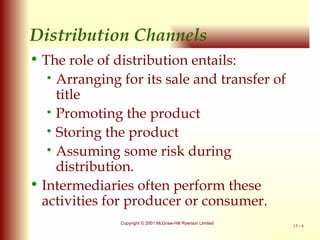
Distribution Channels The role of distribution entails: Arranging for its sale and transfer of title Promoting the product Storing the product Assuming some risk during distribution. Intermediaries often perform these activities for producer or consumer.
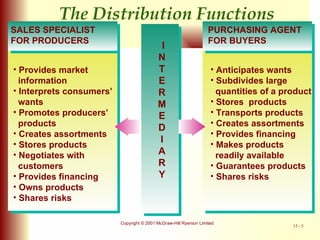
Provides market information Interprets consumers’  wants Promotes producers’  products Creates assortments Stores products Negotiates with  customers Provides financing Owns products Shares risks Anticipates wants Subdivides large quantities of a product Stores  products Transports products Creates assortments Provides financing Makes products  readily available Guarantees products Shares risks SALES SPECIALIST FOR PRODUCERS PURCHASING AGENT FOR BUYERS I N T E R M E D I A R Y The Distribution Functions
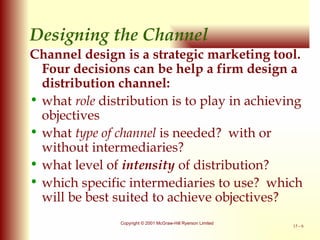
Designing the Channel Channel design is a strategic marketing tool.  Four decisions can be help a firm design a distribution channel:   what  role  distribution is to play in achieving objectives what  type of channel  is needed?  with or without intermediaries? what level of  intensity  of distribution? which specific intermediaries to use?  which will be best suited to achieve objectives?
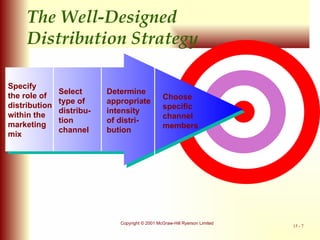
Specify the role of distribution within the marketing mix Select type of distribu- tion  channel Determine  appropriate intensity of distri- bution Choose specific channel members The Well-Designed  Distribution Strategy
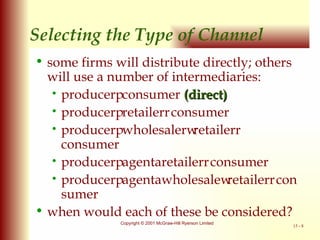
Selecting the Type of Channel some firms will distribute directly; others will use a number of intermediaries: producer  consumer  (direct) producer  retailer  consumer producer  wholesaler  retailer   consumer producer  agent  retailer  consumer producer  agent  wholesale  retailer  consumer when would each of these be considered?
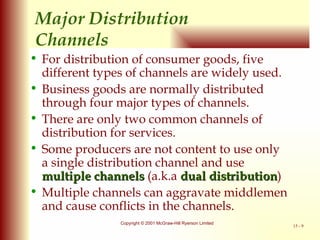
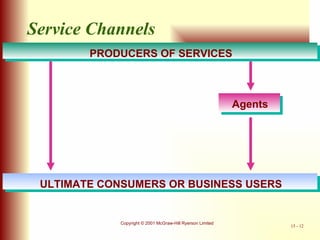
Major Distribution  Channels For distribution of consumer goods, five different types of channels are widely used. Business goods are normally distributed through four major types of channels. There are only two common channels of distribution for services. Some producers are not content to use only a single distribution channel and use  multiple channels  (a.k.a  dual distribution ) Multiple channels can aggravate middlemen and cause conflicts in the channels.
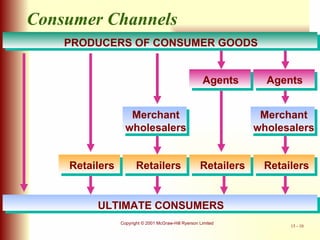
ULTIMATE CONSUMERS PRODUCERS OF CONSUMER GOODS Retailers Retailers Retailers Retailers Merchant wholesalers Merchant wholesalers Agents Agents Consumer Channels
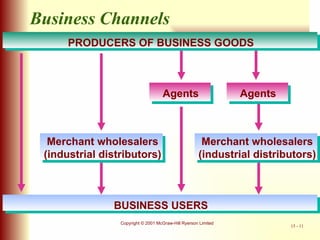
BUSINESS USERS PRODUCERS OF BUSINESS GOODS Merchant wholesalers (industrial distributors) Agents Agents Merchant wholesalers (industrial distributors) Business Channels
ULTIMATE CONSUMERS OR BUSINESS USERS PRODUCERS OF SERVICES Agents Service Channels
Multiple Distribution Channels some firms will use several distribution channels to reach specific markets or segments dual distribution is used, for example, to reach business and consumer markets, or to carry different groups of products or may be used to reach different segments of the seller’s market; different sizes of buyers or different regions of the country some companies operate their own stores
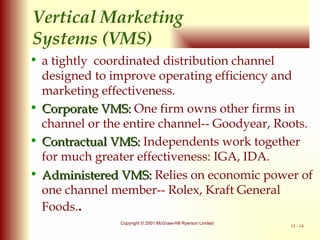
Vertical Marketing  Systems (VMS) a tightly  coordinated distribution channel designed to improve operating efficiency and marketing effectiveness. Corporate VMS:  One firm owns other firms in channel or the entire channel-- Goodyear, Roots. Contractual VMS:  Independents work together for much greater effectiveness: IGA, IDA. Administered VMS:  Relies on economic power of one channel member-- Rolex, Kraft General Foods. .
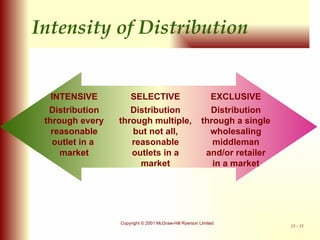
INTENSIVE SELECTIVE EXCLUSIVE Distribution through every reasonable outlet in a  market Distribution through multiple, but not all, reasonable outlets in a market Distribution through a single wholesaling middleman and/or retailer in a market Intensity of Distribution
Considerations in  Channel Choice Market Considerations :  Type of market, concentration, potential customers, order size. Product Considerations : Consider unit value, perishability, technical nature of product. Intermediaries Considerations : Services offered, availability, attitude, dominance. Company Considerations : Desire for channel control,  management, money and services seller can provide to support sales.
Conflict and Control  in Channels Channel conflict  exists when channel members interfere with each others’ objectives. Horizontal conflict  involves firms on same level-- grocery store vs. drug store. Vertical conflict  involves firms at different levels producer versus wholesaler producer versus retailer Channel Power  is the ability to influence or determine behaviour of others in channel. Based on expertise, rewards and sanctions.
Producer/Retailer Conflict Small suppliers’ complaints about large department stores: Onerous logistical demands. Pressure to cut prices. Demands to give the stores exclusivity. Forcing suppliers to contribute advertising and promotional dollars to the stores. Requiring suppliers to invest in elaborate computerized inventory systems.
Small suppliers’ complaints about discounters : Being asked to supply their goods on consignment. Being asked to deal directly with the retailers’ headquarters and to give to the retailer an amount equal to the commission that would have gone to manufacturers’ agents. Responses from smaller suppliers: Quit doing business with big retailers whose demands are too strict and outlandish . Become a retailer. Merge with another manufacturer. More Complaints
Legal Considerations Dealer Selection :   Refusing to sell to some firms. Can be done carefully. Exclusive Dealing  involves shutting out competitors, giving most business to one firm. Tying Contracts  involves providing one item on condition other lines be carried as well. Exclusive Territories   can create monopolies.
Channels for Entering  Foreign Markets Exporting,  through: An  export merchant  in the manufacturer's country that buys goods and exports them. An  export agent  located in either the manufacturer's or the destination country. A  company’s sales branches. Contracting,  via: Licensing:  Right to use production process, patents, trademarks, or other assets. Franchising. Contract manufacturing :  having a foreign-based manufacturer produce the product
More Foreign Market Entry Channel Options Direct investment,  including: Joint venture  or partnership with a foreign company. Strategic alliance . Wholly-owned subsidiaries. Multinational corporation ,  in which the foreign and domestic operations are integrated and are not separately identified.
The Changing Face  of Distribution Internet  (“click and mortar” vs. “brick and mortar”)  a major factor-- where is it heading? Direct Response TV sales  are  growing in popularity, especially for time-starved  shoppers “ The world’s largest bookstore” is on the Internet! (Amazon.com)

9fms Pp15

  • 1.
    Chapter 15Channels of Distribution: Conflict, Cooperation, and Management Sommers  Barnes Ninth Canadian Edition Presentation by Karen A. Blotnicky Mount Saint Vincent University, Halifax, NS Copyright © 200 1 by McGraw-Hill Ryerson Limited
  • 2.
    Chapter GoalsTo gain an understanding of: The nature and importance of intermediaries What a distribution channel is and does The decisions involved in designing a channel of distribution Major channels used to distribute consumer goods, business goods, and services Vertical marketing systems Intensity of distribution Choice of intermediaries and conflict management Legal considerations and channel arrangements
  • 3.
    The Distribution Functiondistribution is about getting the product or service to the customer as conveniently as possible; it deals with access and availability intermediaries perform many of the distribution functions on behalf of suppliers merchant intermediaries actually take title to physical products that they distribute agents do not ever own the products, but they arrange the transfer of title
  • 4.
    Distribution Channels Therole of distribution entails: Arranging for its sale and transfer of title Promoting the product Storing the product Assuming some risk during distribution. Intermediaries often perform these activities for producer or consumer.
  • 5.
    Provides market informationInterprets consumers’ wants Promotes producers’ products Creates assortments Stores products Negotiates with customers Provides financing Owns products Shares risks Anticipates wants Subdivides large quantities of a product Stores products Transports products Creates assortments Provides financing Makes products readily available Guarantees products Shares risks SALES SPECIALIST FOR PRODUCERS PURCHASING AGENT FOR BUYERS I N T E R M E D I A R Y The Distribution Functions
  • 6.
    Designing the ChannelChannel design is a strategic marketing tool. Four decisions can be help a firm design a distribution channel: what role distribution is to play in achieving objectives what type of channel is needed? with or without intermediaries? what level of intensity of distribution? which specific intermediaries to use? which will be best suited to achieve objectives?
  • 7.
    Specify the roleof distribution within the marketing mix Select type of distribu- tion channel Determine appropriate intensity of distri- bution Choose specific channel members The Well-Designed Distribution Strategy
  • 8.
    Selecting the Typeof Channel some firms will distribute directly; others will use a number of intermediaries: producer  consumer (direct) producer  retailer  consumer producer  wholesaler  retailer  consumer producer  agent  retailer  consumer producer  agent  wholesale  retailer  consumer when would each of these be considered?
  • 9.
    Major Distribution Channels For distribution of consumer goods, five different types of channels are widely used. Business goods are normally distributed through four major types of channels. There are only two common channels of distribution for services. Some producers are not content to use only a single distribution channel and use multiple channels (a.k.a dual distribution ) Multiple channels can aggravate middlemen and cause conflicts in the channels.
  • 10.
    ULTIMATE CONSUMERS PRODUCERSOF CONSUMER GOODS Retailers Retailers Retailers Retailers Merchant wholesalers Merchant wholesalers Agents Agents Consumer Channels
  • 11.
    BUSINESS USERS PRODUCERSOF BUSINESS GOODS Merchant wholesalers (industrial distributors) Agents Agents Merchant wholesalers (industrial distributors) Business Channels
  • 12.
    ULTIMATE CONSUMERS ORBUSINESS USERS PRODUCERS OF SERVICES Agents Service Channels
  • 13.
    Multiple Distribution Channelssome firms will use several distribution channels to reach specific markets or segments dual distribution is used, for example, to reach business and consumer markets, or to carry different groups of products or may be used to reach different segments of the seller’s market; different sizes of buyers or different regions of the country some companies operate their own stores
  • 14.
    Vertical Marketing Systems (VMS) a tightly coordinated distribution channel designed to improve operating efficiency and marketing effectiveness. Corporate VMS: One firm owns other firms in channel or the entire channel-- Goodyear, Roots. Contractual VMS: Independents work together for much greater effectiveness: IGA, IDA. Administered VMS: Relies on economic power of one channel member-- Rolex, Kraft General Foods. .
  • 15.
    INTENSIVE SELECTIVE EXCLUSIVEDistribution through every reasonable outlet in a market Distribution through multiple, but not all, reasonable outlets in a market Distribution through a single wholesaling middleman and/or retailer in a market Intensity of Distribution
  • 16.
    Considerations in Channel Choice Market Considerations : Type of market, concentration, potential customers, order size. Product Considerations : Consider unit value, perishability, technical nature of product. Intermediaries Considerations : Services offered, availability, attitude, dominance. Company Considerations : Desire for channel control, management, money and services seller can provide to support sales.
  • 17.
    Conflict and Control in Channels Channel conflict exists when channel members interfere with each others’ objectives. Horizontal conflict involves firms on same level-- grocery store vs. drug store. Vertical conflict involves firms at different levels producer versus wholesaler producer versus retailer Channel Power is the ability to influence or determine behaviour of others in channel. Based on expertise, rewards and sanctions.
  • 18.
    Producer/Retailer Conflict Smallsuppliers’ complaints about large department stores: Onerous logistical demands. Pressure to cut prices. Demands to give the stores exclusivity. Forcing suppliers to contribute advertising and promotional dollars to the stores. Requiring suppliers to invest in elaborate computerized inventory systems.
  • 19.
    Small suppliers’ complaintsabout discounters : Being asked to supply their goods on consignment. Being asked to deal directly with the retailers’ headquarters and to give to the retailer an amount equal to the commission that would have gone to manufacturers’ agents. Responses from smaller suppliers: Quit doing business with big retailers whose demands are too strict and outlandish . Become a retailer. Merge with another manufacturer. More Complaints
  • 20.
    Legal Considerations DealerSelection : Refusing to sell to some firms. Can be done carefully. Exclusive Dealing involves shutting out competitors, giving most business to one firm. Tying Contracts involves providing one item on condition other lines be carried as well. Exclusive Territories can create monopolies.
  • 21.
    Channels for Entering Foreign Markets Exporting, through: An export merchant in the manufacturer's country that buys goods and exports them. An export agent located in either the manufacturer's or the destination country. A company’s sales branches. Contracting, via: Licensing: Right to use production process, patents, trademarks, or other assets. Franchising. Contract manufacturing : having a foreign-based manufacturer produce the product
  • 22.
    More Foreign MarketEntry Channel Options Direct investment, including: Joint venture or partnership with a foreign company. Strategic alliance . Wholly-owned subsidiaries. Multinational corporation , in which the foreign and domestic operations are integrated and are not separately identified.
  • 23.
    The Changing Face of Distribution Internet (“click and mortar” vs. “brick and mortar”) a major factor-- where is it heading? Direct Response TV sales are growing in popularity, especially for time-starved shoppers “ The world’s largest bookstore” is on the Internet! (Amazon.com)