DISTRIBUTED POWER FLOW CONTROLLER FOR
COMPENSATING REACTIVE POWER IN
TRANSMISSION SYSTEMS
PRESENTER:KESAVA VARMA
OBJECTIVES
• To compensate reactive power in
transmission line.
• To overcome the disadvantages of Unified
Power Flow controller(UPFC).
INTRODUCTION
The growing demand and the aging of networks
make it desirable to control the power flow in
power-transmission systems fast and reliably.
The FACTS is defined by “power electronic based
system and other static equipment that provide
control of one or more ac-transmission system
parameters to enhance controllability and increase
power transfer capability’’,and can be utilized for
power flow control.
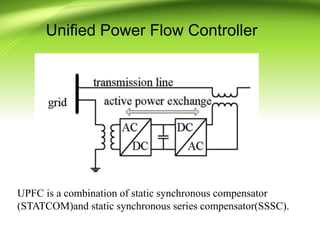
Unified Power Flow Controller
UPFC is a combination of static synchronous compensator
(STATCOM)and static synchronous series compensator(SSSC).
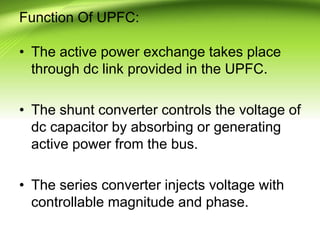
Function Of UPFC:
• The active power exchange takes place
through dc link provided in the UPFC.
• The shunt converter controls the voltage of
dc capacitor by absorbing or generating
active power from the bus.
• The series converter injects voltage with
controllable magnitude and phase.
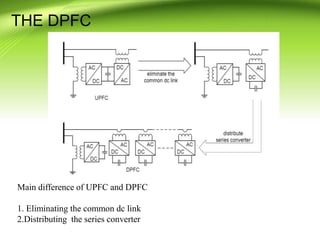
THE DPFC
Main difference of UPFC and DPFC
1. Eliminating the common dc link
2.Distributing the series converter
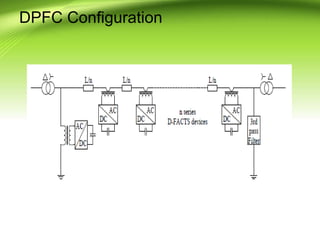
DPFC Configuration
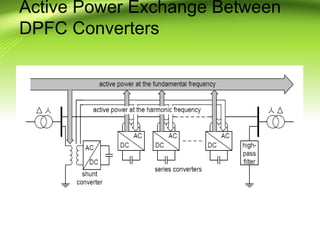
Active Power Exchange Between
DPFC Converters
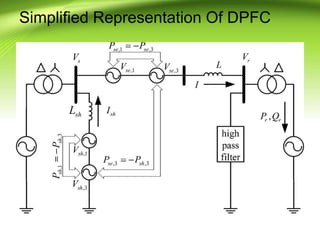
Simplified Representation Of DPFC
Operation Of DPFC:
• The shunt converter converts active power
in at fundamental frequency to active
power at harmonic frequency and gives
back to the transmission line.
• Now the series converter converts this
active power at harmonic frequency to
active power at fundamental frequency.
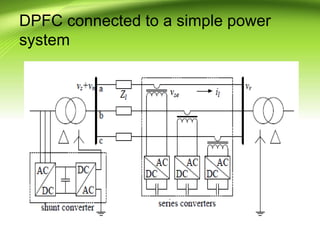
DPFC connected to a simple power
system
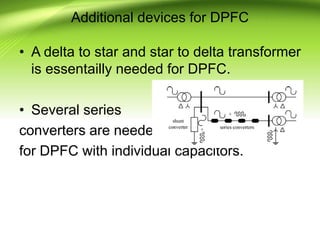
Additional devices for DPFC
• A delta to star and star to delta transformer
is essentailly needed for DPFC.
• Several series
converters are needed
for DPFC with individual capacitors.
DPFC control scheme:
• To control multiple converters, DPFC
consists of three type of controllers
• Central control
• Shunt control
• Series control
• Central converter generates the reference
signals for both series and shunt converter
• Each series converter and shunt converter
has its own controller. `
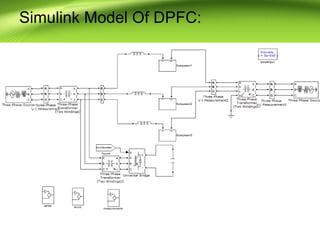
Simulink Model Of DPFC:
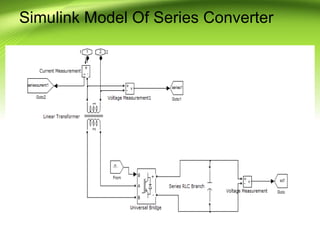
Simulink Model Of Series Converter
Advantages Of DPFC
• High Control Capability: All the parameters
like line impedance , transmission angle
and controlled voltage with specific phase
angle and magnitude.
• High Reliability: Usage of number of series
converters
• Low cost
distributed power flow controller

distributed power flow controller

  • 1.
    DISTRIBUTED POWER FLOWCONTROLLER FOR COMPENSATING REACTIVE POWER IN TRANSMISSION SYSTEMS PRESENTER:KESAVA VARMA
  • 2.
    OBJECTIVES • To compensatereactive power in transmission line. • To overcome the disadvantages of Unified Power Flow controller(UPFC).
  • 3.
    INTRODUCTION The growing demandand the aging of networks make it desirable to control the power flow in power-transmission systems fast and reliably. The FACTS is defined by “power electronic based system and other static equipment that provide control of one or more ac-transmission system parameters to enhance controllability and increase power transfer capability’’,and can be utilized for power flow control.
  • 4.
    Unified Power FlowController UPFC is a combination of static synchronous compensator (STATCOM)and static synchronous series compensator(SSSC).
  • 5.
    Function Of UPFC: •The active power exchange takes place through dc link provided in the UPFC. • The shunt converter controls the voltage of dc capacitor by absorbing or generating active power from the bus. • The series converter injects voltage with controllable magnitude and phase.
  • 6.
    THE DPFC Main differenceof UPFC and DPFC 1. Eliminating the common dc link 2.Distributing the series converter
  • 7.
  • 8.
    Active Power ExchangeBetween DPFC Converters
  • 9.
  • 10.
    Operation Of DPFC: •The shunt converter converts active power in at fundamental frequency to active power at harmonic frequency and gives back to the transmission line. • Now the series converter converts this active power at harmonic frequency to active power at fundamental frequency.
  • 11.
    DPFC connected toa simple power system
  • 12.
    Additional devices forDPFC • A delta to star and star to delta transformer is essentailly needed for DPFC. • Several series converters are needed for DPFC with individual capacitors.
  • 13.
    DPFC control scheme: •To control multiple converters, DPFC consists of three type of controllers • Central control • Shunt control • Series control • Central converter generates the reference signals for both series and shunt converter • Each series converter and shunt converter has its own controller. `
  • 14.
  • 15.
    Simulink Model OfSeries Converter
  • 16.
    Advantages Of DPFC •High Control Capability: All the parameters like line impedance , transmission angle and controlled voltage with specific phase angle and magnitude. • High Reliability: Usage of number of series converters • Low cost