T Jagan Mohan Rao Int. Journal of Engineering Research and Applications www.ijera.com
ISSN : 2248-9622, Vol. 4, Issue 10( Part -1), October 2014, pp.35-40
www.ijera.com 35 | P a g e
Distributed Power-Flow Controller (DPFC) Simulation
1
T Jagan Mohan Rao, 2
B.Ravi kumar
1
Assistant Professor, Department of Electrical & Electronics Engineering, Aditya Institute of Technology &
Management, Tekkali, Srikakulam, Andhra Pradesh, India
2
Assistant Professor, Department of Electrical & Electronics Engineering, Aditya Institute of Technology &
Management, Tekkali, Srikakulam, Andhra Pradesh, India
Abstract:
This paper describes the steady-state response and control of power in transmission line equipped with
FACTS devices. Detailed simulations are carried out on two-machine systems to illustrate the control
features of these devices and their influence to increase power transfer capability and improve
system reliability. The DPFC is derived from the unified power-flow controller (UPFC) and DPFC
has the same control capability as the UPFC. The DPFC can be considered as a UPFC with an eliminated
common dc link. The active power exchange between the shunt and series converters, which is through the
common dc link in the UPFC, is now through the transmission lines at the third-harmonic frequency.
The interaction between the DPFC, the network and the machines are analyzed.
Keywords: FACTS, DPFC, modelling, power transmission, AC-DC power conversion, semiconductor
devices, power system control.
I. Introduction
The flexible ac trans mission system
(FACTS) technology is the application of power
electronics in transmission systems. The main
purpose of this technology is to control and
regulate the electric variables in the power
systems. This is achieved by using converters as
a controllable interface between two power
system terminals. The resulting converter
representations can be useful for a variety of
configurations. Basically, the family of FACTS
devices based on voltage source converters
(VSCs) consists of a series compensator, a shunt
compensator, and a shunt/series compensator. The
static Compensator (STATCOM) is a shunt
connected device that is able to provide reactive
power support at a network location far away
from the generators. Through this reactive power
injection, the STATCOM can regulate the
voltage at the connection node. The static
synchronous series compensator (SSSC) is a series
device which injects a voltage in series with the
transmission line.
Ideally, this injected voltage is in quadrature
with the line current, such that the SSSC behaves
like an inductor or a capacitor for the purpose of
increasing or decreasing the overall reactive
voltage drop across the line, and thereby,
controlling the transmitted power. In this
operating mode, the SSSC does not interchange
any real power with the system in steady-state.
The unified power-flow controller (UPFC) is the
most versatile device of the family of FACTS
devices, since it is able to control the active and
the reactive power, respectively, as well as the
voltage at the connection node.
The Unified Power Flow Controller (UPFC)
is comprised of a STATCOM and a SSSC,
coupled via a common DC link to allow bi-
directional flow of active power between the
series output terminals of the SSSC and the shunt
output terminals of the STATCOM. Each
converter can independently generate (or)
absorb reactive power at its own AC terminal.
The two converters are operated from a DC link
provided by a DC storage capacitor.
The UPFC is not widely applied in practice,
due to their high cost and the susceptibility to
failures. Generally, the reliability can be improved
by reducing the number of components; however,
this is not possible due to the complex topology
of the UPFC. To reduce the failure rate of the
components, selecting components with higher
ratings than necessary or employing redundancy
at the component or system levels. Un fortunately,
these solutions increase the initial investment
necessary, negating any cost related advantages.
Accordingly, new approaches are needed in order
to increase reliability and reduce cost of the UPFC.
The same as the UPFC, the DPFC is able
to control all system parameters like line
RESEARCH ARTICLE OPEN ACCESS
T Jagan Mohan Rao Int. Journal of Engineering Research and Applications www.ijera.com
ISSN : 2248-9622, Vol. 4, Issue 10( Part -1), October 2014, pp.35-40
www.ijera.com 36 | P a g e
impedance, transmission angle and bus voltage.
The DPFC eliminates the common dc link
between the shunt and series converters. The
active power exchange between the shunt and the
series converter is through the transmission line
at the third-harmonic frequency. The series
converter of the DPFC employs the distributed
FACTS (D-FACTS) concept. Comparing with the
UPFC, the DPFC have two major advantages: 1)
Low cost because of the low voltage isolation and
the low component rating of the series converter
and 2) High reliability because of the redundancy
of the series converters and high control
capability. DPFC can also be used to improve the
power quality and systemstability such as power
oscillation damping, Voltage sag restoration or
balancing asymmetry.
II. DPFC Topology:
By introducing the two approaches outlined
in the previous section (elimination of the
common DC link and distribution of the series
converter) into the UPFC, the DPFC is achieved.
Similar as the UPFC, the DPFC consists of shunt
and series connected converters. The shunt
converter is similar as a STATCOM, while the
series converter employs the DSSC concept,
which is to use multiple single -phase converters
instead of one three-phase converter. Each
converter within the DPFC is independent and has
its own DC capacitor to provide the required
DC voltage. The configuration of the DPFC is
shown in Figure 1.
Figure 1: DPFC configuration
As shown, besides the key components - shunt and
series converters, a DPFC also requires a high pass
filter that is shunt connected to the other side of
the transmission line and a transformer on
each side of the line. The reason for these extra
components will be explained later. The unique
control capability of the UPFC is given by the
back-to-back connection between the shunt and
series converters, which allows the active power to
freely exchange. To ensure the DPFC has the
same control capability as the UPFC, a method
that allows active power exchange between
converters with an eliminated DC link is required.
III. DPFC Operating Principle
Active Power Exchange With Eliminated Dc Link
Within the DPFC, the transmission line
presents a common connection between the AC
ports of the shunt and the series converters.
Therefore, it is possible to exchange active
power through the AC ports. The method is
based on power theory of non-sinusoidal
components. According to the Fourier
analysis,non-sinusoidal voltage and current can
be expressed as the sum of sinusoidal functions in
different frequencies with different amplitudes.
The active power resulting from this non-
sinusoidal voltage and current is defined as the
mean value of the product of voltage and
current. Since the integrals of all the cross
product of terms with different frequencies are
zero, the active power can be expressed by:
Where VI and Ii are the voltage and current
at the ith harmonic frequency respectively, and
is the corresponding angle between the voltage
and current. Equation (1) shows that the active
powers at different frequencies are independent
fromeach other and the voltage or current at one
frequency has no influence on the active power at
other frequencies. The independence of the
active power at different frequencies gives the
possibility that a converter without a power
source can generate active power at one
frequency and absorb this power fromother
frequencies.
By applying this method to the DPFC, the
shunt converter can absorb active power from the
grid at the fundamental frequency and inject the
power back at a harmonic frequency. This
harmonic active power flows through a
transmission line equipped with series converters.
According to the amount of required active powe r
at the fundamental frequency, the DPFC series
converters generate a voltage at the harmonic
frequency, there by absorbing the active power
from harmonic components. Neglecting losses,
the active power generated at the fundamental
frequency is equal to the power absorbed at the
harmonic frequency. For a better understanding,
Figure 2 indicates how the active power is
exchanged between the shunt and the series
converters in the DPFC system. The high-pass
filter within the DPFC blocks the fundamental
frequency components and allows the harmonic
co mponents to pass, thereby providing a return
path for the harmonic components. The shunt
T Jagan Mohan Rao Int. Journal of Engineering Research and Applications www.ijera.com
ISSN : 2248-9622, Vol. 4, Issue 10( Part -1), October 2014, pp.35-40
www.ijera.com 37 | P a g e
and series converters, the high pass filter and the
ground form a closed loop for the harmonic
current.
IV. Using Third Harmonic Components
Figure 2: Active power exchange between DPFC
converters
Due to the unique features of 3rd harmonic
frequency components in a three-phase system,
the 3rd harmonic is selected for active power
exchange in the DPFC. In a three-phase system,
the 3rd harmonic in each phase is identical, which
means they are‗zero-sequence‘ co mponents.
Because the zero-sequence harmonic can be
naturally blocked by trans- formers and these
are widely incorporated in power systems (as a
means of changing voltage), there is no extra
filter required to prevent harmonic leakage. As
introduced above, a high-pass filter is required to
make a closed loop for the harmonic current and
the cut off frequency of this filter is
approximately the fundamental frequency.
Because the voltage isolation is high and the
harmonic frequency is close to the cut off
frequency, the filter will be costly. By using the
zero-sequence harmonic, the costly filter can be
replaced by a cable that connects the neutral
point of the transformer on the right side in
Figure 2 with the ground. Because the
-winding appears open-circuit to the 3rd
harmonic current, all harmonic current will flow
through the Y-winding and concentrate to the
grounding cable as shown in Figure 3. Therefore,
the large high-pass filter is eliminated.
Figure 3: Utilize grounded transformer to
filter zero-sequence harmonic
Another advantage of using the 3rd harmonic to
exchange active power is that the grounding of
the transformers can be used to route the
harmonic current in a meshed network. If the
network requires the harmonic current to flow
through a specific branch, the neutral point of the
transformer in that branch, at the side
opposite to the shunt converter, will be grounded
and vice versa.
Figure 4 shows a simple example of routing
the harmonic current by using the grounding of the
transformer. Because the floating neutral
point is located on the transformer of the line
without the series converter, it is an open-circuit
for 3rd harmonic co mponents and therefore no
3rd harmonic current will flow through this line.
Figure 4: Route the harmonic current by using the
grounding of the transformer
The harmonic at the frequencies like 3rd,
6th, 9th... are all zero-sequence and all can be
used to exchange active power in the DPFC.
However, the 3rd harmonic is selected, because it
is the lowest frequency among all zero-sequence
harmonics. The relationship between the
exchanged active power at the ith harmonic
frequency Pi and the voltages generated by the
converters is expressed by the well known the
power flow equation and given as:
Where Xi is the line impedance at ith frequency,
and is the voltage magnitudes of the
harmonic of the shunt and series converters,
and is the angle difference
between the two voltages. As shown, the
impedance of the line limits the active power
exchange capacity. To exchange the same amount
of active power, the line with high impedance
requires higher voltages. Because the
transmission line impedance is mostly inductive
and proportional to frequency, high transmission
frequencies will cause high impedance and result
in high voltage within converters. Consequently,
T Jagan Mohan Rao Int. Journal of Engineering Research and Applications www.ijera.com
ISSN : 2248-9622, Vol. 4, Issue 10( Part -1), October 2014, pp.35-40
www.ijera.com 38 | P a g e
the zero-sequence harmonic with the lowest
frequency - the 3rd harmonic - has been selected.
V. DPFC Control
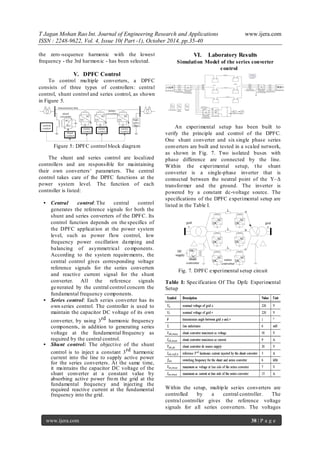
To control multiple converters, a DPFC
consists of three types of controllers: central
control, shunt control and series control, as shown
in Figure 5.
Figure 5: DPFC control block diagram
The shunt and series control are localized
controllers and are responsible for maintaining
their own converters‘ parameters. The central
control takes care of the DPFC functions at the
power system level. The function of each
controller is listed:
• Central control: The central control
generates the reference signals for both the
shunt and series converters of the DPFC. Its
control function depends on the specifics of
the DPFC application at the power system
level, such as power flow control, low
frequency power oscillation damping and
balancing of asymmetrical components.
According to the system requirements, the
central control gives corresponding voltage
reference signals for the series converters
and reactive current signal for the shunt
converter. All the reference signals
generated by the central control concern the
fundamental frequency components.
• Series control: Each series converter has its
own series control. The controller is used to
maintain the capacitor DC voltage of its own
converter, by using 3rd harmonic frequency
components, in addition to generating series
voltage at the fundamental frequency as
required by the central control.
• Shunt control: The objective of the shunt
control is to inject a constant 3rd harmonic
current into the line to supply active power
for the series converters. At the same time,
it maintains the capacitor DC voltage of the
shunt converter at a constant value by
absorbing active power from the grid at the
fundamental frequency and injecting the
required reactive current at the fundamental
frequency into the grid.
VI. Laboratory Results
Simulation Model of the series converter
control
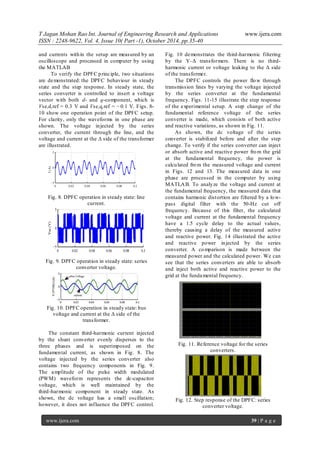
An experimental setup has been built to
verify the principle and control of the DPFC.
One shunt converter and six single phase series
converters are built and tested in a scaled network,
as shown in Fig. 7. Two isolated buses with
phase difference are connected by the line.
Within the experimental setup, t he shunt
converter is a single-phase inverter that is
connected between the neutral point of the Y–Δ
transformer and the ground. The inverter is
powered by a constant dc-voltage source. The
specifications of the DPFC experimental setup are
listed in the Table I.
Fig. 7. DPFC experimental setup circuit
Table I: Specification Of The Dpfc Experimental
Setup
Within the setup, multiple series converters are
controlled by a central controller. The
central controller gives the reference voltage
signals for all series converters. The voltages
T Jagan Mohan Rao Int. Journal of Engineering Research and Applications www.ijera.com
ISSN : 2248-9622, Vol. 4, Issue 10( Part -1), October 2014, pp.35-40
www.ijera.com 39 | P a g e
and currents within the setup are measured by an
oscilloscope and processed in computer by using
the MATLAB
To verify the DPFC principle, two situations
are demonstrated: the DPFC behaviour in steady
state and the step response. In steady state, the
series converter is controlled to insert a voltage
vector with both d- and q-component, which is
Vse,d,ref = 0.3 V and Vse,q,ref = −0.1 V. Figs. 8-
10 show one operation point of the DPFC setup.
For clarity, only the waveforms in one phase are
shown. The voltage injected by the series
converter, the current through the line, and the
voltage and current at the Δ side of the transformer
are illustrated.
Fig. 8. DPFC operation in steady state: line
current.
Fig. 9. DPFC operation in steady state: series
converter voltage.
Fig. 10. DPFC operation in steady state: bus
voltage and current at the Δ side of the
transformer.
The constant third-harmonic current injected
by the shunt converter evenly disperses to the
three phases and is superimposed on the
fundamental current, as shown in Fig. 8. The
voltage injected by the series converter also
contains two frequency components in Fig. 9.
The amplitude of the pulse width modulated
(PWM) waveform represents the dc-capacitor
voltage, which is well maintained by the
third-harmonic component in steady state. As
shown, the dc voltage has a small oscillation;
however, it does not influence the DPFC control.
Fig. 10 demonstrates the third-harmonic filtering
by the Y–Δ transformers. There is no third-
harmonic current or voltage leaking to the Δ side
of the transformer.
The DPFC controls the power flow through
transmission lines by varying the voltage injected
by the series converter at the fundamental
frequency. Figs. 11-15 illustrate the step response
of the experimental setup. A step change of the
fundamental reference voltage of the series
converter is made, which consists of both active
and reactive variations, as shown in Fig. 11.
As shown, the dc voltage of the series
converter is stabilized before and after the step
change. To verify if the series converter can inject
or absorb active and reactive power from the grid
at the fundamental frequency, the power is
calculated from the measured voltage and current
in Figs. 12 and 13. The measured data in one
phase are processed in the computer by using
MATLAB. To analyze the voltage and current at
the fundamental frequency, the measured data that
contains harmonic distortion are filtered by a low-
pass digital filter with the 50-Hz cut off
frequency. Because of this filter, the calculated
voltage and current at the fundamental frequency
have a 1.5 cycle delay to the actual values,
thereby causing a delay of the measured active
and reactive power. Fig. 14 illustrated the active
and reactive power injected by the series
converter. A comparison is made between the
measured power and the calculated power. We can
see that the series converters are able to absorb
and inject both active and reactive power to the
grid at the fundamental frequency.
Fig. 11. Reference voltage for the series
converters.
Fig. 12. Step response of the DPFC: series
converter voltage.
T Jagan Mohan Rao Int. Journal of Engineering Research and Applications www.ijera.com
ISSN : 2248-9622, Vol. 4, Issue 10( Part -1), October 2014, pp.35-40
www.ijera.com 40 | P a g e
Fig. 13. Step response of the DPFC: line current.
Fig. 14. Step response of the DPFC: active and
reactivse power injected by the series converter at
the fundamental frequency.
Fig. 15. Step response of the DPFC: bus voltage
and current at the Δ side of the transformer.
Conclusion
This paper has presented a new concept called
DPFC. The DPFC emerges from the UPFC and
inherits the control capability of the UPFC,
which is the simultaneous adjustment of the
line impedance, the transmission angle, and the
bus-voltage magnitude. The common dc link
between the shunt and series converters, which
is used for exchanging active power in the
UPFC, is eliminated. This power is now
transmitted through the transmission line at the
third-harmonic frequency. The series converter
of the DPFC employs the D-FACTS concept,
which uses multiple s mall single-phase
converters instead of one large-size converter.
The reliability of the DPFC is greatly increased
because of the redundancy of the series
converters. The total cost of the DPFC is also
much lower than the UPFC, because no high-
voltage isolation is required at the series-converter
part and the rating of the components of is low.
The DPFC concept has been verified by an
experimental setup. It is proved that the shunt and
series converters in the DPFC can exchange
active power at the third-harmonic frequency, and
the series converters are able to inject controllable
active and reactive power at the
fundamental frequency.
References
[1] Y.-H. Song and A. Johns, Flexible ac
Transmission Systems (FACTS) (IEE Power
and Energy Series), vol. 30. London, U.K.:
Institution of Electrical Engineers, 1999.
[2] N. G. Hingorani and L. Gyugyi,
Understanding FACTS: Concepts and
Technology of Flexible AC Transmission
Systems. New York: IEEEPress, 2000.
[3] L.Gyugyi, C.D. Schauder, S. L.Williams, T.
R. Rietman,D. R. Torgerson, And A. Edris,
―The unified power flow controller: A new
approach to power transmission control,‖
IEEE Trans.Power Del., vol. 10, no. 2, pp.
1085– 1097, Apr. 1995.
[4] A.-A. Edris, ―Proposed terms and definitions
for flexible ac transmission system (facts),‖
IEEE Trans. Power Del., vol. 12, no. 4, pp.
1848–1853, Oct. 1997.

Distributed Power-Flow Controller (DPFC) Simulation

  • 1.
    T Jagan MohanRao Int. Journal of Engineering Research and Applications www.ijera.com ISSN : 2248-9622, Vol. 4, Issue 10( Part -1), October 2014, pp.35-40 www.ijera.com 35 | P a g e Distributed Power-Flow Controller (DPFC) Simulation 1 T Jagan Mohan Rao, 2 B.Ravi kumar 1 Assistant Professor, Department of Electrical & Electronics Engineering, Aditya Institute of Technology & Management, Tekkali, Srikakulam, Andhra Pradesh, India 2 Assistant Professor, Department of Electrical & Electronics Engineering, Aditya Institute of Technology & Management, Tekkali, Srikakulam, Andhra Pradesh, India Abstract: This paper describes the steady-state response and control of power in transmission line equipped with FACTS devices. Detailed simulations are carried out on two-machine systems to illustrate the control features of these devices and their influence to increase power transfer capability and improve system reliability. The DPFC is derived from the unified power-flow controller (UPFC) and DPFC has the same control capability as the UPFC. The DPFC can be considered as a UPFC with an eliminated common dc link. The active power exchange between the shunt and series converters, which is through the common dc link in the UPFC, is now through the transmission lines at the third-harmonic frequency. The interaction between the DPFC, the network and the machines are analyzed. Keywords: FACTS, DPFC, modelling, power transmission, AC-DC power conversion, semiconductor devices, power system control. I. Introduction The flexible ac trans mission system (FACTS) technology is the application of power electronics in transmission systems. The main purpose of this technology is to control and regulate the electric variables in the power systems. This is achieved by using converters as a controllable interface between two power system terminals. The resulting converter representations can be useful for a variety of configurations. Basically, the family of FACTS devices based on voltage source converters (VSCs) consists of a series compensator, a shunt compensator, and a shunt/series compensator. The static Compensator (STATCOM) is a shunt connected device that is able to provide reactive power support at a network location far away from the generators. Through this reactive power injection, the STATCOM can regulate the voltage at the connection node. The static synchronous series compensator (SSSC) is a series device which injects a voltage in series with the transmission line. Ideally, this injected voltage is in quadrature with the line current, such that the SSSC behaves like an inductor or a capacitor for the purpose of increasing or decreasing the overall reactive voltage drop across the line, and thereby, controlling the transmitted power. In this operating mode, the SSSC does not interchange any real power with the system in steady-state. The unified power-flow controller (UPFC) is the most versatile device of the family of FACTS devices, since it is able to control the active and the reactive power, respectively, as well as the voltage at the connection node. The Unified Power Flow Controller (UPFC) is comprised of a STATCOM and a SSSC, coupled via a common DC link to allow bi- directional flow of active power between the series output terminals of the SSSC and the shunt output terminals of the STATCOM. Each converter can independently generate (or) absorb reactive power at its own AC terminal. The two converters are operated from a DC link provided by a DC storage capacitor. The UPFC is not widely applied in practice, due to their high cost and the susceptibility to failures. Generally, the reliability can be improved by reducing the number of components; however, this is not possible due to the complex topology of the UPFC. To reduce the failure rate of the components, selecting components with higher ratings than necessary or employing redundancy at the component or system levels. Un fortunately, these solutions increase the initial investment necessary, negating any cost related advantages. Accordingly, new approaches are needed in order to increase reliability and reduce cost of the UPFC. The same as the UPFC, the DPFC is able to control all system parameters like line RESEARCH ARTICLE OPEN ACCESS
  • 2.
    T Jagan MohanRao Int. Journal of Engineering Research and Applications www.ijera.com ISSN : 2248-9622, Vol. 4, Issue 10( Part -1), October 2014, pp.35-40 www.ijera.com 36 | P a g e impedance, transmission angle and bus voltage. The DPFC eliminates the common dc link between the shunt and series converters. The active power exchange between the shunt and the series converter is through the transmission line at the third-harmonic frequency. The series converter of the DPFC employs the distributed FACTS (D-FACTS) concept. Comparing with the UPFC, the DPFC have two major advantages: 1) Low cost because of the low voltage isolation and the low component rating of the series converter and 2) High reliability because of the redundancy of the series converters and high control capability. DPFC can also be used to improve the power quality and systemstability such as power oscillation damping, Voltage sag restoration or balancing asymmetry. II. DPFC Topology: By introducing the two approaches outlined in the previous section (elimination of the common DC link and distribution of the series converter) into the UPFC, the DPFC is achieved. Similar as the UPFC, the DPFC consists of shunt and series connected converters. The shunt converter is similar as a STATCOM, while the series converter employs the DSSC concept, which is to use multiple single -phase converters instead of one three-phase converter. Each converter within the DPFC is independent and has its own DC capacitor to provide the required DC voltage. The configuration of the DPFC is shown in Figure 1. Figure 1: DPFC configuration As shown, besides the key components - shunt and series converters, a DPFC also requires a high pass filter that is shunt connected to the other side of the transmission line and a transformer on each side of the line. The reason for these extra components will be explained later. The unique control capability of the UPFC is given by the back-to-back connection between the shunt and series converters, which allows the active power to freely exchange. To ensure the DPFC has the same control capability as the UPFC, a method that allows active power exchange between converters with an eliminated DC link is required. III. DPFC Operating Principle Active Power Exchange With Eliminated Dc Link Within the DPFC, the transmission line presents a common connection between the AC ports of the shunt and the series converters. Therefore, it is possible to exchange active power through the AC ports. The method is based on power theory of non-sinusoidal components. According to the Fourier analysis,non-sinusoidal voltage and current can be expressed as the sum of sinusoidal functions in different frequencies with different amplitudes. The active power resulting from this non- sinusoidal voltage and current is defined as the mean value of the product of voltage and current. Since the integrals of all the cross product of terms with different frequencies are zero, the active power can be expressed by: Where VI and Ii are the voltage and current at the ith harmonic frequency respectively, and is the corresponding angle between the voltage and current. Equation (1) shows that the active powers at different frequencies are independent fromeach other and the voltage or current at one frequency has no influence on the active power at other frequencies. The independence of the active power at different frequencies gives the possibility that a converter without a power source can generate active power at one frequency and absorb this power fromother frequencies. By applying this method to the DPFC, the shunt converter can absorb active power from the grid at the fundamental frequency and inject the power back at a harmonic frequency. This harmonic active power flows through a transmission line equipped with series converters. According to the amount of required active powe r at the fundamental frequency, the DPFC series converters generate a voltage at the harmonic frequency, there by absorbing the active power from harmonic components. Neglecting losses, the active power generated at the fundamental frequency is equal to the power absorbed at the harmonic frequency. For a better understanding, Figure 2 indicates how the active power is exchanged between the shunt and the series converters in the DPFC system. The high-pass filter within the DPFC blocks the fundamental frequency components and allows the harmonic co mponents to pass, thereby providing a return path for the harmonic components. The shunt
  • 3.
    T Jagan MohanRao Int. Journal of Engineering Research and Applications www.ijera.com ISSN : 2248-9622, Vol. 4, Issue 10( Part -1), October 2014, pp.35-40 www.ijera.com 37 | P a g e and series converters, the high pass filter and the ground form a closed loop for the harmonic current. IV. Using Third Harmonic Components Figure 2: Active power exchange between DPFC converters Due to the unique features of 3rd harmonic frequency components in a three-phase system, the 3rd harmonic is selected for active power exchange in the DPFC. In a three-phase system, the 3rd harmonic in each phase is identical, which means they are‗zero-sequence‘ co mponents. Because the zero-sequence harmonic can be naturally blocked by trans- formers and these are widely incorporated in power systems (as a means of changing voltage), there is no extra filter required to prevent harmonic leakage. As introduced above, a high-pass filter is required to make a closed loop for the harmonic current and the cut off frequency of this filter is approximately the fundamental frequency. Because the voltage isolation is high and the harmonic frequency is close to the cut off frequency, the filter will be costly. By using the zero-sequence harmonic, the costly filter can be replaced by a cable that connects the neutral point of the transformer on the right side in Figure 2 with the ground. Because the -winding appears open-circuit to the 3rd harmonic current, all harmonic current will flow through the Y-winding and concentrate to the grounding cable as shown in Figure 3. Therefore, the large high-pass filter is eliminated. Figure 3: Utilize grounded transformer to filter zero-sequence harmonic Another advantage of using the 3rd harmonic to exchange active power is that the grounding of the transformers can be used to route the harmonic current in a meshed network. If the network requires the harmonic current to flow through a specific branch, the neutral point of the transformer in that branch, at the side opposite to the shunt converter, will be grounded and vice versa. Figure 4 shows a simple example of routing the harmonic current by using the grounding of the transformer. Because the floating neutral point is located on the transformer of the line without the series converter, it is an open-circuit for 3rd harmonic co mponents and therefore no 3rd harmonic current will flow through this line. Figure 4: Route the harmonic current by using the grounding of the transformer The harmonic at the frequencies like 3rd, 6th, 9th... are all zero-sequence and all can be used to exchange active power in the DPFC. However, the 3rd harmonic is selected, because it is the lowest frequency among all zero-sequence harmonics. The relationship between the exchanged active power at the ith harmonic frequency Pi and the voltages generated by the converters is expressed by the well known the power flow equation and given as: Where Xi is the line impedance at ith frequency, and is the voltage magnitudes of the harmonic of the shunt and series converters, and is the angle difference between the two voltages. As shown, the impedance of the line limits the active power exchange capacity. To exchange the same amount of active power, the line with high impedance requires higher voltages. Because the transmission line impedance is mostly inductive and proportional to frequency, high transmission frequencies will cause high impedance and result in high voltage within converters. Consequently,
  • 4.
    T Jagan MohanRao Int. Journal of Engineering Research and Applications www.ijera.com ISSN : 2248-9622, Vol. 4, Issue 10( Part -1), October 2014, pp.35-40 www.ijera.com 38 | P a g e the zero-sequence harmonic with the lowest frequency - the 3rd harmonic - has been selected. V. DPFC Control To control multiple converters, a DPFC consists of three types of controllers: central control, shunt control and series control, as shown in Figure 5. Figure 5: DPFC control block diagram The shunt and series control are localized controllers and are responsible for maintaining their own converters‘ parameters. The central control takes care of the DPFC functions at the power system level. The function of each controller is listed: • Central control: The central control generates the reference signals for both the shunt and series converters of the DPFC. Its control function depends on the specifics of the DPFC application at the power system level, such as power flow control, low frequency power oscillation damping and balancing of asymmetrical components. According to the system requirements, the central control gives corresponding voltage reference signals for the series converters and reactive current signal for the shunt converter. All the reference signals generated by the central control concern the fundamental frequency components. • Series control: Each series converter has its own series control. The controller is used to maintain the capacitor DC voltage of its own converter, by using 3rd harmonic frequency components, in addition to generating series voltage at the fundamental frequency as required by the central control. • Shunt control: The objective of the shunt control is to inject a constant 3rd harmonic current into the line to supply active power for the series converters. At the same time, it maintains the capacitor DC voltage of the shunt converter at a constant value by absorbing active power from the grid at the fundamental frequency and injecting the required reactive current at the fundamental frequency into the grid. VI. Laboratory Results Simulation Model of the series converter control An experimental setup has been built to verify the principle and control of the DPFC. One shunt converter and six single phase series converters are built and tested in a scaled network, as shown in Fig. 7. Two isolated buses with phase difference are connected by the line. Within the experimental setup, t he shunt converter is a single-phase inverter that is connected between the neutral point of the Y–Δ transformer and the ground. The inverter is powered by a constant dc-voltage source. The specifications of the DPFC experimental setup are listed in the Table I. Fig. 7. DPFC experimental setup circuit Table I: Specification Of The Dpfc Experimental Setup Within the setup, multiple series converters are controlled by a central controller. The central controller gives the reference voltage signals for all series converters. The voltages
  • 5.
    T Jagan MohanRao Int. Journal of Engineering Research and Applications www.ijera.com ISSN : 2248-9622, Vol. 4, Issue 10( Part -1), October 2014, pp.35-40 www.ijera.com 39 | P a g e and currents within the setup are measured by an oscilloscope and processed in computer by using the MATLAB To verify the DPFC principle, two situations are demonstrated: the DPFC behaviour in steady state and the step response. In steady state, the series converter is controlled to insert a voltage vector with both d- and q-component, which is Vse,d,ref = 0.3 V and Vse,q,ref = −0.1 V. Figs. 8- 10 show one operation point of the DPFC setup. For clarity, only the waveforms in one phase are shown. The voltage injected by the series converter, the current through the line, and the voltage and current at the Δ side of the transformer are illustrated. Fig. 8. DPFC operation in steady state: line current. Fig. 9. DPFC operation in steady state: series converter voltage. Fig. 10. DPFC operation in steady state: bus voltage and current at the Δ side of the transformer. The constant third-harmonic current injected by the shunt converter evenly disperses to the three phases and is superimposed on the fundamental current, as shown in Fig. 8. The voltage injected by the series converter also contains two frequency components in Fig. 9. The amplitude of the pulse width modulated (PWM) waveform represents the dc-capacitor voltage, which is well maintained by the third-harmonic component in steady state. As shown, the dc voltage has a small oscillation; however, it does not influence the DPFC control. Fig. 10 demonstrates the third-harmonic filtering by the Y–Δ transformers. There is no third- harmonic current or voltage leaking to the Δ side of the transformer. The DPFC controls the power flow through transmission lines by varying the voltage injected by the series converter at the fundamental frequency. Figs. 11-15 illustrate the step response of the experimental setup. A step change of the fundamental reference voltage of the series converter is made, which consists of both active and reactive variations, as shown in Fig. 11. As shown, the dc voltage of the series converter is stabilized before and after the step change. To verify if the series converter can inject or absorb active and reactive power from the grid at the fundamental frequency, the power is calculated from the measured voltage and current in Figs. 12 and 13. The measured data in one phase are processed in the computer by using MATLAB. To analyze the voltage and current at the fundamental frequency, the measured data that contains harmonic distortion are filtered by a low- pass digital filter with the 50-Hz cut off frequency. Because of this filter, the calculated voltage and current at the fundamental frequency have a 1.5 cycle delay to the actual values, thereby causing a delay of the measured active and reactive power. Fig. 14 illustrated the active and reactive power injected by the series converter. A comparison is made between the measured power and the calculated power. We can see that the series converters are able to absorb and inject both active and reactive power to the grid at the fundamental frequency. Fig. 11. Reference voltage for the series converters. Fig. 12. Step response of the DPFC: series converter voltage.
  • 6.
    T Jagan MohanRao Int. Journal of Engineering Research and Applications www.ijera.com ISSN : 2248-9622, Vol. 4, Issue 10( Part -1), October 2014, pp.35-40 www.ijera.com 40 | P a g e Fig. 13. Step response of the DPFC: line current. Fig. 14. Step response of the DPFC: active and reactivse power injected by the series converter at the fundamental frequency. Fig. 15. Step response of the DPFC: bus voltage and current at the Δ side of the transformer. Conclusion This paper has presented a new concept called DPFC. The DPFC emerges from the UPFC and inherits the control capability of the UPFC, which is the simultaneous adjustment of the line impedance, the transmission angle, and the bus-voltage magnitude. The common dc link between the shunt and series converters, which is used for exchanging active power in the UPFC, is eliminated. This power is now transmitted through the transmission line at the third-harmonic frequency. The series converter of the DPFC employs the D-FACTS concept, which uses multiple s mall single-phase converters instead of one large-size converter. The reliability of the DPFC is greatly increased because of the redundancy of the series converters. The total cost of the DPFC is also much lower than the UPFC, because no high- voltage isolation is required at the series-converter part and the rating of the components of is low. The DPFC concept has been verified by an experimental setup. It is proved that the shunt and series converters in the DPFC can exchange active power at the third-harmonic frequency, and the series converters are able to inject controllable active and reactive power at the fundamental frequency. References [1] Y.-H. Song and A. Johns, Flexible ac Transmission Systems (FACTS) (IEE Power and Energy Series), vol. 30. London, U.K.: Institution of Electrical Engineers, 1999. [2] N. G. Hingorani and L. Gyugyi, Understanding FACTS: Concepts and Technology of Flexible AC Transmission Systems. New York: IEEEPress, 2000. [3] L.Gyugyi, C.D. Schauder, S. L.Williams, T. R. Rietman,D. R. Torgerson, And A. Edris, ―The unified power flow controller: A new approach to power transmission control,‖ IEEE Trans.Power Del., vol. 10, no. 2, pp. 1085– 1097, Apr. 1995. [4] A.-A. Edris, ―Proposed terms and definitions for flexible ac transmission system (facts),‖ IEEE Trans. Power Del., vol. 12, no. 4, pp. 1848–1853, Oct. 1997.