1. INTRODUCTION
 Functional elements of an instrument
– Static and dynamic characteristics
– Errors in measurement
– Statistical evaluation of measurement data –
Standards and calibration.
 Principle and types of analog and digital
voltmeters, ammeters, millimeters
 Single and three phase wattmeters and energy
meters
– Magnetic measurements Determination of B-H
curve and measurements of iron loss
– Instrument transformers
– Instruments for measurement of frequency and
phase.
 D.C & A.C potentiometers, D.C & A.C bridges,
transformer ratio bridges, self-balancing
bridges, Interference & screening ,
 Multiple earth and earth loops Electrostatic
and electromagnetic interference
 Grounding techniques
 Magnetic disk and tape – Recorders, digital
plotters and printers, CRT display, digital
 CRO, LED, LCD & dot matrix display.
 There are two major functions of all branches
of engineering:-
(1) Design of equipment and process
(2) Proper operation and maintenance of
equipment and process. For both purpose
measurement is required
 The Measurement of a given quantity is
essentially an act (or) the result of comparison
between the quantity and predefined
standard. It expressed in numerical values
 Measurement is the process by which one can
convert physical parameters to meaningful
numbers
 In order that the results of measurement are
meaningful there are two basic requirements
 • The standard used for comparison
purposes must be accurately defined and
should be commonly used
 • The apparatus used and the method
adopted must be provable
 Measurement:- The measurement of a given
quantity is an act or the of comparison
between the quantity whose magnitude is
unknown and a predefined standard. Since
two quantities are compared the result is
expressed in the form of numerical values.
 There are two methods of measurement (i)
Direct method (ii) Indirect method
 1. Direct method :
 The unknown quantity is directly compared
against a standard .The result is expressed as
a numerical value e.g.. Length , Mass ,Time
 2. Indirect method:
Measurement of indirect methods are not
always possible, feasible, and practicable.
These methods in most of the cases are
inaccurate because they involve human
factors
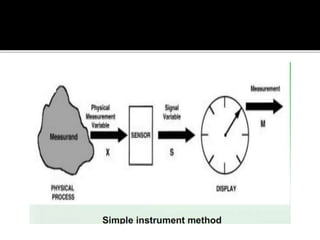
 Measurements involve the use of
instruments as a physical means of
determining quantities (or)Variables
 In simple cases, an instrument consists of a
single unit which gives an output reading (or)
signal according to the unknown variable
applied to it.
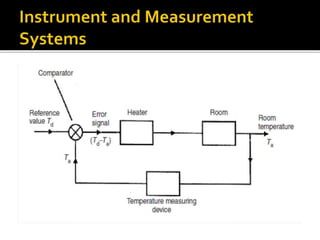
 In more complex measurement situations a
measuring instruments may consists of
several separate instruments.These elements
may consists of transuducing elements which
convert the measured to an analogues form.
 Basic classification of measuring
instruments:
 Mechanical instruments:-They are very
reliable for static and stable conditions.The
disadvantage is they are unable to respond
rapidly to measurement of dynamic and
transient conditions.

 Electrical instruments:- Electrical methods
of indicating the output of detectors are
more rapid than mechanical methods.The
electrical system normally depends upon a
mechanical meter movement as indicating
device.
 Electronic instruments:-These instruments
have very fast response. For example a
cathode ray oscilloscope (CRO) is capable to
follow dynamic and transient changes of the
order of few nano seconds (10-9 sec).
They are many ways in which instruments can
be Classified broadly
1. Absolute InstrumentsThese instrument
give the magnitude of the quantity under
measurement in terms of physical constants
of the instrument .e.g.tangent galvanometer
2. Secondary Instruments These instruments
are so constructed that the quantity being
measured can only be measured by
observing the output indicated by the
instrument . e.g. voltmeter
 Analog and digital instrument
1.Analog instrument : signals that in a
continuous fashion and take on an infinite
number of values in any given range are
called analog signals .The device which
produce these signals are called analog
device
 2.Digital instrument : signals which vary in
steps and thus take up only finite different
values a given range are called digital signals
.The device which produce these signals are
called digital device
Accuracy:- It is closeness with which an
instrument reading approaches the true value of
the quantity being measured.
Precision:- It is the measure of reproducibility of
measurement i.e. gives a fixed value of quantity.
Precision is a measure of degree of agreement
within the group of measurements
 Precision is necessary but not a sufficient
condition for accuracy
 Sensitivity:- The ratio of change in output of
instrument to a change in input is called the
sensitivity.
 Resolution:- The smallest change in a measured
variable to which an instrument will respond is
called resolution.
 Expected value:- The most probable value that
calculations indicate and one should expect to
measure.
 Threshold:- If the input to instrument is
gradually increased from zero, there will some
minimum value below which no output change
can be observed or detected. This minimum
value is defined as the threshold of the
instrument.
 Drift:- It is an undesired change in the output-
input relationship over a period of time.
 Dead Time:- It is defined as the time required by
a measuring system to begin respond to a
change in measured
 The accuracy and precision of an instrument
depends upon its design, the material used
and the workmanship involved in
manufacturing the instrument, which
contributes to various types of errors
 i) Gross error
(ii) Systematic error
(iii) Random error
 Gross error:- This class of error mainly covers
human mistake in reading the instrument,
recording the data and calculating the
measurement results. The experimenter may
grossly misread the scale
 Systematic error:- (a) Instrumental error
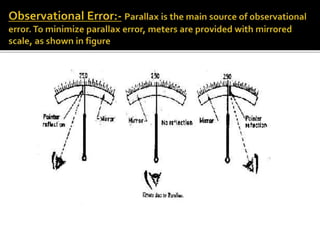
(b) Observational error.
(c)Environmental error
 Instrumental error:- These errors takes place
due to
 inherent shortcoming of instrument,
 misuse of instrument and
 loading effect of instrument.
 Inherent shortcoming of instruments:-
These errors are inherent in instruments
because of their mechanical structure. e.g. if
spring used for producing controlling torque
of a permanent magnet instrument has
become weak, the instrument will always
read high. Errors may take place because of
friction, Hysterisis or backlash of gears
 Misuse of instrument:- The error caused in
measurements are due to the fault of the
operator than that of the instrument. These
errors may be cited for this misuse of
instrument may be failure to adjust the zero
of instrument, poor initial adjustments, use of
high resistance leads.
 Loading effect:- These errors are committed
by beginners. e.g. a well calibrated voltmeter
may give a wrong reading when connected
across a high resistance circuit, the same
voltmeter give a more dependable reading
when connected across a low resistance
circuit
 Environmental Error:- These errors are due
to conditions external to the measuring
device including conditions in the area
surrounding the instrument. These may be
effects of temperature, pressure, humidity,
dust, vibrations or external magnetic field
(stray magnetic field).
 Random Error:- These error exists due to
unknown causes and occurs even when all the
errors have been accounted for
 Limiting or Guarantee Error:- In most
instruments the accuracy is guaranteed to
within a certain percentage of full scale
reading. Components are to be within a
certain percentage of rated value. The limits
of these deviations from the specified values
are defined as limiting errors or guarantee
errors.
* A device for deflection of pointer over the
scale (called deflecting device)
* A device for controlling the movement of
pointer (control device)
* A device to ensure that the pointer comes to
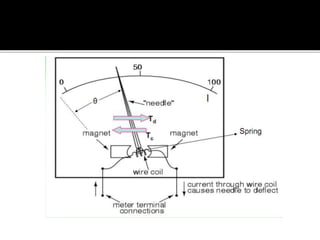
rest quickly with minimum oscillations at its
correct reading position (damping device).
 The deflection of the instrument provides a basis
for determining the quantity under measurement .
 The measured quantity produces some physical
effect with deflects (or) produces a mechanical
displacement of the moving system of the
instrument .
 An opposing effect is built in the Instrument which
tries to oppose the deflection (or) the mechanical
displacement of the moving system.
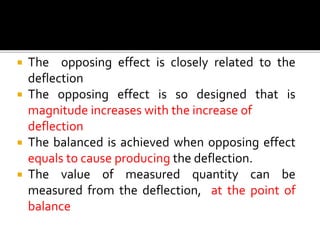
 The opposing effect is closely related to the
deflection
 The opposing effect is so designed that is
magnitude increases with the increase of
deflection
 The balanced is achieved when opposing effect
equals to cause producing the deflection.
 The value of measured quantity can be
measured from the deflection, at the point of
balance
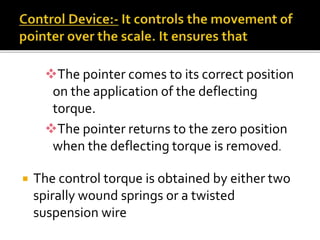
The pointer comes to its correct position
on the application of the deflecting
torque.
The pointer returns to the zero position
when the deflecting torque is removed.
 The control torque is obtained by either two
spirally wound springs or a twisted
suspension wire
 Spring Control:- Spring of non magnetic
alloy such as ‘Phosphor Bronze’ having low
specific resistance and temperature
coefficient of resistance
 Td = G.I
[ where G is depends Flux density, number
of turns are the moving coil]
 Tc = K.θ
[ where K is the spring constant which
depends upon the material and dimensions of
the spring ]
 Damping is the prevention of the oscillations
of the pointer to reduce its settling time.The
torque applied to damped out the oscillations
is called ‘DampingTorque’
 The methods commonly used for damping
are:
(i) Eddy current damping
(ii) Air damping or air friction damping
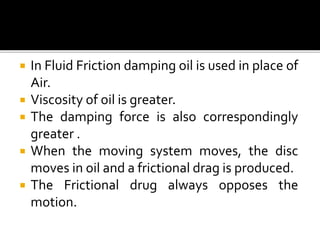
(iii) Fluid damping or fluid friction damping
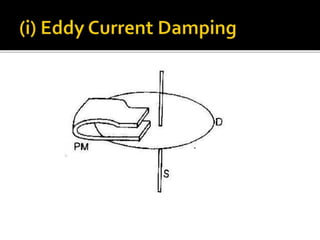
 As shown in figure disc D is attached to the
instrument spindle S.
 The disc is arranged to move in a magnetic
field of a permanent magnet PM. This will
induce a voltage which causing eddy current
to flow in the disc.
 The eddy current produces a flux, which
interacts with the magnetic field to exert a
force on disc.
 By Lenz law this force opposes the
movement of disc, thus damping effect is
obtained
I α emf α velocity of the conductor
 The torque is proportional to the strength of
the magnetic field and current product
T α ϕ α I
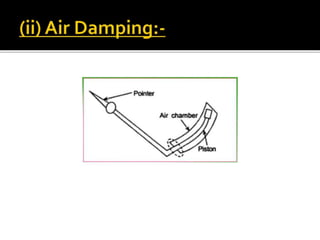
 ii) Air Damping:- When the piston moves in
to chamber, the air inside is compressed and
pressure of air thus build up, opposes the
motion of piston
 When the piston moves out of chamber , the
pressure in closed space Falls, and the
pressure on the open side is greater than the
other
 The pressure on the compressed side is more
than that on the other side.This opposes the
motion of the vane and slows down its
movement
 In Fluid Friction damping oil is used in place of
Air.
 Viscosity of oil is greater.
 The damping force is also correspondingly
greater .
 When the moving system moves, the disc
moves in oil and a frictional drag is produced.
 The Frictional drug always opposes the
motion.
 Permanent Magnet Moving Coil Instrument
(PMMC)
 Moving Iron Instrument
 Electrodynamic Instruments
 HotWire Instruments
 Thermocouple Instruments
 InductionType Instruments
 Electrostatic Instruments
 RectifierType Instruments

ELECTRICAL AND ELECTRONICS MEASUREMENT

  • 1.
    1. INTRODUCTION  Functionalelements of an instrument – Static and dynamic characteristics – Errors in measurement – Statistical evaluation of measurement data – Standards and calibration.
  • 2.
     Principle andtypes of analog and digital voltmeters, ammeters, millimeters  Single and three phase wattmeters and energy meters – Magnetic measurements Determination of B-H curve and measurements of iron loss – Instrument transformers – Instruments for measurement of frequency and phase.
  • 3.
     D.C &A.C potentiometers, D.C & A.C bridges, transformer ratio bridges, self-balancing bridges, Interference & screening ,  Multiple earth and earth loops Electrostatic and electromagnetic interference  Grounding techniques
  • 4.
     Magnetic diskand tape – Recorders, digital plotters and printers, CRT display, digital  CRO, LED, LCD & dot matrix display.
  • 5.
     There aretwo major functions of all branches of engineering:- (1) Design of equipment and process (2) Proper operation and maintenance of equipment and process. For both purpose measurement is required
  • 6.
     The Measurementof a given quantity is essentially an act (or) the result of comparison between the quantity and predefined standard. It expressed in numerical values  Measurement is the process by which one can convert physical parameters to meaningful numbers
  • 7.
     In orderthat the results of measurement are meaningful there are two basic requirements  • The standard used for comparison purposes must be accurately defined and should be commonly used  • The apparatus used and the method adopted must be provable
  • 8.
     Measurement:- Themeasurement of a given quantity is an act or the of comparison between the quantity whose magnitude is unknown and a predefined standard. Since two quantities are compared the result is expressed in the form of numerical values.  There are two methods of measurement (i) Direct method (ii) Indirect method
  • 10.
     1. Directmethod :  The unknown quantity is directly compared against a standard .The result is expressed as a numerical value e.g.. Length , Mass ,Time  2. Indirect method: Measurement of indirect methods are not always possible, feasible, and practicable. These methods in most of the cases are inaccurate because they involve human factors
  • 11.
     Measurements involvethe use of instruments as a physical means of determining quantities (or)Variables  In simple cases, an instrument consists of a single unit which gives an output reading (or) signal according to the unknown variable applied to it.
  • 12.
     In morecomplex measurement situations a measuring instruments may consists of several separate instruments.These elements may consists of transuducing elements which convert the measured to an analogues form.
  • 14.
     Basic classificationof measuring instruments:  Mechanical instruments:-They are very reliable for static and stable conditions.The disadvantage is they are unable to respond rapidly to measurement of dynamic and transient conditions. 
  • 15.
     Electrical instruments:-Electrical methods of indicating the output of detectors are more rapid than mechanical methods.The electrical system normally depends upon a mechanical meter movement as indicating device.
  • 16.
     Electronic instruments:-Theseinstruments have very fast response. For example a cathode ray oscilloscope (CRO) is capable to follow dynamic and transient changes of the order of few nano seconds (10-9 sec).
  • 17.
    They are manyways in which instruments can be Classified broadly 1. Absolute InstrumentsThese instrument give the magnitude of the quantity under measurement in terms of physical constants of the instrument .e.g.tangent galvanometer
  • 18.
    2. Secondary InstrumentsThese instruments are so constructed that the quantity being measured can only be measured by observing the output indicated by the instrument . e.g. voltmeter
  • 19.
     Analog anddigital instrument 1.Analog instrument : signals that in a continuous fashion and take on an infinite number of values in any given range are called analog signals .The device which produce these signals are called analog device
  • 20.
     2.Digital instrument: signals which vary in steps and thus take up only finite different values a given range are called digital signals .The device which produce these signals are called digital device
  • 21.
    Accuracy:- It iscloseness with which an instrument reading approaches the true value of the quantity being measured. Precision:- It is the measure of reproducibility of measurement i.e. gives a fixed value of quantity. Precision is a measure of degree of agreement within the group of measurements  Precision is necessary but not a sufficient condition for accuracy
  • 22.
     Sensitivity:- Theratio of change in output of instrument to a change in input is called the sensitivity.  Resolution:- The smallest change in a measured variable to which an instrument will respond is called resolution.  Expected value:- The most probable value that calculations indicate and one should expect to measure.
  • 23.
     Threshold:- Ifthe input to instrument is gradually increased from zero, there will some minimum value below which no output change can be observed or detected. This minimum value is defined as the threshold of the instrument.  Drift:- It is an undesired change in the output- input relationship over a period of time.  Dead Time:- It is defined as the time required by a measuring system to begin respond to a change in measured
  • 24.
     The accuracyand precision of an instrument depends upon its design, the material used and the workmanship involved in manufacturing the instrument, which contributes to various types of errors
  • 25.
     i) Grosserror (ii) Systematic error (iii) Random error  Gross error:- This class of error mainly covers human mistake in reading the instrument, recording the data and calculating the measurement results. The experimenter may grossly misread the scale
  • 26.
     Systematic error:-(a) Instrumental error (b) Observational error. (c)Environmental error  Instrumental error:- These errors takes place due to  inherent shortcoming of instrument,  misuse of instrument and  loading effect of instrument.
  • 27.
     Inherent shortcomingof instruments:- These errors are inherent in instruments because of their mechanical structure. e.g. if spring used for producing controlling torque of a permanent magnet instrument has become weak, the instrument will always read high. Errors may take place because of friction, Hysterisis or backlash of gears
  • 28.
     Misuse ofinstrument:- The error caused in measurements are due to the fault of the operator than that of the instrument. These errors may be cited for this misuse of instrument may be failure to adjust the zero of instrument, poor initial adjustments, use of high resistance leads.
  • 29.
     Loading effect:-These errors are committed by beginners. e.g. a well calibrated voltmeter may give a wrong reading when connected across a high resistance circuit, the same voltmeter give a more dependable reading when connected across a low resistance circuit
  • 31.
     Environmental Error:-These errors are due to conditions external to the measuring device including conditions in the area surrounding the instrument. These may be effects of temperature, pressure, humidity, dust, vibrations or external magnetic field (stray magnetic field).
  • 32.
     Random Error:-These error exists due to unknown causes and occurs even when all the errors have been accounted for
  • 33.
     Limiting orGuarantee Error:- In most instruments the accuracy is guaranteed to within a certain percentage of full scale reading. Components are to be within a certain percentage of rated value. The limits of these deviations from the specified values are defined as limiting errors or guarantee errors.
  • 34.
    * A devicefor deflection of pointer over the scale (called deflecting device) * A device for controlling the movement of pointer (control device) * A device to ensure that the pointer comes to rest quickly with minimum oscillations at its correct reading position (damping device).
  • 35.
     The deflectionof the instrument provides a basis for determining the quantity under measurement .  The measured quantity produces some physical effect with deflects (or) produces a mechanical displacement of the moving system of the instrument .  An opposing effect is built in the Instrument which tries to oppose the deflection (or) the mechanical displacement of the moving system.
  • 37.
     The opposingeffect is closely related to the deflection  The opposing effect is so designed that is magnitude increases with the increase of deflection  The balanced is achieved when opposing effect equals to cause producing the deflection.  The value of measured quantity can be measured from the deflection, at the point of balance
  • 38.
    The pointer comesto its correct position on the application of the deflecting torque. The pointer returns to the zero position when the deflecting torque is removed.  The control torque is obtained by either two spirally wound springs or a twisted suspension wire
  • 39.
     Spring Control:-Spring of non magnetic alloy such as ‘Phosphor Bronze’ having low specific resistance and temperature coefficient of resistance
  • 40.
     Td =G.I [ where G is depends Flux density, number of turns are the moving coil]  Tc = K.θ [ where K is the spring constant which depends upon the material and dimensions of the spring ]
  • 41.
     Damping isthe prevention of the oscillations of the pointer to reduce its settling time.The torque applied to damped out the oscillations is called ‘DampingTorque’
  • 42.
     The methodscommonly used for damping are: (i) Eddy current damping (ii) Air damping or air friction damping (iii) Fluid damping or fluid friction damping
  • 44.
     As shownin figure disc D is attached to the instrument spindle S.  The disc is arranged to move in a magnetic field of a permanent magnet PM. This will induce a voltage which causing eddy current to flow in the disc.
  • 45.
     The eddycurrent produces a flux, which interacts with the magnetic field to exert a force on disc.  By Lenz law this force opposes the movement of disc, thus damping effect is obtained I α emf α velocity of the conductor
  • 46.
     The torqueis proportional to the strength of the magnetic field and current product T α ϕ α I
  • 48.
     ii) AirDamping:- When the piston moves in to chamber, the air inside is compressed and pressure of air thus build up, opposes the motion of piston  When the piston moves out of chamber , the pressure in closed space Falls, and the pressure on the open side is greater than the other
  • 49.
     The pressureon the compressed side is more than that on the other side.This opposes the motion of the vane and slows down its movement
  • 51.
     In FluidFriction damping oil is used in place of Air.  Viscosity of oil is greater.  The damping force is also correspondingly greater .  When the moving system moves, the disc moves in oil and a frictional drag is produced.  The Frictional drug always opposes the motion.
  • 52.
     Permanent MagnetMoving Coil Instrument (PMMC)  Moving Iron Instrument  Electrodynamic Instruments  HotWire Instruments  Thermocouple Instruments  InductionType Instruments  Electrostatic Instruments  RectifierType Instruments