DISTORTION(OPTICS) IN
ABERRATION
DEFINITION
• Distortion is the most easily recognized optical
aberration .It is deforms the image as whole.
In geometric optics and cathode ray tube (CRT)
displays, distortion is a deviation from rectilinear
projection, a projection in which straight lines in a
scene remain straight in an image. It is a form of
optical aberration.
RADIAL DISTORTION
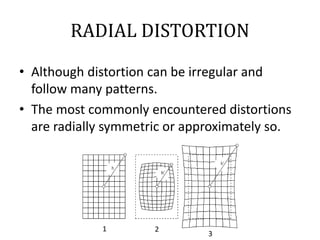
• Although distortion can be irregular and
follow many patterns.
• The most commonly encountered distortions
are radially symmetric or approximately so.
1 2
3
CLASSIFICATION OF RADIAL
DISTORTION IN OPTICS
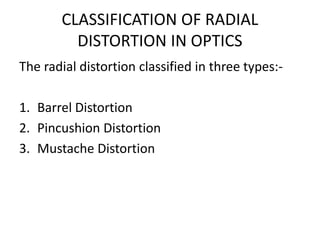
The radial distortion classified in three types:-
1. Barrel Distortion
2. Pincushion Distortion
3. Mustache Distortion
BARREL DISTORTION
• In Barrel Distortion, image magnification decreases
with the distance from optical axis.
• The apparent effect is that of an image which has
been mapped around a Sphere or Barrel.
• Straight lines running through the image centre
remain straight and a circle concentric with the
image centre remains a circle, although its radius is
affected. It is actually a diminished radius mapping
for large radii in comparison with small radii.
1 2
PINCUSHION DISTORTION
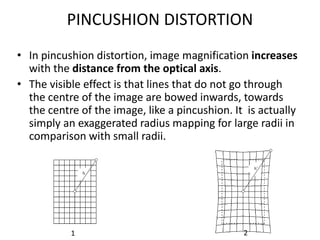
• In pincushion distortion, image magnification increases
with the distance from the optical axis.
• The visible effect is that lines that do not go through
the centre of the image are bowed inwards, towards
the centre of the image, like a pincushion. It is actually
simply an exaggerated radius mapping for large radii in
comparison with small radii.
1 2
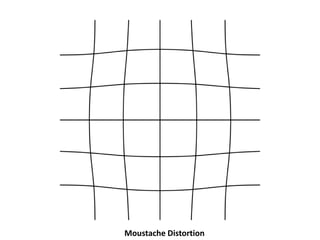
MOUSTACHE DISTORTION
• A mixture of both types, sometimes referred to
as Moustache Distortion (moustache distortion)
or complex distortion, is less common but not
rare. It starts out as barrel distortion close to the
image centre and gradually turns into pincushion
distortion towards the image periphery, making
horizontal lines in the top half of the frame look
like a handlebar moustache.
Moustache Distortion
ORIGIN OF ABERRATION
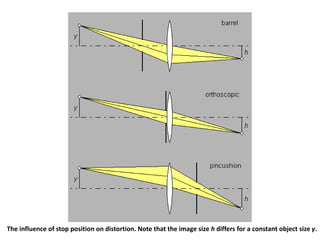
• A common cause of distortion is the
introduction of a aperture stop in a system of
thin lenses to reduce spherical aberration.
• The position of such aperture stop determines
the amount and sign of the distortion
The influence of stop position on distortion. Note that the image size h differs for a constant object size y.
OCCURRENCE
• In photography, distortion is particularly associated with zoom
lenses, particularly large-range zooms, but may also be found
in prime lenses, and depends on focal distance – for example,
the Canon EF(Electro Focus) 50mm
• Barrel distortion may be found in wide-angle lenses.
• Moustache distortion is observed particularly on the wide end
of some zooms, with certain retro focus lenses, and more
recently on large-range zooms such as the Nikon 18–200 mm.
• A certain amount of pincushion distortion is often found with
visual optical instruments .Ex -binoculars.
REFERENCES
• http://en.wikipedia.org/wiki/Distortion_(optic
s)
• www.google.com
• http://toothwalker.org/optics/distortion.html
Distortion(optics) in aberration

Distortion(optics) in aberration

  • 1.
  • 2.
    DEFINITION • Distortion isthe most easily recognized optical aberration .It is deforms the image as whole. In geometric optics and cathode ray tube (CRT) displays, distortion is a deviation from rectilinear projection, a projection in which straight lines in a scene remain straight in an image. It is a form of optical aberration.
  • 3.
    RADIAL DISTORTION • Althoughdistortion can be irregular and follow many patterns. • The most commonly encountered distortions are radially symmetric or approximately so. 1 2 3
  • 4.
    CLASSIFICATION OF RADIAL DISTORTIONIN OPTICS The radial distortion classified in three types:- 1. Barrel Distortion 2. Pincushion Distortion 3. Mustache Distortion
  • 5.
    BARREL DISTORTION • InBarrel Distortion, image magnification decreases with the distance from optical axis. • The apparent effect is that of an image which has been mapped around a Sphere or Barrel. • Straight lines running through the image centre remain straight and a circle concentric with the image centre remains a circle, although its radius is affected. It is actually a diminished radius mapping for large radii in comparison with small radii. 1 2
  • 6.
    PINCUSHION DISTORTION • Inpincushion distortion, image magnification increases with the distance from the optical axis. • The visible effect is that lines that do not go through the centre of the image are bowed inwards, towards the centre of the image, like a pincushion. It is actually simply an exaggerated radius mapping for large radii in comparison with small radii. 1 2
  • 7.
    MOUSTACHE DISTORTION • Amixture of both types, sometimes referred to as Moustache Distortion (moustache distortion) or complex distortion, is less common but not rare. It starts out as barrel distortion close to the image centre and gradually turns into pincushion distortion towards the image periphery, making horizontal lines in the top half of the frame look like a handlebar moustache.
  • 8.
  • 9.
    ORIGIN OF ABERRATION •A common cause of distortion is the introduction of a aperture stop in a system of thin lenses to reduce spherical aberration. • The position of such aperture stop determines the amount and sign of the distortion
  • 10.
    The influence ofstop position on distortion. Note that the image size h differs for a constant object size y.
  • 11.
    OCCURRENCE • In photography,distortion is particularly associated with zoom lenses, particularly large-range zooms, but may also be found in prime lenses, and depends on focal distance – for example, the Canon EF(Electro Focus) 50mm • Barrel distortion may be found in wide-angle lenses. • Moustache distortion is observed particularly on the wide end of some zooms, with certain retro focus lenses, and more recently on large-range zooms such as the Nikon 18–200 mm. • A certain amount of pincushion distortion is often found with visual optical instruments .Ex -binoculars.
  • 12.