Aberration
Presented by:
Ashi Lakher
B. Optometry
Final year
Introduction
• In an ideal optical system, all rays of light from a point in the object
plane would converge to the same point in the image plane, forming
a clear image. The influences which cause different rays to converge
to different points are called aberrations.
• A defect in lens design which causes light to spread out instead
of focusing to form a sharp image.
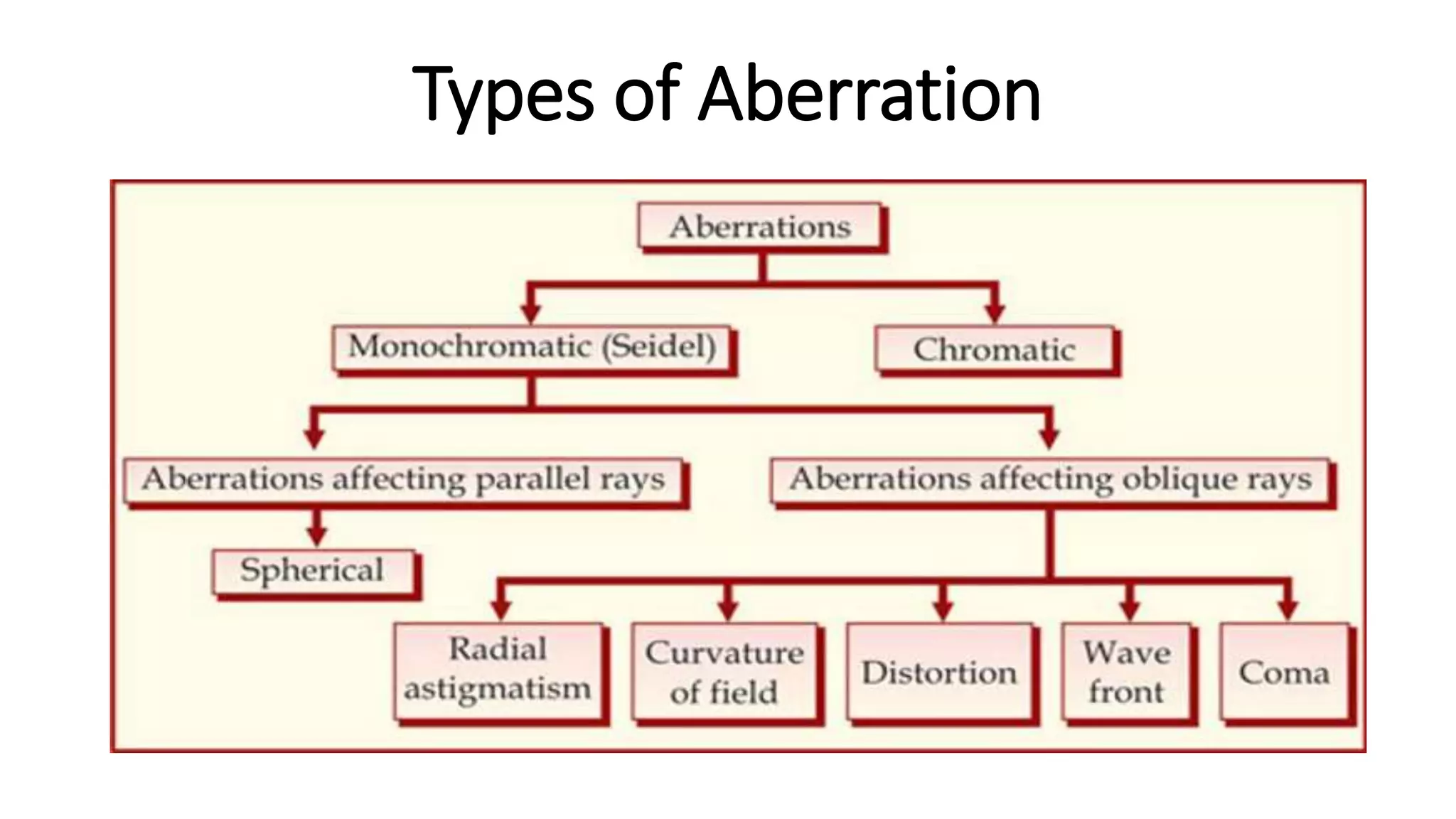
Types of Aberration
Chromatic Aberration:
• Chromatic aberration is due to fact that the refractive index of a
material varies slightly with the wavelength.
• CHROMATIC ABERRATION:
1. Longitudinal (axial) chromatic aberration
2. Transverse (lateral) chromatic aberration.
Clinical implication :
PARAXIAL ASSUMPTION
• For small angle , i.e Paraxial rays makes
SinƟ = Ɵ, (Ɵ= radian)
• But as the angle of incidence increases, better estimation of sinƟ given by
following expansion:
• When 3rd order aberration {Ɵ-(Ɵ3/3!)} is used , image formation differs
from what is predicted by paraxial equation
Monochromatic aberration:
• In 1850’s Ludwig von Seidel described 5 monochromatic aberrations which
affect the image when the object is far enough off axis or the area of the
lens used is far enough from the axis.
• Monochromatic aberrations, a/k/a Seidel aberrations
Spherical aberration
Coma
Oblique astigmatism
Curvature of image
Distortion
Spherical aberration:
• It is due to prismatic effect of lens.
• The collimated rays entering the lens at different distances from the
optical axis will converge to different points, causing an overall loss of
focus. Like many optical aberrations, the blur effect increases towards
the edge of the lens.
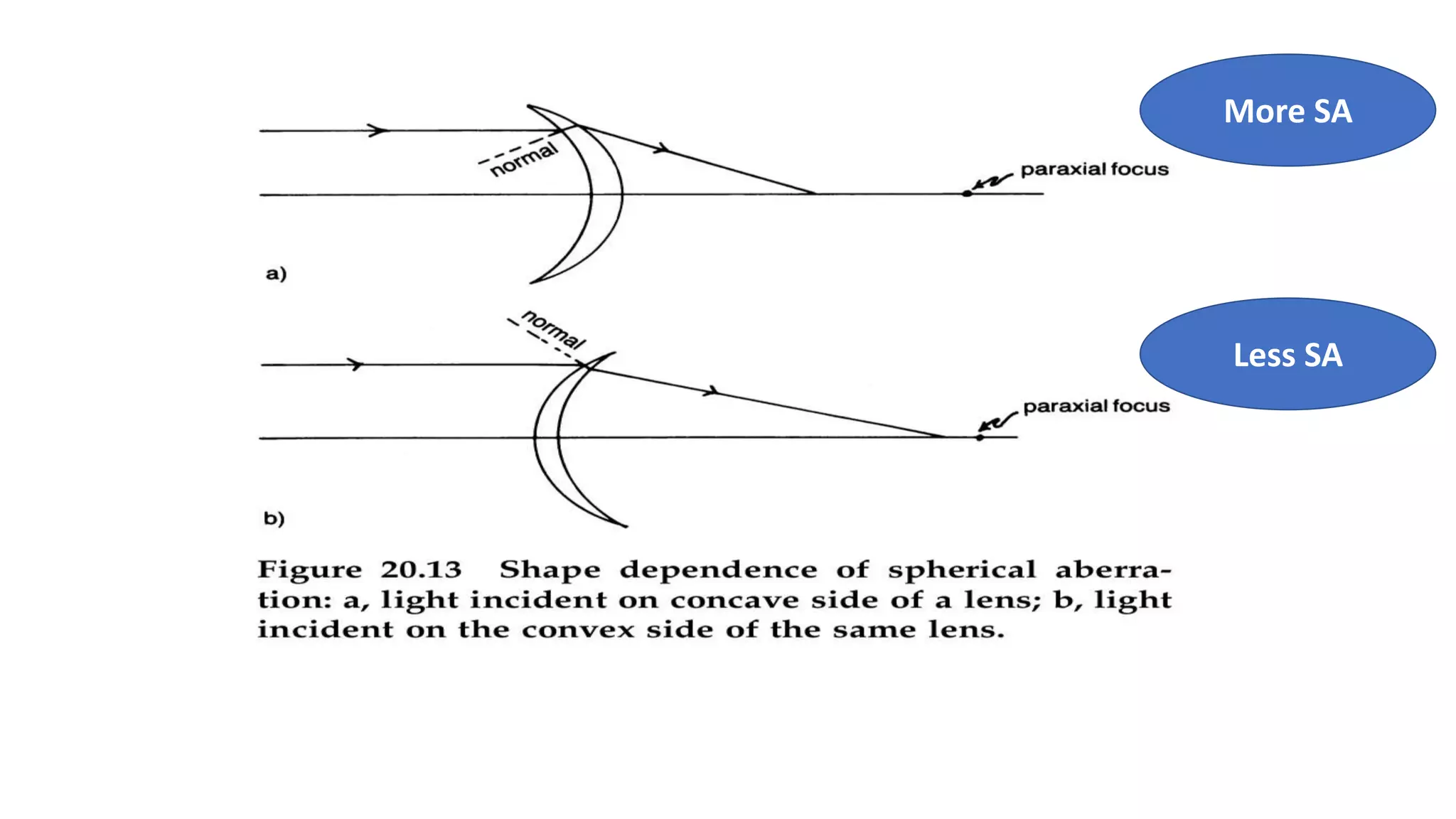
• Light striking periphery of lens deviates more while paraxial light deviates
least, that difference of focal point of peripheral and paraxial rays is
Spherical aberration.
• When peripheral rays deviates more is called Positive and when least is
called Negative Spherical aberration.
More SA
Less SA
Clinical implication:
• Iris prevent SA by blocking peripheral rays.
• Unaccommodated eyes has positive SA.
As eye accommodates – Amount of positive SA decreases
• Night myopia(In dim light pupil dilates ,peripheral rays reaches retina
and eye is myopic )
COMA:
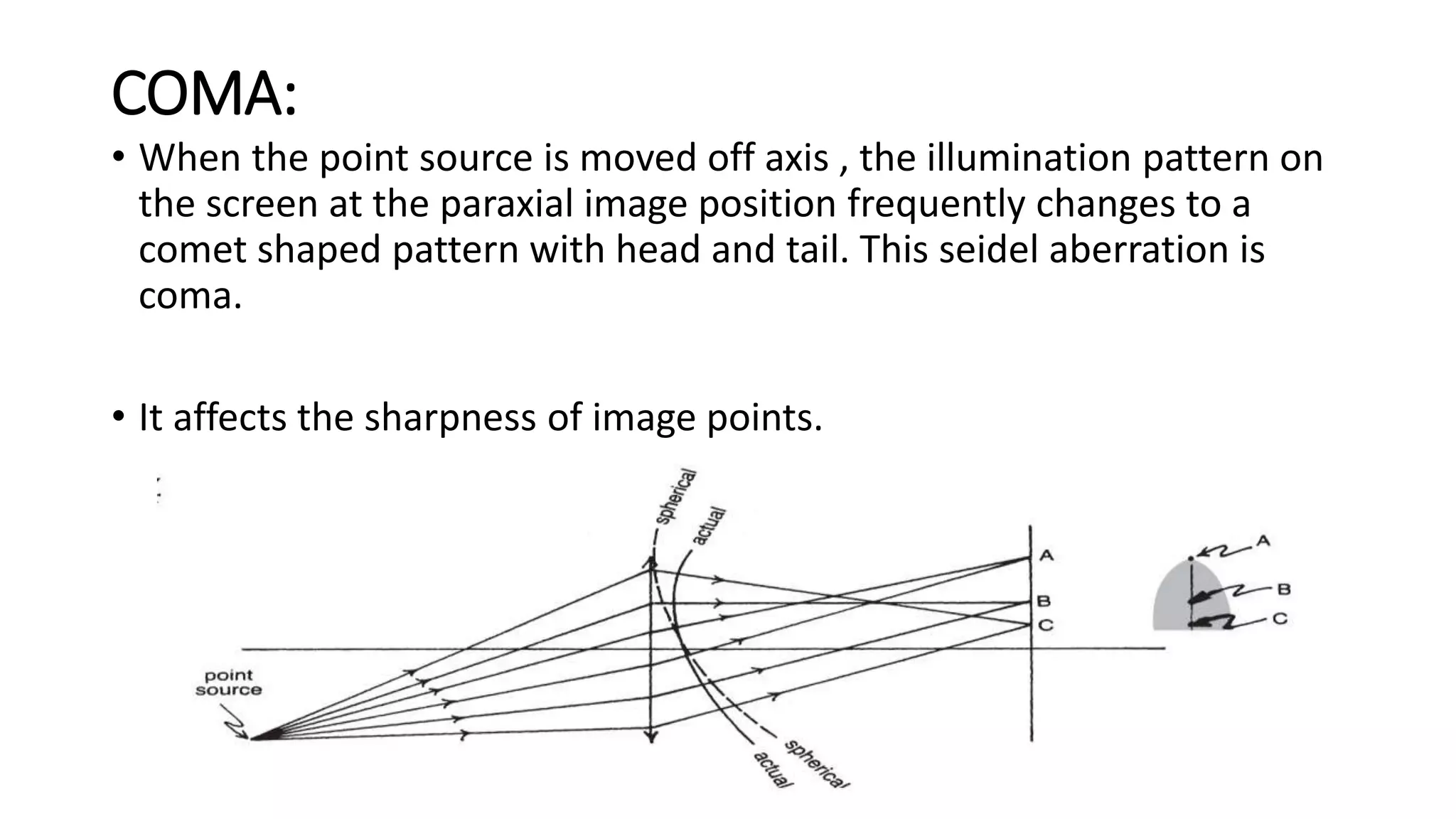
• When the point source is moved off axis , the illumination pattern on
the screen at the paraxial image position frequently changes to a
comet shaped pattern with head and tail. This seidel aberration is
coma.
• It affects the sharpness of image points.
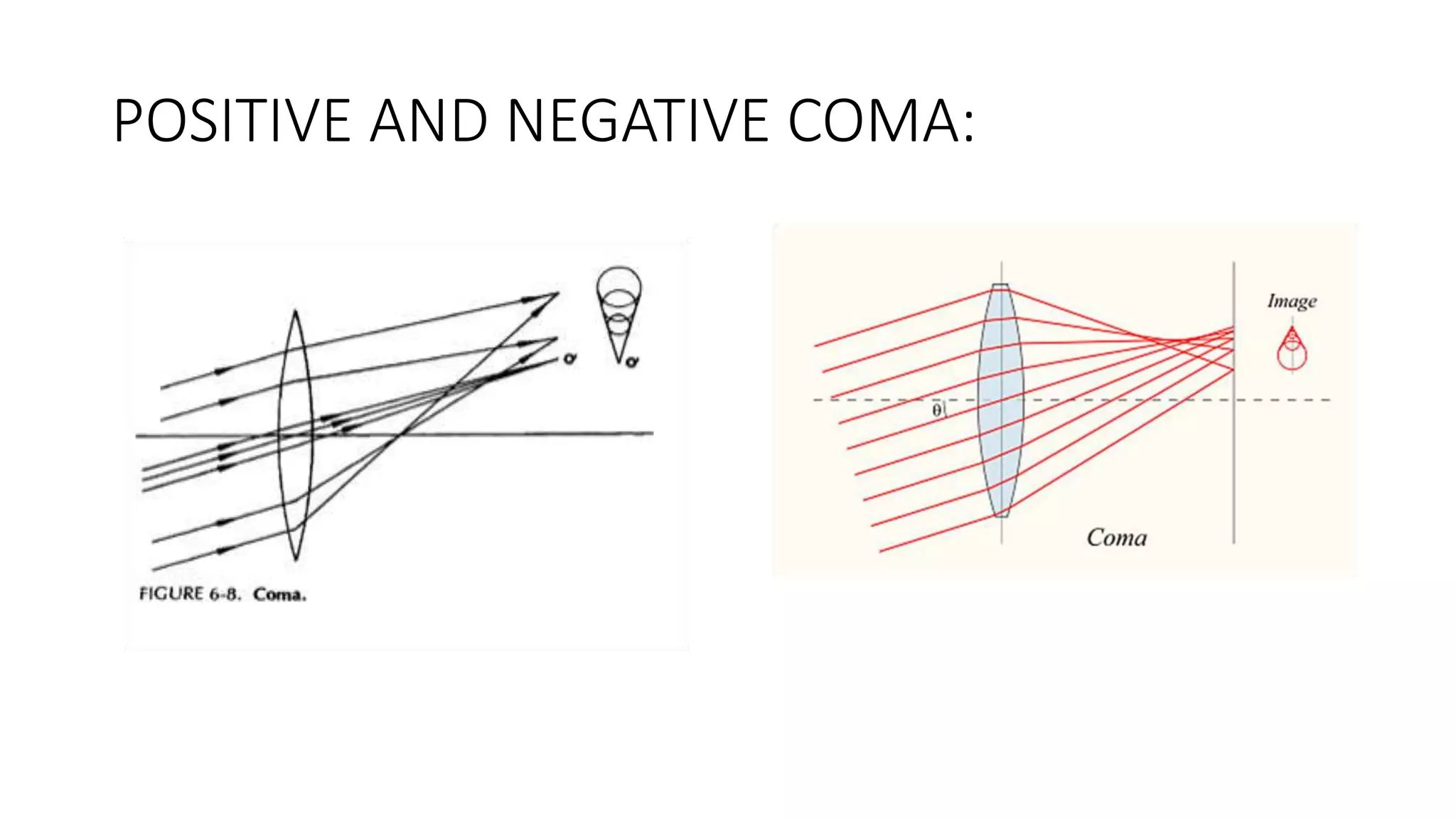
POSITIVE AND NEGATIVE COMA:
Radial Astigmatism :
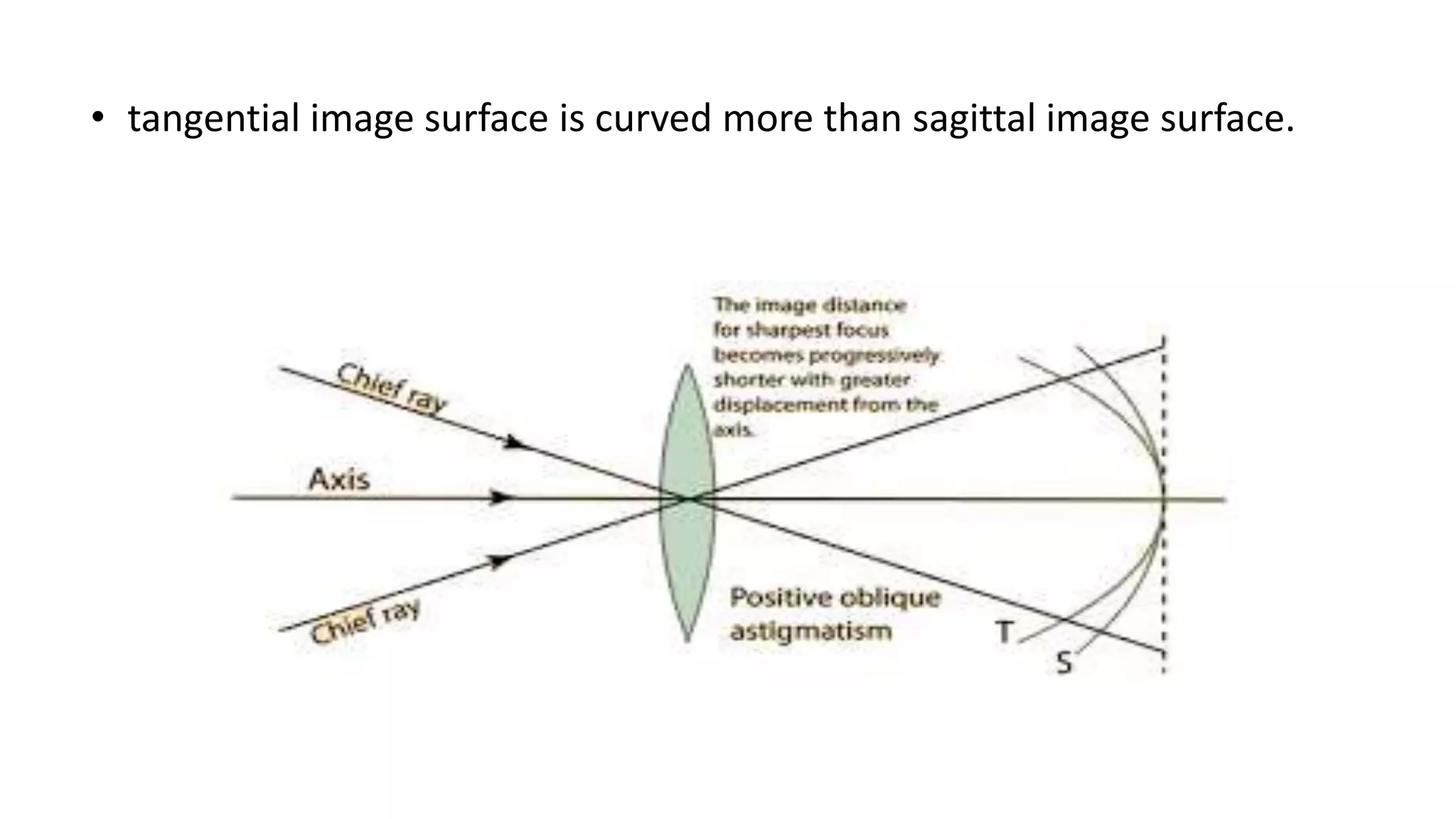
• For an off axis point source ,RA results in a centered spherical system
producing a conoid of Sturm with two perpendicular line image - One
associated with the tangential meridian and one associated with
sagittal meridian.
• The line image form by tangential meridian is horizontal line and
image form by sagittal meridian is vertical line.
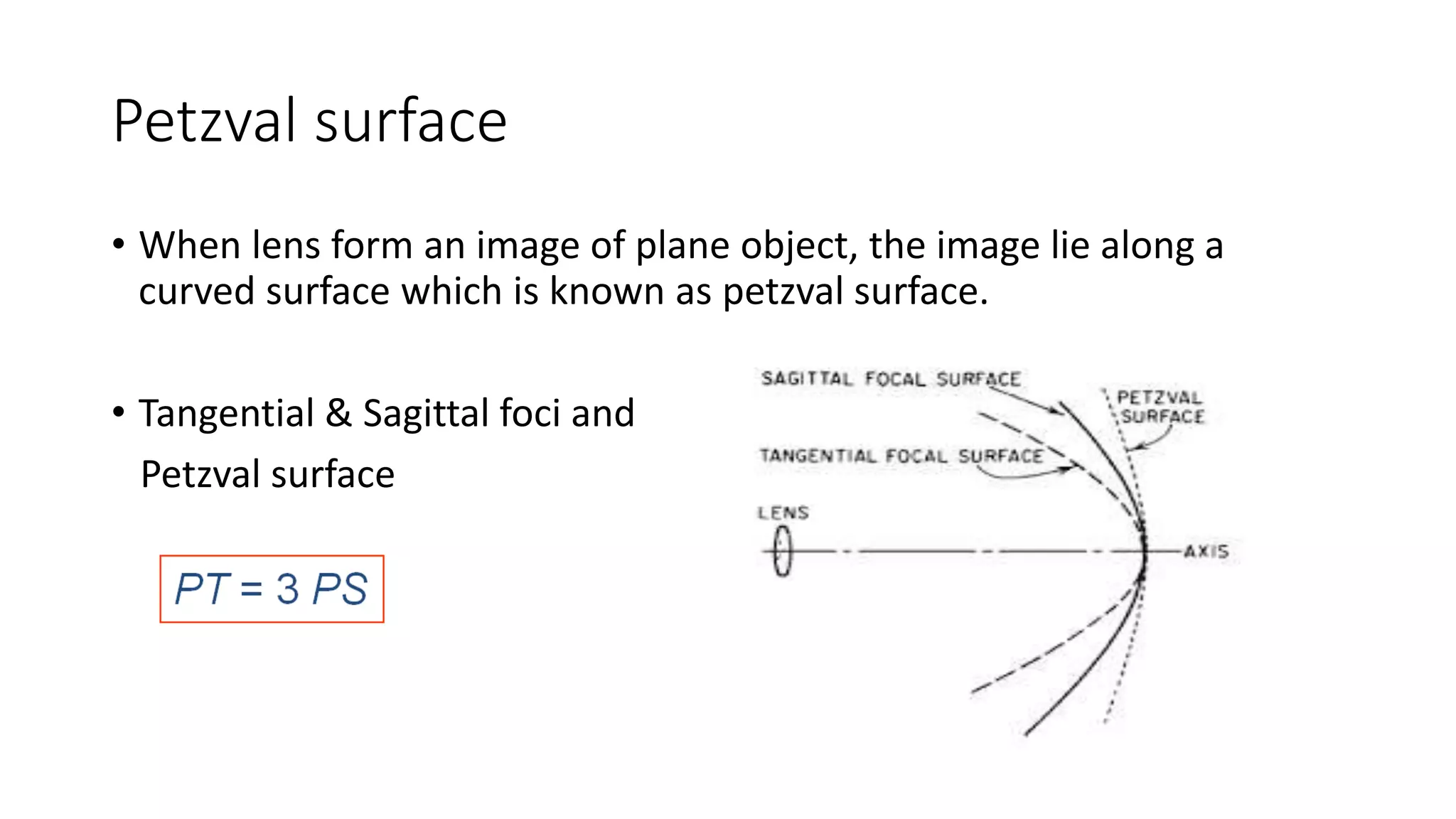
• tangential image surface is curved more than sagittal image surface.
Petzval surface
• When lens form an image of plane object, the image lie along a
curved surface which is known as petzval surface.
• Tangential & Sagittal foci and
Petzval surface
Tscherning ellipse
Teacup and saucer diagram formed by
extended object subjected to oblique
astigmatism.
Clinical implication:
• Even when oblique astigmatism is minimized through proper
selection of the front surface power, it can still be problematic when
the lens is tilted with respect to the eye.
• example, wrap-around sunglasses .
The effective lens power induced by
face form can be calculated by formula:
• Pantoscopic tilt
Pantoscopic tilt increases a minus lens’s minus power. It is for this
reason that undercorrected myopic patients sometimes intentionally
tilt their spectacles to improve distance vision.
CURVATURE OF IMAGE :
• In the absence of other aberration , plan object forms the curve
image which is known as curvature of image.
• This is because all the points on the extended object are not at the
same distance from spherical converging lens
• Principally problem for optical instrument (especially for camera )
because camera use plan image film for image capturing.
• Less problem with eye because retina is curved.
Distortion :
• Distortion is due to fact that the lateral magnification for off-axis
points depend on the exact image and object distance along chief
rays.
• It does not cause any blur or loss of resolution.
Symmetrical:
Pincushion distortion
• It occurs if image size to object size ratio increases with an increase in
object size.
• Plus lens cause pin cushion distortion.
Barrel distortion
• It occurs if image size to object size ratio decreases with an increase
in object size.
• Minus lens cause barrel distortion.
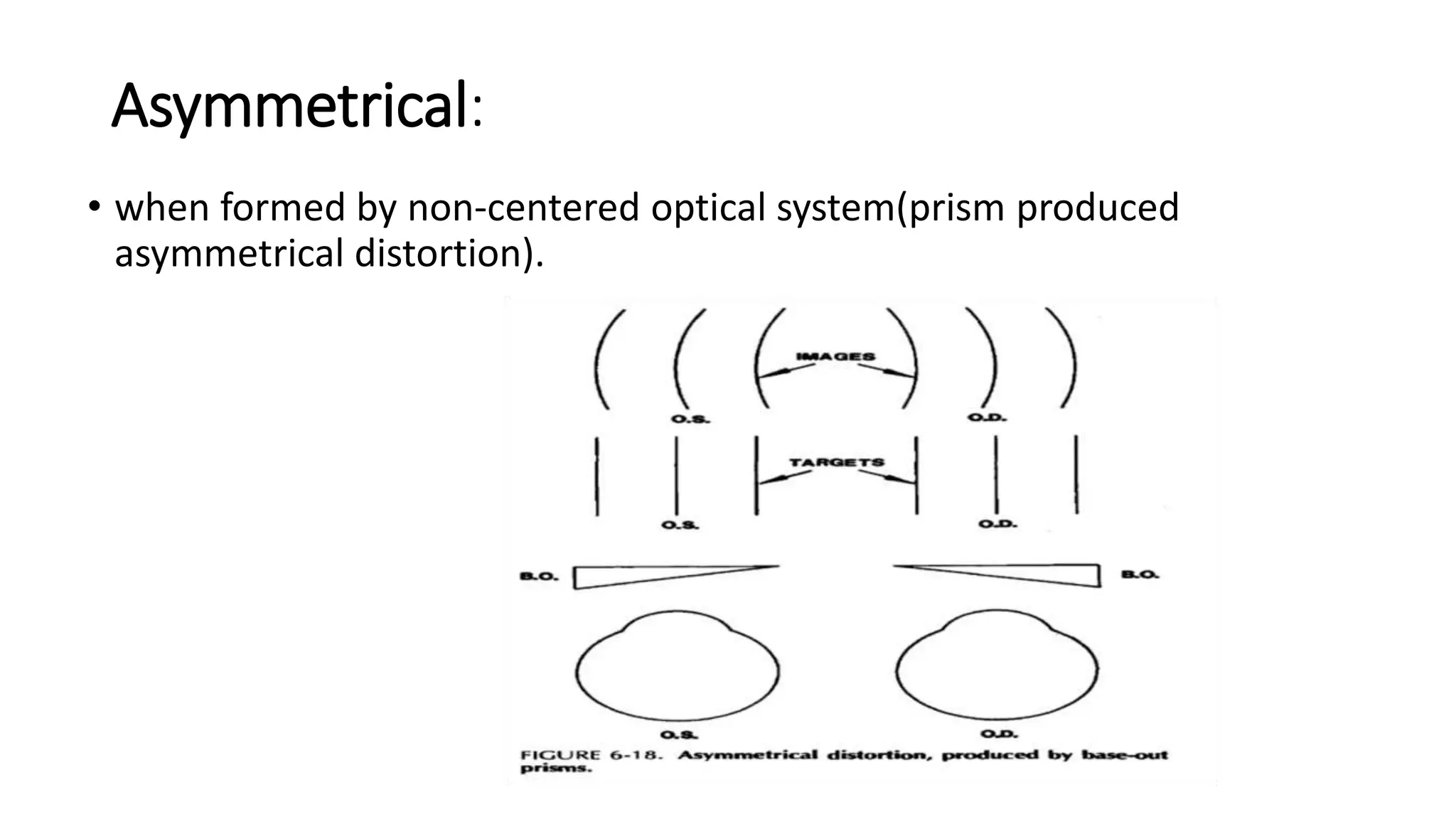
Asymmetrical:
• when formed by non-centered optical system(prism produced
asymmetrical distortion).

Aberration.pptx

  • 1.
  • 2.
    Introduction • In anideal optical system, all rays of light from a point in the object plane would converge to the same point in the image plane, forming a clear image. The influences which cause different rays to converge to different points are called aberrations. • A defect in lens design which causes light to spread out instead of focusing to form a sharp image.
  • 3.
  • 4.
    Chromatic Aberration: • Chromaticaberration is due to fact that the refractive index of a material varies slightly with the wavelength. • CHROMATIC ABERRATION: 1. Longitudinal (axial) chromatic aberration 2. Transverse (lateral) chromatic aberration.
  • 6.
  • 7.
    PARAXIAL ASSUMPTION • Forsmall angle , i.e Paraxial rays makes SinƟ = Ɵ, (Ɵ= radian) • But as the angle of incidence increases, better estimation of sinƟ given by following expansion: • When 3rd order aberration {Ɵ-(Ɵ3/3!)} is used , image formation differs from what is predicted by paraxial equation
  • 8.
    Monochromatic aberration: • In1850’s Ludwig von Seidel described 5 monochromatic aberrations which affect the image when the object is far enough off axis or the area of the lens used is far enough from the axis. • Monochromatic aberrations, a/k/a Seidel aberrations Spherical aberration Coma Oblique astigmatism Curvature of image Distortion
  • 9.
    Spherical aberration: • Itis due to prismatic effect of lens. • The collimated rays entering the lens at different distances from the optical axis will converge to different points, causing an overall loss of focus. Like many optical aberrations, the blur effect increases towards the edge of the lens. • Light striking periphery of lens deviates more while paraxial light deviates least, that difference of focal point of peripheral and paraxial rays is Spherical aberration.
  • 10.
    • When peripheralrays deviates more is called Positive and when least is called Negative Spherical aberration.
  • 12.
  • 13.
    Clinical implication: • Irisprevent SA by blocking peripheral rays. • Unaccommodated eyes has positive SA. As eye accommodates – Amount of positive SA decreases • Night myopia(In dim light pupil dilates ,peripheral rays reaches retina and eye is myopic )
  • 14.
    COMA: • When thepoint source is moved off axis , the illumination pattern on the screen at the paraxial image position frequently changes to a comet shaped pattern with head and tail. This seidel aberration is coma. • It affects the sharpness of image points.
  • 15.
  • 16.
    Radial Astigmatism : •For an off axis point source ,RA results in a centered spherical system producing a conoid of Sturm with two perpendicular line image - One associated with the tangential meridian and one associated with sagittal meridian. • The line image form by tangential meridian is horizontal line and image form by sagittal meridian is vertical line.
  • 18.
    • tangential imagesurface is curved more than sagittal image surface.
  • 19.
    Petzval surface • Whenlens form an image of plane object, the image lie along a curved surface which is known as petzval surface. • Tangential & Sagittal foci and Petzval surface
  • 20.
    Tscherning ellipse Teacup andsaucer diagram formed by extended object subjected to oblique astigmatism.
  • 21.
    Clinical implication: • Evenwhen oblique astigmatism is minimized through proper selection of the front surface power, it can still be problematic when the lens is tilted with respect to the eye. • example, wrap-around sunglasses . The effective lens power induced by face form can be calculated by formula:
  • 22.
    • Pantoscopic tilt Pantoscopictilt increases a minus lens’s minus power. It is for this reason that undercorrected myopic patients sometimes intentionally tilt their spectacles to improve distance vision.
  • 23.
    CURVATURE OF IMAGE: • In the absence of other aberration , plan object forms the curve image which is known as curvature of image.
  • 24.
    • This isbecause all the points on the extended object are not at the same distance from spherical converging lens • Principally problem for optical instrument (especially for camera ) because camera use plan image film for image capturing. • Less problem with eye because retina is curved.
  • 25.
    Distortion : • Distortionis due to fact that the lateral magnification for off-axis points depend on the exact image and object distance along chief rays. • It does not cause any blur or loss of resolution.
  • 26.
    Symmetrical: Pincushion distortion • Itoccurs if image size to object size ratio increases with an increase in object size. • Plus lens cause pin cushion distortion. Barrel distortion • It occurs if image size to object size ratio decreases with an increase in object size. • Minus lens cause barrel distortion.
  • 27.
    Asymmetrical: • when formedby non-centered optical system(prism produced asymmetrical distortion).

Editor's Notes

  • #12 This Figure shows SA plotted as a function of shape factor for various lenses all of which have the same power. spherical aberration is minimized for lenses with approximately planoconvex shapes that are oriented so that the front surface is more convex. 
  • #13 The orientation of the lens is critical—turning it around so that the front surface is flat increases spherical aberration.
  • #16 •When the tip of the comet is pointed toward the optical axis, the coma is said to be positive.  •When it is pointed away, the coma is negative.