


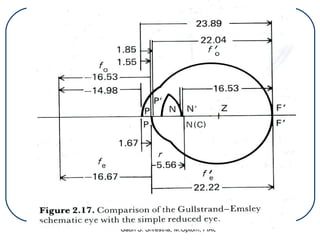
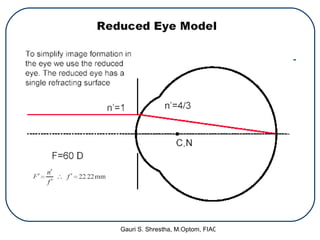
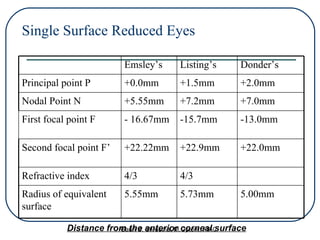
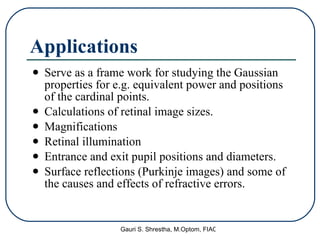
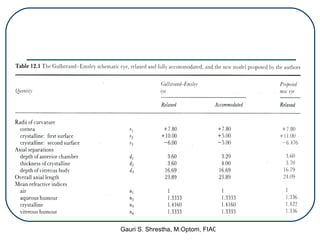
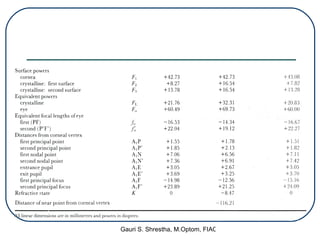


A schematic eye is a mathematical model that represents the basic optical features of the human eye in a simplified manner. It allows for theoretical studies of the eye as an optical instrument. There are different types of schematic eyes that range from more complex exact models to simplified models. The earliest schematic eyes were developed in the 17th-18th centuries, but the most widely used models today are based on the work of Gullstrand in the early 20th century. While schematic eyes are approximations that ignore some complexities, they provide a useful framework for calculating retinal image sizes and other optical properties of the eye.


