MAHARISHI MARKANDESHWAR UNIVERSITY,
SADOPUR AMBALA
PRESANTION
ON
WORK HARDENING & BAUSCHINGER EFFECT
SUBMITTED TO :
Mr. Sachin Mahendru
SUBMITTED BY :
Jitender (75132005) &
Mohd Anas (75134017)
B.Tech 4th sem.
 Work hardening is the strengthening of a
metal by plastic deformation.
 This strengthening occurs because of
dislocation movements and dislocation
generation within the crystal structure of
the material.
 Work hardening also known as Strain
Hardening Or Cold Hardening.
 . Work or Strain hardening is very
commonly employed both on pure metals
and on alloys , as a means of improving
the useful mechanical properties such as
strength and hardness.
 Work hardening however , reduce
ductility and plasticity .
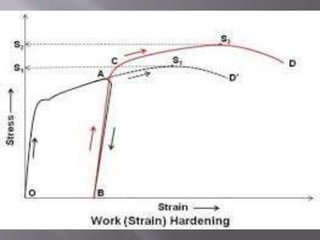
 When loaded , the strain increase with
stress and the curve reaches the point A
in the plastic range.
 If at this stage , the specimen is
unloaded , the strain does not recover
along the original path AO , but moves
along AB .
 If the specimen is reloaded immediately , the
curve again rises from B to A ,but via another
path , and reaches the point C , after which it
will follow the curvature , if loading is
continued .
 If the specimen would not have been
unloaded , after point A , the stress–strain
curve would have followed the dotted path
AD’ .
 A comparison of paths ACD and AD’ shows
that the cold working (plastic deformation)
has increased the yield strength and ultimate
strength of the metal .
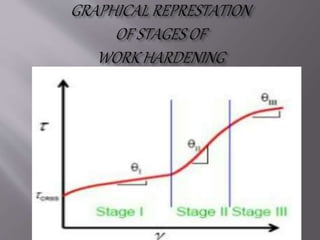
 A typical shear stress – shear strain
curve for a single crystal shows three
stages of work hardening .
 STAGE 1 – Easy Glide Region
 STAGE 2 – Linear Hardening Region
 STAGE 3 – Parabolic Hardening Region .
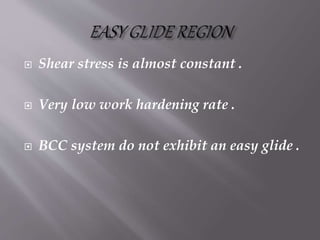
 Shear stress is almost constant .
 Very low work hardening rate .
 BCC system do not exhibit an easy glide .
 LINEARHARDENINGREGION
 Hardening rate is high as well as
constant .
 PARABOLICHARDENINGREGION
 Low hardening rate
 Shape is parabolic
bauschinger effect
• The Bauschinger effect was
discovered by Ohann Bauschinger in
1886.
• Bauschinger effect is a phenomenon in
plastic flow.
• In most materials plastic
deformation in one direction will
affect subsequent response in another
direction.
• .
 The phenomenon by which plastic
deformation of a metal increases the
yield strength in the direction of plastic
flow and decreases the yield strength in
the opposite direction
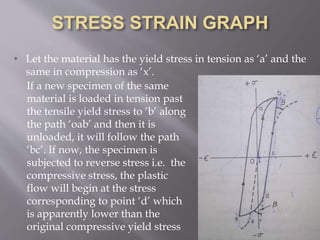
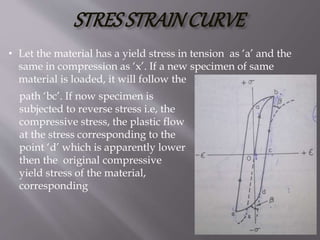
• Let the material has the yield stress in tension as ‘a’ and the
same in compression as ‘x’.
If a new specimen of the same
material is loaded in tension past
the tensile yield stress to ‘b’ along
the path ‘oab’ and then it is
unloaded, it will follow the path
‘bc’. If now, the specimen is
subjected to reverse stress i.e. the
compressive stress, the plastic
flow will begin at the stress
corresponding to point ‘d’ which
is apparently lower than the
original compressive yield stress
of the material, corresponding to point ‘x’.
• Thus while the yield stress in tension was increased by
strain hardening from ‘a to b’ the yield stress in
compression is decreased from ‘x’ to’d’. This is
BAUSCHINGER EFFECT.
• Bauschinger effect is reversible,i.e the specimen
originally been stressed plastically in
compression, the yeild stress in tension would
have been decreased.
• The Bauschinger strain B, helps describing the
Bauschinger effect.
• B is the difference between strain and
compression curve at a given stress
STRESSTRAINCURVE
• Let the material has a yield stress in tension as ‘a’ and the
same in compression as ‘x’. If a new specimen of same
material is loaded, it will follow the
path ‘bc’. If now specimen is
subjected to reverse stress i.e, the
compressive stress, the plastic flow
at the stress corresponding to the
point ‘d’ which is apparently lower
then the original compressive
yield stress of the material,
corresponding
CONCLUSIONFROMBAUSCHINGER
EFFECT
• Metal forming operations result in situations
exposing the metal workpiece to stresses of
reversed sign. The Bauschinger effect
contributes to work softening of the workpiece,
for example in straightening of drawn bars or
rolled sheets, where rollers subject the
workpiece to alternate bending stresses,
thereby reducing the yield strength and
enabling greater cold drawability of the
workpiece
THANKYOU 

Work hardening and Baushinger effect

  • 1.
    MAHARISHI MARKANDESHWAR UNIVERSITY, SADOPURAMBALA PRESANTION ON WORK HARDENING & BAUSCHINGER EFFECT SUBMITTED TO : Mr. Sachin Mahendru SUBMITTED BY : Jitender (75132005) & Mohd Anas (75134017) B.Tech 4th sem.
  • 2.
     Work hardeningis the strengthening of a metal by plastic deformation.  This strengthening occurs because of dislocation movements and dislocation generation within the crystal structure of the material.  Work hardening also known as Strain Hardening Or Cold Hardening.
  • 3.
     . Workor Strain hardening is very commonly employed both on pure metals and on alloys , as a means of improving the useful mechanical properties such as strength and hardness.  Work hardening however , reduce ductility and plasticity .
  • 4.
     When loaded, the strain increase with stress and the curve reaches the point A in the plastic range.  If at this stage , the specimen is unloaded , the strain does not recover along the original path AO , but moves along AB .
  • 6.
     If thespecimen is reloaded immediately , the curve again rises from B to A ,but via another path , and reaches the point C , after which it will follow the curvature , if loading is continued .  If the specimen would not have been unloaded , after point A , the stress–strain curve would have followed the dotted path AD’ .  A comparison of paths ACD and AD’ shows that the cold working (plastic deformation) has increased the yield strength and ultimate strength of the metal .
  • 7.
     A typicalshear stress – shear strain curve for a single crystal shows three stages of work hardening .  STAGE 1 – Easy Glide Region  STAGE 2 – Linear Hardening Region  STAGE 3 – Parabolic Hardening Region .
  • 9.
     Shear stressis almost constant .  Very low work hardening rate .  BCC system do not exhibit an easy glide .
  • 10.
     LINEARHARDENINGREGION  Hardeningrate is high as well as constant .  PARABOLICHARDENINGREGION  Low hardening rate  Shape is parabolic
  • 11.
    bauschinger effect • TheBauschinger effect was discovered by Ohann Bauschinger in 1886. • Bauschinger effect is a phenomenon in plastic flow. • In most materials plastic deformation in one direction will affect subsequent response in another direction. • .
  • 12.
     The phenomenonby which plastic deformation of a metal increases the yield strength in the direction of plastic flow and decreases the yield strength in the opposite direction
  • 13.
    • Let thematerial has the yield stress in tension as ‘a’ and the same in compression as ‘x’. If a new specimen of the same material is loaded in tension past the tensile yield stress to ‘b’ along the path ‘oab’ and then it is unloaded, it will follow the path ‘bc’. If now, the specimen is subjected to reverse stress i.e. the compressive stress, the plastic flow will begin at the stress corresponding to point ‘d’ which is apparently lower than the original compressive yield stress
  • 14.
    of the material,corresponding to point ‘x’. • Thus while the yield stress in tension was increased by strain hardening from ‘a to b’ the yield stress in compression is decreased from ‘x’ to’d’. This is BAUSCHINGER EFFECT. • Bauschinger effect is reversible,i.e the specimen originally been stressed plastically in compression, the yeild stress in tension would have been decreased. • The Bauschinger strain B, helps describing the Bauschinger effect. • B is the difference between strain and compression curve at a given stress
  • 15.
    STRESSTRAINCURVE • Let thematerial has a yield stress in tension as ‘a’ and the same in compression as ‘x’. If a new specimen of same material is loaded, it will follow the path ‘bc’. If now specimen is subjected to reverse stress i.e, the compressive stress, the plastic flow at the stress corresponding to the point ‘d’ which is apparently lower then the original compressive yield stress of the material, corresponding
  • 16.
    CONCLUSIONFROMBAUSCHINGER EFFECT • Metal formingoperations result in situations exposing the metal workpiece to stresses of reversed sign. The Bauschinger effect contributes to work softening of the workpiece, for example in straightening of drawn bars or rolled sheets, where rollers subject the workpiece to alternate bending stresses, thereby reducing the yield strength and enabling greater cold drawability of the workpiece
  • 17.