PRESENTATION
By: Ubaidullah Shalmani
Session (2014-2018)
To: sir waqar ahmad
SUBJECT: Sedimentology
DEPARTMENTof GEOLOGY
University of malakand
DEPOSITIONAL ENVIRONMENTS:
“The area where sediment accumulates and
is later buried by other sediment is known
as its depositional environment”.
 Depositional environments are often
separated into three general types;
a) Terrestrial (on land)
b)Marginal marine (coastal)
c) Marine (open ocean).
DEPOSITIONAL ENVIRONMENTS:
 Examples of each of these three regional
depositional settings are as follows:
Terrestrial-alluvial fans, glacial valleys,
lakes.
Marginal marine- beaches, deltas, estuaries,
tidal mud and sand flats.
Marine-coral reefs, continental slope and
deep marine deposition.
TRANSITIONAL ENVIRONMENTS
Transitional environments are those which
are transition between continental and
marine environments. It includes Delta,
Lagoon, Estuary and Tidal flats.
Transitional environments are also called
coastal environments.
DELTA:
The word delta was used by the Greek
philosopher Herodotus about 490 B.C. to
describe the triangular-shaped alluvial plain
formed at the mouth of the Nile River.
 Delta is defined as;
“A body of sediments deposited when a
river flows into standing water (sea or
lake)”.
SHAPE OF DELTA:
The shape of a delta is not always the
triangle that suggested the name to
Herodotus.
Delta shape is influenced by
a) Sediment input
b) Wave energy
c) Tidal energy.
MOPHOLOGICAL UNITS OF DELTA:
1) Delta platform/plain:
The delta platform is the sub-horizontal
surface nearest the jet mouth.
It is basically composed of sand.
2) Delta slope/front:
The delta platform grades away from the
source into delta slope on which finer sands
and silts come to rest.
It has coarse sand upward, and have good
porosity and permeability.
MOPHOLOGICAL UNITS OF DELTA:
3) Pro-delta:
The pro-delta is that part of the delta
unaffected by wave or tidal processes.
Classically these three elements termed as
1-bottomset, 2-foreset, 3-topset
respectively.
TYPES OF DELTA:
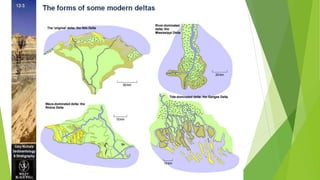
1) RIVER DOMINATED DELTA:
A river-dominated delta has a large volume
of sediment.
when there is a moderate sediment supply it
tends to be lobate.
when the sediment supply is large it tends
to be elongate .
1) RIVER DOMINATED DELTA:
If the sediment supply cannot keep up with
the erosive powers of tides, the delta tends
to be very small.
e.g. Mississippi delta.
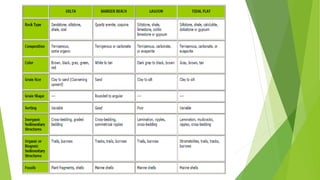
2) TIDE DOMINATED DELTA:
A tide-dominated delta has many linear
channels parallel to the tidal flow and
perpendicular to the shore.
These deltas form along a coast that is
dominated by strong tides.
 The sediments are reshaped into tidal bars
that are aligned parallel to a tidal current.
 e.g. The Ganges-Brahmaputra.
3) WAVE DOMINATED DELTA:
A wave dominated delta is smoothly
arcuate; the wave action reworks the
sediment and makes such deltas much
sandier than other types of deltas.
 e.g. Nile Delta.
DIAGNOSTIC FEATURES OF DELTAS:
They are roughly triangular in plain view
and wedge-shaped in cross section.
 They are tens to thousands of square
kilometers in area and tens to thousands of
meters thick.
There is a wide range of grain sizes from
coarse sand to fine mud, generally
becoming finer away from land.
DIAGNOSTIC FEATURES OF DELTAS:
There are a wide variety of sedimentary
structures including small cross-beds and
ripple marks.
Organic material is very common i.e. thick
layers of coal can form. Most of the world's
great coal deposits come from ancient
deltas.
TIDAL FLATS:
Tidal flats are formed when mud is deposits
by tides or rivers.
 Tidal flats are the border of lagoons and
estuarine environments.
Tidal flats are areas of low relief, cut by
meandering tidal channels.
Laminated or rippled clay, silt, and fine
sand may be deposited by a tidal flat.
BARRIERS:
Barriers are shoreline deposits exposed to
wave energy and dominated by sand.
Beach barriers are composed of sand and/or
gravel material and are largely built up by
wave action.
They may be partially attached to the land,
forming a beach spit, or wholly attached as
a welded barrier that completely encloses a
lagoon, or can be isolated as a barrier island
in front of a lagoon.
BARRIERS:
Barriers range in size from less than 100m
wide to several kilometers and their length
ranges from a few hundred meters to many
tens of kilometers.
ESTUARY
An estuary is the marine-influenced portion
of a drowned valley.
 A drowned valley is the seaward portion of
a river valley that becomes flooded with
seawater when there is a relative rise in sea
level.
 They are regions of mixing of fresh and
seawater.
ESTUARY
Sediment supply to the estuary is from both
river and marine sources.
 Modern estuaries range from a few
kilometers to over 100km long and from a
few hundred meters to over 10km wide.
TYPES OF ESTUARY:
1) WAVE DOMINATED ESTUARY:
This type of estuary developed in an area
with a small tidal range and strong wave
energy.
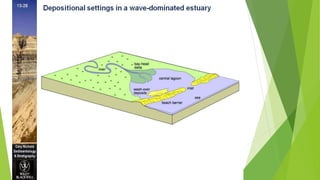
This type has typically three divisions; the
bay-head delta, the central lagoon and the
beach barrier.
a) BAY HEAD DELTA:
The bay-head delta is the zone where
fluvial processes are dominant.
 The form and processes of a bay-head delta
will be those of a river-dominated delta.
b) CENTRAL LAGOON:
The lowest energy part of the estuarine
system is the central lagoon.
 where the river flow rapidly decreases and
the wave energy is mainly concentrated at
the barrier bar.
c) BEACH BARRIER:
The outer part of a wave-dominated estuary
is a zone where wave action reworks
marine sediment to form a barrier.
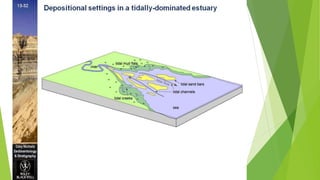
2) TIDE DOMINITED ESTUARY:
Tidal processes may dominate in mesotidal
and macrotidal coastal regimes.
 where tidal current energy exceeds wave
energy at the estuary mouth.
 Three areas of deposition can be identified;
tidal channel deposits, tidal flats and tidal
sand bars.
a) TIDE CHANNELS:
In the inner part of the estuary where the
river channel is influenced by tidal
processes.
 The low-gradient channel commonly
adopts a meandering form.
 when a strong ebb tide and the river act
together, the combined current may
transport sand.
b) TIDAL FLATS:
Adjacent to the channels and all along the
sides of the estuary there are tidal flat areas
that are variably covered with seawater at
high tide and sub aerially exposed at low
tide.
c) TIDAL BARS:
The outer part of a tide-dominated estuary
is the zone of strongest tidal currents,
which transport and deposit both fluvial
derived sediment and material brought in
from the sea.
In macrotidal regions the currents will be
strong enough to cause local scouring and
to move both sand and gravel and tidal bars
are formed.
LAGOON
Lagoon is a coastal body of water that has
very limited connection to the open ocean.
 Seawater reaches a lagoon directly through
a channel or via seepage through a barrier.
 Fresh water is supplied by rainfall or by
surface run-off from the adjacent coastal
plain.
They are typically very shallow, reaching
only a few meters in depth.
LAGOON
 Lagoons generally develop along coasts
where there is a wave-formed barrier.
There is a range of salinity in lagoons:
some lagoons have near freshwater, others
have brackish water which is saltier than
freshwater, but less salty than sea water.
TYPES OF LAGOON:
1) COASTAL LAGOON:
A coastal lagoon is a shallow, coastal body
of water, separated from the ocean by a
barrier.
2) ATOLL LAGOON:
An oceanic or atoll lagoon is a circular
coral reef or string of coral islands
surrounding a lagoon. Atoll lagoons are
much deeper than coastal lagoons,
sometimes about 20 m deep.
TYPES OF COASTAL LAGOON:
a) CHOKED LAGOON:
Choked lagoons usually have a narrow
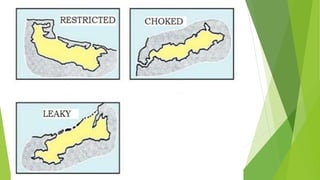
channel to the sea and form in areas where
the energy of waves in the sea is high.
The narrow inlet mostly prevents the tides
from entering, and also prevents much
mixing of water.
In arid areas, high evaporation rates and
reduced tidal inflow result in this type of
lagoon becoming temporarily or
permanently hypersaline.
Mundel Lagoon and Rekawa Lagoon in
Srilanka are examples of choked lagoons.
b) RESTRICTED LAGOON:
Restricted lagoons have more than one
channel to the sea.
 Temporarily ‘restricting’ water exchange,
but in reality there is good water exchange,
and a net transport of water to the sea.
Wind plays a role in restricted lagoons, as
surface currents can develop because of
the wind and result in mixing of water.
 Upper Lagoon, in eastern Sri Lanka and
the Laguna de Terminos, Mexico are
example of restricted lagoons.
c) LEAKY LAGOON:
Leaky lagoons have wide channel to the
sea, unhindered interchange of water and
fast water currents.
The Mississippi Sound, USA is an example
of a leaky lagoon.
DIFFERENCE BETWEEN ESTUARY
AND LAGOON:
The main difference between lagoons and
estuaries is in the flow dynamics of the
water bodies:
 In estuaries, the water flows fast and
strong, while in lagoons the water is more
shallow and flows sluggishly.
 Estuaries are usually deeper than lagoons.
THANKS

Transitional Environments

  • 1.
    PRESENTATION By: Ubaidullah Shalmani Session(2014-2018) To: sir waqar ahmad SUBJECT: Sedimentology DEPARTMENTof GEOLOGY University of malakand
  • 2.
    DEPOSITIONAL ENVIRONMENTS: “The areawhere sediment accumulates and is later buried by other sediment is known as its depositional environment”.  Depositional environments are often separated into three general types; a) Terrestrial (on land) b)Marginal marine (coastal) c) Marine (open ocean).
  • 3.
    DEPOSITIONAL ENVIRONMENTS:  Examplesof each of these three regional depositional settings are as follows: Terrestrial-alluvial fans, glacial valleys, lakes. Marginal marine- beaches, deltas, estuaries, tidal mud and sand flats. Marine-coral reefs, continental slope and deep marine deposition.
  • 4.
    TRANSITIONAL ENVIRONMENTS Transitional environmentsare those which are transition between continental and marine environments. It includes Delta, Lagoon, Estuary and Tidal flats. Transitional environments are also called coastal environments.
  • 5.
    DELTA: The word deltawas used by the Greek philosopher Herodotus about 490 B.C. to describe the triangular-shaped alluvial plain formed at the mouth of the Nile River.  Delta is defined as; “A body of sediments deposited when a river flows into standing water (sea or lake)”.
  • 6.
    SHAPE OF DELTA: Theshape of a delta is not always the triangle that suggested the name to Herodotus. Delta shape is influenced by a) Sediment input b) Wave energy c) Tidal energy.
  • 7.
    MOPHOLOGICAL UNITS OFDELTA: 1) Delta platform/plain: The delta platform is the sub-horizontal surface nearest the jet mouth. It is basically composed of sand. 2) Delta slope/front: The delta platform grades away from the source into delta slope on which finer sands and silts come to rest. It has coarse sand upward, and have good porosity and permeability.
  • 8.
    MOPHOLOGICAL UNITS OFDELTA: 3) Pro-delta: The pro-delta is that part of the delta unaffected by wave or tidal processes. Classically these three elements termed as 1-bottomset, 2-foreset, 3-topset respectively.
  • 9.
    TYPES OF DELTA: 1)RIVER DOMINATED DELTA: A river-dominated delta has a large volume of sediment. when there is a moderate sediment supply it tends to be lobate. when the sediment supply is large it tends to be elongate .
  • 10.
    1) RIVER DOMINATEDDELTA: If the sediment supply cannot keep up with the erosive powers of tides, the delta tends to be very small. e.g. Mississippi delta.
  • 11.
    2) TIDE DOMINATEDDELTA: A tide-dominated delta has many linear channels parallel to the tidal flow and perpendicular to the shore. These deltas form along a coast that is dominated by strong tides.  The sediments are reshaped into tidal bars that are aligned parallel to a tidal current.  e.g. The Ganges-Brahmaputra.
  • 12.
    3) WAVE DOMINATEDDELTA: A wave dominated delta is smoothly arcuate; the wave action reworks the sediment and makes such deltas much sandier than other types of deltas.  e.g. Nile Delta.
  • 14.
    DIAGNOSTIC FEATURES OFDELTAS: They are roughly triangular in plain view and wedge-shaped in cross section.  They are tens to thousands of square kilometers in area and tens to thousands of meters thick. There is a wide range of grain sizes from coarse sand to fine mud, generally becoming finer away from land.
  • 15.
    DIAGNOSTIC FEATURES OFDELTAS: There are a wide variety of sedimentary structures including small cross-beds and ripple marks. Organic material is very common i.e. thick layers of coal can form. Most of the world's great coal deposits come from ancient deltas.
  • 16.
    TIDAL FLATS: Tidal flatsare formed when mud is deposits by tides or rivers.  Tidal flats are the border of lagoons and estuarine environments. Tidal flats are areas of low relief, cut by meandering tidal channels. Laminated or rippled clay, silt, and fine sand may be deposited by a tidal flat.
  • 17.
    BARRIERS: Barriers are shorelinedeposits exposed to wave energy and dominated by sand. Beach barriers are composed of sand and/or gravel material and are largely built up by wave action. They may be partially attached to the land, forming a beach spit, or wholly attached as a welded barrier that completely encloses a lagoon, or can be isolated as a barrier island in front of a lagoon.
  • 18.
    BARRIERS: Barriers range insize from less than 100m wide to several kilometers and their length ranges from a few hundred meters to many tens of kilometers.
  • 19.
    ESTUARY An estuary isthe marine-influenced portion of a drowned valley.  A drowned valley is the seaward portion of a river valley that becomes flooded with seawater when there is a relative rise in sea level.  They are regions of mixing of fresh and seawater.
  • 20.
    ESTUARY Sediment supply tothe estuary is from both river and marine sources.  Modern estuaries range from a few kilometers to over 100km long and from a few hundred meters to over 10km wide.
  • 21.
    TYPES OF ESTUARY: 1)WAVE DOMINATED ESTUARY: This type of estuary developed in an area with a small tidal range and strong wave energy. This type has typically three divisions; the bay-head delta, the central lagoon and the beach barrier.
  • 22.
    a) BAY HEADDELTA: The bay-head delta is the zone where fluvial processes are dominant.  The form and processes of a bay-head delta will be those of a river-dominated delta.
  • 23.
    b) CENTRAL LAGOON: Thelowest energy part of the estuarine system is the central lagoon.  where the river flow rapidly decreases and the wave energy is mainly concentrated at the barrier bar.
  • 24.
    c) BEACH BARRIER: Theouter part of a wave-dominated estuary is a zone where wave action reworks marine sediment to form a barrier.
  • 26.
    2) TIDE DOMINITEDESTUARY: Tidal processes may dominate in mesotidal and macrotidal coastal regimes.  where tidal current energy exceeds wave energy at the estuary mouth.  Three areas of deposition can be identified; tidal channel deposits, tidal flats and tidal sand bars.
  • 27.
    a) TIDE CHANNELS: Inthe inner part of the estuary where the river channel is influenced by tidal processes.  The low-gradient channel commonly adopts a meandering form.  when a strong ebb tide and the river act together, the combined current may transport sand.
  • 28.
    b) TIDAL FLATS: Adjacentto the channels and all along the sides of the estuary there are tidal flat areas that are variably covered with seawater at high tide and sub aerially exposed at low tide.
  • 29.
    c) TIDAL BARS: Theouter part of a tide-dominated estuary is the zone of strongest tidal currents, which transport and deposit both fluvial derived sediment and material brought in from the sea. In macrotidal regions the currents will be strong enough to cause local scouring and to move both sand and gravel and tidal bars are formed.
  • 31.
    LAGOON Lagoon is acoastal body of water that has very limited connection to the open ocean.  Seawater reaches a lagoon directly through a channel or via seepage through a barrier.  Fresh water is supplied by rainfall or by surface run-off from the adjacent coastal plain. They are typically very shallow, reaching only a few meters in depth.
  • 32.
    LAGOON  Lagoons generallydevelop along coasts where there is a wave-formed barrier. There is a range of salinity in lagoons: some lagoons have near freshwater, others have brackish water which is saltier than freshwater, but less salty than sea water.
  • 33.
    TYPES OF LAGOON: 1)COASTAL LAGOON: A coastal lagoon is a shallow, coastal body of water, separated from the ocean by a barrier. 2) ATOLL LAGOON: An oceanic or atoll lagoon is a circular coral reef or string of coral islands surrounding a lagoon. Atoll lagoons are much deeper than coastal lagoons, sometimes about 20 m deep.
  • 34.
    TYPES OF COASTALLAGOON: a) CHOKED LAGOON: Choked lagoons usually have a narrow channel to the sea and form in areas where the energy of waves in the sea is high. The narrow inlet mostly prevents the tides from entering, and also prevents much mixing of water. In arid areas, high evaporation rates and reduced tidal inflow result in this type of lagoon becoming temporarily or permanently hypersaline.
  • 35.
    Mundel Lagoon andRekawa Lagoon in Srilanka are examples of choked lagoons. b) RESTRICTED LAGOON: Restricted lagoons have more than one channel to the sea.  Temporarily ‘restricting’ water exchange, but in reality there is good water exchange, and a net transport of water to the sea.
  • 36.
    Wind plays arole in restricted lagoons, as surface currents can develop because of the wind and result in mixing of water.  Upper Lagoon, in eastern Sri Lanka and the Laguna de Terminos, Mexico are example of restricted lagoons.
  • 37.
    c) LEAKY LAGOON: Leakylagoons have wide channel to the sea, unhindered interchange of water and fast water currents. The Mississippi Sound, USA is an example of a leaky lagoon.
  • 39.
    DIFFERENCE BETWEEN ESTUARY ANDLAGOON: The main difference between lagoons and estuaries is in the flow dynamics of the water bodies:  In estuaries, the water flows fast and strong, while in lagoons the water is more shallow and flows sluggishly.  Estuaries are usually deeper than lagoons.
  • 41.