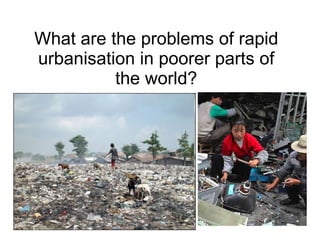
What are the problems of rapid urbanisation in poorer parts of the world?
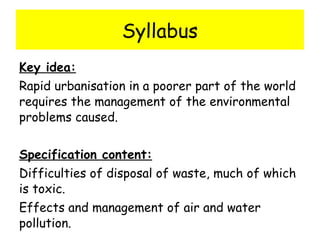
Syllabus Key idea: Rapid urbanisation in a poorer part of the world requires the management of the environmental problems caused. Specification content: Difficulties of disposal of waste, much of which is toxic. Effects and management of air and water pollution.
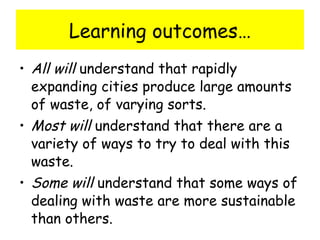
Learning outcomes… All will  understand that rapidly expanding cities produce large amounts of waste, of varying sorts. Most will  understand that there are a variety of ways to try to deal with this waste. Some will  understand that some ways of dealing with waste are more sustainable than others.
References AQA A pg 210 – 212 CGP pg 91
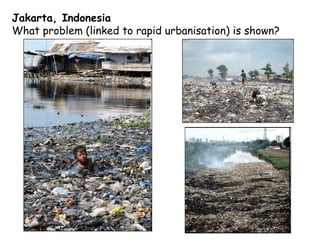
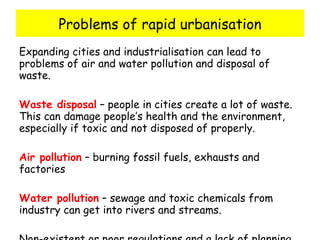
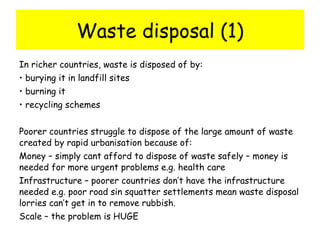
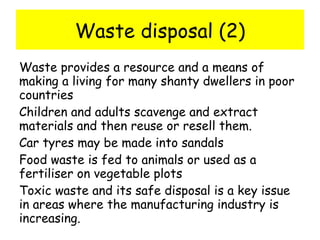
Jakarta, Indonesia  What problem (linked to rapid urbanisation) is shown?
Problems of rapid urbanisation Expanding cities and industrialisation can lead to problems of air and water pollution and disposal of waste. Waste disposal  – people in cities create a lot of waste.  This can damage people’s health and the environment, especially if toxic and not disposed of properly. Air pollution  – burning fossil fuels, exhausts and factories Water pollution  – sewage and toxic chemicals from industry can get into rivers and streams. Non-existent or poor regulations and a lack of planning for an environmental emergency make problems worse
Waste disposal (1) In richer countries, waste is disposed of by: burying it in landfill sites  burning it recycling schemes Poorer countries struggle to dispose of the large amount of waste created by rapid urbanisation because of: Money – simply cant afford to dispose of waste safely – money is needed for more urgent problems e.g. health care Infrastructure – poorer countries don’t have the infrastructure needed e.g. poor road sin squatter settlements mean waste disposal lorries can’t get in to remove rubbish. Scale – the problem is HUGE
Waste disposal (2) Waste provides a resource and a means of making a living for many shanty dwellers in poor countries Children and adults scavenge and extract materials and then reuse or resell them. Car tyres may be made into sandals Food waste is fed to animals or used as a fertiliser on vegetable plots Toxic waste and its safe disposal is a key issue in areas where the manufacturing industry is increasing.
Electronic waste … Creation of electronic waste is another major problem in a rapidly industrialising country like India In the cities, India’s poor scrape a living by breaking down PCs and monitors. They boil, crush or burn parts in order to extract valuable materials like gold or platinum. What they don’t realise is that the toxic chemicals inside like cadmium and lead can pose serious health risks. India’s hospitals are starting to see patients with 10 x the expected level of lead in their blood. Dumping and unsupervised recycling of e-waste is literally leading to a brain drain
What happens to some recycled waste? (3) http://www.youtube.com/watch?v=E4r3krs8eEY Britain gives China a toxic shock  Sky news 25.11.06  http://news.sky.com/skynews/video Blood sweat and luxuries
Your task… Use AQA A book p210 (2nd paragraph) and p211 to make a poster or leaflet to show the issues of waste disposal in LEDC cities.  Include:  Why waste is a problem What kinds of waste Give some facts and figures about amount of waste What are the dangers for people who try to make a living  from waste in LEDC cities What is being done about the problem How successful are these measures?

L14 waste

  • 1.
    What are theproblems of rapid urbanisation in poorer parts of the world?
  • 2.
    Syllabus Key idea:Rapid urbanisation in a poorer part of the world requires the management of the environmental problems caused. Specification content: Difficulties of disposal of waste, much of which is toxic. Effects and management of air and water pollution.
  • 3.
    Learning outcomes… Allwill understand that rapidly expanding cities produce large amounts of waste, of varying sorts. Most will understand that there are a variety of ways to try to deal with this waste. Some will understand that some ways of dealing with waste are more sustainable than others.
  • 4.
    References AQA Apg 210 – 212 CGP pg 91
  • 5.
    Jakarta, Indonesia What problem (linked to rapid urbanisation) is shown?
  • 6.
    Problems of rapidurbanisation Expanding cities and industrialisation can lead to problems of air and water pollution and disposal of waste. Waste disposal – people in cities create a lot of waste. This can damage people’s health and the environment, especially if toxic and not disposed of properly. Air pollution – burning fossil fuels, exhausts and factories Water pollution – sewage and toxic chemicals from industry can get into rivers and streams. Non-existent or poor regulations and a lack of planning for an environmental emergency make problems worse
  • 7.
    Waste disposal (1)In richer countries, waste is disposed of by: burying it in landfill sites burning it recycling schemes Poorer countries struggle to dispose of the large amount of waste created by rapid urbanisation because of: Money – simply cant afford to dispose of waste safely – money is needed for more urgent problems e.g. health care Infrastructure – poorer countries don’t have the infrastructure needed e.g. poor road sin squatter settlements mean waste disposal lorries can’t get in to remove rubbish. Scale – the problem is HUGE
  • 8.
    Waste disposal (2)Waste provides a resource and a means of making a living for many shanty dwellers in poor countries Children and adults scavenge and extract materials and then reuse or resell them. Car tyres may be made into sandals Food waste is fed to animals or used as a fertiliser on vegetable plots Toxic waste and its safe disposal is a key issue in areas where the manufacturing industry is increasing.
  • 9.
    Electronic waste …Creation of electronic waste is another major problem in a rapidly industrialising country like India In the cities, India’s poor scrape a living by breaking down PCs and monitors. They boil, crush or burn parts in order to extract valuable materials like gold or platinum. What they don’t realise is that the toxic chemicals inside like cadmium and lead can pose serious health risks. India’s hospitals are starting to see patients with 10 x the expected level of lead in their blood. Dumping and unsupervised recycling of e-waste is literally leading to a brain drain
  • 10.
    What happens tosome recycled waste? (3) http://www.youtube.com/watch?v=E4r3krs8eEY Britain gives China a toxic shock Sky news 25.11.06 http://news.sky.com/skynews/video Blood sweat and luxuries
  • 11.
    Your task… UseAQA A book p210 (2nd paragraph) and p211 to make a poster or leaflet to show the issues of waste disposal in LEDC cities. Include: Why waste is a problem What kinds of waste Give some facts and figures about amount of waste What are the dangers for people who try to make a living from waste in LEDC cities What is being done about the problem How successful are these measures?