A Seminar on
Precious Gem Minerals and their
Characters with Reference to the
Indian Occurrences
CONTENTS
 Introduction
 Characteristics
 Diamond
 Ruby
 Sapphire
 Emerald
Indian Occurrences
 Diamond
 Ruby
 Sapphire
 Emerald
Conclusions
References
•Gemstones are minerals with special beauty and physical
properties that attract attention for possession.
•The main characteristics of a gemstone are its color, rarity
and durability.
•The cut stones are known as gems while the uncut ones are
known as gemstones.
•The gemstones are grouped into:
 Precious gemstones namely diamond, ruby, sapphire
and emerald.
 Semi-precious gemstones: aquamarine, moonstone,
amethyst, etc.
Characteristics
Diamond
 It is a natural crystalline form of the chemical
element carbon (C) and the only gemstone made up
of a single element.
 It is the most durable and hardest gemstone, with a
Moh’s scale hardness of 10.
 It crystallizes in the cubic system and the crystals are
mostly octahedral or dodecahedral.
 It possess perfect cleavage and hackly or more rarely
conchoidal fracture.
 It has a varying specific gravity of 3.47 to 3.56
depending upon its chemical purity.
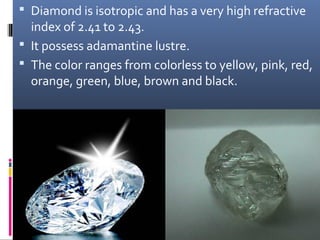
 Diamond is isotropic and has a very high refractive
index of 2.41 to 2.43.
 It possess adamantine lustre.
 The color ranges from colorless to yellow, pink, red,
orange, green, blue, brown and black.
Ruby
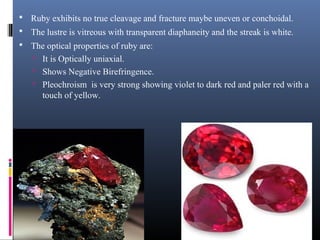
 Ruby is a variety of the mineral corundum whose
chemical composition is Al2O3.
 The red variety of corundum is known as ruby.
The red color is due the presence of chromic
oxide.
 Crystal system of ruby is trigonal.
 The hardness of ruby is 9 which makes it the
hardest gemstone next only to diamond.
 The specific gravity of ruby is 3.94-4.1 and the
refractive index is 1.76-1.77.
 Ruby exhibits no true cleavage and fracture maybe uneven or conchoidal.
 The lustre is vitreous with transparent diaphaneity and the streak is white.
 The optical properties of ruby are:
 It is Optically uniaxial.
 Shows Negative Birefringence.
 Pleochroism is very strong showing violet to dark red and paler red with a
touch of yellow.
Sapphire
 Sapphire is the blue variety of corundum. The
blue coloration is due to the presence of iron and
titanium.
 The chemical composition is Al2O3. Crystal
system is trigonal.
 The hardness is 9, streak is white and the fracture
is conchoidal.
 There is no cleavage, luster is vitreous and its
specific gravity is 3.94-4.1
 The refractive index is 1.76-1.77.
 Optical properties:
 It is Optically uniaxial.
 Shows Negative Birefringence.
 Pleochroism, is stronger than in ruby shows two color clear
blue and greenish-blue.
Emerald
 Emerald is a variety of the mineral Beryl and is
green in color. The traces of chromium and
sometimes vanadium gives the green color.
 Its chemical composition is (Be3Al2(SiO3)6) and
belongs to hexagonal crystal system.
 It has a hardness of 7.5 to 8.0, white streak,
vitreous lustre and imperfect cleavage.
 It exhibits opaque to transparent diaphaneity and
has a specific gravity of 2.76.
 The R.I. is 1.57-1.58.
 Optical properties:
 Uniaxial
 Negative birefringence
 Pleochroism – two colors pale yellowish green and
bluish green
Indian occurrences
 Diamond deposits in India occur in three
geological settings:
 Kimberlite pipes – Wajrakarur in Anantpur
district of A.P.
 Conglomerate beds – Panna, M.P. and
Kurnool district of A.P.
 Alluvial gravels – gravels of Krishna river
basin, A.P.
Other localities are in Uttar Pradesh, Orissa,
Bihar and Maharashtra.
RUBY
 A.P., Khammam district – country rocks are
sillimanite corundum rocks-metamorphosed
schists and pegmatites.
 Karnataka (Bangalore , Mysore, Kolar) –
spordiac occurrences at the contact of basic and
ultra basic rocks with the country rocks.
 M.P., Bastar – semi-gem ruby in schist and
gneisses, intruded by plagio-granite and
metabasic dykes.
 T.N., Salem and Dharmapuri – ruby is
occasionally picked along with corundum.
SAPPHIRE
 Jammu & Kashmir, Doda – occurs in syenite and
pegmatite, intruding actinolite-tremolite-schists.
 Nearby alluvial placers also worked
intermittently but the mine remains closed since
1973.
EMERALD
 Rajasthan, Udaipur – found at the contact of
pegmatites intruding schists, mainly amphibole
schists.
Conclusion
 Gemstones are special minerals which are rare and
exhibit exceptional hardness.
 Gemstones are classified as precious and semi-precious.
 The precious gemstones are diamond, ruby, sapphire and
emerald.
 These precious gemstones are very essential not only in
the jewellery industry but also other industries due to
their exceptional hardness and optical properties.
 India boasts of having all these four gemstone deposits in
various geographical and geological settings.
Reference
BOOKS:
 Prasad, Umeshwar, 2000. Economic Geology: PP:178-189, Patna,
India.
 Borner, Rudolf, 1962. Minerals, Rocks and Gemstones: PP:220-
223, London, U.K.
WEBSITES:
 http://en.wikipedia.org/wiki/Diamond
 http://en.wikipedia.org/wiki/Ruby
 http://en.wikipedia.org/wiki/Sapphire
 http://en.wikipedia.org/wiki/Emerald
Thank you!!!!!

Gemstones

  • 1.
    A Seminar on PreciousGem Minerals and their Characters with Reference to the Indian Occurrences
  • 2.
    CONTENTS  Introduction  Characteristics Diamond  Ruby  Sapphire  Emerald Indian Occurrences  Diamond  Ruby  Sapphire  Emerald Conclusions References
  • 3.
    •Gemstones are mineralswith special beauty and physical properties that attract attention for possession. •The main characteristics of a gemstone are its color, rarity and durability. •The cut stones are known as gems while the uncut ones are known as gemstones. •The gemstones are grouped into:  Precious gemstones namely diamond, ruby, sapphire and emerald.  Semi-precious gemstones: aquamarine, moonstone, amethyst, etc.
  • 5.
    Characteristics Diamond  It isa natural crystalline form of the chemical element carbon (C) and the only gemstone made up of a single element.  It is the most durable and hardest gemstone, with a Moh’s scale hardness of 10.  It crystallizes in the cubic system and the crystals are mostly octahedral or dodecahedral.  It possess perfect cleavage and hackly or more rarely conchoidal fracture.  It has a varying specific gravity of 3.47 to 3.56 depending upon its chemical purity.
  • 7.
     Diamond isisotropic and has a very high refractive index of 2.41 to 2.43.  It possess adamantine lustre.  The color ranges from colorless to yellow, pink, red, orange, green, blue, brown and black.
  • 8.
    Ruby  Ruby isa variety of the mineral corundum whose chemical composition is Al2O3.  The red variety of corundum is known as ruby. The red color is due the presence of chromic oxide.  Crystal system of ruby is trigonal.  The hardness of ruby is 9 which makes it the hardest gemstone next only to diamond.  The specific gravity of ruby is 3.94-4.1 and the refractive index is 1.76-1.77.
  • 9.
     Ruby exhibitsno true cleavage and fracture maybe uneven or conchoidal.  The lustre is vitreous with transparent diaphaneity and the streak is white.  The optical properties of ruby are:  It is Optically uniaxial.  Shows Negative Birefringence.  Pleochroism is very strong showing violet to dark red and paler red with a touch of yellow.
  • 10.
    Sapphire  Sapphire isthe blue variety of corundum. The blue coloration is due to the presence of iron and titanium.  The chemical composition is Al2O3. Crystal system is trigonal.  The hardness is 9, streak is white and the fracture is conchoidal.  There is no cleavage, luster is vitreous and its specific gravity is 3.94-4.1  The refractive index is 1.76-1.77.
  • 11.
     Optical properties: It is Optically uniaxial.  Shows Negative Birefringence.  Pleochroism, is stronger than in ruby shows two color clear blue and greenish-blue.
  • 12.
    Emerald  Emerald isa variety of the mineral Beryl and is green in color. The traces of chromium and sometimes vanadium gives the green color.  Its chemical composition is (Be3Al2(SiO3)6) and belongs to hexagonal crystal system.  It has a hardness of 7.5 to 8.0, white streak, vitreous lustre and imperfect cleavage.  It exhibits opaque to transparent diaphaneity and has a specific gravity of 2.76.  The R.I. is 1.57-1.58.
  • 13.
     Optical properties: Uniaxial  Negative birefringence  Pleochroism – two colors pale yellowish green and bluish green
  • 14.
    Indian occurrences  Diamonddeposits in India occur in three geological settings:  Kimberlite pipes – Wajrakarur in Anantpur district of A.P.  Conglomerate beds – Panna, M.P. and Kurnool district of A.P.  Alluvial gravels – gravels of Krishna river basin, A.P. Other localities are in Uttar Pradesh, Orissa, Bihar and Maharashtra.
  • 15.
    RUBY  A.P., Khammamdistrict – country rocks are sillimanite corundum rocks-metamorphosed schists and pegmatites.  Karnataka (Bangalore , Mysore, Kolar) – spordiac occurrences at the contact of basic and ultra basic rocks with the country rocks.  M.P., Bastar – semi-gem ruby in schist and gneisses, intruded by plagio-granite and metabasic dykes.  T.N., Salem and Dharmapuri – ruby is occasionally picked along with corundum.
  • 16.
    SAPPHIRE  Jammu &Kashmir, Doda – occurs in syenite and pegmatite, intruding actinolite-tremolite-schists.  Nearby alluvial placers also worked intermittently but the mine remains closed since 1973.
  • 17.
    EMERALD  Rajasthan, Udaipur– found at the contact of pegmatites intruding schists, mainly amphibole schists.
  • 18.
    Conclusion  Gemstones arespecial minerals which are rare and exhibit exceptional hardness.  Gemstones are classified as precious and semi-precious.  The precious gemstones are diamond, ruby, sapphire and emerald.  These precious gemstones are very essential not only in the jewellery industry but also other industries due to their exceptional hardness and optical properties.  India boasts of having all these four gemstone deposits in various geographical and geological settings.
  • 19.
    Reference BOOKS:  Prasad, Umeshwar,2000. Economic Geology: PP:178-189, Patna, India.  Borner, Rudolf, 1962. Minerals, Rocks and Gemstones: PP:220- 223, London, U.K. WEBSITES:  http://en.wikipedia.org/wiki/Diamond  http://en.wikipedia.org/wiki/Ruby  http://en.wikipedia.org/wiki/Sapphire  http://en.wikipedia.org/wiki/Emerald
  • 20.