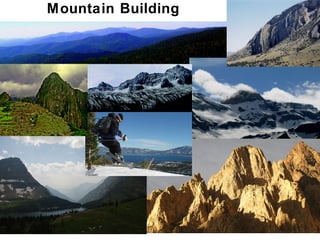
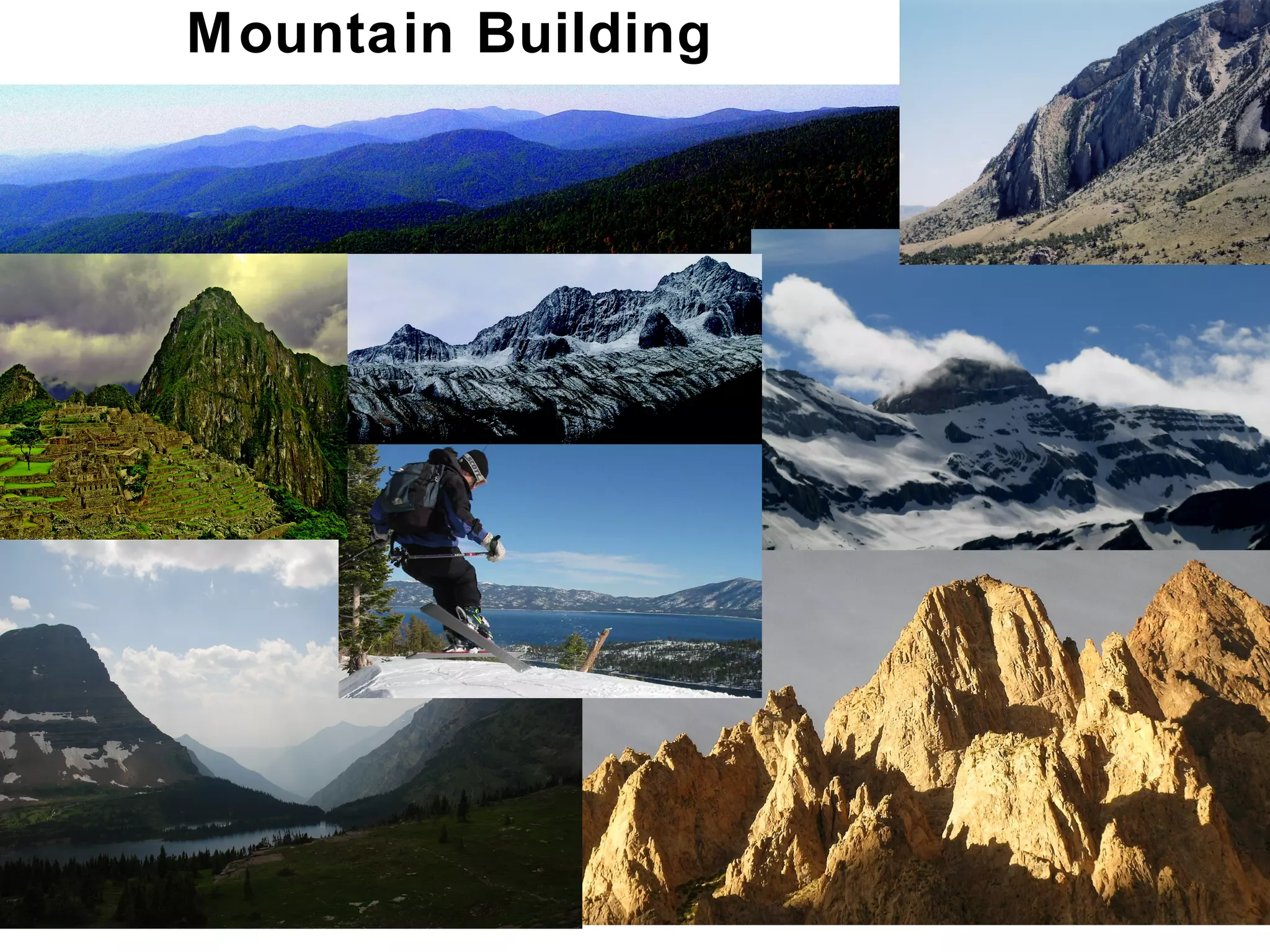
Mountain Building


                    Chapter
                        11
Outline
• Mountains, mountain (orogenic) belts, & building them

• Deformation
   -Results (translation, rotation, distortion (strain))
   -Types: Brittle vs. ductile
   -Cause: stress (3 types)

• Geologic structures
   -Measurement, joints & faults
   -Faults: movement, recognition, types, fault systems
   -Folds: types, identification, formation
   -Foliation due to compression & shear

• Orogenesis
   -Uplift, mtn roots, isostasy, erosion, collapse, causes
   -Case study: history of the Appalachians
                                                              Chapter
                                                             Chapter 11
                                                                   11
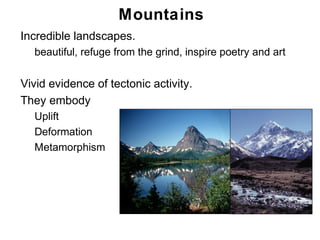
Mountains
• Incredible landscapes.
     beautiful, refuge from the grind, inspire poetry and art

• Vivid evidence of tectonic activity.
• They embody
   • Uplift
   • Deformation
   • Metamorphism


                                                                Chapter
                                                                    11
Mountain Belts
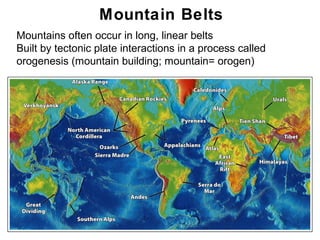
Mountains often occur in long, linear belts
Built by tectonic plate interactions in a process called
orogenesis (mountain building; mountain= orogen)


                                                           Chapter
                                                               11
Mountain Building
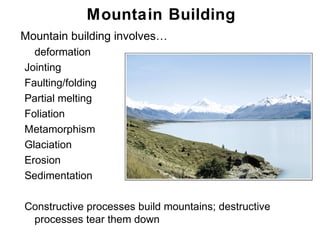
• Mountain building involves…
    deformation
  Jointing
  Faulting/folding
  Partial melting
  Foliation
  Metamorphism
  Glaciation
  Erosion
  Sedimentation

  Constructive processes build mountains; destructive
   processes tear them down
                                                        Chapter
                                                            11
Orogenic Belts
• Mountains have a finite lifespan.
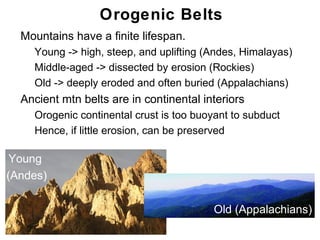
   • Young -> high, steep, and uplifting (Andes, Himalayas)
   • Middle-aged -> dissected by erosion (Rockies)
   • Old -> deeply eroded and often buried (Appalachians)
• Ancient mtn belts are in continental interiors
   • Orogenic continental crust is too buoyant to subduct
   • Hence, if little erosion, can be preserved


 Young
(Andes)

                                            Old (Appalachians)
                                                            Chapter
                                                                11
Outline
• Mountains, mountain (orogenic) belts, & building them

• Deformation
   -Results (translation, rotation, distortion (strain))
   -Types: Brittle vs. ductile
   -Cause: stress (3 types)

• Geologic structures
   -Measurement, joints & faults
   -Faults: movement, recognition, types, fault systems
   -Folds: types, identification, formation
   -Foliation due to compression & shear

• Orogenesis
   -Uplift, mtn roots, isostasy, erosion, collapse, causes
   -Case study: history of the Appalachians
                                                              Chapter
                                                             Chapter 11
                                                                   11
Deformation
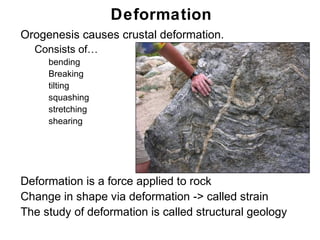
• Orogenesis causes crustal deformation.
  • Consists of…
      •   bending
      •   Breaking
      •   tilting
      •   squashing
      •   stretching
      •   shearing


• Deformation is a force applied to rock
• Change in shape via deformation -> called strain
• The study of deformation is called structural geology
                                                          Chapter
                                                              11
Results of Deformation
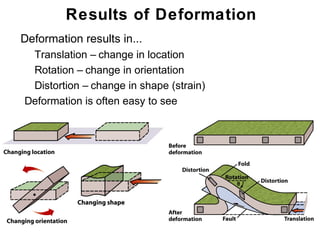
• Deformation results in...
   • Translation – change in location
   • Rotation – change in orientation
   • Distortion – change in shape (strain)
   Deformation is often easy to see


                                             Chapter
                                                 11
Results of Deformation
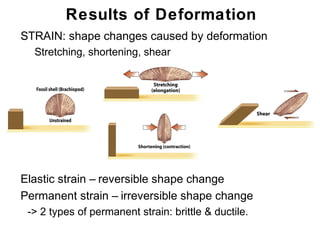
• STRAIN: shape changes caused by deformation
   • Stretching, shortening, shear


• Elastic strain – reversible shape change
• Permanent strain – irreversible shape change
   -> 2 types of permanent strain: brittle & ductile.
                                                        Chapter
                                                            11
Strain
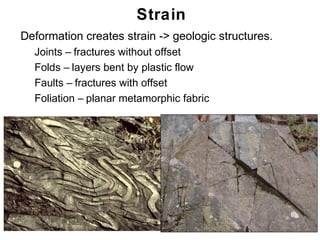
• Deformation creates strain -> geologic structures.
   • Joints – fractures without offset
   • Folds – layers bent by plastic flow
   • Faults – fractures with offset
   • Foliation – planar metamorphic fabric


                                                       Chapter
                                                           11
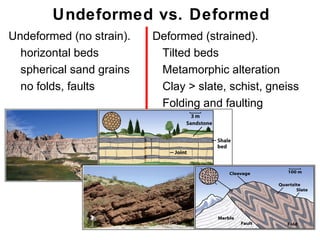
Undeformed vs. Deformed
Undeformed (no strain).   Deformed (strained).
  horizontal beds         • Tilted beds
  spherical sand grains   • Metamorphic alteration
  no folds, faults        • Clay > slate, schist, gneiss
                          • Folding and faulting


                                                      Chapter
                                                          11
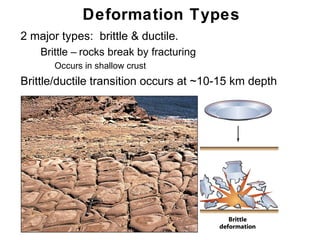
Deformation Types
• 2 major types: brittle & ductile.
   1. Brittle – rocks break by fracturing
      1. Occurs in shallow crust
1. Brittle/ductile transition occurs at ~10-15 km depth


                                                          Chapter
                                                              11
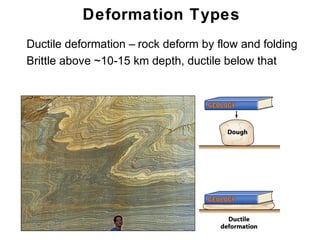
Deformation Types
2. Ductile deformation – rock deform by flow and folding
3. Brittle above ~10-15 km depth, ductile below that


                                                       Chapter
                                                           11
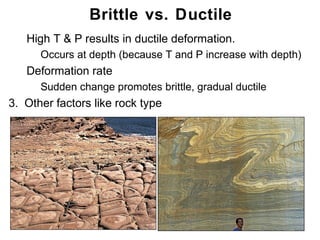
Brittle vs. Ductile
1. High T & P results in ductile deformation.
   1. Occurs at depth (because T and P increase with depth)
2. Deformation rate
  1.   Sudden change promotes brittle, gradual ductile
3. Other factors like rock type


                                                         Chapter
                                                             11
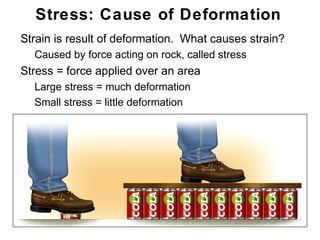
Stress: Cause of Deformation
• Strain is result of deformation. What causes strain?
   • Caused by force acting on rock, called stress
• Stress = force applied over an area
   • Large stress = much deformation
   • Small stress = little deformation


                                                         Chapter
                                                             11
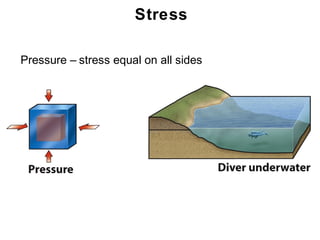
Stress

• Pressure – stress equal on all sides


                                         Chapter
                                             11
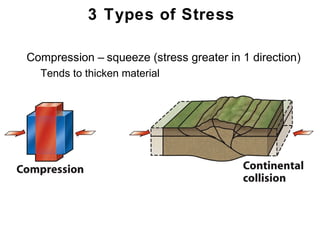
3 Types of Stress

1. Compression – squeeze (stress greater in 1 direction)
   1. Tends to thicken material


                                                     Chapter
                                                         11
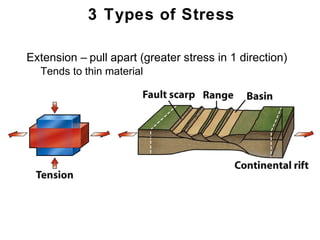
3 Types of Stress

2. Extension – pull apart (greater stress in 1 direction)
   1. Tends to thin material


                                                            Chapter
                                                                11
3 Types of Stress

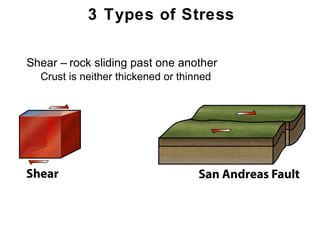
3. Shear – rock sliding past one another
   1. Crust is neither thickened or thinned


                                              Chapter
                                                  11
Stress vs. Strain
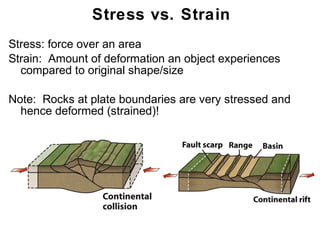
Stress: force over an area
Strain: Amount of deformation an object experiences
  compared to original shape/size

Note: Rocks at plate boundaries are very stressed and
  hence deformed (strained)!


                                                      Chapter
                                                          11
Outline
• Mountains, mountain (orogenic) belts, & building them

• Deformation
   -Results (translation, rotation, distortion (strain))
   -Types: Brittle vs. ductile
   -Cause: stress (3 types)

• Geologic structures
   -Measurement, joints & faults
   -Faults: movement, recognition, types, fault systems
   -Folds: types, identification, formation
   -Foliation due to compression & shear

• Orogenesis
   -Uplift, mtn roots, isostasy, erosion, collapse, causes
   -Case study: history of the Appalachians
                                                              Chapter
                                                             Chapter 11
                                                                   11
Geologic Structures
• Geometric features created by deformation.
   • Folds, faults, joints, etc
   • Often preserve information about stress field
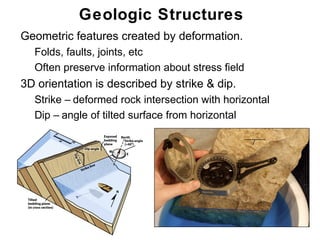
• 3D orientation is described by strike & dip.
   • Strike – deformed rock intersection with horizontal
   • Dip – angle of tilted surface from horizontal


                                                           Chapter
                                                               11
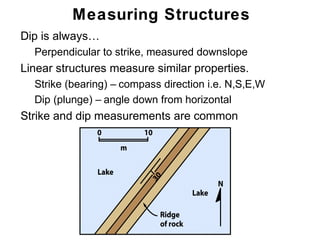
Measuring Structures
• Dip is always…
   • Perpendicular to strike, measured downslope
• Linear structures measure similar properties.
   • Strike (bearing) – compass direction i.e. N,S,E,W
   • Dip (plunge) – angle down from horizontal
• Strike and dip measurements are common


                                                         Chapter
                                                             11
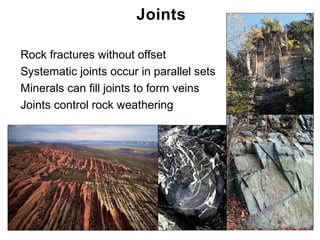
Joints

• Rock fractures without offset
• Systematic joints occur in parallel sets
• Minerals can fill joints to form veins
• Joints control rock weathering


                                             Chapter
                                                 11
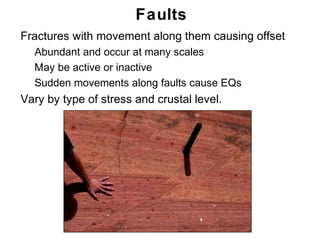
Faults
• Fractures with movement along them causing offset
   • Abundant and occur at many scales
   • May be active or inactive
   • Sudden movements along faults cause EQs
• Vary by type of stress and crustal level.


                                                      Chapter
                                                          11
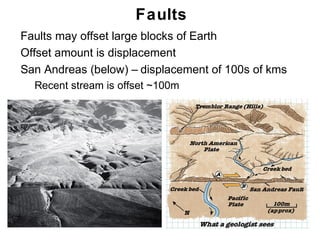
Faults
• Faults may offset large blocks of Earth
• Offset amount is displacement
• San Andreas (below) – displacement of 100s of kms
   • Recent stream is offset ~100m


                                                      Chapter
                                                          11
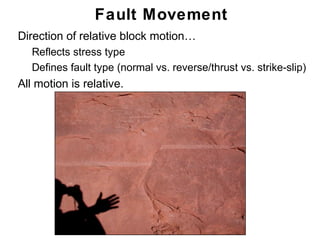
Fault Movement
• Direction of relative block motion…
   • Reflects stress type
   • Defines fault type (normal vs. reverse/thrust vs. strike-slip)
• All motion is relative.


                                                               Chapter
                                                                   11
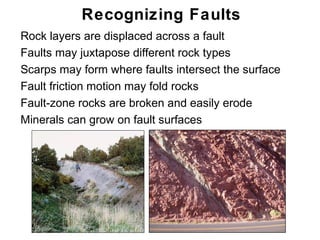
Recognizing Faults
• Rock layers are displaced across a fault
• Faults may juxtapose different rock types
• Scarps may form where faults intersect the surface
• Fault friction motion may fold rocks
• Fault-zone rocks are broken and easily erode
• Minerals can grow on fault surfaces


                                                       Chapter
                                                           11
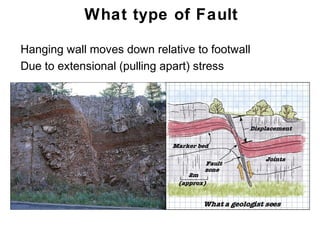
What type of Fault

• Hanging wall moves down relative to footwall
• Due to extensional (pulling apart) stress


                                                 Chapter
                                                     11
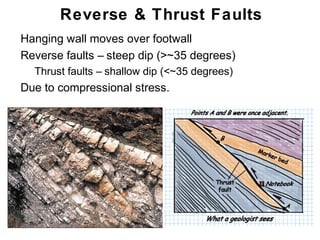
Reverse & Thrust Faults
• Hanging wall moves over footwall
• Reverse faults – steep dip (>~35 degrees)
   • Thrust faults – shallow dip (<~35 degrees)
• Due to compressional stress.


                                                  Chapter
                                                      11
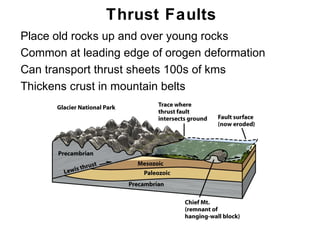
Thrust Faults
• Place old rocks up and over young rocks
• Common at leading edge of orogen deformation
• Can transport thrust sheets 100s of kms
• Thickens crust in mountain belts


                                                 Chapter
                                                     11
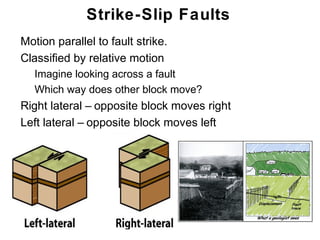
Strike-Slip Faults
• Motion parallel to fault strike.
• Classified by relative motion
   • Imagine looking across a fault
   • Which way does other block move?
• Right lateral – opposite block moves right
• Left lateral – opposite block moves left


                                               Chapter
                                                   11
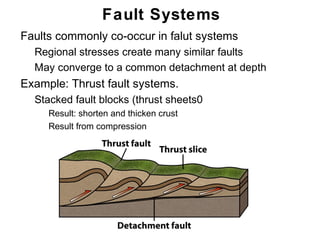
Fault Systems
• Faults commonly co-occur in falut systems
   • Regional stresses create many similar faults
   • May converge to a common detachment at depth
• Example: Thrust fault systems.
   • Stacked fault blocks (thrust sheets0
      • Result: shorten and thicken crust
      • Result from compression


                                                    Chapter
                                                        11
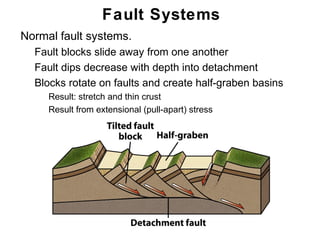
Fault Systems
• Normal fault systems.
  • Fault blocks slide away from one another
  • Fault dips decrease with depth into detachment
  • Blocks rotate on faults and create half-graben basins
     • Result: stretch and thin crust
     • Result from extensional (pull-apart) stress


                                                            Chapter
                                                                11
Folds
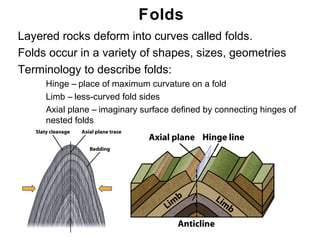
• Layered rocks deform into curves called folds.
• Folds occur in a variety of shapes, sizes, geometries
• Terminology to describe folds:
      • Hinge – place of maximum curvature on a fold
      • Limb – less-curved fold sides
      • Axial plane – imaginary surface defined by connecting hinges of
        nested folds


                                                                     Chapter
                                                                         11
Folds

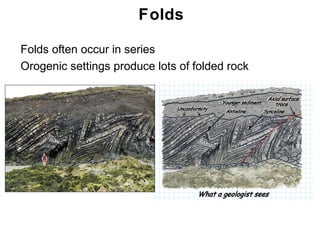
• Folds often occur in series
• Orogenic settings produce lots of folded rock


                                                  Chapter
                                                      11
3 Fold Types
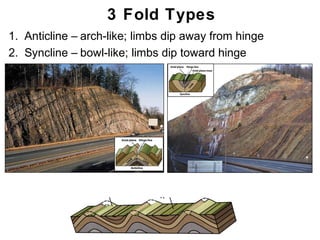
1. Anticline – arch-like; limbs dip away from hinge
2. Syncline – bowl-like; limbs dip toward hinge


 • Anticlines & synclines alternate in series:


                                                      Chapter
                                                          11
3 Fold Types
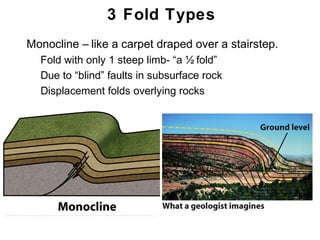
3. Monocline – like a carpet draped over a stairstep.
  1. Fold with only 1 steep limb- “a ½ fold”
  2. Due to “blind” faults in subsurface rock
  3. Displacement folds overlying rocks


                                                        Chapter
                                                            11
Fold Identification
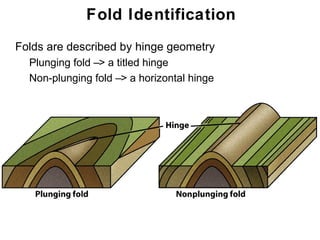
• Folds are described by hinge geometry
   • Plunging fold –> a titled hinge
   • Non-plunging fold –> a horizontal hinge


                                               Chapter
                                                   11
Fold Identification

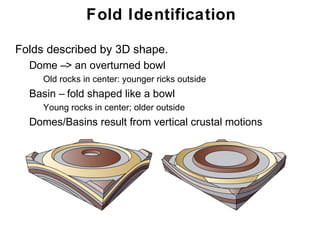
• Folds described by 3D shape.
  • Dome –> an overturned bowl
     • Old rocks in center: younger ricks outside
  • Basin – fold shaped like a bowl
     • Young rocks in center; older outside
  • Domes/Basins result from vertical crustal motions


                                                        Chapter
                                                            11
Forming Folds
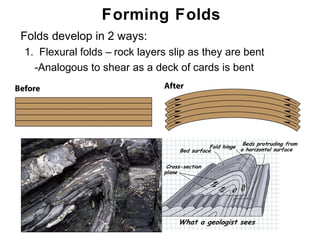
• Folds develop in 2 ways:
   1. Flexural folds – rock layers slip as they are bent
     -Analogous to shear as a deck of cards is bent


                                                           Chapter
                                                               11
Forming Folds
• Folds develop in 2 ways:
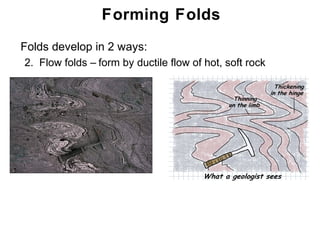
   2. Flow folds – form by ductile flow of hot, soft rock


                                                            Chapter
                                                                11
Why do folds form?
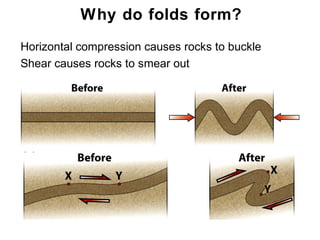
• Horizontal compression causes rocks to buckle
• Shear causes rocks to smear out


                                                  Chapter
                                                      11
Tectonic Foliation
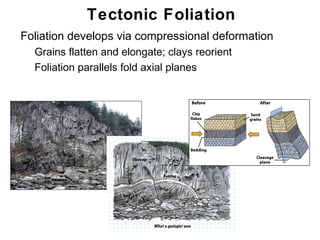
• Foliation develops via compressional deformation
   • Grains flatten and elongate; clays reorient
   • Foliation parallels fold axial planes


                                                     Chapter
                                                         11
Tectonic Foliation
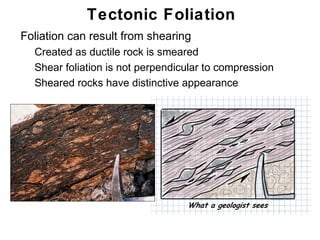
• Foliation can result from shearing
   • Created as ductile rock is smeared
   • Shear foliation is not perpendicular to compression
   • Sheared rocks have distinctive appearance


                                                           Chapter
                                                               11
Outline
• Mountains, mountain (orogenic) belts, & building them

• Deformation
   -Results (translation, rotation, distortion (strain))
   -Types: Brittle vs. ductile
   -Cause: stress (3 types)

• Geologic structures
   -Measurement, joints & faults
   -Faults: movement, recognition, types, fault systems
   -Folds: types, identification, formation
   -Foliation due to compression & shear

• Orogenesis
   -Uplift, mtn roots, isostasy, erosion, collapse, causes
   -Case study: history of the Appalachians
                                                              Chapter
                                                             Chapter 11
                                                                   11
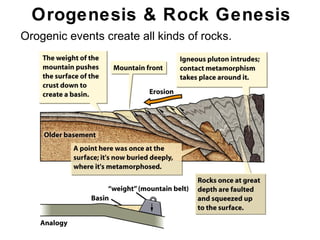
Orogenesis & Rock Genesis
• Orogenic events create all kinds of rocks.


                                               Chapter
                                                   11
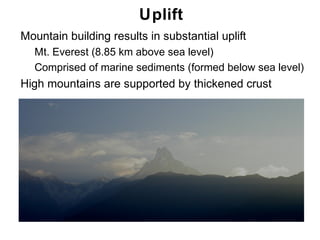
Uplift
• Mountain building results in substantial uplift
   • Mt. Everest (8.85 km above sea level)
   • Comprised of marine sediments (formed below sea level)
• High mountains are supported by thickened crust


                                                        Chapter
                                                            11
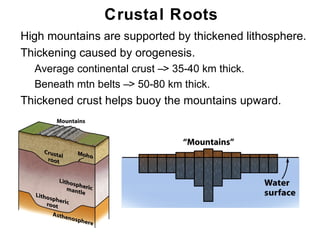
Crustal Roots
• High mountains are supported by thickened lithosphere.
• Thickening caused by orogenesis.
   • Average continental crust –> 35-40 km thick.
   • Beneath mtn belts –> 50-80 km thick.
• Thickened crust helps buoy the mountains upward.


                                                     Chapter
                                                         11
Isostasy
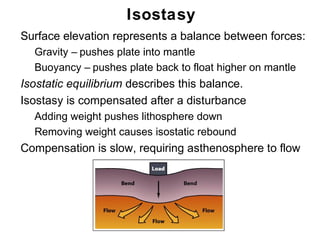
• Surface elevation represents a balance between forces:
   • Gravity – pushes plate into mantle
   • Buoyancy – pushes plate back to float higher on mantle
• Isostatic equilibrium describes this balance.
• Isostasy is compensated after a disturbance
   • Adding weight pushes lithosphere down
   • Removing weight causes isostatic rebound
• Compensation is slow, requiring asthenosphere to flow


                                                         Chapter
                                                             11
Erosion
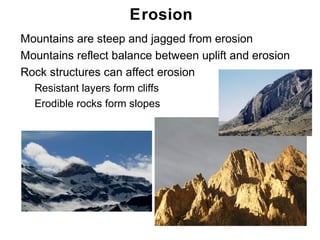
• Mountains are steep and jagged from erosion
• Mountains reflect balance between uplift and erosion
• Rock structures can affect erosion
   • Resistant layers form cliffs
   • Erodible rocks form slopes


                                                     Chapter
                                                         11
Orogenic Collapse: Limit to
•
                         Uplift!
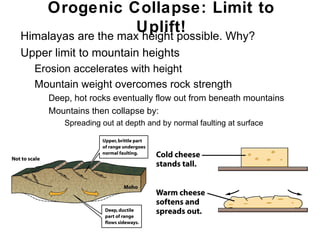
    Himalayas are the max height possible. Why?
• Upper limit to mountain heights
    • Erosion accelerates with height
    • Mountain weight overcomes rock strength
       • Deep, hot rocks eventually flow out from beneath mountains
       • Mountains then collapse by:
           • Spreading out at depth and by normal faulting at surface


                                                                        Chapter
                                                                            11
Causes of Orogenesis
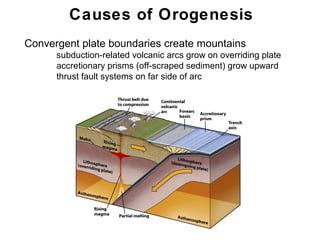
Convergent plate boundaries create mountains
      subduction-related volcanic arcs grow on overriding plate
      accretionary prisms (off-scraped sediment) grow upward
      thrust fault systems on far side of arc


                                                                  Chapter
                                                                      11
Causes of Orogenesis
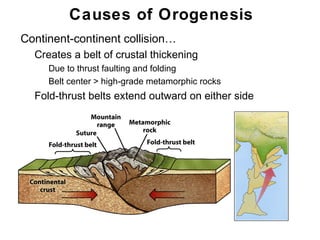
• Continent-continent collision…
   • Creates a belt of crustal thickening
      • Due to thrust faulting and folding
      • Belt center > high-grade metamorphic rocks
   • Fold-thrust belts extend outward on either side


                                                       Chapter
                                                           11
Causes of Orogenesis
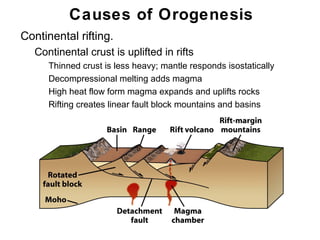
• Continental rifting.
   • Continental crust is uplifted in rifts
      • Thinned crust is less heavy; mantle responds isostatically
      • Decompressional melting adds magma
      • High heat flow form magma expands and uplifts rocks
      • Rifting creates linear fault block mountains and basins


                                                                     Chapter
                                                                         11
Case Study - Appalachians
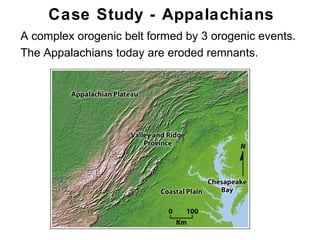
• A complex orogenic belt formed by 3 orogenic events.
• The Appalachians today are eroded remnants.


                                                    Chapter
                                                        11
Case Study - Appalachians
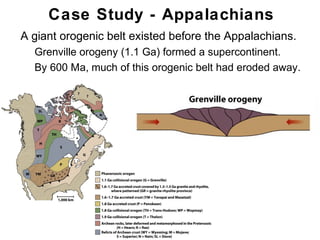
• A giant orogenic belt existed before the Appalachians.
   • Grenville orogeny (1.1 Ga) formed a supercontinent.
   • By 600 Ma, much of this orogenic belt had eroded away.


                                                           Chapter
                                                               11
Case Study - Appalachians
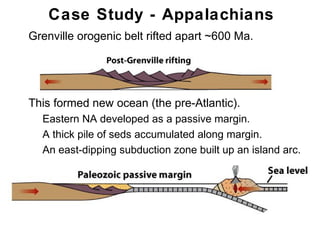
• Grenville orogenic belt rifted apart ~600 Ma.


• This formed new ocean (the pre-Atlantic).
   • Eastern NA developed as a passive margin.
   • A thick pile of seds accumulated along margin.
   • An east-dipping subduction zone built up an island arc.


                                                         Chapter
                                                             11
Case Study - Appalachians
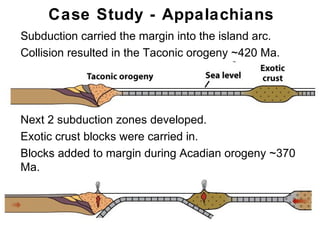
• Subduction carried the margin into the island arc.
• Collision resulted in the Taconic orogeny ~420 Ma.


• Next 2 subduction zones developed.
• Exotic crust blocks were carried in.
• Blocks added to margin during Acadian orogeny ~370
  Ma.


                                                       Chapter
                                                           11
Case Study - Appalachians
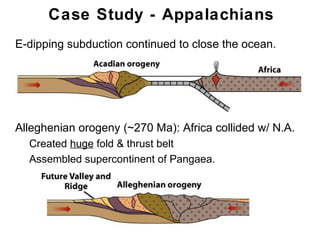
• E-dipping subduction continued to close the ocean.


• Alleghenian orogeny (~270 Ma): Africa collided w/ N.A.
   • Created huge fold & thrust belt
   • Assembled supercontinent of Pangaea.


                                                       Chapter
                                                           11
Case Study - Appalachians
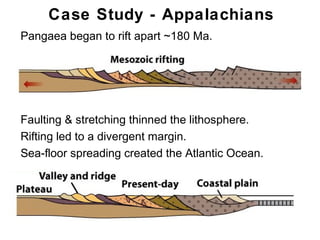
• Pangaea began to rift apart ~180 Ma.


• Faulting & stretching thinned the lithosphere.
• Rifting led to a divergent margin.
• Sea-floor spreading created the Atlantic Ocean.


                                                    Chapter
                                                        11

Geology lecture 12

  • 1.
  • 2.
    Outline • Mountains, mountain(orogenic) belts, & building them • Deformation -Results (translation, rotation, distortion (strain)) -Types: Brittle vs. ductile -Cause: stress (3 types) • Geologic structures -Measurement, joints & faults -Faults: movement, recognition, types, fault systems -Folds: types, identification, formation -Foliation due to compression & shear • Orogenesis -Uplift, mtn roots, isostasy, erosion, collapse, causes -Case study: history of the Appalachians Chapter Chapter 11 11
  • 3.
    Mountains • Incredible landscapes. beautiful, refuge from the grind, inspire poetry and art • Vivid evidence of tectonic activity. • They embody • Uplift • Deformation • Metamorphism Chapter 11
  • 4.
    Mountain Belts Mountains oftenoccur in long, linear belts Built by tectonic plate interactions in a process called orogenesis (mountain building; mountain= orogen) Chapter 11
  • 5.
    Mountain Building • Mountainbuilding involves… deformation Jointing Faulting/folding Partial melting Foliation Metamorphism Glaciation Erosion Sedimentation Constructive processes build mountains; destructive processes tear them down Chapter 11
  • 6.
    Orogenic Belts • Mountainshave a finite lifespan. • Young -> high, steep, and uplifting (Andes, Himalayas) • Middle-aged -> dissected by erosion (Rockies) • Old -> deeply eroded and often buried (Appalachians) • Ancient mtn belts are in continental interiors • Orogenic continental crust is too buoyant to subduct • Hence, if little erosion, can be preserved Young (Andes) Old (Appalachians) Chapter 11
  • 7.
    Outline • Mountains, mountain(orogenic) belts, & building them • Deformation -Results (translation, rotation, distortion (strain)) -Types: Brittle vs. ductile -Cause: stress (3 types) • Geologic structures -Measurement, joints & faults -Faults: movement, recognition, types, fault systems -Folds: types, identification, formation -Foliation due to compression & shear • Orogenesis -Uplift, mtn roots, isostasy, erosion, collapse, causes -Case study: history of the Appalachians Chapter Chapter 11 11
  • 8.
    Deformation • Orogenesis causescrustal deformation. • Consists of… • bending • Breaking • tilting • squashing • stretching • shearing • Deformation is a force applied to rock • Change in shape via deformation -> called strain • The study of deformation is called structural geology Chapter 11
  • 9.
    Results of Deformation •Deformation results in... • Translation – change in location • Rotation – change in orientation • Distortion – change in shape (strain) Deformation is often easy to see Chapter 11
  • 10.
    Results of Deformation •STRAIN: shape changes caused by deformation • Stretching, shortening, shear • Elastic strain – reversible shape change • Permanent strain – irreversible shape change -> 2 types of permanent strain: brittle & ductile. Chapter 11
  • 11.
    Strain • Deformation createsstrain -> geologic structures. • Joints – fractures without offset • Folds – layers bent by plastic flow • Faults – fractures with offset • Foliation – planar metamorphic fabric Chapter 11
  • 12.
    Undeformed vs. Deformed Undeformed(no strain). Deformed (strained). horizontal beds • Tilted beds spherical sand grains • Metamorphic alteration no folds, faults • Clay > slate, schist, gneiss • Folding and faulting Chapter 11
  • 13.
    Deformation Types • 2major types: brittle & ductile. 1. Brittle – rocks break by fracturing 1. Occurs in shallow crust 1. Brittle/ductile transition occurs at ~10-15 km depth Chapter 11
  • 14.
    Deformation Types 2. Ductiledeformation – rock deform by flow and folding 3. Brittle above ~10-15 km depth, ductile below that Chapter 11
  • 15.
    Brittle vs. Ductile 1.High T & P results in ductile deformation. 1. Occurs at depth (because T and P increase with depth) 2. Deformation rate 1. Sudden change promotes brittle, gradual ductile 3. Other factors like rock type Chapter 11
  • 16.
    Stress: Cause ofDeformation • Strain is result of deformation. What causes strain? • Caused by force acting on rock, called stress • Stress = force applied over an area • Large stress = much deformation • Small stress = little deformation Chapter 11
  • 17.
    Stress • Pressure –stress equal on all sides Chapter 11
  • 18.
    3 Types ofStress 1. Compression – squeeze (stress greater in 1 direction) 1. Tends to thicken material Chapter 11
  • 19.
    3 Types ofStress 2. Extension – pull apart (greater stress in 1 direction) 1. Tends to thin material Chapter 11
  • 20.
    3 Types ofStress 3. Shear – rock sliding past one another 1. Crust is neither thickened or thinned Chapter 11
  • 21.
    Stress vs. Strain Stress:force over an area Strain: Amount of deformation an object experiences compared to original shape/size Note: Rocks at plate boundaries are very stressed and hence deformed (strained)! Chapter 11
  • 22.
    Outline • Mountains, mountain(orogenic) belts, & building them • Deformation -Results (translation, rotation, distortion (strain)) -Types: Brittle vs. ductile -Cause: stress (3 types) • Geologic structures -Measurement, joints & faults -Faults: movement, recognition, types, fault systems -Folds: types, identification, formation -Foliation due to compression & shear • Orogenesis -Uplift, mtn roots, isostasy, erosion, collapse, causes -Case study: history of the Appalachians Chapter Chapter 11 11
  • 23.
    Geologic Structures • Geometricfeatures created by deformation. • Folds, faults, joints, etc • Often preserve information about stress field • 3D orientation is described by strike & dip. • Strike – deformed rock intersection with horizontal • Dip – angle of tilted surface from horizontal Chapter 11
  • 24.
    Measuring Structures • Dipis always… • Perpendicular to strike, measured downslope • Linear structures measure similar properties. • Strike (bearing) – compass direction i.e. N,S,E,W • Dip (plunge) – angle down from horizontal • Strike and dip measurements are common Chapter 11
  • 25.
    Joints • Rock fractureswithout offset • Systematic joints occur in parallel sets • Minerals can fill joints to form veins • Joints control rock weathering Chapter 11
  • 26.
    Faults • Fractures withmovement along them causing offset • Abundant and occur at many scales • May be active or inactive • Sudden movements along faults cause EQs • Vary by type of stress and crustal level. Chapter 11
  • 27.
    Faults • Faults mayoffset large blocks of Earth • Offset amount is displacement • San Andreas (below) – displacement of 100s of kms • Recent stream is offset ~100m Chapter 11
  • 28.
    Fault Movement • Directionof relative block motion… • Reflects stress type • Defines fault type (normal vs. reverse/thrust vs. strike-slip) • All motion is relative. Chapter 11
  • 29.
    Recognizing Faults • Rocklayers are displaced across a fault • Faults may juxtapose different rock types • Scarps may form where faults intersect the surface • Fault friction motion may fold rocks • Fault-zone rocks are broken and easily erode • Minerals can grow on fault surfaces Chapter 11
  • 30.
    What type ofFault • Hanging wall moves down relative to footwall • Due to extensional (pulling apart) stress Chapter 11
  • 31.
    Reverse & ThrustFaults • Hanging wall moves over footwall • Reverse faults – steep dip (>~35 degrees) • Thrust faults – shallow dip (<~35 degrees) • Due to compressional stress. Chapter 11
  • 32.
    Thrust Faults • Placeold rocks up and over young rocks • Common at leading edge of orogen deformation • Can transport thrust sheets 100s of kms • Thickens crust in mountain belts Chapter 11
  • 33.
    Strike-Slip Faults • Motionparallel to fault strike. • Classified by relative motion • Imagine looking across a fault • Which way does other block move? • Right lateral – opposite block moves right • Left lateral – opposite block moves left Chapter 11
  • 34.
    Fault Systems • Faultscommonly co-occur in falut systems • Regional stresses create many similar faults • May converge to a common detachment at depth • Example: Thrust fault systems. • Stacked fault blocks (thrust sheets0 • Result: shorten and thicken crust • Result from compression Chapter 11
  • 35.
    Fault Systems • Normalfault systems. • Fault blocks slide away from one another • Fault dips decrease with depth into detachment • Blocks rotate on faults and create half-graben basins • Result: stretch and thin crust • Result from extensional (pull-apart) stress Chapter 11
  • 36.
    Folds • Layered rocksdeform into curves called folds. • Folds occur in a variety of shapes, sizes, geometries • Terminology to describe folds: • Hinge – place of maximum curvature on a fold • Limb – less-curved fold sides • Axial plane – imaginary surface defined by connecting hinges of nested folds Chapter 11
  • 37.
    Folds • Folds oftenoccur in series • Orogenic settings produce lots of folded rock Chapter 11
  • 38.
    3 Fold Types 1.Anticline – arch-like; limbs dip away from hinge 2. Syncline – bowl-like; limbs dip toward hinge • Anticlines & synclines alternate in series: Chapter 11
  • 39.
    3 Fold Types 3.Monocline – like a carpet draped over a stairstep. 1. Fold with only 1 steep limb- “a ½ fold” 2. Due to “blind” faults in subsurface rock 3. Displacement folds overlying rocks Chapter 11
  • 40.
    Fold Identification • Foldsare described by hinge geometry • Plunging fold –> a titled hinge • Non-plunging fold –> a horizontal hinge Chapter 11
  • 41.
    Fold Identification • Foldsdescribed by 3D shape. • Dome –> an overturned bowl • Old rocks in center: younger ricks outside • Basin – fold shaped like a bowl • Young rocks in center; older outside • Domes/Basins result from vertical crustal motions Chapter 11
  • 42.
    Forming Folds • Foldsdevelop in 2 ways: 1. Flexural folds – rock layers slip as they are bent -Analogous to shear as a deck of cards is bent Chapter 11
  • 43.
    Forming Folds • Foldsdevelop in 2 ways: 2. Flow folds – form by ductile flow of hot, soft rock Chapter 11
  • 44.
    Why do foldsform? • Horizontal compression causes rocks to buckle • Shear causes rocks to smear out Chapter 11
  • 45.
    Tectonic Foliation • Foliationdevelops via compressional deformation • Grains flatten and elongate; clays reorient • Foliation parallels fold axial planes Chapter 11
  • 46.
    Tectonic Foliation • Foliationcan result from shearing • Created as ductile rock is smeared • Shear foliation is not perpendicular to compression • Sheared rocks have distinctive appearance Chapter 11
  • 47.
    Outline • Mountains, mountain(orogenic) belts, & building them • Deformation -Results (translation, rotation, distortion (strain)) -Types: Brittle vs. ductile -Cause: stress (3 types) • Geologic structures -Measurement, joints & faults -Faults: movement, recognition, types, fault systems -Folds: types, identification, formation -Foliation due to compression & shear • Orogenesis -Uplift, mtn roots, isostasy, erosion, collapse, causes -Case study: history of the Appalachians Chapter Chapter 11 11
  • 48.
    Orogenesis & RockGenesis • Orogenic events create all kinds of rocks. Chapter 11
  • 49.
    Uplift • Mountain buildingresults in substantial uplift • Mt. Everest (8.85 km above sea level) • Comprised of marine sediments (formed below sea level) • High mountains are supported by thickened crust Chapter 11
  • 50.
    Crustal Roots • Highmountains are supported by thickened lithosphere. • Thickening caused by orogenesis. • Average continental crust –> 35-40 km thick. • Beneath mtn belts –> 50-80 km thick. • Thickened crust helps buoy the mountains upward. Chapter 11
  • 51.
    Isostasy • Surface elevationrepresents a balance between forces: • Gravity – pushes plate into mantle • Buoyancy – pushes plate back to float higher on mantle • Isostatic equilibrium describes this balance. • Isostasy is compensated after a disturbance • Adding weight pushes lithosphere down • Removing weight causes isostatic rebound • Compensation is slow, requiring asthenosphere to flow Chapter 11
  • 52.
    Erosion • Mountains aresteep and jagged from erosion • Mountains reflect balance between uplift and erosion • Rock structures can affect erosion • Resistant layers form cliffs • Erodible rocks form slopes Chapter 11
  • 53.
    Orogenic Collapse: Limitto • Uplift! Himalayas are the max height possible. Why? • Upper limit to mountain heights • Erosion accelerates with height • Mountain weight overcomes rock strength • Deep, hot rocks eventually flow out from beneath mountains • Mountains then collapse by: • Spreading out at depth and by normal faulting at surface Chapter 11
  • 54.
    Causes of Orogenesis Convergentplate boundaries create mountains subduction-related volcanic arcs grow on overriding plate accretionary prisms (off-scraped sediment) grow upward thrust fault systems on far side of arc Chapter 11
  • 55.
    Causes of Orogenesis •Continent-continent collision… • Creates a belt of crustal thickening • Due to thrust faulting and folding • Belt center > high-grade metamorphic rocks • Fold-thrust belts extend outward on either side Chapter 11
  • 56.
    Causes of Orogenesis •Continental rifting. • Continental crust is uplifted in rifts • Thinned crust is less heavy; mantle responds isostatically • Decompressional melting adds magma • High heat flow form magma expands and uplifts rocks • Rifting creates linear fault block mountains and basins Chapter 11
  • 57.
    Case Study -Appalachians • A complex orogenic belt formed by 3 orogenic events. • The Appalachians today are eroded remnants. Chapter 11
  • 58.
    Case Study -Appalachians • A giant orogenic belt existed before the Appalachians. • Grenville orogeny (1.1 Ga) formed a supercontinent. • By 600 Ma, much of this orogenic belt had eroded away. Chapter 11
  • 59.
    Case Study -Appalachians • Grenville orogenic belt rifted apart ~600 Ma. • This formed new ocean (the pre-Atlantic). • Eastern NA developed as a passive margin. • A thick pile of seds accumulated along margin. • An east-dipping subduction zone built up an island arc. Chapter 11
  • 60.
    Case Study -Appalachians • Subduction carried the margin into the island arc. • Collision resulted in the Taconic orogeny ~420 Ma. • Next 2 subduction zones developed. • Exotic crust blocks were carried in. • Blocks added to margin during Acadian orogeny ~370 Ma. Chapter 11
  • 61.
    Case Study -Appalachians • E-dipping subduction continued to close the ocean. • Alleghenian orogeny (~270 Ma): Africa collided w/ N.A. • Created huge fold & thrust belt • Assembled supercontinent of Pangaea. Chapter 11
  • 62.
    Case Study -Appalachians • Pangaea began to rift apart ~180 Ma. • Faulting & stretching thinned the lithosphere. • Rifting led to a divergent margin. • Sea-floor spreading created the Atlantic Ocean. Chapter 11

Editor's Notes

  • #31 Pull apart gives you normal faults Push together gives you reverse faults
  • #50 Thick crust are results from stacking crust on top of each other
  • #51 Beneath mountain belts crust is very thick (what is beneath the surface is much larger than what is above the surface)
  • #52 There has to be a new equilibrium to deal with what happens
  • #58 Pattern in the topography- there are a bunch of ridges that are parallel to one another The mountain belts have mostly eroded because they are so old- took place over three different stages
  • #59 All different colors represent different aged crusts