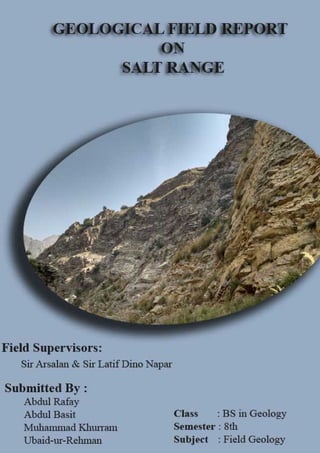
Page No. 1
1-ACKNOWLEDGEMENT
Our deepest gratitude is to our teacher, Sir Arsalan & Sir Latif Dino Napar. We
have been amazingly fortunate to have an advisor who gave us the freedom to
explore on our own, and at the same time the guidance to recover when our
steps faltered. Don taught us how to question thoughts and express ideas. His
patience and support helped us overcome many crisis situations and finish this
dissertation. I hope that one day we would become as good an advisor to our
students as you have been to us.
Page No. 2
GROUP MEMBERS
1. MUHAMMAD KHURRAM
2. ABDUL BASIT
3. ABDUL RAFAY
4. UBAD UR REHMAN
Page No. 3
Table of Content
1-Acknowledgement………….......................................................................................................1
2-Abstract...................................................................................................................................5
3-Geology of the salt range area………………………………………………………………………………………………………6
4-Tectonics………………………….……………………………………………………………………………………………………………8
5-Objective……………………………………………………………………………………………………………………………………….9
6-Map of the study of the area………………………………………………………………………………………………………12
7-Introduction..........................................................................................................................13
8- Stratigraphic Column of Salt Range :................................................................................…14
9-Tectonics of Salt Range.........................................................................................................15
10-Khewra Gorge......................................................................................................…………….16
11-Jhelum Group......................................................................................................................20
Khewra Sandstone ..................................................................................................................20
Kussak Formation....................................................................................................................21
Jutana Formation:...................................................................................................................22
Bhaganwala Formation:..........................................................................................................23
12-Cambrian – Permian Boundary: .........................................................................................24
13-Nilawahan Group:...............................................................................................................25
Tobra Formation: .....................................................................................................................25
Dandot Formation:...................................................................................................................26
Warcha Sandstone:..................................................................................................................27
Sardhai Formation: ..................................................................................................................28
14-Zaluch Group: .....................................................................................................................30
Amb Formation........................................................................................................................30
Wargal Limestone:…………………………………………………………………………………………………………..…31
Chidru Formation:....................................................................................................................32
15-Permo Triassic boundary…………………………………………………………………………………………………………….33
16-Musakhel Group : ..............................................................................................................34
Mianwali Formation:................................................................................................................34
Tredian Formation : .................................................................................................................35
Kingriali Formation :.................................................................................................................36
Page No. 4
17-Surghar Group :..................................................................................................................38
Datta Formation :.....................................................................................................................38
Samanasuk Formation .............................................................................................................39
Chichali Formation...................................................................................................................40
Lumshiwal Formation: .............................................................................................................41
18-Makarwal Group:................................................................................................................42
Hangu Formation: ....................................................................................................................42
Lockart Limestone……………………………………………………………………………………………….……………..43
Patala Formation…………….……….………..……………………………………………….……………………………..44
19-Charat Group……………………………..………………………………………….………………………………………45
Nammal Formation…………………………………………………………………............................................46
Sakesar Limestone:…………………..………………………………………………………………………………………..46
Chorgali Formation: .................................................................................................................47
20-Siwalik Group......................................................................................................................48
Chinji Formation………………………………………………………….…......................................................48
Nagri Formation:......................................................................................................................48
Dhok Pathan.............................................................................................................................50
Soan Formation:.......................................................................................................................50
21-Kundal Oil Seapage:............................................................................................................51
22-Economic Minerals of Salt Range: ......................................................................................52
23-Conclusion: .........................................................................................................................58
Refrence :.................................................................................................................................59
Page No. 5
2-Abstract:
The Salt Range contains the most important geologic and paleontologic localities in Pakistan, and is
one of the outstanding field areas in the entire world. Despite its easy accessibility, it has awealth of
geological and paleontological features. In fact, it represents an open book of geology where various
richly fossiliferous stratified rocks are very well exposed due to lack of vegetation. These include the
Permian carbonate succession with its outstanding brachiopod fauna, Lower Triassic ammonoid beds
(the Mianwali Formation, formerly known as "Ceratite Beds"), and Lower Tertiary marine strata with
age diagnostic foraminifera. These rocks also provide an excellent opportunity for appreciation of
tectonics in the field.
In addition to the easily available roadside geology, some prominent gorges provide fantastic
locations to study the sedimentary succession. Older strata are exposed in the eastern Salt Range
between the Khewra-Choa Saidan Shah and Fort Kussak including the famous Khewra Gorge. In the
west, beyond Kallar Kahar, are younger strata such as in the Nilawahan Gorge at Nurpur, the
Nammal Gorge near Mianwali, the Chichali Gorge near Kalabagh, and further west the Lumshiwal
Nala at Makerwal. This succession has been rightly called a Field Museum of Geology and
Paleontology and can be classified as one of the great paleontological areas of the world, fully
worthy of conservation and protection effort.
Page No. 6
3-GEOLOGY OF SALT RANGE AREA
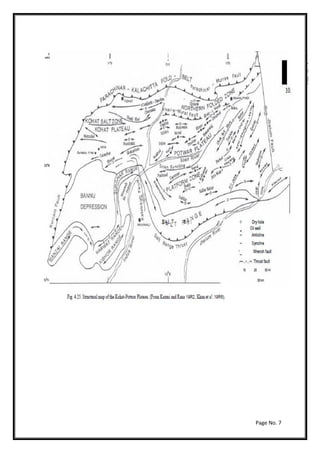
This east-west trending fold belt comprises the low rolling hills and valleys of the uplifted Kohat-
Potwar Plateau, the Salt Range and its westward extensions (Fig. 4.6 and Photo. 11). It is about 85
km wide and extends for about 200 km. It is a discrete structural zone bounded in the north by the
north-dipping Main Boundary Thrust (Sarwar et al. 1979, Yeats et al. 1984, Coward et al. 1985).
Southward the Salt Range Thrust, Kalabagh Fault and the Surghar Thrust form its southern boundary.
West and eastward it is terminated by the N-S oriented Kurram Thrust andJhelum Fault respectively
(Kazmi and Rana 1982).
This range is essentially a complex salt anticlinorium with a series of salt anticlines. It is widest in its
central part, between Khewra and Warcha, where it also contains the best exposures of Paleozoic
and Eocambrian sequence. The structure along its northern slope is comprised of simple, broad,
shallow folds followed by a gentle monocline. Southward the folding becomes tighter and the folds
are commonly faulted. Along the southern scarp the structures are more complicated and comprise
east-west trending faults and overfolds. The Eocambrian evaporites are exposed in some of these
overfolded and faulted anticlines (Fig. 4.26). Though the general trend of the folds is east-west in the
Central Salt Range, a few north-south trending and northward plunging anticlines, which are actually
"nose" type structures, have also formed.
Eastward the Salt Range loses its stature and bifurcates into two narrow northeast trending ridges,
the Diljabba and the Chambal-Jogi Tilla. The latter comprises steeply dipping monoclines,
complicated by complex thrusts and tear faults, whereas the Diljabba Hill is a steeply dipping
anticline traversed by Diljabba-Domeli Thrust (Figs. 4.25 and 4.26). Westward the Salt Range takes a
northwest bend near Warcha. Its structure remains the same and it is separated by the Kalabagh
Fault from the Trans-Indus Ranges. Southward the Salt Range is truncated by the Salt Range Thrust.
Page No. 7
Page No. 8
4-Tectonics
The Salt Range forms the southern border of the hydrocarbon-bearingPotowar Basin in northern
Pakistan, along the northwestern margin of theIndo-Pakistani Plate. It derives its name from the
occurrence of giganticdeposits of rock salt embedded in the Precambrian bright red marls of theSalt
Range Formation (formerly known as the "Punjab Saline Series"). Stratain the Salt Range dip
northwards into the Potowar Basin where non-marine Tertiary sediments, collectively known as the
Siwaliks, are exposed with awealth of vertebrate fossils. The southern face of the Salt Range is an
escarpment that rises abruptlyfrom the Punjab Plains with a junction marked by the Frontal Thrust.
Blockfaulting is the most characteristic tectonic style within the Salt Range. TheSalt Range is
essentially an East-West trending elongated narrow trough bounded on the east by the River Jhelum
and on the west by the River Indus.Beyond the River Indus at Kalabagh, it takes a sharp turn to run
almost in aNorth-South direction. The entire mountainous belt has, therefore, previouslybeen
differentiated into the Cis-Indus Salt Range and Trans-Indus Salt Rangenow known as The Salt Range
and Trans-Indus Surghar Range, respectively. The Salt Range is one of the most important geological
regions in Pakistan. Itis easily accessible and displays a wide variety of geological features
andpaleontological remains. It has, therefore, been rightly called a field museumof geology and
paleontology. It represents an open book of geology withrichly fossiliferous stratified rocks that
include a Permian carbonatesuccession with brachiopods, Lower Triassic ammonite bearing beds
(theMianwali Formation, formerly known as "Ceratite Beds") and Lower Tertiarymarine strata
composed of age diagnostic foraminifera. All the strata areexcellently exposed due to lack of
vegetation. The quality of the exposurealso provides excellent opportunities to appreciate tectonic
features in thefield. The Salt Range is, therefore, of international scientific and educationalvalue, and
is highly worthy of conservation and preservation.
Page No. 9
5-Objective
A field trip was arranged by Federal Urdu University, Department of Geology on 2nd Nov, 2015. It
was a eight day field trip to eastern salt range which is approximately 120-130 km from Islamabad.
We left for trip on Friday 2November, 2015 and arrived back to Karachi on Monday 4 November,
2015.The main objectives of the trip was to study the tectonics, regional geology and
geomorphological features of the area.
Methodology
We applied different methods in our field to recognize the lithology, dipping directions and our
position etc. so these methods are given below:
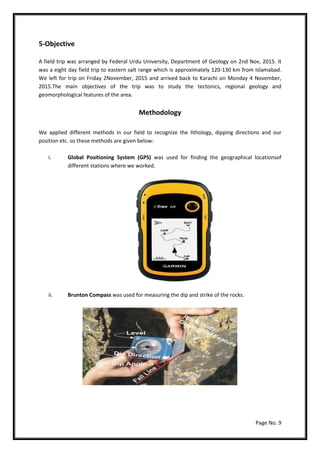
i. Global Positioning System (GPS) was used for finding the geographical locationsof
different stations where we worked.
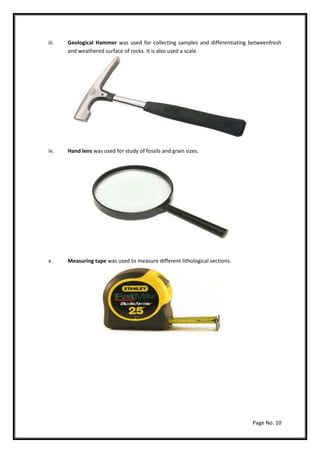
ii. Brunton Compass was used for measuring the dip and strike of the rocks.
Page No. 10
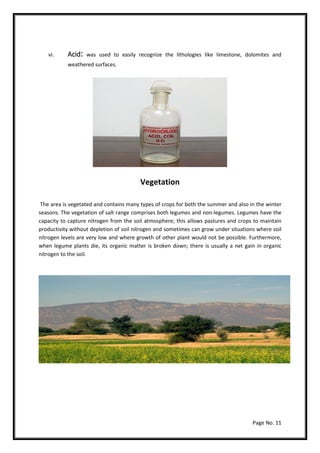
iii. Geological Hammer was used for collecting samples and differentiating betweenfresh
and weathered surface of rocks. It is also used a scale.
iv. Hand lens was used for study of fossils and grain sizes.
v. Measuring tape was used to measure different lithological sections.
Page No. 11
vi. Acid: was used to easily recognize the lithologies like limestone, dolomites and
weathered surfaces.
Vegetation
The area is vegetated and contains many types of crops for both the summer and also in the winter
seasons. The vegetation of salt range comprises both legumes and non-legumes. Legumes have the
capacity to capture nitrogen from the soil atmosphere; this allows pastures and crops to maintain
productivity without depletion of soil nitrogen and sometimes can grow under situations where soil
nitrogen levels are very low and where growth of other plant would not be possible. Furthermore,
when legume plants die, its organic matter is broken down; there is usually a net gain in organic
nitrogen to the soil.
Page No. 12
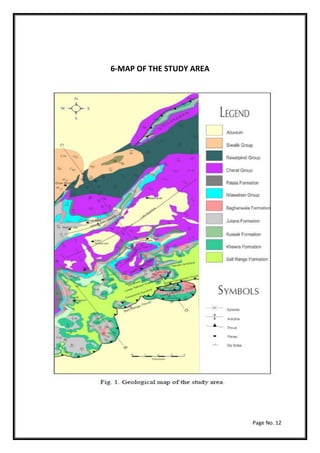
6-MAP OF THE STUDY AREA
Page No. 13
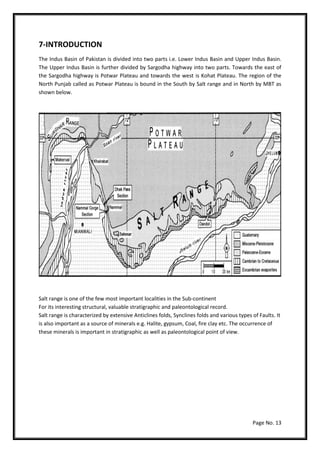
7-INTRODUCTION
The Indus Basin of Pakistan is divided into two parts i.e. Lower Indus Basin and Upper Indus Basin.
The Upper Indus Basin is further divided by Sargodha highway into two parts. Towards the east of
the Sargodha highway is Potwar Plateau and towards the west is Kohat Plateau. The region of the
North Punjab called as Potwar Plateau is bound in the South by Salt range and in North by MBT as
shown below.
Salt range is one of the few most important localities in the Sub-continent
For its interesting structural, valuable stratigraphic and paleontological record.
Salt range is characterized by extensive Anticlines folds, Synclines folds and various types of Faults. It
is also important as a source of minerals e.g. Halite, gypsum, Coal, fire clay etc. The occurrence of
these minerals is important in stratigraphic as well as paleontological point of view.
Page No. 14
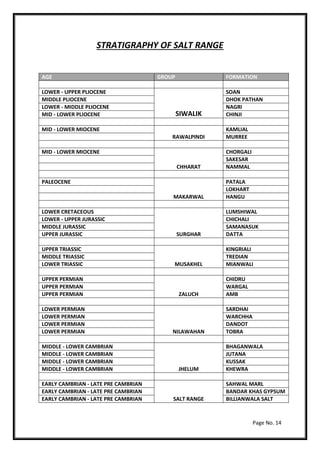
STRATIGRAPHY OF SALT RANGE
AGE GROUP FORMATION
LOWER - UPPER PLIOCENE
SIWALIK
SOAN
MIDDLE PLIOCENE DHOK PATHAN
LOWER - MIDDLE PLIOCENE NAGRI
MID - LOWER PLIOCENE CHINJI
MID - LOWER MIOCENE
RAWALPINDI
KAMLIAL
MURREE
MID - LOWER MIOCENE
CHHARAT
CHORGALI
SAKESAR
NAMMAL
PALEOCENE
MAKARWAL
PATALA
LOKHART
HANGU
LOWER CRETACEOUS
SURGHAR
LUMSHIWAL
LOWER - UPPER JURASSIC CHICHALI
MIDDLE JURASSIC SAMANASUK
UPPER JURASSIC DATTA
UPPER TRIASSIC
MUSAKHEL
KINGRIALI
MIDDLE TRIASSIC TREDIAN
LOWER TRIASSIC MIANWALI
UPPER PERMIAN
ZALUCH
CHIDRU
UPPER PERMIAN WARGAL
UPPER PERMIAN AMB
LOWER PERMIAN
NILAWAHAN
SARDHAI
LOWER PERMIAN WARCHHA
LOWER PERMIAN DANDOT
LOWER PERMIAN TOBRA
MIDDLE - LOWER CAMBRIAN
JHELUM
BHAGANWALA
MIDDLE - LOWER CAMBRIAN JUTANA
MIDDLE - LOWER CAMBRIAN KUSSAK
MIDDLE - LOWER CAMBRIAN KHEWRA
EARLY CAMBRIAN - LATE PRE CAMBRIAN
SALT RANGE
SAHWAL MARL
EARLY CAMBRIAN - LATE PRE CAMBRIAN BANDAR KHAS GYPSUM
EARLY CAMBRIAN - LATE PRE CAMBRIAN BILLIANWALA SALT
Page No. 15
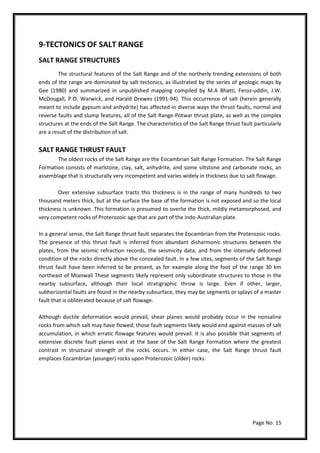
9-TECTONICS OF SALT RANGE
SALT RANGE STRUCTURES
The structural features of the Salt Range and of the northerly trending extensions of both
ends of the range are dominated by salt tectonics, as illustrated by the series of geologic maps by
Gee (1980) and summarized in unpublished mapping compiled by M.A Bhatti, Feroz-uddin, J.W.
McDougall, P.O. Warwick, and Harald Drewes (1991-94). This occurrence of salt (herein generally
meant to include gypsum and anhydrite) has affected in diverse ways the thrust faults, normal and
reverse faults and slump features, all of the Salt Range-Potwar thrust plate, as well as the complex
structures at the ends of the Salt Range. The characteristics of the Salt Range thrust fault particularly
are a result of the distribution of salt.
SALT RANGE THRUST FAULT
The oldest rocks of the Salt Range are the Eocambrian Salt Range Formation. The Salt Range
Formation consists of marlstone, clay, salt, anhydrite, and some siltstone and carbonate rocks, an
assemblage that is structurally very incompetent and varies widely in thickness due to salt flowage.
Over extensive subsurface tracts this thickness is in the range of many hundreds to two
thousand meters thick, but at the surface the base of the formation is not exposed and so the local
thickness is unknown. This formation is presumed to overlie the thick, mildly metamorphosed, and
very competent rocks of Proterozoic age that are part of the Indo-Australian plate.
In a general sense, the Salt Range thrust fault separates the Eocambrian from the Proterozoic rocks.
The presence of this thrust fault is inferred from abundant disharmonic structures between the
plates, from the seismic refraction records, the seismicity data, and from the intensely deformed
condition of the rocks directly above the concealed fault. In a few sites, segments of the Salt Range
thrust fault have been inferred to be present, as for example along the foot of the range 30 km
northeast of Mianwali These segments likely represent only subordinate structures to those in the
nearby subsurface, although their local stratigraphic throw is large. Even if other, larger,
subhorizontal faults are found in the nearby subsurface, they may be segments or splays of a master
fault that is obliterated because of salt flowage.
Although ductile deformation would prevail, shear planes would probably occur in the nonsaline
rocks from which salt may have flowed; those fault segments likely would end against masses of salt
accumulation, in which erratic flowage features would prevail. It is also possible that segments of
extensive discrete fault planes exist at the base of the Salt Range Formation where the greatest
contrast in structural strength of the rocks occurs. In either case, the Salt Range thrust fault
emplaces Eocambrian (younger) rocks upon Proterozoic (older) rocks.
Page No. 16
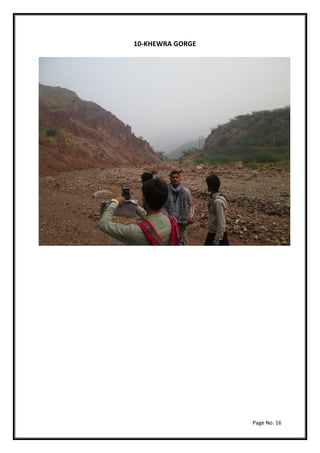
10-KHEWRA GORGE
Page No. 17
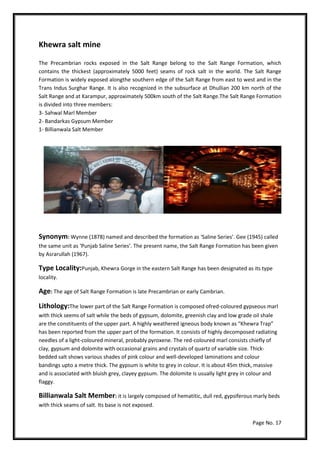
Khewra salt mine
The Precambrian rocks exposed in the Salt Range belong to the Salt Range Formation, which
contains the thickest (approximately 5000 feet) seams of rock salt in the world. The Salt Range
Formation is widely exposed alongthe southern edge of the Salt Range from east to west and in the
Trans Indus Surghar Range. It is also recognized in the subsurface at Dhullian 200 km north of the
Salt Range and at Karampur, approximately 500km south of the Salt Range.The Salt Range Formation
is divided into three members:
3- Sahwal Marl Member
2- Bandarkas Gypsum Member
1- Billianwala Salt Member
Synonym: Wynne (1878) named and described the formation as ‘Saline Series’. Gee (1945) called
the same unit as ‘Punjab Saline Series’. The present name, the Salt Range Formation has been given
by Asrarullah (1967).
Type Locality:Punjab, Khewra Gorge in the eastern Salt Range has been designated as its type
locality.
Age: The age of Salt Range Formation is late Precambrian or early Cambrian.
Lithology:The lower part of the Salt Range Formation is composed ofred-coloured gypseous marl
with thick seems of salt while the beds of gypsum, dolomite, greenish clay and low grade oil shale
are the constituents of the upper part. A highly weathered igneous body known as “Khewra Trap”
has been reported from the upper part of the formation. It consists of highly decomposed radiating
needles of a light-coloured mineral, probably pyroxene. The red-coloured marl consists chiefly of
clay, gypsum and dolomite with occasional grains and crystals of quartz of variable size. Thick-
bedded salt shows various shades of pink colour and well-developed laminations and colour
bandings upto a metre thick. The gypsum is white to grey in colour. It is about 45m thick, massive
and is associated with bluish grey, clayey gypsum. The dolomite is usually light grey in colour and
flaggy.
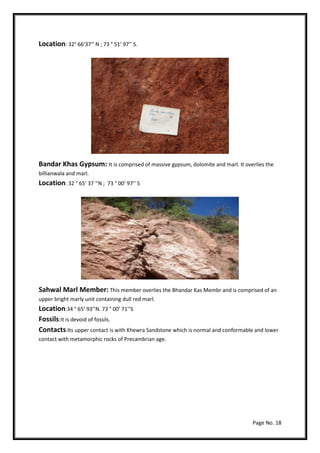
Billianwala Salt Member: it is largely composed of hematitic, dull red, gypsiferous marly beds
with thick seams of salt. Its base is not exposed.
Page No. 18
Location: 32° 66‘37‘’ N ; 73 ° 51’ 97’’ S.
Bandar Khas Gypsum: It is comprised of massive gypsum, dolomite and marl. It overlies the
billianwala and marl.
Location: 32 ° 65’ 37 ‘’N ; 73 ° 00’ 97’’ S
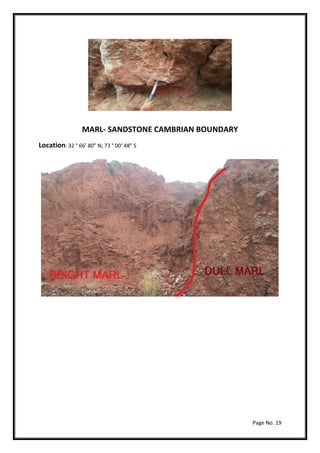
Sahwal Marl Member: This member overlies the Bhandar Kas Membr and is comprised of an
upper bright marly unit containing dull red marl.
Location:34 ° 65’ 93’’N. 73 ° 00’ 71’’S
Fossils:It is devoid of fossils.
Contacts:Its upper contact is with Khewra Sandstone which is normal and conformable and lower
contact with metamorphic rocks of Precambrian age.
Page No. 19
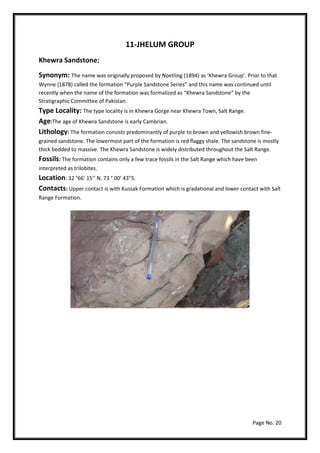
MARL- SANDSTONE CAMBRIAN BOUNDARY
Location: 32 ° 66’ 80” N; 73 ° 00’ 48” S
Page No. 20
11-JHELUM GROUP
Khewra Sandstone:
Synonym: The name was originally proposed by Noetling (1894) as ‘Khewra Group’. Prior to that
Wynne (1878) called the formation “Purple Sandstone Series” and this name was continued until
recently when the name of the formation was formalized as “Khewra Sandstone” by the
Stratigraphic Committee of Pakistan.
Type Locality: The type locality is in Khewra Gorge near Khewra Town, Salt Range.
Age:The age of Khewra Sandstone is early Cambrian.
Lithology: The formation consists predominantly of purple to brown and yellowish brown fine-
grained sandstone. The lowermost part of the formation is red flaggy shale. The sandstone is mostly
thick bedded to massive. The Khewra Sandstone is widely distributed throughout the Salt Range.
Fossils: The formation contains only a few trace fossils in the Salt Range which have been
interpreted as trilobites.
Location: 32 °66’ 15’’ N. 73 ° 00’ 43”S.
Contacts: Upper contact is with Kussak Formation which is gradational and lower contact with Salt
Range Formation.
Page No. 21
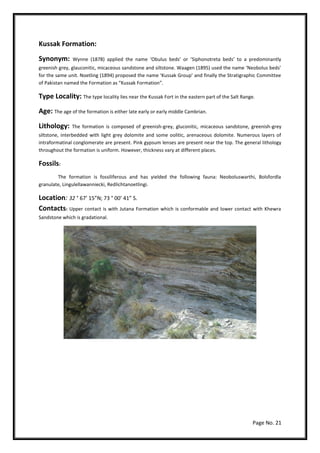
Kussak Formation:
Synonym: Wynne (1878) applied the name ‘Obulus beds’ or ‘Siphonotreta beds’ to a predominantly
greenish grey, glauconitic, micaceous sandstone and siltstone. Waagen (1895) used the name ‘Neobolus beds’
for the same unit. Noetling (1894) proposed the name ‘Kussak Group’ and finally the Stratigraphic Committee
of Pakistan named the Formation as “Kussak Formation”.
Type Locality: The type locality lies near the Kussak Fort in the eastern part of the Salt Range.
Age: The age of the formation is either late early or early middle Cambrian.
Lithology: The formation is composed of greenish-grey, gluconitic, micaceous sandstone, greenish-grey
siltstone, interbedded with light grey dolomite and some oolitic, arenaceous dolomite. Numerous layers of
intraformatinal conglomerate are present. Pink gypsum lenses are present near the top. The general lithology
throughout the formation is uniform. However, thickness vary at different places.
Fossils:
The formation is fossiliferous and has yielded the following fauna: Neoboluswarthi, Bolsfordla
granulate, Lingulellawanniecki, Redlichtanoetlingi.
Location: 32 ° 67’ 15”N; 73 ° 00’ 41” S.
Contacts: Upper contact is with Jutana Formation which is conformable and lower contact with Khewra
Sandstone which is gradational.
Page No. 22
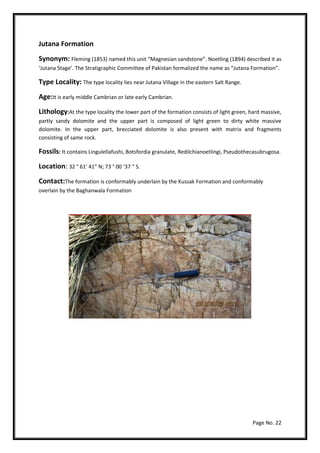
Jutana Formation
Synonym: Fleming (1853) named this unit “Magnesian sandstone”. Noetling (1894) described it as
‘Jutana Stage’. The Stratigraphic Committee of Pakistan formalized the name as “Jutana Formation”.
Type Locality: The type locality lies near Jutana Village in the eastern Salt Range.
Age:It is early middle Cambrian or late early Cambrian.
Lithology:At the type locality the lower part of the formation consists of light green, hard massive,
partly sandy dolomite and the upper part is composed of light green to dirty white massive
dolomite. In the upper part, brecciated dolomite is also present with matrix and fragments
consisting of same rock.
Fossils: It contains Lingulellafushi, Botsfordia granulate, Redilchianoetlingi, Pseudothecasubrugosa.
Location: 32 ° 61’ 41” N; 73 ° 00 ‘37 “ S.
Contact:The formation is conformably underlain by the Kussak Formation and conformably
overlain by the Baghanwala Formation
Page No. 23
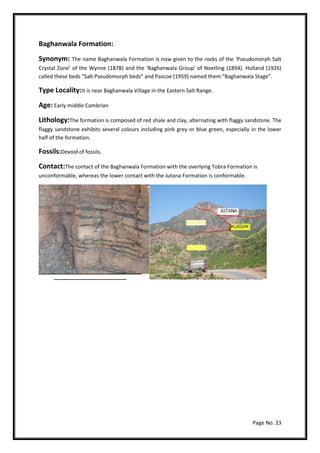
Baghanwala Formation:
Synonym: The name Baghanwala Formation is now given to the rocks of the ‘Pseudomorph Salt
Crystal Zone’ of the Wynne (1878) and the ‘Baghanwala Group’ of Noetling (1894). Holland (1926)
called these beds “Salt Pseudomorph beds” and Pascoe (1959) named them “Baghanwala Stage”.
Type Locality:It is near Baghanwala Village in the Eastern Salt Range.
Age: Early middle Cambrian
Lithology:The formation is composed of red shale and clay, alternating with flaggy sandstone. The
flaggy sandstone exhibits several colours including pink grey or blue green, especially in the lower
half of the formation.
Fossils:Devoid of fossils.
Contact:The contact of the Baghanwala Formation with the overlying Tobra Formation is
unconformable, whereas the lower contact with the Jutana Formation is conformable.
Page No. 24
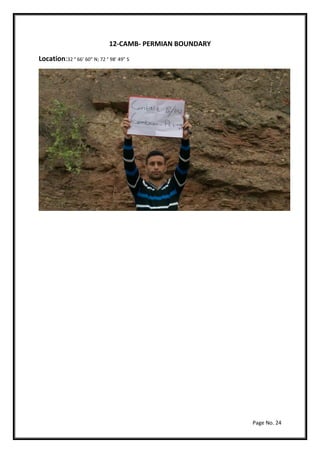
12-CAMB- PERMIAN BOUNDARY
Location:32 ° 66’ 60” N; 72 ° 98’ 49” S
Page No. 25
13-NILAWAHAN GROUP
Tobra Formation:
Synonym: It was previously known in the literature as “Talchir Boulder Bed” or “Talchir Stage” of
Gee and “Salt Range Boulder Bed” of Teichert (1967).
Type Locality: The type locality is located near Tobra Village in the eastern Salt Range.
Age: Early Permian
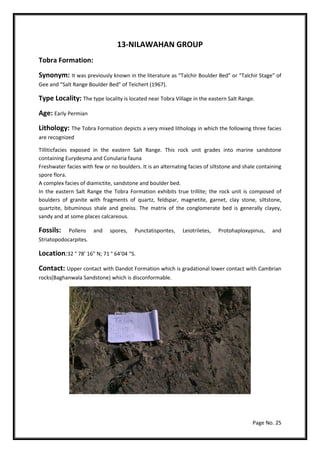
Lithology: The Tobra Formation depicts a very mixed lithology in which the following three facies
are recognized
Tilliticfacies exposed in the eastern Salt Range. This rock unit grades into marine sandstone
containing Eurydesma and Conularia fauna
Freshwater facies with few or no boulders. It is an alternating facies of siltstone and shale containing
spore flora.
A complex facies of diamictite, sandstone and boulder bed.
In the eastern Salt Range the Tobra Formation exhibits true trillite; the rock unit is composed of
boulders of granite with fragments of quartz, feldspar, magnetite, garnet, clay stone, siltstone,
quartzite, bituminous shale and gneiss. The matrix of the conglomerate bed is generally clayey,
sandy and at some places calcareous.
Fossils: Pollens and spores, Punctatisporites, Leiotriletes, Protohaploxypinus, and
Striatopodocarpites.
Location:32 ° 78’ 16” N; 71 ° 64’04 “S.
Contact: Upper contact with Dandot Formation which is gradational lower contact with Cambrian
rocks(Baghanwala Sandstone) which is disconformable.
Page No. 26
Dandot Formation:
Synonym: The name Dandot Formation is formalized after the ‘Dandot Group’ of Noetling (1901)
and includes the “Olive Series”, ‘ Eurydesma beds’ of Wynne (1878) and the ‘Speckled sandstone’ of
Waagen (1879).
Type Locality: The type locality is near Dandot Village, eastern Salt Range.
Age: Early Permian.
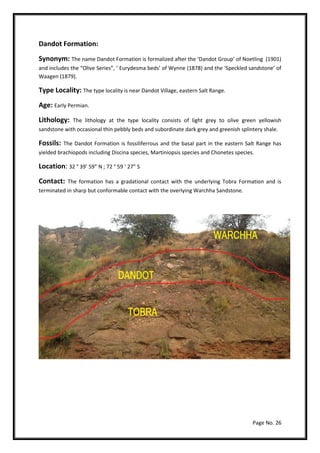
Lithology: The lithology at the type locality consists of light grey to olive green yellowish
sandstone with occasional thin pebbly beds and subordinate dark grey and greenish splintery shale.
Fossils: The Dandot Formation is fossiliferrous and the basal part in the eastern Salt Range has
yielded brachiopods including Discina species, Martiniopsis species and Chonetes species.
Location: 32 ° 39’ 59” N ; 72 ° 59 ‘ 27” S
Contact: The formation has a gradational contact with the underlying Tobra Formation and is
terminated in sharp but conformable contact with the overlying Warchha Sandstone.
Page No. 27
WARCHHA SANDSTONE:
Synonym: Warchha group by noetling 1901 is named as warchha sandstone by hussian ahmed
in1967.
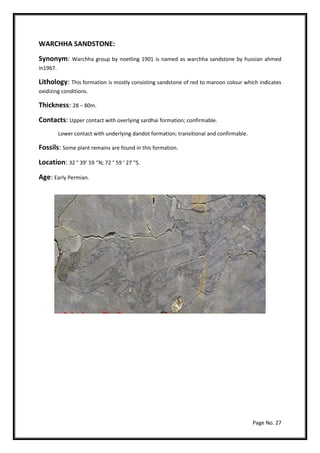
Lithology: This formation is mostly consisting sandstone of red to maroon colour which indicates
oxidizing conditions.
Thickness: 28 – 80m.
Contacts: Upper contact with overlying sardhai formation; confirmable.
Lower contact with underlying dandot formation; transitional and confirmable.
Fossils: Some plant remains are found in this formation.
Location: 32 ° 39’ 59 “N; 72 ° 59 ‘ 27 “S.
Age: Early Permian.
Page No. 28
Sardhai Formation:
Synonym: Upper part of the warchha group by noetling in 1901 named as lavender clays or
sardhai formation. By gee and Pascoe in 1959.
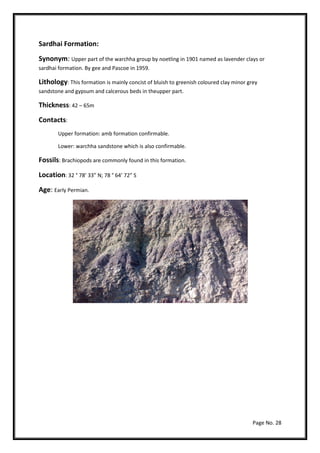
Lithology: This formation is mainly concist of bluish to greenish coloured clay minor grey
sandstone and gypsum and calcerous beds in theupper part.
Thickness: 42 – 65m
Contacts:
Upper formation: amb formation confirmable.
Lower: warchha sandstone which is also confirmable.
Fossils: Brachiopods are commonly found in this formation.
Location: 32 ° 78’ 33” N; 78 ° 64’ 72” S
Age: Early Permian.
Page No. 29
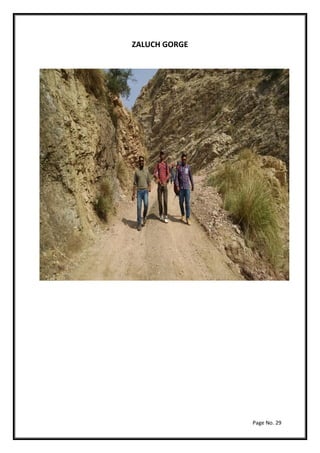
ZALUCH GORGE
Page No. 30
14-ZALUCH GROUP
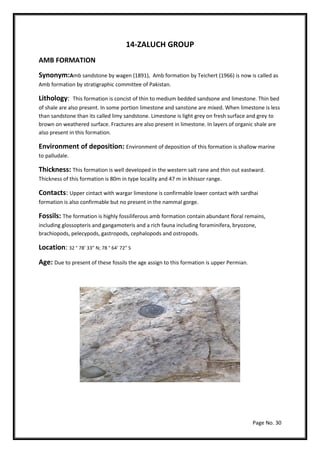
AMB FORMATION
Synonym:Amb sandstone by wagen (1891), Amb formation by Teichert (1966) is now is called as
Amb formation by stratigraphic committee of Pakistan.
Lithology: This formation is concist of thin to medium bedded sandsone and limestone. Thin bed
of shale are also present. In some portion limestone and sanstone are mixed. When limestone is less
than sandstone than its called limy sandstone. Limestone is light grey on fresh surface and grey to
brown on weathered surface. Fractures are also present in limestone. In layers of organic shale are
also present in this formation.
Environment of deposition: Environment of deposition of this formation is shallow marine
to palludale.
Thickness: This formation is well developed in the western salt rane and thin out eastward.
Thickness of this formation is 80m in type locality and 47 m in khissor range.
Contacts: Upper cintact with wargar limestone is confirmable lower contact with sardhai
formation is also confirmable but no present in the nammal gorge.
Fossils: The formation is highly fossiliferous amb formation contain abundant floral remains,
including glossopteris and gangamoteris and a rich fauna including foraminifera, bryozone,
brachiopods, pelecypods, gastropods, cephalopods and ostropods.
Location: 32 ° 78’ 33” N; 78 ° 64’ 72” S
Age: Due to present of these fossils the age assign to this formation is upper Permian.
Page No. 31
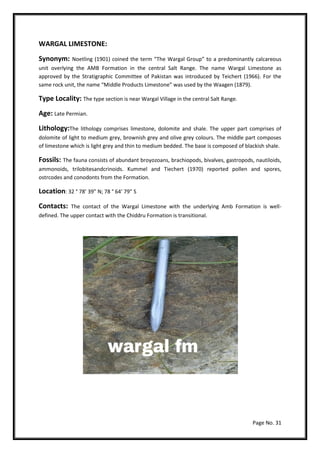
WARGAL LIMESTONE:
Synonym: Noetling (1901) coined the term “The Wargal Group” to a predominantly calcareous
unit overlying the AMB Formation in the central Salt Range. The name Wargal Limestone as
approved by the Stratigraphic Committee of Pakistan was introduced by Teichert (1966). For the
same rock unit, the name “Middle Products Limestone” was used by the Waagen (1879).
Type Locality: The type section is near Wargal Village in the central Salt Range.
Age: Late Permian.
Lithology:The lithology comprises limestone, dolomite and shale. The upper part comprises of
dolomite of light to medium grey, brownish grey and olive grey colours. The middle part composes
of limestone which is light grey and thin to medium bedded. The base is composed of blackish shale.
Fossils: The fauna consists of abundant broyozoans, brachiopods, bivalves, gastropods, nautiloids,
ammonoids, trilobitesandcrinoids. Kummel and Tiechert (1970) reported pollen and spores,
ostrcodes and conodonts from the Formation.
Location: 32 ° 78’ 39” N; 78 ° 64’ 79” S
Contacts: The contact of the Wargal Limestone with the underlying Amb Formation is well-
defined. The upper contact with the Chiddru Formation is transitional.
Page No. 32
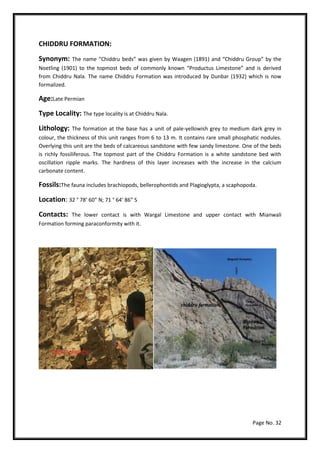
CHIDDRU FORMATION:
Synonym: The name “Chiddru beds” was given by Waagen (1891) and “Chiddru Group” by the
Noetling (1901) to the topmost beds of commonly known “Productus Limestone” and is derived
from Chiddru Nala. The name Chiddru Formation was introduced by Dunbar (1932) which is now
formalized.
Age:Late Permian
Type Locality: The type locality is at Chiddru Nala.
Lithology: The formation at the base has a unit of pale-yellowish grey to medium dark grey in
colour, the thickness of this unit ranges from 6 to 13 m. It contains rare small phosphatic nodules.
Overlying this unit are the beds of calcareous sandstone with few sandy limestone. One of the beds
is richly fossiliferous. The topmost part of the Chiddru Formation is a white sandstone bed with
oscillation ripple marks. The hardness of this layer increases with the increase in the calcium
carbonate content.
Fossils:The fauna includes brachiopods, bellerophontids and Plagioglypta, a scaphopoda.
Location: 32 ° 78’ 60” N; 71 ° 64’ 86” S
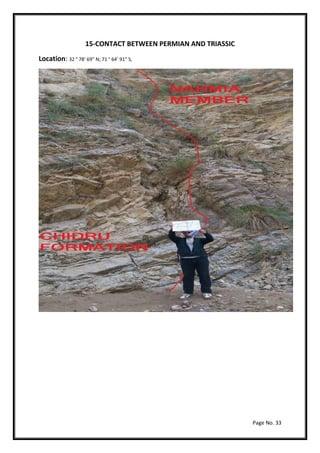
Contacts: The lower contact is with Wargal Limestone and upper contact with Mianwali
Formation forming paraconformity with it.
Page No. 33
15-CONTACT BETWEEN PERMIAN AND TRIASSIC
Location: 32 ° 78’ 69” N; 71 ° 64’ 91” S,
Page No. 34
16-MUSAKHEL GROUP
MIANWALI FORMATION:
Synonym: The name “Mianwali Series” was used by Gee and later modified by Kummel (1966)
into a formation.
Type Locality: The formation is best exposed in Zaluch Nala and Khisor Range.
Age:Triassic
Lithology: The following three members have been recognized by Kummel (1966).
o Kathwai Member.
o Mittiwali Member.
o Narmia Member.
Kathwai Member: The unit consists of dolomite in the lower part and limestone in the upper
part. The dolomite is finally crystalline and includes fossil fragments (mainly echinoderms) and
quartz grains. The upper unit is grey to brown glauconitic limestone. The total thickness of Kathwai
Member is 3.7 in Zaluch Nala and 2.4m in Tappan Wahan.
Location: 32 ° 78’ 32” N; 71 ° 64’ 94” S
Mittiwali Member: The lithology consists of grey, fine-grained, non-glauconitic limestone with
abundant ammonites. The basal beds consist of limestone. The rest of the unit consists of greenish
to greyish shale, silty shale with some sandstone and limestone interbeds. The unit is richly
fossiliferous.
Location: 32 ° 78’ 70” N; 71 ° 64’ 90” S
Narmia Member: The basal bed of Narmia member is a 3 m thick limestone which in Zaluch
Nala consists of dark grey to brown fragmental limestone, sandy in part and containing brachiopods,
bivalves and ammonoids. The rest of the unit consists of grey to black shale with interbeds of
sandstone and lenticular limestone or dolomite. The topmost bed is a grey to brown massive
dolomite.
Fossils:
In Kathwai Member the most significant fossils are Ophicerasconnectens, Glyptophiceras of.
G. himalayanumis also reported. The fauna includes endothyracean Foraminifera, Lingula borealis,
rhynchonellids, pectnids, ostracodes, crinoid and ophiuroid fragments, echinoids, conodonts, fish
teeth and a rich assemblage of pollen, spores and acritarchs. In Mittiwali Member the fauna is
dominated by ammonoids and a few nautiloids. The ammonoids include Ambites, Proptychites,
Kingites and Paranorites. The remainder of the fauna consists of pectinids, ostracodes and
conodonts. In Narmia Member brachiopods, ammonoids, nautiloids, echinoid spines and crinodial
remains.
Page No. 35
Contacts:
The lower contact with the Chiddru Formation of Late Permian age is marked by a
paraconformity while the upper contact with the Tradian Formation is sharp and well-defined.
TREDIAN FORMATION
Synonym: The name Tradian Formation was introduced by Gee to replace, in part, his earlier
name “Kingrali Sandstone”.
Type Locality: Its thickness is 76 m in the Zaluch section of the Salt Range.
Age: It is regarded as Middle Triassic.
Lithology:The formation comprises of two members; the lower is Landa Member (Kummel, 1966)
and the upper is the Khatkiara Member (Shah 1967).
Landa Member: It consists of sandstone and shale. The sandstone is micaceous and varies in colour
from pinkish, reddish grey to greenish grey. It is thin to thick-bedded, with ripple marks and slump
structure.
Location: 32 ° 78’ 76” N; 71 ° 65’ 03” S
Khatkiara Member:It is massive, thick-bedded white sandstone that grades into the overlying
Kingrali Formation with the inclusion of some dolomite beds in its upper part.
Location: 32 ° 78’ 74” N; 71 ° 64’ 94”
Fossils: The formation consists of plant microfossils described by Blame (1970). The lower Landa
Member contains acritarchs whereas the Khatkiara Member yielded only spores, pollen grains and
wood fragments. Some of the essential polynomorphs of Tradian Formation are:
Calamosporalindiana, Cyciogranisporitesarenosus, Aratrisporitespanulatus, Falcisporitesstabilis,
Platysaccusquenslandi.
Contact: Its lower contact is with Mianwali Formation and upper contact with Kingrali Formation.
Page No. 36
KINGRIALI FORMATION
Synonym: The name Kingrali Dolomite was used by Gee (1945) and later amended as Kingrali
Formation, because several lithological facies are represented. The name originates from Kingrali
Peak in the Khisor Range.
Type Locality: Good sections of the formation occur in Zaluch Nala in the Western Salt Range,
Landa Nala in the Surghar Range and in the Tapan Wahan Gori Tang Nala in the Khisor Range.
Age: Late Triassic.
Lithology: The formation consists of thin to thick-bedded, massive, and fine to coarse-grained,
light grey-brown dolomite and dolomitic limestone with interbeds of greenish dolomitic and shale in
the upper part.
Fossils: Fossils are rare and preserved. Some brachiopods, bivalves and crinoidal remains have
been reported.
Location: 32 ° 78’ 76” N; 71 ° 65’ 03” S
Contact: Its lower contact is with the Tradian Formation which is transitional and upper
disconformable contact with Datta Formation.
Page No. 37
CHAPRI GORGE
Page No. 38
17-SURGHAR GROUP
DATTA FORMATION
Synonym: The name Datta Formation was introduced by Danilchik (1961) and Danilchik and Shah
(1967) to replace the name “Variegated Stage” of Gee (1945) and earlier workers.
Type Locality: The type section is located in Datta Nala in the Surghar Range.
Age: Early Jurassic.
Lithology: The formation is mainly of continental origin and consists of variegated (red, maroon,
grey, green and white) sandstone, shale, siltstone and mudstone with irregularly distributed
calcareous, dolomitic, carbonaceous, ferruginous, glass sand and fireclay horizons. The fireclay is
normally present in the lower part while the upper part includes a thick bed (4 to 7 m) of maroon
shale easily recognizable in Salt Range and Trans-Indus Ranges.
Fossils: No diagnostic fossils have been reported from the formation except some carbonaceous
remains.
Location: 32 ° 99’ 76” N; 71 ° 40’ 30” S
Contacts: It rests unconformably on the Kingrali Formation and the lower contact with the
Shinwari Formation is gradational.
Page No. 39
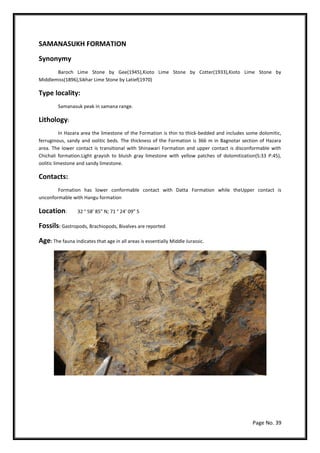
SAMANASUKH FORMATION
Synonymy
Baroch Lime Stone by Gee(1945),Kioto Lime Stone by Cotter(1933),Kioto Lime Stone by
Middlemiss(1896),Sikhar Lime Stone by Latief(1970)
Type locality:
Samanasuk peak in samana range.
Lithology:
In Hazara area the limestone of the Formation is thin to thick-bedded and includes some dolomitic,
ferruginous, sandy and oolitic beds. The thickness of the Formation is 366 m in Bagnotar section of Hazara
area. The lower contact is transitional with Shinawari Formation and upper contact is disconformable with
Chichali formation.Light grayish to bluish gray limestone with yellow patches of dolomitization(S:33 P:45),
oolitic limestone and sandy limestone.
Contacts:
Formation has lower conformable contact with Datta Formation while theUpper contact is
unconformable with Hangu formation
Location: 32 ° 58’ 85” N; 71 ° 24’ 09” S
Fossils: Gastropods, Brachiopods, Bivalves are reported
Age: The fauna indicates that age in all areas is essentially Middle Jurassic.
Page No. 40
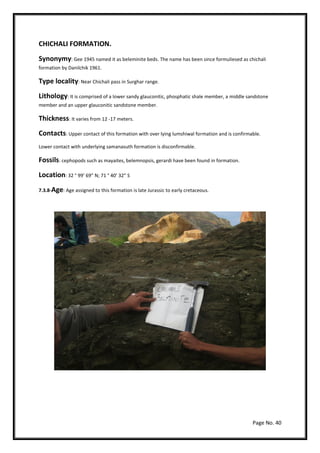
CHICHALI FORMATION.
Synonymy: Gee 1945 named it as beleminite beds. The name has been since formuliesed as chichali
formation by Danilchik 1961.
Type locality: Near Chichali pass in Surghar range.
Lithology: It is comprised of a lower sandy glauconitic, phosphatic shale member, a middle sandstone
member and an upper glauconitic sandstone member.
Thickness: It varies from 12 -17 meters.
Contacts: Upper contact of this formation with over lying lumshiwal formation and is confirmable.
Lower contact with underlying samanasuth formation is disconfirmable.
Fossils: cephopods such as mayaites, belemnopsis, gerardi have been found in formation.
Location: 32 ° 99’ 69” N; 71 ° 40’ 32” S
7.3.8-Age: Age assigned to this formation is late Jurassic to early cretaceous.
Page No. 41
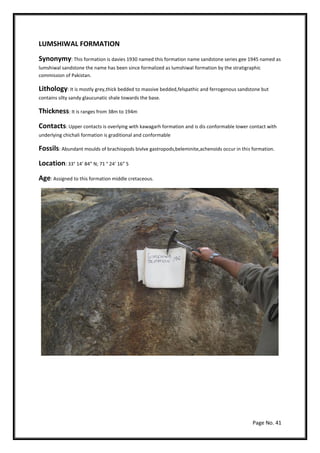
LUMSHIWAL FORMATION
Synonymy: This formation is davies 1930 named this formation name sandstone series gee 1945 named as
lumshiwal sandstone the name has been since formalized as lumshiwal formation by the stratigraphic
commission of Pakistan.
Lithology: It is mostly grey,thick bedded to massive bedded,felspathic and ferrogenous sandstone but
contains silty sandy glaucunatic shale towards the base.
Thickness: It is ranges from 38m to 194m
Contacts: Upper contacts is overlying with kawagarh formation and is dis conformable lower contact with
underlying chichali formation is graditional and conformable
Fossils: Abundant moulds of brachiopods bivlve gastropods,beleminite,achenoids occur in this formation.
Location: 33° 14’ 84” N; 71 ° 24’ 16” S
Age: Assigned to this formation middle cretaceous.
Page No. 42
18-MAKARWAL GROUP
HANGU FORMATION
Synonymy: “HanguShales” and “Hangu Sandstone” by Davies (1930) and “Hangu Formation” by
Stratigraphic Committee of Pakistan (1973)
Type locality: The type section of the formation is near fort Lockhart
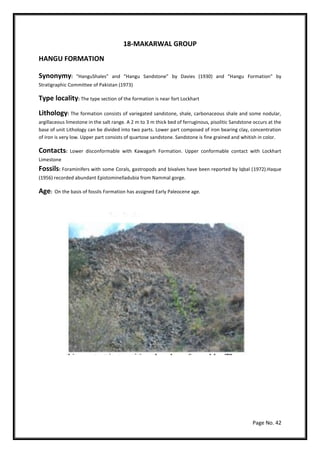
Lithology: The formation consists of variegated sandstone, shale, carbonaceous shale and some nodular,
argillaceous limestone in the salt range. A 2 m to 3 m thick bed of ferruginous, pisolitic Sandstone occurs at the
base of unit Lithology can be divided into two parts. Lower part composed of iron bearing clay, concentration
of iron is very low. Upper part consists of quartose sandstone. Sandstone is fine grained and whitish in color.
Contacts: Lower disconformable with Kawagarh Formation. Upper conformable contact with Lockhart
Limestone
Fossils: Foraminifers with some Corals, gastropods and bivalves have been reported by lqbal (1972).Haque
(1956) recorded abundant Epistominelladubia from Nammal gorge.
Age: On the basis of fossils Formation has assigned Early Paleocene age.
Page No. 43
LOCKHART LIMESTONE:
Synonym: Davies introduced the term “Lockhart Limestone” for a Paleocene limestone unit in the Kohat
area and this usage has been extended by the Stratigraphic Committee of Pakistan to similar units in other
parts of the Kohat-Potwar and Hazara areas.
Type Locality: Fort Lockhart in the Samana Range has been designated as the type locality of the unit.
Age: Paleocene.
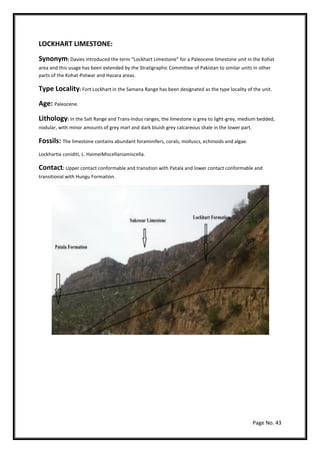
Lithology: In the Salt Range and Trans-Indus ranges, the limestone is grey to light-grey, medium bedded,
nodular, with minor amounts of grey marl and dark bluish grey calcareous shale in the lower part.
Fossils: The limestone contains abundant foraminifers, corals, molluscs, echinoids and algae.
Lockhartia coniditi, L. HaimeiMiscellaniamiscella.
Contact: Upper contact conformable and transition with Patala and lower contact conformable and
transitional with Hungu Formation.
Page No. 44
PATALA FORMATION
Synonymy: Patala Shales” by Davies (1937), “TarkhobiShales” by Eames (1952), “Hill Limestone”
by Wynne (1873). The present name was given by Stratigraphic Committee of Pakistan.
Type locality: The section exposed in Patala nala is designated as type section in Salt range
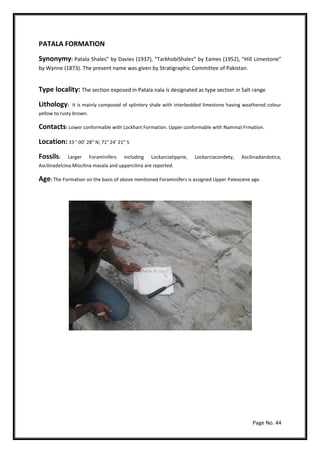
Lithology: It is mainly composed of splintery shale with interbedded limestone having weathered colour
yellow to rusty brown.
Contacts: Lower conformable with Lockhart Formation. Upper conformable with Nammal Frmation.
Location: 33 ° 00’ 28” N; 71° 24’ 21” S
Fossils: Larger Foraminifers including Lockarciatipprie, Lockarciacondety, Ascilinadandotica,
Ascilinadelcina.Miscilina masala and uppercilina are reported.
Age: The Formation on the basis of above mentioned Foraminifers is assigned Upper Paleocene age.
Page No. 45
19-CHHARAT GROUP
Namal Formation:
Synonym: The term Nammal Formation has been formally accepted by the Stratigraphic Committee of
Pakistan for the “Nammal Limestone and Shale” of Gee (in Fermor, 1935) and “Nammal Marl” of Danilehik and
Shah (1967) occurring in the Salt and Trans Indus Ranges.
Type Locality: The section is exposed in the Nammal Gorge (lat. 32˚ 40˚ N: lon. 71˚ 07’ E) is the type
section.
Age: Early Eocene.
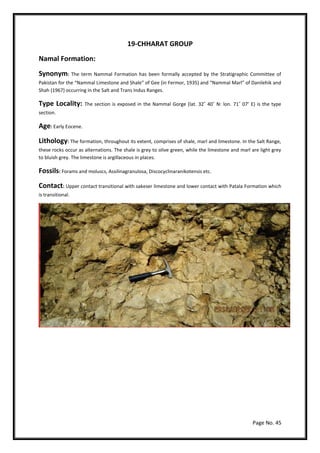
Lithology: The formation, throughout its extent, comprises of shale, marl and limestone. In the Salt Range,
these rocks occur as alternations. The shale is grey to olive green, while the limestone and marl are light grey
to bluish grey. The limestone is argillaceous in places.
Fossils: Forams and moluscs, Assilinagranulosa, Discocyclinaranikotensis etc.
Contact: Upper contact transitional with sakeser limestone and lower contact with Patala Formation which
is transitional.
Page No. 46
SAKESAR LIMESTONE
Synonymy: The term "Sakesar Limestone" has been introduced by Gee after the peak Sakesar in
theCentral Salt Range. Sakesar Peak (lat. 32°31'30"N; long. 71°36'E), Central Salt Range.Principal
reference section is Bhadrar village (lat. 32°41'N; long. 72°31'E) in Eastern Salt Range,Jhelum district,
Punjab Province.
Lithology: The Formation consists predominantly of limestone with subordinate marl. The
limestonethroughout its extent is cream colored to light grey, nodular, usually massive
withconsiderable development of chert in the upper part.In the mapped area, the Sakesar limestone
is composed of dense homogeneous limestonewhich varies from light grey to dark grey in color. It is
massive too thick bedded and is highlyfossiliferous at places.
Distribution and Thickness:It is widely distributed in the northern part of the mapped area. It
is not measured in theMapped Area.
Contacts: The Formation conformably overlies the Namal Formation.
Fossils: The Sakesar Limestone has a sporadic capricious distribution of fossils. Foraminifers are
mostabundant followed in numbers by mollusks and echinoids.
Age: On the base of fauna, Early Eocene age has been given to this unit (Kazmi and Abbasi, 2008)
Page No. 47
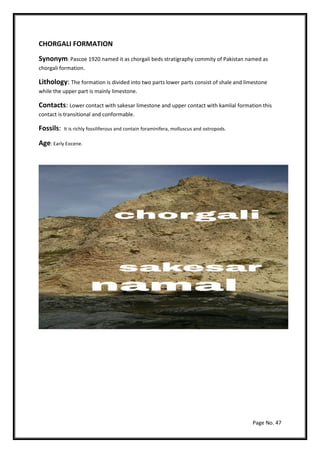
CHORGALI FORMATION
Synonym: Pascoe 1920 named it as chorgali beds stratigraphy commity of Pakistan named as
chorgali formation.
Lithology: The formation is divided into two parts lower parts consist of shale and limestone
while the upper part is mainly limestone.
Contacts: Lower contact with sakesar limestone and upper contact with kamlial formation this
contact is transitional and conformable.
Fossils: It is richly fossiliferous and contain foraminifera, molluscus and ostropods.
Age: Early Eocene.
Page No. 48
20-SIWALIK GROUP
CHINJI FORMATION
Synonym: Chinji zone by pilgrim (1913), lewis called it chinji formation and the named is accepted
by stratigraphic committee of Pakistan.
Type locality: The formation consist of red clay with subordinate ash grey sandstone. This
sandstone is fine to medium grained, occasionally cross bedded and soft. Pebbles and
conglomerates are also found in this formation.
Thickness: It is 750m thick in the type area. And more than 1800m in the singhar range.
Contact: Lower contact with kamlial formation, confirmable
Upper contact with nagri formation; confirmable
Fossils: Abundant vertebrate fossils e.g. crocodiles, lizard aquatic birds.
Age: It is late Miocene.
NAGRI FORMATION
Synonym: Nagri zone by pilgrim in 1913, lower Manchhar of Blandford “nagri formation”
of lewis 1937 has been accepted by stratigraphic committee of Pakistan.
Type locality: The village of nagri at campbellpur District.
Lithology: The formation concist of sandstone with clay and conglomerate.
Thickness: Formation is widely distributed inIndus basin. Thickenss ranges from 300 to 2000m.
Contacts: Lower contact with chinji formation; confirmable
Upper transational contact with dhok pathan.
Fossils: Its rich assemblage in vertebrates remains.
Age: Early Pliocene.
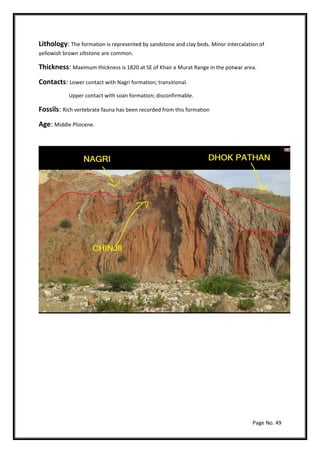
DHOK PATHAN FORMATION
Synonym: The name dhok pathan was introduced by pilgrims 1913. Cotter 191 redefined the unit
as dhok pathan formation wich was adopted by stratigraphic committee of Pakistan.
Type locality: Village dhok pathan, campbellpur district.
Page No. 49
Lithology: The formation is represented by sandstone and clay beds. Minor intercalation of
yellowish brown siltstone are common.
Thickness: Maximum thickness is 1820 at SE of Khair e Murat Range in the potwar area.
Contacts: Lower contact with Nagri formation; transitional.
Upper contact with soan formation; disconfirmable.
Fossils: Rich vertebrate fauna has been recorded from this formation
Age: Middle Pliocene.
Page No. 50
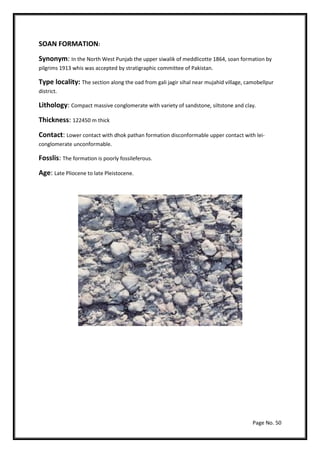
SOAN FORMATION:
Synonym: In the North West Punjab the upper siwalik of meddlicotte 1864, soan formation by
pilgrims 1913 whis was accepted by stratigraphic committee of Pakistan.
Type locality: The section along the oad from gali jagir sihal near mujahid village, camobellpur
district.
Lithology: Compact massive conglomerate with variety of sandstone, siltstone and clay.
Thickness: 122450 m thick
Contact: Lower contact with dhok pathan formation disconformable upper contact with lei-
conglomerate unconformable.
Fosslis: The formation is poorly fossileferous.
Age: Late Pliocene to late Pleistocene.
Page No. 51
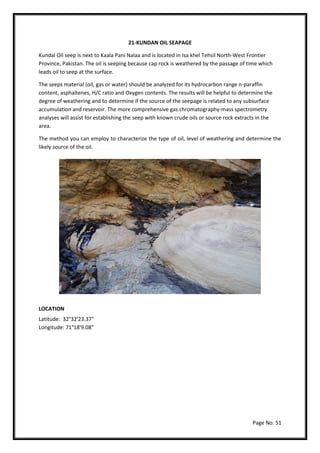
21-KUNDAN OIL SEAPAGE
Kundal Oil seep is next to Kaala Pani Nalaa and is located in Isa khel Tehsil North-West Frontier
Province, Pakistan. The oil is seeping because cap rock is weathered by the passage of time which
leads oil to seep at the surface.
The seeps material (oil, gas or water) should be analyzed for its hydrocarbon range n-paraffin
content, asphaltenes, H/C ratio and Oxygen contents. The results will be helpful to determine the
degree of weathering and to determine if the source of the seepage is related to any subsurface
accumulation and reservoir. The more comprehensive gas chromatography-mass spectrometry
analyses will assist for establishing the seep with known crude oils or source rock extracts in the
area.
The method you can employ to characterize the type of oil, level of weathering and determine the
likely source of the oil.
LOCATION
Latitude: 32°32'23.37"
Longitude: 71°18'9.08"
Page No. 52
22-ECONOMIC MINERALS OF SALT RANGE
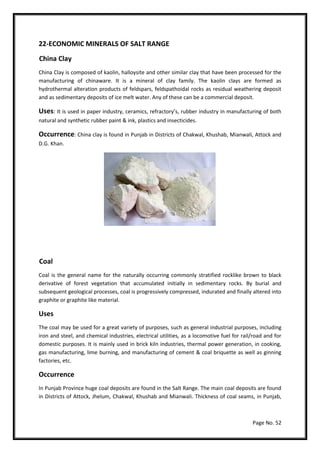
China Clay
China Clay is composed of kaolin, halloysite and other similar clay that have been processed for the
manufacturing of chinaware. It is a mineral of clay family. The kaolin clays are formed as
hydrothermal alteration products of feldspars, feldspathoidal rocks as residual weathering deposit
and as sedimentary deposits of ice melt water. Any of these can be a commercial deposit.
Uses: It is used in paper industry, ceramics, refractory’s, rubber industry in manufacturing of both
natural and synthetic rubber paint & ink, plastics and insecticides.
Occurrence: China clay is found in Punjab in Districts of Chakwal, Khushab, Mianwali, Attock and
D.G. Khan.
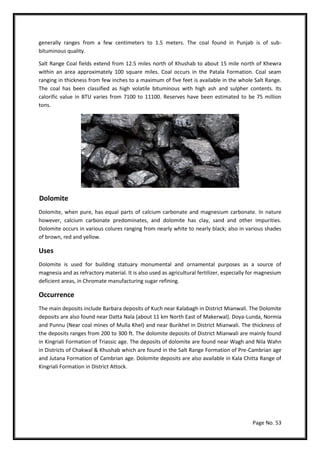
Coal
Coal is the general name for the naturally occurring commonly stratified rocklike brown to black
derivative of forest vegetation that accumulated initially in sedimentary rocks. By burial and
subsequent geological processes, coal is progressively compressed, indurated and finally altered into
graphite or graphite like material.
Uses
The coal may be used for a great variety of purposes, such as general industrial purposes, including
iron and steel, and chemical industries, electrical utilities, as a locomotive fuel for rail/road and for
domestic purposes. It is mainly used in brick kiln industries, thermal power generation, in cooking,
gas manufacturing, lime burning, and manufacturing of cement & coal briquette as well as ginning
factories, etc.
Occurrence
In Punjab Province huge coal deposits are found in the Salt Range. The main coal deposits are found
in Districts of Attock, Jhelum, Chakwal, Khushab and Mianwali. Thickness of coal seams, in Punjab,
Page No. 53
generally ranges from a few centimeters to 1.5 meters. The coal found in Punjab is of sub-
bituminous quality.
Salt Range Coal fields extend from 12.5 miles north of Khushab to about 15 mile north of Khewra
within an area approximately 100 square miles. Coal occurs in the Patala Formation. Coal seam
ranging in thickness from few inches to a maximum of five feet is available in the whole Salt Range.
The coal has been classified as high volatile bituminous with high ash and sulpher contents. Its
calorific value in BTU varies from 7100 to 11100. Reserves have been estimated to be 75 million
tons.
Dolomite
Dolomite, when pure, has equal parts of calcium carbonate and magnesium carbonate. In nature
however, calcium carbonate predominates, and dolomite has clay, sand and other impurities.
Dolomite occurs in various colures ranging from nearly white to nearly black; also in various shades
of brown, red and yellow.
Uses
Dolomite is used for building statuary monumental and ornamental purposes as a source of
magnesia and as refractory material. It is also used as agricultural fertilizer, especially for magnesium
deficient areas, in Chromate manufacturing sugar refining.
Occurrence
The main deposits include Barbara deposits of Kuch near Kalabagh in District Mianwali. The Dolomite
deposits are also found near Datta Nala (about 11 km North East of Makerwal). Doya-Lunda, Normia
and Punnu (Near coal mines of Mulla Khel) and near Burikhel in District Mianwali. The thickness of
the deposits ranges from 200 to 300 ft. The dolomite deposits of District Mianwali are mainly found
in Kingriali Formation of Triassic age. The deposits of dolomite are found near Wagh and Nila Wahn
in Districts of Chakwal & Khushab which are found in the Salt Range Formation of Pre-Cambrian age
and Jutana Formation of Cambrian age. Dolomite deposits are also available in Kala Chitta Range of
Kingriali Formation in District Attock.
Page No. 54
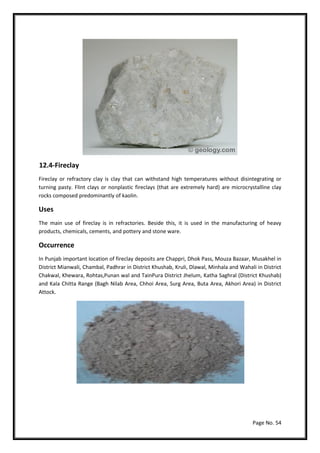
12.4-Fireclay
Fireclay or refractory clay is clay that can withstand high temperatures without disintegrating or
turning pasty. Flint clays or nonplastic fireclays (that are extremely hard) are microcrystalline clay
rocks composed predominantly of kaolin.
Uses
The main use of fireclay is in refractories. Beside this, it is used in the manufacturing of heavy
products, chemicals, cements, and pottery and stone ware.
Occurrence
In Punjab important location of fireclay deposits are Chappri, Dhok Pass, Mouza Bazaar, Musakhel in
District Mianwali, Chambal, Padhrar in District Khushab, Kruli, Dlawal, Minhala and Wahali in District
Chakwal, Khewara, Rohtas,Punan wal and TainPura District Jhelum, Katha Saghral (District Khushab)
and Kala Chitta Range (Bagh Nilab Area, Chhoi Area, Surg Area, Buta Area, Akhori Area) in District
Attock.
Page No. 55
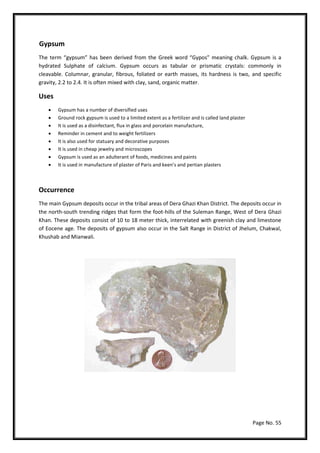
Gypsum
The term “gypsum” has been derived from the Greek word “Gypos” meaning chalk. Gypsum is a
hydrated Sulphate of calcium. Gypsum occurs as tabular or prismatic crystals: commonly in
cleavable. Columnar, granular, fibrous, foliated or earth masses, its hardness is two, and specific
gravity, 2.2 to 2.4. It is often mixed with clay, sand, organic matter.
Uses
 Gypsum has a number of diversified uses
 Ground rock gypsum is used to a limited extent as a fertilizer and is called land plaster
 It is used as a disinfectant, flux in glass and porcelain manufacture,
 Reminder in cement and to weight fertilizers
 It is also used for statuary and decorative purposes
 It is used in cheap jewelry and microscopes
 Gypsum is used as an adulterant of foods, medicines and paints
 It is used in manufacture of plaster of Paris and keen’s and pertian plasters
Occurrence
The main Gypsum deposits occur in the tribal areas of Dera Ghazi Khan District. The deposits occur in
the north-south trending ridges that form the foot-hills of the Suleman Range, West of Dera Ghazi
Khan. These deposits consist of 10 to 18 meter thick, interrelated with greenish clay and limestone
of Eocene age. The deposits of gypsum also occur in the Salt Range in District of Jhelum, Chakwal,
Khushab and Mianwali.
Page No. 56
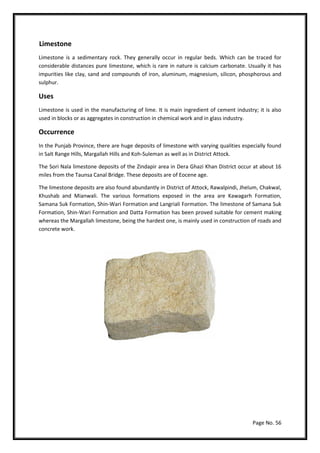
Limestone
Limestone is a sedimentary rock. They generally occur in regular beds. Which can be traced for
considerable distances pure limestone, which is rare in nature is calcium carbonate. Usually it has
impurities like clay, sand and compounds of iron, aluminum, magnesium, silicon, phosphorous and
sulphur.
Uses
Limestone is used in the manufacturing of lime. It is main ingredient of cement industry; it is also
used in blocks or as aggregates in construction in chemical work and in glass industry.
Occurrence
In the Punjab Province, there are huge deposits of limestone with varying qualities especially found
in Salt Range Hills, Margallah Hills and Koh-Suleman as well as in District Attock.
The Sori Nala limestone deposits of the Zindapir area in Dera Ghazi Khan District occur at about 16
miles from the Taunsa Canal Bridge. These deposits are of Eocene age.
The limestone deposits are also found abundantly in District of Attock, Rawalpindi, Jhelum, Chakwal,
Khushab and Mianwali. The various formations exposed in the area are Kawagarh Formation,
Samana Suk Formation, Shin-Wari Formation and Langriali Formation. The limestone of Samana Suk
Formation, Shin-Wari Formation and Datta Formation has been proved suitable for cement making
whereas the Margallah limestone, being the hardest one, is mainly used in construction of roads and
concrete work.
Page No. 57
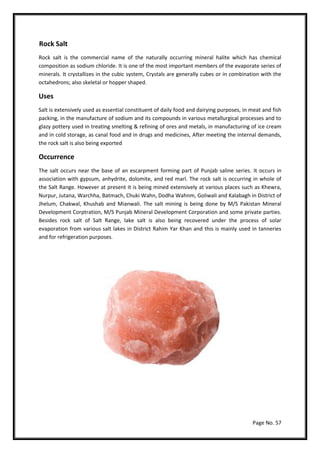
Rock Salt
Rock salt is the commercial name of the naturally occurring mineral halite which has chemical
composition as sodium chloride. It is one of the most important members of the evaporate series of
minerals. It crystallizes in the cubic system, Crystals are generally cubes or in combination with the
octahedrons; also skeletal or hopper shaped.
Uses
Salt is extensively used as essential constituent of daily food and dairying purposes, in meat and fish
packing, in the manufacture of sodium and its compounds in various metallurgical processes and to
glazy pottery used in treating smelting & refining of ores and metals, in manufacturing of ice cream
and in cold storage, as canal food and in drugs and medicines, After meeting the internal demands,
the rock salt is also being exported
Occurrence
The salt occurs near the base of an escarpment forming part of Punjab saline series. It occurs in
association with gypsum, anhydrite, dolomite, and red marl. The rock salt is occurring in whole of
the Salt Range. However at present it is being mined extensively at various places such as Khewra,
Nurpur, Jutana, Warchha, Batmach, Chuki Wahn, Dodha Wahnm, Goliwali and Kalabagh in District of
Jhelum, Chakwal, Khushab and Mianwali. The salt mining is being done by M/S Pakistan Mineral
Development Corptration, M/S Punjab Mineral Development Corporation and some private parties.
Besides rock salt of Salt Range, lake salt is also being recovered under the process of solar
evaporation from various salt lakes in District Rahim Yar Khan and this is mainly used in tanneries
and for refrigeration purposes.
Page No. 58
23-CONCLUSION
Main purpose of the field trip was to give students practical hands on experience about the field
work, back bone of geology. Study the distribution of the various time units in the Salt Range area,
so as to investigate the lateral changes in these units and how to correlate them in different parts of
the Salt range. Keeping these things in mind localities in eastern, central and western part of the Salt
range were visited where the units were best exposed. Two days were spent in Khewra and
adjoining areas for the study of stratigraphic units in east, one day in the central Salt range area and
two days in Mianwali and surroundings to look at the western part of the Salt range.
We saw grabben structure .We marked Cambrian Permian boundary between Jhelum and
Nilawahan group, we also observed Permo - triassic boundary between Zaluch and Musakhel group.
We saw igneous intrusion called khewrite at Khewra. We saw oil seepage at the Kundal area. Salt
range possess very importance because we get 97.5% Gypsum, rock salt , salt , fire clay , china clay ,
coal ,limestone and dolomite etc.
The Government should preserve these formation especially Pre-Cambrian age formation which are
our Geological Asset. It is found rarely in the world but Pakistan has many exposure of them. It’s our
duty to maintain it for our next generations.
Page No. 59
REFERENCES
Fatmi, A. N., 1972, Stratigraphy of Jurassic and Lower Cretaceous rocks and Jurassic Ammonites from
Northern areas of West Pakistan: Bull. Bri. Mus. Nat. Hist. Vol. No. 7.
Fatmi, A. N., 1972. Some recent evidence on the age of Samana Suk Formation, Samana Range,
Kohat: Geonews No. 2, p. 22-41.
Azad, J., 1960, the Geology of Mianwali and Tank Re-entrant. (Unpublished).
Jaswal, T. M., R.J. Lillie and R.D. Lawrence, 1997, Structure and Evolution of the Northern Potwar
Deform Zone, Pakistan: AAPG Bull., v.81, p.308-328.
Jaume, S. C. and R. J. Lillie, 1988, Mechanics of the Salt Range- Potwar Plateau, Pakistan: a fold and
thrust belt underlain by evaporates: Tectonics, v.7, p.57-71.
Stratigraphy of Pakistan – by S.M.Ibrahim Shah
Geology and Tectonics of Pakistan - by M. Qasim Jan.
The Geological Survey of Pakistan (volume 22)
www.brooks/cole.com/geology
www.gsp.gov.pk/pakistan/index.html
www.mcgraw-hill.co.uk/geology
www.wikipedia.com/geology

Salt Range Field Report

  • 2.
    Page No. 1 1-ACKNOWLEDGEMENT Ourdeepest gratitude is to our teacher, Sir Arsalan & Sir Latif Dino Napar. We have been amazingly fortunate to have an advisor who gave us the freedom to explore on our own, and at the same time the guidance to recover when our steps faltered. Don taught us how to question thoughts and express ideas. His patience and support helped us overcome many crisis situations and finish this dissertation. I hope that one day we would become as good an advisor to our students as you have been to us.
  • 3.
    Page No. 2 GROUPMEMBERS 1. MUHAMMAD KHURRAM 2. ABDUL BASIT 3. ABDUL RAFAY 4. UBAD UR REHMAN
  • 4.
    Page No. 3 Tableof Content 1-Acknowledgement………….......................................................................................................1 2-Abstract...................................................................................................................................5 3-Geology of the salt range area………………………………………………………………………………………………………6 4-Tectonics………………………….……………………………………………………………………………………………………………8 5-Objective……………………………………………………………………………………………………………………………………….9 6-Map of the study of the area………………………………………………………………………………………………………12 7-Introduction..........................................................................................................................13 8- Stratigraphic Column of Salt Range :................................................................................…14 9-Tectonics of Salt Range.........................................................................................................15 10-Khewra Gorge......................................................................................................…………….16 11-Jhelum Group......................................................................................................................20 Khewra Sandstone ..................................................................................................................20 Kussak Formation....................................................................................................................21 Jutana Formation:...................................................................................................................22 Bhaganwala Formation:..........................................................................................................23 12-Cambrian – Permian Boundary: .........................................................................................24 13-Nilawahan Group:...............................................................................................................25 Tobra Formation: .....................................................................................................................25 Dandot Formation:...................................................................................................................26 Warcha Sandstone:..................................................................................................................27 Sardhai Formation: ..................................................................................................................28 14-Zaluch Group: .....................................................................................................................30 Amb Formation........................................................................................................................30 Wargal Limestone:…………………………………………………………………………………………………………..…31 Chidru Formation:....................................................................................................................32 15-Permo Triassic boundary…………………………………………………………………………………………………………….33 16-Musakhel Group : ..............................................................................................................34 Mianwali Formation:................................................................................................................34 Tredian Formation : .................................................................................................................35 Kingriali Formation :.................................................................................................................36
  • 5.
    Page No. 4 17-SurgharGroup :..................................................................................................................38 Datta Formation :.....................................................................................................................38 Samanasuk Formation .............................................................................................................39 Chichali Formation...................................................................................................................40 Lumshiwal Formation: .............................................................................................................41 18-Makarwal Group:................................................................................................................42 Hangu Formation: ....................................................................................................................42 Lockart Limestone……………………………………………………………………………………………….……………..43 Patala Formation…………….……….………..……………………………………………….……………………………..44 19-Charat Group……………………………..………………………………………….………………………………………45 Nammal Formation…………………………………………………………………............................................46 Sakesar Limestone:…………………..………………………………………………………………………………………..46 Chorgali Formation: .................................................................................................................47 20-Siwalik Group......................................................................................................................48 Chinji Formation………………………………………………………….…......................................................48 Nagri Formation:......................................................................................................................48 Dhok Pathan.............................................................................................................................50 Soan Formation:.......................................................................................................................50 21-Kundal Oil Seapage:............................................................................................................51 22-Economic Minerals of Salt Range: ......................................................................................52 23-Conclusion: .........................................................................................................................58 Refrence :.................................................................................................................................59
  • 6.
    Page No. 5 2-Abstract: TheSalt Range contains the most important geologic and paleontologic localities in Pakistan, and is one of the outstanding field areas in the entire world. Despite its easy accessibility, it has awealth of geological and paleontological features. In fact, it represents an open book of geology where various richly fossiliferous stratified rocks are very well exposed due to lack of vegetation. These include the Permian carbonate succession with its outstanding brachiopod fauna, Lower Triassic ammonoid beds (the Mianwali Formation, formerly known as "Ceratite Beds"), and Lower Tertiary marine strata with age diagnostic foraminifera. These rocks also provide an excellent opportunity for appreciation of tectonics in the field. In addition to the easily available roadside geology, some prominent gorges provide fantastic locations to study the sedimentary succession. Older strata are exposed in the eastern Salt Range between the Khewra-Choa Saidan Shah and Fort Kussak including the famous Khewra Gorge. In the west, beyond Kallar Kahar, are younger strata such as in the Nilawahan Gorge at Nurpur, the Nammal Gorge near Mianwali, the Chichali Gorge near Kalabagh, and further west the Lumshiwal Nala at Makerwal. This succession has been rightly called a Field Museum of Geology and Paleontology and can be classified as one of the great paleontological areas of the world, fully worthy of conservation and protection effort.
  • 7.
    Page No. 6 3-GEOLOGYOF SALT RANGE AREA This east-west trending fold belt comprises the low rolling hills and valleys of the uplifted Kohat- Potwar Plateau, the Salt Range and its westward extensions (Fig. 4.6 and Photo. 11). It is about 85 km wide and extends for about 200 km. It is a discrete structural zone bounded in the north by the north-dipping Main Boundary Thrust (Sarwar et al. 1979, Yeats et al. 1984, Coward et al. 1985). Southward the Salt Range Thrust, Kalabagh Fault and the Surghar Thrust form its southern boundary. West and eastward it is terminated by the N-S oriented Kurram Thrust andJhelum Fault respectively (Kazmi and Rana 1982). This range is essentially a complex salt anticlinorium with a series of salt anticlines. It is widest in its central part, between Khewra and Warcha, where it also contains the best exposures of Paleozoic and Eocambrian sequence. The structure along its northern slope is comprised of simple, broad, shallow folds followed by a gentle monocline. Southward the folding becomes tighter and the folds are commonly faulted. Along the southern scarp the structures are more complicated and comprise east-west trending faults and overfolds. The Eocambrian evaporites are exposed in some of these overfolded and faulted anticlines (Fig. 4.26). Though the general trend of the folds is east-west in the Central Salt Range, a few north-south trending and northward plunging anticlines, which are actually "nose" type structures, have also formed. Eastward the Salt Range loses its stature and bifurcates into two narrow northeast trending ridges, the Diljabba and the Chambal-Jogi Tilla. The latter comprises steeply dipping monoclines, complicated by complex thrusts and tear faults, whereas the Diljabba Hill is a steeply dipping anticline traversed by Diljabba-Domeli Thrust (Figs. 4.25 and 4.26). Westward the Salt Range takes a northwest bend near Warcha. Its structure remains the same and it is separated by the Kalabagh Fault from the Trans-Indus Ranges. Southward the Salt Range is truncated by the Salt Range Thrust.
  • 8.
  • 9.
    Page No. 8 4-Tectonics TheSalt Range forms the southern border of the hydrocarbon-bearingPotowar Basin in northern Pakistan, along the northwestern margin of theIndo-Pakistani Plate. It derives its name from the occurrence of giganticdeposits of rock salt embedded in the Precambrian bright red marls of theSalt Range Formation (formerly known as the "Punjab Saline Series"). Stratain the Salt Range dip northwards into the Potowar Basin where non-marine Tertiary sediments, collectively known as the Siwaliks, are exposed with awealth of vertebrate fossils. The southern face of the Salt Range is an escarpment that rises abruptlyfrom the Punjab Plains with a junction marked by the Frontal Thrust. Blockfaulting is the most characteristic tectonic style within the Salt Range. TheSalt Range is essentially an East-West trending elongated narrow trough bounded on the east by the River Jhelum and on the west by the River Indus.Beyond the River Indus at Kalabagh, it takes a sharp turn to run almost in aNorth-South direction. The entire mountainous belt has, therefore, previouslybeen differentiated into the Cis-Indus Salt Range and Trans-Indus Salt Rangenow known as The Salt Range and Trans-Indus Surghar Range, respectively. The Salt Range is one of the most important geological regions in Pakistan. Itis easily accessible and displays a wide variety of geological features andpaleontological remains. It has, therefore, been rightly called a field museumof geology and paleontology. It represents an open book of geology withrichly fossiliferous stratified rocks that include a Permian carbonatesuccession with brachiopods, Lower Triassic ammonite bearing beds (theMianwali Formation, formerly known as "Ceratite Beds") and Lower Tertiarymarine strata composed of age diagnostic foraminifera. All the strata areexcellently exposed due to lack of vegetation. The quality of the exposurealso provides excellent opportunities to appreciate tectonic features in thefield. The Salt Range is, therefore, of international scientific and educationalvalue, and is highly worthy of conservation and preservation.
  • 10.
    Page No. 9 5-Objective Afield trip was arranged by Federal Urdu University, Department of Geology on 2nd Nov, 2015. It was a eight day field trip to eastern salt range which is approximately 120-130 km from Islamabad. We left for trip on Friday 2November, 2015 and arrived back to Karachi on Monday 4 November, 2015.The main objectives of the trip was to study the tectonics, regional geology and geomorphological features of the area. Methodology We applied different methods in our field to recognize the lithology, dipping directions and our position etc. so these methods are given below: i. Global Positioning System (GPS) was used for finding the geographical locationsof different stations where we worked. ii. Brunton Compass was used for measuring the dip and strike of the rocks.
  • 11.
    Page No. 10 iii.Geological Hammer was used for collecting samples and differentiating betweenfresh and weathered surface of rocks. It is also used a scale. iv. Hand lens was used for study of fossils and grain sizes. v. Measuring tape was used to measure different lithological sections.
  • 12.
    Page No. 11 vi.Acid: was used to easily recognize the lithologies like limestone, dolomites and weathered surfaces. Vegetation The area is vegetated and contains many types of crops for both the summer and also in the winter seasons. The vegetation of salt range comprises both legumes and non-legumes. Legumes have the capacity to capture nitrogen from the soil atmosphere; this allows pastures and crops to maintain productivity without depletion of soil nitrogen and sometimes can grow under situations where soil nitrogen levels are very low and where growth of other plant would not be possible. Furthermore, when legume plants die, its organic matter is broken down; there is usually a net gain in organic nitrogen to the soil.
  • 13.
    Page No. 12 6-MAPOF THE STUDY AREA
  • 14.
    Page No. 13 7-INTRODUCTION TheIndus Basin of Pakistan is divided into two parts i.e. Lower Indus Basin and Upper Indus Basin. The Upper Indus Basin is further divided by Sargodha highway into two parts. Towards the east of the Sargodha highway is Potwar Plateau and towards the west is Kohat Plateau. The region of the North Punjab called as Potwar Plateau is bound in the South by Salt range and in North by MBT as shown below. Salt range is one of the few most important localities in the Sub-continent For its interesting structural, valuable stratigraphic and paleontological record. Salt range is characterized by extensive Anticlines folds, Synclines folds and various types of Faults. It is also important as a source of minerals e.g. Halite, gypsum, Coal, fire clay etc. The occurrence of these minerals is important in stratigraphic as well as paleontological point of view.
  • 15.
    Page No. 14 STRATIGRAPHYOF SALT RANGE AGE GROUP FORMATION LOWER - UPPER PLIOCENE SIWALIK SOAN MIDDLE PLIOCENE DHOK PATHAN LOWER - MIDDLE PLIOCENE NAGRI MID - LOWER PLIOCENE CHINJI MID - LOWER MIOCENE RAWALPINDI KAMLIAL MURREE MID - LOWER MIOCENE CHHARAT CHORGALI SAKESAR NAMMAL PALEOCENE MAKARWAL PATALA LOKHART HANGU LOWER CRETACEOUS SURGHAR LUMSHIWAL LOWER - UPPER JURASSIC CHICHALI MIDDLE JURASSIC SAMANASUK UPPER JURASSIC DATTA UPPER TRIASSIC MUSAKHEL KINGRIALI MIDDLE TRIASSIC TREDIAN LOWER TRIASSIC MIANWALI UPPER PERMIAN ZALUCH CHIDRU UPPER PERMIAN WARGAL UPPER PERMIAN AMB LOWER PERMIAN NILAWAHAN SARDHAI LOWER PERMIAN WARCHHA LOWER PERMIAN DANDOT LOWER PERMIAN TOBRA MIDDLE - LOWER CAMBRIAN JHELUM BHAGANWALA MIDDLE - LOWER CAMBRIAN JUTANA MIDDLE - LOWER CAMBRIAN KUSSAK MIDDLE - LOWER CAMBRIAN KHEWRA EARLY CAMBRIAN - LATE PRE CAMBRIAN SALT RANGE SAHWAL MARL EARLY CAMBRIAN - LATE PRE CAMBRIAN BANDAR KHAS GYPSUM EARLY CAMBRIAN - LATE PRE CAMBRIAN BILLIANWALA SALT
  • 16.
    Page No. 15 9-TECTONICSOF SALT RANGE SALT RANGE STRUCTURES The structural features of the Salt Range and of the northerly trending extensions of both ends of the range are dominated by salt tectonics, as illustrated by the series of geologic maps by Gee (1980) and summarized in unpublished mapping compiled by M.A Bhatti, Feroz-uddin, J.W. McDougall, P.O. Warwick, and Harald Drewes (1991-94). This occurrence of salt (herein generally meant to include gypsum and anhydrite) has affected in diverse ways the thrust faults, normal and reverse faults and slump features, all of the Salt Range-Potwar thrust plate, as well as the complex structures at the ends of the Salt Range. The characteristics of the Salt Range thrust fault particularly are a result of the distribution of salt. SALT RANGE THRUST FAULT The oldest rocks of the Salt Range are the Eocambrian Salt Range Formation. The Salt Range Formation consists of marlstone, clay, salt, anhydrite, and some siltstone and carbonate rocks, an assemblage that is structurally very incompetent and varies widely in thickness due to salt flowage. Over extensive subsurface tracts this thickness is in the range of many hundreds to two thousand meters thick, but at the surface the base of the formation is not exposed and so the local thickness is unknown. This formation is presumed to overlie the thick, mildly metamorphosed, and very competent rocks of Proterozoic age that are part of the Indo-Australian plate. In a general sense, the Salt Range thrust fault separates the Eocambrian from the Proterozoic rocks. The presence of this thrust fault is inferred from abundant disharmonic structures between the plates, from the seismic refraction records, the seismicity data, and from the intensely deformed condition of the rocks directly above the concealed fault. In a few sites, segments of the Salt Range thrust fault have been inferred to be present, as for example along the foot of the range 30 km northeast of Mianwali These segments likely represent only subordinate structures to those in the nearby subsurface, although their local stratigraphic throw is large. Even if other, larger, subhorizontal faults are found in the nearby subsurface, they may be segments or splays of a master fault that is obliterated because of salt flowage. Although ductile deformation would prevail, shear planes would probably occur in the nonsaline rocks from which salt may have flowed; those fault segments likely would end against masses of salt accumulation, in which erratic flowage features would prevail. It is also possible that segments of extensive discrete fault planes exist at the base of the Salt Range Formation where the greatest contrast in structural strength of the rocks occurs. In either case, the Salt Range thrust fault emplaces Eocambrian (younger) rocks upon Proterozoic (older) rocks.
  • 17.
  • 18.
    Page No. 17 Khewrasalt mine The Precambrian rocks exposed in the Salt Range belong to the Salt Range Formation, which contains the thickest (approximately 5000 feet) seams of rock salt in the world. The Salt Range Formation is widely exposed alongthe southern edge of the Salt Range from east to west and in the Trans Indus Surghar Range. It is also recognized in the subsurface at Dhullian 200 km north of the Salt Range and at Karampur, approximately 500km south of the Salt Range.The Salt Range Formation is divided into three members: 3- Sahwal Marl Member 2- Bandarkas Gypsum Member 1- Billianwala Salt Member Synonym: Wynne (1878) named and described the formation as ‘Saline Series’. Gee (1945) called the same unit as ‘Punjab Saline Series’. The present name, the Salt Range Formation has been given by Asrarullah (1967). Type Locality:Punjab, Khewra Gorge in the eastern Salt Range has been designated as its type locality. Age: The age of Salt Range Formation is late Precambrian or early Cambrian. Lithology:The lower part of the Salt Range Formation is composed ofred-coloured gypseous marl with thick seems of salt while the beds of gypsum, dolomite, greenish clay and low grade oil shale are the constituents of the upper part. A highly weathered igneous body known as “Khewra Trap” has been reported from the upper part of the formation. It consists of highly decomposed radiating needles of a light-coloured mineral, probably pyroxene. The red-coloured marl consists chiefly of clay, gypsum and dolomite with occasional grains and crystals of quartz of variable size. Thick- bedded salt shows various shades of pink colour and well-developed laminations and colour bandings upto a metre thick. The gypsum is white to grey in colour. It is about 45m thick, massive and is associated with bluish grey, clayey gypsum. The dolomite is usually light grey in colour and flaggy. Billianwala Salt Member: it is largely composed of hematitic, dull red, gypsiferous marly beds with thick seams of salt. Its base is not exposed.
  • 19.
    Page No. 18 Location:32° 66‘37‘’ N ; 73 ° 51’ 97’’ S. Bandar Khas Gypsum: It is comprised of massive gypsum, dolomite and marl. It overlies the billianwala and marl. Location: 32 ° 65’ 37 ‘’N ; 73 ° 00’ 97’’ S Sahwal Marl Member: This member overlies the Bhandar Kas Membr and is comprised of an upper bright marly unit containing dull red marl. Location:34 ° 65’ 93’’N. 73 ° 00’ 71’’S Fossils:It is devoid of fossils. Contacts:Its upper contact is with Khewra Sandstone which is normal and conformable and lower contact with metamorphic rocks of Precambrian age.
  • 20.
    Page No. 19 MARL-SANDSTONE CAMBRIAN BOUNDARY Location: 32 ° 66’ 80” N; 73 ° 00’ 48” S
  • 21.
    Page No. 20 11-JHELUMGROUP Khewra Sandstone: Synonym: The name was originally proposed by Noetling (1894) as ‘Khewra Group’. Prior to that Wynne (1878) called the formation “Purple Sandstone Series” and this name was continued until recently when the name of the formation was formalized as “Khewra Sandstone” by the Stratigraphic Committee of Pakistan. Type Locality: The type locality is in Khewra Gorge near Khewra Town, Salt Range. Age:The age of Khewra Sandstone is early Cambrian. Lithology: The formation consists predominantly of purple to brown and yellowish brown fine- grained sandstone. The lowermost part of the formation is red flaggy shale. The sandstone is mostly thick bedded to massive. The Khewra Sandstone is widely distributed throughout the Salt Range. Fossils: The formation contains only a few trace fossils in the Salt Range which have been interpreted as trilobites. Location: 32 °66’ 15’’ N. 73 ° 00’ 43”S. Contacts: Upper contact is with Kussak Formation which is gradational and lower contact with Salt Range Formation.
  • 22.
    Page No. 21 KussakFormation: Synonym: Wynne (1878) applied the name ‘Obulus beds’ or ‘Siphonotreta beds’ to a predominantly greenish grey, glauconitic, micaceous sandstone and siltstone. Waagen (1895) used the name ‘Neobolus beds’ for the same unit. Noetling (1894) proposed the name ‘Kussak Group’ and finally the Stratigraphic Committee of Pakistan named the Formation as “Kussak Formation”. Type Locality: The type locality lies near the Kussak Fort in the eastern part of the Salt Range. Age: The age of the formation is either late early or early middle Cambrian. Lithology: The formation is composed of greenish-grey, gluconitic, micaceous sandstone, greenish-grey siltstone, interbedded with light grey dolomite and some oolitic, arenaceous dolomite. Numerous layers of intraformatinal conglomerate are present. Pink gypsum lenses are present near the top. The general lithology throughout the formation is uniform. However, thickness vary at different places. Fossils: The formation is fossiliferous and has yielded the following fauna: Neoboluswarthi, Bolsfordla granulate, Lingulellawanniecki, Redlichtanoetlingi. Location: 32 ° 67’ 15”N; 73 ° 00’ 41” S. Contacts: Upper contact is with Jutana Formation which is conformable and lower contact with Khewra Sandstone which is gradational.
  • 23.
    Page No. 22 JutanaFormation Synonym: Fleming (1853) named this unit “Magnesian sandstone”. Noetling (1894) described it as ‘Jutana Stage’. The Stratigraphic Committee of Pakistan formalized the name as “Jutana Formation”. Type Locality: The type locality lies near Jutana Village in the eastern Salt Range. Age:It is early middle Cambrian or late early Cambrian. Lithology:At the type locality the lower part of the formation consists of light green, hard massive, partly sandy dolomite and the upper part is composed of light green to dirty white massive dolomite. In the upper part, brecciated dolomite is also present with matrix and fragments consisting of same rock. Fossils: It contains Lingulellafushi, Botsfordia granulate, Redilchianoetlingi, Pseudothecasubrugosa. Location: 32 ° 61’ 41” N; 73 ° 00 ‘37 “ S. Contact:The formation is conformably underlain by the Kussak Formation and conformably overlain by the Baghanwala Formation
  • 24.
    Page No. 23 BaghanwalaFormation: Synonym: The name Baghanwala Formation is now given to the rocks of the ‘Pseudomorph Salt Crystal Zone’ of the Wynne (1878) and the ‘Baghanwala Group’ of Noetling (1894). Holland (1926) called these beds “Salt Pseudomorph beds” and Pascoe (1959) named them “Baghanwala Stage”. Type Locality:It is near Baghanwala Village in the Eastern Salt Range. Age: Early middle Cambrian Lithology:The formation is composed of red shale and clay, alternating with flaggy sandstone. The flaggy sandstone exhibits several colours including pink grey or blue green, especially in the lower half of the formation. Fossils:Devoid of fossils. Contact:The contact of the Baghanwala Formation with the overlying Tobra Formation is unconformable, whereas the lower contact with the Jutana Formation is conformable.
  • 25.
    Page No. 24 12-CAMB-PERMIAN BOUNDARY Location:32 ° 66’ 60” N; 72 ° 98’ 49” S
  • 26.
    Page No. 25 13-NILAWAHANGROUP Tobra Formation: Synonym: It was previously known in the literature as “Talchir Boulder Bed” or “Talchir Stage” of Gee and “Salt Range Boulder Bed” of Teichert (1967). Type Locality: The type locality is located near Tobra Village in the eastern Salt Range. Age: Early Permian Lithology: The Tobra Formation depicts a very mixed lithology in which the following three facies are recognized Tilliticfacies exposed in the eastern Salt Range. This rock unit grades into marine sandstone containing Eurydesma and Conularia fauna Freshwater facies with few or no boulders. It is an alternating facies of siltstone and shale containing spore flora. A complex facies of diamictite, sandstone and boulder bed. In the eastern Salt Range the Tobra Formation exhibits true trillite; the rock unit is composed of boulders of granite with fragments of quartz, feldspar, magnetite, garnet, clay stone, siltstone, quartzite, bituminous shale and gneiss. The matrix of the conglomerate bed is generally clayey, sandy and at some places calcareous. Fossils: Pollens and spores, Punctatisporites, Leiotriletes, Protohaploxypinus, and Striatopodocarpites. Location:32 ° 78’ 16” N; 71 ° 64’04 “S. Contact: Upper contact with Dandot Formation which is gradational lower contact with Cambrian rocks(Baghanwala Sandstone) which is disconformable.
  • 27.
    Page No. 26 DandotFormation: Synonym: The name Dandot Formation is formalized after the ‘Dandot Group’ of Noetling (1901) and includes the “Olive Series”, ‘ Eurydesma beds’ of Wynne (1878) and the ‘Speckled sandstone’ of Waagen (1879). Type Locality: The type locality is near Dandot Village, eastern Salt Range. Age: Early Permian. Lithology: The lithology at the type locality consists of light grey to olive green yellowish sandstone with occasional thin pebbly beds and subordinate dark grey and greenish splintery shale. Fossils: The Dandot Formation is fossiliferrous and the basal part in the eastern Salt Range has yielded brachiopods including Discina species, Martiniopsis species and Chonetes species. Location: 32 ° 39’ 59” N ; 72 ° 59 ‘ 27” S Contact: The formation has a gradational contact with the underlying Tobra Formation and is terminated in sharp but conformable contact with the overlying Warchha Sandstone.
  • 28.
    Page No. 27 WARCHHASANDSTONE: Synonym: Warchha group by noetling 1901 is named as warchha sandstone by hussian ahmed in1967. Lithology: This formation is mostly consisting sandstone of red to maroon colour which indicates oxidizing conditions. Thickness: 28 – 80m. Contacts: Upper contact with overlying sardhai formation; confirmable. Lower contact with underlying dandot formation; transitional and confirmable. Fossils: Some plant remains are found in this formation. Location: 32 ° 39’ 59 “N; 72 ° 59 ‘ 27 “S. Age: Early Permian.
  • 29.
    Page No. 28 SardhaiFormation: Synonym: Upper part of the warchha group by noetling in 1901 named as lavender clays or sardhai formation. By gee and Pascoe in 1959. Lithology: This formation is mainly concist of bluish to greenish coloured clay minor grey sandstone and gypsum and calcerous beds in theupper part. Thickness: 42 – 65m Contacts: Upper formation: amb formation confirmable. Lower: warchha sandstone which is also confirmable. Fossils: Brachiopods are commonly found in this formation. Location: 32 ° 78’ 33” N; 78 ° 64’ 72” S Age: Early Permian.
  • 30.
  • 31.
    Page No. 30 14-ZALUCHGROUP AMB FORMATION Synonym:Amb sandstone by wagen (1891), Amb formation by Teichert (1966) is now is called as Amb formation by stratigraphic committee of Pakistan. Lithology: This formation is concist of thin to medium bedded sandsone and limestone. Thin bed of shale are also present. In some portion limestone and sanstone are mixed. When limestone is less than sandstone than its called limy sandstone. Limestone is light grey on fresh surface and grey to brown on weathered surface. Fractures are also present in limestone. In layers of organic shale are also present in this formation. Environment of deposition: Environment of deposition of this formation is shallow marine to palludale. Thickness: This formation is well developed in the western salt rane and thin out eastward. Thickness of this formation is 80m in type locality and 47 m in khissor range. Contacts: Upper cintact with wargar limestone is confirmable lower contact with sardhai formation is also confirmable but no present in the nammal gorge. Fossils: The formation is highly fossiliferous amb formation contain abundant floral remains, including glossopteris and gangamoteris and a rich fauna including foraminifera, bryozone, brachiopods, pelecypods, gastropods, cephalopods and ostropods. Location: 32 ° 78’ 33” N; 78 ° 64’ 72” S Age: Due to present of these fossils the age assign to this formation is upper Permian.
  • 32.
    Page No. 31 WARGALLIMESTONE: Synonym: Noetling (1901) coined the term “The Wargal Group” to a predominantly calcareous unit overlying the AMB Formation in the central Salt Range. The name Wargal Limestone as approved by the Stratigraphic Committee of Pakistan was introduced by Teichert (1966). For the same rock unit, the name “Middle Products Limestone” was used by the Waagen (1879). Type Locality: The type section is near Wargal Village in the central Salt Range. Age: Late Permian. Lithology:The lithology comprises limestone, dolomite and shale. The upper part comprises of dolomite of light to medium grey, brownish grey and olive grey colours. The middle part composes of limestone which is light grey and thin to medium bedded. The base is composed of blackish shale. Fossils: The fauna consists of abundant broyozoans, brachiopods, bivalves, gastropods, nautiloids, ammonoids, trilobitesandcrinoids. Kummel and Tiechert (1970) reported pollen and spores, ostrcodes and conodonts from the Formation. Location: 32 ° 78’ 39” N; 78 ° 64’ 79” S Contacts: The contact of the Wargal Limestone with the underlying Amb Formation is well- defined. The upper contact with the Chiddru Formation is transitional.
  • 33.
    Page No. 32 CHIDDRUFORMATION: Synonym: The name “Chiddru beds” was given by Waagen (1891) and “Chiddru Group” by the Noetling (1901) to the topmost beds of commonly known “Productus Limestone” and is derived from Chiddru Nala. The name Chiddru Formation was introduced by Dunbar (1932) which is now formalized. Age:Late Permian Type Locality: The type locality is at Chiddru Nala. Lithology: The formation at the base has a unit of pale-yellowish grey to medium dark grey in colour, the thickness of this unit ranges from 6 to 13 m. It contains rare small phosphatic nodules. Overlying this unit are the beds of calcareous sandstone with few sandy limestone. One of the beds is richly fossiliferous. The topmost part of the Chiddru Formation is a white sandstone bed with oscillation ripple marks. The hardness of this layer increases with the increase in the calcium carbonate content. Fossils:The fauna includes brachiopods, bellerophontids and Plagioglypta, a scaphopoda. Location: 32 ° 78’ 60” N; 71 ° 64’ 86” S Contacts: The lower contact is with Wargal Limestone and upper contact with Mianwali Formation forming paraconformity with it.
  • 34.
    Page No. 33 15-CONTACTBETWEEN PERMIAN AND TRIASSIC Location: 32 ° 78’ 69” N; 71 ° 64’ 91” S,
  • 35.
    Page No. 34 16-MUSAKHELGROUP MIANWALI FORMATION: Synonym: The name “Mianwali Series” was used by Gee and later modified by Kummel (1966) into a formation. Type Locality: The formation is best exposed in Zaluch Nala and Khisor Range. Age:Triassic Lithology: The following three members have been recognized by Kummel (1966). o Kathwai Member. o Mittiwali Member. o Narmia Member. Kathwai Member: The unit consists of dolomite in the lower part and limestone in the upper part. The dolomite is finally crystalline and includes fossil fragments (mainly echinoderms) and quartz grains. The upper unit is grey to brown glauconitic limestone. The total thickness of Kathwai Member is 3.7 in Zaluch Nala and 2.4m in Tappan Wahan. Location: 32 ° 78’ 32” N; 71 ° 64’ 94” S Mittiwali Member: The lithology consists of grey, fine-grained, non-glauconitic limestone with abundant ammonites. The basal beds consist of limestone. The rest of the unit consists of greenish to greyish shale, silty shale with some sandstone and limestone interbeds. The unit is richly fossiliferous. Location: 32 ° 78’ 70” N; 71 ° 64’ 90” S Narmia Member: The basal bed of Narmia member is a 3 m thick limestone which in Zaluch Nala consists of dark grey to brown fragmental limestone, sandy in part and containing brachiopods, bivalves and ammonoids. The rest of the unit consists of grey to black shale with interbeds of sandstone and lenticular limestone or dolomite. The topmost bed is a grey to brown massive dolomite. Fossils: In Kathwai Member the most significant fossils are Ophicerasconnectens, Glyptophiceras of. G. himalayanumis also reported. The fauna includes endothyracean Foraminifera, Lingula borealis, rhynchonellids, pectnids, ostracodes, crinoid and ophiuroid fragments, echinoids, conodonts, fish teeth and a rich assemblage of pollen, spores and acritarchs. In Mittiwali Member the fauna is dominated by ammonoids and a few nautiloids. The ammonoids include Ambites, Proptychites, Kingites and Paranorites. The remainder of the fauna consists of pectinids, ostracodes and conodonts. In Narmia Member brachiopods, ammonoids, nautiloids, echinoid spines and crinodial remains.
  • 36.
    Page No. 35 Contacts: Thelower contact with the Chiddru Formation of Late Permian age is marked by a paraconformity while the upper contact with the Tradian Formation is sharp and well-defined. TREDIAN FORMATION Synonym: The name Tradian Formation was introduced by Gee to replace, in part, his earlier name “Kingrali Sandstone”. Type Locality: Its thickness is 76 m in the Zaluch section of the Salt Range. Age: It is regarded as Middle Triassic. Lithology:The formation comprises of two members; the lower is Landa Member (Kummel, 1966) and the upper is the Khatkiara Member (Shah 1967). Landa Member: It consists of sandstone and shale. The sandstone is micaceous and varies in colour from pinkish, reddish grey to greenish grey. It is thin to thick-bedded, with ripple marks and slump structure. Location: 32 ° 78’ 76” N; 71 ° 65’ 03” S Khatkiara Member:It is massive, thick-bedded white sandstone that grades into the overlying Kingrali Formation with the inclusion of some dolomite beds in its upper part. Location: 32 ° 78’ 74” N; 71 ° 64’ 94” Fossils: The formation consists of plant microfossils described by Blame (1970). The lower Landa Member contains acritarchs whereas the Khatkiara Member yielded only spores, pollen grains and wood fragments. Some of the essential polynomorphs of Tradian Formation are: Calamosporalindiana, Cyciogranisporitesarenosus, Aratrisporitespanulatus, Falcisporitesstabilis, Platysaccusquenslandi. Contact: Its lower contact is with Mianwali Formation and upper contact with Kingrali Formation.
  • 37.
    Page No. 36 KINGRIALIFORMATION Synonym: The name Kingrali Dolomite was used by Gee (1945) and later amended as Kingrali Formation, because several lithological facies are represented. The name originates from Kingrali Peak in the Khisor Range. Type Locality: Good sections of the formation occur in Zaluch Nala in the Western Salt Range, Landa Nala in the Surghar Range and in the Tapan Wahan Gori Tang Nala in the Khisor Range. Age: Late Triassic. Lithology: The formation consists of thin to thick-bedded, massive, and fine to coarse-grained, light grey-brown dolomite and dolomitic limestone with interbeds of greenish dolomitic and shale in the upper part. Fossils: Fossils are rare and preserved. Some brachiopods, bivalves and crinoidal remains have been reported. Location: 32 ° 78’ 76” N; 71 ° 65’ 03” S Contact: Its lower contact is with the Tradian Formation which is transitional and upper disconformable contact with Datta Formation.
  • 38.
  • 39.
    Page No. 38 17-SURGHARGROUP DATTA FORMATION Synonym: The name Datta Formation was introduced by Danilchik (1961) and Danilchik and Shah (1967) to replace the name “Variegated Stage” of Gee (1945) and earlier workers. Type Locality: The type section is located in Datta Nala in the Surghar Range. Age: Early Jurassic. Lithology: The formation is mainly of continental origin and consists of variegated (red, maroon, grey, green and white) sandstone, shale, siltstone and mudstone with irregularly distributed calcareous, dolomitic, carbonaceous, ferruginous, glass sand and fireclay horizons. The fireclay is normally present in the lower part while the upper part includes a thick bed (4 to 7 m) of maroon shale easily recognizable in Salt Range and Trans-Indus Ranges. Fossils: No diagnostic fossils have been reported from the formation except some carbonaceous remains. Location: 32 ° 99’ 76” N; 71 ° 40’ 30” S Contacts: It rests unconformably on the Kingrali Formation and the lower contact with the Shinwari Formation is gradational.
  • 40.
    Page No. 39 SAMANASUKHFORMATION Synonymy Baroch Lime Stone by Gee(1945),Kioto Lime Stone by Cotter(1933),Kioto Lime Stone by Middlemiss(1896),Sikhar Lime Stone by Latief(1970) Type locality: Samanasuk peak in samana range. Lithology: In Hazara area the limestone of the Formation is thin to thick-bedded and includes some dolomitic, ferruginous, sandy and oolitic beds. The thickness of the Formation is 366 m in Bagnotar section of Hazara area. The lower contact is transitional with Shinawari Formation and upper contact is disconformable with Chichali formation.Light grayish to bluish gray limestone with yellow patches of dolomitization(S:33 P:45), oolitic limestone and sandy limestone. Contacts: Formation has lower conformable contact with Datta Formation while theUpper contact is unconformable with Hangu formation Location: 32 ° 58’ 85” N; 71 ° 24’ 09” S Fossils: Gastropods, Brachiopods, Bivalves are reported Age: The fauna indicates that age in all areas is essentially Middle Jurassic.
  • 41.
    Page No. 40 CHICHALIFORMATION. Synonymy: Gee 1945 named it as beleminite beds. The name has been since formuliesed as chichali formation by Danilchik 1961. Type locality: Near Chichali pass in Surghar range. Lithology: It is comprised of a lower sandy glauconitic, phosphatic shale member, a middle sandstone member and an upper glauconitic sandstone member. Thickness: It varies from 12 -17 meters. Contacts: Upper contact of this formation with over lying lumshiwal formation and is confirmable. Lower contact with underlying samanasuth formation is disconfirmable. Fossils: cephopods such as mayaites, belemnopsis, gerardi have been found in formation. Location: 32 ° 99’ 69” N; 71 ° 40’ 32” S 7.3.8-Age: Age assigned to this formation is late Jurassic to early cretaceous.
  • 42.
    Page No. 41 LUMSHIWALFORMATION Synonymy: This formation is davies 1930 named this formation name sandstone series gee 1945 named as lumshiwal sandstone the name has been since formalized as lumshiwal formation by the stratigraphic commission of Pakistan. Lithology: It is mostly grey,thick bedded to massive bedded,felspathic and ferrogenous sandstone but contains silty sandy glaucunatic shale towards the base. Thickness: It is ranges from 38m to 194m Contacts: Upper contacts is overlying with kawagarh formation and is dis conformable lower contact with underlying chichali formation is graditional and conformable Fossils: Abundant moulds of brachiopods bivlve gastropods,beleminite,achenoids occur in this formation. Location: 33° 14’ 84” N; 71 ° 24’ 16” S Age: Assigned to this formation middle cretaceous.
  • 43.
    Page No. 42 18-MAKARWALGROUP HANGU FORMATION Synonymy: “HanguShales” and “Hangu Sandstone” by Davies (1930) and “Hangu Formation” by Stratigraphic Committee of Pakistan (1973) Type locality: The type section of the formation is near fort Lockhart Lithology: The formation consists of variegated sandstone, shale, carbonaceous shale and some nodular, argillaceous limestone in the salt range. A 2 m to 3 m thick bed of ferruginous, pisolitic Sandstone occurs at the base of unit Lithology can be divided into two parts. Lower part composed of iron bearing clay, concentration of iron is very low. Upper part consists of quartose sandstone. Sandstone is fine grained and whitish in color. Contacts: Lower disconformable with Kawagarh Formation. Upper conformable contact with Lockhart Limestone Fossils: Foraminifers with some Corals, gastropods and bivalves have been reported by lqbal (1972).Haque (1956) recorded abundant Epistominelladubia from Nammal gorge. Age: On the basis of fossils Formation has assigned Early Paleocene age.
  • 44.
    Page No. 43 LOCKHARTLIMESTONE: Synonym: Davies introduced the term “Lockhart Limestone” for a Paleocene limestone unit in the Kohat area and this usage has been extended by the Stratigraphic Committee of Pakistan to similar units in other parts of the Kohat-Potwar and Hazara areas. Type Locality: Fort Lockhart in the Samana Range has been designated as the type locality of the unit. Age: Paleocene. Lithology: In the Salt Range and Trans-Indus ranges, the limestone is grey to light-grey, medium bedded, nodular, with minor amounts of grey marl and dark bluish grey calcareous shale in the lower part. Fossils: The limestone contains abundant foraminifers, corals, molluscs, echinoids and algae. Lockhartia coniditi, L. HaimeiMiscellaniamiscella. Contact: Upper contact conformable and transition with Patala and lower contact conformable and transitional with Hungu Formation.
  • 45.
    Page No. 44 PATALAFORMATION Synonymy: Patala Shales” by Davies (1937), “TarkhobiShales” by Eames (1952), “Hill Limestone” by Wynne (1873). The present name was given by Stratigraphic Committee of Pakistan. Type locality: The section exposed in Patala nala is designated as type section in Salt range Lithology: It is mainly composed of splintery shale with interbedded limestone having weathered colour yellow to rusty brown. Contacts: Lower conformable with Lockhart Formation. Upper conformable with Nammal Frmation. Location: 33 ° 00’ 28” N; 71° 24’ 21” S Fossils: Larger Foraminifers including Lockarciatipprie, Lockarciacondety, Ascilinadandotica, Ascilinadelcina.Miscilina masala and uppercilina are reported. Age: The Formation on the basis of above mentioned Foraminifers is assigned Upper Paleocene age.
  • 46.
    Page No. 45 19-CHHARATGROUP Namal Formation: Synonym: The term Nammal Formation has been formally accepted by the Stratigraphic Committee of Pakistan for the “Nammal Limestone and Shale” of Gee (in Fermor, 1935) and “Nammal Marl” of Danilehik and Shah (1967) occurring in the Salt and Trans Indus Ranges. Type Locality: The section is exposed in the Nammal Gorge (lat. 32˚ 40˚ N: lon. 71˚ 07’ E) is the type section. Age: Early Eocene. Lithology: The formation, throughout its extent, comprises of shale, marl and limestone. In the Salt Range, these rocks occur as alternations. The shale is grey to olive green, while the limestone and marl are light grey to bluish grey. The limestone is argillaceous in places. Fossils: Forams and moluscs, Assilinagranulosa, Discocyclinaranikotensis etc. Contact: Upper contact transitional with sakeser limestone and lower contact with Patala Formation which is transitional.
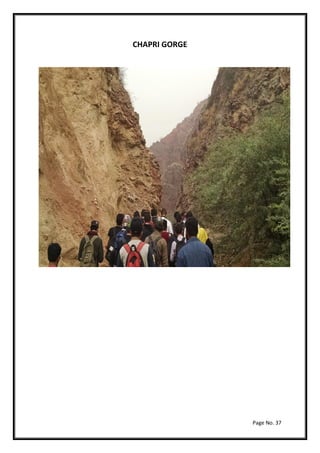
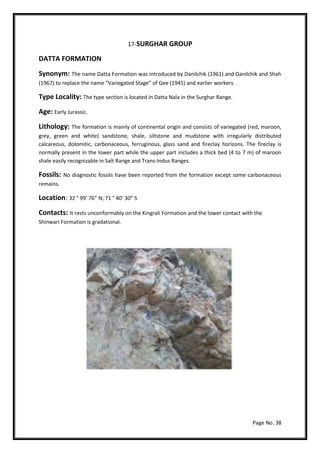
  • 47.
    Page No. 46 SAKESARLIMESTONE Synonymy: The term "Sakesar Limestone" has been introduced by Gee after the peak Sakesar in theCentral Salt Range. Sakesar Peak (lat. 32°31'30"N; long. 71°36'E), Central Salt Range.Principal reference section is Bhadrar village (lat. 32°41'N; long. 72°31'E) in Eastern Salt Range,Jhelum district, Punjab Province. Lithology: The Formation consists predominantly of limestone with subordinate marl. The limestonethroughout its extent is cream colored to light grey, nodular, usually massive withconsiderable development of chert in the upper part.In the mapped area, the Sakesar limestone is composed of dense homogeneous limestonewhich varies from light grey to dark grey in color. It is massive too thick bedded and is highlyfossiliferous at places. Distribution and Thickness:It is widely distributed in the northern part of the mapped area. It is not measured in theMapped Area. Contacts: The Formation conformably overlies the Namal Formation. Fossils: The Sakesar Limestone has a sporadic capricious distribution of fossils. Foraminifers are mostabundant followed in numbers by mollusks and echinoids. Age: On the base of fauna, Early Eocene age has been given to this unit (Kazmi and Abbasi, 2008)
  • 48.
    Page No. 47 CHORGALIFORMATION Synonym: Pascoe 1920 named it as chorgali beds stratigraphy commity of Pakistan named as chorgali formation. Lithology: The formation is divided into two parts lower parts consist of shale and limestone while the upper part is mainly limestone. Contacts: Lower contact with sakesar limestone and upper contact with kamlial formation this contact is transitional and conformable. Fossils: It is richly fossiliferous and contain foraminifera, molluscus and ostropods. Age: Early Eocene.
  • 49.
    Page No. 48 20-SIWALIKGROUP CHINJI FORMATION Synonym: Chinji zone by pilgrim (1913), lewis called it chinji formation and the named is accepted by stratigraphic committee of Pakistan. Type locality: The formation consist of red clay with subordinate ash grey sandstone. This sandstone is fine to medium grained, occasionally cross bedded and soft. Pebbles and conglomerates are also found in this formation. Thickness: It is 750m thick in the type area. And more than 1800m in the singhar range. Contact: Lower contact with kamlial formation, confirmable Upper contact with nagri formation; confirmable Fossils: Abundant vertebrate fossils e.g. crocodiles, lizard aquatic birds. Age: It is late Miocene. NAGRI FORMATION Synonym: Nagri zone by pilgrim in 1913, lower Manchhar of Blandford “nagri formation” of lewis 1937 has been accepted by stratigraphic committee of Pakistan. Type locality: The village of nagri at campbellpur District. Lithology: The formation concist of sandstone with clay and conglomerate. Thickness: Formation is widely distributed inIndus basin. Thickenss ranges from 300 to 2000m. Contacts: Lower contact with chinji formation; confirmable Upper transational contact with dhok pathan. Fossils: Its rich assemblage in vertebrates remains. Age: Early Pliocene. DHOK PATHAN FORMATION Synonym: The name dhok pathan was introduced by pilgrims 1913. Cotter 191 redefined the unit as dhok pathan formation wich was adopted by stratigraphic committee of Pakistan. Type locality: Village dhok pathan, campbellpur district.
  • 50.
    Page No. 49 Lithology:The formation is represented by sandstone and clay beds. Minor intercalation of yellowish brown siltstone are common. Thickness: Maximum thickness is 1820 at SE of Khair e Murat Range in the potwar area. Contacts: Lower contact with Nagri formation; transitional. Upper contact with soan formation; disconfirmable. Fossils: Rich vertebrate fauna has been recorded from this formation Age: Middle Pliocene.
  • 51.
    Page No. 50 SOANFORMATION: Synonym: In the North West Punjab the upper siwalik of meddlicotte 1864, soan formation by pilgrims 1913 whis was accepted by stratigraphic committee of Pakistan. Type locality: The section along the oad from gali jagir sihal near mujahid village, camobellpur district. Lithology: Compact massive conglomerate with variety of sandstone, siltstone and clay. Thickness: 122450 m thick Contact: Lower contact with dhok pathan formation disconformable upper contact with lei- conglomerate unconformable. Fosslis: The formation is poorly fossileferous. Age: Late Pliocene to late Pleistocene.
  • 52.
    Page No. 51 21-KUNDANOIL SEAPAGE Kundal Oil seep is next to Kaala Pani Nalaa and is located in Isa khel Tehsil North-West Frontier Province, Pakistan. The oil is seeping because cap rock is weathered by the passage of time which leads oil to seep at the surface. The seeps material (oil, gas or water) should be analyzed for its hydrocarbon range n-paraffin content, asphaltenes, H/C ratio and Oxygen contents. The results will be helpful to determine the degree of weathering and to determine if the source of the seepage is related to any subsurface accumulation and reservoir. The more comprehensive gas chromatography-mass spectrometry analyses will assist for establishing the seep with known crude oils or source rock extracts in the area. The method you can employ to characterize the type of oil, level of weathering and determine the likely source of the oil. LOCATION Latitude: 32°32'23.37" Longitude: 71°18'9.08"
  • 53.
    Page No. 52 22-ECONOMICMINERALS OF SALT RANGE China Clay China Clay is composed of kaolin, halloysite and other similar clay that have been processed for the manufacturing of chinaware. It is a mineral of clay family. The kaolin clays are formed as hydrothermal alteration products of feldspars, feldspathoidal rocks as residual weathering deposit and as sedimentary deposits of ice melt water. Any of these can be a commercial deposit. Uses: It is used in paper industry, ceramics, refractory’s, rubber industry in manufacturing of both natural and synthetic rubber paint & ink, plastics and insecticides. Occurrence: China clay is found in Punjab in Districts of Chakwal, Khushab, Mianwali, Attock and D.G. Khan. Coal Coal is the general name for the naturally occurring commonly stratified rocklike brown to black derivative of forest vegetation that accumulated initially in sedimentary rocks. By burial and subsequent geological processes, coal is progressively compressed, indurated and finally altered into graphite or graphite like material. Uses The coal may be used for a great variety of purposes, such as general industrial purposes, including iron and steel, and chemical industries, electrical utilities, as a locomotive fuel for rail/road and for domestic purposes. It is mainly used in brick kiln industries, thermal power generation, in cooking, gas manufacturing, lime burning, and manufacturing of cement & coal briquette as well as ginning factories, etc. Occurrence In Punjab Province huge coal deposits are found in the Salt Range. The main coal deposits are found in Districts of Attock, Jhelum, Chakwal, Khushab and Mianwali. Thickness of coal seams, in Punjab,
  • 54.
    Page No. 53 generallyranges from a few centimeters to 1.5 meters. The coal found in Punjab is of sub- bituminous quality. Salt Range Coal fields extend from 12.5 miles north of Khushab to about 15 mile north of Khewra within an area approximately 100 square miles. Coal occurs in the Patala Formation. Coal seam ranging in thickness from few inches to a maximum of five feet is available in the whole Salt Range. The coal has been classified as high volatile bituminous with high ash and sulpher contents. Its calorific value in BTU varies from 7100 to 11100. Reserves have been estimated to be 75 million tons. Dolomite Dolomite, when pure, has equal parts of calcium carbonate and magnesium carbonate. In nature however, calcium carbonate predominates, and dolomite has clay, sand and other impurities. Dolomite occurs in various colures ranging from nearly white to nearly black; also in various shades of brown, red and yellow. Uses Dolomite is used for building statuary monumental and ornamental purposes as a source of magnesia and as refractory material. It is also used as agricultural fertilizer, especially for magnesium deficient areas, in Chromate manufacturing sugar refining. Occurrence The main deposits include Barbara deposits of Kuch near Kalabagh in District Mianwali. The Dolomite deposits are also found near Datta Nala (about 11 km North East of Makerwal). Doya-Lunda, Normia and Punnu (Near coal mines of Mulla Khel) and near Burikhel in District Mianwali. The thickness of the deposits ranges from 200 to 300 ft. The dolomite deposits of District Mianwali are mainly found in Kingriali Formation of Triassic age. The deposits of dolomite are found near Wagh and Nila Wahn in Districts of Chakwal & Khushab which are found in the Salt Range Formation of Pre-Cambrian age and Jutana Formation of Cambrian age. Dolomite deposits are also available in Kala Chitta Range of Kingriali Formation in District Attock.
  • 55.
    Page No. 54 12.4-Fireclay Fireclayor refractory clay is clay that can withstand high temperatures without disintegrating or turning pasty. Flint clays or nonplastic fireclays (that are extremely hard) are microcrystalline clay rocks composed predominantly of kaolin. Uses The main use of fireclay is in refractories. Beside this, it is used in the manufacturing of heavy products, chemicals, cements, and pottery and stone ware. Occurrence In Punjab important location of fireclay deposits are Chappri, Dhok Pass, Mouza Bazaar, Musakhel in District Mianwali, Chambal, Padhrar in District Khushab, Kruli, Dlawal, Minhala and Wahali in District Chakwal, Khewara, Rohtas,Punan wal and TainPura District Jhelum, Katha Saghral (District Khushab) and Kala Chitta Range (Bagh Nilab Area, Chhoi Area, Surg Area, Buta Area, Akhori Area) in District Attock.
  • 56.
    Page No. 55 Gypsum Theterm “gypsum” has been derived from the Greek word “Gypos” meaning chalk. Gypsum is a hydrated Sulphate of calcium. Gypsum occurs as tabular or prismatic crystals: commonly in cleavable. Columnar, granular, fibrous, foliated or earth masses, its hardness is two, and specific gravity, 2.2 to 2.4. It is often mixed with clay, sand, organic matter. Uses  Gypsum has a number of diversified uses  Ground rock gypsum is used to a limited extent as a fertilizer and is called land plaster  It is used as a disinfectant, flux in glass and porcelain manufacture,  Reminder in cement and to weight fertilizers  It is also used for statuary and decorative purposes  It is used in cheap jewelry and microscopes  Gypsum is used as an adulterant of foods, medicines and paints  It is used in manufacture of plaster of Paris and keen’s and pertian plasters Occurrence The main Gypsum deposits occur in the tribal areas of Dera Ghazi Khan District. The deposits occur in the north-south trending ridges that form the foot-hills of the Suleman Range, West of Dera Ghazi Khan. These deposits consist of 10 to 18 meter thick, interrelated with greenish clay and limestone of Eocene age. The deposits of gypsum also occur in the Salt Range in District of Jhelum, Chakwal, Khushab and Mianwali.
  • 57.
    Page No. 56 Limestone Limestoneis a sedimentary rock. They generally occur in regular beds. Which can be traced for considerable distances pure limestone, which is rare in nature is calcium carbonate. Usually it has impurities like clay, sand and compounds of iron, aluminum, magnesium, silicon, phosphorous and sulphur. Uses Limestone is used in the manufacturing of lime. It is main ingredient of cement industry; it is also used in blocks or as aggregates in construction in chemical work and in glass industry. Occurrence In the Punjab Province, there are huge deposits of limestone with varying qualities especially found in Salt Range Hills, Margallah Hills and Koh-Suleman as well as in District Attock. The Sori Nala limestone deposits of the Zindapir area in Dera Ghazi Khan District occur at about 16 miles from the Taunsa Canal Bridge. These deposits are of Eocene age. The limestone deposits are also found abundantly in District of Attock, Rawalpindi, Jhelum, Chakwal, Khushab and Mianwali. The various formations exposed in the area are Kawagarh Formation, Samana Suk Formation, Shin-Wari Formation and Langriali Formation. The limestone of Samana Suk Formation, Shin-Wari Formation and Datta Formation has been proved suitable for cement making whereas the Margallah limestone, being the hardest one, is mainly used in construction of roads and concrete work.
  • 58.
    Page No. 57 RockSalt Rock salt is the commercial name of the naturally occurring mineral halite which has chemical composition as sodium chloride. It is one of the most important members of the evaporate series of minerals. It crystallizes in the cubic system, Crystals are generally cubes or in combination with the octahedrons; also skeletal or hopper shaped. Uses Salt is extensively used as essential constituent of daily food and dairying purposes, in meat and fish packing, in the manufacture of sodium and its compounds in various metallurgical processes and to glazy pottery used in treating smelting & refining of ores and metals, in manufacturing of ice cream and in cold storage, as canal food and in drugs and medicines, After meeting the internal demands, the rock salt is also being exported Occurrence The salt occurs near the base of an escarpment forming part of Punjab saline series. It occurs in association with gypsum, anhydrite, dolomite, and red marl. The rock salt is occurring in whole of the Salt Range. However at present it is being mined extensively at various places such as Khewra, Nurpur, Jutana, Warchha, Batmach, Chuki Wahn, Dodha Wahnm, Goliwali and Kalabagh in District of Jhelum, Chakwal, Khushab and Mianwali. The salt mining is being done by M/S Pakistan Mineral Development Corptration, M/S Punjab Mineral Development Corporation and some private parties. Besides rock salt of Salt Range, lake salt is also being recovered under the process of solar evaporation from various salt lakes in District Rahim Yar Khan and this is mainly used in tanneries and for refrigeration purposes.
  • 59.
    Page No. 58 23-CONCLUSION Mainpurpose of the field trip was to give students practical hands on experience about the field work, back bone of geology. Study the distribution of the various time units in the Salt Range area, so as to investigate the lateral changes in these units and how to correlate them in different parts of the Salt range. Keeping these things in mind localities in eastern, central and western part of the Salt range were visited where the units were best exposed. Two days were spent in Khewra and adjoining areas for the study of stratigraphic units in east, one day in the central Salt range area and two days in Mianwali and surroundings to look at the western part of the Salt range. We saw grabben structure .We marked Cambrian Permian boundary between Jhelum and Nilawahan group, we also observed Permo - triassic boundary between Zaluch and Musakhel group. We saw igneous intrusion called khewrite at Khewra. We saw oil seepage at the Kundal area. Salt range possess very importance because we get 97.5% Gypsum, rock salt , salt , fire clay , china clay , coal ,limestone and dolomite etc. The Government should preserve these formation especially Pre-Cambrian age formation which are our Geological Asset. It is found rarely in the world but Pakistan has many exposure of them. It’s our duty to maintain it for our next generations.
  • 60.
    Page No. 59 REFERENCES Fatmi,A. N., 1972, Stratigraphy of Jurassic and Lower Cretaceous rocks and Jurassic Ammonites from Northern areas of West Pakistan: Bull. Bri. Mus. Nat. Hist. Vol. No. 7. Fatmi, A. N., 1972. Some recent evidence on the age of Samana Suk Formation, Samana Range, Kohat: Geonews No. 2, p. 22-41. Azad, J., 1960, the Geology of Mianwali and Tank Re-entrant. (Unpublished). Jaswal, T. M., R.J. Lillie and R.D. Lawrence, 1997, Structure and Evolution of the Northern Potwar Deform Zone, Pakistan: AAPG Bull., v.81, p.308-328. Jaume, S. C. and R. J. Lillie, 1988, Mechanics of the Salt Range- Potwar Plateau, Pakistan: a fold and thrust belt underlain by evaporates: Tectonics, v.7, p.57-71. Stratigraphy of Pakistan – by S.M.Ibrahim Shah Geology and Tectonics of Pakistan - by M. Qasim Jan. The Geological Survey of Pakistan (volume 22) www.brooks/cole.com/geology www.gsp.gov.pk/pakistan/index.html www.mcgraw-hill.co.uk/geology www.wikipedia.com/geology