FOOD BIOTECHNOLOGY 
CHEESE MAKING 
Presented by 
G.Suganeshwari 
II- M.Sc., Food Science and Nutrition
CHEESE MAKING 
• Cheese is perhaps the most important and popular products of 
the dairy world. 
• Cheese making has been an age old practice as it served as a 
very effective means of preserving milk solids through moisture 
removal by coagulation and had a longer shelf-life besides high 
nutritive value. 
• Cheese making process as an art several hundred years before 
christ exactly the same way as the Indian products like dahi.
• The method of cheese-making differed from country- to – country and 
region-to-region meet the divers local tastes and requirements which led to 
the development of numerous varieties of cheeses. 
DEFINITION: 
Cheese is “the curd of milk separated from the whey and pressed into solid 
mass”. It is defined as “a product made from the curd obtained from milk by 
coagulating the casein with the help of rennet or similar enzymes in the 
presence of lactic acid produced by added or adventitious micro-organisms, 
from which part of the moisture has been removed by cutting, cooking and/or 
pressing, which has been shaped in and then ripened by holding it for 
sometimes at temperatures and humidities.”
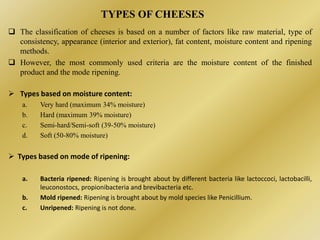
TYPES OF CHEESES 
 The classification of cheeses is based on a number of factors like raw material, type of 
consistency, appearance (interior and exterior), fat content, moisture content and ripening 
methods. 
 However, the most commonly used criteria are the moisture content of the finished 
product and the mode ripening. 
 Types based on moisture content: 
a. Very hard (maximum 34% moisture) 
b. Hard (maximum 39% moisture) 
c. Semi-hard/Semi-soft (39-50% moisture) 
d. Soft (50-80% moisture) 
 Types based on mode of ripening: 
a. Bacteria ripened: Ripening is brought about by different bacteria like lactoccoci, lactobacilli, 
leuconostocs, propionibacteria and brevibacteria etc. 
b. Mold ripened: Ripening is brought about by mold species like Penicillium. 
c. Unripened: Ripening is not done.
COMPOSITION 
Cheese constituents, viz., fat, protein, moisture, minerals and vitamins differ 
greatly with the variety of the product. 
Types of 
cheese 
Moisture 
(%) 
Fat (%) Protein Calcium 
(%) 
Vitamins Energy 
content 
Vit-A (Kcal/100g) 
(μg/100g) 
Thaimin 
(mg/100g) 
Riboflavin 
(μg/100g) 
Hard 
(Cheddar) 
35.0 33.0 26.0 0.83 380 50 0.50 400 
Semi- 
Hard(Edam) 
43.0 24.0 26.0 0.76 250 60 0.35 320 
Blue-Veined 
(Roquefort) 
40.0 31.0 21.0 0.32 300 30 0.70 360 
Soft 
(camembert 
51.0 23.0 19.0 0.38 240 50 0.45 280 
Unripened 
(Cottage) 
79.0 0.4 16.9 0.09 3 30 0.28 82
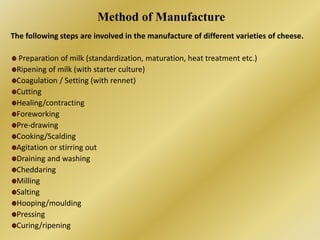
Method of Manufacture 
The following steps are involved in the manufacture of different varieties of cheese. 
Preparation of milk (standardization, maturation, heat treatment etc.) 
Ripening of milk (with starter culture) 
Coagulation / Setting (with rennet) 
Cutting 
Healing/contracting 
Foreworking 
Pre-drawing 
Cooking/Scalding 
Agitation or stirring out 
Draining and washing 
Cheddaring 
Milling 
Salting 
Hooping/moulding 
Pressing 
Curing/ripening
CHEESE
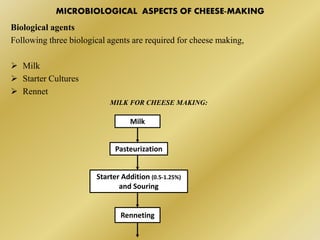
MICROBIOLOGICAL ASPECTS OF CHEESE-MAKING 
Biological agents 
Following three biological agents are required for cheese making, 
 Milk 
 Starter Cultures 
 Rennet 
MILK FOR CHEESE MAKING: 
Milk 
Pasteurization 
Starter Addition (0.5-1.25%) 
and Souring 
Renneting
Cont..... Curd 
Cutting and Healing 
Cooking/Scaling 
Setting of Curd Without Stirring 
(Matting) 
Cutting into Block “Cheddaring” 
or Turning and Stacking 
Milling 
Salting 
Whey
Cont....... 
Moulding (Hopping) 
Pressing 
Cheese Curd Blocks 
Packaging/Boxing 
Ripening 
Cheese
Manufacture of Emmental (swiss) Cheese. 
Milk (Raw) 
Starter Addition and Souring 
Renneting 
Curd 
Cutting 
Scalding /Cooking 
Setting of Curd 
Whey
Cont.... Mould filling 
Pressing and Turning 
Salting 
Drying 
Warm /storage (Eye formation 
22⁰ – 24 ⁰ C/6-8 weeks) 
Ripening 
Cheese
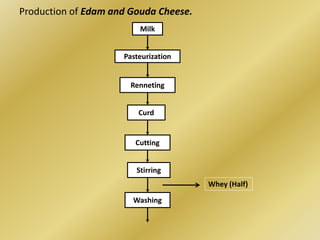
Production of Edam and Gouda Cheese. 
Milk 
Pasteurization 
Renneting 
Curd 
Cutting 
Stirring 
Washing 
Whey (Half)
Cont.... 
Scalding/Cooking 
Moulding(Hopping) 
Pressing 
Salting 
Ripening (3-4 weeks at 
12⁰ – 14 ⁰ c) 
Turning 
Washing 
(Complete) whey
Cont.... 
Turning 
Waxing, Wrapping 
Cheese
BASIC STEPS IN CHEESE MAKING 
The process of cheese making involves two basic phenomenon: 
 Preparation of cheese curd 
 Ripening of cheese which are accomplished through a series of steps, 
namely, preparation of milk, addition of starter, rennet coagulation of 
milk, processing of the curd (cutting, healing, fore working, predrawing, 
cooking, agitation, washing, draining, matting, cheddaring, milling, mixing, 
hooping, pressing) salting of cheese curd and ripening / curing of cheese 
curd into final product.
SALTING OF CHEESE CURD 
 The different varieties of cheese are salted at the rate of 1 to 10% of sodium 
chloride. 
 Salt is added to cheese either as dry salt or as brine by one of the following 
methods or their combination. 
 Dry salt may be added to cheese milk, dusted on the milled curd in the vat 
just before hooping (e.g. In cheddar cheese), rubbed on cheese surface or 
added to creaming mixture. 
 The distribution is affected by different factors, namely, moisture content of 
the cheese, concentrations of salt/brine applied, time and temperature of 
exposure and surface area to volume ratio of the cheese.
RIPENING OF CHEESE 
 Ripening (also referred to as curing, maturing of ageing) of cheese is a process 
of fresh cheese curd at suitable temperature(s) till it transforms into a finished 
product of desirable body, texture and flavour. 
 The transforms involves the activity of ripening agents, viz., micro-organisms) 
on various cheese constituents (mainly lactose, protein and fat) to cause 
physical, chemical (biochemical) and microbiological changes in the product. 
i) Ripening agents: Cohn was the first to correlate the cheese maturation with 
bacterial activity in 1875. 
ii) Most of the micro-organisms isolated by him from, cheese were rods which 
when inoculated in milk produced cheesy aroma. 
iii) Subsequently, a number of theories were proposed on cheese ripening. 
iv) It believed that cheese maturation is an enzymatic process wherein enzymes 
are liberated on autolysis of micro-organisms. 
v) Micro-organisms and enzymes are, therefore, believed to constitute the two 
basically required biological agents for cheese ripening.
PHYSICAL CHANGES 
 Body: 
The body of cheese, which refers to its consistency, covers the following 
characteristics: 
Firmness, elasticity, plasticity, and cohesiveness. 
 Texture: 
In cheese, texture refers to the extend of openness due to presence or 
absence of ‘holes’ or spaces in the cheese mass. 
 Flavour: 
Production of desirable flavour in cheese is the primary change during 
ripening process.
MICROBIOLOGICAL SPOILAGES OF CHEESE AND THEIR 
CONTROL 
 Cheese is extremely susceptible to microbiological spoilage. 
 However, there are a number of limiting factors inherent in 
cheese which can influence the microbiological quality of 
cheese. 
 These factors include moisture content, residual lactose 
content, oxygen level, salt concentration and pH of the 
product.
Cheese Making

Cheese Making

  • 1.
    FOOD BIOTECHNOLOGY CHEESEMAKING Presented by G.Suganeshwari II- M.Sc., Food Science and Nutrition
  • 2.
    CHEESE MAKING •Cheese is perhaps the most important and popular products of the dairy world. • Cheese making has been an age old practice as it served as a very effective means of preserving milk solids through moisture removal by coagulation and had a longer shelf-life besides high nutritive value. • Cheese making process as an art several hundred years before christ exactly the same way as the Indian products like dahi.
  • 3.
    • The methodof cheese-making differed from country- to – country and region-to-region meet the divers local tastes and requirements which led to the development of numerous varieties of cheeses. DEFINITION: Cheese is “the curd of milk separated from the whey and pressed into solid mass”. It is defined as “a product made from the curd obtained from milk by coagulating the casein with the help of rennet or similar enzymes in the presence of lactic acid produced by added or adventitious micro-organisms, from which part of the moisture has been removed by cutting, cooking and/or pressing, which has been shaped in and then ripened by holding it for sometimes at temperatures and humidities.”
  • 4.
    TYPES OF CHEESES  The classification of cheeses is based on a number of factors like raw material, type of consistency, appearance (interior and exterior), fat content, moisture content and ripening methods.  However, the most commonly used criteria are the moisture content of the finished product and the mode ripening.  Types based on moisture content: a. Very hard (maximum 34% moisture) b. Hard (maximum 39% moisture) c. Semi-hard/Semi-soft (39-50% moisture) d. Soft (50-80% moisture)  Types based on mode of ripening: a. Bacteria ripened: Ripening is brought about by different bacteria like lactoccoci, lactobacilli, leuconostocs, propionibacteria and brevibacteria etc. b. Mold ripened: Ripening is brought about by mold species like Penicillium. c. Unripened: Ripening is not done.
  • 5.
    COMPOSITION Cheese constituents,viz., fat, protein, moisture, minerals and vitamins differ greatly with the variety of the product. Types of cheese Moisture (%) Fat (%) Protein Calcium (%) Vitamins Energy content Vit-A (Kcal/100g) (μg/100g) Thaimin (mg/100g) Riboflavin (μg/100g) Hard (Cheddar) 35.0 33.0 26.0 0.83 380 50 0.50 400 Semi- Hard(Edam) 43.0 24.0 26.0 0.76 250 60 0.35 320 Blue-Veined (Roquefort) 40.0 31.0 21.0 0.32 300 30 0.70 360 Soft (camembert 51.0 23.0 19.0 0.38 240 50 0.45 280 Unripened (Cottage) 79.0 0.4 16.9 0.09 3 30 0.28 82
  • 6.
    Method of Manufacture The following steps are involved in the manufacture of different varieties of cheese. Preparation of milk (standardization, maturation, heat treatment etc.) Ripening of milk (with starter culture) Coagulation / Setting (with rennet) Cutting Healing/contracting Foreworking Pre-drawing Cooking/Scalding Agitation or stirring out Draining and washing Cheddaring Milling Salting Hooping/moulding Pressing Curing/ripening
  • 7.
  • 8.
    MICROBIOLOGICAL ASPECTS OFCHEESE-MAKING Biological agents Following three biological agents are required for cheese making,  Milk  Starter Cultures  Rennet MILK FOR CHEESE MAKING: Milk Pasteurization Starter Addition (0.5-1.25%) and Souring Renneting
  • 9.
    Cont..... Curd Cuttingand Healing Cooking/Scaling Setting of Curd Without Stirring (Matting) Cutting into Block “Cheddaring” or Turning and Stacking Milling Salting Whey
  • 10.
    Cont....... Moulding (Hopping) Pressing Cheese Curd Blocks Packaging/Boxing Ripening Cheese
  • 11.
    Manufacture of Emmental(swiss) Cheese. Milk (Raw) Starter Addition and Souring Renneting Curd Cutting Scalding /Cooking Setting of Curd Whey
  • 12.
    Cont.... Mould filling Pressing and Turning Salting Drying Warm /storage (Eye formation 22⁰ – 24 ⁰ C/6-8 weeks) Ripening Cheese
  • 13.
    Production of Edamand Gouda Cheese. Milk Pasteurization Renneting Curd Cutting Stirring Washing Whey (Half)
  • 14.
    Cont.... Scalding/Cooking Moulding(Hopping) Pressing Salting Ripening (3-4 weeks at 12⁰ – 14 ⁰ c) Turning Washing (Complete) whey
  • 15.
    Cont.... Turning Waxing,Wrapping Cheese
  • 16.
    BASIC STEPS INCHEESE MAKING The process of cheese making involves two basic phenomenon:  Preparation of cheese curd  Ripening of cheese which are accomplished through a series of steps, namely, preparation of milk, addition of starter, rennet coagulation of milk, processing of the curd (cutting, healing, fore working, predrawing, cooking, agitation, washing, draining, matting, cheddaring, milling, mixing, hooping, pressing) salting of cheese curd and ripening / curing of cheese curd into final product.
  • 17.
    SALTING OF CHEESECURD  The different varieties of cheese are salted at the rate of 1 to 10% of sodium chloride.  Salt is added to cheese either as dry salt or as brine by one of the following methods or their combination.  Dry salt may be added to cheese milk, dusted on the milled curd in the vat just before hooping (e.g. In cheddar cheese), rubbed on cheese surface or added to creaming mixture.  The distribution is affected by different factors, namely, moisture content of the cheese, concentrations of salt/brine applied, time and temperature of exposure and surface area to volume ratio of the cheese.
  • 18.
    RIPENING OF CHEESE  Ripening (also referred to as curing, maturing of ageing) of cheese is a process of fresh cheese curd at suitable temperature(s) till it transforms into a finished product of desirable body, texture and flavour.  The transforms involves the activity of ripening agents, viz., micro-organisms) on various cheese constituents (mainly lactose, protein and fat) to cause physical, chemical (biochemical) and microbiological changes in the product. i) Ripening agents: Cohn was the first to correlate the cheese maturation with bacterial activity in 1875. ii) Most of the micro-organisms isolated by him from, cheese were rods which when inoculated in milk produced cheesy aroma. iii) Subsequently, a number of theories were proposed on cheese ripening. iv) It believed that cheese maturation is an enzymatic process wherein enzymes are liberated on autolysis of micro-organisms. v) Micro-organisms and enzymes are, therefore, believed to constitute the two basically required biological agents for cheese ripening.
  • 19.
    PHYSICAL CHANGES Body: The body of cheese, which refers to its consistency, covers the following characteristics: Firmness, elasticity, plasticity, and cohesiveness.  Texture: In cheese, texture refers to the extend of openness due to presence or absence of ‘holes’ or spaces in the cheese mass.  Flavour: Production of desirable flavour in cheese is the primary change during ripening process.
  • 20.
    MICROBIOLOGICAL SPOILAGES OFCHEESE AND THEIR CONTROL  Cheese is extremely susceptible to microbiological spoilage.  However, there are a number of limiting factors inherent in cheese which can influence the microbiological quality of cheese.  These factors include moisture content, residual lactose content, oxygen level, salt concentration and pH of the product.

Editor's Notes