DEHYDRATION
Presented by :
Kadam Mayur
DEHYDRATION
• Dehydration (or drying) is defined as "the application of
heat under controlled conditions to remove the majority
of the water normally present in a food by evaporation.
• The main purpose of dehydration is to extend the shelf
life of foods by a reduction in water activity.
• This is inhibits microbial growth and enzyme activity,
but; the processing temperature is usually insufficient to
cause their inactivation. Therefore any increase in
moisture content during storage, result in rapid
spoilage.
• Drying causes deterioration of both the eating quality
and the nutritional value of the food .The design and
operation of dehydration equipment aim to minimize
these changes.
Dehydration means virtually complete removal of water from food under
controlled condition which cause minimum or ideally no change in the
food properties.
Sun drying – very much economical, but uncontrolled.
• Used to dry raisins, prawns, figs, grains, dates and apricots.
• Massion and Chalet of France developed a vegetable dehydratorin
1975. It consisted of hot air (40°C) flow over thin slices of vegetables.
Dehydrated foods - 1 to 5% moisture content.
Sun dried foods - @ 15% moisture content.
Advantage:
More concentrated than any other preserved form; reduced bulk
facilities leading to easy storage and distribution; minimizes labour
requirement, produces convenience items, such as instant coffee etc.
Food Dehydration
PRESERVATION EFFECT
Dehydrated foods have lower water activity(aw=0.2-0.6)
This aw not enough(free water) for:
• Microorganism growth (needs aw0.93, specially
bacteria)
oStaphylococcus aureus (aw ≥ 0.85)
oMold (need aw≥0.6)
• Enzymatic reactions chemical reactions (eg)
mailllard browning) (need aw>0.3)
Microorganisms are not killed, keep microorganisms in-
active stage.
Mo will resume growth after food is rehydrated
(suitable environment)
CONTROLLING FACTORS FOR
DEHYDRATION
Two separate phenomena are involved in dehydration.
• First moisture must move from the interior to
surface of the material. This is occur two ways:
• capillary action or diffusion.
• Movement by capillary action occur during early
stages of drying.
Second the surface water must be evaporated into air.
Evaporation rate depend on;
• condition of drying air, and
• concentration of water at the surface.
FACTORS AFFECTING
DEHYDRATION
• Surface area
• Smaller food piece, more rapid the rate of moisture loss.
• Temperature
• Increase in temperature will increase the dehydration rate
• Air velocity
• Maximize velocity of heated air moving around the food particles
• Humidity of drying air
• The drier the air, the moisture it can absorb
• % RH(relative humidity)of the drying air determines the final
moisture content of food
• Atmospheric pressure and vacuum
• Water boils at 100C(at a pressure of 1atm =760Hg)
• At lower pressure the boiling temperature will decrease
• Eg. Under vacuum, water will boil at 32°C
• Important for heat sensitive food products
• MOSTLY USED FOR FREEZE DRYING
CHANGES DURING DEHYDRATION
1. Cell / tissue shrinkage
2. Case hardening
3. Chemical changes
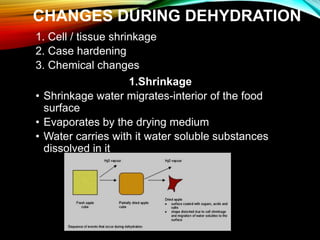
1.Shrinkage
• Shrinkage water migrates-interior of the food
surface
• Evaporates by the drying medium
• Water carries with it water soluble substances
dissolved in it
CELLULAR STRUCTURE:-
Moisture exists between and within the cells. When
the cell walls and membranes hold moisture within the cells, but when
the animal or plant is killed cell becomes more permeable to moisture,
Blanching or cooking makes the cell more permeable to moisture.
Hence cooked vegetables, meat and fish dry more easily than their
counterpart.
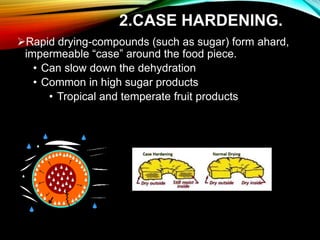
2.CASE HARDENING.
Rapid drying-compounds (such as sugar) form ahard,
impermeable “case” around the food piece.
• Can slow down the dehydration
• Common in high sugar products
• Tropical and temperate fruit products
THERMOPLASTICITY :-
Soften on heating. Cellular foods retain its structure and some rigidity
even at drying temperatures.
When liquid foods are dried, the high concentrations of sugar and
other solutes soften and melt at drying temperatures.
Even when all the water is removed in such foods the solid attains a
thermoplastic tacky condition, sticking to the pan, which gives the impression
that they still contain moisture.
Upon cooling they harden into a crystalline or amorphous glassy form
and is easily removed in the brittle condition.
POROSITY:
• Porosity may be developed by creating steam
pressure within the food material and a case hardened
surface through rapid drying.
• The escaping steam tends to puff ( sponge like
structure) such products (potato puffs).
• Porosity may also be developed by whipping or
foaming a liquid food or puree prior to drying.
3. CHEMICAL CHANGES
• Browning and flavor changes due to reactions
• Maillard browning = from increased solution
concentration
• Denaturation of proteins, aggregation of
polysaccharides
• Loss of water soluble binding capacity
• Loss of water soluble components
• Concentration on the surface of the food (case
hardening)
• Loss of volatiles (especially flavor compounds)
EFFECT ON FOODS
Products undergo changes during drying that reduce their quality
compared to the fresh material.
1.Texture
• Rupture, crack, compress and permanently distort the
relatively rigid cells,
• Change texture apperance
• To give the food a shrunken shriveled appearance.
• Re-hydrated product absorbs water more slowly and does not
regain the firm texture of the fresh material.
• Drying pieces of meat-severe changes in texture.
• Caused by aggregation and denaturation of proteins and
loss of water-holding capacity.
• Case hardening effect.
• Reduces the rate of drying to produce a food with a dry
surface and a moist interior
2.Flavor and Aroma
• Heat not only vaporizes water during drying but also causes
loss of volatile components.
• Volatile loss depends on;
• Temperature and moisture content of the food
• And the vapour pressure of the volatiles and their solubility
in water.
• The open porous structure of dried food allows access of
oxygen,
• which is a second important cause of aroma loss due to
oxidation of volatile components and lipids during storage.
• These changes are can reduced by:
• vacuum or gas packing
• low storage temperatures
• maintenance of low moisture contents
• addition of synthetic antioxidants
• preservation of natural anti-oxidants.
3.Colour
• Causes of colour loss or change in dried foods;
• drying changes the surface characteristics of a food and
alter the reflectivity of surface.
• Fruits and vegetables,
• Chemical changes to carotenoid and chlorophyl pigments.
• Caused by heat and oxidation during drying
• Residual polyphenoloxidase enzyme activity causes
browning.
• Prevented by treatment of fruits with ascorbic acid or sulphur
dioxide.
• However, sulphur dioxide bleaches anthocyanins, and
residual sulphur dioxide is also health problem.
DRIERS COMMONLY USED ARE:-
Fruits and vegetables
Apples
Milk, whole egg, egg
yolk
Meat products, coffee
Juices
Vegetables
Fruit juice concentrates
Milk, vegetable juice
Tunnel drier
Kiln drier
Cabinet drier.
Spray drier
Freeze drier
Foam mat drier
Fluidized drier
Vacuum drier
Drum drier
DEHYDRATION & NUTRITIVE VALUE:-
Advantages: –
Increase in concentration of nutrients due to the loss of
moisture.
Proteins, fats and carbohydrates are present in larger amount
per unit mass of dried food.
Spray drying induces little loss in carotene. Drum & spray
drying retains Vit-A in good proportions.
Pryridoxine and niacin are not materially lost.
Low temperature drying may increase the digestibility of
protein over native material.
DISADVANTAGES:-
Loss of vitamin content, water soluble vitamins can be partially
oxidized, diminished during blanching and enzyme
inactivation.
Ascorbic acid and carotene are damaged by oxidative process.
Riboflavin is light sensitive and thiamin is heat sensitive.
Sun drying induces great loss in Vit C.
Carotene content of vegetables is decreased up to 80% if
processing is accomplished without enzyme inactivation.
Rapid drying retains greater amounts of ascorbic acid than slow
drying
Thiamin and riboflavin losses in spray and drum drying is less in case
of food other than fruits and vegetables.
Vit D of fluid milk is greatly decreased in drying.
Dried meat contains slightly less Vit than fresh meat.
Prolonged exposures to high temperature can render protein less
useful.
Oxidation of fat is greater at higher temperature drying.
Sun drying permits extensive carbohydrate deterioration.
DRYING AND MICROORGANISMS:-
• Molds can grow with 12% moisture in some foods.
Some molds can grow even at less than 5% moisture
in foods. Above 2% moisture in food mold growth
can be anticipated.
• Bacteria and yeasts require higher moisture level,
usually over 30%.
• Putrefactive growth is controlled with sodium chloride
(5%).
• Fruits are dried to 15 to 25 % moisture content.
• Apple- sorted, washed, peeled, trimmed, sulfite treated
and dried in kiln dryer.
• Grapes – lye dipped and sulfured, sun or tunnel dried.
• Pears- blanched, sulfured and dried for 24 to 30 hr.
• Vegetables are dried to less than 4%.
• Cabbage, Carrot, potato beans etc. are lye peeled,
shredded, or sliced or diced, blanched in boiling water
or steam to inactivate enzymes, dried in tunnel,
cabinet or belt driers at 60 to 62° C
• Animal products such as meat and poultry are dried to
less than 4 to 7% moisture content.
• Fish – cleaned and split down the back and dried.

Dehydration

  • 1.
  • 2.
    DEHYDRATION • Dehydration (ordrying) is defined as "the application of heat under controlled conditions to remove the majority of the water normally present in a food by evaporation. • The main purpose of dehydration is to extend the shelf life of foods by a reduction in water activity. • This is inhibits microbial growth and enzyme activity, but; the processing temperature is usually insufficient to cause their inactivation. Therefore any increase in moisture content during storage, result in rapid spoilage. • Drying causes deterioration of both the eating quality and the nutritional value of the food .The design and operation of dehydration equipment aim to minimize these changes.
  • 3.
    Dehydration means virtuallycomplete removal of water from food under controlled condition which cause minimum or ideally no change in the food properties. Sun drying – very much economical, but uncontrolled. • Used to dry raisins, prawns, figs, grains, dates and apricots. • Massion and Chalet of France developed a vegetable dehydratorin 1975. It consisted of hot air (40°C) flow over thin slices of vegetables. Dehydrated foods - 1 to 5% moisture content. Sun dried foods - @ 15% moisture content. Advantage: More concentrated than any other preserved form; reduced bulk facilities leading to easy storage and distribution; minimizes labour requirement, produces convenience items, such as instant coffee etc. Food Dehydration
  • 4.
    PRESERVATION EFFECT Dehydrated foodshave lower water activity(aw=0.2-0.6) This aw not enough(free water) for: • Microorganism growth (needs aw0.93, specially bacteria) oStaphylococcus aureus (aw ≥ 0.85) oMold (need aw≥0.6) • Enzymatic reactions chemical reactions (eg) mailllard browning) (need aw>0.3) Microorganisms are not killed, keep microorganisms in- active stage. Mo will resume growth after food is rehydrated (suitable environment)
  • 5.
    CONTROLLING FACTORS FOR DEHYDRATION Twoseparate phenomena are involved in dehydration. • First moisture must move from the interior to surface of the material. This is occur two ways: • capillary action or diffusion. • Movement by capillary action occur during early stages of drying. Second the surface water must be evaporated into air. Evaporation rate depend on; • condition of drying air, and • concentration of water at the surface.
  • 6.
    FACTORS AFFECTING DEHYDRATION • Surfacearea • Smaller food piece, more rapid the rate of moisture loss. • Temperature • Increase in temperature will increase the dehydration rate • Air velocity • Maximize velocity of heated air moving around the food particles • Humidity of drying air • The drier the air, the moisture it can absorb • % RH(relative humidity)of the drying air determines the final moisture content of food • Atmospheric pressure and vacuum • Water boils at 100C(at a pressure of 1atm =760Hg) • At lower pressure the boiling temperature will decrease • Eg. Under vacuum, water will boil at 32°C • Important for heat sensitive food products • MOSTLY USED FOR FREEZE DRYING
  • 8.
    CHANGES DURING DEHYDRATION 1.Cell / tissue shrinkage 2. Case hardening 3. Chemical changes 1.Shrinkage • Shrinkage water migrates-interior of the food surface • Evaporates by the drying medium • Water carries with it water soluble substances dissolved in it
  • 9.
    CELLULAR STRUCTURE:- Moisture existsbetween and within the cells. When the cell walls and membranes hold moisture within the cells, but when the animal or plant is killed cell becomes more permeable to moisture, Blanching or cooking makes the cell more permeable to moisture. Hence cooked vegetables, meat and fish dry more easily than their counterpart.
  • 10.
    2.CASE HARDENING. Rapid drying-compounds(such as sugar) form ahard, impermeable “case” around the food piece. • Can slow down the dehydration • Common in high sugar products • Tropical and temperate fruit products
  • 11.
    THERMOPLASTICITY :- Soften onheating. Cellular foods retain its structure and some rigidity even at drying temperatures. When liquid foods are dried, the high concentrations of sugar and other solutes soften and melt at drying temperatures. Even when all the water is removed in such foods the solid attains a thermoplastic tacky condition, sticking to the pan, which gives the impression that they still contain moisture. Upon cooling they harden into a crystalline or amorphous glassy form and is easily removed in the brittle condition.
  • 12.
    POROSITY: • Porosity maybe developed by creating steam pressure within the food material and a case hardened surface through rapid drying. • The escaping steam tends to puff ( sponge like structure) such products (potato puffs). • Porosity may also be developed by whipping or foaming a liquid food or puree prior to drying.
  • 13.
    3. CHEMICAL CHANGES •Browning and flavor changes due to reactions • Maillard browning = from increased solution concentration • Denaturation of proteins, aggregation of polysaccharides • Loss of water soluble binding capacity • Loss of water soluble components • Concentration on the surface of the food (case hardening) • Loss of volatiles (especially flavor compounds)
  • 14.
    EFFECT ON FOODS Productsundergo changes during drying that reduce their quality compared to the fresh material. 1.Texture • Rupture, crack, compress and permanently distort the relatively rigid cells, • Change texture apperance • To give the food a shrunken shriveled appearance. • Re-hydrated product absorbs water more slowly and does not regain the firm texture of the fresh material. • Drying pieces of meat-severe changes in texture. • Caused by aggregation and denaturation of proteins and loss of water-holding capacity. • Case hardening effect. • Reduces the rate of drying to produce a food with a dry surface and a moist interior
  • 15.
    2.Flavor and Aroma •Heat not only vaporizes water during drying but also causes loss of volatile components. • Volatile loss depends on; • Temperature and moisture content of the food • And the vapour pressure of the volatiles and their solubility in water. • The open porous structure of dried food allows access of oxygen, • which is a second important cause of aroma loss due to oxidation of volatile components and lipids during storage. • These changes are can reduced by: • vacuum or gas packing • low storage temperatures • maintenance of low moisture contents • addition of synthetic antioxidants • preservation of natural anti-oxidants.
  • 16.
    3.Colour • Causes ofcolour loss or change in dried foods; • drying changes the surface characteristics of a food and alter the reflectivity of surface. • Fruits and vegetables, • Chemical changes to carotenoid and chlorophyl pigments. • Caused by heat and oxidation during drying • Residual polyphenoloxidase enzyme activity causes browning. • Prevented by treatment of fruits with ascorbic acid or sulphur dioxide. • However, sulphur dioxide bleaches anthocyanins, and residual sulphur dioxide is also health problem.
  • 17.
    DRIERS COMMONLY USEDARE:- Fruits and vegetables Fruits and vegetables Apples Milk, whole egg, egg yolk Meat products, coffee Juices Vegetables Fruit juice concentrates Milk, vegetable juice Tunnel drier Kiln drier Cabinet drier. Spray drier Freeze drier Foam mat drier Fluidized drier Vacuum drier Drum drier
  • 18.
    DEHYDRATION & NUTRITIVEVALUE:- Advantages: – Increase in concentration of nutrients due to the loss of moisture. Proteins, fats and carbohydrates are present in larger amount per unit mass of dried food. Spray drying induces little loss in carotene. Drum & spray drying retains Vit-A in good proportions. Pryridoxine and niacin are not materially lost. Low temperature drying may increase the digestibility of protein over native material.
  • 19.
    DISADVANTAGES:- Loss of vitamincontent, water soluble vitamins can be partially oxidized, diminished during blanching and enzyme inactivation. Ascorbic acid and carotene are damaged by oxidative process. Riboflavin is light sensitive and thiamin is heat sensitive. Sun drying induces great loss in Vit C. Carotene content of vegetables is decreased up to 80% if processing is accomplished without enzyme inactivation. Rapid drying retains greater amounts of ascorbic acid than slow drying
  • 20.
    Thiamin and riboflavinlosses in spray and drum drying is less in case of food other than fruits and vegetables. Vit D of fluid milk is greatly decreased in drying. Dried meat contains slightly less Vit than fresh meat. Prolonged exposures to high temperature can render protein less useful. Oxidation of fat is greater at higher temperature drying. Sun drying permits extensive carbohydrate deterioration.
  • 21.
    DRYING AND MICROORGANISMS:- •Molds can grow with 12% moisture in some foods. Some molds can grow even at less than 5% moisture in foods. Above 2% moisture in food mold growth can be anticipated. • Bacteria and yeasts require higher moisture level, usually over 30%. • Putrefactive growth is controlled with sodium chloride (5%). • Fruits are dried to 15 to 25 % moisture content. • Apple- sorted, washed, peeled, trimmed, sulfite treated and dried in kiln dryer.
  • 22.
    • Grapes –lye dipped and sulfured, sun or tunnel dried. • Pears- blanched, sulfured and dried for 24 to 30 hr. • Vegetables are dried to less than 4%. • Cabbage, Carrot, potato beans etc. are lye peeled, shredded, or sliced or diced, blanched in boiling water or steam to inactivate enzymes, dried in tunnel, cabinet or belt driers at 60 to 62° C • Animal products such as meat and poultry are dried to less than 4 to 7% moisture content. • Fish – cleaned and split down the back and dried.