FILTRATION
Dr. Basavaraj K. Nanjwade M. Pharm., Ph. D
Department of Pharmaceutics
Faculty of Pharmacy
Omer Al-Mukhtar University
Tobruk, Libya.
E-mail: nanjwadebk@gmail.com
2014/05/27 1
Faculty of Pharmacy, Omer Al-Mukhtar University,
Tobruk, Libya.
CONTENTS
• Theory: Darcy and Kosni equations
• Batch filters
• Classification of filtration equipment
• Continuous filters
• References
2014/05/27 2
Faculty of Pharmacy, Omer Al-Mukhtar University,
Tobruk, Libya.
Definition of Filtration
• Filtration is the process, whereby solid particles are
separated from the liquid or gas by passing it through
a porous medium which retains the solid but allows
the fluid to pass.
Slurry: It is a suspension to be filtered.
Filter medium: It is a porous medium used to retain the
solids
Filter cake: The solids which are present on the filter
Filtrate: Clear liquid passing through the filter.
2014/05/27 3
Faculty of Pharmacy, Omer Al-Mukhtar University,
Tobruk, Libya.
Applications of filtration
1. Production of sterile products:- (HEPA) filters (or) laminar air
bench provide sterile environment during manufacture of sterile
products.
2. Bacteria proof filters are used for filtration of thermo labile
substances where heat sterilization is not applicable.
3. Production of bulk drugs:- Filtration is an essential step in the
removal of impurities from the products.
4. Production of liquid orals:- Filtration is very important in the
production of liquid orals and other for obtaining clear solutions.
Eg. In aromatic water preparations, syrups, elixirs, and eye drops,
where removal of foreign impurities is very important.
5. Effluent and waste water treatment
(HEPA-High-efficiency particulate arrestance)
2014/05/27 4
Faculty of Pharmacy, Omer Al-Mukhtar University,
Tobruk, Libya.
Factors affecting on Filtration
1. Pressure
2. Viscosity
3. Surface area of filter media
4. Temperature of liquid to be filtered
5. Particle size
6. Pore size of filter media
7. Thickness of cake
8. Nature of solid material
2014/05/27 5
Faculty of Pharmacy, Omer Al-Mukhtar University,
Tobruk, Libya.
Theory:
Darcy equations
Darcy’s law:
KA∆P
V= -----------
ηl
Where,
V= Volume of filtrate
K= Permeability coefficient and is dependent on the nature of the precipitate
to be filtered and the filter medium
A= Area of filter bed
∆P= Pressure difference on the liquid and below the filter medium
η= Viscosity of the liquid
l= Thickness of filter cake
2014/05/27 6
Faculty of Pharmacy, Omer Al-Mukhtar University,
Tobruk, Libya.
Kozeny- Carman Equation
Kozeny-Carman equation is widely used for filtration
A ∆P Σ2
V= ------- X ------ X ---------
nS2
KL (1- Σ)2
Where,
Σ=Pososityofthecake(bed)
S=Specificsurfaceofthe particlescomprisingthecake
K=Kozenyconstant (usuallytaken as5)
Note:Darcyequationisfurthermodifiedbyincludingcharacteristicsof Kby Kozeny-Carmanequation
2014/05/27 7
Faculty of Pharmacy, Omer Al-Mukhtar
University, Tobruk, Libya.
Batch filters
• Batch filter presses are known industry wide for their
thoroughness in dewatering wastewater with high
solids content.
• Unlike funnel, vacuum, and belt filter presses, these
are designed to apply high pressure directly to the
slurry in between the press plates, expelling nearly
every bit of liquid.
• What remains is a solid, compact, sludge cake ready
for the landfill and water that’s fit for reuse or
expulsion into the sewer after filtering.
2014/05/27 8
Faculty of Pharmacy, Omer Al-Mukhtar
University, Tobruk, Libya.
2014/05/27
Faculty of Pharmacy, Omer Al-Mukhtar
University, Tobruk, Libya.
9
Batch filters
Classification of filtration
equipment
• Various filtering devices used in pharmaceutical
industry are:
1. Filter press
2. Meta filters
3. Filter leaf
4. Membrane filters
5. Filter candles
6. Sintered filters
2014/05/27 10
Faculty of Pharmacy, Omer Al-Mukhtar University,
Tobruk, Libya.
1. Filter press
2014/05/27 11
Faculty of Pharmacy, Omer Al-Mukhtar University,
Tobruk, Libya.
1. Filter press
• Construction: It consists of plates and frames. The
frame is open and is used as an inlet for the material to
be filtered. Plate has a grooved surface which gives
support to the filter cloth. The plate and frame my be
made of various metals which provide resistance to
corrosion or prevent metallic contamination of the
filtrate. Filter cloth is fitted on each side of the plate.
The plates and frames are placed alternatively and
fitted in the outer frame of the press. Each plate acts as
a single filtration unit. The outlet of each plate is
connected to a common outlet pipe.
2014/05/27 12
Faculty of Pharmacy, Omer Al-Mukhtar University,
Tobruk, Libya.
• Working: The filtrate is collected in the plates from
where it is collected through common outlet pipe.
The cake is deposited in the frames. The process of
filtration is continued until the frame is filled with
filter cake. When the process is stopped, the frame is
emptied and the cycle is restarted.
• The thickness of the cake can be varied by using
frames of different thickness. The thickness of filter
cake depends mainly on the solid content present in
the filtering liquid and the resistance of filter cake.
1. Filter press
2014/05/27 13
Faculty of Pharmacy, Omer Al-Mukhtar University,
Tobruk, Libya.
2. Meta filters
2014/05/27 14
Faculty of Pharmacy, Omer Al-Mukhtar University,
Tobruk, Libya.
2. Meta filters
• Constriction: It consist of a grooved, drainage rod on
which are packed a number of metallic rings. These
rings are usually for stainless steel and have 0.8 mm
thickness, 15 mm inside diameter and 22 mm outer
diameter. These rings have a number of semicircular
projections on one surface and when they are packed
on the rod, the opening between the rings is about 0.2
mm.
2014/05/27 15
Faculty of Pharmacy, Omer Al-Mukhtar University,
Tobruk, Libya.
2. Meta filters
• Working: The entire assembly is placed inside a
pressure vessel, containing the liquid to be filtered.
When vacuum is applied, liquid will flow from outside
to inside. In this form a metafilter can only be used as
strainer for coarse particles. But for separation of finer
particles, a bed of suitable materials such as Kieselguhr
is used. In this way the pack of rings acts as a base on
which the true filter medium is supported.
• Uses: The meta filter are mostly used for clarification
of syrups, elixirs and parenteral solutions.
2014/05/27 16
Faculty of Pharmacy, Omer Al-Mukhtar University,
Tobruk, Libya.
3. Filter leaf
2014/05/27 17
Faculty of Pharmacy, Omer Al-Mukhtar University,
Tobruk, Libya.
3. Filter leaf
• Construction: It is the simplest for of filter. It
consists of a frame enclosing a drainage screen or a
grooved plate. Filter cloth is used as the filtering
medium, the whole unit being covered with filter
cloth. The frame used may be of any shape i.e.
square, rectangular or of a circular shape.
2014/05/27 18
Faculty of Pharmacy, Omer Al-Mukhtar University,
Tobruk, Libya.
• Working: The filter leaf is placed in a vessel containing
the liquid to be filtered. When vacuum is applied, the
pressure inside the leaf is decreased. Due to the difference
in external pressure and pressure inside the leaf, the liquid
moves inside the filter through filter cloth. The filtrate is
collected in the receiver, whereas the cake gets collected
on outside of the cloth.
• Uses: This method has the advantage that the liquid can
be filtered from any vessel and cake can be washed by
immersing it in a vessel containing water. The cake can
be removed just by flowing air in the reverse direction.
3. Filter leaf
2014/05/27 19
Faculty of Pharmacy, Omer Al-Mukhtar University,
Tobruk, Libya.
4. Membrane filters
2014/05/27 20
Faculty of Pharmacy, Omer Al-Mukhtar University,
Tobruk, Libya.
4. Membrane filters
• Construction: Membrane filters are made of thin and
flat membranes of cellulose derivatives, such as,
cellulose acetate and cellulose nitrate. These filters
are brittle when in dry condition and can be stored for
an indefinite period. The filters are between 50 and
150 µ thick and are available in sizes upto 60 cm2
.
2014/05/27 21
Faculty of Pharmacy, Omer Al-Mukhtar University,
Tobruk, Libya.
4. Membrane filters
• Working: A membrane filter has 400 to 500 million
pores per square centimetre of filter surface. The pores
are absolutely uniform in size and occupy about 80% of
filter volume. To avoid rapid clogging of a membrane,
pre-filtration is often required. The selection of a
membrane filter for a particular application depends on
the particles to be removed.
• Uses: These filters are mainly used for sterilization of
both aqueous and oily liquids. The membrane filters
cannot be used for filtration of organic solvents, such as
alcohols, ketones, esters and chloroform.
2014/05/27 22
Faculty of Pharmacy, Omer Al-Mukhtar University,
Tobruk, Libya.
5. Filter candles
2014/05/27 23
Faculty of Pharmacy, Omer Al-Mukhtar University,
Tobruk, Libya.
5. Filter candles
• Construction: These are ceramic filters and are made
of porcelain or Kieselguhr. Kiesel-guhr filters are
usually softer than the porcelain variety. These are
cylindrical candles with an opening which is
connected to vacuum pump for reducing the pressure
under it, during the filtration process. The candles are
available in a range of different pore size which is
designed by a number.
2014/05/27 24
Faculty of Pharmacy, Omer Al-Mukhtar University,
Tobruk, Libya.
5. Filter candles
• Working: The candle is placed in the solution to be
filtered. When vacuum is applied, the liquid will pass
through the thick wall of the candle and gets collected
inside the candle from where it is removed.
• The filter candle gets blocked with continuous use. This
can be cleaned by scratching the external surface with a
nail brush and passing water through it in the reverse
direction.
• Uses: These candles are used for sterilization of solutions.
It has the tendency to absorb materials from aqueous
solutions. Therefore, it is not used commonly.
2014/05/27 25
Faculty of Pharmacy, Omer Al-Mukhtar
University, Tobruk, Libya.
6. Sintered filters
2014/05/27 26
Faculty of Pharmacy, Omer Al-Mukhtar University,
Tobruk, Libya.
6. Sintered filters
• Construction: These are made of borosilicate glass.
Borosilicate glass is finely powdered, sieved and
particle of desired size are separated. It is then packed
into a disc mould and heated to a temperature at
which adhesion takes place between the particles. The
disc is then fused to a funnel of suitable shape and
size.
2014/05/27 27
Faculty of Pharmacy, Omer Al-Mukhtar University,
Tobruk, Libya.
• Working: The sintered glass filters are available in
different pore size. Hence the funnel with a sintered
filter is numbered according to the pore size. The
filtration is carried out under reduced pressure. These
funnel are used for bacterial filtration.
• Uses: Sintered filters are also available in stainless
steel which has a greater mechanical strength.
However these are very much liable to attack by the
solutions passing through them.
6. Sintered filters
2014/05/27 28
Faculty of Pharmacy, Omer Al-Mukhtar University,
Tobruk, Libya.
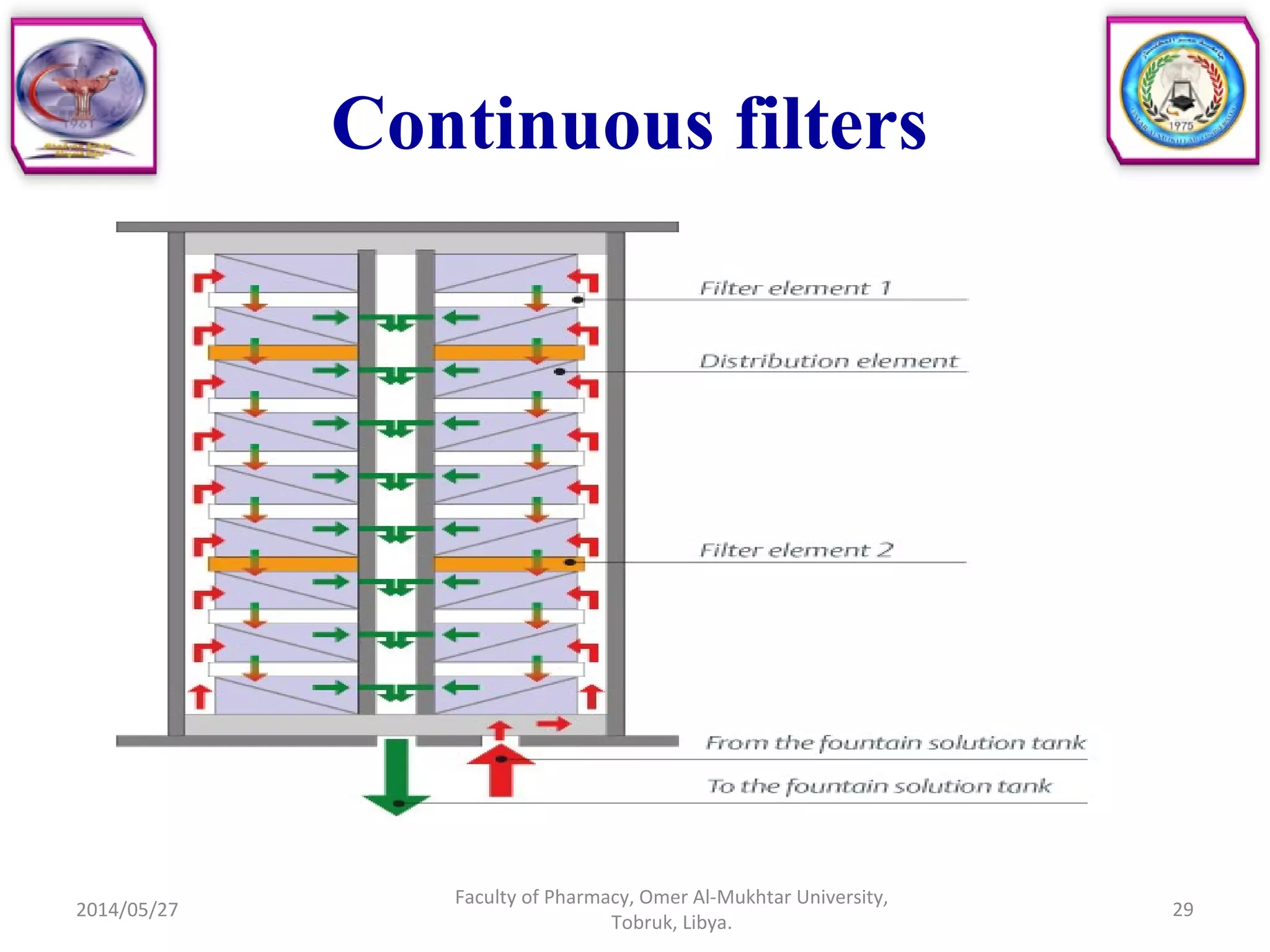
Continuous filters
2014/05/27 29
Faculty of Pharmacy, Omer Al-Mukhtar University,
Tobruk, Libya.
• Continuous upstream filtration process where
the filter media is washed continually.
• Cleaning of the filter media is operated by an
air lift pump which pumps the filter media to
the sand washer.
2014/05/27
Faculty of Pharmacy, Omer Al-Mukhtar University,
Tobruk, Libya.
30
Continuous filters
THANK YOUe-mail: nanjwadebk@gmail.com
2014/05/27 31
Faculty of Pharmacy, Omer Al-Mukhtar University,
Tobruk, Libya.

Filtration

  • 1.
    FILTRATION Dr. Basavaraj K.Nanjwade M. Pharm., Ph. D Department of Pharmaceutics Faculty of Pharmacy Omer Al-Mukhtar University Tobruk, Libya. E-mail: nanjwadebk@gmail.com 2014/05/27 1 Faculty of Pharmacy, Omer Al-Mukhtar University, Tobruk, Libya.
  • 2.
    CONTENTS • Theory: Darcyand Kosni equations • Batch filters • Classification of filtration equipment • Continuous filters • References 2014/05/27 2 Faculty of Pharmacy, Omer Al-Mukhtar University, Tobruk, Libya.
  • 3.
    Definition of Filtration •Filtration is the process, whereby solid particles are separated from the liquid or gas by passing it through a porous medium which retains the solid but allows the fluid to pass. Slurry: It is a suspension to be filtered. Filter medium: It is a porous medium used to retain the solids Filter cake: The solids which are present on the filter Filtrate: Clear liquid passing through the filter. 2014/05/27 3 Faculty of Pharmacy, Omer Al-Mukhtar University, Tobruk, Libya.
  • 4.
    Applications of filtration 1.Production of sterile products:- (HEPA) filters (or) laminar air bench provide sterile environment during manufacture of sterile products. 2. Bacteria proof filters are used for filtration of thermo labile substances where heat sterilization is not applicable. 3. Production of bulk drugs:- Filtration is an essential step in the removal of impurities from the products. 4. Production of liquid orals:- Filtration is very important in the production of liquid orals and other for obtaining clear solutions. Eg. In aromatic water preparations, syrups, elixirs, and eye drops, where removal of foreign impurities is very important. 5. Effluent and waste water treatment (HEPA-High-efficiency particulate arrestance) 2014/05/27 4 Faculty of Pharmacy, Omer Al-Mukhtar University, Tobruk, Libya.
  • 5.
    Factors affecting onFiltration 1. Pressure 2. Viscosity 3. Surface area of filter media 4. Temperature of liquid to be filtered 5. Particle size 6. Pore size of filter media 7. Thickness of cake 8. Nature of solid material 2014/05/27 5 Faculty of Pharmacy, Omer Al-Mukhtar University, Tobruk, Libya.
  • 6.
    Theory: Darcy equations Darcy’s law: KA∆P V=----------- ηl Where, V= Volume of filtrate K= Permeability coefficient and is dependent on the nature of the precipitate to be filtered and the filter medium A= Area of filter bed ∆P= Pressure difference on the liquid and below the filter medium η= Viscosity of the liquid l= Thickness of filter cake 2014/05/27 6 Faculty of Pharmacy, Omer Al-Mukhtar University, Tobruk, Libya.
  • 7.
    Kozeny- Carman Equation Kozeny-Carmanequation is widely used for filtration A ∆P Σ2 V= ------- X ------ X --------- nS2 KL (1- Σ)2 Where, Σ=Pososityofthecake(bed) S=Specificsurfaceofthe particlescomprisingthecake K=Kozenyconstant (usuallytaken as5) Note:Darcyequationisfurthermodifiedbyincludingcharacteristicsof Kby Kozeny-Carmanequation 2014/05/27 7 Faculty of Pharmacy, Omer Al-Mukhtar University, Tobruk, Libya.
  • 8.
    Batch filters • Batchfilter presses are known industry wide for their thoroughness in dewatering wastewater with high solids content. • Unlike funnel, vacuum, and belt filter presses, these are designed to apply high pressure directly to the slurry in between the press plates, expelling nearly every bit of liquid. • What remains is a solid, compact, sludge cake ready for the landfill and water that’s fit for reuse or expulsion into the sewer after filtering. 2014/05/27 8 Faculty of Pharmacy, Omer Al-Mukhtar University, Tobruk, Libya.
  • 9.
    2014/05/27 Faculty of Pharmacy,Omer Al-Mukhtar University, Tobruk, Libya. 9 Batch filters
  • 10.
    Classification of filtration equipment •Various filtering devices used in pharmaceutical industry are: 1. Filter press 2. Meta filters 3. Filter leaf 4. Membrane filters 5. Filter candles 6. Sintered filters 2014/05/27 10 Faculty of Pharmacy, Omer Al-Mukhtar University, Tobruk, Libya.
  • 11.
    1. Filter press 2014/05/2711 Faculty of Pharmacy, Omer Al-Mukhtar University, Tobruk, Libya.
  • 12.
    1. Filter press •Construction: It consists of plates and frames. The frame is open and is used as an inlet for the material to be filtered. Plate has a grooved surface which gives support to the filter cloth. The plate and frame my be made of various metals which provide resistance to corrosion or prevent metallic contamination of the filtrate. Filter cloth is fitted on each side of the plate. The plates and frames are placed alternatively and fitted in the outer frame of the press. Each plate acts as a single filtration unit. The outlet of each plate is connected to a common outlet pipe. 2014/05/27 12 Faculty of Pharmacy, Omer Al-Mukhtar University, Tobruk, Libya.
  • 13.
    • Working: Thefiltrate is collected in the plates from where it is collected through common outlet pipe. The cake is deposited in the frames. The process of filtration is continued until the frame is filled with filter cake. When the process is stopped, the frame is emptied and the cycle is restarted. • The thickness of the cake can be varied by using frames of different thickness. The thickness of filter cake depends mainly on the solid content present in the filtering liquid and the resistance of filter cake. 1. Filter press 2014/05/27 13 Faculty of Pharmacy, Omer Al-Mukhtar University, Tobruk, Libya.
  • 14.
    2. Meta filters 2014/05/2714 Faculty of Pharmacy, Omer Al-Mukhtar University, Tobruk, Libya.
  • 15.
    2. Meta filters •Constriction: It consist of a grooved, drainage rod on which are packed a number of metallic rings. These rings are usually for stainless steel and have 0.8 mm thickness, 15 mm inside diameter and 22 mm outer diameter. These rings have a number of semicircular projections on one surface and when they are packed on the rod, the opening between the rings is about 0.2 mm. 2014/05/27 15 Faculty of Pharmacy, Omer Al-Mukhtar University, Tobruk, Libya.
  • 16.
    2. Meta filters •Working: The entire assembly is placed inside a pressure vessel, containing the liquid to be filtered. When vacuum is applied, liquid will flow from outside to inside. In this form a metafilter can only be used as strainer for coarse particles. But for separation of finer particles, a bed of suitable materials such as Kieselguhr is used. In this way the pack of rings acts as a base on which the true filter medium is supported. • Uses: The meta filter are mostly used for clarification of syrups, elixirs and parenteral solutions. 2014/05/27 16 Faculty of Pharmacy, Omer Al-Mukhtar University, Tobruk, Libya.
  • 17.
    3. Filter leaf 2014/05/2717 Faculty of Pharmacy, Omer Al-Mukhtar University, Tobruk, Libya.
  • 18.
    3. Filter leaf •Construction: It is the simplest for of filter. It consists of a frame enclosing a drainage screen or a grooved plate. Filter cloth is used as the filtering medium, the whole unit being covered with filter cloth. The frame used may be of any shape i.e. square, rectangular or of a circular shape. 2014/05/27 18 Faculty of Pharmacy, Omer Al-Mukhtar University, Tobruk, Libya.
  • 19.
    • Working: Thefilter leaf is placed in a vessel containing the liquid to be filtered. When vacuum is applied, the pressure inside the leaf is decreased. Due to the difference in external pressure and pressure inside the leaf, the liquid moves inside the filter through filter cloth. The filtrate is collected in the receiver, whereas the cake gets collected on outside of the cloth. • Uses: This method has the advantage that the liquid can be filtered from any vessel and cake can be washed by immersing it in a vessel containing water. The cake can be removed just by flowing air in the reverse direction. 3. Filter leaf 2014/05/27 19 Faculty of Pharmacy, Omer Al-Mukhtar University, Tobruk, Libya.
  • 20.
    4. Membrane filters 2014/05/2720 Faculty of Pharmacy, Omer Al-Mukhtar University, Tobruk, Libya.
  • 21.
    4. Membrane filters •Construction: Membrane filters are made of thin and flat membranes of cellulose derivatives, such as, cellulose acetate and cellulose nitrate. These filters are brittle when in dry condition and can be stored for an indefinite period. The filters are between 50 and 150 µ thick and are available in sizes upto 60 cm2 . 2014/05/27 21 Faculty of Pharmacy, Omer Al-Mukhtar University, Tobruk, Libya.
  • 22.
    4. Membrane filters •Working: A membrane filter has 400 to 500 million pores per square centimetre of filter surface. The pores are absolutely uniform in size and occupy about 80% of filter volume. To avoid rapid clogging of a membrane, pre-filtration is often required. The selection of a membrane filter for a particular application depends on the particles to be removed. • Uses: These filters are mainly used for sterilization of both aqueous and oily liquids. The membrane filters cannot be used for filtration of organic solvents, such as alcohols, ketones, esters and chloroform. 2014/05/27 22 Faculty of Pharmacy, Omer Al-Mukhtar University, Tobruk, Libya.
  • 23.
    5. Filter candles 2014/05/2723 Faculty of Pharmacy, Omer Al-Mukhtar University, Tobruk, Libya.
  • 24.
    5. Filter candles •Construction: These are ceramic filters and are made of porcelain or Kieselguhr. Kiesel-guhr filters are usually softer than the porcelain variety. These are cylindrical candles with an opening which is connected to vacuum pump for reducing the pressure under it, during the filtration process. The candles are available in a range of different pore size which is designed by a number. 2014/05/27 24 Faculty of Pharmacy, Omer Al-Mukhtar University, Tobruk, Libya.
  • 25.
    5. Filter candles •Working: The candle is placed in the solution to be filtered. When vacuum is applied, the liquid will pass through the thick wall of the candle and gets collected inside the candle from where it is removed. • The filter candle gets blocked with continuous use. This can be cleaned by scratching the external surface with a nail brush and passing water through it in the reverse direction. • Uses: These candles are used for sterilization of solutions. It has the tendency to absorb materials from aqueous solutions. Therefore, it is not used commonly. 2014/05/27 25 Faculty of Pharmacy, Omer Al-Mukhtar University, Tobruk, Libya.
  • 26.
    6. Sintered filters 2014/05/2726 Faculty of Pharmacy, Omer Al-Mukhtar University, Tobruk, Libya.
  • 27.
    6. Sintered filters •Construction: These are made of borosilicate glass. Borosilicate glass is finely powdered, sieved and particle of desired size are separated. It is then packed into a disc mould and heated to a temperature at which adhesion takes place between the particles. The disc is then fused to a funnel of suitable shape and size. 2014/05/27 27 Faculty of Pharmacy, Omer Al-Mukhtar University, Tobruk, Libya.
  • 28.
    • Working: Thesintered glass filters are available in different pore size. Hence the funnel with a sintered filter is numbered according to the pore size. The filtration is carried out under reduced pressure. These funnel are used for bacterial filtration. • Uses: Sintered filters are also available in stainless steel which has a greater mechanical strength. However these are very much liable to attack by the solutions passing through them. 6. Sintered filters 2014/05/27 28 Faculty of Pharmacy, Omer Al-Mukhtar University, Tobruk, Libya.
  • 29.
    Continuous filters 2014/05/27 29 Facultyof Pharmacy, Omer Al-Mukhtar University, Tobruk, Libya.
  • 30.
    • Continuous upstreamfiltration process where the filter media is washed continually. • Cleaning of the filter media is operated by an air lift pump which pumps the filter media to the sand washer. 2014/05/27 Faculty of Pharmacy, Omer Al-Mukhtar University, Tobruk, Libya. 30 Continuous filters
  • 31.
    THANK YOUe-mail: nanjwadebk@gmail.com 2014/05/2731 Faculty of Pharmacy, Omer Al-Mukhtar University, Tobruk, Libya.