TABLETS
By:- Siddharth Kumar Sahu
 Introduction.
 Advantages & Disadvantages of the Tablet dosage form.
 General properties.
 Different types of Tablets.
 Tablet Ingredients.
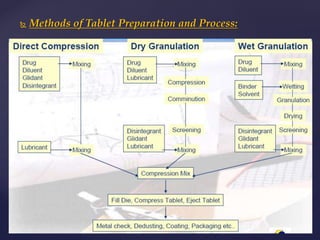
 Methods of Tablet Preparation and Process
 Evaluation of Tablet.
 Coating of Tablets.
 Defects in Tablets.
Contents
 Tablet is defined as a compressed solid unit dosage form
containing medicaments with or without excipients.
 According to the Indian Pharmacopoeia Pharmaceutical
tablets are solid, flat or biconvex dishes, unit dosage form,
prepared by compressing a drugs or a mixture of drugs,
with or without diluents.
 They vary in shape and differ greatly in size and weight,
depending on amount of medicinal substance and the
intended mode of administration..
Introduction
1. They are unit dosage form and offer the greatest capabilities of all oral dosage
form for the greatest dose precision and the least content variability.
2. Cost is lowest of all oral dosage form.
3. Lighter and compact.
4. Easiest and cheapest to package and strip.
5. Easy to swallowing with least tendency for hang‐up.
6. Sustained release product is possible by enteric coating.
7. Objectionable odour and bitter taste can be masked by coating technique.
8. Sui-table for large scale production.
9. Greatest chemical and microbial stability over all oral dosage form.
10. Product identification is easy and rapid requiring no additional steps when
employing an embossed and/or monogrammed punch face.
The Advantages of the Tablet dosage form are:
1. Difficult to swallow in case of children and unconscious patients.
2. Some drugs resist compression into dense compacts, owing to
amorphous nature, low density character.
3. Drugs with poor wetting, slow dissolution properties, optimum
absorption high in GIT may be difficult to formulate or manufacture as
a tablet that will still provide adequate or full drug bioavailability.
4. Bitter testing drugs, drugs with an objectionable odour or drugs that
are sensitive to oxygen may require encapsulation or coating. In such
cases, capsule may offer the best and lowest cost.
Disadvantages of Tablet dosage form are:
1. A tablet should have elegant product identity while free of defects like chips,
cracks, discoloration, and contamination.
2. Should have sufficient strength to withstand mechanical shock during its
production packaging, shipping and dispensing.
3. Should have the chemical and physical stability to maintain its physical
attributes over time
4. The tablet must be able to release the medicinal agents in a predictable and
reproducible manner.
5. Must have a chemical stability over time so as not to follow alteration of the
medicinal agents.
General Properties of Tablet dosage forms:
(A) Tablets Ingested Orally:
1. Compressed tablet, e.g. Paracetamol tablet
2. Multiple compressed tablet
3. Delayed release tablet, e.g. Enteric coated Bisacodyl tablet
4. Sugar coated tablet, e.g. Multivitamin tablet
5. Film coated tablet, e.g. Metronidazole tablet
6. Chewable tablet, e.g. Antacid tablet
(B)Tablets used in Oral Cavity:
1. Buccal tablet, e.g. Vitamin‐c tablet
2. Sublingual tablet, e.g. Vicks Menthol tablet
3. Troches or lozenges, e.g. Cough tablets
4. Dental cone
Different types of Tablets:
(C) Tablets Administered by Other Route:
1. Implantation tablet
2. Vaginal tablet, e.g. Clotrimazole tablet
(D) Tablets used to Prepare Solution:
1. Effervescent tablet, e.g. Disprin tablet (Aspirin)
2. Dispensing tablet, e.g. Enzyme tablet (Digiplex)
3. Hypodermic tablet
4. Tablet triturates e.g. Enzyme tablet (Digiplex)
 In addition to active ingredients, tablet contains a number of inert
materials known as additives or excipients. (Drug+Excipients)
 Different Excipients are:
1. Diluent
2. Binder and Adhesive
3. Disintegrates
4. Lubricants and Glidants
5. Colouring Agents
6. Flavouring Agents
7. Sweetening Agents
Tablet Ingredients
 A diluent should have following properties:
1. They must be non toxic
2. They must be commercially available in acceptable grade
3. There cost must be low
4. They must be physiologically inert
5. They must be physically & chemically stable by themselves & in
combination with the drugs.
6. They must be free from all microbial contamination.
7. They do not alter the bioavailability of drug.
8. They must be colour compatible.
 Commonly used tablet diluents:
Microcrystalline cellulose‐Avicel (PH 101and PH 102), Mannitol. Sorbitol,
Sucrose, Dextrose.
1.Diluent: Diluents are fillers used to make required bulk of the tablet
when the drug dosage itself is in adequate to produce the bulk. Secondary
reason is to provide better tablet properties such as improve cohesion, to
permit use of direct compression manufacturing or to promote flow.
2. Binders and Adhesives: These materials are added either dry or in
wet‐form to form granules or to form cohesive compacts for directly
compressed tablet. Examples are:
1. Acacia, tragacanth‐Solution for 10‐25% Conc.
2. Cellulose derivatives‐Methyl cellulose, Hydroxy propyl methyl cellulose,
Hydroxy propyl cellulose
3. Gelatin‐10‐20% solution
4. Glucose‐50% solution
5. PolyVinylPyrrolidone (PVP)‐2% conc.
6. Starch paste‐10‐20% solution
7. Sodium alginate, Sorbitol
3. Disintegrants: Added to a tablet formulation to facilitate its breaking or
disintegration when it contact in water in the GIT. Examples are:
1. Starch‐5‐20% of tablet weight.
2. Starch derivative –Primogel and Explotab (1‐8%)
3. Clays, bentonite 10% level in colored tablet only
4. Cellulose & Cellulose derivatives‐Ac‐Di‐Sol (sodium carboxy methyl
5. cellulose)
6. Alginate
7. PVP (PolyVinylPyrrolidone).
 Superdisintegrants: Swells up to ten fold within 30 seconds
when contact water.
 Example: Cross carmellose‐cross‐linked cellulose, Cross
povidone‐cross‐linked povidone(polymer), Sodium starch
glycolate‐cross‐linked starch.
4.Lubricant and Glidants:
 Lubricants are intended to prevent adhesion of the tablet materials
to the surface of dies and punches, reduce inter particle friction and
may improve the rate of flow of the tablet granulation.
 Glidants are intended to promote flow of granules or powder
material by reducing the friction between the particles.
 Example:
 Lubricants‐ Stearic acid, Stearic acid, Magnesium stearate, Talc,
PEG (PolyEthyleneGlycols), Surfactants
 Glidants‐ Corn Starch–5‐10%conc., Talc‐5%conc., Silica derivative‐
Colloidal silicas such as Cab‐O‐Sil, Syloid, Aerosilin 0.25‐3%conc.
5. Colouring agent:
The use of colours and dyes in a tablet has three purposes:
1. Masking of off colour drugs
2. Product Identification
3. Production of more elegant product
 All colouring agents must be approved and certified by FDA
 Example:‐ sunset-yellow, Tartrazine, Fast Green, Brilliant Blue, Indigo
carmine, Erythrosine, EosinY.
6. Flavouring agents:
 For chewable tablet‐ flavour oil, Sugar are used
7. Sweetening agents:
 For chewable tablets: Sugar, mannitol.
Example:‐
 Saccharine (artificial): 500 time’s sweeter than sucrose
Disadvantage: Bitter after taste and carcinogenic
 Aspartame (artificial)
Disadvantage: Lack of stability in presence of moisture.
 Methods of Tablet Preparation and Process:
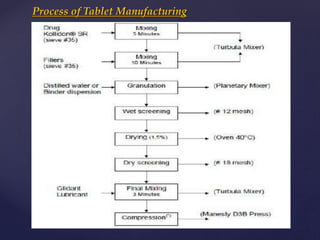
Process of Tablet Manufacturing
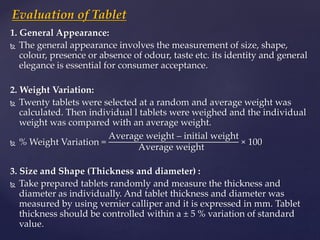
1. General Appearance:
 The general appearance involves the measurement of size, shape,
colour, presence or absence of odour, taste etc. its identity and general
elegance is essential for consumer acceptance.
2. Weight Variation:
 Twenty tablets were selected at a random and average weight was
calculated. Then individual l tablets were weighed and the individual
weight was compared with an average weight.
 % Weight Variation =
Average weight – initial weight
Average weight
× 100
3. Size and Shape (Thickness and diameter) :
 Take prepared tablets randomly and measure the thickness and
diameter as individually. And tablet thickness and diameter was
measured by using vernier calliper and it is expressed in mm. Tablet
thickness should be controlled within a ± 5 % variation of standard
value.
Evaluation of Tablet
4. Hardness:
 Hardness indicates the ability to resistance to shipping and breakage
under condition of storage, transportation and handling before
usage depends on its hardness.
 The hardness of each batch of tablet can checke by using Monsanto
hardness tester. The hardness was measured in terms of kg/cm².
5. Friability:
 Friability refers to loss in weight of tablets in the containers due to
removal of fines from the tablet surface. Friability generally reflects
poor cohesion of tablet ingredients. Roche Friabilator can used for
the measurement.
 The % friability can calculates by the following formula:
 Percentage friability =
Initial weight –Final weight
Initial weight
X 100
6. Drug content:
7. Wetting time: The tablet was placed on the paper and the time
required for water to reach the centre of the upper surface of the tablet
was measured in seconds and noted as wetting time.
8. In-vitro Disintegration Time:
 To test the disintegration time of tablets, one tablet is placed in each
tube and the basket racks is positioned in a 900ml beaker containing
water/gastric fluid/intestinal fluid at 37°C ± 1°C such that the tablet
remains 2.5 cm below the surface of the liquid. The time taken for
the complete disintegration of the tablets is than noted.
 Some standard disintegration time for different types of tablets
are:
 -Effervescent tablet - < 3 min. -Dispersible tablet- < 5 min,
-Uncoated tablets- 15 min, -Sugar & Film coated -60 min.
-Enteric coated tablet- in 0.1 N HCl >2hrs.
in 6.8 𝑷𝑶 𝟒 buffer- 60 min.
9. In Vitro Dissolution Time:
 For dissolving tablets basket or paddle type of dissolution
apparatus can use at rpm 50 and temperature 37±0.5°C in suitable
dissolution medium.
 At each specified intervals of time 5 ml sample is withdrawn and
replaced by fresh media.
 The samples is than analytically tested to determine the
concentration by UV spectroscopy method.
Dissolution Apparatus
Disintegration Time
Apparatus
Objectives Of Tablet Coating:
 To Mask the Unpleasant Taste and Odour
 To Improve the Appearance of Tablets
 To Prevent the Medicament From Atmospheric Effects
 To Control the Site of Action of Drugs (Enteric Coating)
 To Produce the Sustained Released Product.
 To Avoid Chemical Incompatibilities.
 Polymers, Colour, Plasticizer, Solvent are the Coating
Composition which is uses in Tablet Coating.
Coating of Tablets
I. Pan coating
II. Perforated coating pan
III. Fluidized bed coater
The equipment's used for the tablet coating
are :-
Pan coating
The Coating Of Tablets is Classified Into:-
I. Sugar coating
II. Film coating
III. Enteric coating
I. SUGAR COATING
 It involves the application of sugar solution with color for several
times to give uniform and elegant film.
 Advantages:
 It prevents unpleasant odour.
 Give sweet taste to tablet by masking bitter taste.
 Highly elegant and glossed tablets are obtained.
 The various stages of sugar coating are as follows:
1. Sealing
2. Sub-coating
3. Syrup coating (smoothing)
4. Finishing
5. Polishing
1) Sealing :-
 At this stage prepared the water proof layer on the surface of the
tablet. It prevents moisture penetration in to the tablet core. This is
done by using shellac or cellulose derivatives.
2) Sub-coating:-
 Sub coating is applied to form uniform edges and to build up the
tablet size by several coats of concentrated syrup. This increases the
weight of tablet up to 50 to100 percent.
 Examples- Gelatine, sugarcane powder, corn syrup, Gum acacia.
3) Syrup coating (Smoothing)
 It is done to cover the imperfections in the tablet surface caused during sub
coating step.
 Several coats of the syrup with syrup contains colouring material &
opacifying agents are applied to the tablets.
 Syrup coating constituents- colorant, coating powder, calcium carbonate,
cane sugar, corn starch, syrup.
4) Finishing
 Three to four coats of syrup are applied in rapid succession without
dusting powder & cold air is circulated to dry each coat. This forms a hard
smooth coat.
5) Polishing
 The desired luster to the tablet is obtained by polishing, This gives a proper
shining to the tablets
 Example:- carnauba wax, bees wax, paraffin wax.
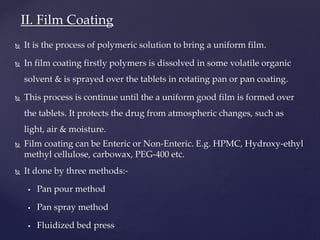
 It is the process of polymeric solution to bring a uniform film.
 In film coating firstly polymers is dissolved in some volatile organic
solvent & is sprayed over the tablets in rotating pan or pan coating.
 This process is continue until the a uniform good film is formed over
the tablets. It protects the drug from atmospheric changes, such as
light, air & moisture.
 Film coating can be Enteric or Non-Enteric. E.g. HPMC, Hydroxy-ethyl
methyl cellulose, carbowax, PEG-400 etc.
 It done by three methods:-
 Pan pour method
 Pan spray method
 Fluidized bed press
II. Film Coating
 An enteric coating is a polymer barrier applied on oral medication that
prevents its dissolution or disintegration in the gastric environment.
 This helps by either -
 protecting drugs from the acidity of the stomach, the stomach from the
detrimental effects of the drug,
 or to release the drug after the stomach.
 Resistance to gastric fluids. It means the tablet will not disintegrate in
stomach but pass in the intestine & get disintegrate.
Examples:-
 Cellulose acetate trimellitate (CAT)
 Hydroxyl propyl methyl cellulose phthalate (HPMCP)
 Polyvinyl acetate phthalate (PVAP)
 Methacrylic acid copolymers
III. Enteric Coating
 Microencapsulation is a technique by which coating can be applied
to small particles of solids, droplets of liquid or dispersion thus
forming microencapsulation.
 It is different from other coating methods because in that process is
used to coat the particles, having particle size range from several
tenth of a micron to 5000 μ.
 Coating Materials
 Gum:- Gum Arabic, Sodium Alginate
 Carbohydrates:- Starch, Dextran, Glucose
 Cellulose:- CMC, Methyl Cellulose
 Lipid:- Beex Wax, Stearic Acid, Phospholipids
 Protein:- Gelatin, Albumine.
Microencapsulation
Benefits
-Enzyme immobilization.
-Protection against UV, heat, oxidation, acid bases.
-Masking taste and odour.
-Improved shelf life due to preventing degradation reaction.
 The defects related to Tableting Process
 i) Capping: It is partial or complete separation of the top
or bottom of tablet due air-entrapment in the granular material.
 ii) Lamination: It is separation of tablet into two or more layers due to
air-entrapment in the granular material.
 iii) Cracking: It is due to rapid expansion of tablets when deep
concave punches are used.
 The defects related to Excipient
 iv) Chipping: It is due to very dry granules.
 v) Sticking: It is the adhesion of granulation material to the die wall
 vi) Picking: It is the removal of material from the surface of tablet and
its adherence to the face of punch.
 vii) Binding: These problems (v, vi, vii) are due to more amount of
binder in the granules or wet granules.
Defects In Tablets
 The defect related to more than one factor
 viii) Mottling: It is either due to any one or more of these factors: Due
to a coloured drug, which has different colour than the rest of the
granular material (Excipient- related);improper mixing of granular
material (Process-related);dirt in the granular material or on punch
faces; oil spots by using oily lubricant.
 The defect related to Machine
 ix) Double Impression: It is due to free rotation of the punches,
which have some engraving on the punch faces. Further, in this
section, each problem is described along-with its causes and
remedies which may be related to either of formulation (granulation)
or of machine (dies, punches and entire tablet press)
 For detail study on defects of tablets, click on this link:-
 https://pharmaguddu.com/tablets-manufactring-defects-and-
remedies/
 R. M. Mehta, A textbook of “Pharmaceutics-1”, Sixth Edition
Reprint 2018, Vallabh Prakashan, Page No. 253-284.
 www.slideshare.net
 Mr. R.R. Patil ‘Processing of Tablet’.
 Tablet Coating
 www.google.com
 Formulation and evaluation of orodispersible tablet of
Montelukast sodium, Research J. Pharm. and Tech. 11(3): March
2018
References
Tablets

Tablets

  • 1.
  • 2.
     Introduction.  Advantages& Disadvantages of the Tablet dosage form.  General properties.  Different types of Tablets.  Tablet Ingredients.  Methods of Tablet Preparation and Process  Evaluation of Tablet.  Coating of Tablets.  Defects in Tablets. Contents
  • 3.
     Tablet isdefined as a compressed solid unit dosage form containing medicaments with or without excipients.  According to the Indian Pharmacopoeia Pharmaceutical tablets are solid, flat or biconvex dishes, unit dosage form, prepared by compressing a drugs or a mixture of drugs, with or without diluents.  They vary in shape and differ greatly in size and weight, depending on amount of medicinal substance and the intended mode of administration.. Introduction
  • 4.
    1. They areunit dosage form and offer the greatest capabilities of all oral dosage form for the greatest dose precision and the least content variability. 2. Cost is lowest of all oral dosage form. 3. Lighter and compact. 4. Easiest and cheapest to package and strip. 5. Easy to swallowing with least tendency for hang‐up. 6. Sustained release product is possible by enteric coating. 7. Objectionable odour and bitter taste can be masked by coating technique. 8. Sui-table for large scale production. 9. Greatest chemical and microbial stability over all oral dosage form. 10. Product identification is easy and rapid requiring no additional steps when employing an embossed and/or monogrammed punch face. The Advantages of the Tablet dosage form are:
  • 5.
    1. Difficult toswallow in case of children and unconscious patients. 2. Some drugs resist compression into dense compacts, owing to amorphous nature, low density character. 3. Drugs with poor wetting, slow dissolution properties, optimum absorption high in GIT may be difficult to formulate or manufacture as a tablet that will still provide adequate or full drug bioavailability. 4. Bitter testing drugs, drugs with an objectionable odour or drugs that are sensitive to oxygen may require encapsulation or coating. In such cases, capsule may offer the best and lowest cost. Disadvantages of Tablet dosage form are:
  • 6.
    1. A tabletshould have elegant product identity while free of defects like chips, cracks, discoloration, and contamination. 2. Should have sufficient strength to withstand mechanical shock during its production packaging, shipping and dispensing. 3. Should have the chemical and physical stability to maintain its physical attributes over time 4. The tablet must be able to release the medicinal agents in a predictable and reproducible manner. 5. Must have a chemical stability over time so as not to follow alteration of the medicinal agents. General Properties of Tablet dosage forms:
  • 7.
    (A) Tablets IngestedOrally: 1. Compressed tablet, e.g. Paracetamol tablet 2. Multiple compressed tablet 3. Delayed release tablet, e.g. Enteric coated Bisacodyl tablet 4. Sugar coated tablet, e.g. Multivitamin tablet 5. Film coated tablet, e.g. Metronidazole tablet 6. Chewable tablet, e.g. Antacid tablet (B)Tablets used in Oral Cavity: 1. Buccal tablet, e.g. Vitamin‐c tablet 2. Sublingual tablet, e.g. Vicks Menthol tablet 3. Troches or lozenges, e.g. Cough tablets 4. Dental cone Different types of Tablets:
  • 8.
    (C) Tablets Administeredby Other Route: 1. Implantation tablet 2. Vaginal tablet, e.g. Clotrimazole tablet (D) Tablets used to Prepare Solution: 1. Effervescent tablet, e.g. Disprin tablet (Aspirin) 2. Dispensing tablet, e.g. Enzyme tablet (Digiplex) 3. Hypodermic tablet 4. Tablet triturates e.g. Enzyme tablet (Digiplex)
  • 9.
     In additionto active ingredients, tablet contains a number of inert materials known as additives or excipients. (Drug+Excipients)  Different Excipients are: 1. Diluent 2. Binder and Adhesive 3. Disintegrates 4. Lubricants and Glidants 5. Colouring Agents 6. Flavouring Agents 7. Sweetening Agents Tablet Ingredients
  • 10.
     A diluentshould have following properties: 1. They must be non toxic 2. They must be commercially available in acceptable grade 3. There cost must be low 4. They must be physiologically inert 5. They must be physically & chemically stable by themselves & in combination with the drugs. 6. They must be free from all microbial contamination. 7. They do not alter the bioavailability of drug. 8. They must be colour compatible.  Commonly used tablet diluents: Microcrystalline cellulose‐Avicel (PH 101and PH 102), Mannitol. Sorbitol, Sucrose, Dextrose. 1.Diluent: Diluents are fillers used to make required bulk of the tablet when the drug dosage itself is in adequate to produce the bulk. Secondary reason is to provide better tablet properties such as improve cohesion, to permit use of direct compression manufacturing or to promote flow.
  • 11.
    2. Binders andAdhesives: These materials are added either dry or in wet‐form to form granules or to form cohesive compacts for directly compressed tablet. Examples are: 1. Acacia, tragacanth‐Solution for 10‐25% Conc. 2. Cellulose derivatives‐Methyl cellulose, Hydroxy propyl methyl cellulose, Hydroxy propyl cellulose 3. Gelatin‐10‐20% solution 4. Glucose‐50% solution 5. PolyVinylPyrrolidone (PVP)‐2% conc. 6. Starch paste‐10‐20% solution 7. Sodium alginate, Sorbitol 3. Disintegrants: Added to a tablet formulation to facilitate its breaking or disintegration when it contact in water in the GIT. Examples are: 1. Starch‐5‐20% of tablet weight. 2. Starch derivative –Primogel and Explotab (1‐8%) 3. Clays, bentonite 10% level in colored tablet only 4. Cellulose & Cellulose derivatives‐Ac‐Di‐Sol (sodium carboxy methyl 5. cellulose) 6. Alginate 7. PVP (PolyVinylPyrrolidone).
  • 12.
     Superdisintegrants: Swellsup to ten fold within 30 seconds when contact water.  Example: Cross carmellose‐cross‐linked cellulose, Cross povidone‐cross‐linked povidone(polymer), Sodium starch glycolate‐cross‐linked starch. 4.Lubricant and Glidants:  Lubricants are intended to prevent adhesion of the tablet materials to the surface of dies and punches, reduce inter particle friction and may improve the rate of flow of the tablet granulation.  Glidants are intended to promote flow of granules or powder material by reducing the friction between the particles.  Example:  Lubricants‐ Stearic acid, Stearic acid, Magnesium stearate, Talc, PEG (PolyEthyleneGlycols), Surfactants  Glidants‐ Corn Starch–5‐10%conc., Talc‐5%conc., Silica derivative‐ Colloidal silicas such as Cab‐O‐Sil, Syloid, Aerosilin 0.25‐3%conc.
  • 13.
    5. Colouring agent: Theuse of colours and dyes in a tablet has three purposes: 1. Masking of off colour drugs 2. Product Identification 3. Production of more elegant product  All colouring agents must be approved and certified by FDA  Example:‐ sunset-yellow, Tartrazine, Fast Green, Brilliant Blue, Indigo carmine, Erythrosine, EosinY. 6. Flavouring agents:  For chewable tablet‐ flavour oil, Sugar are used 7. Sweetening agents:  For chewable tablets: Sugar, mannitol. Example:‐  Saccharine (artificial): 500 time’s sweeter than sucrose Disadvantage: Bitter after taste and carcinogenic  Aspartame (artificial) Disadvantage: Lack of stability in presence of moisture.
  • 14.
     Methods ofTablet Preparation and Process:
  • 15.
    Process of TabletManufacturing
  • 16.
    1. General Appearance: The general appearance involves the measurement of size, shape, colour, presence or absence of odour, taste etc. its identity and general elegance is essential for consumer acceptance. 2. Weight Variation:  Twenty tablets were selected at a random and average weight was calculated. Then individual l tablets were weighed and the individual weight was compared with an average weight.  % Weight Variation = Average weight – initial weight Average weight × 100 3. Size and Shape (Thickness and diameter) :  Take prepared tablets randomly and measure the thickness and diameter as individually. And tablet thickness and diameter was measured by using vernier calliper and it is expressed in mm. Tablet thickness should be controlled within a ± 5 % variation of standard value. Evaluation of Tablet
  • 17.
    4. Hardness:  Hardnessindicates the ability to resistance to shipping and breakage under condition of storage, transportation and handling before usage depends on its hardness.  The hardness of each batch of tablet can checke by using Monsanto hardness tester. The hardness was measured in terms of kg/cm². 5. Friability:  Friability refers to loss in weight of tablets in the containers due to removal of fines from the tablet surface. Friability generally reflects poor cohesion of tablet ingredients. Roche Friabilator can used for the measurement.  The % friability can calculates by the following formula:  Percentage friability = Initial weight –Final weight Initial weight X 100
  • 18.
    6. Drug content: 7.Wetting time: The tablet was placed on the paper and the time required for water to reach the centre of the upper surface of the tablet was measured in seconds and noted as wetting time. 8. In-vitro Disintegration Time:  To test the disintegration time of tablets, one tablet is placed in each tube and the basket racks is positioned in a 900ml beaker containing water/gastric fluid/intestinal fluid at 37°C ± 1°C such that the tablet remains 2.5 cm below the surface of the liquid. The time taken for the complete disintegration of the tablets is than noted.  Some standard disintegration time for different types of tablets are:  -Effervescent tablet - < 3 min. -Dispersible tablet- < 5 min, -Uncoated tablets- 15 min, -Sugar & Film coated -60 min. -Enteric coated tablet- in 0.1 N HCl >2hrs. in 6.8 𝑷𝑶 𝟒 buffer- 60 min.
  • 19.
    9. In VitroDissolution Time:  For dissolving tablets basket or paddle type of dissolution apparatus can use at rpm 50 and temperature 37±0.5°C in suitable dissolution medium.  At each specified intervals of time 5 ml sample is withdrawn and replaced by fresh media.  The samples is than analytically tested to determine the concentration by UV spectroscopy method. Dissolution Apparatus Disintegration Time Apparatus
  • 20.
    Objectives Of TabletCoating:  To Mask the Unpleasant Taste and Odour  To Improve the Appearance of Tablets  To Prevent the Medicament From Atmospheric Effects  To Control the Site of Action of Drugs (Enteric Coating)  To Produce the Sustained Released Product.  To Avoid Chemical Incompatibilities.  Polymers, Colour, Plasticizer, Solvent are the Coating Composition which is uses in Tablet Coating. Coating of Tablets
  • 21.
    I. Pan coating II.Perforated coating pan III. Fluidized bed coater The equipment's used for the tablet coating are :- Pan coating
  • 22.
    The Coating OfTablets is Classified Into:- I. Sugar coating II. Film coating III. Enteric coating I. SUGAR COATING  It involves the application of sugar solution with color for several times to give uniform and elegant film.  Advantages:  It prevents unpleasant odour.  Give sweet taste to tablet by masking bitter taste.  Highly elegant and glossed tablets are obtained.
  • 23.
     The variousstages of sugar coating are as follows: 1. Sealing 2. Sub-coating 3. Syrup coating (smoothing) 4. Finishing 5. Polishing 1) Sealing :-  At this stage prepared the water proof layer on the surface of the tablet. It prevents moisture penetration in to the tablet core. This is done by using shellac or cellulose derivatives. 2) Sub-coating:-  Sub coating is applied to form uniform edges and to build up the tablet size by several coats of concentrated syrup. This increases the weight of tablet up to 50 to100 percent.  Examples- Gelatine, sugarcane powder, corn syrup, Gum acacia.
  • 24.
    3) Syrup coating(Smoothing)  It is done to cover the imperfections in the tablet surface caused during sub coating step.  Several coats of the syrup with syrup contains colouring material & opacifying agents are applied to the tablets.  Syrup coating constituents- colorant, coating powder, calcium carbonate, cane sugar, corn starch, syrup. 4) Finishing  Three to four coats of syrup are applied in rapid succession without dusting powder & cold air is circulated to dry each coat. This forms a hard smooth coat. 5) Polishing  The desired luster to the tablet is obtained by polishing, This gives a proper shining to the tablets  Example:- carnauba wax, bees wax, paraffin wax.
  • 25.
     It isthe process of polymeric solution to bring a uniform film.  In film coating firstly polymers is dissolved in some volatile organic solvent & is sprayed over the tablets in rotating pan or pan coating.  This process is continue until the a uniform good film is formed over the tablets. It protects the drug from atmospheric changes, such as light, air & moisture.  Film coating can be Enteric or Non-Enteric. E.g. HPMC, Hydroxy-ethyl methyl cellulose, carbowax, PEG-400 etc.  It done by three methods:-  Pan pour method  Pan spray method  Fluidized bed press II. Film Coating
  • 26.
     An entericcoating is a polymer barrier applied on oral medication that prevents its dissolution or disintegration in the gastric environment.  This helps by either -  protecting drugs from the acidity of the stomach, the stomach from the detrimental effects of the drug,  or to release the drug after the stomach.  Resistance to gastric fluids. It means the tablet will not disintegrate in stomach but pass in the intestine & get disintegrate. Examples:-  Cellulose acetate trimellitate (CAT)  Hydroxyl propyl methyl cellulose phthalate (HPMCP)  Polyvinyl acetate phthalate (PVAP)  Methacrylic acid copolymers III. Enteric Coating
  • 27.
     Microencapsulation isa technique by which coating can be applied to small particles of solids, droplets of liquid or dispersion thus forming microencapsulation.  It is different from other coating methods because in that process is used to coat the particles, having particle size range from several tenth of a micron to 5000 μ.  Coating Materials  Gum:- Gum Arabic, Sodium Alginate  Carbohydrates:- Starch, Dextran, Glucose  Cellulose:- CMC, Methyl Cellulose  Lipid:- Beex Wax, Stearic Acid, Phospholipids  Protein:- Gelatin, Albumine. Microencapsulation
  • 28.
    Benefits -Enzyme immobilization. -Protection againstUV, heat, oxidation, acid bases. -Masking taste and odour. -Improved shelf life due to preventing degradation reaction.
  • 29.
     The defectsrelated to Tableting Process  i) Capping: It is partial or complete separation of the top or bottom of tablet due air-entrapment in the granular material.  ii) Lamination: It is separation of tablet into two or more layers due to air-entrapment in the granular material.  iii) Cracking: It is due to rapid expansion of tablets when deep concave punches are used.  The defects related to Excipient  iv) Chipping: It is due to very dry granules.  v) Sticking: It is the adhesion of granulation material to the die wall  vi) Picking: It is the removal of material from the surface of tablet and its adherence to the face of punch.  vii) Binding: These problems (v, vi, vii) are due to more amount of binder in the granules or wet granules. Defects In Tablets
  • 30.
     The defectrelated to more than one factor  viii) Mottling: It is either due to any one or more of these factors: Due to a coloured drug, which has different colour than the rest of the granular material (Excipient- related);improper mixing of granular material (Process-related);dirt in the granular material or on punch faces; oil spots by using oily lubricant.  The defect related to Machine  ix) Double Impression: It is due to free rotation of the punches, which have some engraving on the punch faces. Further, in this section, each problem is described along-with its causes and remedies which may be related to either of formulation (granulation) or of machine (dies, punches and entire tablet press)  For detail study on defects of tablets, click on this link:-  https://pharmaguddu.com/tablets-manufactring-defects-and- remedies/
  • 33.
     R. M.Mehta, A textbook of “Pharmaceutics-1”, Sixth Edition Reprint 2018, Vallabh Prakashan, Page No. 253-284.  www.slideshare.net  Mr. R.R. Patil ‘Processing of Tablet’.  Tablet Coating  www.google.com  Formulation and evaluation of orodispersible tablet of Montelukast sodium, Research J. Pharm. and Tech. 11(3): March 2018 References