Presentation on
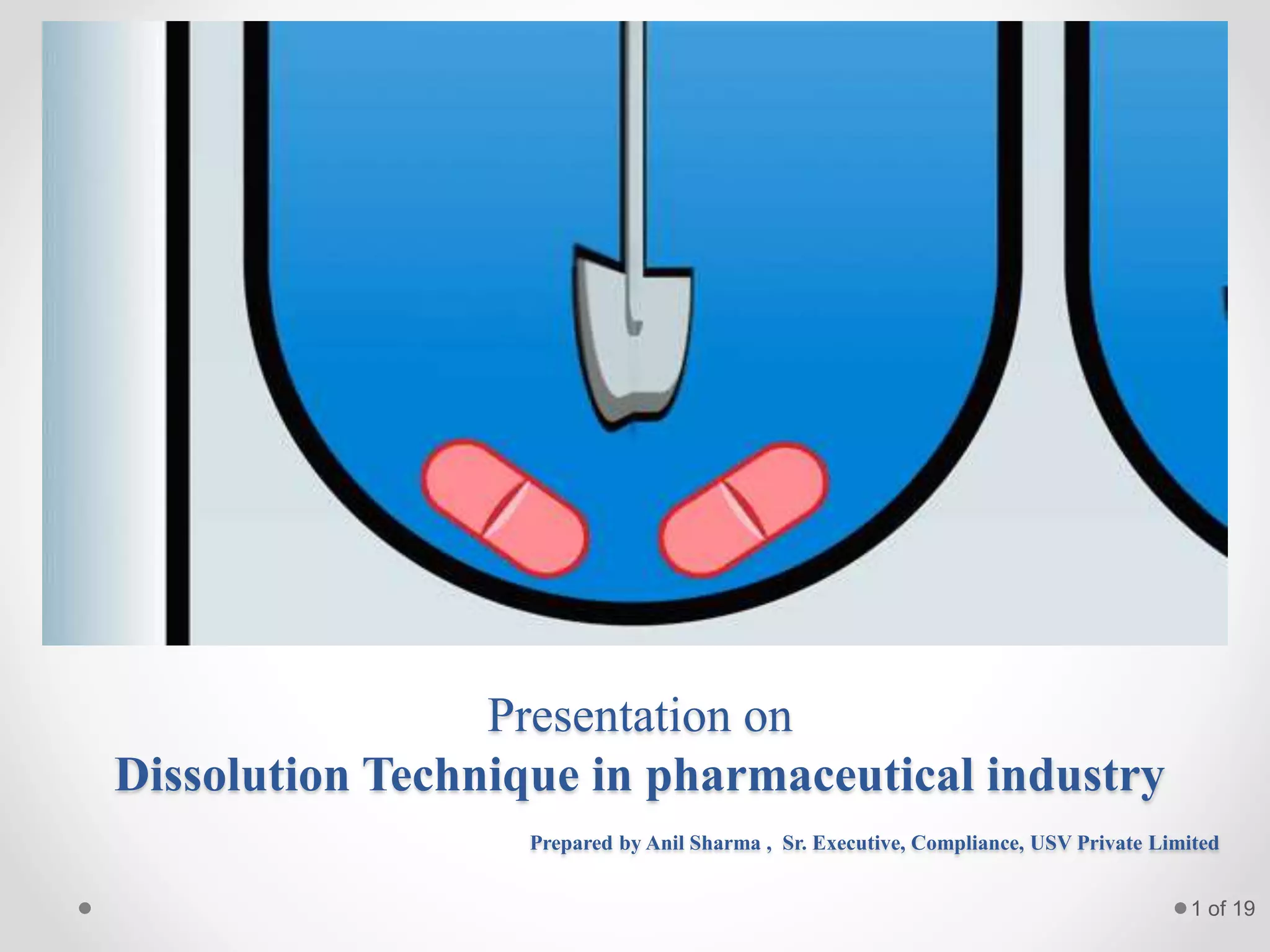
Dissolution Technique in pharmaceutical industry
Prepared by Anil Sharma , Sr. Executive, Compliance, USV Private Limited
1 of 19
Table of Contents
• What is Dissolution?
• Importance of Dissolution
• History of Dissolution
• Type of Dissolution Apparatus
• Classification of Dissolution Apparatus in different pharmacopoeias
• Diagram of Apparatus – 1 & Apparatus II
• Interpretation of Dissolution Results
• Calibration Of Dissolution Apparatus
• Dissolution Calibration Toolkit & Types of Sinkers
• Dissolution Test For Solid Oral Dosage Forms (WHO) Draft Guideline.
2 of 19
What is Dissolution?
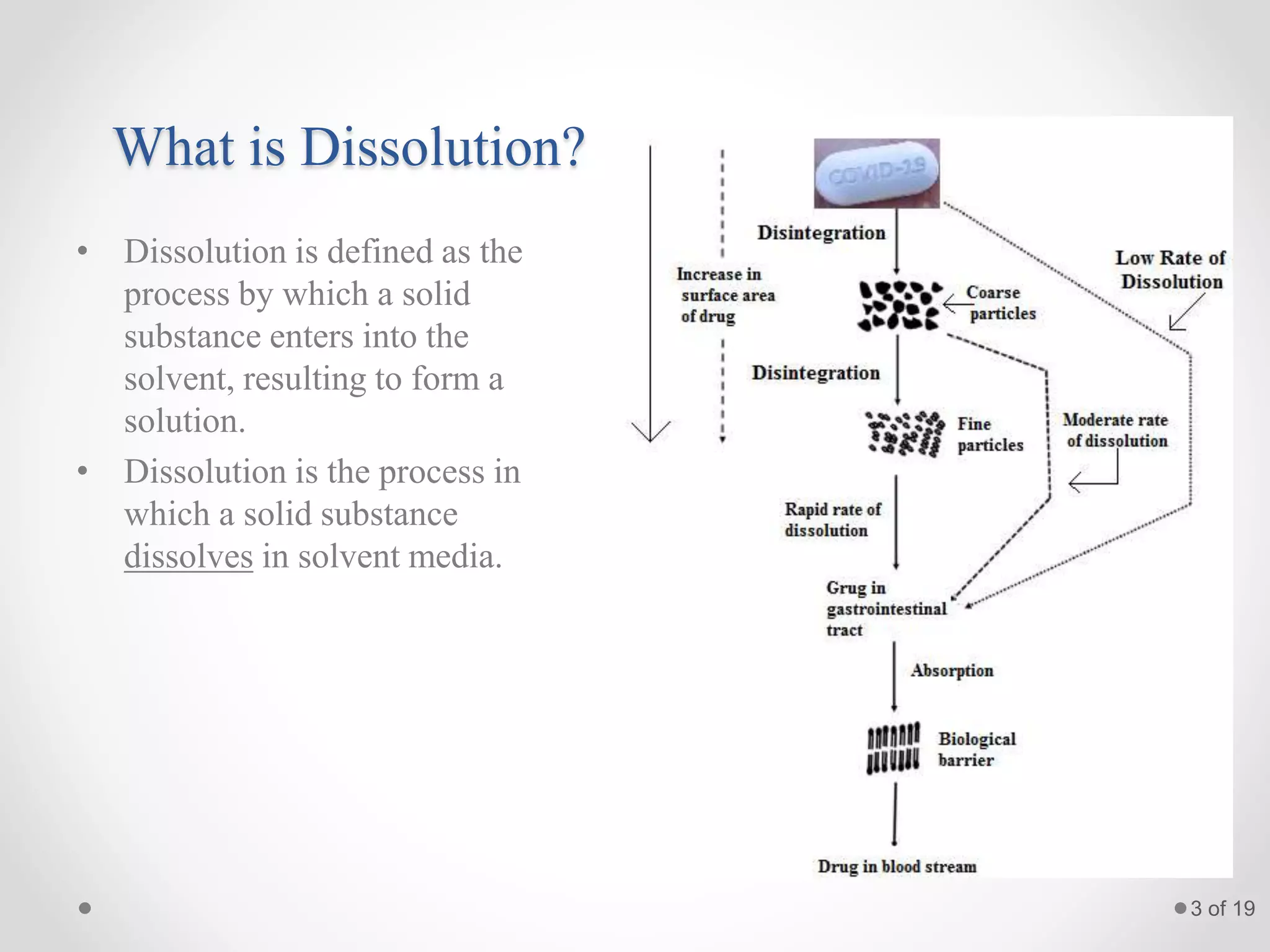
• Dissolution is defined as the
process by which a solid
substance enters into the
solvent, resulting to form a
solution.
• Dissolution is the process in
which a solid substance
dissolves in solvent media.
3 of 19
Importance of Dissolution
• Dissolution is the rate limiting step and controls the rate of absorptions.
• Bioavailability (In-vivo) can be correlated with the in-vitro dissolution results.
• To evaluate batch to batch variation.
• To identify critical manufacturing variables
 Binder Effect
 Mixing effect
 Granulation procedure
 Coating parameters
 Role of excipients in formulation
 Comparative profile studies
4 of 19
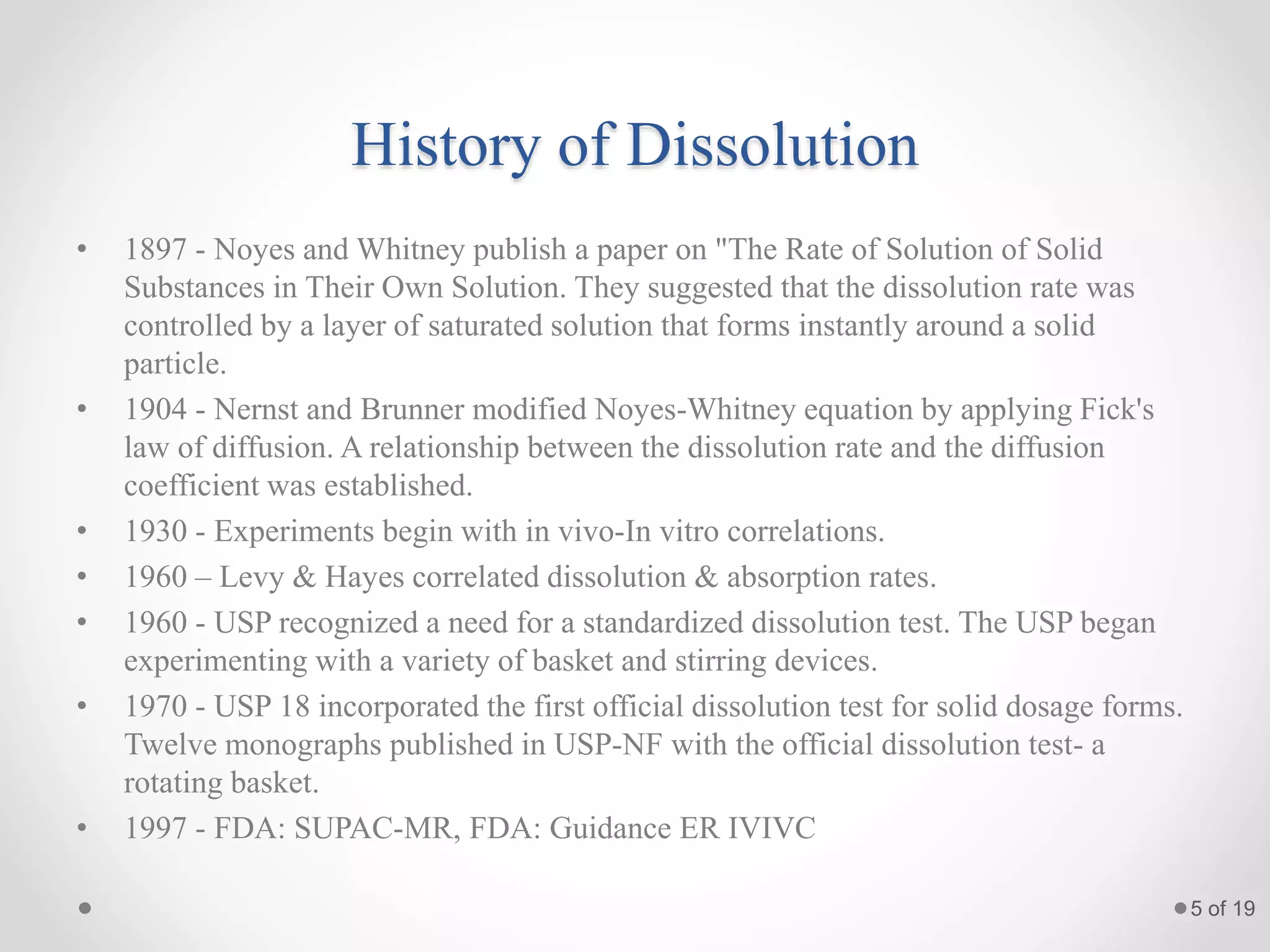
History of Dissolution
• 1897 - Noyes and Whitney publish a paper on "The Rate of Solution of Solid
Substances in Their Own Solution. They suggested that the dissolution rate was
controlled by a layer of saturated solution that forms instantly around a solid
particle.
• 1904 - Nernst and Brunner modified Noyes-Whitney equation by applying Fick's
law of diffusion. A relationship between the dissolution rate and the diffusion
coefficient was established.
• 1930 - Experiments begin with in vivo-In vitro correlations.
• 1960 – Levy & Hayes correlated dissolution & absorption rates.
• 1960 - USP recognized a need for a standardized dissolution test. The USP began
experimenting with a variety of basket and stirring devices.
• 1970 - USP 18 incorporated the first official dissolution test for solid dosage forms.
Twelve monographs published in USP-NF with the official dissolution test- a
rotating basket.
• 1997 - FDA: SUPAC-MR, FDA: Guidance ER IVIVC
5 of 19
Type of Dissolution Apparatus
6 of 19
Apparatus* Name Drug Product
Apparatus-1 Rotating Basket Tablets & Capsules
Apparatus-2 Paddle Tablets, Capsules & Suspensions
Apparatus-3 Reciprocating
Cylinder
Extended release drug product
Apparatus-4 Flow Through Cell Low water soluble drugs, Granules
Apparatus-5 Paddle Over Disk Transdermal products
Apparatus-6 Cylinder Transdermal products
Apparatus-7 Reciprocating Disk Transdermal products
Rotating Bottle (Non-USP-NF) Extended release drug product (Beads)
Diffusion Cell (Non-USP-NF) Ointment, cream & Transdermal products
* Apparatus 1 to 7 refer to compendial dissolution apparatus in USP-NF
Classification of Dissolution Apparatus in different pharmacopoeias
7 of 19
Apparatus* USP B.P. E.P. I.P.
Apparatus-1
Rotating
Basket
Rotating
Basket
Paddle Paddle
Apparatus-2 Paddle Paddle Rotating Basket Rotating Basket
Apparatus-3
Reciprocating
Cylinder
Flow
Through
Cell
Flow Through
Cell
Apparatus-4
Flow
Through Cell
Apparatus-5
Paddle Over
Disk
Apparatus-6 Cylinder
Apparatus-7
Reciprocating
Disk
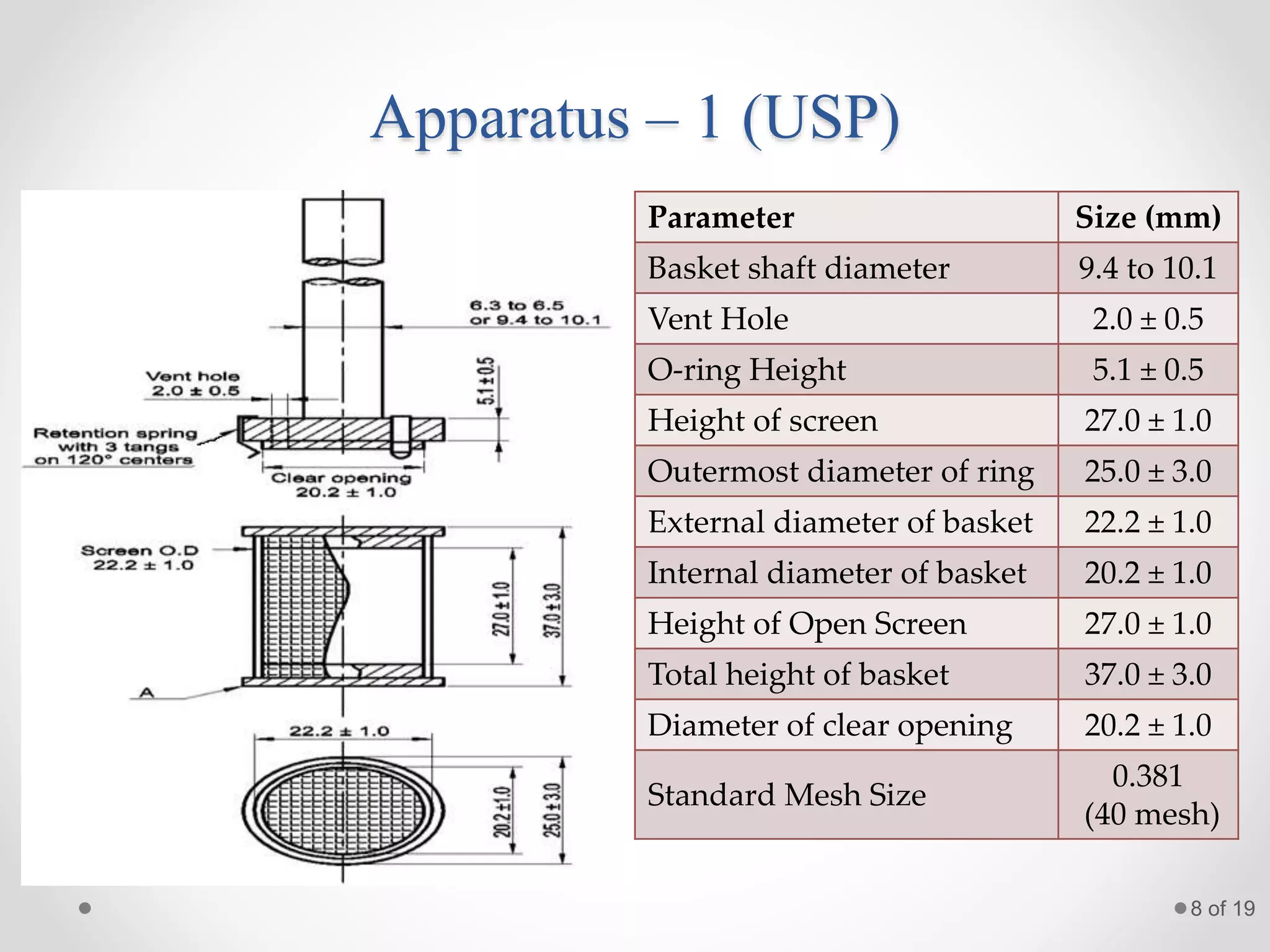
Apparatus – 1 (USP)
8 of 19
Parameter Size (mm)
Basket shaft diameter 9.4 to 10.1
Vent Hole 2.0 ± 0.5
O-ring Height 5.1 ± 0.5
Height of screen 27.0 ± 1.0
Outermost diameter of ring 25.0 ± 3.0
External diameter of basket 22.2 ± 1.0
Internal diameter of basket 20.2 ± 1.0
Height of Open Screen 27.0 ± 1.0
Total height of basket 37.0 ± 3.0
Diameter of clear opening 20.2 ± 1.0
Standard Mesh Size
0.381
(40 mesh)
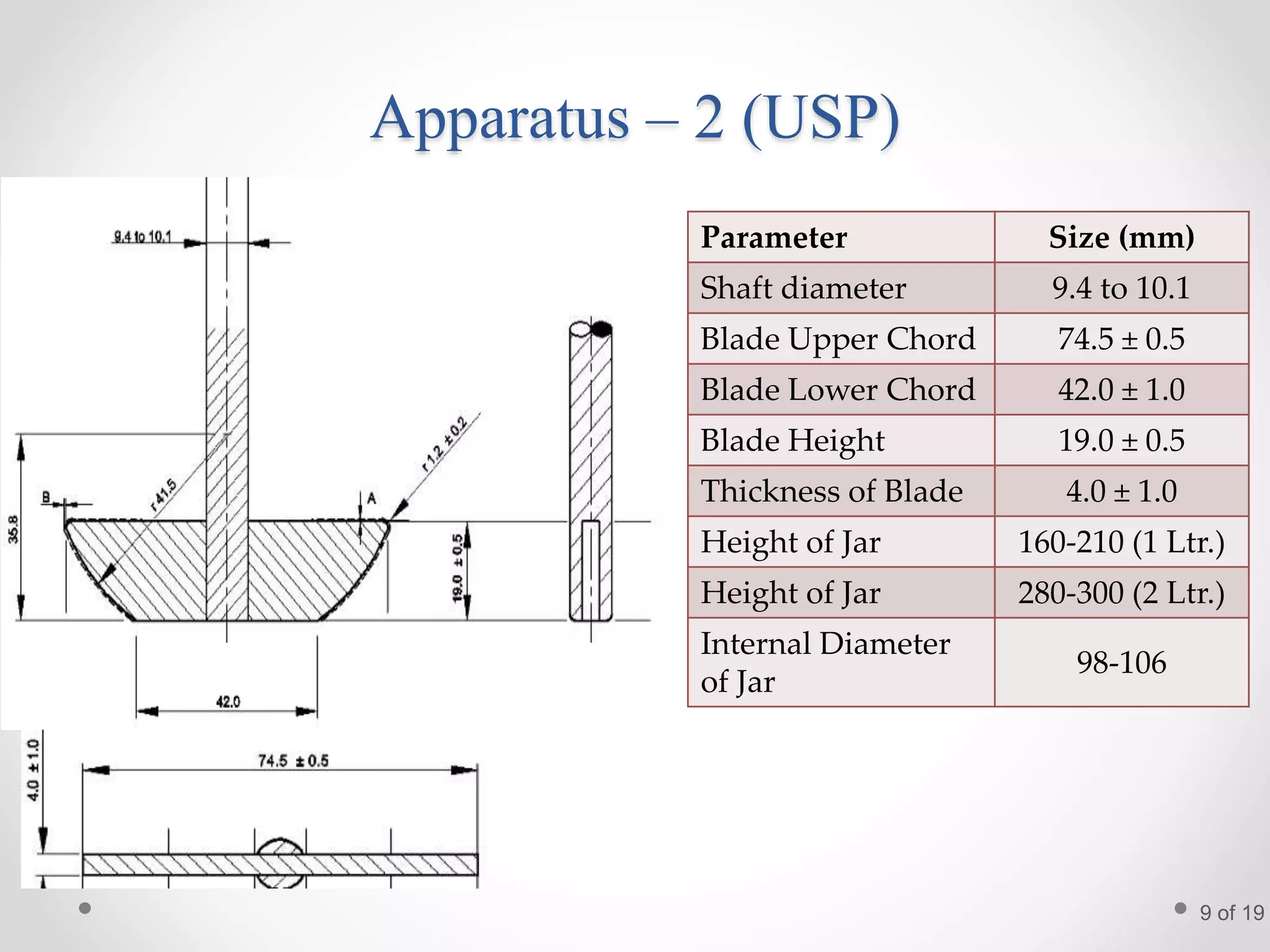
Apparatus – 2 (USP)
9 of 19
Parameter Size (mm)
Shaft diameter 9.4 to 10.1
Blade Upper Chord 74.5 ± 0.5
Blade Lower Chord 42.0 ± 1.0
Blade Height 19.0 ± 0.5
Thickness of Blade 4.0 ± 1.0
Height of Jar 160-210 (1 Ltr.)
Height of Jar 280-300 (2 Ltr.)
Internal Diameter
of Jar
98-106
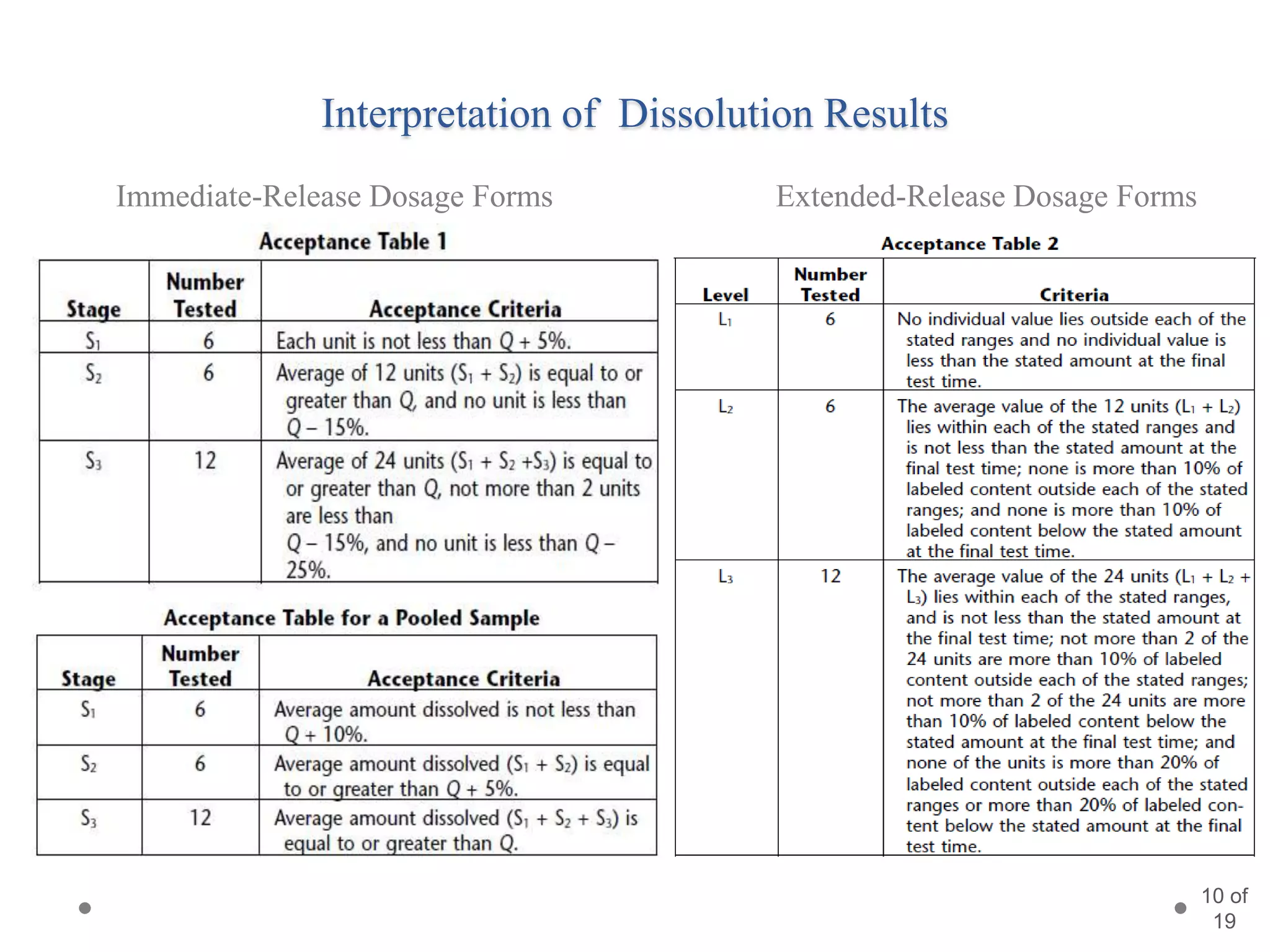
Interpretation of Dissolution Results
Immediate-Release Dosage Forms Extended-Release Dosage Forms
10 of
19
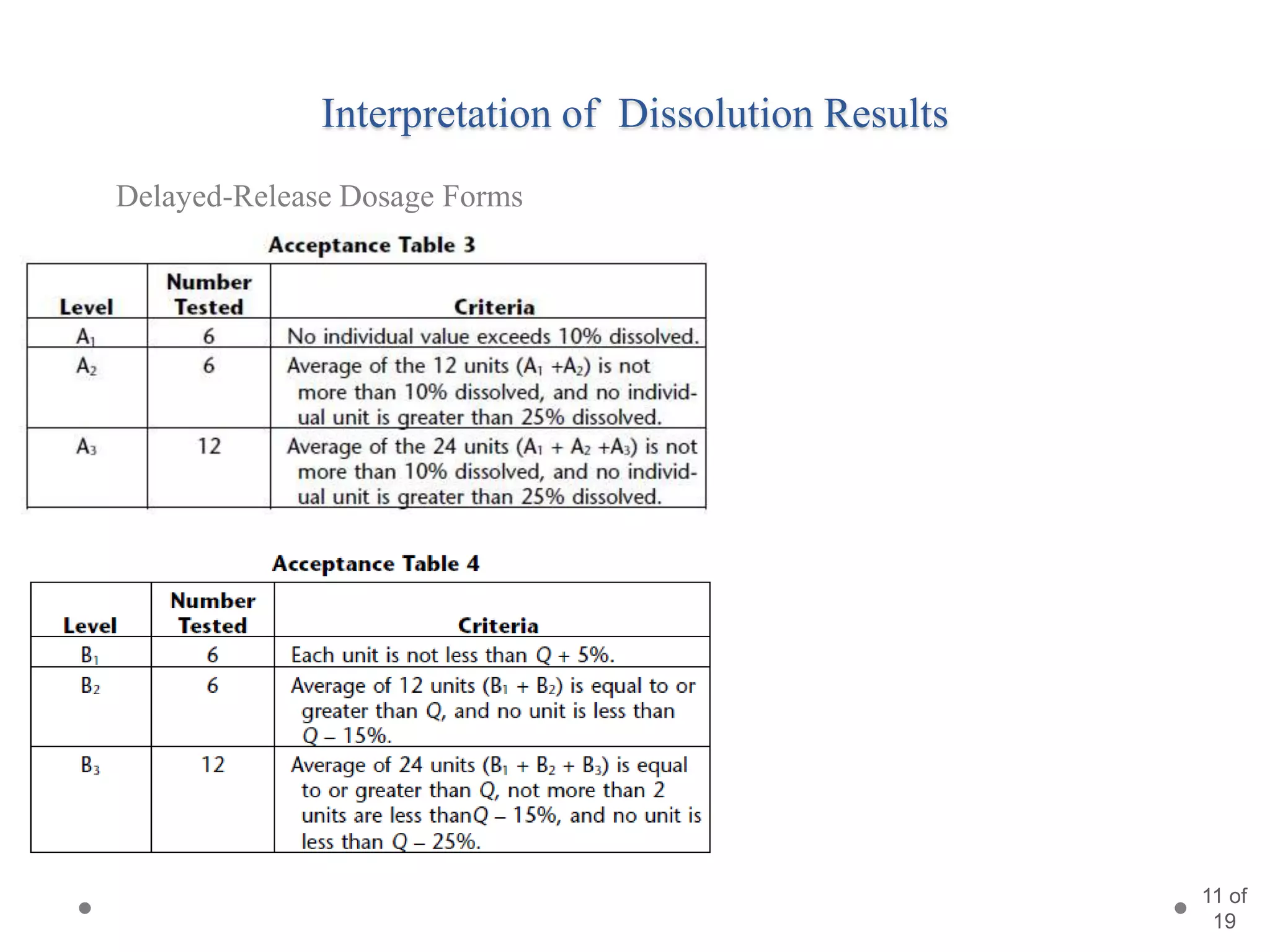
Interpretation of Dissolution Results
Delayed-Release Dosage Forms
11 of
19
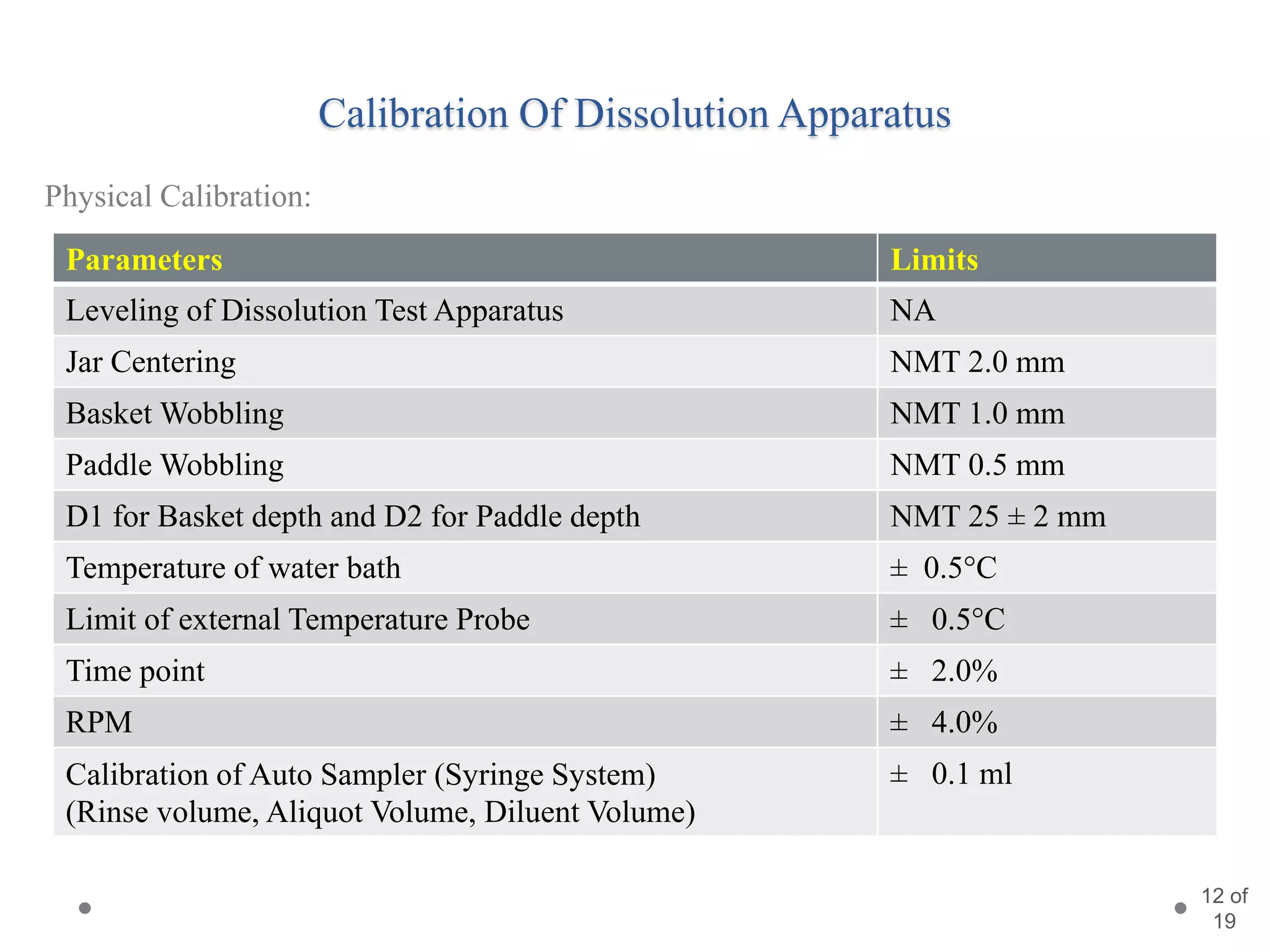
Calibration Of Dissolution Apparatus
Physical Calibration:
12 of
19
Parameters Limits
Leveling of Dissolution Test Apparatus NA
Jar Centering NMT 2.0 mm
Basket Wobbling NMT 1.0 mm
Paddle Wobbling NMT 0.5 mm
D1 for Basket depth and D2 for Paddle depth NMT 25 ± 2 mm
Temperature of water bath ± 0.5°C
Limit of external Temperature Probe ± 0.5°C
Time point ± 2.0%
RPM ± 4.0%
Calibration of Auto Sampler (Syringe System)
(Rinse volume, Aliquot Volume, Diluent Volume)
± 0.1 ml
Calibration Of Dissolution Apparatus
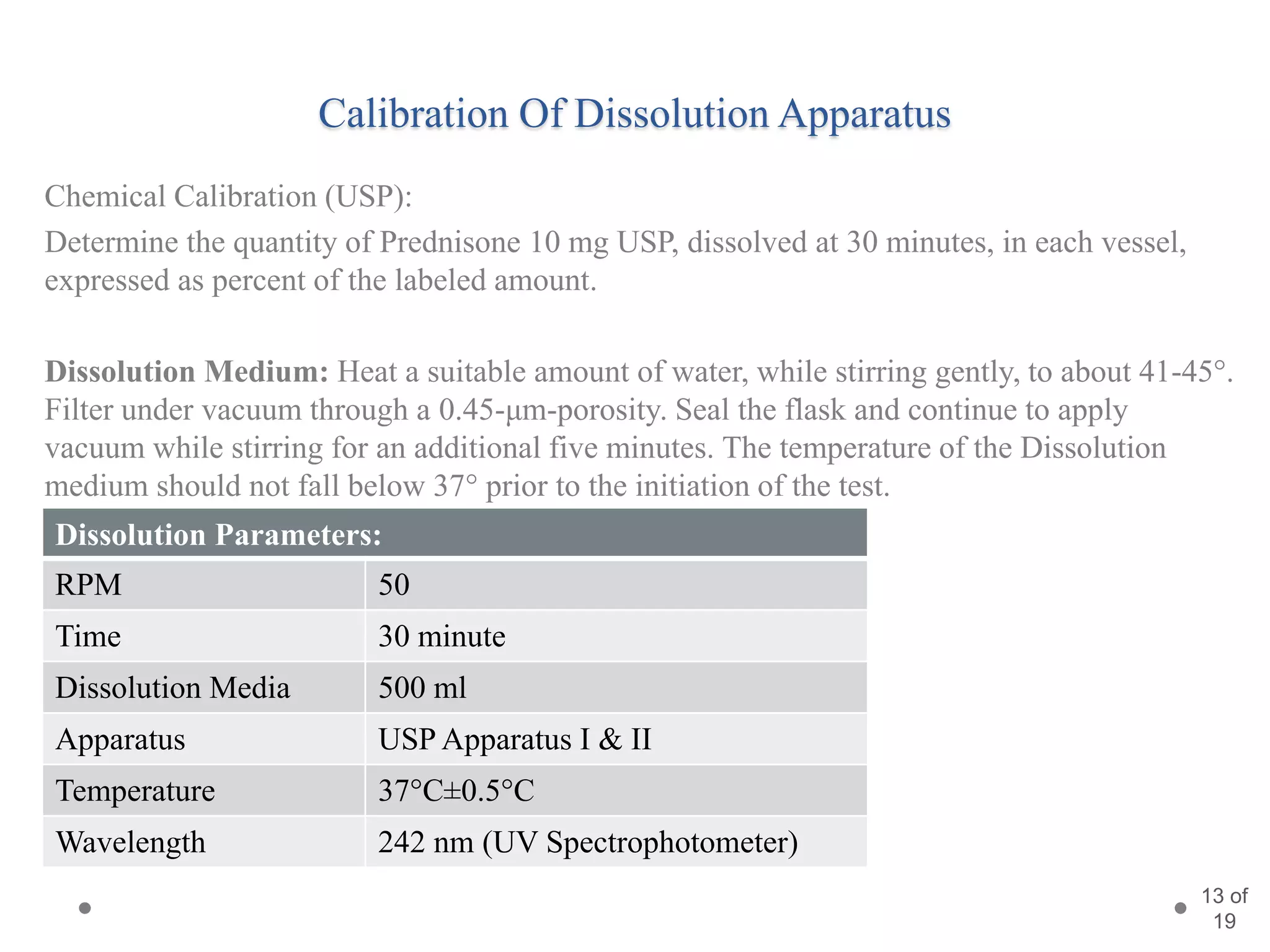
Chemical Calibration (USP):
Determine the quantity of Prednisone 10 mg USP, dissolved at 30 minutes, in each vessel,
expressed as percent of the labeled amount.
Dissolution Medium: Heat a suitable amount of water, while stirring gently, to about 41-45°.
Filter under vacuum through a 0.45-μm-porosity. Seal the flask and continue to apply
vacuum while stirring for an additional five minutes. The temperature of the Dissolution
medium should not fall below 37° prior to the initiation of the test.
13 of
19
Dissolution Parameters:
RPM 50
Time 30 minute
Dissolution Media 500 ml
Apparatus USP Apparatus I & II
Temperature 37°C±0.5°C
Wavelength 242 nm (UV Spectrophotometer)
Calibration Of Dissolution
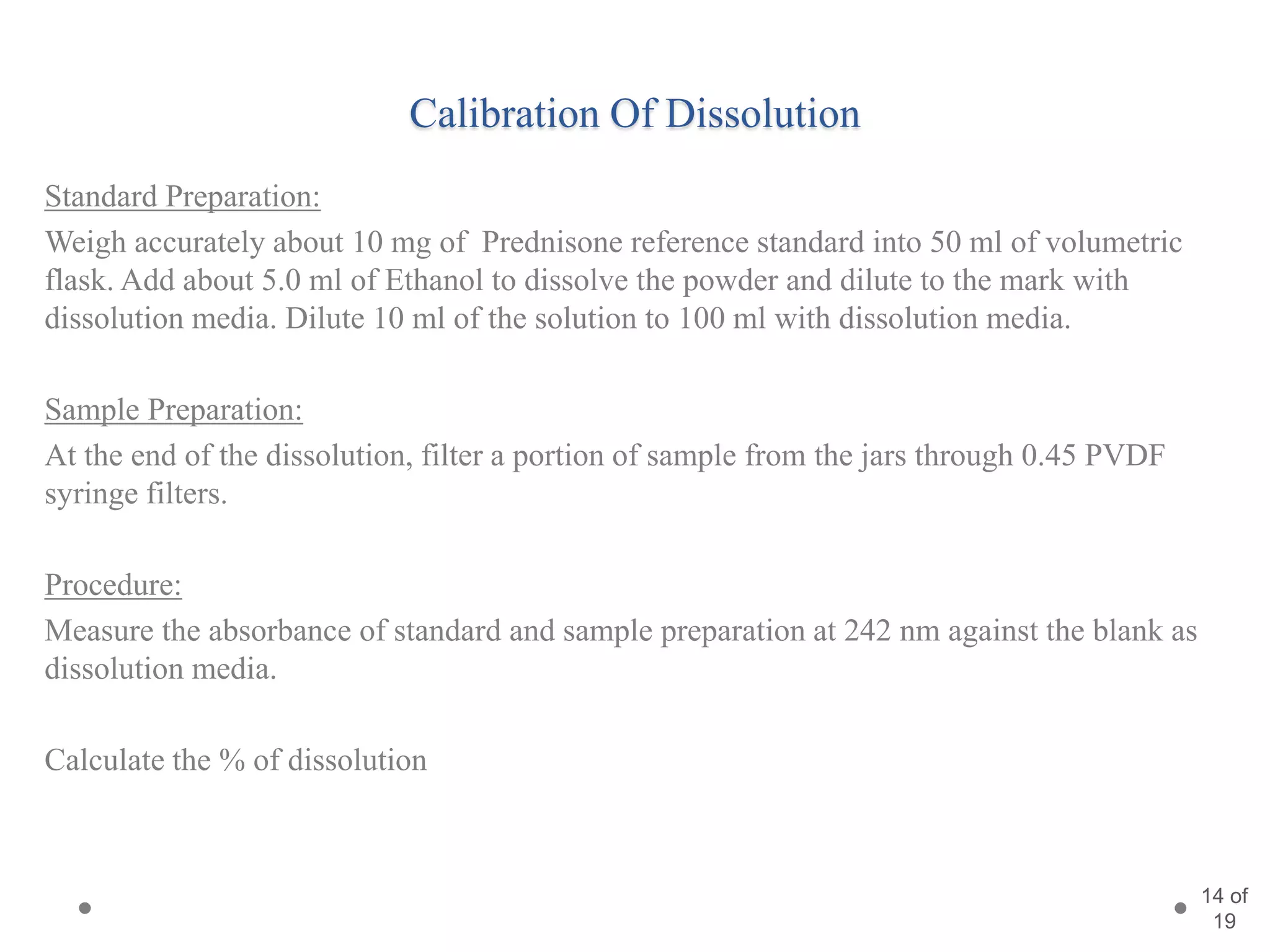
Standard Preparation:
Weigh accurately about 10 mg of Prednisone reference standard into 50 ml of volumetric
flask. Add about 5.0 ml of Ethanol to dissolve the powder and dilute to the mark with
dissolution media. Dilute 10 ml of the solution to 100 ml with dissolution media.
Sample Preparation:
At the end of the dissolution, filter a portion of sample from the jars through 0.45 PVDF
syringe filters.
Procedure:
Measure the absorbance of standard and sample preparation at 242 nm against the blank as
dissolution media.
Calculate the % of dissolution
14 of
19
Calibration Of Dissolution Apparatus
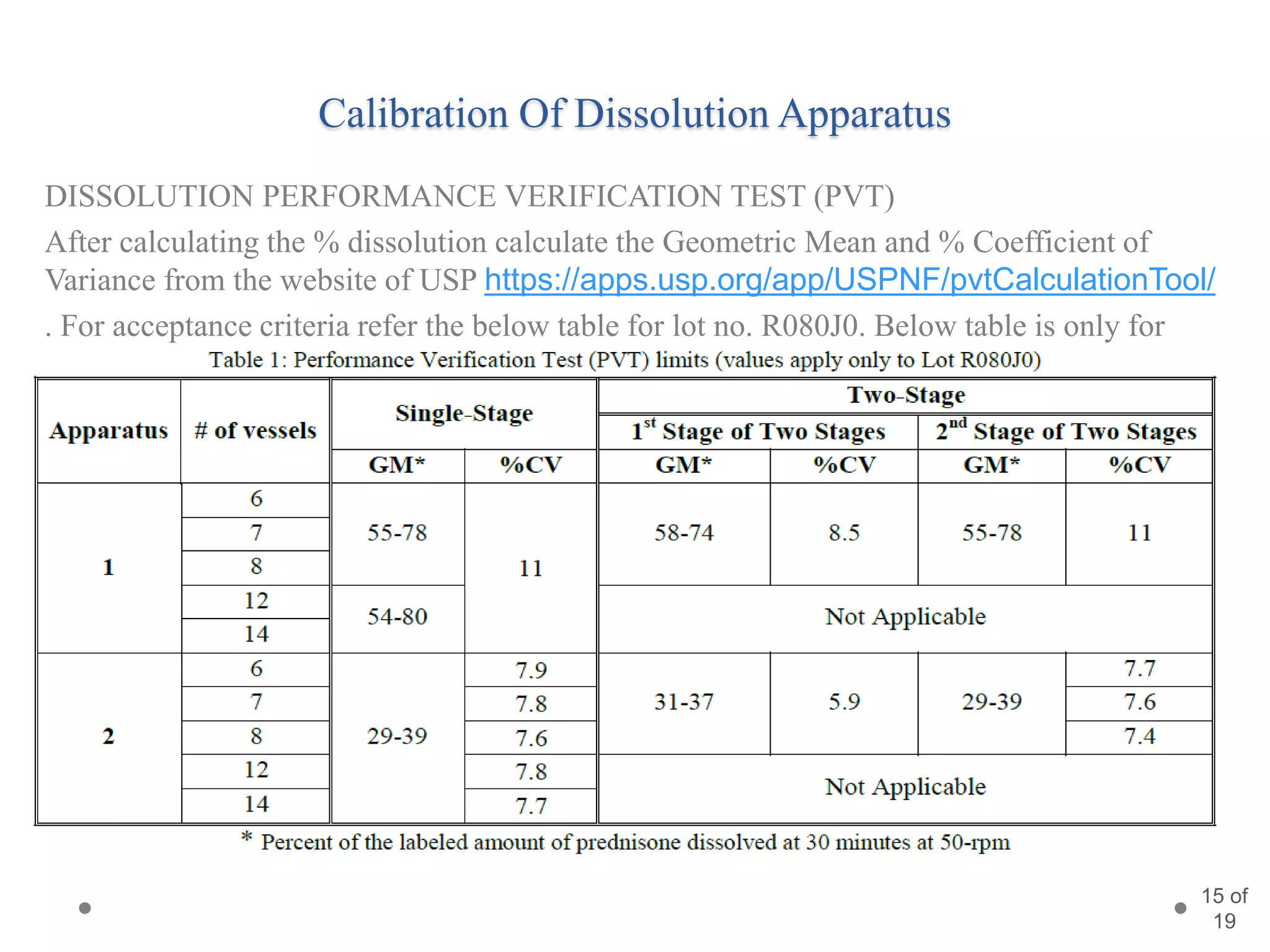
DISSOLUTION PERFORMANCE VERIFICATION TEST (PVT)
After calculating the % dissolution calculate the Geometric Mean and % Coefficient of
Variance from the website of USP https://apps.usp.org/app/USPNF/pvtCalculationTool/
. For acceptance criteria refer the below table for lot no. R080J0. Below table is only for
reference purpose.
15 of
19
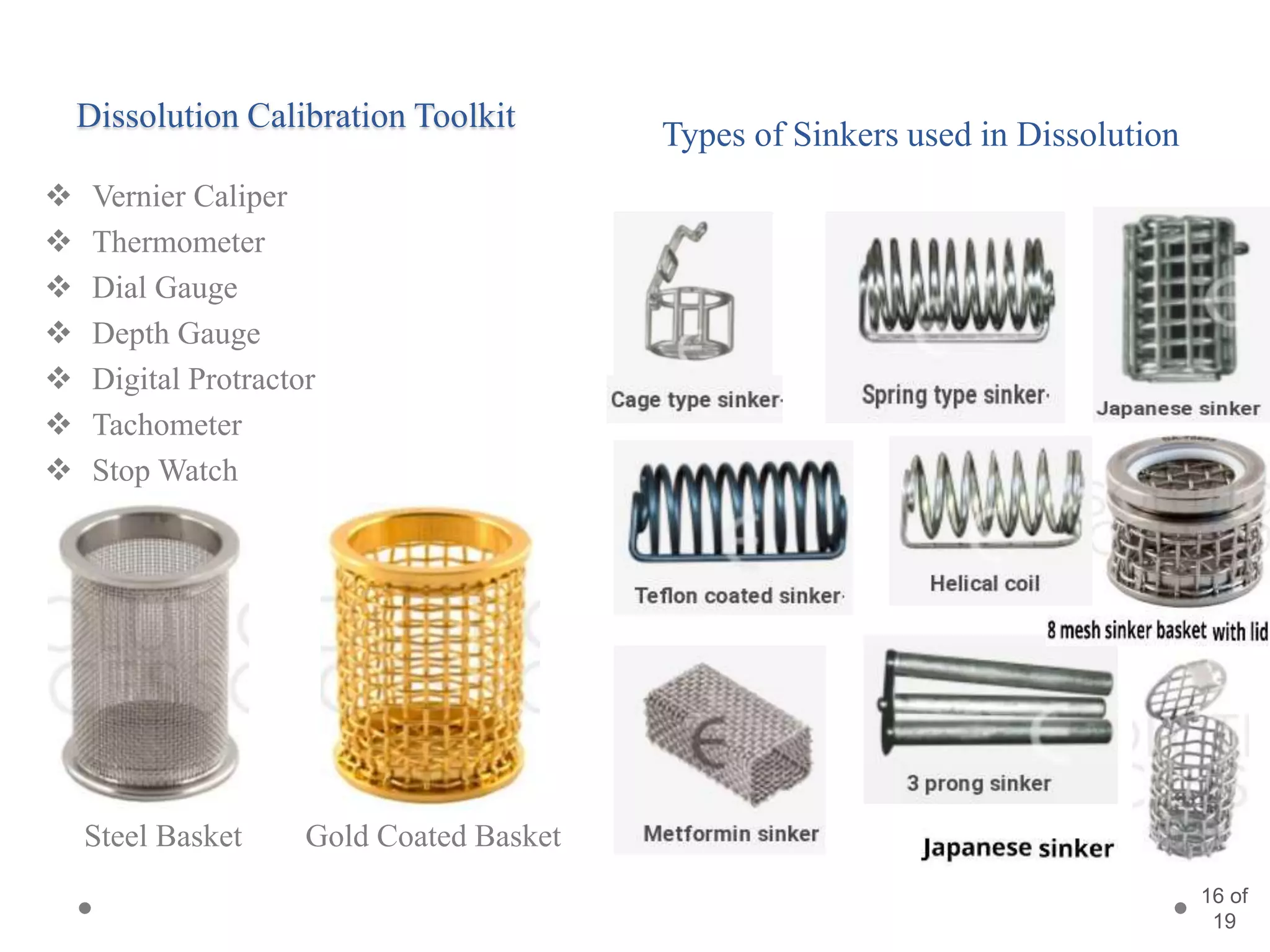
Dissolution Calibration Toolkit
 Vernier Caliper
 Thermometer
 Dial Gauge
 Depth Gauge
 Digital Protractor
 Tachometer
 Stop Watch
Steel Basket Gold Coated Basket
16 of
19
Types of Sinkers used in Dissolution
Dissolution Test For Solid Oral Dosage Forms (WHO)
• WHO publish draft proposal for
revision of chapter 5.5 in The
International Pharmacopoeia
guideline for comments.
• Chapter 5.5 Dissolution test for
solid oral dosage forms, The
International Pharmacopoeia - Ninth
Edition, 2019.
• Reason for revision:- Addition of
analysis of Suspensions and
powders for suspension.
• Dr. Herbert Schmidt, Technical
officer, mail ID schmidth@who.int
Send your comments by 31 August
2020.
17 of
19
Proposal by WHO (PDG)
Suspensions and Powders for oral suspension
Powders for Suspension/ Dissolution apparatus
oral suspension/ Re-Suspend
Suspension
Procedure:
• Avoid the introducing of bubbles into the sample to ensure the precision of dosing.
• Transfer to the dissolution by weight as indicated in the monograph.
• If no amount is given, use an amount that is equivalent to 1 unit dose.
• In case the product has different doses depending on body weight or age, the amount of
sample that corresponds to the highest unit dose to be administered at one time.
• If the product is labeled for single use, each sample should come from a different
container/packet.
18 of
19
19 of
19
Thank You

Dissolution Technique in pharmaceutical industry

  • 1.
    Presentation on Dissolution Techniquein pharmaceutical industry Prepared by Anil Sharma , Sr. Executive, Compliance, USV Private Limited 1 of 19
  • 2.
    Table of Contents •What is Dissolution? • Importance of Dissolution • History of Dissolution • Type of Dissolution Apparatus • Classification of Dissolution Apparatus in different pharmacopoeias • Diagram of Apparatus – 1 & Apparatus II • Interpretation of Dissolution Results • Calibration Of Dissolution Apparatus • Dissolution Calibration Toolkit & Types of Sinkers • Dissolution Test For Solid Oral Dosage Forms (WHO) Draft Guideline. 2 of 19
  • 3.
    What is Dissolution? •Dissolution is defined as the process by which a solid substance enters into the solvent, resulting to form a solution. • Dissolution is the process in which a solid substance dissolves in solvent media. 3 of 19
  • 4.
    Importance of Dissolution •Dissolution is the rate limiting step and controls the rate of absorptions. • Bioavailability (In-vivo) can be correlated with the in-vitro dissolution results. • To evaluate batch to batch variation. • To identify critical manufacturing variables  Binder Effect  Mixing effect  Granulation procedure  Coating parameters  Role of excipients in formulation  Comparative profile studies 4 of 19
  • 5.
    History of Dissolution •1897 - Noyes and Whitney publish a paper on "The Rate of Solution of Solid Substances in Their Own Solution. They suggested that the dissolution rate was controlled by a layer of saturated solution that forms instantly around a solid particle. • 1904 - Nernst and Brunner modified Noyes-Whitney equation by applying Fick's law of diffusion. A relationship between the dissolution rate and the diffusion coefficient was established. • 1930 - Experiments begin with in vivo-In vitro correlations. • 1960 – Levy & Hayes correlated dissolution & absorption rates. • 1960 - USP recognized a need for a standardized dissolution test. The USP began experimenting with a variety of basket and stirring devices. • 1970 - USP 18 incorporated the first official dissolution test for solid dosage forms. Twelve monographs published in USP-NF with the official dissolution test- a rotating basket. • 1997 - FDA: SUPAC-MR, FDA: Guidance ER IVIVC 5 of 19
  • 6.
    Type of DissolutionApparatus 6 of 19 Apparatus* Name Drug Product Apparatus-1 Rotating Basket Tablets & Capsules Apparatus-2 Paddle Tablets, Capsules & Suspensions Apparatus-3 Reciprocating Cylinder Extended release drug product Apparatus-4 Flow Through Cell Low water soluble drugs, Granules Apparatus-5 Paddle Over Disk Transdermal products Apparatus-6 Cylinder Transdermal products Apparatus-7 Reciprocating Disk Transdermal products Rotating Bottle (Non-USP-NF) Extended release drug product (Beads) Diffusion Cell (Non-USP-NF) Ointment, cream & Transdermal products * Apparatus 1 to 7 refer to compendial dissolution apparatus in USP-NF
  • 7.
    Classification of DissolutionApparatus in different pharmacopoeias 7 of 19 Apparatus* USP B.P. E.P. I.P. Apparatus-1 Rotating Basket Rotating Basket Paddle Paddle Apparatus-2 Paddle Paddle Rotating Basket Rotating Basket Apparatus-3 Reciprocating Cylinder Flow Through Cell Flow Through Cell Apparatus-4 Flow Through Cell Apparatus-5 Paddle Over Disk Apparatus-6 Cylinder Apparatus-7 Reciprocating Disk
  • 8.
    Apparatus – 1(USP) 8 of 19 Parameter Size (mm) Basket shaft diameter 9.4 to 10.1 Vent Hole 2.0 ± 0.5 O-ring Height 5.1 ± 0.5 Height of screen 27.0 ± 1.0 Outermost diameter of ring 25.0 ± 3.0 External diameter of basket 22.2 ± 1.0 Internal diameter of basket 20.2 ± 1.0 Height of Open Screen 27.0 ± 1.0 Total height of basket 37.0 ± 3.0 Diameter of clear opening 20.2 ± 1.0 Standard Mesh Size 0.381 (40 mesh)
  • 9.
    Apparatus – 2(USP) 9 of 19 Parameter Size (mm) Shaft diameter 9.4 to 10.1 Blade Upper Chord 74.5 ± 0.5 Blade Lower Chord 42.0 ± 1.0 Blade Height 19.0 ± 0.5 Thickness of Blade 4.0 ± 1.0 Height of Jar 160-210 (1 Ltr.) Height of Jar 280-300 (2 Ltr.) Internal Diameter of Jar 98-106
  • 10.
    Interpretation of DissolutionResults Immediate-Release Dosage Forms Extended-Release Dosage Forms 10 of 19
  • 11.
    Interpretation of DissolutionResults Delayed-Release Dosage Forms 11 of 19
  • 12.
    Calibration Of DissolutionApparatus Physical Calibration: 12 of 19 Parameters Limits Leveling of Dissolution Test Apparatus NA Jar Centering NMT 2.0 mm Basket Wobbling NMT 1.0 mm Paddle Wobbling NMT 0.5 mm D1 for Basket depth and D2 for Paddle depth NMT 25 ± 2 mm Temperature of water bath ± 0.5°C Limit of external Temperature Probe ± 0.5°C Time point ± 2.0% RPM ± 4.0% Calibration of Auto Sampler (Syringe System) (Rinse volume, Aliquot Volume, Diluent Volume) ± 0.1 ml
  • 13.
    Calibration Of DissolutionApparatus Chemical Calibration (USP): Determine the quantity of Prednisone 10 mg USP, dissolved at 30 minutes, in each vessel, expressed as percent of the labeled amount. Dissolution Medium: Heat a suitable amount of water, while stirring gently, to about 41-45°. Filter under vacuum through a 0.45-μm-porosity. Seal the flask and continue to apply vacuum while stirring for an additional five minutes. The temperature of the Dissolution medium should not fall below 37° prior to the initiation of the test. 13 of 19 Dissolution Parameters: RPM 50 Time 30 minute Dissolution Media 500 ml Apparatus USP Apparatus I & II Temperature 37°C±0.5°C Wavelength 242 nm (UV Spectrophotometer)
  • 14.
    Calibration Of Dissolution StandardPreparation: Weigh accurately about 10 mg of Prednisone reference standard into 50 ml of volumetric flask. Add about 5.0 ml of Ethanol to dissolve the powder and dilute to the mark with dissolution media. Dilute 10 ml of the solution to 100 ml with dissolution media. Sample Preparation: At the end of the dissolution, filter a portion of sample from the jars through 0.45 PVDF syringe filters. Procedure: Measure the absorbance of standard and sample preparation at 242 nm against the blank as dissolution media. Calculate the % of dissolution 14 of 19
  • 15.
    Calibration Of DissolutionApparatus DISSOLUTION PERFORMANCE VERIFICATION TEST (PVT) After calculating the % dissolution calculate the Geometric Mean and % Coefficient of Variance from the website of USP https://apps.usp.org/app/USPNF/pvtCalculationTool/ . For acceptance criteria refer the below table for lot no. R080J0. Below table is only for reference purpose. 15 of 19
  • 16.
    Dissolution Calibration Toolkit Vernier Caliper  Thermometer  Dial Gauge  Depth Gauge  Digital Protractor  Tachometer  Stop Watch Steel Basket Gold Coated Basket 16 of 19 Types of Sinkers used in Dissolution
  • 17.
    Dissolution Test ForSolid Oral Dosage Forms (WHO) • WHO publish draft proposal for revision of chapter 5.5 in The International Pharmacopoeia guideline for comments. • Chapter 5.5 Dissolution test for solid oral dosage forms, The International Pharmacopoeia - Ninth Edition, 2019. • Reason for revision:- Addition of analysis of Suspensions and powders for suspension. • Dr. Herbert Schmidt, Technical officer, mail ID schmidth@who.int Send your comments by 31 August 2020. 17 of 19
  • 18.
    Proposal by WHO(PDG) Suspensions and Powders for oral suspension Powders for Suspension/ Dissolution apparatus oral suspension/ Re-Suspend Suspension Procedure: • Avoid the introducing of bubbles into the sample to ensure the precision of dosing. • Transfer to the dissolution by weight as indicated in the monograph. • If no amount is given, use an amount that is equivalent to 1 unit dose. • In case the product has different doses depending on body weight or age, the amount of sample that corresponds to the highest unit dose to be administered at one time. • If the product is labeled for single use, each sample should come from a different container/packet. 18 of 19
  • 19.