Engage MOOC
Group Discussion
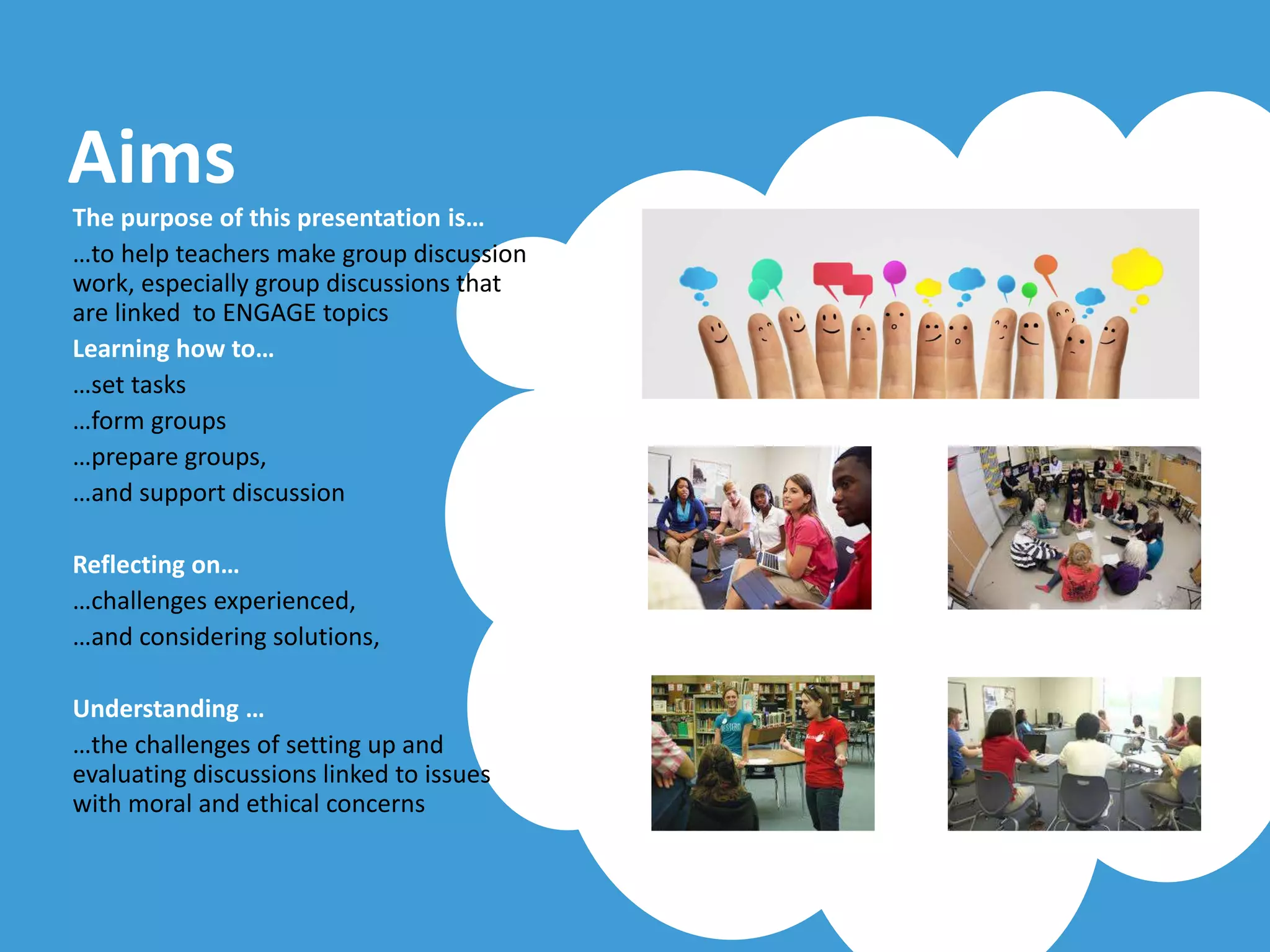
Aims
The purpose of this presentation is…
…to help teachers make group discussion
work, especially group discussions that
are linked to ENGAGE topics
Learning how to…
…set tasks
…form groups
…prepare groups,
…and support discussion
Reflecting on…
…challenges experienced,
…and considering solutions,
Understanding …
…the challenges of setting up and
evaluating discussions linked to issues
with moral and ethical concerns
Why using Group Discussions?
Group discussions are an important teaching approach in school
science, because group discussions
support a student-centered teaching
help students to articulate on their own ideas about a scientific phenomenon
and reflect upon a certain scientific ethical dilemma
support the development of key science skills like arguing and reasoning
support engaging with controversial issues also beyond school, through opinion sharing, discussion and negotiation
students learn more actively, when they have more control and choice
students learn from each other (to gain confidence and competence), using another’s ideas to help build their own,
evaluating ideas, and comparing solutions
shy or less articulate students may find it less threatening than speaking out in class, and easier to talk without the
barrier of teacher-approved language
Students enjoy it!
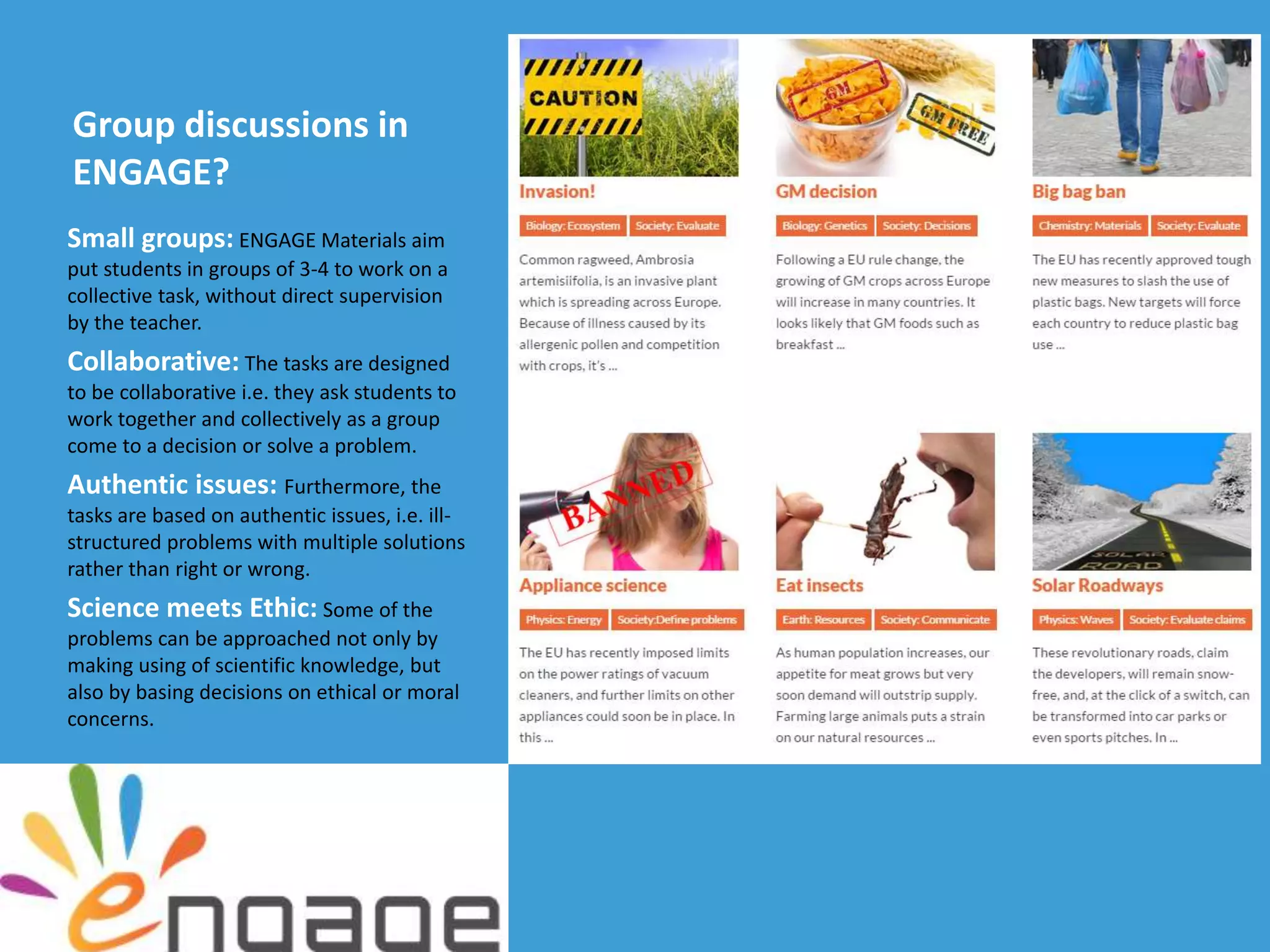
Group discussions in
ENGAGE?
Small groups: ENGAGE Materials aim
put students in groups of 3-4 to work on a
collective task, without direct supervision
by the teacher.
Collaborative: The tasks are designed
to be collaborative i.e. they ask students to
work together and collectively as a group
come to a decision or solve a problem.
Authentic issues: Furthermore, the
tasks are based on authentic issues, i.e. ill-
structured problems with multiple solutions
rather than right or wrong.
Science meets Ethic: Some of the
problems can be approached not only by
making using of scientific knowledge, but
also by basing decisions on ethical or moral
concerns.
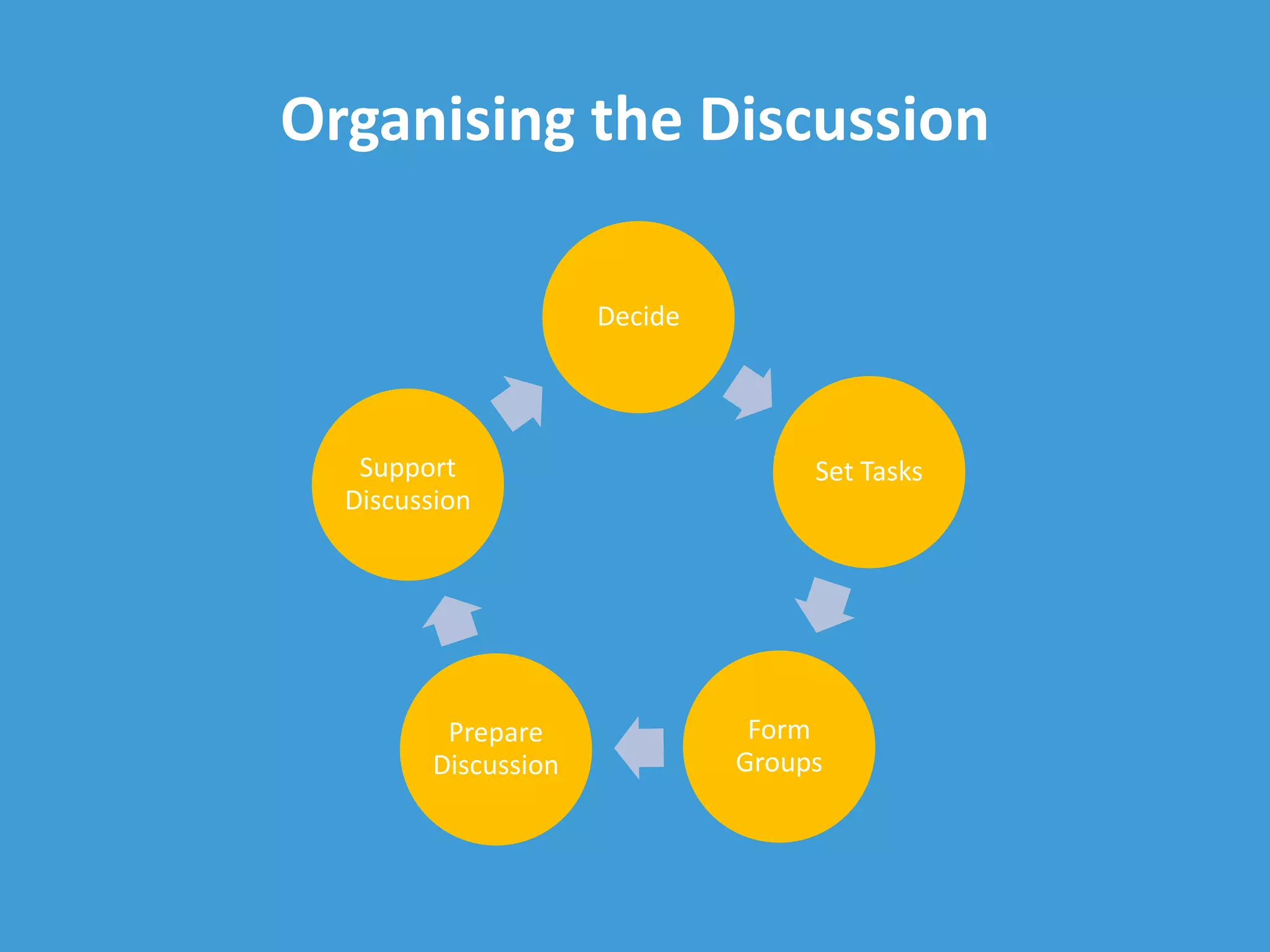
Organising the Discussion
Decide
Set Tasks
Form
Groups
Prepare
Discussion
Support
Discussion
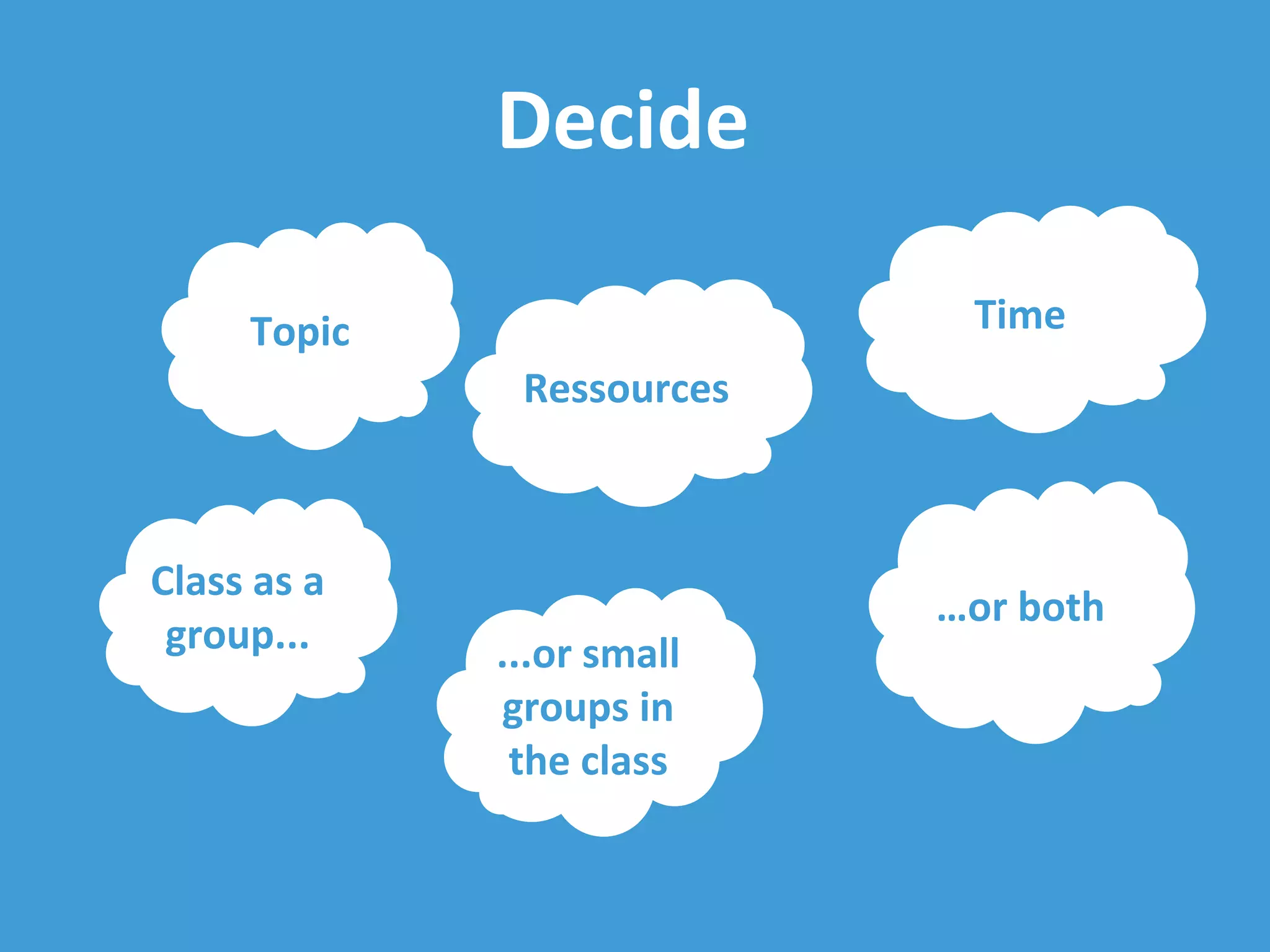
Decide
Class as a
group... ...or small
groups in
the class
…or both
Topic
Ressources
Time
Set Tasks
1) Check students have sufficient knowledge
Discussion is more productive if students are confident with the expected prior knowledge that they will need
to use in their discussion In ENGAGE materials, there is a starter to recap science concepts, before their
implications are discussed. Our tasks also make it clear what are facts (not to be questioned) and what are
evidence/opinion (can be argued about).
2) Keep tasks short and structured
Less experienced students are likely to wander off topic, and it is best to start with short focussed tasks. To
encourage high level discussion, ENGAGE tasks have a ‘discussion agenda’, listing the points to be discussed, to
ensure students know what to talk about, and know when they are on/off topic. But take care, since on the
other hand, over-structuring the task can stop students from thinking for themselves.
3) Make groups accountable for an output
The best way to ensure students learn without supervision is to define a clear output for the task e.g. to solve a
problem or come to a group decision. This should be reported back in some form, so that students know they
have responsibility to achieve the output.
4) Create conflict – present the dilemma
Students will be more likely to engage in arguing if the see a reason to do so - conflict. ENGAGE tasks create
conflict by having sources which disagree, or by putting students into roles which have differences of opinion.
Research indicates that conflict and the need to build on each others views improves quality of discussion and
reevaluation of students’ positions.
Form Group(s)
Use groups of 3 to 4 students
• Sometimes students discuss in pairs, but this can lead to students seeing it as situation of right/wrong
whereas with 4 students they will more likely see a range of opinions to be evaluated. Although a group can
be up to 6, smaller groups help to avoid having students sitting on the sidelines while others dominate.
Try friendship groups (?)
• Group dynamics play a big part in a discussion. Students won’t discuss until they feel confident with their
peers, and that it is OK to argue/conflict opinions. So stick with the same groups for a while. Friendship
groups (which are generally single-sex) are worth trying, as they have been found to function more
effectively than groupings that the teacher has decided.
Give students discussion roles
• Allocating roles can lead to more effective discussion when the roles support group interaction (and avoid
students working independently). Leadership is vital to keep the discussion focussed and to uphold the
ground rules.
– Leader: reads the assignment, restates points, mediates conflict, and manages time
– Listener - asks probing questions, or asks for better explanations, or recalls areas left out
– Reporter - get group to answer his questions in order to report back
– Encourager: gives team members feedback, is responsible for ensuring that all group members are heard.
– Reflector: who keeps track of group process and makes comments about focus, listening skills, participation.
• Organise the environment
• Some laboratories present obstacles for small group discussion. Ideally students should sit in small circles,
close together. Everyone needs to be facing each other if they are to talk to one another.
Prepare Group(s)
Establish ground rules upfront
Students need to know the behaviour expected of them in groups. Too often these
are left implicit. Ground rules for discussion can identified as a class, but an
effective way to get students to follow them is to get them to write the list for
themselves and to display it within the group. Then encourage students to refer to
these whenever an issue arises.
Since the whole purpose of discussion is to see things from perspectives different
from our own, the most fundamental rule is listening to others
A good set of rules might include:
everyone's opinion is listened to and respected
everyone takes responsibility for good behaviour
Silence is O.K. Think before speaking
Don’t interruptions or ridicule are discouraged
If you don’t understand, ask for clarification
everyone has an equal right to be heard
Prepare Groups II (if you have time)
Use practice exercises to develop discussion skills
Try short exercises to build specific skills, before students start the
discussion. For instance, there are many games to promote better listening:
Being heard: Pair up students. One person talks about a hobby while the other
person is instructed to ignore them. Discuss the frustration that can come with not
feeling heard, and review strategies a good listener should practice.
Listening accurately: One student reads a short story, and the others have to
paraphrase. This activity shows how we prioritize certain information over others.
Listening actively: One talks about a location they’d like to visit, but gives only
hints as to the specific place. The listener has to pick up on these subtleties and at
the end, recommend a suitable place. The original speaker will confirm or deny
whether this and the two discuss ways people can pick up on the appropriate cues
to play a more vital role in discussions.
FORMATS / METHODS FOR
GROUP DISCUSSION
Group Discussion Formats
discussions involving socio-scientific issues, ethical aspects and
decision-making is an interplay of meanings and ideas mainly from
students and affords a different type of questioning
Express ideas, no wright or wrong: More specifically, students need
opportunities to express their own ideas (even if they are not always
correct or well-structured), listen to their peers ideas, evaluate and
critique ideas, and revise and integrate them as well. Classroom talk
should center on engagement and thoughtfulness.
Ask teachers and peers: Students should ask questions that arise from
their own interests or confusion—and they should ask questions to each
other as well as to the teacher.
Teacher triggers: Teachers should pose questions that push students to
think more deeply about what they have observed, experienced, or
read.
Group discussion Methods
Conscience alley
Debatte
Consequences wheel
Mind movies
Two Stray, One Stay
Jigsaw
Four Corners
Conscience alley
What
How to Use
When to Use
Debatte
What
How to Use
When to Use
Consequences wheel
What
How to Use
When to Use
Mind movies
What
How to Use
When to Use
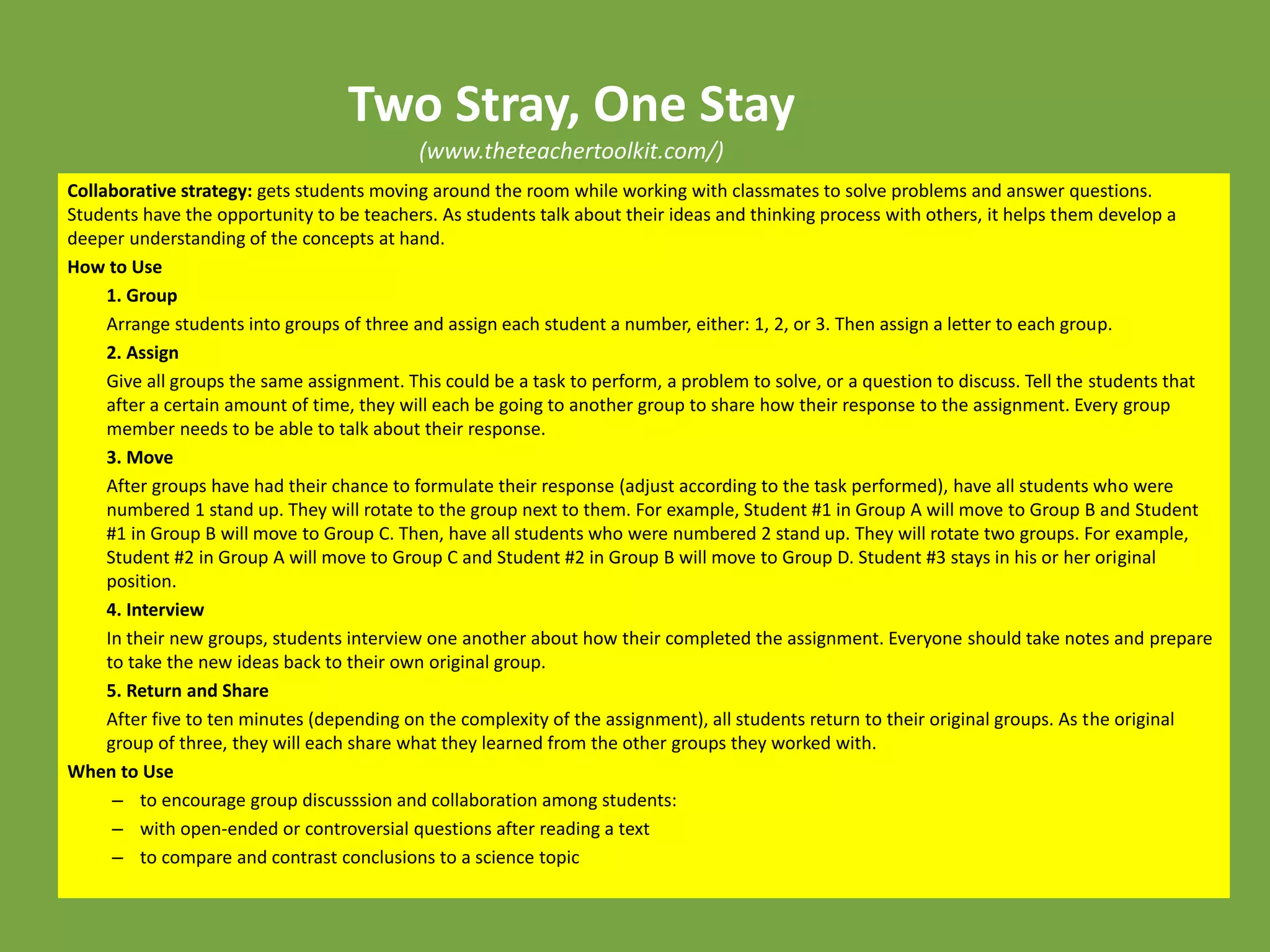
Two Stray, One Stay
(www.theteachertoolkit.com/)
Collaborative strategy: gets students moving around the room while working with classmates to solve problems and answer questions.
Students have the opportunity to be teachers. As students talk about their ideas and thinking process with others, it helps them develop a
deeper understanding of the concepts at hand.
How to Use
1. Group
Arrange students into groups of three and assign each student a number, either: 1, 2, or 3. Then assign a letter to each group.
2. Assign
Give all groups the same assignment. This could be a task to perform, a problem to solve, or a question to discuss. Tell the students that
after a certain amount of time, they will each be going to another group to share how their response to the assignment. Every group
member needs to be able to talk about their response.
3. Move
After groups have had their chance to formulate their response (adjust according to the task performed), have all students who were
numbered 1 stand up. They will rotate to the group next to them. For example, Student #1 in Group A will move to Group B and Student
#1 in Group B will move to Group C. Then, have all students who were numbered 2 stand up. They will rotate two groups. For example,
Student #2 in Group A will move to Group C and Student #2 in Group B will move to Group D. Student #3 stays in his or her original
position.
4. Interview
In their new groups, students interview one another about how their completed the assignment. Everyone should take notes and prepare
to take the new ideas back to their own original group.
5. Return and Share
After five to ten minutes (depending on the complexity of the assignment), all students return to their original groups. As the original
group of three, they will each share what they learned from the other groups they worked with.
When to Use
– to encourage group discusssion and collaboration among students:
– with open-ended or controversial questions after reading a text
– to compare and contrast conclusions to a science topic
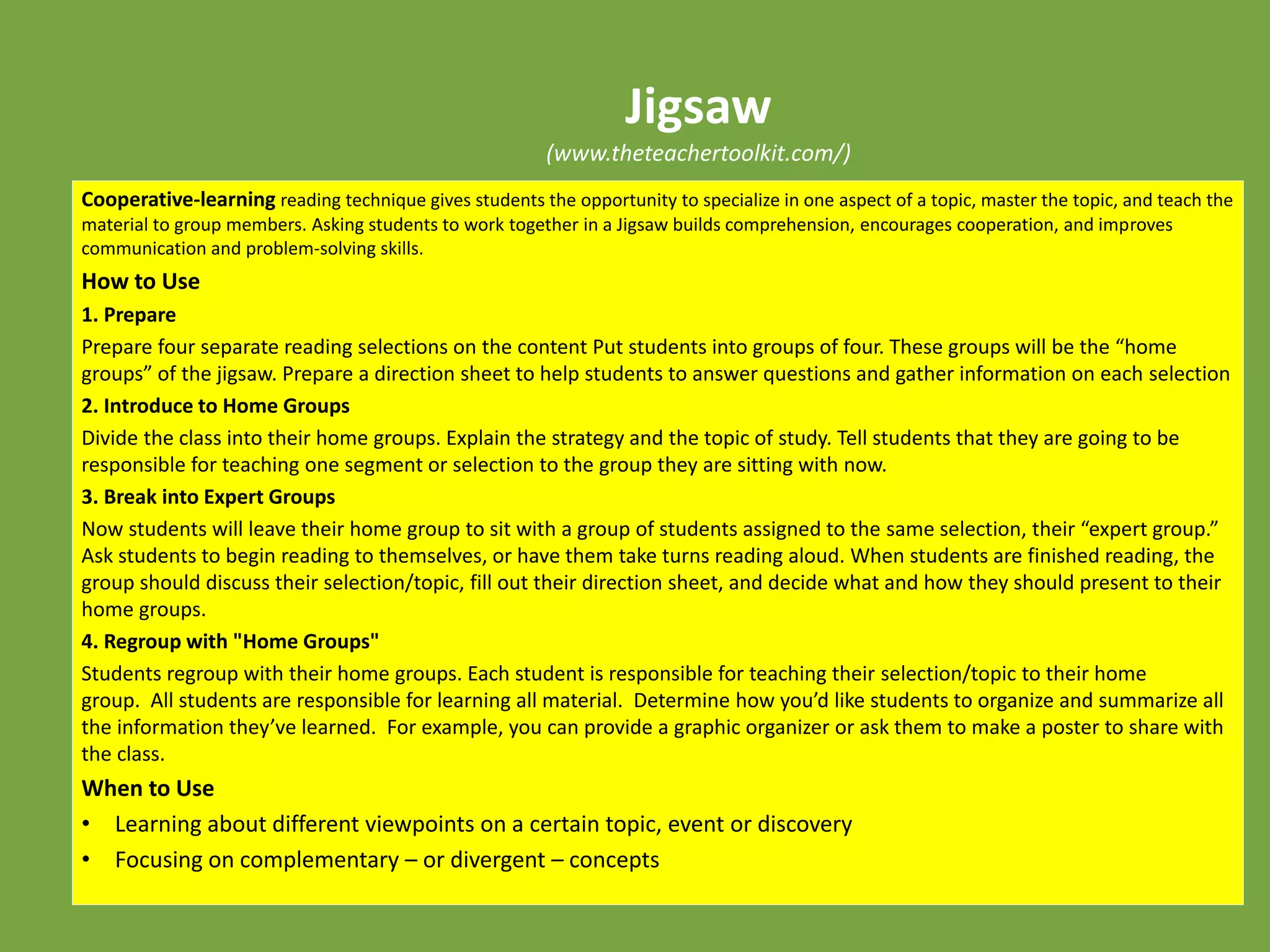
Jigsaw
(www.theteachertoolkit.com/)
Cooperative-learning reading technique gives students the opportunity to specialize in one aspect of a topic, master the topic, and teach the
material to group members. Asking students to work together in a Jigsaw builds comprehension, encourages cooperation, and improves
communication and problem-solving skills.
How to Use
1. Prepare
Prepare four separate reading selections on the content Put students into groups of four. These groups will be the “home
groups” of the jigsaw. Prepare a direction sheet to help students to answer questions and gather information on each selection
2. Introduce to Home Groups
Divide the class into their home groups. Explain the strategy and the topic of study. Tell students that they are going to be
responsible for teaching one segment or selection to the group they are sitting with now.
3. Break into Expert Groups
Now students will leave their home group to sit with a group of students assigned to the same selection, their “expert group.”
Ask students to begin reading to themselves, or have them take turns reading aloud. When students are finished reading, the
group should discuss their selection/topic, fill out their direction sheet, and decide what and how they should present to their
home groups.
4. Regroup with "Home Groups"
Students regroup with their home groups. Each student is responsible for teaching their selection/topic to their home
group. All students are responsible for learning all material. Determine how you’d like students to organize and summarize all
the information they’ve learned. For example, you can provide a graphic organizer or ask them to make a poster to share with
the class.
When to Use
• Learning about different viewpoints on a certain topic, event or discovery
• Focusing on complementary – or divergent – concepts
Four Corners
(www.theteachertoolkit.com/)
This technique stimulates student learning through movement and discussion. Students are presented with a controversial
statement or are asked a question. In each of the four corners of the classroom, an opinion or response is posted. Students
express their opinion or response by standing in front of one of four statements, and then talking to others about why they
have chosen their corner. Four Corners promotes listening, verbal communication, critical thinking, and decision-making.
How to Use
1. Prepare Generate a controversial statement or a question related to your topic of study. Create four different opinions
(often teachers use “Strongly Agree,” “Agree,” “Disagree,” and “Strongly Disagree”) related to the statement or four possible
answer choices to the question. Post these on chart paper in four different areas of your classroom. The opinions/answers can
also be shown on the overhead in multiple choice format, while each corner of the room is labeled as A, B, C, or D.
2. Present: Read the statement or problem to the class, without giving them choices. Allow time for students to independently
think about an answer to the statement/question. You can ask them to write down their answer and reason for their choice.
Then, provide the answer choices. Ask students to choose the option that comes closest to their original answer.
3. Commit to a Corner: Ask students to gather in the corner of the room that corresponds to their choice. In each corner,
students form groups of two or three to discuss the reasons for selecting a particular choice.
4. Discuss: Allow two or three minutes of discussion. Call on students to present a group summary of their opinions. This can
be done through an oral presentation or as a written statement.
When to Use
• Before introducing new material to tap into prior knowledge
• After watching a debatable film clip to gauge a reaction
• After reading a short text to begin a discussion
Supporte the discussion
Listen in, then support or challenge
Drop in on groups for short periods. As they may stop talking when a teacher appears, make sure they know you’re
just there to listen. When they continue talking in your presence, decide whether your input will be a) give them
more support in the mechanics of discussion, or b) challenge them to discuss on a higher level.
Deal with emerging problems
Noise can be a problem, and needs to be kept to a productive level. Don’t allow one group to become too noisy or
they will attract interest from other groups, who will lose their identity. Some student’ behaviours may fall into one of
these categories which will require action. Here are some suggestions:
Silent/shy students: invite them directly, ban interruptions, and congratulate small contributions
Clowns/distractors: confront and explain problem, give guidance and reward better behaviour, separate from anyone who encourages this
behaviour
Apathetic/bored: Place with friends, give them a specific role, and encourage contribution
Dominant/over-talkative: explain problem (but praise contribution) allocate a recording or leadership role, place with similar students
Duellists/aggressors: identify reasons, suggest preferred behaviour and advise on self-control and resolving conflict, separate known duellists
Move between small group and whole group
Show students their discussions are valued by getting contributions from individual groups and sharing these with the
whole group. Draw out similarities and differences, and get individual students to give reasons for the range of views.
Anticipate sensitive issues
If there are students who are vulnerable to the discussion topic, either warn them in advance, make sure they are in
an understanding group, or let them sit out.

Group discussion in_engage

  • 1.
  • 2.
    Aims The purpose ofthis presentation is… …to help teachers make group discussion work, especially group discussions that are linked to ENGAGE topics Learning how to… …set tasks …form groups …prepare groups, …and support discussion Reflecting on… …challenges experienced, …and considering solutions, Understanding … …the challenges of setting up and evaluating discussions linked to issues with moral and ethical concerns
  • 3.
    Why using GroupDiscussions? Group discussions are an important teaching approach in school science, because group discussions support a student-centered teaching help students to articulate on their own ideas about a scientific phenomenon and reflect upon a certain scientific ethical dilemma support the development of key science skills like arguing and reasoning support engaging with controversial issues also beyond school, through opinion sharing, discussion and negotiation students learn more actively, when they have more control and choice students learn from each other (to gain confidence and competence), using another’s ideas to help build their own, evaluating ideas, and comparing solutions shy or less articulate students may find it less threatening than speaking out in class, and easier to talk without the barrier of teacher-approved language Students enjoy it!
  • 4.
    Group discussions in ENGAGE? Smallgroups: ENGAGE Materials aim put students in groups of 3-4 to work on a collective task, without direct supervision by the teacher. Collaborative: The tasks are designed to be collaborative i.e. they ask students to work together and collectively as a group come to a decision or solve a problem. Authentic issues: Furthermore, the tasks are based on authentic issues, i.e. ill- structured problems with multiple solutions rather than right or wrong. Science meets Ethic: Some of the problems can be approached not only by making using of scientific knowledge, but also by basing decisions on ethical or moral concerns.
  • 5.
    Organising the Discussion Decide SetTasks Form Groups Prepare Discussion Support Discussion
  • 6.
    Decide Class as a group......or small groups in the class …or both Topic Ressources Time
  • 7.
    Set Tasks 1) Checkstudents have sufficient knowledge Discussion is more productive if students are confident with the expected prior knowledge that they will need to use in their discussion In ENGAGE materials, there is a starter to recap science concepts, before their implications are discussed. Our tasks also make it clear what are facts (not to be questioned) and what are evidence/opinion (can be argued about). 2) Keep tasks short and structured Less experienced students are likely to wander off topic, and it is best to start with short focussed tasks. To encourage high level discussion, ENGAGE tasks have a ‘discussion agenda’, listing the points to be discussed, to ensure students know what to talk about, and know when they are on/off topic. But take care, since on the other hand, over-structuring the task can stop students from thinking for themselves. 3) Make groups accountable for an output The best way to ensure students learn without supervision is to define a clear output for the task e.g. to solve a problem or come to a group decision. This should be reported back in some form, so that students know they have responsibility to achieve the output. 4) Create conflict – present the dilemma Students will be more likely to engage in arguing if the see a reason to do so - conflict. ENGAGE tasks create conflict by having sources which disagree, or by putting students into roles which have differences of opinion. Research indicates that conflict and the need to build on each others views improves quality of discussion and reevaluation of students’ positions.
  • 8.
    Form Group(s) Use groupsof 3 to 4 students • Sometimes students discuss in pairs, but this can lead to students seeing it as situation of right/wrong whereas with 4 students they will more likely see a range of opinions to be evaluated. Although a group can be up to 6, smaller groups help to avoid having students sitting on the sidelines while others dominate. Try friendship groups (?) • Group dynamics play a big part in a discussion. Students won’t discuss until they feel confident with their peers, and that it is OK to argue/conflict opinions. So stick with the same groups for a while. Friendship groups (which are generally single-sex) are worth trying, as they have been found to function more effectively than groupings that the teacher has decided. Give students discussion roles • Allocating roles can lead to more effective discussion when the roles support group interaction (and avoid students working independently). Leadership is vital to keep the discussion focussed and to uphold the ground rules. – Leader: reads the assignment, restates points, mediates conflict, and manages time – Listener - asks probing questions, or asks for better explanations, or recalls areas left out – Reporter - get group to answer his questions in order to report back – Encourager: gives team members feedback, is responsible for ensuring that all group members are heard. – Reflector: who keeps track of group process and makes comments about focus, listening skills, participation. • Organise the environment • Some laboratories present obstacles for small group discussion. Ideally students should sit in small circles, close together. Everyone needs to be facing each other if they are to talk to one another.
  • 9.
    Prepare Group(s) Establish groundrules upfront Students need to know the behaviour expected of them in groups. Too often these are left implicit. Ground rules for discussion can identified as a class, but an effective way to get students to follow them is to get them to write the list for themselves and to display it within the group. Then encourage students to refer to these whenever an issue arises. Since the whole purpose of discussion is to see things from perspectives different from our own, the most fundamental rule is listening to others A good set of rules might include: everyone's opinion is listened to and respected everyone takes responsibility for good behaviour Silence is O.K. Think before speaking Don’t interruptions or ridicule are discouraged If you don’t understand, ask for clarification everyone has an equal right to be heard
  • 10.
    Prepare Groups II(if you have time) Use practice exercises to develop discussion skills Try short exercises to build specific skills, before students start the discussion. For instance, there are many games to promote better listening: Being heard: Pair up students. One person talks about a hobby while the other person is instructed to ignore them. Discuss the frustration that can come with not feeling heard, and review strategies a good listener should practice. Listening accurately: One student reads a short story, and the others have to paraphrase. This activity shows how we prioritize certain information over others. Listening actively: One talks about a location they’d like to visit, but gives only hints as to the specific place. The listener has to pick up on these subtleties and at the end, recommend a suitable place. The original speaker will confirm or deny whether this and the two discuss ways people can pick up on the appropriate cues to play a more vital role in discussions.
  • 11.
    FORMATS / METHODSFOR GROUP DISCUSSION
  • 12.
    Group Discussion Formats discussionsinvolving socio-scientific issues, ethical aspects and decision-making is an interplay of meanings and ideas mainly from students and affords a different type of questioning Express ideas, no wright or wrong: More specifically, students need opportunities to express their own ideas (even if they are not always correct or well-structured), listen to their peers ideas, evaluate and critique ideas, and revise and integrate them as well. Classroom talk should center on engagement and thoughtfulness. Ask teachers and peers: Students should ask questions that arise from their own interests or confusion—and they should ask questions to each other as well as to the teacher. Teacher triggers: Teachers should pose questions that push students to think more deeply about what they have observed, experienced, or read.
  • 13.
    Group discussion Methods Consciencealley Debatte Consequences wheel Mind movies Two Stray, One Stay Jigsaw Four Corners
  • 14.
  • 15.
  • 16.
  • 17.
    Mind movies What How toUse When to Use
  • 18.
    Two Stray, OneStay (www.theteachertoolkit.com/) Collaborative strategy: gets students moving around the room while working with classmates to solve problems and answer questions. Students have the opportunity to be teachers. As students talk about their ideas and thinking process with others, it helps them develop a deeper understanding of the concepts at hand. How to Use 1. Group Arrange students into groups of three and assign each student a number, either: 1, 2, or 3. Then assign a letter to each group. 2. Assign Give all groups the same assignment. This could be a task to perform, a problem to solve, or a question to discuss. Tell the students that after a certain amount of time, they will each be going to another group to share how their response to the assignment. Every group member needs to be able to talk about their response. 3. Move After groups have had their chance to formulate their response (adjust according to the task performed), have all students who were numbered 1 stand up. They will rotate to the group next to them. For example, Student #1 in Group A will move to Group B and Student #1 in Group B will move to Group C. Then, have all students who were numbered 2 stand up. They will rotate two groups. For example, Student #2 in Group A will move to Group C and Student #2 in Group B will move to Group D. Student #3 stays in his or her original position. 4. Interview In their new groups, students interview one another about how their completed the assignment. Everyone should take notes and prepare to take the new ideas back to their own original group. 5. Return and Share After five to ten minutes (depending on the complexity of the assignment), all students return to their original groups. As the original group of three, they will each share what they learned from the other groups they worked with. When to Use – to encourage group discusssion and collaboration among students: – with open-ended or controversial questions after reading a text – to compare and contrast conclusions to a science topic
  • 19.
    Jigsaw (www.theteachertoolkit.com/) Cooperative-learning reading techniquegives students the opportunity to specialize in one aspect of a topic, master the topic, and teach the material to group members. Asking students to work together in a Jigsaw builds comprehension, encourages cooperation, and improves communication and problem-solving skills. How to Use 1. Prepare Prepare four separate reading selections on the content Put students into groups of four. These groups will be the “home groups” of the jigsaw. Prepare a direction sheet to help students to answer questions and gather information on each selection 2. Introduce to Home Groups Divide the class into their home groups. Explain the strategy and the topic of study. Tell students that they are going to be responsible for teaching one segment or selection to the group they are sitting with now. 3. Break into Expert Groups Now students will leave their home group to sit with a group of students assigned to the same selection, their “expert group.” Ask students to begin reading to themselves, or have them take turns reading aloud. When students are finished reading, the group should discuss their selection/topic, fill out their direction sheet, and decide what and how they should present to their home groups. 4. Regroup with "Home Groups" Students regroup with their home groups. Each student is responsible for teaching their selection/topic to their home group. All students are responsible for learning all material. Determine how you’d like students to organize and summarize all the information they’ve learned. For example, you can provide a graphic organizer or ask them to make a poster to share with the class. When to Use • Learning about different viewpoints on a certain topic, event or discovery • Focusing on complementary – or divergent – concepts
  • 20.
    Four Corners (www.theteachertoolkit.com/) This techniquestimulates student learning through movement and discussion. Students are presented with a controversial statement or are asked a question. In each of the four corners of the classroom, an opinion or response is posted. Students express their opinion or response by standing in front of one of four statements, and then talking to others about why they have chosen their corner. Four Corners promotes listening, verbal communication, critical thinking, and decision-making. How to Use 1. Prepare Generate a controversial statement or a question related to your topic of study. Create four different opinions (often teachers use “Strongly Agree,” “Agree,” “Disagree,” and “Strongly Disagree”) related to the statement or four possible answer choices to the question. Post these on chart paper in four different areas of your classroom. The opinions/answers can also be shown on the overhead in multiple choice format, while each corner of the room is labeled as A, B, C, or D. 2. Present: Read the statement or problem to the class, without giving them choices. Allow time for students to independently think about an answer to the statement/question. You can ask them to write down their answer and reason for their choice. Then, provide the answer choices. Ask students to choose the option that comes closest to their original answer. 3. Commit to a Corner: Ask students to gather in the corner of the room that corresponds to their choice. In each corner, students form groups of two or three to discuss the reasons for selecting a particular choice. 4. Discuss: Allow two or three minutes of discussion. Call on students to present a group summary of their opinions. This can be done through an oral presentation or as a written statement. When to Use • Before introducing new material to tap into prior knowledge • After watching a debatable film clip to gauge a reaction • After reading a short text to begin a discussion
  • 21.
    Supporte the discussion Listenin, then support or challenge Drop in on groups for short periods. As they may stop talking when a teacher appears, make sure they know you’re just there to listen. When they continue talking in your presence, decide whether your input will be a) give them more support in the mechanics of discussion, or b) challenge them to discuss on a higher level. Deal with emerging problems Noise can be a problem, and needs to be kept to a productive level. Don’t allow one group to become too noisy or they will attract interest from other groups, who will lose their identity. Some student’ behaviours may fall into one of these categories which will require action. Here are some suggestions: Silent/shy students: invite them directly, ban interruptions, and congratulate small contributions Clowns/distractors: confront and explain problem, give guidance and reward better behaviour, separate from anyone who encourages this behaviour Apathetic/bored: Place with friends, give them a specific role, and encourage contribution Dominant/over-talkative: explain problem (but praise contribution) allocate a recording or leadership role, place with similar students Duellists/aggressors: identify reasons, suggest preferred behaviour and advise on self-control and resolving conflict, separate known duellists Move between small group and whole group Show students their discussions are valued by getting contributions from individual groups and sharing these with the whole group. Draw out similarities and differences, and get individual students to give reasons for the range of views. Anticipate sensitive issues If there are students who are vulnerable to the discussion topic, either warn them in advance, make sure they are in an understanding group, or let them sit out.