DNA TIMELINE
What is DNA?
DNA stands for Deoxyribo Nucleic Acid.
DNA carries all of the genetic information for an

organism.
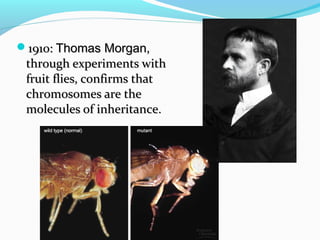
1910: Thomas Morgan,

through experiments with
fruit flies, confirms that
chromosomes are the
molecules of inheritance.
1928: Frederick Griffith conducts the first genetic

experiments on mammals.
His experiments dealt with mice and the
pneumonia virus.
He used two forms: the S form (deadly) and the R
form (not deadly).
A transforming material passed from dead S
bacteria to live R bacteria, making them deadly.
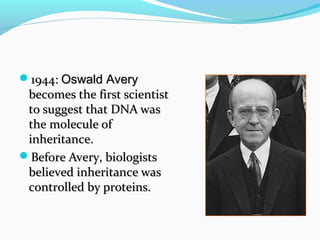
1944: Oswald Avery

becomes the first scientist
to suggest that DNA was
the molecule of
inheritance.
Before Avery, biologists
believed inheritance was
controlled by proteins.
1950: Edwin Chargaff

determines that certain
purines and pyrimidines
occur in equal amounts in
a DNA strand.
This leads to Chargaff’s
Rules: the amount of A =
the amount of T, and the
amount of G = the amount
of C.
“For every A there is a T, for every G there is a C”
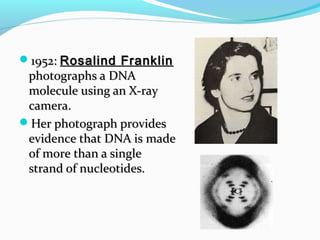
1952: Rosalind Franklin

photographs a DNA
molecule using an X-ray
camera.
Her photograph provides
evidence that DNA is made
of more than a single
strand of nucleotides.
Franklin’s co-worker,

Maurice Wilkins, gives the
photograph to a pair of
scientists, James
Watson & Francis
Crick , who are trying to
determine the structure of
DNA.
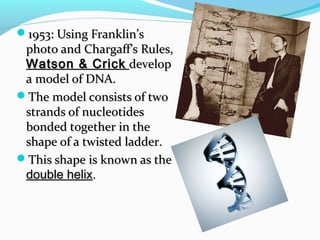
1953: Using Franklin’s

photo and Chargaff’s Rules,
Watson & Crick develop
a model of DNA.
The model consists of two
strands of nucleotides
bonded together in the
shape of a twisted ladder.
This shape is known as the
double helix.
DNA Structure is the same in all organisms.
DNA is a Nucleic Acid (one of the macromolecules

[polymers] we learned about during our Biochemistry
unit) made up of long chains of nucleotides.
Each nucleotide has three parts.
phosphate group

deoxyribose (sugar)

nitrogen-containing
base
DNA Structure


DNA consists of two
strands of nucleotides.
DNA looks like a twisted
ladder
The “backbone” of the
ladder is formed by bonds
between the...
 Sugars (Deoxyribose)
 Phosphates.

The “rungs” of the ladder

are formed by hydrogen
bonds between
nitrogenous bases.

Nucleotide

Sugarphosphate
backbone

Hydrogen
bonds
1. Purines: larger bases.
There are two
purines.
A. Adenine (A)
B. Guanine (G)
2. Pyrimidines: smaller
bases. There are two
pyrimidines.
A. Cytosine (C)
B. Thymine (T)

A

G
C

Phosphate

T

Deoxyribose
DNA Structure

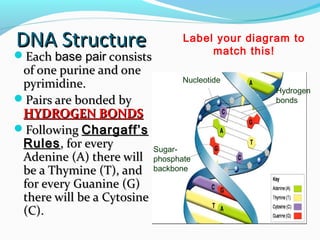
Each base pair consists

of one purine and one
pyrimidine.
Pairs are bonded by
HYDROGEN BONDS
Following Chargaff’s
Rules , for every
Adenine (A) there will
be a Thymine (T), and
for every Guanine (G)
there will be a Cytosine
(C).

Label your diagram to
match this!
Nucleotide

Sugarphosphate
backbone

Hydrogen
bonds

DNA discovery & Structure 8.1 & 8.2

  • 1.
  • 2.
    What is DNA? DNAstands for Deoxyribo Nucleic Acid. DNA carries all of the genetic information for an organism.
  • 3.
    1910: Thomas Morgan, throughexperiments with fruit flies, confirms that chromosomes are the molecules of inheritance.
  • 4.
    1928: Frederick Griffithconducts the first genetic experiments on mammals. His experiments dealt with mice and the pneumonia virus. He used two forms: the S form (deadly) and the R form (not deadly). A transforming material passed from dead S bacteria to live R bacteria, making them deadly.
  • 5.
    1944: Oswald Avery becomesthe first scientist to suggest that DNA was the molecule of inheritance. Before Avery, biologists believed inheritance was controlled by proteins.
  • 6.
    1950: Edwin Chargaff determinesthat certain purines and pyrimidines occur in equal amounts in a DNA strand. This leads to Chargaff’s Rules: the amount of A = the amount of T, and the amount of G = the amount of C. “For every A there is a T, for every G there is a C”
  • 7.
    1952: Rosalind Franklin photographsa DNA molecule using an X-ray camera. Her photograph provides evidence that DNA is made of more than a single strand of nucleotides.
  • 8.
    Franklin’s co-worker, Maurice Wilkins,gives the photograph to a pair of scientists, James Watson & Francis Crick , who are trying to determine the structure of DNA.
  • 9.
    1953: Using Franklin’s photoand Chargaff’s Rules, Watson & Crick develop a model of DNA. The model consists of two strands of nucleotides bonded together in the shape of a twisted ladder. This shape is known as the double helix.
  • 10.
    DNA Structure isthe same in all organisms. DNA is a Nucleic Acid (one of the macromolecules [polymers] we learned about during our Biochemistry unit) made up of long chains of nucleotides. Each nucleotide has three parts. phosphate group deoxyribose (sugar) nitrogen-containing base
  • 11.
    DNA Structure  DNA consistsof two strands of nucleotides. DNA looks like a twisted ladder The “backbone” of the ladder is formed by bonds between the...  Sugars (Deoxyribose)  Phosphates. The “rungs” of the ladder are formed by hydrogen bonds between nitrogenous bases. Nucleotide Sugarphosphate backbone Hydrogen bonds
  • 12.
    1. Purines: largerbases. There are two purines. A. Adenine (A) B. Guanine (G) 2. Pyrimidines: smaller bases. There are two pyrimidines. A. Cytosine (C) B. Thymine (T) A G C Phosphate T Deoxyribose
  • 14.
    DNA Structure Each basepair consists of one purine and one pyrimidine. Pairs are bonded by HYDROGEN BONDS Following Chargaff’s Rules , for every Adenine (A) there will be a Thymine (T), and for every Guanine (G) there will be a Cytosine (C). Label your diagram to match this! Nucleotide Sugarphosphate backbone Hydrogen bonds