History DNA
Development
What is DNA?
• DNA or Deoxyribonucleic acid
is the genetic material that is
passed from one generation
to the next or a blue print for
building living organisms.
• The two DNA strands are
called polynucleotides since
they are composed of
simple monomer units
called nucleotides.
• Each nucleotide contains a
phosphate group, a sugar
group and a nitrogen base.
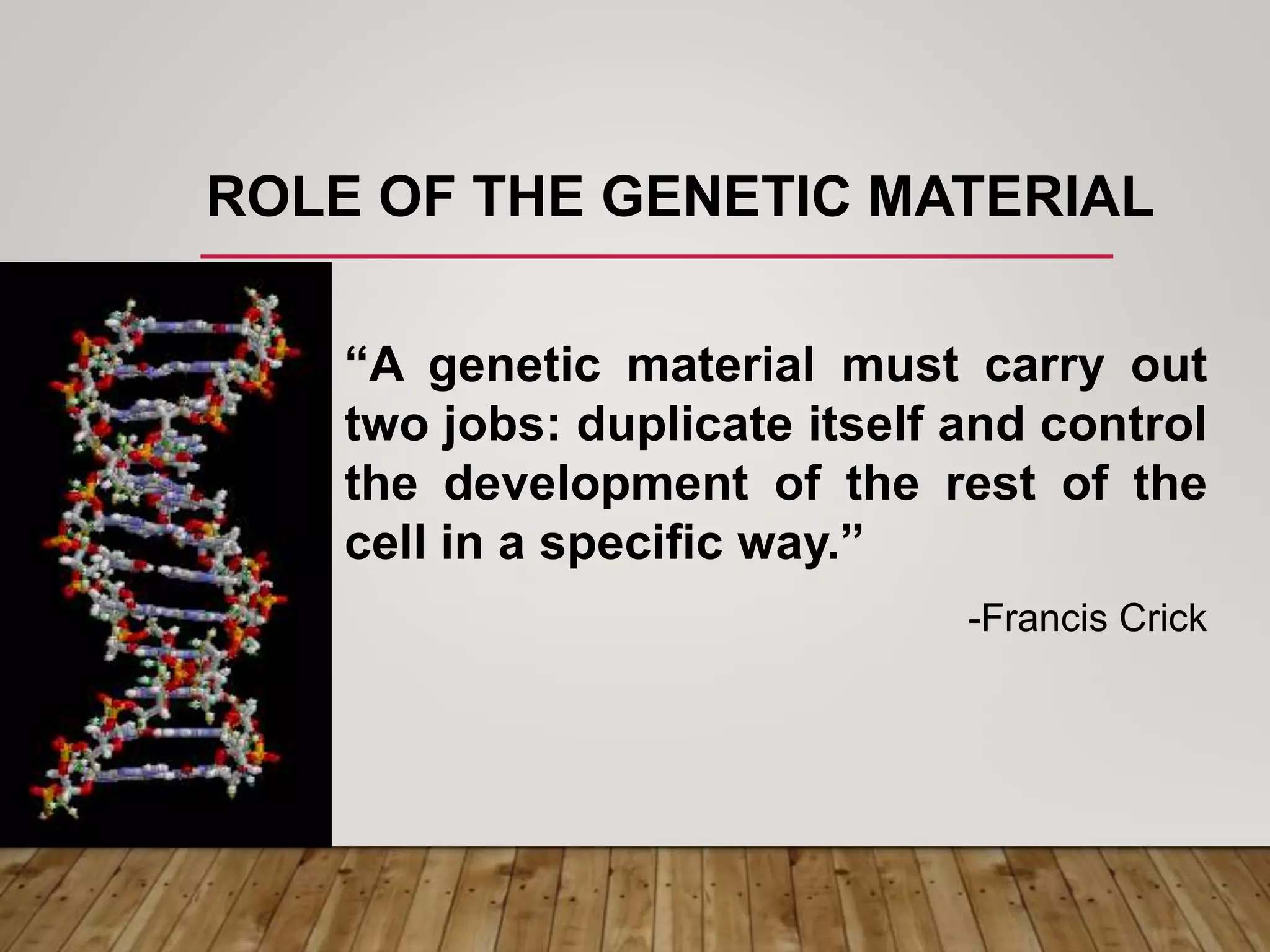
ROLE OF THE GENETIC MATERIAL
“A genetic material must carry out
two jobs: duplicate itself and control
the development of the rest of the
cell in a specific way.”
-Francis Crick
HISTORY
• Although we now accept the idea that DNA is
responsible for our biological structure, before
the mid-1800’s it was unthinkable for the leading
Scientists and Philosophers that a chemical
molecule could hold enough information to build
a human. They believed that plants and animals
had been specifically designed by a creator.
• Charles Darwin is famous for challenging
this view. In 1859 Charles Darwin
published ‘The Origin of Species‘ which
expressed that living things appear to be
designed, but may actually be the result
of natural selection. Darwin showed that
living creatures evolve over several
generations through a series of small
changes.
Charles Darwin
• Charles Robert Darwin, was an English
naturalist, geologist and biologist, best
known for his contributions to the
science of evolution. Darwin began
detailed investigations and in 1838
conceived his theory of natural selection.
In the 1860s Darwin's ideas were finally
supported when genetics was discovered
by Gregor Mendel. He discover the basic
rules of Heredity of garden pea. His
experiment involved growing thousands
of pea plants for 8 years and observed 7
characters.
Gregor Mendel
1823-1884
Conclusion Of Mendel Experiment
An individual organism has two
alternative heredity units for a given trait
(Dominant trait vs. Recessive trait)
The genes are passed to later
generations from both its parents.
He gave two law
1.Law of Segregation
2. Law of Independent Assortment
In 1869, a German scientist named
Friedrich Miescher had isolated various
phosphate rich chemicals found in the
nucleus called nuclein from the nuclei of
white blood cells. These were proteins and
nucleic acids.
Friedrich Miescher raised the idea
that the nucleic acids could be involved in
heredity.
Later he isolated a pure sample of
the material now known as DNA from the
sperm of salmon, and in 1899 his
pupil, Richard Altmann named it "nucleic
acid". The extract is rich in Phosphorus and
Nitrogen, but not in sulfur. This substance
was found to exist only in the
chromosomes.
Johannes Friedrich
Miescher Swiss physician
1844-1895
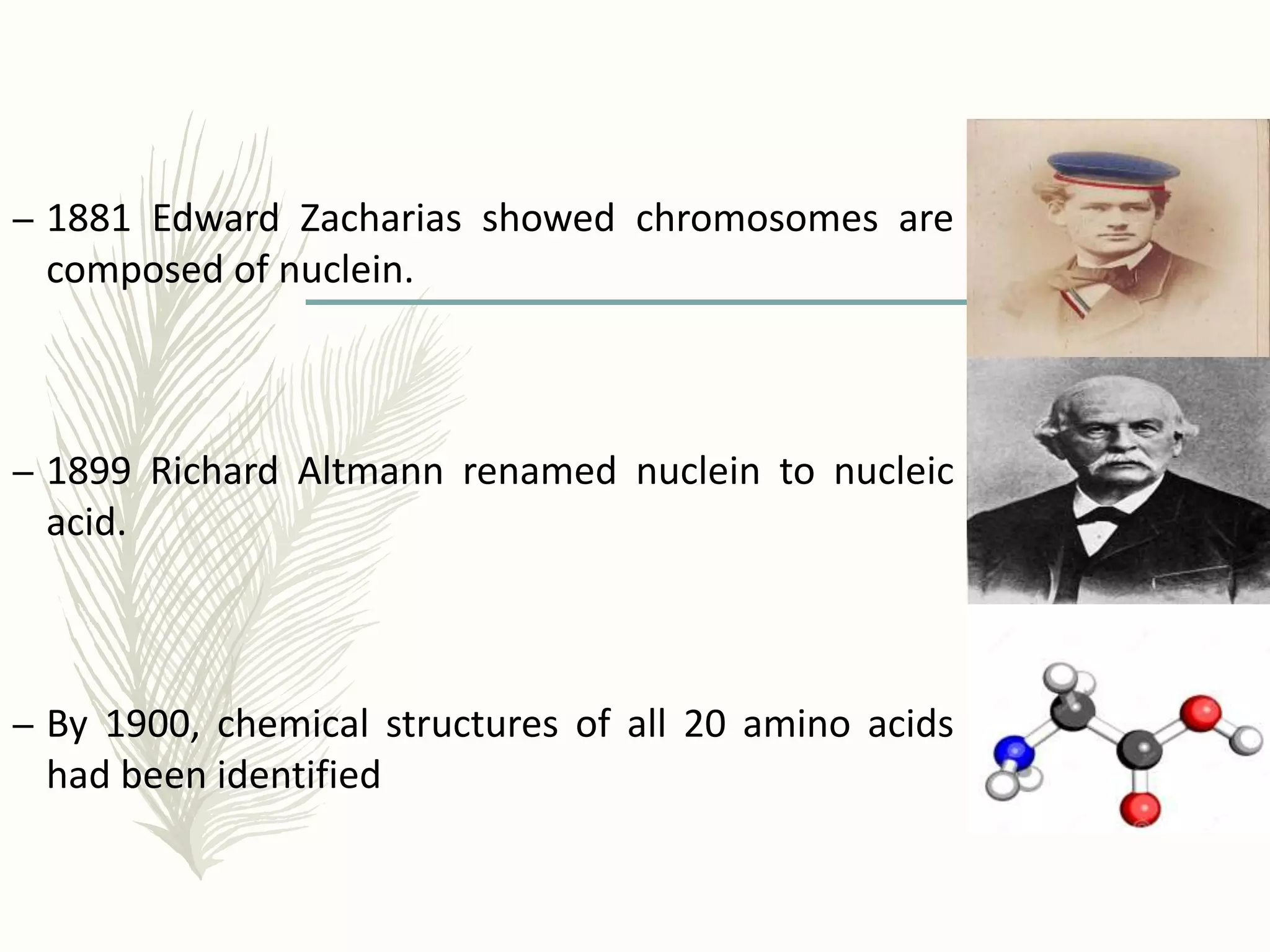
– 1881 Edward Zacharias showed chromosomes are
composed of nuclein.
– 1899 Richard Altmann renamed nuclein to nucleic
acid.
– By 1900, chemical structures of all 20 amino acids
had been identified
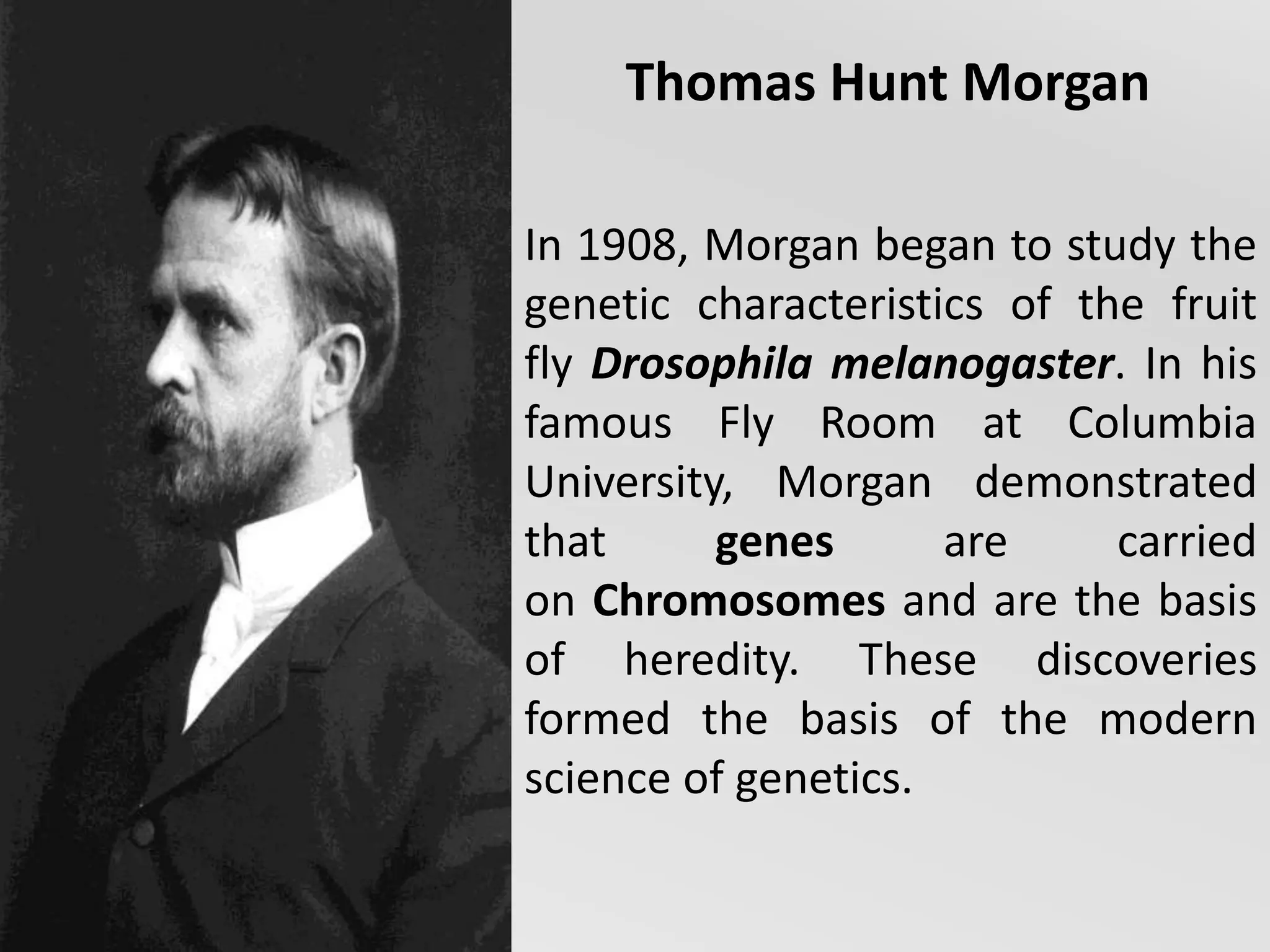
Thomas Hunt Morgan
In 1908, Morgan began to study the
genetic characteristics of the fruit
fly Drosophila melanogaster. In his
famous Fly Room at Columbia
University, Morgan demonstrated
that genes are carried
on Chromosomes and are the basis
of heredity. These discoveries
formed the basis of the modern
science of genetics.
Frederick Griffith
He was working on a project in
1928 that formed the basis that DNA
was the molecule of
inheritance. Griffith's experiment
involved mice and two types of
pneumonia. One was virulent and the
other non-virulent.
-S bacteria (smooth coat)- pneumonia
-R bacteria (rough coat) - no
pneumonia
1881 - 1941
Bacterial
colonies
Rough
nonvirulent
(strain R)
Injection
Results
Mouse healthy
Smooth
virulent
(strain S)
Mouse dies
Heat-killed
smooth
virulent
(strain S)
Live strain S bacteria
Found in blood sample
from dead mouse
Mouse dies
Mouse healthy
+
Rough
nonvirulent
(strain R)
Heat-killed
smooth
virulent
(strain S)
Griffith’s experiment identifying the “transforming principle”
• Discovery: something in heat-killed virulent bacteria could be
transferred to live harmless bacteria and make them virulent.
1. He injected the virulent pneumonia into a mouse and the
mouse died.
2. Next he injected the non-virulent pneumonia into a mouse
and the mouse survived.
3. After this, he heated up the virulent disease to kill it and then
injected it into a mouse. This time the animal survived as
predicted.
4. Last he injected non-virulent pneumonia and virulent
pneumonia that had been heated and killed, into a
mouse. This time the mouse died.
Phoebus Levene
In 1929 Phoebus Levene at the
Rockefeller Institute identified the
components that make up a DNA
Molecule. Those components are:
1.The four bases
1.Adenine (A) 3. Thymine (T)
2.Guanine (G) 4. Cytosine (C)
2.Sugar
3.Phosphate
• He showed that the
components of DNA were linked
in the order phosphate-sugar-N
base.
1869-1940
• He said that each of these units is a nucleotide and
suggested the DNA molecule consisted of a string of
nucleotide units linked together through the
phosphate groups. He suggested that these form a
'backbone' of the molecule.
• However, Levene thought the chain was short and
that the bases repeated in the same fixed order. It
was Torbjorn Caspersson and Einar Hammerstein
who showed that DNA was a polymer.
Oswald Avery ,
McCarty & MacLeod
(1877-1955)
Avery continued working with Griffith’s
findings in hope of discovering what
factor in bacteria carried the trait of
virulence and showed that DNA is the
unit of Inheritance in 1944. And his work
inspired Watson and Crick to seek DNA's
Structure.
• They decided to use the process of
elimination
• Extracts were treated with either
1. Proteases (to destroy protein)
2. RNase (to destroy RNA)
3. DNase (to destroy DNA)
• Transformation was due exclusively
to DNA
In this experiment he destroyed the carbohydrates,
lipids, ribonucleic acids (RNA), and proteins of the
virulent pneumonia. Transformation still occurred after
this. Next he destroyed the deoxyribonucleic
acid(DNA). Transformation did not occur. He had found
the basis of the inheritance and showed that DNA is the
unit of Inheritance.
Erwin Chargaff and
Chargaff’s rule
• To understand the DNA molecule
better, scientists were trying to make a
model to understand how it works and
what it does. In the 1947 Erwin
Chargaff found the pattern in the
amounts of the four bases: adenine,
guanine, cytosine, and thymine.
• He took samples of DNA of different
cells and found that the amount of
adenine was almost equal to the
amount of thymine, and that the
amount of guanine was almost equal
to the amount of cytosine.
(1905-2002)
• The first rule was that in DNA the number of guanine
units is equal to the number of cytosine units, and the
number of adenine units is equal to the number of
thymine units. This hinted at the base pair makeup of
DNA.
• Thus you could say: A=T and G=C
• The second rule was that the relative amounts of
guanine, cytosine, adenine and thymine bases vary
from one species to another. This hinted that DNA
rather than protein could be the genetic material.
• Bases present in characteristic ratio
humans:
A = 30.9% T = 29.4%
G = 19.9% C = 19.8%
“This discovery later became Chargaff’s Rule”
Alfred Hershey and
Martha Chase
• In 1952, Alfred Hershey and
Martha Chase used
bacteriophage (a viruses that
infect the Bacteria) to prove
that DNA was the hereditary
material.
• grew phage viruses in 2 media,
radioactively labeled with
either
35S in their proteins
32P in their DNA
Protein coat labeled
with 35S
DNA labeled with 32P
bacteriophages infect
bacterial cells
T2 bacteriophages
are labeled with
radioactive isotopes
Sulphur vs Phosphorus
bacterial cells are agitated
to remove viral protein coats
35S radioactivity
found in the medium
32P radioactivity found
in the bacterial cells
Hershey &
Chase
Radioactive phage & bacteria in blender
35S phage
radioactive proteins stayed in supernatant
therefore viral protein did not enter bacteria
32P phage
radioactive DNA stayed in pellet
therefore viral DNA did enter bacteria
Confirmed DNA is the genetic material.
Blender experiment
Rosalind Franklin (1920-1958)
[THE DARK LADY OF DNA]
• Franklin, trained as a chemist,
was expert in deducing the
structure of molecules by firing X-
rays through them. Her images of
DNA disclosed without her
knowledge & Watson and Crick
on the track towards the right
structure. She went on to do
pioneering work on the
structures of viruses.
Rosalind Franklin
The Evidence
James Watson and Francis Crick used this photo as an evidence to
describe the structure of DNA
X-ray diffraction photo of DNA
Image produced by Rosalind
Franklin gave in 1952
Photo-51
James Watson – American
ornithologist
Francis Crick – British Physicist
• James Watson was an
American, born in 1928, was
only 24 when the discovery
was made.
• Francis Crick was born in 1916.
He went to London University
and trained as a physicist. After
the war he changed the
direction of his research to
molecular biology.
James Watson
• Watson went to university in
Chicago at age 15, and teamed
up with Crick in Cambridge in
late 1951. After solving the
double helix, he went on to work
on viruses and RNA. He also
helped to launch the human
genome project and is president
of Cold Spring Harbor Laboratory
in New York.
Francis Crick (1916-2004)
• Crick trained and worked as a
physicist, but switched to biology
after the Second World War.
After co discovering the structure
of DNA, he went on to crack the
genetic code that translates DNA
into protein. He is widely known
for the use of the term "central
dogma" to summarize the idea
that once information is
transferred from nucleic acids
(DNA or RNA) to proteins, it
cannot flow back to nucleic
acids.
Linus Pauling (1901-1994)
• The titan of twentieth-century
chemistry, Pauling led the way
in working out the structure of
big biological molecules, and
Watson and Crick saw him as
their main competitor. In early
1953,he was working without
the benefit of X-ray pictures and
he published a paper suggesting
that DNA was a triple helix.
• The DNA molecule was discovered in 1951 by Francis
Crick, James Watson and Maurice Wilkins using X-ray
Diffraction.
• In Spring 1953, Francis Crick and James Watson, two
scientists working at the Cavendish Laboratory in
Cambridge, discovered the structure of the DNA a
double helix, or inter-locking pair of spirals, joined by
pairs of molecules.
• In July 1952, Erwin Chargaff visited Watson and
Crick and told of his 1947 findings that the ratios of
A/T and G/C were statistically equal for a wide
variety of DNA’s. Crick became convinced that base
pairing was the key to the structure.
• Prompted by receiving a flawed manuscript on
DNA structure from Pauling, Watson again visited
King’s and Wilkins showed him a DNA x-ray pattern
taken by Franklin showing clear double helical
characteristics.
• Along with Francis Crick, Watson used
characteristics and features of Photo 51 to develop
the chemical model of the DNA molecule
• Watson brought back to Cambridge, but Crick produced a
three-strand model structure only a week later.
• Invited to view this, Franklind pointed out that it was
inconsistent with her results – it had the phosphate groups
on the inside whereas her results showed they were on the
outside, and the water content was too low.
• Watson began pursuing the idea of hydrogen bonding of
the four bases. He found that (A+T) and (G+C) could be
bonded together to form pairs with very similar shapes.
• On this basis, a model was built consistent with the
Franklin’s symmetry and Chargaff’s results, and Watson &
Crick published in April 1953 in Nature accompanied by
ones from the Wilkins and Franklin groups.
• Watson and Crick’s paper ends with the oft-
quoted line “It has not escaped our notice that
the specific pairing we have postulated
immediately suggests a possible copying
mechanism for the genetic material”.
1. Franklin’s X-ray data
• Double helix
• Uniform width of 2 nm
• Bases stacked 0.34 nm apart
2. Chargaff's rules
• Adenine pairs with thymine
• Cytosine pairs with guanine
What they deduced from
3. What they came up with
on their own:
• Bases face inward,
phosphates and sugars
outward
• Hydrogen bonding
• Hinted at semi-conservative
model for replication
Watson and Crick with their DNA model
Crick, Watson and Wilkins won the Nobel Prize for medicine in
1962. Maurice Wilkins was at King's College, London and was
an expert in X-ray photography. His colleague, Rosalind
Franklin, did brilliant work developing the technique to
photograph a single strand of DNA. She received little
recognition for this at the time and died tragically of cancer in
1958, so could not be recognized in the Nobel Award.
The Nobel Prize
The Meselson–Stahl experiment is an experiment
by Matthew Meselson and Franklin Stahl in 1958
which supported Watson and Crick's hypothesis
that DNA replication was semiconservative. In
semiconservative replication, when the double
stranded DNA helix is replicated, each of the two new
double-stranded DNA helices consisted of one strand
from the original helix and one newly synthesized. It
has been called "the most beautiful experiment in
biology”
Meselson–Stahl
conservative semiconservative dispersive
Models of DNA Replication
Frederick Sanger
• In 1977, Frederick Sanger
developed the classical “DNA
sequencing” technique, now
known as the Sanger method, to
determine the order of bases in a
strand of DNA.
• Special enzymes are used to
synthesize short pieces of DNA,
which end when a selected
“terminating” base is added to the
stretch of DNA being synthesized.
• Typically, each of these
terminating bases is tagged with a
radioactive marker, so it can be
identified.
• Then the DNA fragments, of varying lengths,
are separated by how rapidly they move
through a gel matrix when an electric field is
applied – a technique called electrophoresis.
• Frederick Sanger shared the 1980 Nobel Prize
in Chemistry for his contributions to DNA-
sequencing methods, which he shared with
Walter Gilbert and Paul Berg.
T.H. Morgan (1908) :: genes are on chromosomes
Frederick Griffith (1928) :: a transforming factor can change
phenotype
Phoebus Levene (1929) :: identified the components
that
make up a DNA
Molecule
Avery, McCarty & MacLeod (1944) :: transforming factor is
DNA
Erwin Chargaff (1947) :: Chargaff rules: A = T, C = G
Scientific History
Hershey & Chase (1952) :: confirmation that DNA is
genetic material
Rosalind Franklin (1952) :: Gave Photo-51 which showed X-
ray diffraction photo of DNA
Watson & Crick (1953) :: determined double helix
structure of DNA
Meselson & Stahl (1958) :: supported DNA replication is
semi-conservative replication
Frederick Sanger :: DNA sequencing
History of DNA Development

History of DNA Development

  • 1.
  • 2.
    What is DNA? •DNA or Deoxyribonucleic acid is the genetic material that is passed from one generation to the next or a blue print for building living organisms. • The two DNA strands are called polynucleotides since they are composed of simple monomer units called nucleotides. • Each nucleotide contains a phosphate group, a sugar group and a nitrogen base.
  • 3.
    ROLE OF THEGENETIC MATERIAL “A genetic material must carry out two jobs: duplicate itself and control the development of the rest of the cell in a specific way.” -Francis Crick
  • 4.
    HISTORY • Although wenow accept the idea that DNA is responsible for our biological structure, before the mid-1800’s it was unthinkable for the leading Scientists and Philosophers that a chemical molecule could hold enough information to build a human. They believed that plants and animals had been specifically designed by a creator.
  • 5.
    • Charles Darwinis famous for challenging this view. In 1859 Charles Darwin published ‘The Origin of Species‘ which expressed that living things appear to be designed, but may actually be the result of natural selection. Darwin showed that living creatures evolve over several generations through a series of small changes. Charles Darwin • Charles Robert Darwin, was an English naturalist, geologist and biologist, best known for his contributions to the science of evolution. Darwin began detailed investigations and in 1838 conceived his theory of natural selection.
  • 6.
    In the 1860sDarwin's ideas were finally supported when genetics was discovered by Gregor Mendel. He discover the basic rules of Heredity of garden pea. His experiment involved growing thousands of pea plants for 8 years and observed 7 characters. Gregor Mendel 1823-1884 Conclusion Of Mendel Experiment An individual organism has two alternative heredity units for a given trait (Dominant trait vs. Recessive trait) The genes are passed to later generations from both its parents. He gave two law 1.Law of Segregation 2. Law of Independent Assortment
  • 7.
    In 1869, aGerman scientist named Friedrich Miescher had isolated various phosphate rich chemicals found in the nucleus called nuclein from the nuclei of white blood cells. These were proteins and nucleic acids. Friedrich Miescher raised the idea that the nucleic acids could be involved in heredity. Later he isolated a pure sample of the material now known as DNA from the sperm of salmon, and in 1899 his pupil, Richard Altmann named it "nucleic acid". The extract is rich in Phosphorus and Nitrogen, but not in sulfur. This substance was found to exist only in the chromosomes. Johannes Friedrich Miescher Swiss physician 1844-1895
  • 8.
    – 1881 EdwardZacharias showed chromosomes are composed of nuclein. – 1899 Richard Altmann renamed nuclein to nucleic acid. – By 1900, chemical structures of all 20 amino acids had been identified
  • 9.
    Thomas Hunt Morgan In1908, Morgan began to study the genetic characteristics of the fruit fly Drosophila melanogaster. In his famous Fly Room at Columbia University, Morgan demonstrated that genes are carried on Chromosomes and are the basis of heredity. These discoveries formed the basis of the modern science of genetics.
  • 10.
    Frederick Griffith He wasworking on a project in 1928 that formed the basis that DNA was the molecule of inheritance. Griffith's experiment involved mice and two types of pneumonia. One was virulent and the other non-virulent. -S bacteria (smooth coat)- pneumonia -R bacteria (rough coat) - no pneumonia 1881 - 1941
  • 11.
    Bacterial colonies Rough nonvirulent (strain R) Injection Results Mouse healthy Smooth virulent (strainS) Mouse dies Heat-killed smooth virulent (strain S) Live strain S bacteria Found in blood sample from dead mouse Mouse dies Mouse healthy + Rough nonvirulent (strain R) Heat-killed smooth virulent (strain S) Griffith’s experiment identifying the “transforming principle” • Discovery: something in heat-killed virulent bacteria could be transferred to live harmless bacteria and make them virulent.
  • 12.
    1. He injectedthe virulent pneumonia into a mouse and the mouse died. 2. Next he injected the non-virulent pneumonia into a mouse and the mouse survived. 3. After this, he heated up the virulent disease to kill it and then injected it into a mouse. This time the animal survived as predicted. 4. Last he injected non-virulent pneumonia and virulent pneumonia that had been heated and killed, into a mouse. This time the mouse died.
  • 13.
    Phoebus Levene In 1929Phoebus Levene at the Rockefeller Institute identified the components that make up a DNA Molecule. Those components are: 1.The four bases 1.Adenine (A) 3. Thymine (T) 2.Guanine (G) 4. Cytosine (C) 2.Sugar 3.Phosphate • He showed that the components of DNA were linked in the order phosphate-sugar-N base. 1869-1940
  • 14.
    • He saidthat each of these units is a nucleotide and suggested the DNA molecule consisted of a string of nucleotide units linked together through the phosphate groups. He suggested that these form a 'backbone' of the molecule. • However, Levene thought the chain was short and that the bases repeated in the same fixed order. It was Torbjorn Caspersson and Einar Hammerstein who showed that DNA was a polymer.
  • 15.
    Oswald Avery , McCarty& MacLeod (1877-1955) Avery continued working with Griffith’s findings in hope of discovering what factor in bacteria carried the trait of virulence and showed that DNA is the unit of Inheritance in 1944. And his work inspired Watson and Crick to seek DNA's Structure. • They decided to use the process of elimination • Extracts were treated with either 1. Proteases (to destroy protein) 2. RNase (to destroy RNA) 3. DNase (to destroy DNA) • Transformation was due exclusively to DNA
  • 16.
    In this experimenthe destroyed the carbohydrates, lipids, ribonucleic acids (RNA), and proteins of the virulent pneumonia. Transformation still occurred after this. Next he destroyed the deoxyribonucleic acid(DNA). Transformation did not occur. He had found the basis of the inheritance and showed that DNA is the unit of Inheritance.
  • 18.
    Erwin Chargaff and Chargaff’srule • To understand the DNA molecule better, scientists were trying to make a model to understand how it works and what it does. In the 1947 Erwin Chargaff found the pattern in the amounts of the four bases: adenine, guanine, cytosine, and thymine. • He took samples of DNA of different cells and found that the amount of adenine was almost equal to the amount of thymine, and that the amount of guanine was almost equal to the amount of cytosine. (1905-2002)
  • 19.
    • The firstrule was that in DNA the number of guanine units is equal to the number of cytosine units, and the number of adenine units is equal to the number of thymine units. This hinted at the base pair makeup of DNA. • Thus you could say: A=T and G=C • The second rule was that the relative amounts of guanine, cytosine, adenine and thymine bases vary from one species to another. This hinted that DNA rather than protein could be the genetic material. • Bases present in characteristic ratio humans: A = 30.9% T = 29.4% G = 19.9% C = 19.8% “This discovery later became Chargaff’s Rule”
  • 20.
    Alfred Hershey and MarthaChase • In 1952, Alfred Hershey and Martha Chase used bacteriophage (a viruses that infect the Bacteria) to prove that DNA was the hereditary material. • grew phage viruses in 2 media, radioactively labeled with either 35S in their proteins 32P in their DNA
  • 21.
    Protein coat labeled with35S DNA labeled with 32P bacteriophages infect bacterial cells T2 bacteriophages are labeled with radioactive isotopes Sulphur vs Phosphorus bacterial cells are agitated to remove viral protein coats 35S radioactivity found in the medium 32P radioactivity found in the bacterial cells Hershey & Chase
  • 22.
    Radioactive phage &bacteria in blender 35S phage radioactive proteins stayed in supernatant therefore viral protein did not enter bacteria 32P phage radioactive DNA stayed in pellet therefore viral DNA did enter bacteria Confirmed DNA is the genetic material. Blender experiment
  • 23.
    Rosalind Franklin (1920-1958) [THEDARK LADY OF DNA] • Franklin, trained as a chemist, was expert in deducing the structure of molecules by firing X- rays through them. Her images of DNA disclosed without her knowledge & Watson and Crick on the track towards the right structure. She went on to do pioneering work on the structures of viruses. Rosalind Franklin
  • 24.
    The Evidence James Watsonand Francis Crick used this photo as an evidence to describe the structure of DNA X-ray diffraction photo of DNA Image produced by Rosalind Franklin gave in 1952 Photo-51
  • 25.
    James Watson –American ornithologist Francis Crick – British Physicist • James Watson was an American, born in 1928, was only 24 when the discovery was made. • Francis Crick was born in 1916. He went to London University and trained as a physicist. After the war he changed the direction of his research to molecular biology.
  • 26.
    James Watson • Watsonwent to university in Chicago at age 15, and teamed up with Crick in Cambridge in late 1951. After solving the double helix, he went on to work on viruses and RNA. He also helped to launch the human genome project and is president of Cold Spring Harbor Laboratory in New York.
  • 27.
    Francis Crick (1916-2004) •Crick trained and worked as a physicist, but switched to biology after the Second World War. After co discovering the structure of DNA, he went on to crack the genetic code that translates DNA into protein. He is widely known for the use of the term "central dogma" to summarize the idea that once information is transferred from nucleic acids (DNA or RNA) to proteins, it cannot flow back to nucleic acids.
  • 28.
    Linus Pauling (1901-1994) •The titan of twentieth-century chemistry, Pauling led the way in working out the structure of big biological molecules, and Watson and Crick saw him as their main competitor. In early 1953,he was working without the benefit of X-ray pictures and he published a paper suggesting that DNA was a triple helix.
  • 30.
    • The DNAmolecule was discovered in 1951 by Francis Crick, James Watson and Maurice Wilkins using X-ray Diffraction. • In Spring 1953, Francis Crick and James Watson, two scientists working at the Cavendish Laboratory in Cambridge, discovered the structure of the DNA a double helix, or inter-locking pair of spirals, joined by pairs of molecules.
  • 31.
    • In July1952, Erwin Chargaff visited Watson and Crick and told of his 1947 findings that the ratios of A/T and G/C were statistically equal for a wide variety of DNA’s. Crick became convinced that base pairing was the key to the structure. • Prompted by receiving a flawed manuscript on DNA structure from Pauling, Watson again visited King’s and Wilkins showed him a DNA x-ray pattern taken by Franklin showing clear double helical characteristics. • Along with Francis Crick, Watson used characteristics and features of Photo 51 to develop the chemical model of the DNA molecule
  • 32.
    • Watson broughtback to Cambridge, but Crick produced a three-strand model structure only a week later. • Invited to view this, Franklind pointed out that it was inconsistent with her results – it had the phosphate groups on the inside whereas her results showed they were on the outside, and the water content was too low. • Watson began pursuing the idea of hydrogen bonding of the four bases. He found that (A+T) and (G+C) could be bonded together to form pairs with very similar shapes. • On this basis, a model was built consistent with the Franklin’s symmetry and Chargaff’s results, and Watson & Crick published in April 1953 in Nature accompanied by ones from the Wilkins and Franklin groups.
  • 33.
    • Watson andCrick’s paper ends with the oft- quoted line “It has not escaped our notice that the specific pairing we have postulated immediately suggests a possible copying mechanism for the genetic material”.
  • 34.
    1. Franklin’s X-raydata • Double helix • Uniform width of 2 nm • Bases stacked 0.34 nm apart 2. Chargaff's rules • Adenine pairs with thymine • Cytosine pairs with guanine What they deduced from 3. What they came up with on their own: • Bases face inward, phosphates and sugars outward • Hydrogen bonding • Hinted at semi-conservative model for replication
  • 35.
    Watson and Crickwith their DNA model
  • 36.
    Crick, Watson andWilkins won the Nobel Prize for medicine in 1962. Maurice Wilkins was at King's College, London and was an expert in X-ray photography. His colleague, Rosalind Franklin, did brilliant work developing the technique to photograph a single strand of DNA. She received little recognition for this at the time and died tragically of cancer in 1958, so could not be recognized in the Nobel Award. The Nobel Prize
  • 37.
    The Meselson–Stahl experimentis an experiment by Matthew Meselson and Franklin Stahl in 1958 which supported Watson and Crick's hypothesis that DNA replication was semiconservative. In semiconservative replication, when the double stranded DNA helix is replicated, each of the two new double-stranded DNA helices consisted of one strand from the original helix and one newly synthesized. It has been called "the most beautiful experiment in biology” Meselson–Stahl
  • 38.
  • 39.
    Frederick Sanger • In1977, Frederick Sanger developed the classical “DNA sequencing” technique, now known as the Sanger method, to determine the order of bases in a strand of DNA. • Special enzymes are used to synthesize short pieces of DNA, which end when a selected “terminating” base is added to the stretch of DNA being synthesized. • Typically, each of these terminating bases is tagged with a radioactive marker, so it can be identified.
  • 40.
    • Then theDNA fragments, of varying lengths, are separated by how rapidly they move through a gel matrix when an electric field is applied – a technique called electrophoresis. • Frederick Sanger shared the 1980 Nobel Prize in Chemistry for his contributions to DNA- sequencing methods, which he shared with Walter Gilbert and Paul Berg.
  • 41.
    T.H. Morgan (1908):: genes are on chromosomes Frederick Griffith (1928) :: a transforming factor can change phenotype Phoebus Levene (1929) :: identified the components that make up a DNA Molecule Avery, McCarty & MacLeod (1944) :: transforming factor is DNA Erwin Chargaff (1947) :: Chargaff rules: A = T, C = G Scientific History
  • 42.
    Hershey & Chase(1952) :: confirmation that DNA is genetic material Rosalind Franklin (1952) :: Gave Photo-51 which showed X- ray diffraction photo of DNA Watson & Crick (1953) :: determined double helix structure of DNA Meselson & Stahl (1958) :: supported DNA replication is semi-conservative replication Frederick Sanger :: DNA sequencing