Disaster
nursing PREPARED BY;
REMYA RAMACHANDRAN
IST YEAR MSC NURSING
MIMS CON
INTRODUCTION
 Integral part of human experiences since beginning
of time .
 Which creates all kind of losses to the individual.
French word “DESASTRE “ & Italian word “DISASTRO”
which means “Bad star”
DEFINITION
 “Any occurrence that cause damage,
ecological disruption ,loss of human life,
deterioration of health and health services on
a scale sufficient to warrant an extra ordinary
response from the outside community or area
“
. WHO
RECENT DISASTERS
INDIAN STATISTICS :
14th January 2016:Landslide in
Darjeeling .
6th Jan 2016: Massive earthquakes
in Himalayan region.
22 February 2016 : Earthquake in
patna
20th March 2016:Earth quake triggers
in J&K
21ST March 2016:Earth quake in
Meghalaya & landslide blocks in
Jammu & Srinagar highway.
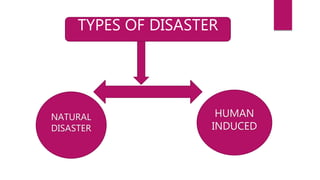
TYPES OF DISASTER
HUMAN
INDUCED
NATURAL
DISASTER
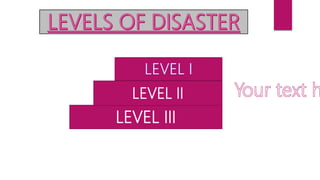
LEVEL III
LEVEL II
 Goolby & Kulkarni 2006 classify disaster into
level according to the magnitude of disaster
in relation to the ability of agency to respond
.
KEY ELEMENTS OF NURSING
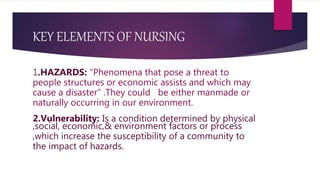
1.HAZARDS: “Phenomena that pose a threat to
people structures or economic assists and which may
cause a disaster” .They could be either manmade or
naturally occurring in our environment.
2.Vulnerability: Is a condition determined by physical
,social, economic,& environment factors or process
,which increase the susceptibility of a community to
the impact of hazards.
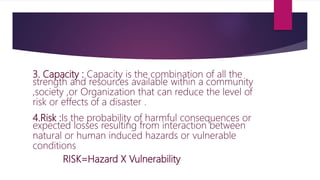
3. Capacity : Capacity is the combination of all the
strength and resources available within a community
,society ,or Organization that can reduce the level of
risk or effects of a disaster .
4.Risk :Is the probability of harmful consequences or
expected losses resulting from interaction between
natural or human induced hazards or vulnerable
conditions
RISK=Hazard X Vulnerability
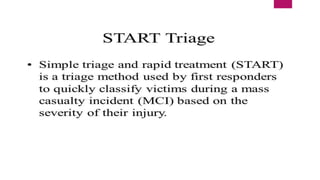
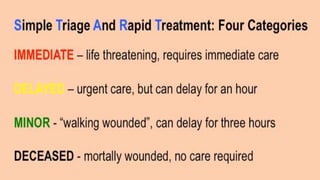
Disaster triage
 Triage derived from French word trier which means “to sort
out or to choose “
 Baron Dominique Jean Larry organized first triage system.
DEFINITION.
“Triage is a process which place the right person
in right place at the right time to receive the right
level of care “
RICE & ABEL 1992
Need of the disaster triage
1.Inadequate resource to meet
immediate needs.
2.Infrastructure limitations.
3.Inadequate hazard preparation.
4.Limitation transport capabilities.
5.Multiple agencies responding.
6.Hospital Resources overwhelmed.
Aims of triage
To sort patients based on needs for
immediate care
Medical needs will outstrip the
immediately available resources
 Additional resources will become
available given enough time.
PRINCIPLES OF TRIAGE
 Every patient should receive and triaged by
appropriate skilled health-care professionals.
 Triage is a clinic-managerial decision and
must involve collaborative planning.
 The triage process should not cause a delay
in the delivery of effective clinical care.
Advantages of triage
 Helps to bring order and organization to a chaotic
scene*.
 It identifies and provides care to those who are in
greatest need
 Helps make the difficult decisions easier
 Assure that resources are used in the most effective
manner
 May take some of the emotional burden away, from
those doing triage
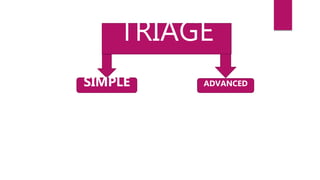
TRIAGE
SIMPLE ADVANCED
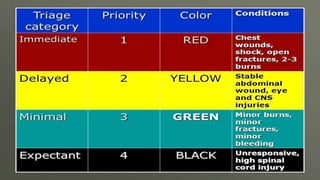
Advanced triage categories
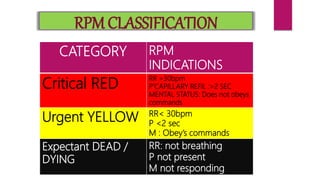
CATEGORY RPM
INDICATIONS
Critical RED
RR >30bpm
P’CAPILLARY REFIL :>2 SEC
MENTAL STATUS: Does not obeys
commands
Urgent YELLOW RR< 30bpm
P <2 sec
M : Obey’s commands
Expectant DEAD /
DYING
RR: not breathing
P not present
M not responding
RPM CLASSIFICATION
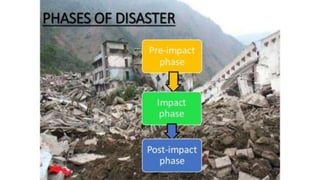
PHASES OF DISASTER
Phases of disaster management
Disaster preparedness
 Should be in the form of manpower, money,
materials.
 Evaluation from past experience about risk.
 Location of disaster prone areas.
 Organization of communication,
information,& warning systems.
 Ensuring Co-ordination & response mechanisms.
 Development of Public education Program.
 Coordination with media.
 Keeping stocks of foods ,Drugs,& other essential
commodities.
INDIAN METEROLOGICAL DEPARTMENT (IMD):
Plays a key role in fore warning the disaster of cyclone –
storms by detection tracing. It has 5 centers in India
Kolkata, Bhubaneswar , Vishakhapatnam, Chennai, Mumbai .
DISATER IMPACT
1.Physical.*
2.Economic.
3.Social.
4.Psychological.
MORE VULNERABLE GROUPS
DEFINITION
Is defined as a group which has some
special needs in a disaster and cannot
comfortably access and use the
standard resources offered in disaster
preparedness, relief & recovery.
DISASTER NURSING
DEFINTION
“The adaptation of professional
nursing knowledge, skills and attitude
in recognizing and meeting the
nursing, health and emotional needs
of disaster victims.”
GOALS OF THE DISASTER NURSING
 To meet the immediate basic survival needs of
populations affected by disasters (water, food,
shelter, and security).
 To identify the potential for a secondary disaster.
 To appraise both risks and resources in the
environment.
 To correct inequalities in access to health care or appropriate
resources.
 To empower survivors to participate in and advocate for their
own health and well-being.
 To respect cultural, lingual, and religious diversity in
individuals and families and to apply this principle in all
health promotion activities.
 To promote the highest achievable quality of life for survivors
PRINCIPLES OF DISASTER NURSING
 Rapid assessment of the situation and of nursing
care needs.
 Triage and initiation of life-saving measures first.
 The selected use of essential nursing interventions
and the elimination of nonessential nursing
activities.
 Evaluation of the environment and the mitigation or
removal of any health hazards.
 Adaptation of necessary nursing skills to disaster and
other emergency situations. The nurse must use
imagination and resourcefulness in dealing with a
lack of supplies, equipment, and personnel.
 Prevention of further injury or illness.
 Leadership in coordinating patient triage, care, and
transport during times of crisis.
 The teaching, supervision, and utilization of
auxiliary medical personnel and volunteers.
 Provision of understanding, compassion, and
emotional support to all victims and their
families.
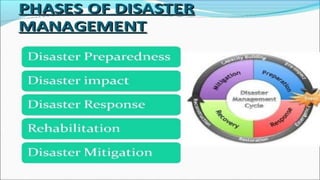
Disaster management cycle
Anxiety disorder that can occur
following the experience or
witnessing the traumatic event.
People with PTSD experience 3 set of
symptoms.
DISASTER REHABILITATION
Rehabilitation is the act of restoring
something to its original state.
DISASTER REHABILITATION
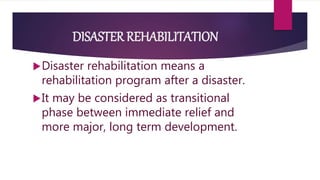
Disaster rehabilitation means a
rehabilitation program after a disaster.
It may be considered as transitional
phase between immediate relief and
more major, long term development.
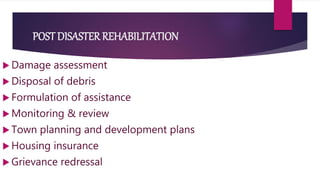
POST DISASTER REHABILITATION
 Damage assessment
 Disposal of debris
 Formulation of assistance
 Monitoring & review
 Town planning and development plans
 Housing insurance
 Grievance redressal
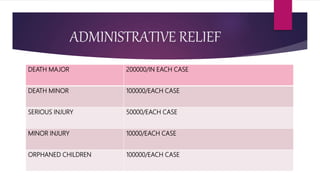
ADMINISTRATIVE RELIEF
DEATH MAJOR 200000/IN EACH CASE
DEATH MINOR 100000/EACH CASE
SERIOUS INJURY 50000/EACH CASE
MINOR INJURY 10000/EACH CASE
ORPHANED CHILDREN 100000/EACH CASE
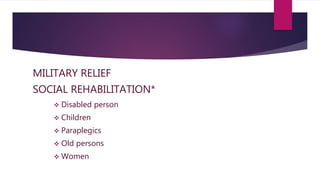
MILITARY RELIEF
SOCIAL REHABILITATION*
 Disabled person
 Children
 Paraplegics
 Old persons
 Women
PREVENTION OF DISASTER
Collection area checks for potential
disaster .
Emergency planning committee EPC.*
INTERNATIONAL ORGANIZATIONS
1.Office for the coordination of Humanitarian affair OCHA .
2.Food and Agricultural FAO.
3.International Organization for migration IOM.
4.The Office of united nations high commissioner for Human rights OHCHR.
5.United nations high commission for Refuges.
6.United nations children Emergency Fund.
7.World Food Program WFP.
8.World Health Organizations WHO.
 The international federation of Red cross &
Red crescent Societies.
 The mission is to improve the lives of
vulnerable people by mobilizing the power of
humanity.
International non governmental agencies
1.CARE:
 Humanitarian organization fighting global poverty.
 Women are the heart of CARE
 To improve education prevent the spread of HIV , to increase the
access to clean water & sanitation.
 Protect the natural resources
2.Rehabilitation International:
RI is a global network of expert professionals
 To empower people with disabilities &
provide sustainable solution for accessible
society.
 Disaster management panning .
REFERENCE:
1) Deborah S Adelman.Timotty J Legg”Disaster Nursing A Handbook for practice” 1st
edition 2011 Jones & Bartlett learning.
2) K park “Preventive and social medicine “21st edition Bhanoot publications.
3) B.T. Basavanthappa “Community Health Nursing “ 2nd edition 2008 ,jaypee publications
.
4) “DISASTER MANAGEMENT IN INDIA”, Published by Government of India Ministry of
Home Affairs.
5) DISASTER, http://www.icm.tn.gov.in/dengue/disaster.htm
6) WHAT IS DISASTER, http://www.karimganj.nic.in/disaster.htm

Disaster nursing

  • 1.
    Disaster nursing PREPARED BY; REMYARAMACHANDRAN IST YEAR MSC NURSING MIMS CON
  • 2.
    INTRODUCTION  Integral partof human experiences since beginning of time .  Which creates all kind of losses to the individual. French word “DESASTRE “ & Italian word “DISASTRO” which means “Bad star”
  • 3.
    DEFINITION  “Any occurrencethat cause damage, ecological disruption ,loss of human life, deterioration of health and health services on a scale sufficient to warrant an extra ordinary response from the outside community or area “ . WHO
  • 4.
    RECENT DISASTERS INDIAN STATISTICS: 14th January 2016:Landslide in Darjeeling . 6th Jan 2016: Massive earthquakes in Himalayan region. 22 February 2016 : Earthquake in patna
  • 5.
    20th March 2016:Earthquake triggers in J&K 21ST March 2016:Earth quake in Meghalaya & landslide blocks in Jammu & Srinagar highway.
  • 6.
  • 7.
  • 8.
     Goolby &Kulkarni 2006 classify disaster into level according to the magnitude of disaster in relation to the ability of agency to respond .
  • 9.
    KEY ELEMENTS OFNURSING 1.HAZARDS: “Phenomena that pose a threat to people structures or economic assists and which may cause a disaster” .They could be either manmade or naturally occurring in our environment. 2.Vulnerability: Is a condition determined by physical ,social, economic,& environment factors or process ,which increase the susceptibility of a community to the impact of hazards.
  • 10.
    3. Capacity :Capacity is the combination of all the strength and resources available within a community ,society ,or Organization that can reduce the level of risk or effects of a disaster . 4.Risk :Is the probability of harmful consequences or expected losses resulting from interaction between natural or human induced hazards or vulnerable conditions RISK=Hazard X Vulnerability
  • 11.
    Disaster triage  Triagederived from French word trier which means “to sort out or to choose “  Baron Dominique Jean Larry organized first triage system. DEFINITION. “Triage is a process which place the right person in right place at the right time to receive the right level of care “ RICE & ABEL 1992
  • 12.
    Need of thedisaster triage 1.Inadequate resource to meet immediate needs. 2.Infrastructure limitations. 3.Inadequate hazard preparation. 4.Limitation transport capabilities. 5.Multiple agencies responding. 6.Hospital Resources overwhelmed.
  • 13.
    Aims of triage Tosort patients based on needs for immediate care Medical needs will outstrip the immediately available resources  Additional resources will become available given enough time.
  • 14.
    PRINCIPLES OF TRIAGE Every patient should receive and triaged by appropriate skilled health-care professionals.  Triage is a clinic-managerial decision and must involve collaborative planning.  The triage process should not cause a delay in the delivery of effective clinical care.
  • 15.
    Advantages of triage Helps to bring order and organization to a chaotic scene*.  It identifies and provides care to those who are in greatest need  Helps make the difficult decisions easier  Assure that resources are used in the most effective manner  May take some of the emotional burden away, from those doing triage
  • 16.
  • 19.
  • 21.
    CATEGORY RPM INDICATIONS Critical RED RR>30bpm P’CAPILLARY REFIL :>2 SEC MENTAL STATUS: Does not obeys commands Urgent YELLOW RR< 30bpm P <2 sec M : Obey’s commands Expectant DEAD / DYING RR: not breathing P not present M not responding RPM CLASSIFICATION
  • 22.
  • 23.
  • 25.
    Disaster preparedness  Shouldbe in the form of manpower, money, materials.  Evaluation from past experience about risk.  Location of disaster prone areas.  Organization of communication, information,& warning systems.
  • 26.
     Ensuring Co-ordination& response mechanisms.  Development of Public education Program.  Coordination with media.  Keeping stocks of foods ,Drugs,& other essential commodities. INDIAN METEROLOGICAL DEPARTMENT (IMD): Plays a key role in fore warning the disaster of cyclone – storms by detection tracing. It has 5 centers in India Kolkata, Bhubaneswar , Vishakhapatnam, Chennai, Mumbai .
  • 27.
  • 28.
    MORE VULNERABLE GROUPS DEFINITION Isdefined as a group which has some special needs in a disaster and cannot comfortably access and use the standard resources offered in disaster preparedness, relief & recovery.
  • 29.
  • 30.
    DEFINTION “The adaptation ofprofessional nursing knowledge, skills and attitude in recognizing and meeting the nursing, health and emotional needs of disaster victims.”
  • 31.
    GOALS OF THEDISASTER NURSING  To meet the immediate basic survival needs of populations affected by disasters (water, food, shelter, and security).  To identify the potential for a secondary disaster.  To appraise both risks and resources in the environment.
  • 32.
     To correctinequalities in access to health care or appropriate resources.  To empower survivors to participate in and advocate for their own health and well-being.  To respect cultural, lingual, and religious diversity in individuals and families and to apply this principle in all health promotion activities.  To promote the highest achievable quality of life for survivors
  • 33.
    PRINCIPLES OF DISASTERNURSING  Rapid assessment of the situation and of nursing care needs.  Triage and initiation of life-saving measures first.  The selected use of essential nursing interventions and the elimination of nonessential nursing activities.  Evaluation of the environment and the mitigation or removal of any health hazards.
  • 34.
     Adaptation ofnecessary nursing skills to disaster and other emergency situations. The nurse must use imagination and resourcefulness in dealing with a lack of supplies, equipment, and personnel.  Prevention of further injury or illness.  Leadership in coordinating patient triage, care, and transport during times of crisis.
  • 35.
     The teaching,supervision, and utilization of auxiliary medical personnel and volunteers.  Provision of understanding, compassion, and emotional support to all victims and their families.
  • 36.
  • 39.
    Anxiety disorder thatcan occur following the experience or witnessing the traumatic event. People with PTSD experience 3 set of symptoms.
  • 40.
    DISASTER REHABILITATION Rehabilitation isthe act of restoring something to its original state.
  • 41.
    DISASTER REHABILITATION Disaster rehabilitationmeans a rehabilitation program after a disaster. It may be considered as transitional phase between immediate relief and more major, long term development.
  • 42.
    POST DISASTER REHABILITATION Damage assessment  Disposal of debris  Formulation of assistance  Monitoring & review  Town planning and development plans  Housing insurance  Grievance redressal
  • 43.
    ADMINISTRATIVE RELIEF DEATH MAJOR200000/IN EACH CASE DEATH MINOR 100000/EACH CASE SERIOUS INJURY 50000/EACH CASE MINOR INJURY 10000/EACH CASE ORPHANED CHILDREN 100000/EACH CASE
  • 44.
    MILITARY RELIEF SOCIAL REHABILITATION* Disabled person  Children  Paraplegics  Old persons  Women
  • 45.
    PREVENTION OF DISASTER Collectionarea checks for potential disaster . Emergency planning committee EPC.*
  • 46.
    INTERNATIONAL ORGANIZATIONS 1.Office forthe coordination of Humanitarian affair OCHA . 2.Food and Agricultural FAO. 3.International Organization for migration IOM. 4.The Office of united nations high commissioner for Human rights OHCHR. 5.United nations high commission for Refuges. 6.United nations children Emergency Fund. 7.World Food Program WFP. 8.World Health Organizations WHO.
  • 47.
     The internationalfederation of Red cross & Red crescent Societies.  The mission is to improve the lives of vulnerable people by mobilizing the power of humanity.
  • 48.
    International non governmentalagencies 1.CARE:  Humanitarian organization fighting global poverty.  Women are the heart of CARE  To improve education prevent the spread of HIV , to increase the access to clean water & sanitation.  Protect the natural resources
  • 49.
    2.Rehabilitation International: RI isa global network of expert professionals  To empower people with disabilities & provide sustainable solution for accessible society.  Disaster management panning .
  • 50.
    REFERENCE: 1) Deborah SAdelman.Timotty J Legg”Disaster Nursing A Handbook for practice” 1st edition 2011 Jones & Bartlett learning. 2) K park “Preventive and social medicine “21st edition Bhanoot publications. 3) B.T. Basavanthappa “Community Health Nursing “ 2nd edition 2008 ,jaypee publications . 4) “DISASTER MANAGEMENT IN INDIA”, Published by Government of India Ministry of Home Affairs. 5) DISASTER, http://www.icm.tn.gov.in/dengue/disaster.htm 6) WHAT IS DISASTER, http://www.karimganj.nic.in/disaster.htm