Interventions for Clients with HIV/AIDSJolene Bethune, RN, MSN
ObjectivesProvide an overview of HIV and AIDS with key terms you will hear in practiceProvide brief outline of pathophysiology and etiology of viral infectionDescribe methods of transmissionDescribe methods of preventing transmission in the health care environmentUse the nursing process to describe care of the infected client
OverviewAcquired immunodeficiency syndrome (AIDS) is the late stage of a continuum of symptoms resulting from infection with the human immunodeficiency virus (HIV)
AIDS and HIV are not the same; not everyone with HIV has AIDSMost people aren’t diagnosed at the time of infection because they don’t  seek medical care when symptoms occur, or health care providers don’t take an adequate historyAIDS is seriously debilitating; eventually fatal; can occur in any age group
Key Terms
Immunodeficiency – a deficient response of the immune system d/t a missing or damaged immune componentImmunocompromised – immune system impaired, destroyed resulting in an impaired ability to neutralize, destroy or eliminate antigens
Primary, congenital – immune malfunction present from birthSecondary, acquired – occurs in a person with  a normally functioning immune system at birth; becomes immmunodeficient d/t disease, injury, exposure to toxins, medical therapy or an unknown cause
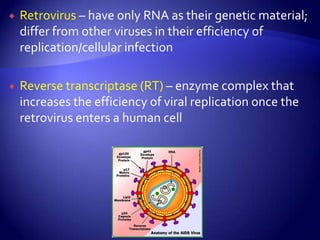
Retrovirus– have only RNA as their genetic material; differ from other viruses in their efficiency of replication/cellular infectionReverse transcriptase (RT) – enzyme complex that increases the efficiency of viral replication once the retrovirus enters a human cell
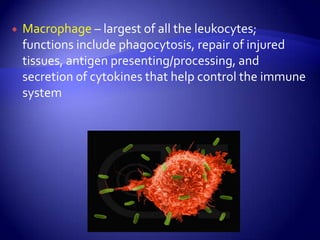
Macrophage – largest of all the leukocytes; functions include phagocytosis, repair of injured tissues, antigen presenting/processing, and secretion of cytokines that help control the immune system
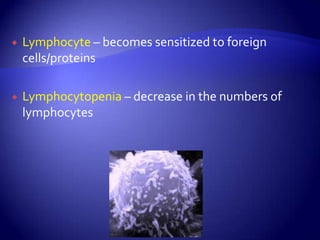
Lymphocyte – becomes sensitized to foreign cells/proteinsLymphocytopenia– decrease in the numbers of lymphocytes
Viremia– high concentration of virus in the bloodPathogenic infections – infections occurring in people with normally functioning immune systems
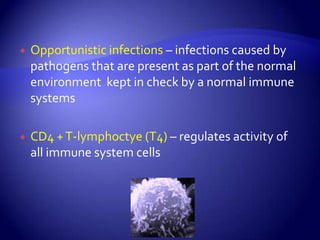
Opportunistic infections – infections caused by pathogens that are present as part of the normal environment  kept in check by a normal immune systemsCD4 + T-lymphoctye (T4) – regulates activity of all immune system cells
Nonprogressors – individuals infected with HIV for more than 10 years who remain asymptomatic and have T4 lymphocyte counts within a normal range
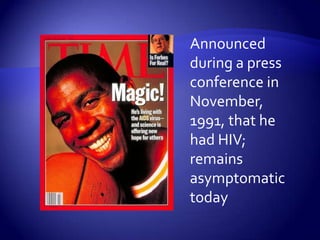
Announced during a press conference in November, 1991, that he had HIV; remains asymptomatic today
Pathophysiology
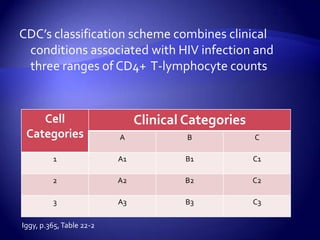
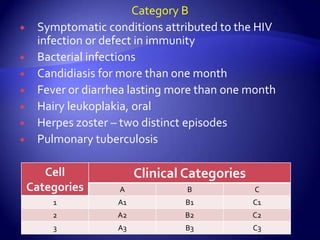
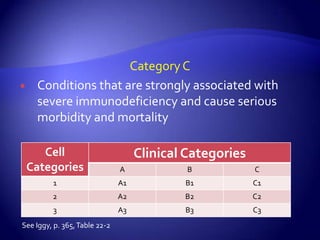
CDC’s classification scheme combines clinical conditions associated with HIV infection and three ranges of CD4+  T-lymphocyte countsIggy, p.365, Table 22-2
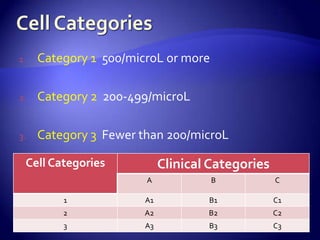
Cell CategoriesCategory 1  500/microL or moreCategory 2  200-499/microLCategory 3  Fewer than 200/microL
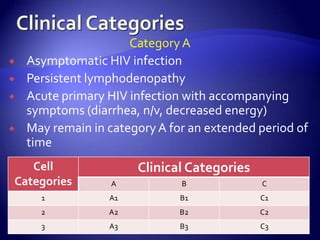
Clinical CategoriesCategory AAsymptomatic HIV infectionPersistent lymphodenopathyAcute primary HIV infection with accompanying symptoms (diarrhea, n/v, decreased energy)May remain in category A for an extended period of time
Category BSymptomatic conditions attributed to the HIV infection or defect in immunityBacterial infectionsCandidiasis for more than one monthFever or diarrhea lasting more than one monthHairy leukoplakia, oralHerpes zoster – two distinct episodesPulmonary tuberculosis
Category CConditions that are strongly associated with severe immunodeficiency and cause serious morbidity and mortalitySee Iggy, p. 365, Table 22-2
Progression from HIV to AIDS can take months or yearsPeople who have been transfused with HIV-positive blood develop AIDS more quicklyThose who become HIV-positive as a result of a single sexual encounter have a longer latency periodOther influences include frequency of re-exposure to HIV, nutritional status, pregnancy, and stress
Etiology
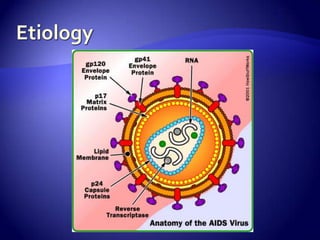
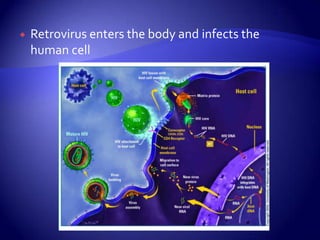
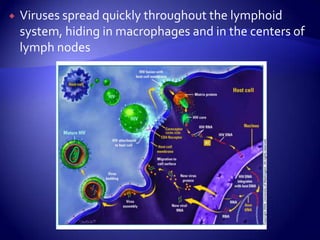
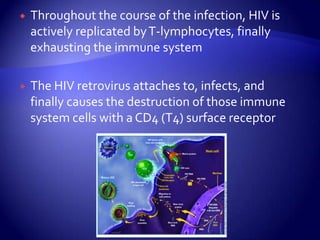
Retrovirus enters the body and infects the human cell
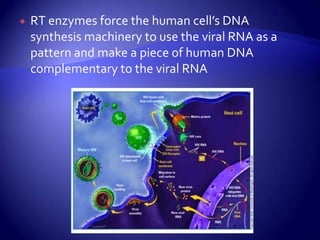
RT enzymes force the human cell’s DNA synthesis machinery to use the viral RNA as a pattern and make a piece of human DNA complementary to the viral RNA
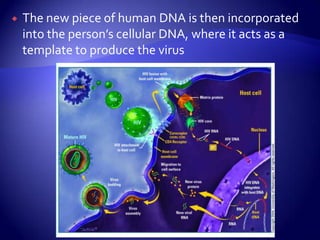
The new piece of human DNA is then incorporated into the person’s cellular DNA, where it acts as a template to produce the virus
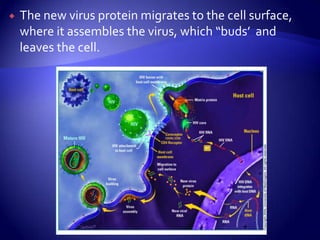
The new virus protein migrates to the cell surface, where it assembles the virus, which “buds’  and leaves the cell.
Viruses spread quickly throughout the lymphoid system, hiding in macrophages and in the centers of lymph nodes
Throughout the course of the infection, HIV is actively replicated by T-lymphocytes, finally exhausting the immune systemThe HIV retrovirus attaches to, infects, and finally causes the destruction of those immune system cells with a CD4 (T4) surface receptor
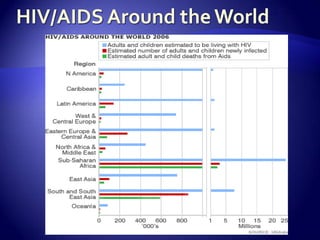
HIV/AIDS Around the World
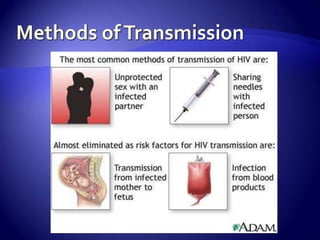
Methods of Transmission
Parental (Blood) TransmissionSharing contaminated needlesAccidental needle sticks from an infected personHIV+ women may transmit to their children through perinatal transmission, breastfeedingExposure to an infected client’s blood through an open wound
Sexual TransmissionHomosexual malesHeterosexual partners if either is infectedAny sexual activity involving exposure to bodily fluids of an infected person
Perinatal TransmissionTransplacentally in uteroIntrapartally, during exposure tho blood and vaginal secretions during birthPostpartally, through breastmilk
HIV dies quickly outside the body because it needs living tissue and moisture to surviveHIV may not be transmitted byHugging, kissing, holding hands or other nonsexual contactInanimate objects (money, doorknobs, bathtubs, toilet seats, etc.)Dishes, silverware, or food handled by an infected personAnimals or insects
After exposure to the virus, symptoms may develop within 6-12 weeks; however, symptoms may not develop for 6 months Once infected, the client will probably harbor the virus for the rest of his lifeOpportunistic infections take advantage of the suppressed immune systemTend to resist conventional treatmentClient may have multiple opportunistic infections
Prevention of Transmission in a Health Care Setting
Maintain standard precautionsConsider all blood and bodily fluids to be contaminatedAvoid contaminating outside of container when collecting specimensDo not recap needles and syringes
Cleanse work surface areas with appropriate germicideClean up spills of blood and body fluid immediatelyFollow CDC recommendations for immunization of health care workers
CD4 (T4) malfunctions, suppressing the entire immune systemResults:LymphocytopeniaAbnormal T-cell functionIncreased production of incomplete and nonfunctional antibodiesAbnormally functioning macrophages
Providing care can evoke complex personal issues for nursesAcknowledge your own fearAcknowledge any negative attitudes regarding possible lifestyles contributing to HIV infectionPractice appropriate infection control techniques alwaysProvide compassionate, nonjudgmental care
ASSESSMENT
HistoryAge, gender, occupation and residenceThoroughly assess current complaint/illnessAsk when HIV was diagnosed and what symptoms led to that diagnosisChronology of infections/clinical problems since diagnosis
HistoryHealth history (any blood transfusions 1978-1985?)History of STDs, infectious diseasesClotting factors, if hemophiliacAssess client’s level of knowledge
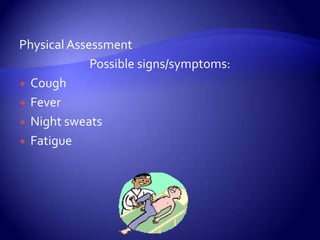
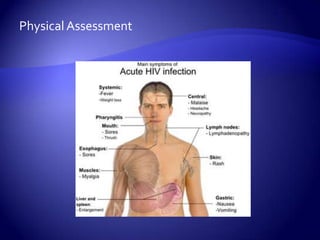
Physical AssessmentPossible signs/symptoms: CoughFeverNight sweatsFatigue
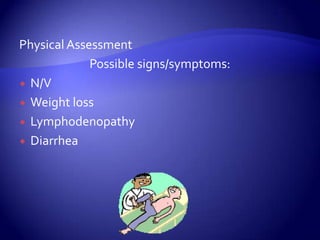
Physical AssessmentPossible signs/symptoms: N/VWeight lossLymphodenopathyDiarrhea
Physical AssessmentPossible signs/symptoms: Visual changesHeadacheMemory lossConfusionSeizuresPersonality changes
Physical AssessmentPossible signs/symptoms: Dry skinRashesSkin lesionsPainDiscomfort
Physical Assessment
Physical Assessment – Opportunistic InfectionsProtozoal InfectionsPneumocystis carinii pneumonia (PNP) – fatigue, weight loss; crackles on auscultationToxoplasmosis encephalitis – sudden mental, neurological changesCryptosporidosis – mild to severe diarrhea with wasting, electrolyte imbalance
Physical Assessment – Opportunistic InfectionsFungal InfectionsCandida stomatitis/esophagitis – mouth/retrosternal pain; cottage cheese plaques; (vaginal candidiasis – plaques, pruritis, discharge, perineal irritation)Cryptococcosis – meningitis (fever, headache, n/v, nuchal rigidity,  mental/neurological changes)Histoplasmosis – respiratory infection (dyspnea, fever, cough, weight loss)
Physical Assessment – Opportunistic InfectionsBacterial InfectionsMAC syndrome (systemic mycobacterium infections of respiratory and/or gastrointestinal tracts; tuberculosis) – fever, weight loss, debility; lymphadenopathy, organ diseaseRecurrent pneumonia – chest pain, productive cough, fever, dyspnea
Physical Assessment – Opportunistic InfectionsViral InfectionsCytomegalovirus (CMV) – eyes, respiratory/ gastrointestinal tracts, central nervous systemHerpes simplex virus (HSV) – painful lesions/ulcers, fever, pain, bleeding and lymph node enlargementVaricella zoster (VZ) – shingles (pain, burning along dermatome nerve tracts, headache, low grade fever, large painful vesicles
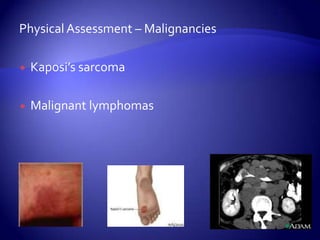
Physical Assessment – MalignanciesKaposi’s sarcomaMalignant lymphomas
Physical Assessment – Other Clinical ManifestationsAIDS Dementia ComplexWasting SyndromeIntegumentary changes
Laboratory AssessmentLymphocyte countsCD4/CD8 countsAntibody tests – enzyme-linked immunosorbent assay (ELISA); Western blot testViral cultureViral load testing – measures RNA or viral protein in client’s blood
Psychosocial AssessmentAsk about client’s support system – family, SOs, friendsProtect confidentialityActivities of daily livingEmploymentAssess client’s levels of anxiety, self esteemAssess changes in body imageCoping strategies, strengths
NURSING DIAGNOSES
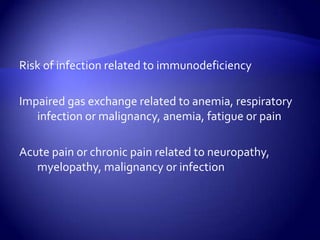
Risk of infection related to immunodeficiencyImpaired gas exchange related to anemia, respiratory infection or malignancy, anemia, fatigue or painAcute pain or chronic pain related to neuropathy, myelopathy, malignancy or infection
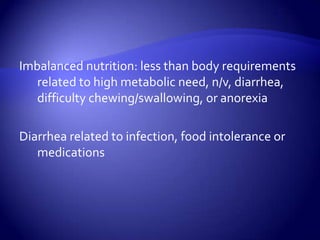
Imbalanced nutrition: less than body requirements related to high metabolic need, n/v, diarrhea, difficulty chewing/swallowing, or anorexiaDiarrhea related to infection, food intolerance or medications
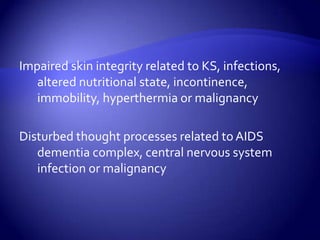
Impaired skin integrity related to KS, infections, altered nutritional state, incontinence, immobility, hyperthermia or malignancyDisturbed thought processes related to AIDS dementia complex, central nervous system infection or malignancy
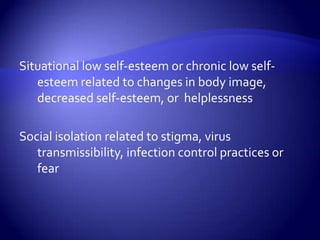
Situational low self-esteem or chronic low self-esteem related to changes in body image, decreased self-esteem, or  helplessnessSocial isolation related to stigma, virus transmissibility, infection control practices or fear
PLANNING/IMPLEMENTATION
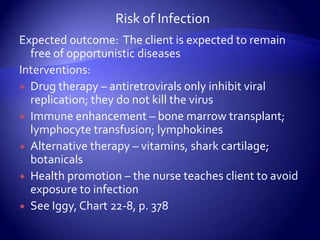
Risk of InfectionExpected outcome:  The client is expected to remain free of opportunistic diseasesInterventions:Drug therapy – antiretrovirals only inhibit viral replication; they do not kill the virusImmune enhancement – bone marrow transplant; lymphocyte transfusion; lymphokinesAlternative therapy – vitamins, shark cartilage; botanicalsHealth promotion – the nurse teaches client to avoid exposure to infectionSee Iggy, Chart 22-8, p. 378
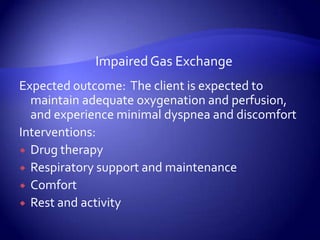
Impaired Gas ExchangeExpected outcome:  The client is expected to maintain adequate oxygenation and perfusion, and experience minimal dyspnea and discomfortInterventions:Drug therapyRespiratory support and maintenanceComfortRest and activity
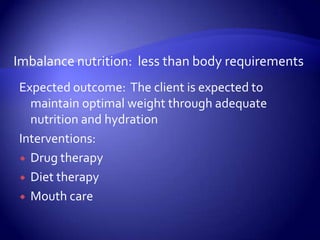
Imbalance nutrition:  less than body requirementsExpected outcome:  The client is expected to maintain optimal weight through adequate nutrition and hydrationInterventions:Drug therapyDiet therapyMouth care
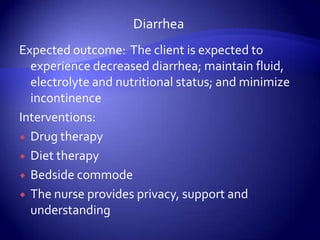
DiarrheaExpected outcome:  The client is expected to experience decreased diarrhea; maintain fluid, electrolyte and nutritional status; and minimize incontinenceInterventions:Drug therapyDiet therapyBedside commodeThe nurse provides privacy, support and understanding
Impaired Skin IntegrityExpected outcome:  The client is expected to have healing of any existing lesions and avoid increased skin breakdown or secondary infectionInterventions:ChemotherapyDrug therapyWound careMake-up, concealers
Disturbed Thought ProcessesExpected outcome:  The client is expected to demonstrate improved mental status and sustain no injuryInterventions:OrientationDrug therapySafety measuresSupport
Situational Low Self-EsteemExpected outcome:  The client is expected to identify positive aspects of himself or herself and accept himself or herselfInterventions:The nurse allows for privacy, but does not avoid, isolate the clientPromote self care, independence, control and decision-makingComplementary alternative therapies
Social IsolationExpected outcome:  The client is expected to identify behaviors that cause social isolation and demonstrate behaviors that reduce social isolationInterventions:Promotion of interactionEducation
EVALUATION
Outcomes:  Expected outcomes include that the client willNot develop opportunistic infectionsDemonstrate adequate respiratory functionAchieve and acceptable level of physical comfortAttain adequate weight, nutritional and fluid status
Maintain skin integrityRemain oriented and/or in a safe environmentMaintain self-esteemMaintain a support system and involvement with othersComply with the appropriate and available therapy
Other ImmunodeficienciesTherapy-induced ImmunodeficienciesDrug-induced ImmunodeficienciesCytotoxic drugsCorticosteroidsCyclosporineRadiation-induced Immunodeficiencies – Collaborative management
REFERENCESAll Refer (2009). Cancer. Retrieved October 25, 2009, from http://health.allrefer.com/health/cancer-lymphoma-malignant-ct-scan.htmlBBC (2008). US set to spend $50bn against HIV. Retrieved October 25, 2009, from http://news.bbc.co.uk/2/hi/7327694.stmBoth Teams Play Hard (n.d.). . Retrieved October 25, 2009, from http://www.bothteamsplayedhard.net/wp-content/uploads/2008/10/magazines-time-magicjohnson.jpgCouncil Rock School District (2005). STDs, HIV & AIDS Outline. Retrieved October 25, 2009, from http://images.google.com/imgres?imgurl=http://www.crsd.org/5033092714043/lib/5033092714043/HIV.gif&imgrefurl=http://www.crsd.org/5033092714043/blank/browse.asp%3FA%3D383%26BMDRN%3D2000%26BCOB%3D0%26C%3D54173&usg=__LBtWre-1cFFVCpyIbMTj1x5hVXY=&h=404&w=402&sz=57&hl=en&start=13&sig2=BQ-IpGPifjU7sjBf5-h_yQ&um=1&tbnid=SADbWJqc8nr6vM:&tbnh=124&tbnw=123&prev=/images%3Fq%3Dhiv%2Bimages%26ndsp%3D20%26hl%3Den%26rls%3Dcom.microsoft:en-us:IE-SearchBox%26rlz%3D1I7GGLL_en%26sa%3DN%26um%3D1&ei=-dfkStTIA93Btwey0t3LCA
REFERENCESDreamstime (n.d.). Categories. Retrieved October 25, 2009, from http://www.dreamstime.com/stock-photos-hiv-positive-image3961133Ignatavicius, D. D., & Workman, M. L. (2002). Medical-Surgical Nursing:  Critical Thinking for Collaborative Care (4 ed.). Philadelphia, PA: W. B. Saunders Company.Medline Plus (2009). Primary HIV Infection. Retrieved October 25, 2009, from http://www.nlm.nih.gov/medlineplus/ency/imagepages/17268.htmStephanie Relfe (2008). Oil pulling amazing health for almost no cost. Retrieved October 25, 2009, from http://www.relfe.com/07/oil_pulling.htmlZerwekh, J., & Claborn, J. C. (2002). NCLEX-RN:  a comprehensive study guide (5 ed.). Midlothian, TX: Nursing Education Consultants.

Interventions For Clients With Hiv

  • 1.
    Interventions for Clientswith HIV/AIDSJolene Bethune, RN, MSN
  • 2.
    ObjectivesProvide an overviewof HIV and AIDS with key terms you will hear in practiceProvide brief outline of pathophysiology and etiology of viral infectionDescribe methods of transmissionDescribe methods of preventing transmission in the health care environmentUse the nursing process to describe care of the infected client
  • 3.
    OverviewAcquired immunodeficiency syndrome(AIDS) is the late stage of a continuum of symptoms resulting from infection with the human immunodeficiency virus (HIV)
  • 4.
    AIDS and HIVare not the same; not everyone with HIV has AIDSMost people aren’t diagnosed at the time of infection because they don’t seek medical care when symptoms occur, or health care providers don’t take an adequate historyAIDS is seriously debilitating; eventually fatal; can occur in any age group
  • 5.
  • 6.
    Immunodeficiency – adeficient response of the immune system d/t a missing or damaged immune componentImmunocompromised – immune system impaired, destroyed resulting in an impaired ability to neutralize, destroy or eliminate antigens
  • 7.
    Primary, congenital –immune malfunction present from birthSecondary, acquired – occurs in a person with a normally functioning immune system at birth; becomes immmunodeficient d/t disease, injury, exposure to toxins, medical therapy or an unknown cause
  • 8.
    Retrovirus– have onlyRNA as their genetic material; differ from other viruses in their efficiency of replication/cellular infectionReverse transcriptase (RT) – enzyme complex that increases the efficiency of viral replication once the retrovirus enters a human cell
  • 9.
    Macrophage – largestof all the leukocytes; functions include phagocytosis, repair of injured tissues, antigen presenting/processing, and secretion of cytokines that help control the immune system
  • 10.
    Lymphocyte – becomessensitized to foreign cells/proteinsLymphocytopenia– decrease in the numbers of lymphocytes
  • 11.
    Viremia– high concentrationof virus in the bloodPathogenic infections – infections occurring in people with normally functioning immune systems
  • 12.
    Opportunistic infections –infections caused by pathogens that are present as part of the normal environment kept in check by a normal immune systemsCD4 + T-lymphoctye (T4) – regulates activity of all immune system cells
  • 13.
    Nonprogressors – individualsinfected with HIV for more than 10 years who remain asymptomatic and have T4 lymphocyte counts within a normal range
  • 14.
    Announced during apress conference in November, 1991, that he had HIV; remains asymptomatic today
  • 15.
  • 16.
    CDC’s classification schemecombines clinical conditions associated with HIV infection and three ranges of CD4+ T-lymphocyte countsIggy, p.365, Table 22-2
  • 17.
    Cell CategoriesCategory 1 500/microL or moreCategory 2 200-499/microLCategory 3 Fewer than 200/microL
  • 18.
    Clinical CategoriesCategory AAsymptomaticHIV infectionPersistent lymphodenopathyAcute primary HIV infection with accompanying symptoms (diarrhea, n/v, decreased energy)May remain in category A for an extended period of time
  • 19.
    Category BSymptomatic conditionsattributed to the HIV infection or defect in immunityBacterial infectionsCandidiasis for more than one monthFever or diarrhea lasting more than one monthHairy leukoplakia, oralHerpes zoster – two distinct episodesPulmonary tuberculosis
  • 20.
    Category CConditions thatare strongly associated with severe immunodeficiency and cause serious morbidity and mortalitySee Iggy, p. 365, Table 22-2
  • 21.
    Progression from HIVto AIDS can take months or yearsPeople who have been transfused with HIV-positive blood develop AIDS more quicklyThose who become HIV-positive as a result of a single sexual encounter have a longer latency periodOther influences include frequency of re-exposure to HIV, nutritional status, pregnancy, and stress
  • 22.
  • 23.
    Retrovirus enters thebody and infects the human cell
  • 24.
    RT enzymes forcethe human cell’s DNA synthesis machinery to use the viral RNA as a pattern and make a piece of human DNA complementary to the viral RNA
  • 25.
    The new pieceof human DNA is then incorporated into the person’s cellular DNA, where it acts as a template to produce the virus
  • 26.
    The new virusprotein migrates to the cell surface, where it assembles the virus, which “buds’ and leaves the cell.
  • 27.
    Viruses spread quicklythroughout the lymphoid system, hiding in macrophages and in the centers of lymph nodes
  • 28.
    Throughout the courseof the infection, HIV is actively replicated by T-lymphocytes, finally exhausting the immune systemThe HIV retrovirus attaches to, infects, and finally causes the destruction of those immune system cells with a CD4 (T4) surface receptor
  • 29.
  • 30.
  • 31.
    Parental (Blood) TransmissionSharingcontaminated needlesAccidental needle sticks from an infected personHIV+ women may transmit to their children through perinatal transmission, breastfeedingExposure to an infected client’s blood through an open wound
  • 32.
    Sexual TransmissionHomosexual malesHeterosexualpartners if either is infectedAny sexual activity involving exposure to bodily fluids of an infected person
  • 33.
    Perinatal TransmissionTransplacentally inuteroIntrapartally, during exposure tho blood and vaginal secretions during birthPostpartally, through breastmilk
  • 34.
    HIV dies quicklyoutside the body because it needs living tissue and moisture to surviveHIV may not be transmitted byHugging, kissing, holding hands or other nonsexual contactInanimate objects (money, doorknobs, bathtubs, toilet seats, etc.)Dishes, silverware, or food handled by an infected personAnimals or insects
  • 35.
    After exposure tothe virus, symptoms may develop within 6-12 weeks; however, symptoms may not develop for 6 months Once infected, the client will probably harbor the virus for the rest of his lifeOpportunistic infections take advantage of the suppressed immune systemTend to resist conventional treatmentClient may have multiple opportunistic infections
  • 36.
    Prevention of Transmissionin a Health Care Setting
  • 37.
    Maintain standard precautionsConsiderall blood and bodily fluids to be contaminatedAvoid contaminating outside of container when collecting specimensDo not recap needles and syringes
  • 38.
    Cleanse work surfaceareas with appropriate germicideClean up spills of blood and body fluid immediatelyFollow CDC recommendations for immunization of health care workers
  • 39.
    CD4 (T4) malfunctions,suppressing the entire immune systemResults:LymphocytopeniaAbnormal T-cell functionIncreased production of incomplete and nonfunctional antibodiesAbnormally functioning macrophages
  • 40.
    Providing care canevoke complex personal issues for nursesAcknowledge your own fearAcknowledge any negative attitudes regarding possible lifestyles contributing to HIV infectionPractice appropriate infection control techniques alwaysProvide compassionate, nonjudgmental care
  • 41.
  • 42.
    HistoryAge, gender, occupationand residenceThoroughly assess current complaint/illnessAsk when HIV was diagnosed and what symptoms led to that diagnosisChronology of infections/clinical problems since diagnosis
  • 43.
    HistoryHealth history (anyblood transfusions 1978-1985?)History of STDs, infectious diseasesClotting factors, if hemophiliacAssess client’s level of knowledge
  • 44.
    Physical AssessmentPossible signs/symptoms:CoughFeverNight sweatsFatigue
  • 45.
    Physical AssessmentPossible signs/symptoms:N/VWeight lossLymphodenopathyDiarrhea
  • 46.
    Physical AssessmentPossible signs/symptoms:Visual changesHeadacheMemory lossConfusionSeizuresPersonality changes
  • 47.
    Physical AssessmentPossible signs/symptoms:Dry skinRashesSkin lesionsPainDiscomfort
  • 48.
  • 49.
    Physical Assessment –Opportunistic InfectionsProtozoal InfectionsPneumocystis carinii pneumonia (PNP) – fatigue, weight loss; crackles on auscultationToxoplasmosis encephalitis – sudden mental, neurological changesCryptosporidosis – mild to severe diarrhea with wasting, electrolyte imbalance
  • 50.
    Physical Assessment –Opportunistic InfectionsFungal InfectionsCandida stomatitis/esophagitis – mouth/retrosternal pain; cottage cheese plaques; (vaginal candidiasis – plaques, pruritis, discharge, perineal irritation)Cryptococcosis – meningitis (fever, headache, n/v, nuchal rigidity, mental/neurological changes)Histoplasmosis – respiratory infection (dyspnea, fever, cough, weight loss)
  • 51.
    Physical Assessment –Opportunistic InfectionsBacterial InfectionsMAC syndrome (systemic mycobacterium infections of respiratory and/or gastrointestinal tracts; tuberculosis) – fever, weight loss, debility; lymphadenopathy, organ diseaseRecurrent pneumonia – chest pain, productive cough, fever, dyspnea
  • 52.
    Physical Assessment –Opportunistic InfectionsViral InfectionsCytomegalovirus (CMV) – eyes, respiratory/ gastrointestinal tracts, central nervous systemHerpes simplex virus (HSV) – painful lesions/ulcers, fever, pain, bleeding and lymph node enlargementVaricella zoster (VZ) – shingles (pain, burning along dermatome nerve tracts, headache, low grade fever, large painful vesicles
  • 53.
    Physical Assessment –MalignanciesKaposi’s sarcomaMalignant lymphomas
  • 54.
    Physical Assessment –Other Clinical ManifestationsAIDS Dementia ComplexWasting SyndromeIntegumentary changes
  • 55.
    Laboratory AssessmentLymphocyte countsCD4/CD8countsAntibody tests – enzyme-linked immunosorbent assay (ELISA); Western blot testViral cultureViral load testing – measures RNA or viral protein in client’s blood
  • 56.
    Psychosocial AssessmentAsk aboutclient’s support system – family, SOs, friendsProtect confidentialityActivities of daily livingEmploymentAssess client’s levels of anxiety, self esteemAssess changes in body imageCoping strategies, strengths
  • 57.
  • 58.
    Risk of infectionrelated to immunodeficiencyImpaired gas exchange related to anemia, respiratory infection or malignancy, anemia, fatigue or painAcute pain or chronic pain related to neuropathy, myelopathy, malignancy or infection
  • 59.
    Imbalanced nutrition: lessthan body requirements related to high metabolic need, n/v, diarrhea, difficulty chewing/swallowing, or anorexiaDiarrhea related to infection, food intolerance or medications
  • 60.
    Impaired skin integrityrelated to KS, infections, altered nutritional state, incontinence, immobility, hyperthermia or malignancyDisturbed thought processes related to AIDS dementia complex, central nervous system infection or malignancy
  • 61.
    Situational low self-esteemor chronic low self-esteem related to changes in body image, decreased self-esteem, or helplessnessSocial isolation related to stigma, virus transmissibility, infection control practices or fear
  • 62.
  • 63.
    Risk of InfectionExpectedoutcome: The client is expected to remain free of opportunistic diseasesInterventions:Drug therapy – antiretrovirals only inhibit viral replication; they do not kill the virusImmune enhancement – bone marrow transplant; lymphocyte transfusion; lymphokinesAlternative therapy – vitamins, shark cartilage; botanicalsHealth promotion – the nurse teaches client to avoid exposure to infectionSee Iggy, Chart 22-8, p. 378
  • 64.
    Impaired Gas ExchangeExpectedoutcome: The client is expected to maintain adequate oxygenation and perfusion, and experience minimal dyspnea and discomfortInterventions:Drug therapyRespiratory support and maintenanceComfortRest and activity
  • 65.
    Imbalance nutrition: less than body requirementsExpected outcome: The client is expected to maintain optimal weight through adequate nutrition and hydrationInterventions:Drug therapyDiet therapyMouth care
  • 66.
    DiarrheaExpected outcome: The client is expected to experience decreased diarrhea; maintain fluid, electrolyte and nutritional status; and minimize incontinenceInterventions:Drug therapyDiet therapyBedside commodeThe nurse provides privacy, support and understanding
  • 67.
    Impaired Skin IntegrityExpectedoutcome: The client is expected to have healing of any existing lesions and avoid increased skin breakdown or secondary infectionInterventions:ChemotherapyDrug therapyWound careMake-up, concealers
  • 68.
    Disturbed Thought ProcessesExpectedoutcome: The client is expected to demonstrate improved mental status and sustain no injuryInterventions:OrientationDrug therapySafety measuresSupport
  • 69.
    Situational Low Self-EsteemExpectedoutcome: The client is expected to identify positive aspects of himself or herself and accept himself or herselfInterventions:The nurse allows for privacy, but does not avoid, isolate the clientPromote self care, independence, control and decision-makingComplementary alternative therapies
  • 70.
    Social IsolationExpected outcome: The client is expected to identify behaviors that cause social isolation and demonstrate behaviors that reduce social isolationInterventions:Promotion of interactionEducation
  • 71.
  • 72.
    Outcomes: Expectedoutcomes include that the client willNot develop opportunistic infectionsDemonstrate adequate respiratory functionAchieve and acceptable level of physical comfortAttain adequate weight, nutritional and fluid status
  • 73.
    Maintain skin integrityRemainoriented and/or in a safe environmentMaintain self-esteemMaintain a support system and involvement with othersComply with the appropriate and available therapy
  • 74.
    Other ImmunodeficienciesTherapy-induced ImmunodeficienciesDrug-inducedImmunodeficienciesCytotoxic drugsCorticosteroidsCyclosporineRadiation-induced Immunodeficiencies – Collaborative management
  • 75.
    REFERENCESAll Refer (2009).Cancer. Retrieved October 25, 2009, from http://health.allrefer.com/health/cancer-lymphoma-malignant-ct-scan.htmlBBC (2008). US set to spend $50bn against HIV. Retrieved October 25, 2009, from http://news.bbc.co.uk/2/hi/7327694.stmBoth Teams Play Hard (n.d.). . Retrieved October 25, 2009, from http://www.bothteamsplayedhard.net/wp-content/uploads/2008/10/magazines-time-magicjohnson.jpgCouncil Rock School District (2005). STDs, HIV & AIDS Outline. Retrieved October 25, 2009, from http://images.google.com/imgres?imgurl=http://www.crsd.org/5033092714043/lib/5033092714043/HIV.gif&imgrefurl=http://www.crsd.org/5033092714043/blank/browse.asp%3FA%3D383%26BMDRN%3D2000%26BCOB%3D0%26C%3D54173&usg=__LBtWre-1cFFVCpyIbMTj1x5hVXY=&h=404&w=402&sz=57&hl=en&start=13&sig2=BQ-IpGPifjU7sjBf5-h_yQ&um=1&tbnid=SADbWJqc8nr6vM:&tbnh=124&tbnw=123&prev=/images%3Fq%3Dhiv%2Bimages%26ndsp%3D20%26hl%3Den%26rls%3Dcom.microsoft:en-us:IE-SearchBox%26rlz%3D1I7GGLL_en%26sa%3DN%26um%3D1&ei=-dfkStTIA93Btwey0t3LCA
  • 76.
    REFERENCESDreamstime (n.d.). Categories.Retrieved October 25, 2009, from http://www.dreamstime.com/stock-photos-hiv-positive-image3961133Ignatavicius, D. D., & Workman, M. L. (2002). Medical-Surgical Nursing: Critical Thinking for Collaborative Care (4 ed.). Philadelphia, PA: W. B. Saunders Company.Medline Plus (2009). Primary HIV Infection. Retrieved October 25, 2009, from http://www.nlm.nih.gov/medlineplus/ency/imagepages/17268.htmStephanie Relfe (2008). Oil pulling amazing health for almost no cost. Retrieved October 25, 2009, from http://www.relfe.com/07/oil_pulling.htmlZerwekh, J., & Claborn, J. C. (2002). NCLEX-RN: a comprehensive study guide (5 ed.). Midlothian, TX: Nursing Education Consultants.