MEDICAL SURGICAL -II
UNIT NO. XI
DISASTER MANAGEMENT
IN NURSING
COMPILED BY -
Mr. Ashish Henjali Roy
B.Sc Nursing(Nursing Tutor)
Savitri Hospital And Paramedical
Institute,Gorakhpur,UttarPradesh.
Definition
A serious disruption of the functioning of a community or a
society causing widespread human, material, economic or
environmental losses which exceed the ability of the affected
community or society to cope using its own resources.
WHO Definition:
An occurrence of a severity and magnitude that normally
results in death, injuries and property damage that cannot be
managed through the routine procedure and resources of
government.
Emergency management/ disaster
management
 Discipline of dealing with and avoiding risks
 It is a discipline that involves preparing for disaster before it
happens, disaster response(emergency evacuation ,
quarantine, etc.) as well as supporting and rebuilding society
after natural or human made disasters.
Cont.…
 Continuous process by which all individuals, groups and
communities, manage hazards in an effort to avoid and
ameliorate the impact of disaster resulting from hazards.
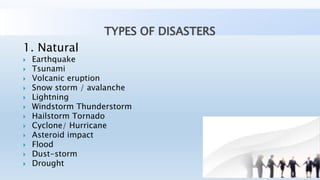
TYPES OF DISASTERS
1. Natural
 Earthquake
 Tsunami
 Volcanic eruption
 Snow storm / avalanche
 Lightning
 Windstorm Thunderstorm
 Hailstorm Tornado
 Cyclone/ Hurricane
 Asteroid impact
 Flood
 Dust-storm
 Drought
Cont.…
2. Human- Influence
Cont.…
Cont.…
4. Some natural influence
 Crop disease
 Insect infestation
 Forest fire
 Mangrove decline
 Coral reef decline
 Acid rain
 Ozone depletion
Cont.…
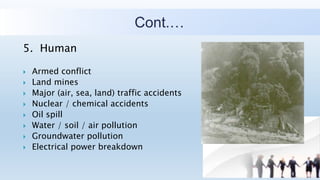
5. Human
 Armed conflict
 Land mines
 Major (air, sea, land) traffic accidents
 Nuclear / chemical accidents
 Oil spill
 Water / soil / air pollution
 Groundwater pollution
 Electrical power breakdown
Phases Of Disaster Management
Phase I: Mitigation
 Attempt to prevent hazards from developing into disasters or to
reduce the effect of disaster when they occur.
 Focuses on
 long term measures for reducing/eliminating risks
 Most cost effective
Types of mitigation:
I. Structural mitigation
II. Non-Structural measures
Cont.…
Mitigation Activities:
• Identification of risks
• Catastrophe modeling tools
Cont..
•Personnel activities in mitigation:
Cont…
•Phase II –Disaster Preparedness
 Focuses on preparing equipment, procedure
 Development of volunteer response capability
among civilian population
 Causality prediction
Cont.… Phase II
Development of emergency plan of action
 Communication plans with easily understandable terminology
 Practice of multi-agency co-ordination
 Proper maintenance and training of emergency services
 Rehearsal of emergency evacuation plans
 Development and exercise of emergency preparedness warning
system and evacuation plans
 Stockpiling, inventory and maintenance of supplies
Phase III – Disaster response
 Determined by the level of disaster.
 Mobilization of emergency services
 Well rehearsed emergency plan a prerequisite
 On a personal front it may be evacuation or home
confinement.
 Starts immediately after the immediate threat to life has
subsided
 Aim is to restore the affected area to its previous state
 Involves rebuilding destroyed property, reemployment and
the repair of infrastructure.
 Implementation of mitigative efforts
DISASTER SERVICES
Triage in disaster:
 Separates those who need rapid medical care to save life or
limb.
 It reduces the burden on the medical facilities
 It provides for equitable and rational distribution of
causalities among the available hospitals.
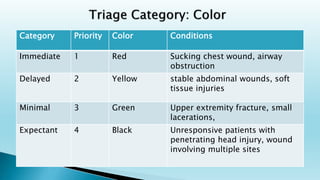
Category Priority Color Conditions
Immediate 1 Red Sucking chest wound, airway
obstruction
Delayed 2 Yellow stable abdominal wounds, soft
tissue injuries
Minimal 3 Green Upper extremity fracture, small
lacerations,
Expectant 4 Black Unresponsive patients with
penetrating head injury, wound
involving multiple sites
The Indian scenario
National Disaster Management Authority Of India
Disaster risk in India:
 Vulnerable
 58.6%landmass prone to earthquakes of moderate to very severe
intensity.
 40 million hectare (12%of land ) prone to floods and river erosion
 Of the 7,516 km long coastline,5,700 prone to cyclones, tsunamis
 68%cultivable land prone to draught
 Hilly areas at risk of avalanches and landslides
Cont.…
 Vulnerable to nuclear, biological ,and chemical warfare.
 Compounded by ever-growing population, vast disparity of
income, rapid urbanisation, development within high-risk
zones, environment degradation, climate change
Disaster management initiatives in India
High powered committee(HPC)
 First initiative, Aug 1999 under JC Pant
 Prepared comprehensive model for disaster management at
national, state and district levels
National Committee on Disaster Management
 Initiated after the Gujarat Earthquake under the
chairmanship of the PM of India
Disaster Management Act 2005
 Holistic management of disaster
 Dec 23,2005
 Accordingly NDMA setup at New Delhi under
the PM
 Responsible for laying down policies and
guidelines for Disaster management, ensuring
timely and effective response coordination,
enforcement and implementation of policy and
plans
 Is evolving a National policy on Disaster
management
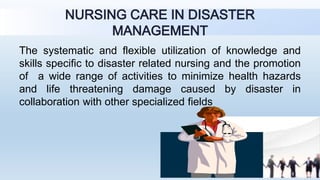
The systematic and flexible utilization of knowledge and
skills specific to disaster related nursing and the promotion
of a wide range of activities to minimize health hazards
and life threatening damage caused by disaster in
collaboration with other specialized fields
OBJECTIVES:
 To effectively reduce the Impact of the disaster on human
life and health.
 To participate in the coordinated efforts of all groups to
reduce loss of life, property. damage, social and economic
disruption and
 To initiate rehabilitation.
Role of the nurse
In Disaster preparedness:
 Facilitate preparation within the community
 Initiate and update disaster plan
 Update record of vulnerable population
 Check availability of resources in case of disaster.
 Assess and report environmental health hazards.
In Disaster response:
 Member of the assessment team
 Feeding back
 Facilitate rapid rescue
 Recovery
 Ongoing assessment and surveillance
Cont.…
In Recovery:
 Hygiene and immunization
 Referral to mental health professionals
 Assessment for environmental hazards
 Assessment for faulty conditions facilitating future
disasters.
 Case finding and referrals
Common Psychological complications due to Disaster:
 Organic ,mental disorder secondary to head injury ,toxins
,illness, dehydration
 Acute stress disorders
 Adjustment disorders
 Substance abuse
 PTSD(Post traumatic stress disorder)
 Generalized anxiety disorder
 Behavioral responses like family violence.
Role of nurse -psychological stress of disaster
victims
 Nursing assessment
 Assess for high risk
o Those who have lost one or more family members
o Those with serious injuries
o Those with previous history of psychiatric illness
o Those who have lost home or possession
o People on fixed family income
o Elderly, minority or without adequate support system
,
Cont.…
 Identification of victims behavior
 Perception of events
 Support systems & coping mechanisms
 Identification of negative feelings
Nursing interventions in Disaster
management:
 Tailored to the community served.
 Appropriate to the stage of emotional response
 Should work with families or group of families
 Survivor should feel “valued”
 Do not give false reassurances.
Cont.…
 Keep families together especially parents and children
 Remove panic stricken people from main group
 Keep people in group
 Assignee small supervised tasks
 Increase awareness of what has happened
 Do not isolate
 Explore provisions for reconstruction of life style
Cont.…
 Assist in contact with friends
 Give information about social, financial, health resources.
 Establish and maintain communication network
 Prevent /reduce rumors
 Encourage sharing of information
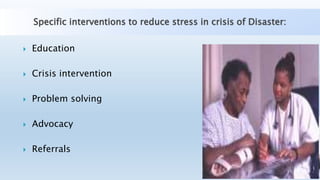
Specific interventions to reduce stress in crisis of Disaster:
 Education
 Crisis intervention
 Problem solving
 Advocacy
 Referrals
;) THANKYOU SO MUCH FOR
YOUR CAREFULL LISTENING
AND
KIND ATTENTION !!! ;)

Disaster Management in Nursing

  • 1.
    MEDICAL SURGICAL -II UNITNO. XI DISASTER MANAGEMENT IN NURSING COMPILED BY - Mr. Ashish Henjali Roy B.Sc Nursing(Nursing Tutor) Savitri Hospital And Paramedical Institute,Gorakhpur,UttarPradesh.
  • 2.
    Definition A serious disruptionof the functioning of a community or a society causing widespread human, material, economic or environmental losses which exceed the ability of the affected community or society to cope using its own resources.
  • 3.
    WHO Definition: An occurrenceof a severity and magnitude that normally results in death, injuries and property damage that cannot be managed through the routine procedure and resources of government.
  • 4.
    Emergency management/ disaster management Discipline of dealing with and avoiding risks  It is a discipline that involves preparing for disaster before it happens, disaster response(emergency evacuation , quarantine, etc.) as well as supporting and rebuilding society after natural or human made disasters.
  • 5.
    Cont.…  Continuous processby which all individuals, groups and communities, manage hazards in an effort to avoid and ameliorate the impact of disaster resulting from hazards.
  • 6.
    TYPES OF DISASTERS 1.Natural  Earthquake  Tsunami  Volcanic eruption  Snow storm / avalanche  Lightning  Windstorm Thunderstorm  Hailstorm Tornado  Cyclone/ Hurricane  Asteroid impact  Flood  Dust-storm  Drought
  • 7.
  • 8.
  • 9.
    Cont.… 4. Some naturalinfluence  Crop disease  Insect infestation  Forest fire  Mangrove decline  Coral reef decline  Acid rain  Ozone depletion
  • 10.
    Cont.… 5. Human  Armedconflict  Land mines  Major (air, sea, land) traffic accidents  Nuclear / chemical accidents  Oil spill  Water / soil / air pollution  Groundwater pollution  Electrical power breakdown
  • 12.
    Phases Of DisasterManagement Phase I: Mitigation  Attempt to prevent hazards from developing into disasters or to reduce the effect of disaster when they occur.  Focuses on  long term measures for reducing/eliminating risks  Most cost effective Types of mitigation: I. Structural mitigation II. Non-Structural measures
  • 13.
    Cont.… Mitigation Activities: • Identificationof risks • Catastrophe modeling tools
  • 14.
  • 15.
    Cont… •Phase II –DisasterPreparedness  Focuses on preparing equipment, procedure  Development of volunteer response capability among civilian population  Causality prediction
  • 16.
    Cont.… Phase II Developmentof emergency plan of action  Communication plans with easily understandable terminology  Practice of multi-agency co-ordination  Proper maintenance and training of emergency services  Rehearsal of emergency evacuation plans  Development and exercise of emergency preparedness warning system and evacuation plans  Stockpiling, inventory and maintenance of supplies
  • 17.
    Phase III –Disaster response  Determined by the level of disaster.  Mobilization of emergency services  Well rehearsed emergency plan a prerequisite  On a personal front it may be evacuation or home confinement.
  • 18.
     Starts immediatelyafter the immediate threat to life has subsided  Aim is to restore the affected area to its previous state  Involves rebuilding destroyed property, reemployment and the repair of infrastructure.  Implementation of mitigative efforts
  • 19.
    DISASTER SERVICES Triage indisaster:  Separates those who need rapid medical care to save life or limb.  It reduces the burden on the medical facilities  It provides for equitable and rational distribution of causalities among the available hospitals.
  • 20.
    Category Priority ColorConditions Immediate 1 Red Sucking chest wound, airway obstruction Delayed 2 Yellow stable abdominal wounds, soft tissue injuries Minimal 3 Green Upper extremity fracture, small lacerations, Expectant 4 Black Unresponsive patients with penetrating head injury, wound involving multiple sites
  • 21.
    The Indian scenario NationalDisaster Management Authority Of India Disaster risk in India:  Vulnerable  58.6%landmass prone to earthquakes of moderate to very severe intensity.  40 million hectare (12%of land ) prone to floods and river erosion  Of the 7,516 km long coastline,5,700 prone to cyclones, tsunamis  68%cultivable land prone to draught  Hilly areas at risk of avalanches and landslides
  • 22.
    Cont.…  Vulnerable tonuclear, biological ,and chemical warfare.  Compounded by ever-growing population, vast disparity of income, rapid urbanisation, development within high-risk zones, environment degradation, climate change
  • 23.
    Disaster management initiativesin India High powered committee(HPC)  First initiative, Aug 1999 under JC Pant  Prepared comprehensive model for disaster management at national, state and district levels National Committee on Disaster Management  Initiated after the Gujarat Earthquake under the chairmanship of the PM of India
  • 24.
    Disaster Management Act2005  Holistic management of disaster  Dec 23,2005  Accordingly NDMA setup at New Delhi under the PM  Responsible for laying down policies and guidelines for Disaster management, ensuring timely and effective response coordination, enforcement and implementation of policy and plans  Is evolving a National policy on Disaster management
  • 25.
    The systematic andflexible utilization of knowledge and skills specific to disaster related nursing and the promotion of a wide range of activities to minimize health hazards and life threatening damage caused by disaster in collaboration with other specialized fields
  • 26.
    OBJECTIVES:  To effectivelyreduce the Impact of the disaster on human life and health.  To participate in the coordinated efforts of all groups to reduce loss of life, property. damage, social and economic disruption and  To initiate rehabilitation.
  • 27.
    Role of thenurse In Disaster preparedness:  Facilitate preparation within the community  Initiate and update disaster plan  Update record of vulnerable population  Check availability of resources in case of disaster.  Assess and report environmental health hazards.
  • 28.
    In Disaster response: Member of the assessment team  Feeding back  Facilitate rapid rescue  Recovery  Ongoing assessment and surveillance
  • 29.
    Cont.… In Recovery:  Hygieneand immunization  Referral to mental health professionals  Assessment for environmental hazards  Assessment for faulty conditions facilitating future disasters.  Case finding and referrals
  • 30.
    Common Psychological complicationsdue to Disaster:  Organic ,mental disorder secondary to head injury ,toxins ,illness, dehydration  Acute stress disorders  Adjustment disorders  Substance abuse  PTSD(Post traumatic stress disorder)  Generalized anxiety disorder  Behavioral responses like family violence.
  • 31.
    Role of nurse-psychological stress of disaster victims  Nursing assessment  Assess for high risk o Those who have lost one or more family members o Those with serious injuries o Those with previous history of psychiatric illness o Those who have lost home or possession o People on fixed family income o Elderly, minority or without adequate support system ,
  • 32.
    Cont.…  Identification ofvictims behavior  Perception of events  Support systems & coping mechanisms  Identification of negative feelings
  • 33.
    Nursing interventions inDisaster management:  Tailored to the community served.  Appropriate to the stage of emotional response  Should work with families or group of families  Survivor should feel “valued”  Do not give false reassurances.
  • 34.
    Cont.…  Keep familiestogether especially parents and children  Remove panic stricken people from main group  Keep people in group  Assignee small supervised tasks  Increase awareness of what has happened  Do not isolate  Explore provisions for reconstruction of life style
  • 35.
    Cont.…  Assist incontact with friends  Give information about social, financial, health resources.  Establish and maintain communication network  Prevent /reduce rumors  Encourage sharing of information
  • 36.
    Specific interventions toreduce stress in crisis of Disaster:  Education  Crisis intervention  Problem solving  Advocacy  Referrals
  • 37.
    ;) THANKYOU SOMUCH FOR YOUR CAREFULL LISTENING AND KIND ATTENTION !!! ;)