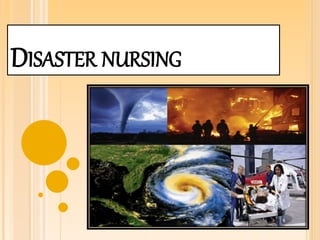
DISASTER NURSING
INTRODUCTION
 We do not expect disasters , but they happen.
 The word disaster derives from Greek prefix ‘dus’ which means
bad and ‘taster’ which means star.
 Developing countries suffer the greatest when a disaster hits.
 95% of all deaths caused by disasters occur in developing
countries
 loses due to natural disasters are 20 times greater in developing
countries.
DEFINITION
 Disaster is defined as any occurrence that causes
damage, economic destruction, loss of human life,
and deterioration in health and health services on a
scale sufficient to warrant an extraordinary
response from outside the affected community or
area.
-WHO
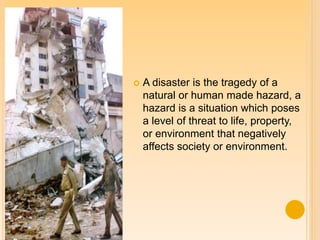
 A disaster is the tragedy of a
natural or human made hazard, a
hazard is a situation which poses
a level of threat to life, property,
or environment that negatively
affects society or environment.
TYPES OF DISASTER
 Bonet classifies disasters based on a numeric categorization,
 Minor disasters-
upper limit of 25 person injured or killed.
 Moderate disasters-
up to 100 person injured or killed.
 Major disasters-
it exceeds 100 person injured or killed.
CLASSIFICATION OF DISASTER
 Natural Disasters:
 Disasters of acute onset such as earth quake,
cyclones, tsunamis, floods.
 Disasters of chronic onset such as drought, famine,
deforestation, chronic exposure to toxic substances.
 Human made Disasters:
 Technological disasters such as engineering failure,
transport disasters.
 Sociological disasters have a strong human motive
such as criminal acts, riots, wars.
 Other Disasters:
 Effect of loose policies which allows use of tobacco,
sale of harmful drugs etc.
 Cold wave
 Thunderstorms
 Heat waves
 Mud slides
 Storm
 Flood
 Cyclone
 Drought
 Earthquake
Minor natural disaster Major natural disaster
 Setting of fires
 Epidemic
 Deforestation
 Chemical pollution
 Wars
 Road traffic accidents
 Riots
 Food poisoning
 Industrial disasters
 Environmental pollution
Major man
made
disasters
Minor man made
disasters
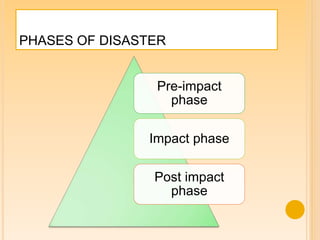
PHASES OF DISASTER
Pre-impact
phase
Impact phase
Post impact
phase
NON-DISASTER PHASE /INTER DISASTER
PHASE/PRE-IMPACT PHASE
 Phase for preparedness
 Disaster prevention measures and conduct disaster
training and education programme for community.
 Activities are:
- mapping the potential locations
- vulnerability analysis
- inventory of existing resources
- planning appropriate preventive, preparedness
and mitigation measures
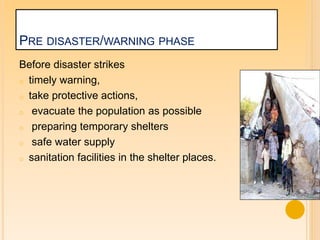
PRE DISASTER/WARNING PHASE
Before disaster strikes
o timely warning,
o take protective actions,
o evacuate the population as possible
o preparing temporary shelters
o safe water supply
o sanitation facilities in the shelter places.
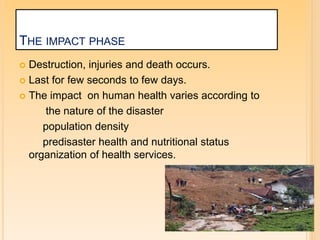
THE IMPACT PHASE
 Destruction, injuries and death occurs.
 Last for few seconds to few days.
 The impact on human health varies according to
the nature of the disaster
population density
predisaster health and nutritional status
organization of health services.
POST IMPACT PHASE
Emergency phase
Recovery phase
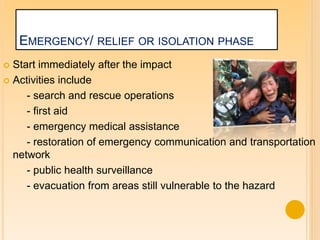
EMERGENCY/ RELIEF OR ISOLATION PHASE
 Start immediately after the impact
 Activities include
- search and rescue operations
- first aid
- emergency medical assistance
- restoration of emergency communication and transportation
network
- public health surveillance
- evacuation from areas still vulnerable to the hazard
RECONSTRUCTION/REHABILITATION
PHASE/POST IMPACT PHASE
 Restoration of pre disaster condition begins
 Involves reestablishing normal health services, and
assessing ,repairing, and reconstructing damaged
facilities and buildings.
 Time to think about the lesson learned from the
recent disaster.
 Time span for this phase is difficult to define, it may
start fairly early, even during the emergency period
and may last for many years.
DISASTER
MANAGEMENT
OBJECTIVES OF DISASTER NURSING
 To effectively reduce the impact of disaster on
human life and health.
 To participate in the co ordinated efforts of all
groups to reduce
loss of life
property damage
social and economic disruption.
 To initiate rehabilitation.
DISASTER CYCLE:-PHASES OF DISASTER
MANAGEMENT
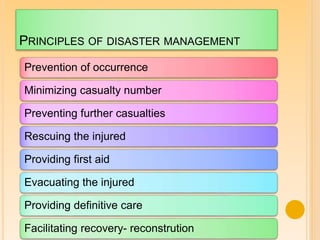
PRINCIPLES OF DISASTER MANAGEMENT
Prevention of occurrence
Minimizing casualty number
Preventing further casualties
Rescuing the injured
Providing first aid
Evacuating the injured
Providing definitive care
Facilitating recovery- reconstrution
ESSENTIAL ELEMENTS OF DISASTER
MANAGEMENT
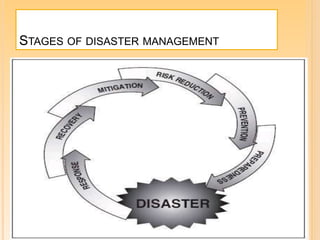
STAGES OF DISASTER MANAGEMENT
 Preparedness
 Disaster response
Efforts to minimize the hazards
 Mitigation
minimizing the effects of disaster
 Recovery
Returning community to normal
a )Personal preparedness
b) Professional preparedness
c) Community Preparedness
HEALTH CONSEQUENCES OF A DISASTER
 Unexpected number of deaths, injuries and illnesses
 Adverse effects on environment and population
 Affect the psychological and social behavior
 Shortage of food with nutritional consequences
 Large spontaneous or organized population movements,
morbidity, mortality and communicable diseases.
COMMON REACTIONS TO CHILDREN
 Regressive behaviors ( bed wetting,
thumb sucking, crying and clinging to
parents )
 Nightmares
 School related problems like inability
to concentrate, refusal to go back to
school
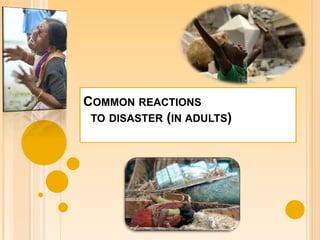
COMMON REACTIONS
TO DISASTER (IN ADULTS)
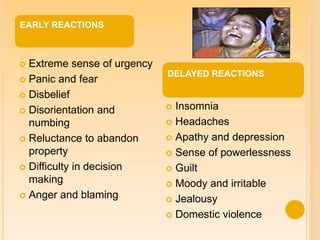
 Extreme sense of urgency
 Panic and fear
 Disbelief
 Disorientation and
numbing
 Reluctance to abandon
property
 Difficulty in decision
making
 Anger and blaming
 Insomnia
 Headaches
 Apathy and depression
 Sense of powerlessness
 Guilt
 Moody and irritable
 Jealousy
 Domestic violence
EARLY REACTIONS
DELAYED REACTIONS
POST DISASTER STRESS RESPONSE
 Definition
Is a response to witnessing a
traumatic event that involves
interpersonal violence or some
natural disaster.
Person’s will have
 intense fear,
 helplessness, or horror,
 impairment in social,
occupational or other
functioning.
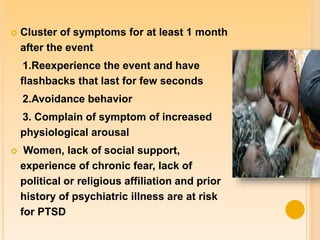
 Cluster of symptoms for at least 1 month
after the event
1.Reexperience the event and have
flashbacks that last for few seconds
2.Avoidance behavior
3. Complain of symptom of increased
physiological arousal
 Women, lack of social support,
experience of chronic fear, lack of
political or religious affiliation and prior
history of psychiatric illness are at risk
for PTSD
STRESS MANAGEMENT
LEVELS OF DISASTER PREVENTION
 PRIMARY PREVENTION
- Awareness of risk factors
- Individual and community preparedness
- Safety practices
 SECONDARY PREVENTION
- Immediate rescue
- Prevention of additional injury and death
- First aid, definitive medical care, shelters
- Organized community response
 TERTIARY PREVENTION
- Actions for rehabilitation and disability limitation
- Long term alternative shelters, Relocation services
- Family and community rehabilitation
MASS CASUALTY DRILLS OR
MOCK DISASTERS
PURPOSES
 Promote confidence
 Develop skills
 Co ordinate activities
 Coordinate participants
 To familarize with roles and
responsibilities
 To point out weakness or
Omissions in the plan
TYPES OF DRILLS
Orientation
seminar
Table top
exercise
Functional
exercise
Full scale
exercise
SETTING UP DISASTER MANAGEMENT TEAM
 IN INDIA- National level
Ministry of home affairs is the nodal ministry
(central relief commissioner (CRC) is the nodal officer. Ministries/
Departments/ Organizations concerned are:
 India meteorological dept
 Central water commission
 Ministry of home affairs
 Ministry of defense
 Ministry of finance
 Ministry of rural and urban development
 Department of communication
 Ministry of health
 Ministry of information and broadcasting
 Ministry of railways etc
STATE LEVEL
 Department of relief and rehabilitation
-State crisis management committee under the
chairmanship of Chief secretary.
- Control room is established
District level:
 Collector /Dy. Commissioner is the chief
administrator.
 District level co ordination and relief committee is
constituted.
 INTER GOVERMENTAL ORGANIZATIONS:
 ECHO
 OAS
 CCPN
 CDER
 NON GOVERNMENTAL ORGANIZATIONS:
 CARE
 ICRC
 ICVA
 IFRC
 IMC
 VITA
RESOURCES REQUIRED FOR DISASTER
MANAGEMENT
o Transportation facilities
o Communication facilities
o Public work and engineering
o Fire fighting
o Information and planning
o Health and medical services
o Manpower
o Food and water supply
o Financial support
AGENCIES INVOLVED IN DISASTER
MANAGEMENT
 UNITED NATIONS AGENCIES ARE:
 OCHA
 WHO
 UNICEF
 WFP
 FAO
disaster nursing ppt.pptx

disaster nursing ppt.pptx

  • 1.
  • 2.
    INTRODUCTION  We donot expect disasters , but they happen.  The word disaster derives from Greek prefix ‘dus’ which means bad and ‘taster’ which means star.  Developing countries suffer the greatest when a disaster hits.  95% of all deaths caused by disasters occur in developing countries  loses due to natural disasters are 20 times greater in developing countries.
  • 3.
    DEFINITION  Disaster isdefined as any occurrence that causes damage, economic destruction, loss of human life, and deterioration in health and health services on a scale sufficient to warrant an extraordinary response from outside the affected community or area. -WHO
  • 4.
     A disasteris the tragedy of a natural or human made hazard, a hazard is a situation which poses a level of threat to life, property, or environment that negatively affects society or environment.
  • 5.
    TYPES OF DISASTER Bonet classifies disasters based on a numeric categorization,  Minor disasters- upper limit of 25 person injured or killed.  Moderate disasters- up to 100 person injured or killed.  Major disasters- it exceeds 100 person injured or killed.
  • 6.
    CLASSIFICATION OF DISASTER Natural Disasters:  Disasters of acute onset such as earth quake, cyclones, tsunamis, floods.  Disasters of chronic onset such as drought, famine, deforestation, chronic exposure to toxic substances.
  • 7.
     Human madeDisasters:  Technological disasters such as engineering failure, transport disasters.  Sociological disasters have a strong human motive such as criminal acts, riots, wars.  Other Disasters:  Effect of loose policies which allows use of tobacco, sale of harmful drugs etc.
  • 8.
     Cold wave Thunderstorms  Heat waves  Mud slides  Storm  Flood  Cyclone  Drought  Earthquake Minor natural disaster Major natural disaster
  • 9.
     Setting offires  Epidemic  Deforestation  Chemical pollution  Wars  Road traffic accidents  Riots  Food poisoning  Industrial disasters  Environmental pollution Major man made disasters Minor man made disasters
  • 10.
  • 11.
    NON-DISASTER PHASE /INTERDISASTER PHASE/PRE-IMPACT PHASE  Phase for preparedness  Disaster prevention measures and conduct disaster training and education programme for community.  Activities are: - mapping the potential locations - vulnerability analysis - inventory of existing resources - planning appropriate preventive, preparedness and mitigation measures
  • 12.
    PRE DISASTER/WARNING PHASE Beforedisaster strikes o timely warning, o take protective actions, o evacuate the population as possible o preparing temporary shelters o safe water supply o sanitation facilities in the shelter places.
  • 13.
    THE IMPACT PHASE Destruction, injuries and death occurs.  Last for few seconds to few days.  The impact on human health varies according to the nature of the disaster population density predisaster health and nutritional status organization of health services.
  • 14.
    POST IMPACT PHASE Emergencyphase Recovery phase
  • 15.
    EMERGENCY/ RELIEF ORISOLATION PHASE  Start immediately after the impact  Activities include - search and rescue operations - first aid - emergency medical assistance - restoration of emergency communication and transportation network - public health surveillance - evacuation from areas still vulnerable to the hazard
  • 16.
    RECONSTRUCTION/REHABILITATION PHASE/POST IMPACT PHASE Restoration of pre disaster condition begins  Involves reestablishing normal health services, and assessing ,repairing, and reconstructing damaged facilities and buildings.  Time to think about the lesson learned from the recent disaster.  Time span for this phase is difficult to define, it may start fairly early, even during the emergency period and may last for many years.
  • 17.
  • 18.
    OBJECTIVES OF DISASTERNURSING  To effectively reduce the impact of disaster on human life and health.  To participate in the co ordinated efforts of all groups to reduce loss of life property damage social and economic disruption.  To initiate rehabilitation.
  • 19.
    DISASTER CYCLE:-PHASES OFDISASTER MANAGEMENT
  • 20.
    PRINCIPLES OF DISASTERMANAGEMENT Prevention of occurrence Minimizing casualty number Preventing further casualties Rescuing the injured Providing first aid Evacuating the injured Providing definitive care Facilitating recovery- reconstrution
  • 21.
    ESSENTIAL ELEMENTS OFDISASTER MANAGEMENT
  • 22.
  • 23.
     Preparedness  Disasterresponse Efforts to minimize the hazards  Mitigation minimizing the effects of disaster  Recovery Returning community to normal a )Personal preparedness b) Professional preparedness c) Community Preparedness
  • 24.
  • 25.
     Unexpected numberof deaths, injuries and illnesses  Adverse effects on environment and population  Affect the psychological and social behavior  Shortage of food with nutritional consequences  Large spontaneous or organized population movements, morbidity, mortality and communicable diseases.
  • 26.
    COMMON REACTIONS TOCHILDREN  Regressive behaviors ( bed wetting, thumb sucking, crying and clinging to parents )  Nightmares  School related problems like inability to concentrate, refusal to go back to school
  • 27.
  • 28.
     Extreme senseof urgency  Panic and fear  Disbelief  Disorientation and numbing  Reluctance to abandon property  Difficulty in decision making  Anger and blaming  Insomnia  Headaches  Apathy and depression  Sense of powerlessness  Guilt  Moody and irritable  Jealousy  Domestic violence EARLY REACTIONS DELAYED REACTIONS
  • 29.
    POST DISASTER STRESSRESPONSE  Definition Is a response to witnessing a traumatic event that involves interpersonal violence or some natural disaster. Person’s will have  intense fear,  helplessness, or horror,  impairment in social, occupational or other functioning.
  • 30.
     Cluster ofsymptoms for at least 1 month after the event 1.Reexperience the event and have flashbacks that last for few seconds 2.Avoidance behavior 3. Complain of symptom of increased physiological arousal  Women, lack of social support, experience of chronic fear, lack of political or religious affiliation and prior history of psychiatric illness are at risk for PTSD
  • 31.
  • 32.
    LEVELS OF DISASTERPREVENTION  PRIMARY PREVENTION - Awareness of risk factors - Individual and community preparedness - Safety practices  SECONDARY PREVENTION - Immediate rescue - Prevention of additional injury and death - First aid, definitive medical care, shelters - Organized community response  TERTIARY PREVENTION - Actions for rehabilitation and disability limitation - Long term alternative shelters, Relocation services - Family and community rehabilitation
  • 33.
    MASS CASUALTY DRILLSOR MOCK DISASTERS
  • 34.
    PURPOSES  Promote confidence Develop skills  Co ordinate activities  Coordinate participants  To familarize with roles and responsibilities  To point out weakness or Omissions in the plan
  • 35.
    TYPES OF DRILLS Orientation seminar Tabletop exercise Functional exercise Full scale exercise
  • 36.
    SETTING UP DISASTERMANAGEMENT TEAM  IN INDIA- National level Ministry of home affairs is the nodal ministry (central relief commissioner (CRC) is the nodal officer. Ministries/ Departments/ Organizations concerned are:  India meteorological dept  Central water commission  Ministry of home affairs  Ministry of defense  Ministry of finance  Ministry of rural and urban development  Department of communication  Ministry of health  Ministry of information and broadcasting  Ministry of railways etc
  • 37.
    STATE LEVEL  Departmentof relief and rehabilitation -State crisis management committee under the chairmanship of Chief secretary. - Control room is established District level:  Collector /Dy. Commissioner is the chief administrator.  District level co ordination and relief committee is constituted.
  • 38.
     INTER GOVERMENTALORGANIZATIONS:  ECHO  OAS  CCPN  CDER  NON GOVERNMENTAL ORGANIZATIONS:  CARE  ICRC  ICVA  IFRC  IMC  VITA
  • 39.
    RESOURCES REQUIRED FORDISASTER MANAGEMENT o Transportation facilities o Communication facilities o Public work and engineering o Fire fighting o Information and planning o Health and medical services o Manpower o Food and water supply o Financial support
  • 40.
    AGENCIES INVOLVED INDISASTER MANAGEMENT  UNITED NATIONS AGENCIES ARE:  OCHA  WHO  UNICEF  WFP  FAO