Presented by- P.K. PANWAR
WEB- www.pkpanwarauthor.com
“Any occurrence that causes damage,
ecological disruptions, loss of human
life and deterioration of health and
health services, on a scale sufficient to
warrant an extraordinary response
from outside the affected community.”
( WHO)
Defines a disaster as “an
occurrence, either natural or
manmade that causes human
suffering and creates human
needs that victims cannot alleviate
without assistance
( ACCORDING TOAMERICANREDCROSS)
 Emergency Nursing – (usually)
involves the provision of nursing
care for patient or patients with
acute injuries or life threatening
illnesses. (Usually) care is
provided at ED, Urgent care,
Trauma unit and/or ICU/CCU
 Disaster Nursing – involves
response to (and preparedness
for) natural or man-made events
that affect an entire community or
communities. (Usually) involve
massive numbers of casualties
and extensive property damage.
 D- DESTRUCTION
 I- INCIDENTS
 S- SUFFERINGS
 A- ADMINISTRATIVE, FINANCIAL FAILURES
 S- SENTIMENTS
 T- TRAGIDIES
 E- ERRUPTION OF COMMUNICABLE DISEASES
 R-RESEACH PROGRAMME AND ITS
IMPLEMENTATION
NATURAL
 Earthquakes
 Volcanic eruption
 Landslides
 Windstorms
 Tornadoes
 Hailstorms
 Floods
MAN-MADE DISASTER
 Conventional warfare
 Nuclear , chemical war
 Terrorist acts
 Drowning
 Explosions
 Air pollutions
 Fires
 Gas leak
HYBRID
 Spread of disease in community
 Global warming
TYPES OF DISASTER BASED ON LOCATION
OF IMPACT
 Land related disaster
 Hydrological, Costal disaster
 Space disasters
 Technological disaster
 Industrial disaster
 VULNERABILITY OF POPULATION.
 WARNING TIME.
 POVERTY.
 POPULATION GROWTH.
FACTORS AFFECTING SCOPE AND
SEVERITY OF DISASTER
 RAPID URBANIZATION.
 TRANSITION IN CULTURAL PRACTICES.
 ENVIRONMENTAL DEGRADATION.
 LACK OF AWARENESS.
 WAR AND CIVIL LIFE.
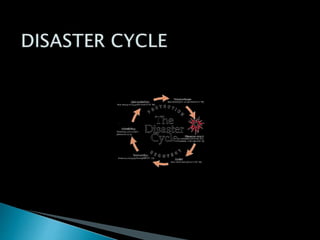
 Mitigation:
◦ Lessen the impact of a disaster before it strikes
 Preparedness:
◦ Activities undertaken to handle a disaster when it
strikes
 Response:
◦ Search and rescue, clearing debris, and feeding and
sheltering victims (and responders if necessary).
 Recovery:
◦ Getting a community back to its pre-disaster status
 Activities that reduce or eliminate a hazard
◦ Prevention
◦ Risk reduction
 Examples
◦ Immunization programs
◦ Public education
 Activities that are taken to build capacity and
identify resources that may be used
◦ Know evacuation shelters
◦ Emergency communication plan
◦ Preventive measures to prevent spread of disease
◦ Public Education
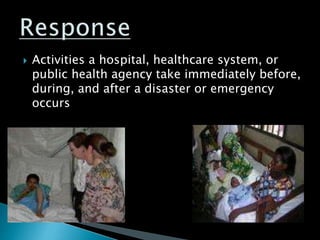
 Activities a hospital, healthcare system, or
public health agency take immediately before,
during, and after a disaster or emergency
occurs
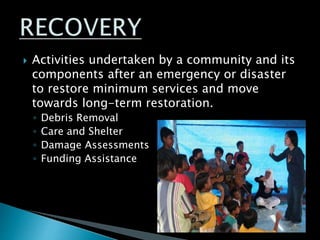
 Activities undertaken by a community and its
components after an emergency or disaster
to restore minimum services and move
towards long-term restoration.
◦ Debris Removal
◦ Care and Shelter
◦ Damage Assessments
◦ Funding Assistance
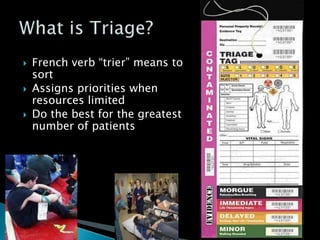
 French verb “trier” means to
sort
 Assigns priorities when
resources limited
 Do the best for the greatest
number of patients
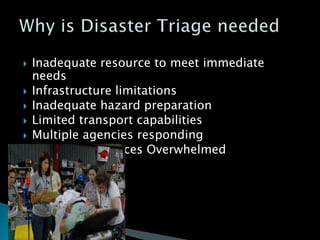
 Inadequate resource to meet immediate
needs
 Infrastructure limitations
 Inadequate hazard preparation
 Limited transport capabilities
 Multiple agencies responding
 Hospital Resources Overwhelmed
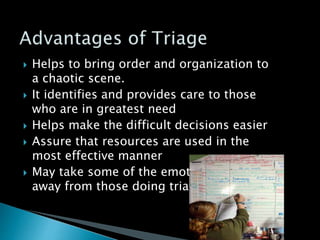
 Helps to bring order and organization to
a chaotic scene.
 It identifies and provides care to those
who are in greatest need
 Helps make the difficult decisions easier
 Assure that resources are used in the
most effective manner
 May take some of the emotional burden
away from those doing triage
 Every patient should be received and triaged
by appropriate skilled health care
professionals.
 Triage is a clinical managerial decision and
must involve collaborative planning.
 The triage process should not cause a delay
in the delivery of effective clinical care.
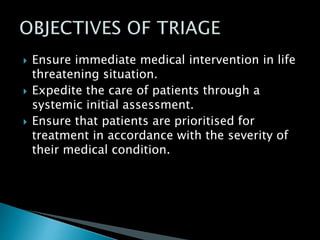
 Ensure immediate medical intervention in life
threatening situation.
 Expedite the care of patients through a
systemic initial assessment.
 Ensure that patients are prioritised for
treatment in accordance with the severity of
their medical condition.
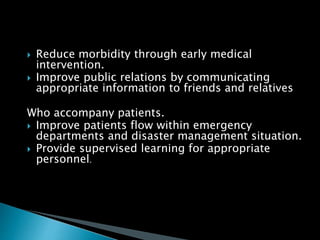
 Reduce morbidity through early medical
intervention.
 Improve public relations by communicating
appropriate information to friends and relatives
Who accompany patients.
 Improve patients flow within emergency
departments and disaster management situation.
 Provide supervised learning for appropriate
personnel.
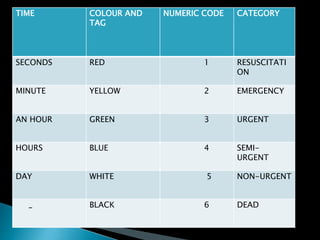
 Fitzgerald developed a scale for the triage –
ipswich scale
TIME COLOUR AND
TAG
NUMERIC CODE CATEGORY
SECONDS RED 1 RESUSCITATI
ON
MINUTE YELLOW 2 EMERGENCY
AN HOUR GREEN 3 URGENT
HOURS BLUE 4 SEMI-
URGENT
DAY WHITE 5 NON-URGENT
_ BLACK 6 DEAD
 LOSS OF LIFE
 SEVERE PHYSICAL INJURIES
 PSYCHOLOGICAL TRAUMA
 PROPERTY DAMAGE
 ENVIRONMENTAL DESTRUCTION
 ECONOMIC AND BUSINESS LOSS
 CLIMATIC EXPOSURES
 EXTREMES OF TEMPERATURE
 FOOD AND NUTRITION- SCARCITY
 PROBLEMS IN LARGE SCALE DISTRIBUTON
 MENTAL HEALTH- ACUTE MENTAL ILLNESS
 ANXIETY, NEUROSIS , DEPRESSION
 COMMUNICABLE DISEASES
 DIARRHEA DISEASES, MEASLES, MALARIA,T.B,
SCABIES, RESPIRATORY COMPLAINTS ETC.
 SOCIAL REACTION- FOR OBVIOUS REASONS
 DAMAGE TO HEALTH INFRASTRUCURE
 DIRECT CONSEQUENCE OF DISASTER

it is the discipline that deals with and avoid
risks and impact of a disaster.
 Involves in preparing for disaster before it
happens.
 Responds immediately to the outcome prior
to and following a disaster.
 Deals with the process of supporting and
rebuilding society after a disaster.
 Is an emergency management system which
is a continuous process involving individuals,
groups and community to manage hazards
 To ensure that appropriate systems,
procedures and resources are in place to
provide prompt, effective assistance to
disaster victims, thus facilitating relief
measures and rehabilitation services.
 reduce the impact of the life of the
individuals and health in addition to
emergency services and to participate in
the disaster team efforts to reduce the
loss of life, damage to property, social and
economic disruption and to initiation of
psycho-social rehabilitation.
• Prevent the disaster
• Minimize casualties
• Prevent further casualties
• Rescue the victims
• First aid
• Evacuate
• Medical care
• Reconstruction
Disaster preparedness, including risk
assessment and multi-disciplinary
management strategies at all system levels,
is critical to the delivery of effective
responses to the short, medium, and long-
term health needs of a disaster-stricken
population.
International Council of Nurses
(2006)
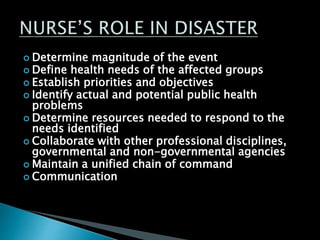
 Determine magnitude of the event
 Define health needs of the affected groups
 Establish priorities and objectives
 Identify actual and potential public health
problems
 Determine resources needed to respond to the
needs identified
 Collaborate with other professional disciplines,
governmental and non-governmental agencies
 Maintain a unified chain of command
 Communication
Disaster nursing

Disaster nursing

  • 1.
    Presented by- P.K.PANWAR WEB- www.pkpanwarauthor.com
  • 2.
    “Any occurrence thatcauses damage, ecological disruptions, loss of human life and deterioration of health and health services, on a scale sufficient to warrant an extraordinary response from outside the affected community.” ( WHO)
  • 3.
    Defines a disasteras “an occurrence, either natural or manmade that causes human suffering and creates human needs that victims cannot alleviate without assistance ( ACCORDING TOAMERICANREDCROSS)
  • 4.
     Emergency Nursing– (usually) involves the provision of nursing care for patient or patients with acute injuries or life threatening illnesses. (Usually) care is provided at ED, Urgent care, Trauma unit and/or ICU/CCU
  • 5.
     Disaster Nursing– involves response to (and preparedness for) natural or man-made events that affect an entire community or communities. (Usually) involve massive numbers of casualties and extensive property damage.
  • 6.
     D- DESTRUCTION I- INCIDENTS  S- SUFFERINGS  A- ADMINISTRATIVE, FINANCIAL FAILURES  S- SENTIMENTS  T- TRAGIDIES  E- ERRUPTION OF COMMUNICABLE DISEASES  R-RESEACH PROGRAMME AND ITS IMPLEMENTATION
  • 7.
    NATURAL  Earthquakes  Volcaniceruption  Landslides  Windstorms  Tornadoes  Hailstorms  Floods
  • 8.
    MAN-MADE DISASTER  Conventionalwarfare  Nuclear , chemical war  Terrorist acts  Drowning  Explosions  Air pollutions  Fires  Gas leak
  • 9.
    HYBRID  Spread ofdisease in community  Global warming TYPES OF DISASTER BASED ON LOCATION OF IMPACT  Land related disaster  Hydrological, Costal disaster  Space disasters  Technological disaster  Industrial disaster
  • 10.
     VULNERABILITY OFPOPULATION.  WARNING TIME.  POVERTY.  POPULATION GROWTH. FACTORS AFFECTING SCOPE AND SEVERITY OF DISASTER
  • 11.
     RAPID URBANIZATION. TRANSITION IN CULTURAL PRACTICES.  ENVIRONMENTAL DEGRADATION.  LACK OF AWARENESS.  WAR AND CIVIL LIFE.
  • 12.
     Mitigation: ◦ Lessenthe impact of a disaster before it strikes  Preparedness: ◦ Activities undertaken to handle a disaster when it strikes  Response: ◦ Search and rescue, clearing debris, and feeding and sheltering victims (and responders if necessary).  Recovery: ◦ Getting a community back to its pre-disaster status
  • 13.
     Activities thatreduce or eliminate a hazard ◦ Prevention ◦ Risk reduction  Examples ◦ Immunization programs ◦ Public education
  • 14.
     Activities thatare taken to build capacity and identify resources that may be used ◦ Know evacuation shelters ◦ Emergency communication plan ◦ Preventive measures to prevent spread of disease ◦ Public Education
  • 15.
     Activities ahospital, healthcare system, or public health agency take immediately before, during, and after a disaster or emergency occurs
  • 16.
     Activities undertakenby a community and its components after an emergency or disaster to restore minimum services and move towards long-term restoration. ◦ Debris Removal ◦ Care and Shelter ◦ Damage Assessments ◦ Funding Assistance
  • 17.
     French verb“trier” means to sort  Assigns priorities when resources limited  Do the best for the greatest number of patients
  • 18.
     Inadequate resourceto meet immediate needs  Infrastructure limitations  Inadequate hazard preparation  Limited transport capabilities  Multiple agencies responding  Hospital Resources Overwhelmed
  • 19.
     Helps tobring order and organization to a chaotic scene.  It identifies and provides care to those who are in greatest need  Helps make the difficult decisions easier  Assure that resources are used in the most effective manner  May take some of the emotional burden away from those doing triage
  • 20.
     Every patientshould be received and triaged by appropriate skilled health care professionals.  Triage is a clinical managerial decision and must involve collaborative planning.  The triage process should not cause a delay in the delivery of effective clinical care.
  • 21.
     Ensure immediatemedical intervention in life threatening situation.  Expedite the care of patients through a systemic initial assessment.  Ensure that patients are prioritised for treatment in accordance with the severity of their medical condition.
  • 22.
     Reduce morbiditythrough early medical intervention.  Improve public relations by communicating appropriate information to friends and relatives Who accompany patients.  Improve patients flow within emergency departments and disaster management situation.  Provide supervised learning for appropriate personnel.
  • 23.
     Fitzgerald developeda scale for the triage – ipswich scale
  • 24.
    TIME COLOUR AND TAG NUMERICCODE CATEGORY SECONDS RED 1 RESUSCITATI ON MINUTE YELLOW 2 EMERGENCY AN HOUR GREEN 3 URGENT HOURS BLUE 4 SEMI- URGENT DAY WHITE 5 NON-URGENT _ BLACK 6 DEAD
  • 25.
     LOSS OFLIFE  SEVERE PHYSICAL INJURIES  PSYCHOLOGICAL TRAUMA  PROPERTY DAMAGE
  • 26.
     ENVIRONMENTAL DESTRUCTION ECONOMIC AND BUSINESS LOSS  CLIMATIC EXPOSURES  EXTREMES OF TEMPERATURE  FOOD AND NUTRITION- SCARCITY
  • 27.
     PROBLEMS INLARGE SCALE DISTRIBUTON  MENTAL HEALTH- ACUTE MENTAL ILLNESS  ANXIETY, NEUROSIS , DEPRESSION  COMMUNICABLE DISEASES
  • 28.
     DIARRHEA DISEASES,MEASLES, MALARIA,T.B, SCABIES, RESPIRATORY COMPLAINTS ETC.  SOCIAL REACTION- FOR OBVIOUS REASONS  DAMAGE TO HEALTH INFRASTRUCURE  DIRECT CONSEQUENCE OF DISASTER 
  • 30.
    it is thediscipline that deals with and avoid risks and impact of a disaster.  Involves in preparing for disaster before it happens.  Responds immediately to the outcome prior to and following a disaster.  Deals with the process of supporting and rebuilding society after a disaster.  Is an emergency management system which is a continuous process involving individuals, groups and community to manage hazards
  • 31.
     To ensurethat appropriate systems, procedures and resources are in place to provide prompt, effective assistance to disaster victims, thus facilitating relief measures and rehabilitation services.  reduce the impact of the life of the individuals and health in addition to emergency services and to participate in the disaster team efforts to reduce the loss of life, damage to property, social and economic disruption and to initiation of psycho-social rehabilitation.
  • 32.
    • Prevent thedisaster • Minimize casualties • Prevent further casualties • Rescue the victims • First aid • Evacuate • Medical care • Reconstruction
  • 33.
    Disaster preparedness, includingrisk assessment and multi-disciplinary management strategies at all system levels, is critical to the delivery of effective responses to the short, medium, and long- term health needs of a disaster-stricken population. International Council of Nurses (2006)
  • 34.
     Determine magnitudeof the event  Define health needs of the affected groups  Establish priorities and objectives  Identify actual and potential public health problems  Determine resources needed to respond to the needs identified  Collaborate with other professional disciplines, governmental and non-governmental agencies  Maintain a unified chain of command  Communication

Editor's Notes

  • #18 In triage causalities are categorized according to severity of injury. The color red requires immediate and quick attention because it means life threatening injury. On this level nurses focus on airway, breathing, and circulation and based on that decide the level of intervention needed. Triage aims to: To sort patients based on needs for immediate care To recognize futility Assumption: Medical needs will outstrip the immediately available resources Additional resources will become available given enough time
  • #20 How Does Triage Manage Resources? By preventing the use of excessive resources on patients who are likely to die no matter what we do for them By preventing the use of excessive resources on patients who have minor injuries and require little to no treatment By focusing resources on those patients with severe injuries and high survivability rates