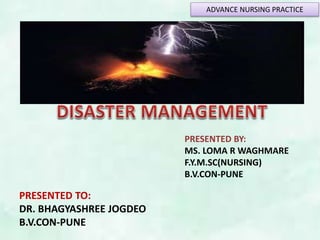
ADVANCE NURSING PRACTICE
PRESENTED BY:
MS. LOMA R WAGHMARE
F.Y.M.SC(NURSING)
B.V.CON-PUNE
PRESENTED TO:
DR. BHAGYASHREE JOGDEO
B.V.CON-PUNE
SR. NO TOPICS
1. Definition of disaster
2. Types of disaster
3. Epidemiology
4. Principles of disaster management
5. Phases if disaster management
6. Disaster management committee
7. Triaging
8. Disaster Nursing
8.a Qualities of Disaster Nurse
8.b Role of Nurse in phases of disaster
9. Summary
10 Bibliography
• AT THE END OF THE SEMINAR, THE STUDENTS
WILL BE ABLE TO GAIN KNOWLEDGE ON
DISASTER MANAGEMENT AND WILL ABLE APPLY
IN CLINICAL PRACTICE
At the end of the seminar, the group will be able to,
• Define Disaster
• Enlist types of disaster
• Describe the epidemiology of disaster
• Describe the phases of disaster management
• Enumerate the principles of disaster management
• Discuss about the disaster management committee
• Discuss about disaster nursing
• Enlist the qualities of a nurse working in disaster
management team
• Discuss what is triaging
• Explain the role of disaster management nurse with
respect to the phases of disaster management
• Disaster is any occurrence that causes damage, ecological
disruption, loss of human life or deterioration of health and
health services on a scale sufficient to warrant an
extraordinary response from outside the affected
community or area. (WHO 1995)
• An occurrence of a severity and magnitude that normally
results in death, injuries and property damage that cannot
be managed through the routine procedure and resources of
government.
- FEMA (Federal Emergency Management Agency)
• Disaster can be defined as an occurrence either nature or
man made that causes human suffering and creates human
needs that victims cannot alleviate without assistance.
- American Red Cross (ARC)
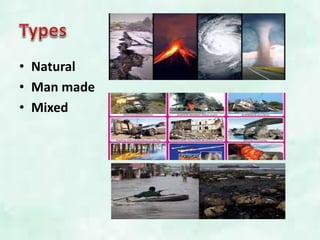
• Natural
• Man made
• Mixed
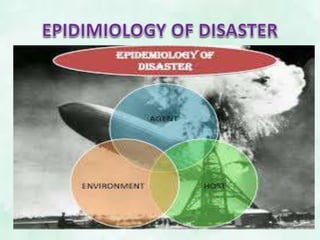
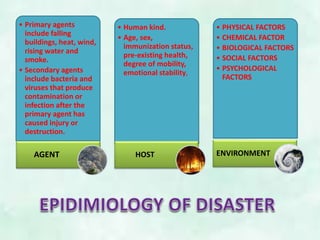
• Primary agents
include falling
buildings, heat, wind,
rising water and
smoke.
• Secondary agents
include bacteria and
viruses that produce
contamination or
infection after the
primary agent has
caused injury or
destruction.
AGENT
• Human kind.
• Age, sex,
immunization status,
pre-existing health,
degree of mobility,
emotional stability,
HOST
• PHYSICAL FACTORS
• CHEMICAL FACTOR
• BIOLOGICAL FACTORS
• SOCIAL FACTORS
• PSYCHOLOGICAL
FACTORS
ENVIRONMENT
• Definition: It can he defined as the effective
organization direction and utilization of
available counter-disaster resources
• Prevent the occurrence of the disaster whenever
possible.
• Minimize the number of casualties if the
disaster cannot be prevented.
• Prevent further casualties from occurring after
the initial impact of the disaster.
• Rescue the victims.
• Provide first aid
• Evacuate the injured to medical facilities.
• Provide definitive medical care.
• Promote reconstruction of lives.
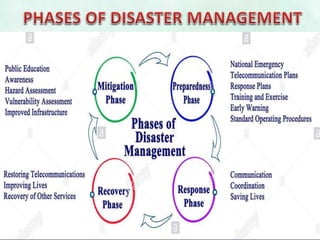
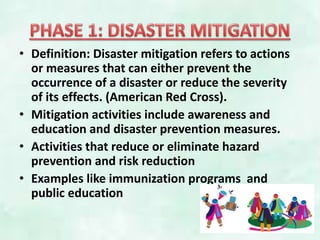
• Definition: Disaster mitigation refers to actions
or measures that can either prevent the
occurrence of a disaster or reduce the severity
of its effects. (American Red Cross).
• Mitigation activities include awareness and
education and disaster prevention measures.
• Activities that reduce or eliminate hazard
prevention and risk reduction
• Examples like immunization programs and
public education
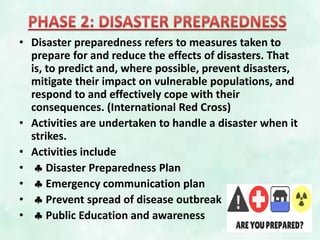
• Disaster preparedness refers to measures taken to
prepare for and reduce the effects of disasters. That
is, to predict and, where possible, prevent disasters,
mitigate their impact on vulnerable populations, and
respond to and effectively cope with their
consequences. (International Red Cross)
• Activities are undertaken to handle a disaster when it
strikes.
• Activities include
•  Disaster Preparedness Plan
•  Emergency communication plan
•  Prevent spread of disease outbreak
•  Public Education and awareness
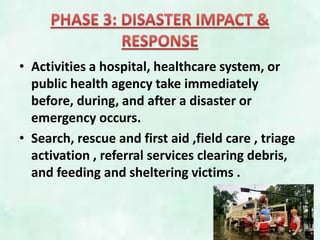
• Activities a hospital, healthcare system, or
public health agency take immediately
before, during, and after a disaster or
emergency occurs.
• Search, rescue and first aid ,field care , triage
activation , referral services clearing debris,
and feeding and sheltering victims .
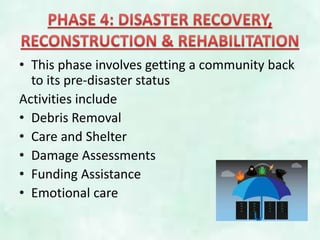
• This phase involves getting a community back
to its pre-disaster status
Activities include
• Debris Removal
• Care and Shelter
• Damage Assessments
• Funding Assistance
• Emotional care
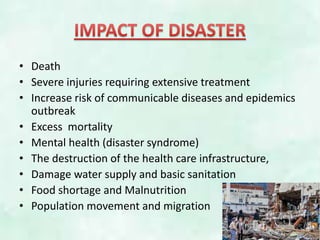
• Death
• Severe injuries requiring extensive treatment
• Increase risk of communicable diseases and epidemics
outbreak
• Excess mortality
• Mental health (disaster syndrome)
• The destruction of the health care infrastructure,
• Damage water supply and basic sanitation
• Food shortage and Malnutrition
• Population movement and migration
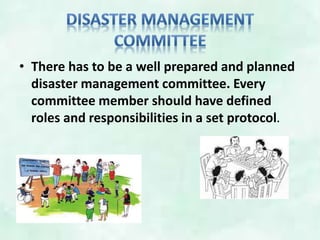
• There has to be a well prepared and planned
disaster management committee. Every
committee member should have defined
roles and responsibilities in a set protocol.
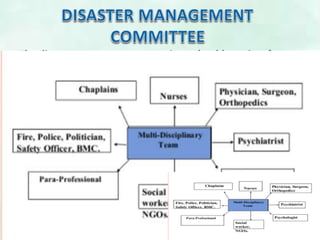
The disaster management committee should consist of
following members.
• Chairman
• Medical superintendent/ Director
• Additional Medical Superintendent
• Nursing Superintendent/ Chief Nursing Officer
• Chief medical officer (Emergency Department)
• Head of departments- surgery, medicine, orthopedics,
radiology, anesthesiology, neurosurgery
• Blood bank in charge
• Security officers
• Transport officer
• Sanitary personnel
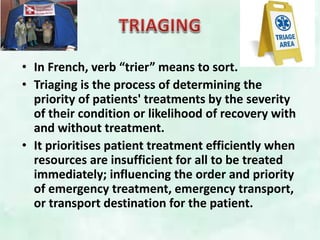
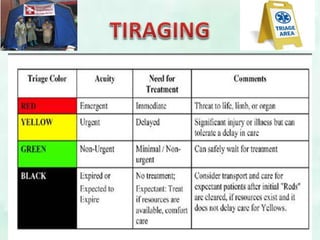
• In French, verb “trier” means to sort.
• Triaging is the process of determining the
priority of patients' treatments by the severity
of their condition or likelihood of recovery with
and without treatment.
• It prioritises patient treatment efficiently when
resources are insufficient for all to be treated
immediately; influencing the order and priority
of emergency treatment, emergency transport,
or transport destination for the patient.
Helps to bring order and organization to a
chaotic scene.
It identifies and provides care to those who
are in greatest need
Helps make the difficult decisions easier
Assure that resources are used in the most
effective manner
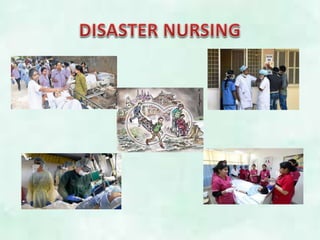
• DEFINITION: Disaster nursing can be defined
as the adaptation of professional nursing skills
in recognizing and meeting the physical,
health and emotional needs of the affected
community resulting from a disasters.
• NURSING GOAL is to achieve the best possible
level of health for the people and the
community affected by disasters.
• Confidence
• Cooperation
• Commitment
• Coordination
• Control
• Value of human life
• Gentleness and
devotion
• Strength
• Trust
• Interdependence and
Team spirit
• Accept Self criticism
• Toughness & Sensitivity
• Leadership
• Responsibility and
accountability
• Risk assessment and analysis:
- Identify previous disaster
- local climate conducive to disaster formation
- understand the magnitude of disaster
- the coping strategies of the locals
- current community disaster plan
- health personnel & health facilities available
- local agencies and organizations.
• Diagnose Community Disaster :
- determine actual and potential disaster threats
- preventive measures
- community preparedness
ROLE OF NURSE IN: DISASTER
PREPAREDNESS
Elements of disaster plan:
Chain of authority  Lines of communication
Modes of transport Mobilization Warning
 Equation Rescue and recovery Triage
Treatment Support of victims and families
 Care of dead bodies Disaster worker
rehabilitation.
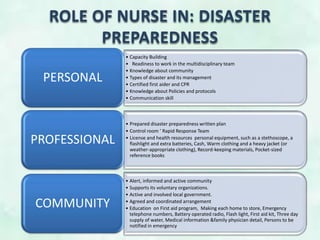
ROLE OF NURSE IN: DISASTER
PREPAREDNESS
• Capacity Building
• Readiness to work in the multidisciplinary team
• Knowledge about community
• Types of disaster and its management
• Certified first aider and CPR
• Knowledge about Policies and protocols
• Communication skill
PERSONAL
• Prepared disaster preparedness written plan
• Control room  Rapid Response Team
• License and health resources personal equipment, such as a stethoscope, a
flashlight and extra batteries, Cash, Warm clothing and a heavy jacket (or
weather-appropriate clothing), Record-keeping materials, Pocket-sized
reference books
PROFESSIONAL
• Alert, informed and active community
• Supports its voluntary organizations.
• Active and involved local government.
• Agreed and coordinated arrangement
• Education on First aid program, Making each home to store, Emergency
telephone numbers, Battery operated radio, Flash light, First aid kit, Three day
supply of water, Medical information &family physician detail, Persons to be
notified in emergency
COMMUNITY
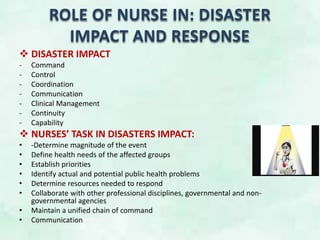
ROLE OF NURSE IN: DISASTER
IMPACT AND RESPONSE
 DISASTER IMPACT
- Command
- Control
- Coordination
- Communication
- Clinical Management
- Continuity
- Capability
 NURSES’ TASK IN DISASTERS IMPACT:
• -Determine magnitude of the event
• Define health needs of the affected groups
• Establish priorities
• Identify actual and potential public health problems
• Determine resources needed to respond
• Collaborate with other professional disciplines, governmental and non-
governmental agencies
• Maintain a unified chain of command
• Communication
ROLE OF NURSE IN: DISASTER
RESPONSE
Immediate post disaster intervention include
• Establish safety
• Medical Treatment & Nursing Care as Per Need
• Utilization of Available Resources
• Psychological Support
• Life Saving Measures , First Aid
• Evacuation & Supply - Shelter, Food, Water, Medicine,
Communication
• Maintaining Public Moral
• Voluntary Reception, Relatives Waiting Areas
• Management of Infection Control
• Re-riving post disaster stress.
• Encourage ventilation.
• Establishing outreach program to provide community support.
• Referral services
ROLE OF NURSE IN: RECOVERY,
REHABILITATION AND
RECONSTRUCTION
• Community cleanup efforts
• Teaching Proper Hygiene
• Alert For Environmental Health Hazards
• Home Visits
• Follow up care
NODAL AGENCY AND ORGANIZATION DISASTER:
• Ministry of home affair
• Ministry of agriculture
• Ministry of civil aviation
• Ministry of railways
• Ministry of environment and forests
• Ministry of health
• Department of atomic energy
CORE COMPETENCIES IN DISASTER NURSING TRAINING
• Ethical and legal issues, and decision making;
• Care principles;
• Nursing care;
• Needs assessment and planning;
• Safety and security;
• Communication and interpersonal relationships;
• Public health; and
• Health care systems and policies in emergency
situations (WHO, 2008)
TOPICS THAT MUST BE COVERED BY DISASTER NURSING
TRAINING:
• Basic life support
• System and planning for settings where nurses work
• Communications (what to report and to whom)
• Working in the damaged facilities and with damaged
equipment
• Safety of clients and practitioners
• Working within a team (understand each member’s role
and responsibility)
• Infection control
• Mental and psychosocial support (WHO, 2006)
• DISASTER MANAGEMENT PROTOCOL HAS TO
BE FORMULATED IN HOSPITAL
• CODE BLACK
• DISASTER MANAGEMENT TRAINIGN
• https://youtu.be/iwGWMJnEwUk
BIBLIOGRAPHY
 Park K;PREVENTIVE AND SOCIAL MEDICINE;2005;18th
edn;Jabalpur;Banarsidas Bhanot publishers;pp 600-605
 Alexander,David;PRINCIPLES OF EMERGENCY PLANNING AND
MANAGEMENT;2002;harpenden;Terra publishing;pp 1-1036.
 Haddow,George D;Jane A Bullock;INTRODUCTION TO EMERGENCY
MANAGEMENT;Amsterdam;Butterworth-Heinemann;pp 6-194.
 WHO;COPING WITH NATURAL DISASTERS,THE ROLE OF LOCAL
HEALTH PERSONNEL AND THE COMMUNITY;1989;WHO
publishing;pp 10-225.
 Maxy,R,Last;PUBLIC HEALTH AND PREVENTIVE MEDICINE;1992;13th
edn;Massattussette;Mosby Inc;pp214-268.
6.WHO;COMMUNITY EMERGENCY PREPAREDNESS A MANUAL FOR
MANAGERS AND POLICY MAKERS;1999;2nd edn;Geneva;WHO;pp
3-331.
JOURNALS
1.Walker,Peter;International search and rescue teams,A league discussion
paper;geneva;League of the Red Cross and Red Crecent societies;28:37:1998.
2.Singh J;72 hours kits,an article from home security guru;Indian Journal of public
health;20:43:2002
Web sites
www.ready.gov
www.onestorm.org
www.fema.gov
www.who.org
www.un.orgwww.healthalerts.com
DISASTER MANAGEMENT.pptx

DISASTER MANAGEMENT.pptx

  • 2.
    ADVANCE NURSING PRACTICE PRESENTEDBY: MS. LOMA R WAGHMARE F.Y.M.SC(NURSING) B.V.CON-PUNE PRESENTED TO: DR. BHAGYASHREE JOGDEO B.V.CON-PUNE
  • 3.
    SR. NO TOPICS 1.Definition of disaster 2. Types of disaster 3. Epidemiology 4. Principles of disaster management 5. Phases if disaster management 6. Disaster management committee 7. Triaging 8. Disaster Nursing 8.a Qualities of Disaster Nurse 8.b Role of Nurse in phases of disaster 9. Summary 10 Bibliography
  • 4.
    • AT THEEND OF THE SEMINAR, THE STUDENTS WILL BE ABLE TO GAIN KNOWLEDGE ON DISASTER MANAGEMENT AND WILL ABLE APPLY IN CLINICAL PRACTICE
  • 5.
    At the endof the seminar, the group will be able to, • Define Disaster • Enlist types of disaster • Describe the epidemiology of disaster • Describe the phases of disaster management • Enumerate the principles of disaster management • Discuss about the disaster management committee • Discuss about disaster nursing • Enlist the qualities of a nurse working in disaster management team • Discuss what is triaging • Explain the role of disaster management nurse with respect to the phases of disaster management
  • 6.
    • Disaster isany occurrence that causes damage, ecological disruption, loss of human life or deterioration of health and health services on a scale sufficient to warrant an extraordinary response from outside the affected community or area. (WHO 1995) • An occurrence of a severity and magnitude that normally results in death, injuries and property damage that cannot be managed through the routine procedure and resources of government. - FEMA (Federal Emergency Management Agency) • Disaster can be defined as an occurrence either nature or man made that causes human suffering and creates human needs that victims cannot alleviate without assistance. - American Red Cross (ARC)
  • 7.
    • Natural • Manmade • Mixed
  • 11.
    • Primary agents includefalling buildings, heat, wind, rising water and smoke. • Secondary agents include bacteria and viruses that produce contamination or infection after the primary agent has caused injury or destruction. AGENT • Human kind. • Age, sex, immunization status, pre-existing health, degree of mobility, emotional stability, HOST • PHYSICAL FACTORS • CHEMICAL FACTOR • BIOLOGICAL FACTORS • SOCIAL FACTORS • PSYCHOLOGICAL FACTORS ENVIRONMENT
  • 12.
    • Definition: Itcan he defined as the effective organization direction and utilization of available counter-disaster resources
  • 13.
    • Prevent theoccurrence of the disaster whenever possible. • Minimize the number of casualties if the disaster cannot be prevented. • Prevent further casualties from occurring after the initial impact of the disaster. • Rescue the victims. • Provide first aid • Evacuate the injured to medical facilities. • Provide definitive medical care. • Promote reconstruction of lives.
  • 15.
    • Definition: Disastermitigation refers to actions or measures that can either prevent the occurrence of a disaster or reduce the severity of its effects. (American Red Cross). • Mitigation activities include awareness and education and disaster prevention measures. • Activities that reduce or eliminate hazard prevention and risk reduction • Examples like immunization programs and public education
  • 16.
    • Disaster preparednessrefers to measures taken to prepare for and reduce the effects of disasters. That is, to predict and, where possible, prevent disasters, mitigate their impact on vulnerable populations, and respond to and effectively cope with their consequences. (International Red Cross) • Activities are undertaken to handle a disaster when it strikes. • Activities include •  Disaster Preparedness Plan •  Emergency communication plan •  Prevent spread of disease outbreak •  Public Education and awareness
  • 17.
    • Activities ahospital, healthcare system, or public health agency take immediately before, during, and after a disaster or emergency occurs. • Search, rescue and first aid ,field care , triage activation , referral services clearing debris, and feeding and sheltering victims .
  • 18.
    • This phaseinvolves getting a community back to its pre-disaster status Activities include • Debris Removal • Care and Shelter • Damage Assessments • Funding Assistance • Emotional care
  • 19.
    • Death • Severeinjuries requiring extensive treatment • Increase risk of communicable diseases and epidemics outbreak • Excess mortality • Mental health (disaster syndrome) • The destruction of the health care infrastructure, • Damage water supply and basic sanitation • Food shortage and Malnutrition • Population movement and migration
  • 20.
    • There hasto be a well prepared and planned disaster management committee. Every committee member should have defined roles and responsibilities in a set protocol.
  • 21.
    The disaster managementcommittee should consist of following members. • Chairman • Medical superintendent/ Director • Additional Medical Superintendent • Nursing Superintendent/ Chief Nursing Officer • Chief medical officer (Emergency Department) • Head of departments- surgery, medicine, orthopedics, radiology, anesthesiology, neurosurgery • Blood bank in charge • Security officers • Transport officer • Sanitary personnel
  • 22.
    • In French,verb “trier” means to sort. • Triaging is the process of determining the priority of patients' treatments by the severity of their condition or likelihood of recovery with and without treatment. • It prioritises patient treatment efficiently when resources are insufficient for all to be treated immediately; influencing the order and priority of emergency treatment, emergency transport, or transport destination for the patient.
  • 24.
    Helps to bringorder and organization to a chaotic scene. It identifies and provides care to those who are in greatest need Helps make the difficult decisions easier Assure that resources are used in the most effective manner
  • 26.
    • DEFINITION: Disasternursing can be defined as the adaptation of professional nursing skills in recognizing and meeting the physical, health and emotional needs of the affected community resulting from a disasters. • NURSING GOAL is to achieve the best possible level of health for the people and the community affected by disasters.
  • 27.
    • Confidence • Cooperation •Commitment • Coordination • Control • Value of human life • Gentleness and devotion • Strength • Trust • Interdependence and Team spirit • Accept Self criticism • Toughness & Sensitivity • Leadership • Responsibility and accountability
  • 28.
    • Risk assessmentand analysis: - Identify previous disaster - local climate conducive to disaster formation - understand the magnitude of disaster - the coping strategies of the locals - current community disaster plan - health personnel & health facilities available - local agencies and organizations. • Diagnose Community Disaster : - determine actual and potential disaster threats - preventive measures - community preparedness
  • 29.
    ROLE OF NURSEIN: DISASTER PREPAREDNESS Elements of disaster plan: Chain of authority  Lines of communication Modes of transport Mobilization Warning  Equation Rescue and recovery Triage Treatment Support of victims and families  Care of dead bodies Disaster worker rehabilitation.
  • 30.
    ROLE OF NURSEIN: DISASTER PREPAREDNESS • Capacity Building • Readiness to work in the multidisciplinary team • Knowledge about community • Types of disaster and its management • Certified first aider and CPR • Knowledge about Policies and protocols • Communication skill PERSONAL • Prepared disaster preparedness written plan • Control room  Rapid Response Team • License and health resources personal equipment, such as a stethoscope, a flashlight and extra batteries, Cash, Warm clothing and a heavy jacket (or weather-appropriate clothing), Record-keeping materials, Pocket-sized reference books PROFESSIONAL • Alert, informed and active community • Supports its voluntary organizations. • Active and involved local government. • Agreed and coordinated arrangement • Education on First aid program, Making each home to store, Emergency telephone numbers, Battery operated radio, Flash light, First aid kit, Three day supply of water, Medical information &family physician detail, Persons to be notified in emergency COMMUNITY
  • 31.
    ROLE OF NURSEIN: DISASTER IMPACT AND RESPONSE  DISASTER IMPACT - Command - Control - Coordination - Communication - Clinical Management - Continuity - Capability  NURSES’ TASK IN DISASTERS IMPACT: • -Determine magnitude of the event • Define health needs of the affected groups • Establish priorities • Identify actual and potential public health problems • Determine resources needed to respond • Collaborate with other professional disciplines, governmental and non- governmental agencies • Maintain a unified chain of command • Communication
  • 32.
    ROLE OF NURSEIN: DISASTER RESPONSE Immediate post disaster intervention include • Establish safety • Medical Treatment & Nursing Care as Per Need • Utilization of Available Resources • Psychological Support • Life Saving Measures , First Aid • Evacuation & Supply - Shelter, Food, Water, Medicine, Communication • Maintaining Public Moral • Voluntary Reception, Relatives Waiting Areas • Management of Infection Control • Re-riving post disaster stress. • Encourage ventilation. • Establishing outreach program to provide community support. • Referral services
  • 33.
    ROLE OF NURSEIN: RECOVERY, REHABILITATION AND RECONSTRUCTION • Community cleanup efforts • Teaching Proper Hygiene • Alert For Environmental Health Hazards • Home Visits • Follow up care
  • 34.
    NODAL AGENCY ANDORGANIZATION DISASTER: • Ministry of home affair • Ministry of agriculture • Ministry of civil aviation • Ministry of railways • Ministry of environment and forests • Ministry of health • Department of atomic energy
  • 35.
    CORE COMPETENCIES INDISASTER NURSING TRAINING • Ethical and legal issues, and decision making; • Care principles; • Nursing care; • Needs assessment and planning; • Safety and security; • Communication and interpersonal relationships; • Public health; and • Health care systems and policies in emergency situations (WHO, 2008)
  • 36.
    TOPICS THAT MUSTBE COVERED BY DISASTER NURSING TRAINING: • Basic life support • System and planning for settings where nurses work • Communications (what to report and to whom) • Working in the damaged facilities and with damaged equipment • Safety of clients and practitioners • Working within a team (understand each member’s role and responsibility) • Infection control • Mental and psychosocial support (WHO, 2006)
  • 37.
    • DISASTER MANAGEMENTPROTOCOL HAS TO BE FORMULATED IN HOSPITAL • CODE BLACK • DISASTER MANAGEMENT TRAINIGN • https://youtu.be/iwGWMJnEwUk
  • 39.
    BIBLIOGRAPHY  Park K;PREVENTIVEAND SOCIAL MEDICINE;2005;18th edn;Jabalpur;Banarsidas Bhanot publishers;pp 600-605  Alexander,David;PRINCIPLES OF EMERGENCY PLANNING AND MANAGEMENT;2002;harpenden;Terra publishing;pp 1-1036.  Haddow,George D;Jane A Bullock;INTRODUCTION TO EMERGENCY MANAGEMENT;Amsterdam;Butterworth-Heinemann;pp 6-194.  WHO;COPING WITH NATURAL DISASTERS,THE ROLE OF LOCAL HEALTH PERSONNEL AND THE COMMUNITY;1989;WHO publishing;pp 10-225.  Maxy,R,Last;PUBLIC HEALTH AND PREVENTIVE MEDICINE;1992;13th edn;Massattussette;Mosby Inc;pp214-268. 6.WHO;COMMUNITY EMERGENCY PREPAREDNESS A MANUAL FOR MANAGERS AND POLICY MAKERS;1999;2nd edn;Geneva;WHO;pp 3-331.
  • 40.
    JOURNALS 1.Walker,Peter;International search andrescue teams,A league discussion paper;geneva;League of the Red Cross and Red Crecent societies;28:37:1998. 2.Singh J;72 hours kits,an article from home security guru;Indian Journal of public health;20:43:2002 Web sites www.ready.gov www.onestorm.org www.fema.gov www.who.org www.un.orgwww.healthalerts.com