DISASTER MANAGEMENT
Mamta Parihar
M.Sc. PreviousYear
G.C.O.N . Jodhpur
The word derives from
French “désastre” and
which in turn comes from
the Greek pejorative
prefix dus = "bad" + aster
= "star".
INTRODUCTION
DEFINITIONS
WHO defines Disaster as "any
occurrence that causes damage, ecological
disruption, loss of human life,
deterioration of health and health
services, on a scale sufficient to warrant
an extraordinary response from outside
the affected community or area."
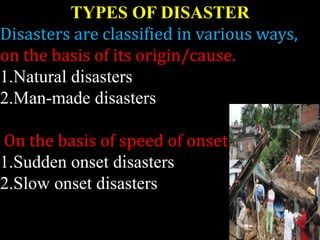
TYPES OF DISASTER
Disasters are classified in various ways,
on the basis of its origin/cause.
1.Natural disasters
2.Man-made disasters
On the basis of speed of onset-
1.Sudden onset disasters
2.Slow onset disasters
NATURAL DISASTERS
A. Hydrometer logical disaster
CYCLONES
TYPHOONS
 HURRICANES
TORNADOS
 STORMS
HAILSTORMS
 SNOWSTORMS
DROUGHTS
1.NATURAL DISASTERS
B. Geographical disaster
 Earthquake
 tsunami
 volcanic activity
 Mass movements landslides
 geographical fault activities
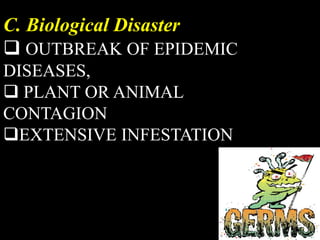
C. Biological Disaster
 OUTBREAK OF EPIDEMIC
DISEASES,
 PLANT OR ANIMAL
CONTAGION
EXTENSIVE INFESTATION
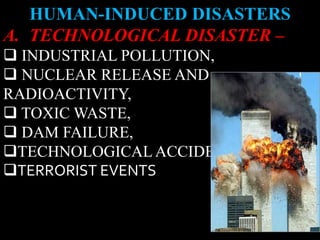
HUMAN-INDUCED DISASTERS
A. TECHNOLOGICAL DISASTER –
 INDUSTRIAL POLLUTION,
 NUCLEAR RELEASE AND
RADIOACTIVITY,
 TOXIC WASTE,
 DAM FAILURE,
TECHNOLOGICAL ACCIDENTS
TERRORIST EVENTS
B. ENVIRONMENTAL DEGRADATION
 LAND DEGRADATION,
 DEFORESTATION,
DESERTIFICATION,
 WILD LAND FIRE,
 LOSS OF BIODIVERSITY, LAND,
 WATER AND AIR POLLUTION
 CLIMATE CHANGE,
 SEA LEVEL RISE
 OZONE DEPLETION
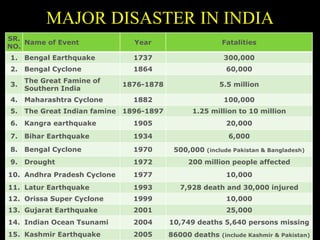
MAJOR DISASTER IN INDIA
SR.
NO.
Name of Event Year Fatalities
1. Bengal Earthquake 1737 300,000
2. Bengal Cyclone 1864 60,000
3.
The Great Famine of
Southern India
1876-1878 5.5 million
4. Maharashtra Cyclone 1882 100,000

5. The Great Indian famine 1896-1897 1.25 million to 10 million
6. Kangra earthquake 1905 20,000
7. Bihar Earthquake 1934 6,000
8. Bengal Cyclone 1970 500,000 (include Pakistan & Bangladesh)
9. Drought 1972 200 million people affected
10. Andhra Pradesh Cyclone 1977 10,000
11. Latur Earthquake 1993 7,928 death and 30,000 injured
12. Orissa Super Cyclone 1999 10,000
13. Gujarat Earthquake 2001 25,000
14. Indian Ocean Tsunami 2004 10,749 deaths 5,640 persons missing
15. Kashmir Earthquake 2005 86000 deaths (include Kashmir & Pakistan)
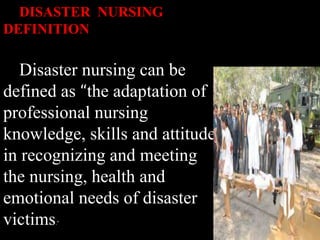
DISASTER NURSING
DEFINITION
Disaster nursing can be
defined as “the adaptation of
professional nursing
knowledge, skills and attitude
in recognizing and meeting
the nursing, health and
emotional needs of disaster
victims.”
GOALS OF THE DISASTER NURSING
•To meet the immediate basic survival needs of
populations (water, food, shelter, and security).
•To identify the potential for a secondary
disaster.
•To appraise both risks and resources in the
environment.
•To correct inequalities in access to health care
or appropriate resources.
To empower survivors to participate in
and advocate for their own health and well-
being.
To respect cultural, lingual, and religious
diversity in individuals and families and to
apply this principle in all health promotion
activities.
To promote the highest achievable
quality of life for survivors.
GOALS OF THE DISASTER NURSING
PRINCIPALS OF DISASTER NURSING
Rapid assessment of the situation and of
nursing care needs.
Triage and initiation of life-saving measures
first.
The selected use of essential nursing
interventions and the elimination of
nonessential nursing activities.
Adaptation of necessary nursing skills
. The nurse must use imagination and resourcefulness in
dealing with a lack of supplies, equipment, and personnel.
Evaluation of the environment and the mitigation or removal
of any health hazards.
Prevention of further injury or illness.
Leadership in coordinating patient triage, care, and
transport during times of crisis.
PRINCIPALS OF DISASTER
NURSING
The teaching, supervision, and utilization
of auxiliary medical personnel and
volunteers.
Provision of understanding, compassion,
and emotional support to all victims and
their families.
PRINCIPALS OF DISASTER
NURSING
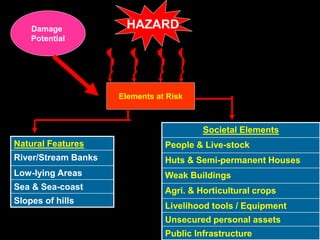
HAZARD
Damage
Potential
Elements at Risk
Slopes of hills
Sea & Sea-coast
Low-lying Areas
River/Stream Banks
Natural Features
Unsecured personal assets
Livelihood tools / Equipment
Public Infrastructure
Agri. & Horticultural crops
Weak Buildings
Huts & Semi-permanent Houses
People & Live-stock
Societal Elements
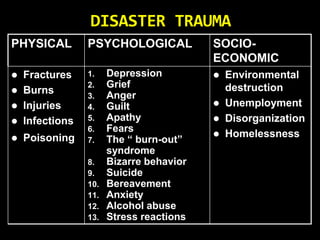
DISASTER TRAUMA
PHYSICAL PSYCHOLOGICAL SOCIO-
ECONOMIC
 Fractures
 Burns
 Injuries
 Infections
 Poisoning
1. Depression
2. Grief
3. Anger
4. Guilt
5. Apathy
6. Fears
7. The “ burn-out”
syndrome
8. Bizarre behavior
9. Suicide
10. Bereavement
11. Anxiety
12. Alcohol abuse
13. Stress reactions
 Environmental
destruction
 Unemployment
 Disorganization
 Homelessness
DISASTER MANAGEMENT CYCLE
This refers to the real-time event of a
hazard occurring and affecting the
‘elements at risk’
DISASTER
IMPACT
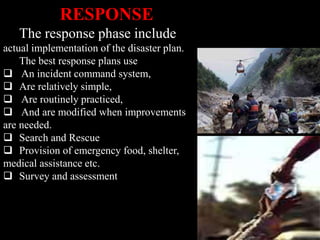
RESPONSE
The response phase include
actual implementation of the disaster plan.
The best response plans use
 An incident command system,
 Are relatively simple,
 Are routinely practiced,
 And are modified when improvements
are needed.
 Search and Rescue
 Provision of emergency food, shelter,
medical assistance etc.
 Survey and assessment
RECOVERY
Recovery is the process by which communities and the
nation are assisted in returning to their proper level of
functioning following a disaster.
Activities undertaken by a community and its components
after an emergency or disaster to restore minimum services
and move towards long-term restoration.
 Debris removal
 Care and shelter
 Damage assessments
 Funding assistance
EVALUATION OR DEVELOPMENT
Often this phase receives the least
attention. After a disaster, employees and
the community are anxious to return to
usual operations. It is essential that a formal
evaluation be done to determine what went
well (what really worked) and what
problems were identified.
MITIGATION
Intended to reduce the effects of disaster on a nation or
community.
Prepare cross training staff to perform other
tasks to maintain services during a staffing crisis
that is due to a weather emergency.
PREPAREDNESS/RISK MANAGEMENT
Issues to consider include:
Weather patterns;
 Geographic location;
 Expectations related to public events and gatherings;
age,
 Condition, and location of the facility;
 Industries in close proximity to the hospital (e.g.,
Nuclear power plant or chemical factory).
MANAGEMENT OF MASS CASUALTIES
OBJECTIVES
The application of triage
and tagging
Understand the priorities
in triage and tagging
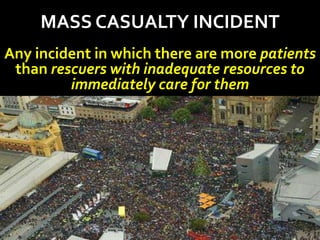
MASS CASUALTY INCIDENT
Any incident in which there are more patients
than rescuers with inadequate resources to
immediately care for them
DISASTER TRIAGE
•The word triage is derived from the
French word Trier, which means, “to
sort out or choose.”
ADVANTAGES OF TRIAGE
•Helps to bring order and organization to a chaotic scene.
•It identifies and provides care to those who are in greatest
need
•Helps make the difficult decisions easier
•Assure that resources are used in the most effective manner
•May take some of the emotional burden away from those
doing triage
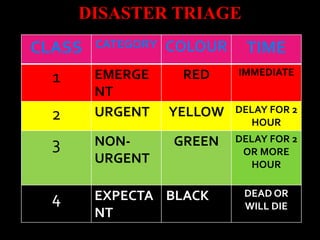
CLASS CATEGORY COLOUR TIME
1 EMERGE
NT
RED IMMEDIATE
2 URGENT YELLOW DELAY FOR 2
HOUR
3 NON-
URGENT
GREEN DELAY FOR 2
OR MORE
HOUR
4 EXPECTA
NT
BLACKAC
K
DEAD OR
WILL DIE
DISASTER TRIAGE
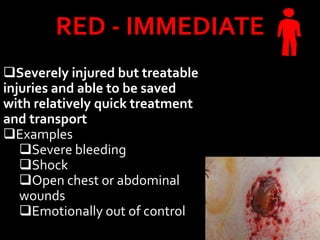
RED - IMMEDIATE
Severely injured but treatable
injuries and able to be saved
with relatively quick treatment
and transport
Examples
Severe bleeding
Shock
Open chest or abdominal
wounds
Emotionally out of control
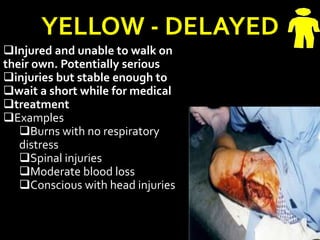
YELLOW - DELAYED
Injured and unable to walk on
their own. Potentially serious
injuries but stable enough to
wait a short while for medical
treatment
Examples
Burns with no respiratory
distress
Spinal injuries
Moderate blood loss
Conscious with head injuries
GREEN – NON-URGENT
Minor injuries that can wait for a longer
period of time for treatment.
May or may not be able to ambulate
Examples
Minor fractures
Minor bleeding
Minor lacerations
BLACK - DECEASED
Dead or obviously dying. May have signs of
life but injuries are incompatible with survival.
Handle based on local protocols
Examples
Cardiac arrest
Respiratory arrest with a pulse
Massive head injury
Can be psychologically difficult to tag a child
as black
Nodal Agencies for Disaster Management
 Floods : Ministry ofWater Resources, CWC
 Cyclones : Indian Meteorological Department
 Earthquakes : Indian Meteorological Department
 Epidemics : Ministry of Health and Family Welfare
 Avian Flu: Ministry of Health, Ministry of Environment,
Ministry of Agriculture and Animal Husbandry
 Chemical Disasters : Ministry of Environment and
Forests
 Industrial Disasters : Ministry of Labour
 Rail Accidents : Ministry of Railways
 Air Accidents : Ministry of Civil Aviation
 Fire : Ministry of Home Affairs
 Nuclear Incidents : Department of Atomic Energy
 Mine Disasters : Department of Mines
MAJOR ROLES OF NURSE IN
DISASTER
Determine magnitude of the event
Define health needs of the affected
groups
Establish priorities and objectives
Identify actual and potential public
health problems
Determine resources needed to respond
to the needs identified
Collaborate with other professional
disciplines, governmental and non-
governmental agencies
Maintain a unified chain of command
Communication
Any Questions
THE END
THANKYOU

Disaster management

  • 1.
    DISASTER MANAGEMENT Mamta Parihar M.Sc.PreviousYear G.C.O.N . Jodhpur
  • 2.
    The word derivesfrom French “désastre” and which in turn comes from the Greek pejorative prefix dus = "bad" + aster = "star". INTRODUCTION
  • 3.
    DEFINITIONS WHO defines Disasteras "any occurrence that causes damage, ecological disruption, loss of human life, deterioration of health and health services, on a scale sufficient to warrant an extraordinary response from outside the affected community or area."
  • 4.
    TYPES OF DISASTER Disastersare classified in various ways, on the basis of its origin/cause. 1.Natural disasters 2.Man-made disasters On the basis of speed of onset- 1.Sudden onset disasters 2.Slow onset disasters
  • 5.
    NATURAL DISASTERS A. Hydrometerlogical disaster CYCLONES TYPHOONS  HURRICANES TORNADOS  STORMS HAILSTORMS  SNOWSTORMS DROUGHTS 1.NATURAL DISASTERS
  • 6.
    B. Geographical disaster Earthquake  tsunami  volcanic activity  Mass movements landslides  geographical fault activities
  • 7.
    C. Biological Disaster OUTBREAK OF EPIDEMIC DISEASES,  PLANT OR ANIMAL CONTAGION EXTENSIVE INFESTATION
  • 8.
    HUMAN-INDUCED DISASTERS A. TECHNOLOGICALDISASTER –  INDUSTRIAL POLLUTION,  NUCLEAR RELEASE AND RADIOACTIVITY,  TOXIC WASTE,  DAM FAILURE, TECHNOLOGICAL ACCIDENTS TERRORIST EVENTS
  • 9.
    B. ENVIRONMENTAL DEGRADATION LAND DEGRADATION,  DEFORESTATION, DESERTIFICATION,  WILD LAND FIRE,  LOSS OF BIODIVERSITY, LAND,  WATER AND AIR POLLUTION  CLIMATE CHANGE,  SEA LEVEL RISE  OZONE DEPLETION
  • 10.
    MAJOR DISASTER ININDIA SR. NO. Name of Event Year Fatalities 1. Bengal Earthquake 1737 300,000 2. Bengal Cyclone 1864 60,000 3. The Great Famine of Southern India 1876-1878 5.5 million 4. Maharashtra Cyclone 1882 100,000 5. The Great Indian famine 1896-1897 1.25 million to 10 million 6. Kangra earthquake 1905 20,000 7. Bihar Earthquake 1934 6,000 8. Bengal Cyclone 1970 500,000 (include Pakistan & Bangladesh) 9. Drought 1972 200 million people affected 10. Andhra Pradesh Cyclone 1977 10,000 11. Latur Earthquake 1993 7,928 death and 30,000 injured 12. Orissa Super Cyclone 1999 10,000 13. Gujarat Earthquake 2001 25,000 14. Indian Ocean Tsunami 2004 10,749 deaths 5,640 persons missing 15. Kashmir Earthquake 2005 86000 deaths (include Kashmir & Pakistan)
  • 11.
    DISASTER NURSING DEFINITION Disaster nursingcan be defined as “the adaptation of professional nursing knowledge, skills and attitude in recognizing and meeting the nursing, health and emotional needs of disaster victims.”
  • 12.
    GOALS OF THEDISASTER NURSING •To meet the immediate basic survival needs of populations (water, food, shelter, and security). •To identify the potential for a secondary disaster. •To appraise both risks and resources in the environment. •To correct inequalities in access to health care or appropriate resources.
  • 13.
    To empower survivorsto participate in and advocate for their own health and well- being. To respect cultural, lingual, and religious diversity in individuals and families and to apply this principle in all health promotion activities. To promote the highest achievable quality of life for survivors. GOALS OF THE DISASTER NURSING
  • 14.
    PRINCIPALS OF DISASTERNURSING Rapid assessment of the situation and of nursing care needs. Triage and initiation of life-saving measures first. The selected use of essential nursing interventions and the elimination of nonessential nursing activities. Adaptation of necessary nursing skills
  • 15.
    . The nursemust use imagination and resourcefulness in dealing with a lack of supplies, equipment, and personnel. Evaluation of the environment and the mitigation or removal of any health hazards. Prevention of further injury or illness. Leadership in coordinating patient triage, care, and transport during times of crisis. PRINCIPALS OF DISASTER NURSING
  • 16.
    The teaching, supervision,and utilization of auxiliary medical personnel and volunteers. Provision of understanding, compassion, and emotional support to all victims and their families. PRINCIPALS OF DISASTER NURSING
  • 17.
    HAZARD Damage Potential Elements at Risk Slopesof hills Sea & Sea-coast Low-lying Areas River/Stream Banks Natural Features Unsecured personal assets Livelihood tools / Equipment Public Infrastructure Agri. & Horticultural crops Weak Buildings Huts & Semi-permanent Houses People & Live-stock Societal Elements
  • 18.
    DISASTER TRAUMA PHYSICAL PSYCHOLOGICALSOCIO- ECONOMIC  Fractures  Burns  Injuries  Infections  Poisoning 1. Depression 2. Grief 3. Anger 4. Guilt 5. Apathy 6. Fears 7. The “ burn-out” syndrome 8. Bizarre behavior 9. Suicide 10. Bereavement 11. Anxiety 12. Alcohol abuse 13. Stress reactions  Environmental destruction  Unemployment  Disorganization  Homelessness
  • 19.
  • 20.
    This refers tothe real-time event of a hazard occurring and affecting the ‘elements at risk’ DISASTER IMPACT
  • 21.
    RESPONSE The response phaseinclude actual implementation of the disaster plan. The best response plans use  An incident command system,  Are relatively simple,  Are routinely practiced,  And are modified when improvements are needed.  Search and Rescue  Provision of emergency food, shelter, medical assistance etc.  Survey and assessment
  • 22.
    RECOVERY Recovery is theprocess by which communities and the nation are assisted in returning to their proper level of functioning following a disaster. Activities undertaken by a community and its components after an emergency or disaster to restore minimum services and move towards long-term restoration.  Debris removal  Care and shelter  Damage assessments  Funding assistance
  • 23.
    EVALUATION OR DEVELOPMENT Oftenthis phase receives the least attention. After a disaster, employees and the community are anxious to return to usual operations. It is essential that a formal evaluation be done to determine what went well (what really worked) and what problems were identified.
  • 24.
    MITIGATION Intended to reducethe effects of disaster on a nation or community. Prepare cross training staff to perform other tasks to maintain services during a staffing crisis that is due to a weather emergency.
  • 25.
    PREPAREDNESS/RISK MANAGEMENT Issues toconsider include: Weather patterns;  Geographic location;  Expectations related to public events and gatherings; age,  Condition, and location of the facility;  Industries in close proximity to the hospital (e.g., Nuclear power plant or chemical factory).
  • 26.
    MANAGEMENT OF MASSCASUALTIES OBJECTIVES The application of triage and tagging Understand the priorities in triage and tagging
  • 27.
    MASS CASUALTY INCIDENT Anyincident in which there are more patients than rescuers with inadequate resources to immediately care for them
  • 28.
    DISASTER TRIAGE •The wordtriage is derived from the French word Trier, which means, “to sort out or choose.” ADVANTAGES OF TRIAGE •Helps to bring order and organization to a chaotic scene. •It identifies and provides care to those who are in greatest need •Helps make the difficult decisions easier •Assure that resources are used in the most effective manner •May take some of the emotional burden away from those doing triage
  • 29.
    CLASS CATEGORY COLOURTIME 1 EMERGE NT RED IMMEDIATE 2 URGENT YELLOW DELAY FOR 2 HOUR 3 NON- URGENT GREEN DELAY FOR 2 OR MORE HOUR 4 EXPECTA NT BLACKAC K DEAD OR WILL DIE DISASTER TRIAGE
  • 31.
    RED - IMMEDIATE Severelyinjured but treatable injuries and able to be saved with relatively quick treatment and transport Examples Severe bleeding Shock Open chest or abdominal wounds Emotionally out of control
  • 32.
    YELLOW - DELAYED Injuredand unable to walk on their own. Potentially serious injuries but stable enough to wait a short while for medical treatment Examples Burns with no respiratory distress Spinal injuries Moderate blood loss Conscious with head injuries
  • 33.
    GREEN – NON-URGENT Minorinjuries that can wait for a longer period of time for treatment. May or may not be able to ambulate Examples Minor fractures Minor bleeding Minor lacerations
  • 34.
    BLACK - DECEASED Deador obviously dying. May have signs of life but injuries are incompatible with survival. Handle based on local protocols Examples Cardiac arrest Respiratory arrest with a pulse Massive head injury Can be psychologically difficult to tag a child as black
  • 35.
    Nodal Agencies forDisaster Management  Floods : Ministry ofWater Resources, CWC  Cyclones : Indian Meteorological Department  Earthquakes : Indian Meteorological Department  Epidemics : Ministry of Health and Family Welfare  Avian Flu: Ministry of Health, Ministry of Environment, Ministry of Agriculture and Animal Husbandry  Chemical Disasters : Ministry of Environment and Forests  Industrial Disasters : Ministry of Labour  Rail Accidents : Ministry of Railways  Air Accidents : Ministry of Civil Aviation  Fire : Ministry of Home Affairs  Nuclear Incidents : Department of Atomic Energy  Mine Disasters : Department of Mines
  • 36.
    MAJOR ROLES OFNURSE IN DISASTER Determine magnitude of the event Define health needs of the affected groups Establish priorities and objectives Identify actual and potential public health problems Determine resources needed to respond to the needs identified Collaborate with other professional disciplines, governmental and non- governmental agencies Maintain a unified chain of command Communication
  • 37.
  • 38.
  • 39.