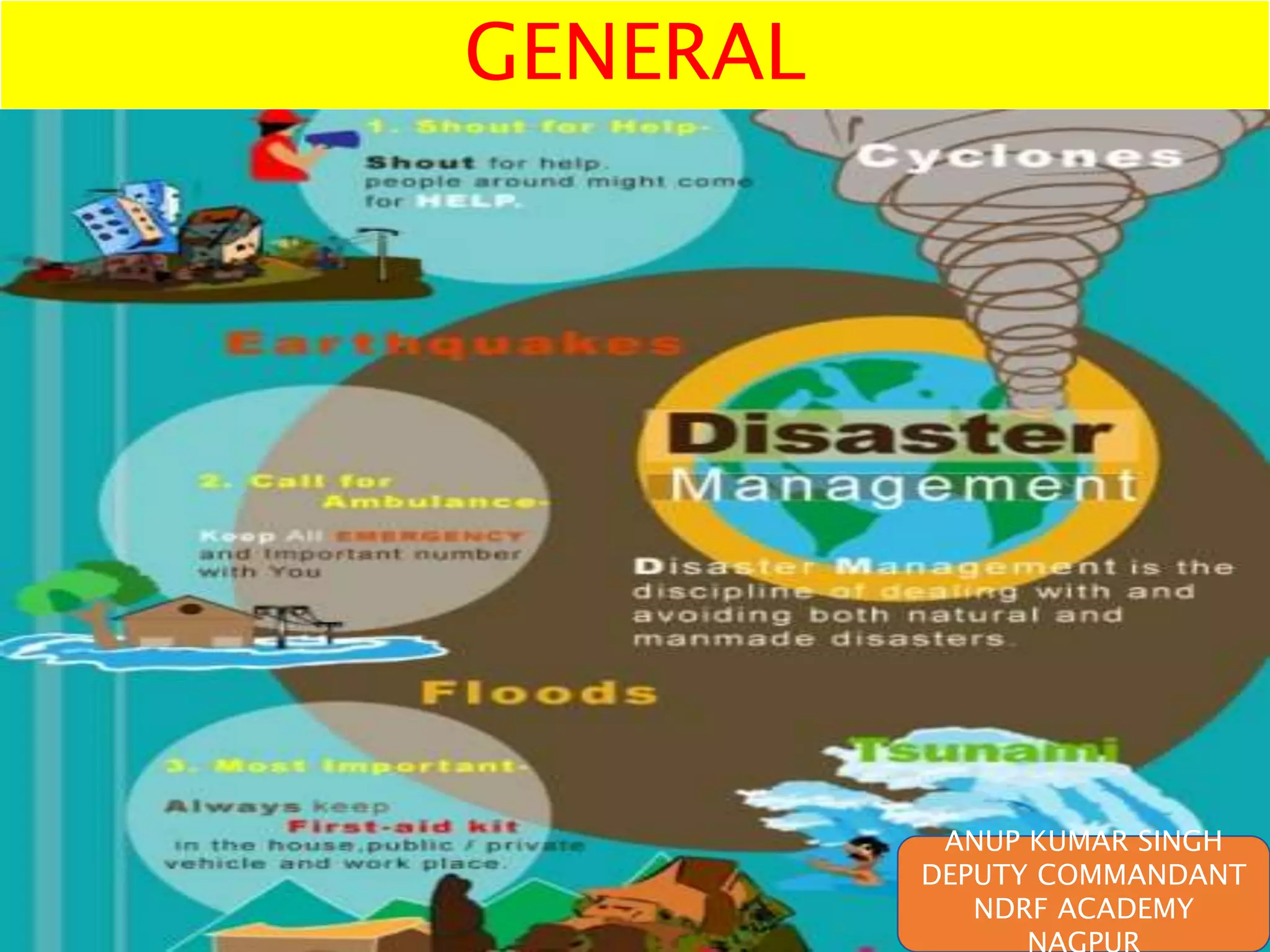

GENERAL
ANUP KUMAR SINGH
DEPUTY COMMANDANT
NDRF ACADEMY
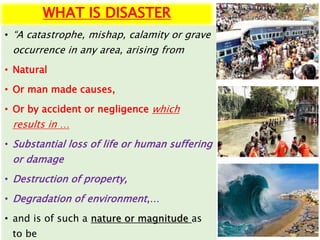
WHAT IS DISASTER
• “A catastrophe, mishap, calamity or grave
occurrence in any area, arising from
• Natural
• Or man made causes,
• Or by accident or negligence which
results in …
• Substantial loss of life or human suffering
or damage
• Destruction of property,
• Degradation of environment,…
• and is of such a nature or magnitude as
to be
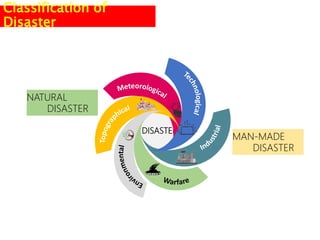
Classification of
Disaster
DISASTER
NATURAL
DISASTER
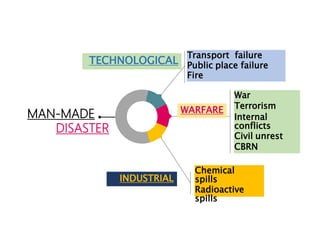
MAN-MADE
DISASTER
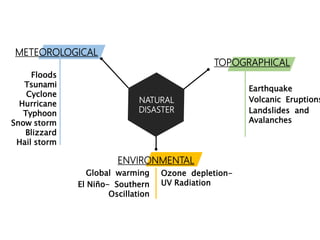
Earthquake
Volcanic Eruptions
Landslides and
Avalanches
TOPOGRAPHICAL
Floods
Tsunami
Cyclone
Hurricane
Typhoon
Snow storm
Blizzard
Hail storm
METEOROLOGICAL
Global warming
El Niño- Southern
Oscillation
Ozone depletion-
UV Radiation
ENVIRONMENTAL
NATURAL
DISASTER
Transport failure
Public place failure
Fire
War
Terrorism
Internal
conflicts
Civil unrest
CBRN
Chemical
spills
Radioactive
spills
TECHNOLOGICAL
WARFARE
INDUSTRIAL
MAN-MADE
DISASTER
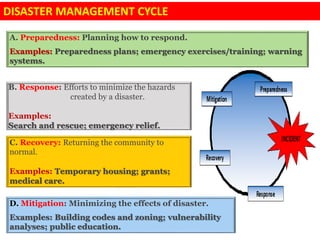
B. Response: Efforts to minimize the hazards
created by a disaster.
Examples:
Search and rescue; emergency relief.
A. Preparedness: Planning how to respond.
Examples: Preparedness plans; emergency exercises/training; warning
systems.
DISASTER MANAGEMENT CYCLE
C. Recovery: Returning the community to
normal.
Examples: Temporary housing; grants;
medical care.
D. Mitigation: Minimizing the effects of disaster.
Examples: Building codes and zoning; vulnerability
analyses; public education.
INDIA & DISASTERS
 A Major Disaster occurs every 2-3 years.
 12% Govt. revenue spent on relief and rehabilitation.
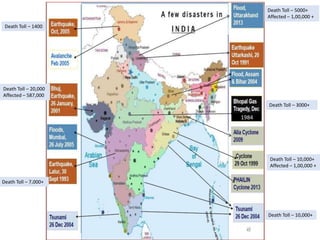
Death Toll – 5000+
Affected – 1,00,000 +
Death Toll – 10,000+
Death Toll – 20,000
Affected – 587,000
Death Toll – 10,000+
Affected – 1,00,000 +
Death Toll – 3000+
Death Toll – 7,000+
Death Toll – 1400
1984
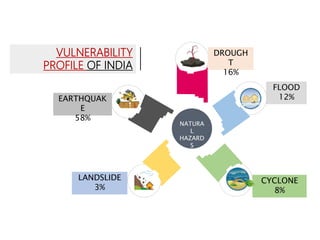
FLOOD
12%
CYCLONE
8%
LANDSLIDE
3%
NATURA
L
HAZARD
S
VULNERABILITY
PROFILE OF INDIA
EARTHQUAK
E
58%
DROUGH
T
16%
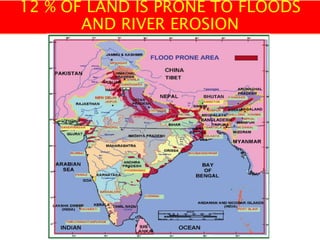
12 % OF LAND IS PRONE TO FLOODS
AND RIVER EROSION
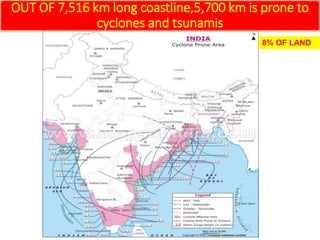
OUT OF 7,516 km long coastline,5,700 km is prone to
cyclones and tsunamis
8% OF LAND
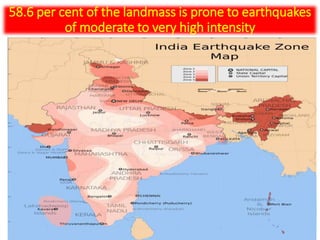
58.6 per cent of the landmass is prone to earthquakes
of moderate to very high intensity
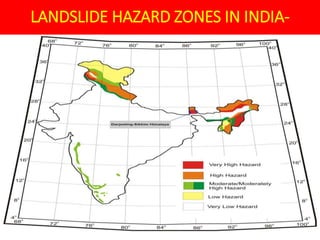
LANDSLIDE HAZARD ZONES IN INDIA-
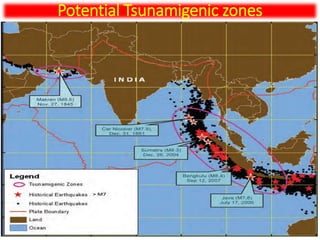
Potential Tsunamigenic zones
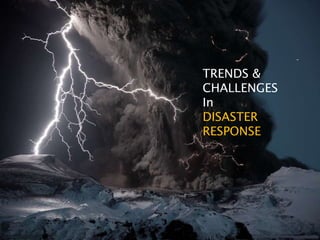
TRENDS &
CHALLENGES
In
DISASTER
RESPONSE
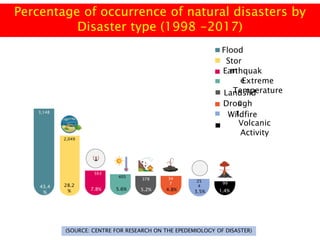
Percentage of occurrence of natural disasters by
Disaster type (1998 -2017)
3,148
43.4
%
Flood
2,049
28.2
%
Stor
m
563
7.8%
Earthquak
e
405
5.6%
Extreme
Temperature
378
5.2%
Landslid
e
34
7
4.8%
Drough
t
25
4
3.5%
Wildfire
99
1.4%
Volcanic
Activity
(SOURCE: CENTRE FOR RESEARCH ON THE EPEDEMIOLOGY OF DISASTER)
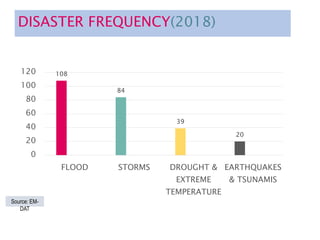
DISASTER FREQUENCY(2018)
108
84
39
20
0
20
40
60
80
100
120
FLOOD STORMS DROUGHT &
EXTREME
TEMPERATURE
EARTHQUAKES
& TSUNAMIS
Source: EM-
DAT
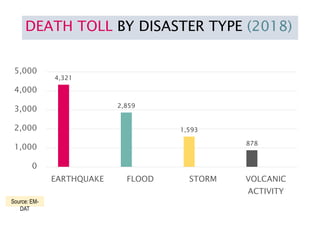
DEATH TOLL BY DISASTER TYPE (2018)
4,321
2,859
1,593
878
0
1,000
2,000
3,000
4,000
5,000
EARTHQUAKE FLOOD STORM VOLCANIC
ACTIVITY
Source: EM-
DAT
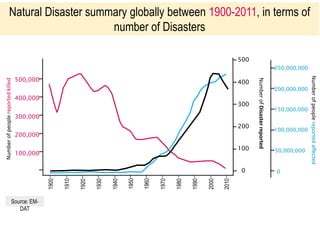
Natural Disaster summary globally between 1900-2011, in terms of
number of Disasters
NumberofDisasterreported
Numberofpeoplereportedkilled
Numberofpeoplereportedaffected
250,000,000
200,000,000
150,000,000
100,000,000
50,000,000
0
500
400
300
200
100
0
500,000
400,000
200,000
100,000
300,000
1900
1910
1920
1930
1940
1950
1960
1970
1980
1990
2000
2010
Source: EM-
DAT
0 5,000 10,000 15,000 20,000 25,000
0 2 4 6 8 10 12
FLOOD
EARTHQUAKE
DROUGHT
FATALITIES/CASUALTIES
FREQUENCY/NO. OF OCCURANCE
EVENTS
FREQUENCY/No. of Outcome FATALITIES/CASUALTIES
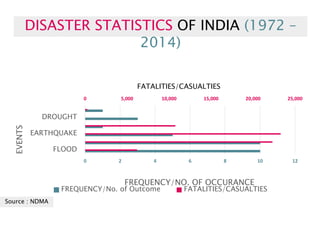
DISASTER STATISTICS OF INDIA (1972 –
2014)
Source : NDMA
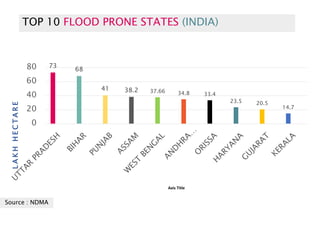
TOP 10 FLOOD PRONE STATES (INDIA)
73
68
41 38.2 37.66 34.8 33.4
23.5 20.5
14.7
0
20
40
60
80
LAKHHECTARE
Axis Title
Source : NDMA
INDIA PHILIPPINES CHINA NIGERIA GUATAMELA
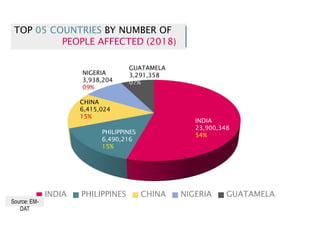
TOP 05 COUNTRIES BY NUMBER OF
PEOPLE AFFECTED (2018)
Source: EM-
DAT
INDIA
23,900,348
54%
PHILIPPINES
6,490,216
15%
CHINA
6,415,024
15%
NIGERIA
3,938,204
09%
GUATAMELA
3,291,358
07%
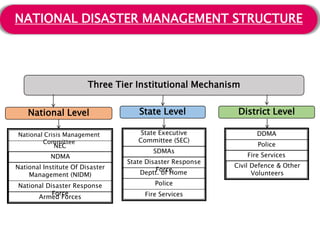
Three Tier Institutional Mechanism
National Level State Level District Level
National Institute Of Disaster
Management (NIDM)
National Disaster Response
Force
NEC
State Executive
Committee (SEC)
SDMAs
State Disaster Response
ForceDeptt. of Home
DDMA
Police
Fire Services
Civil Defence & Other
Volunteers
Police
Fire ServicesNDMA
Armed Forces
NATIONAL DISASTER MANAGEMENT STRUCTURE
National Crisis Management
Committee
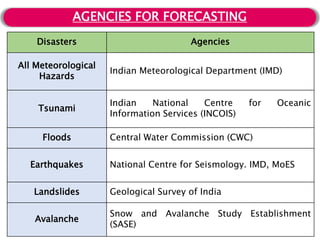
AGENCIES FOR FORECASTING
Disasters Agencies
All Meteorological
Hazards
Indian Meteorological Department (IMD)
Tsunami
Indian National Centre for Oceanic
Information Services (INCOIS)
Floods Central Water Commission (CWC)
Earthquakes National Centre for Seismology. IMD, MoES
Landslides Geological Survey of India
Avalanche
Snow and Avalanche Study Establishment
(SASE)
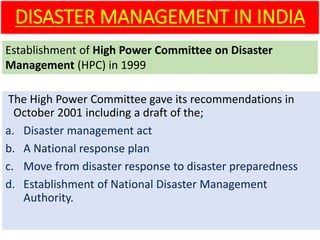
The High Power Committee gave its recommendations in
October 2001 including a draft of the;
a. Disaster management act
b. A National response plan
c. Move from disaster response to disaster preparedness
d. Establishment of National Disaster Management
Authority.
DISASTER MANAGEMENT IN INDIA
Establishment of High Power Committee on Disaster
Management (HPC) in 1999
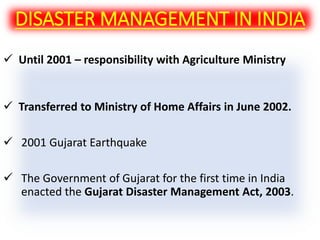
 Until 2001 – responsibility with Agriculture Ministry
 Transferred to Ministry of Home Affairs in June 2002.
 2001 Gujarat Earthquake
 The Government of Gujarat for the first time in India
enacted the Gujarat Disaster Management Act, 2003.
DISASTER MANAGEMENT IN INDIA
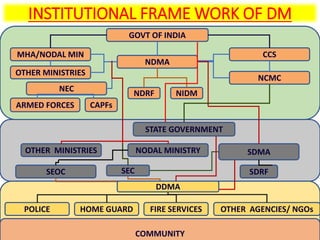
GOVT OF INDIA
NDMA
CCS
NCMC
MHA/NODAL MIN
OTHER MINISTRIES
NDRF
NEC
ARMED FORCES
NIDM
CAPFs
SDMA
SDRF
NODAL MINISTRY
SECSEOC
COMMUNITY
POLICE HOME GUARD
OTHER MINISTRIES
FIRE SERVICES OTHER AGENCIES/ NGOs
STATE GOVERNMENT
DDMA
INSTITUTIONAL FRAME WORK OF DM
Lakshadweep
A & N Islands
Maharashtra
Andhra
Pradesh
Odisha
Goa
Telangana
MP
Bihar
Jharkhand
Gujarat
Nagaland
Manipur
Mizoram
Tripura
Uttarakhand
Sikkim
Meghalaya
Rajasthan
Haryana
Punjab
J & K
Chandigarh
WB
NDRF Bns
RRC
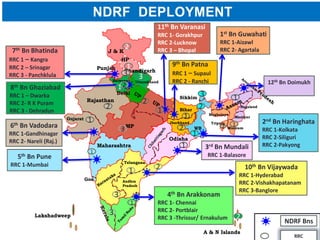
4th Bn Arakkonam
RRC 1- Chennai
RRC 2- Portblair
RRC 3 -Thrissur/ Ernakulum
1
2
10th Bn Vijaywada
RRC 1-Hyderabad
RRC 2-Vishakhapatanam
RRC 3-Banglore
3
1 2
5th Bn Pune
RRC 1-Mumbai
1
6th Bn Vadodara
RRC 1-Gandhinagar
RRC 2- Nareli (Raj.)
1
2
8th Bn Ghaziabad
RRC 1 – Dwarka
RRC 2- R K Puram
RRC 3 - Dehradun
1
3
7th Bn Bhatinda
RRC 1 – Kangra
RRC 2 – Srinagar
RRC 3 - Panchklula
1
11th Bn Varanasi
RRC 1- Gorakhpur
RRC 2-Lucknow
RRC 3 – Bhopal
1
2
9th Bn Patna
RRC 1 – Supaul
RRC 2 - Ranchi
1
1st Bn Guwahati
RRC 1-Aizawl
RRC 2- Agartala
12
12th Bn Doimukh
1
2nd Bn Haringhata
RRC 1-Kolkata
RRC 2-Siliguri
RRC 2-Pakyong
1
2
3
3rd Bn Mundali
RRC 1-Balasore
1
HP
NDRF DEPLOYMENT
3
2
2
Delhi
3
3
2
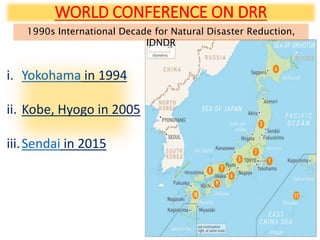
WORLD CONFERENCE ON DRR
1990s International Decade for Natural Disaster Reduction,
IDNDR
i. Yokohama in 1994
ii. Kobe, Hyogo in 2005
iii.Sendai in 2015
SENDAI FRAMEWORK FOR DISASTER RISK REDUCTION
The Sendai framework is a 15-year, voluntary, non-binding
agreement
It recognizes that the state has the primary role to reduce
disaster risk
 But that responsibility should be shared with other
stakeholders
 Including local government, the private sector and other
stakeholders.
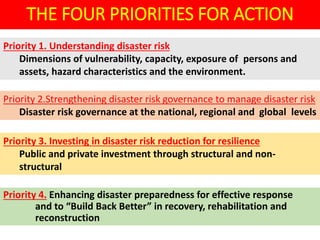
THE FOUR PRIORITIES FOR ACTION
Priority 4. Enhancing disaster preparedness for effective response
and to “Build Back Better” in recovery, rehabilitation and
reconstruction
Priority 1. Understanding disaster risk
Dimensions of vulnerability, capacity, exposure of persons and
assets, hazard characteristics and the environment.
Priority 2.Strengthening disaster risk governance to manage disaster risk
Disaster risk governance at the national, regional and global levels
Priority 3. Investing in disaster risk reduction for resilience
Public and private investment through structural and non-
structural
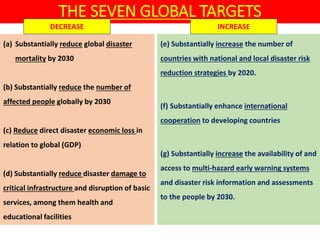
THE SEVEN GLOBAL TARGETS
(e) Substantially increase the number of
countries with national and local disaster risk
reduction strategies by 2020.
(f) Substantially enhance international
cooperation to developing countries
(g) Substantially increase the availability of and
access to multi-hazard early warning systems
and disaster risk information and assessments
to the people by 2030.
(a) Substantially reduce global disaster
mortality by 2030
(b) Substantially reduce the number of
affected people globally by 2030
(c) Reduce direct disaster economic loss in
relation to global (GDP)
(d) Substantially reduce disaster damage to
critical infrastructure and disruption of basic
services, among them health and
educational facilities
DECREASE INCREASE
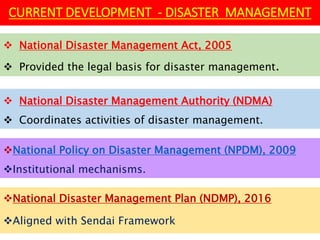
National Disaster Management Plan (NDMP), 2016
Aligned with Sendai Framework
 National Disaster Management Act, 2005
 Provided the legal basis for disaster management.
CURRENT DEVELOPMENT - DISASTER MANAGEMENT
 National Disaster Management Authority (NDMA)
 Coordinates activities of disaster management.
National Policy on Disaster Management (NPDM), 2009
Institutional mechanisms.
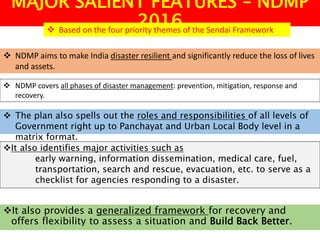
MAJOR SALIENT FEATURES – NDMP
2016
 NDMP aims to make India disaster resilient and significantly reduce the loss of lives
and assets.
 Based on the four priority themes of the Sendai Framework
 NDMP covers all phases of disaster management: prevention, mitigation, response and
recovery.
 The plan also spells out the roles and responsibilities of all levels of
Government right up to Panchayat and Urban Local Body level in a
matrix format.
It also identifies major activities such as
early warning, information dissemination, medical care, fuel,
transportation, search and rescue, evacuation, etc. to serve as a
checklist for agencies responding to a disaster.
It also provides a generalized framework for recovery and
offers flexibility to assess a situation and Build Back Better.
THANKS

DISASTER MANAGEMENT IN GENRAL

  • 1.
    GENERAL ANUP KUMAR SINGH DEPUTYCOMMANDANT NDRF ACADEMY
  • 2.
    WHAT IS DISASTER •“A catastrophe, mishap, calamity or grave occurrence in any area, arising from • Natural • Or man made causes, • Or by accident or negligence which results in … • Substantial loss of life or human suffering or damage • Destruction of property, • Degradation of environment,… • and is of such a nature or magnitude as to be
  • 3.
  • 4.
    Earthquake Volcanic Eruptions Landslides and Avalanches TOPOGRAPHICAL Floods Tsunami Cyclone Hurricane Typhoon Snowstorm Blizzard Hail storm METEOROLOGICAL Global warming El Niño- Southern Oscillation Ozone depletion- UV Radiation ENVIRONMENTAL NATURAL DISASTER
  • 5.
    Transport failure Public placefailure Fire War Terrorism Internal conflicts Civil unrest CBRN Chemical spills Radioactive spills TECHNOLOGICAL WARFARE INDUSTRIAL MAN-MADE DISASTER
  • 8.
    B. Response: Effortsto minimize the hazards created by a disaster. Examples: Search and rescue; emergency relief. A. Preparedness: Planning how to respond. Examples: Preparedness plans; emergency exercises/training; warning systems. DISASTER MANAGEMENT CYCLE C. Recovery: Returning the community to normal. Examples: Temporary housing; grants; medical care. D. Mitigation: Minimizing the effects of disaster. Examples: Building codes and zoning; vulnerability analyses; public education.
  • 9.
    INDIA & DISASTERS A Major Disaster occurs every 2-3 years.  12% Govt. revenue spent on relief and rehabilitation.
  • 10.
    Death Toll –5000+ Affected – 1,00,000 + Death Toll – 10,000+ Death Toll – 20,000 Affected – 587,000 Death Toll – 10,000+ Affected – 1,00,000 + Death Toll – 3000+ Death Toll – 7,000+ Death Toll – 1400 1984
  • 11.
  • 12.
    12 % OFLAND IS PRONE TO FLOODS AND RIVER EROSION
  • 13.
    OUT OF 7,516km long coastline,5,700 km is prone to cyclones and tsunamis 8% OF LAND
  • 14.
    58.6 per centof the landmass is prone to earthquakes of moderate to very high intensity
  • 15.
  • 16.
  • 17.
  • 18.
    Percentage of occurrenceof natural disasters by Disaster type (1998 -2017) 3,148 43.4 % Flood 2,049 28.2 % Stor m 563 7.8% Earthquak e 405 5.6% Extreme Temperature 378 5.2% Landslid e 34 7 4.8% Drough t 25 4 3.5% Wildfire 99 1.4% Volcanic Activity (SOURCE: CENTRE FOR RESEARCH ON THE EPEDEMIOLOGY OF DISASTER)
  • 19.
    DISASTER FREQUENCY(2018) 108 84 39 20 0 20 40 60 80 100 120 FLOOD STORMSDROUGHT & EXTREME TEMPERATURE EARTHQUAKES & TSUNAMIS Source: EM- DAT
  • 20.
    DEATH TOLL BYDISASTER TYPE (2018) 4,321 2,859 1,593 878 0 1,000 2,000 3,000 4,000 5,000 EARTHQUAKE FLOOD STORM VOLCANIC ACTIVITY Source: EM- DAT
  • 21.
    Natural Disaster summaryglobally between 1900-2011, in terms of number of Disasters NumberofDisasterreported Numberofpeoplereportedkilled Numberofpeoplereportedaffected 250,000,000 200,000,000 150,000,000 100,000,000 50,000,000 0 500 400 300 200 100 0 500,000 400,000 200,000 100,000 300,000 1900 1910 1920 1930 1940 1950 1960 1970 1980 1990 2000 2010 Source: EM- DAT
  • 22.
    0 5,000 10,00015,000 20,000 25,000 0 2 4 6 8 10 12 FLOOD EARTHQUAKE DROUGHT FATALITIES/CASUALTIES FREQUENCY/NO. OF OCCURANCE EVENTS FREQUENCY/No. of Outcome FATALITIES/CASUALTIES DISASTER STATISTICS OF INDIA (1972 – 2014) Source : NDMA
  • 23.
    TOP 10 FLOODPRONE STATES (INDIA) 73 68 41 38.2 37.66 34.8 33.4 23.5 20.5 14.7 0 20 40 60 80 LAKHHECTARE Axis Title Source : NDMA
  • 24.
    INDIA PHILIPPINES CHINANIGERIA GUATAMELA TOP 05 COUNTRIES BY NUMBER OF PEOPLE AFFECTED (2018) Source: EM- DAT INDIA 23,900,348 54% PHILIPPINES 6,490,216 15% CHINA 6,415,024 15% NIGERIA 3,938,204 09% GUATAMELA 3,291,358 07%
  • 25.
    Three Tier InstitutionalMechanism National Level State Level District Level National Institute Of Disaster Management (NIDM) National Disaster Response Force NEC State Executive Committee (SEC) SDMAs State Disaster Response ForceDeptt. of Home DDMA Police Fire Services Civil Defence & Other Volunteers Police Fire ServicesNDMA Armed Forces NATIONAL DISASTER MANAGEMENT STRUCTURE National Crisis Management Committee
  • 26.
    AGENCIES FOR FORECASTING DisastersAgencies All Meteorological Hazards Indian Meteorological Department (IMD) Tsunami Indian National Centre for Oceanic Information Services (INCOIS) Floods Central Water Commission (CWC) Earthquakes National Centre for Seismology. IMD, MoES Landslides Geological Survey of India Avalanche Snow and Avalanche Study Establishment (SASE)
  • 27.
    The High PowerCommittee gave its recommendations in October 2001 including a draft of the; a. Disaster management act b. A National response plan c. Move from disaster response to disaster preparedness d. Establishment of National Disaster Management Authority. DISASTER MANAGEMENT IN INDIA Establishment of High Power Committee on Disaster Management (HPC) in 1999
  • 28.
     Until 2001– responsibility with Agriculture Ministry  Transferred to Ministry of Home Affairs in June 2002.  2001 Gujarat Earthquake  The Government of Gujarat for the first time in India enacted the Gujarat Disaster Management Act, 2003. DISASTER MANAGEMENT IN INDIA
  • 29.
    GOVT OF INDIA NDMA CCS NCMC MHA/NODALMIN OTHER MINISTRIES NDRF NEC ARMED FORCES NIDM CAPFs SDMA SDRF NODAL MINISTRY SECSEOC COMMUNITY POLICE HOME GUARD OTHER MINISTRIES FIRE SERVICES OTHER AGENCIES/ NGOs STATE GOVERNMENT DDMA INSTITUTIONAL FRAME WORK OF DM
  • 30.
    Lakshadweep A & NIslands Maharashtra Andhra Pradesh Odisha Goa Telangana MP Bihar Jharkhand Gujarat Nagaland Manipur Mizoram Tripura Uttarakhand Sikkim Meghalaya Rajasthan Haryana Punjab J & K Chandigarh WB NDRF Bns RRC 4th Bn Arakkonam RRC 1- Chennai RRC 2- Portblair RRC 3 -Thrissur/ Ernakulum 1 2 10th Bn Vijaywada RRC 1-Hyderabad RRC 2-Vishakhapatanam RRC 3-Banglore 3 1 2 5th Bn Pune RRC 1-Mumbai 1 6th Bn Vadodara RRC 1-Gandhinagar RRC 2- Nareli (Raj.) 1 2 8th Bn Ghaziabad RRC 1 – Dwarka RRC 2- R K Puram RRC 3 - Dehradun 1 3 7th Bn Bhatinda RRC 1 – Kangra RRC 2 – Srinagar RRC 3 - Panchklula 1 11th Bn Varanasi RRC 1- Gorakhpur RRC 2-Lucknow RRC 3 – Bhopal 1 2 9th Bn Patna RRC 1 – Supaul RRC 2 - Ranchi 1 1st Bn Guwahati RRC 1-Aizawl RRC 2- Agartala 12 12th Bn Doimukh 1 2nd Bn Haringhata RRC 1-Kolkata RRC 2-Siliguri RRC 2-Pakyong 1 2 3 3rd Bn Mundali RRC 1-Balasore 1 HP NDRF DEPLOYMENT 3 2 2 Delhi 3 3 2
  • 31.
    WORLD CONFERENCE ONDRR 1990s International Decade for Natural Disaster Reduction, IDNDR i. Yokohama in 1994 ii. Kobe, Hyogo in 2005 iii.Sendai in 2015
  • 32.
    SENDAI FRAMEWORK FORDISASTER RISK REDUCTION The Sendai framework is a 15-year, voluntary, non-binding agreement It recognizes that the state has the primary role to reduce disaster risk  But that responsibility should be shared with other stakeholders  Including local government, the private sector and other stakeholders.
  • 33.
    THE FOUR PRIORITIESFOR ACTION Priority 4. Enhancing disaster preparedness for effective response and to “Build Back Better” in recovery, rehabilitation and reconstruction Priority 1. Understanding disaster risk Dimensions of vulnerability, capacity, exposure of persons and assets, hazard characteristics and the environment. Priority 2.Strengthening disaster risk governance to manage disaster risk Disaster risk governance at the national, regional and global levels Priority 3. Investing in disaster risk reduction for resilience Public and private investment through structural and non- structural
  • 34.
    THE SEVEN GLOBALTARGETS (e) Substantially increase the number of countries with national and local disaster risk reduction strategies by 2020. (f) Substantially enhance international cooperation to developing countries (g) Substantially increase the availability of and access to multi-hazard early warning systems and disaster risk information and assessments to the people by 2030. (a) Substantially reduce global disaster mortality by 2030 (b) Substantially reduce the number of affected people globally by 2030 (c) Reduce direct disaster economic loss in relation to global (GDP) (d) Substantially reduce disaster damage to critical infrastructure and disruption of basic services, among them health and educational facilities DECREASE INCREASE
  • 35.
    National Disaster ManagementPlan (NDMP), 2016 Aligned with Sendai Framework  National Disaster Management Act, 2005  Provided the legal basis for disaster management. CURRENT DEVELOPMENT - DISASTER MANAGEMENT  National Disaster Management Authority (NDMA)  Coordinates activities of disaster management. National Policy on Disaster Management (NPDM), 2009 Institutional mechanisms.
  • 36.
    MAJOR SALIENT FEATURES– NDMP 2016  NDMP aims to make India disaster resilient and significantly reduce the loss of lives and assets.  Based on the four priority themes of the Sendai Framework  NDMP covers all phases of disaster management: prevention, mitigation, response and recovery.  The plan also spells out the roles and responsibilities of all levels of Government right up to Panchayat and Urban Local Body level in a matrix format. It also identifies major activities such as early warning, information dissemination, medical care, fuel, transportation, search and rescue, evacuation, etc. to serve as a checklist for agencies responding to a disaster. It also provides a generalized framework for recovery and offers flexibility to assess a situation and Build Back Better.
  • 37.