MRS.ARUNA MANO
MSC (N),MEDICAL SURGICAL NURSING
LECTURER
GANGA COLLEGE OF NURSING
COIMBATORE
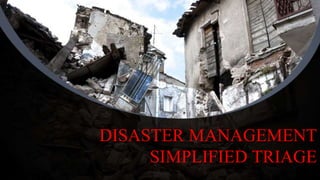
DISASTER MANAGEMENT
SIMPLIFIED TRIAGE
OBJECTIVES:
• Definition
• Classification
• Major disaster in India
• Product B• Out hospital disaster &
management
• In hospital disaster &
management
• Disaster management in
India
• International agencies –
Disaster management
Disaster……
It’s not a new thing…In
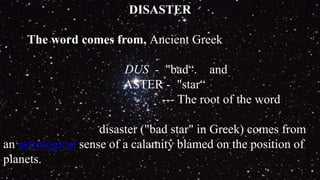
DISASTER
The word comes from, Ancient Greek
DUS - "bad“. and
ASTER - "star“
--- The root of the word
disaster ("bad star" in Greek) comes from
an astrological sense of a calamity blamed on the position of
planets.
A disaster is an occurrence
distributing the normal condition of
existence and causing a level of
suffering that exceeds the capacity
of adjustment of the affected
community…
-WHO
DEFINITION:
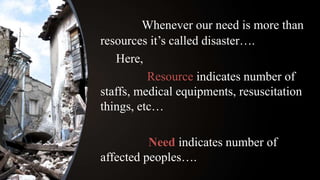
Whenever our need is more than
resources it’s called disaster….
Here,
Resource indicates number of
staffs, medical equipments, resuscitation
things, etc…
Need indicates number of
affected peoples….
CLASSIFICATION
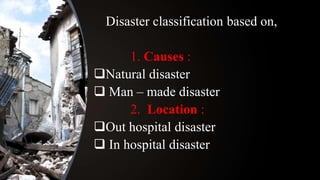
Disaster classification based on,
1. Causes :
Natural disaster
 Man – made disaster
2. Location :
Out hospital disaster
 In hospital disaster
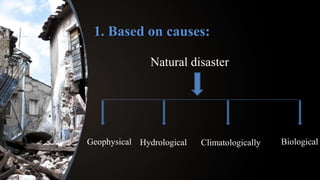
1. Based on causes:
Natural disaster
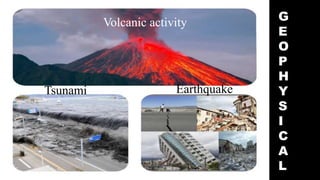
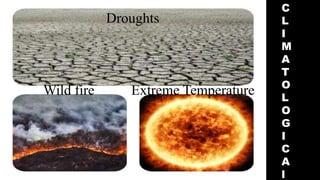
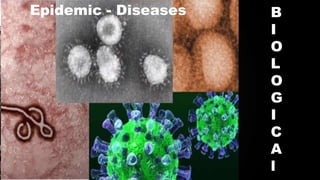
Geophysical Hydrological Climatologically Biological
Volcanic activity
Tsunami Earthquake
G
E
O
P
H
Y
S
I
C
A
L
Flood Avalanche
H
Y
D
R
O
L
O
G
I
C
A
L
Droughts
Wild fire Extreme Temperature
C
L
I
M
A
T
O
L
O
G
I
C
A
l
Epidemic - Diseases B
I
O
L
O
G
I
C
A
l
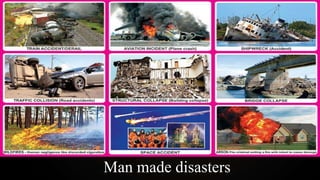
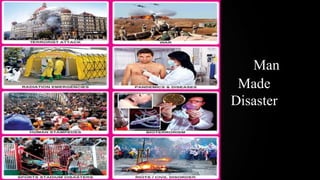
2. Man made disaster :
• Man made disaster or Man made
crisis results from,
✓Human intent
✓ Negligence
✓ Error involving a
failure of a man made system
Man made disasters
Man
Made
Disaster
Major disaster in India:
• 2019 Bihar floods
• 2019 India alcohol poisoning
• 2019 Indian floods
• 2019 Karnataka floods
• 2019 Kerala floods
• 2019 Kullu bus accident
• 2019 Mumbai foot over bridge collapse
• 2019 Pune flood
• 2019 Vadodara flood
• 2019 Assam alcohol poisonings
• 2019 Bandipur forest fires
• 2019 Bihar encephalitis outbreak
• 2019 Chennai water crisis
• 2019 Delhi factory fire
• Delhi hotel fire
• Dharwad building collapse
• Cyclone Fani
• 2019 heat wave in India and Pakistan
• 2019 Indian Air Force An-32 crash
• Seemanchal Express derailment
• 2019 Surat fire
• Tiware dam failure
• 2020 Uttarakhand forest fires.
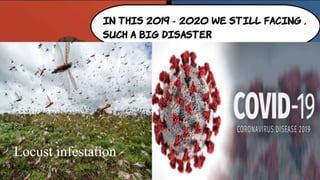
Locust infestation
Out hospital disaster
Management
Disaster happened at the out side of
hospital….like flood, war, droughts, bio –
terrorism
Now,
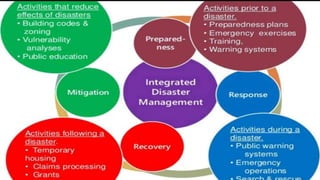
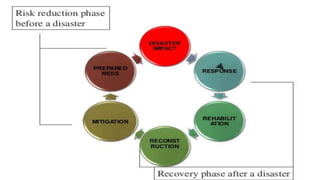
The management of disaster have
2 phases:
✓ 4 phase
✓ 6 phase
4 phase - cycle
6 phase - cycle
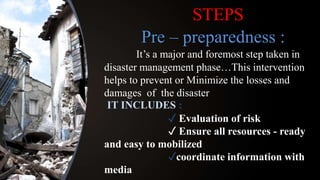
STEPS
Pre – preparedness :
It’s a major and foremost step taken in
disaster management phase…This intervention
helps to prevent or Minimize the losses and
damages of the disaster
IT INCLUDES :
✓ Evaluation of risk
✓ Ensure all resources - ready
and easy to mobilized
✓coordinate information with
media
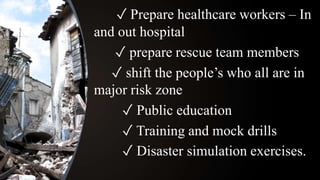
✓ Prepare healthcare workers – In
and out hospital
✓ prepare rescue team members
✓ shift the people’s who all are in
major risk zone
✓ Public education
✓ Training and mock drills
✓ Disaster simulation exercises.
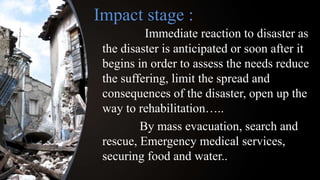
Impact stage :
Immediate reaction to disaster as
the disaster is anticipated or soon after it
begins in order to assess the needs reduce
the suffering, limit the spread and
consequences of the disaster, open up the
way to rehabilitation…..
By mass evacuation, search and
rescue, Emergency medical services,
securing food and water..
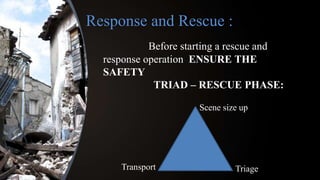
Response and Rescue :
Before starting a rescue and
response operation ENSURE THE
SAFETY
TRIAD – RESCUE PHASE:
Scene size up
TriageTransport
✓ First and foremost step
taken in disaster management
✓ Set the border around
disaster happened area and restrict the
unnecessary people’s entry
✓ Only health care
professionals, Rescue team members,
Ambulance….
Scene size up:
Triage :
TRIAGE word derived from,
TRIER ( French word
) Meaning – To short.
Triage defined as a shortening Of
peoples based on their severity and also
our resources..
✓In disaster area
mass casualty is there…so we
can’t do person by person
assessment…
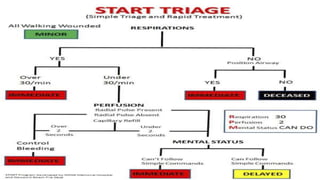
✓ so here we use
simple ‘SALT’ triage
system….
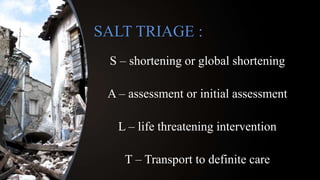
SALT TRIAGE :
S – shortening or global shortening
A – assessment or initial assessment
L – life threatening intervention
T – Transport to definite care
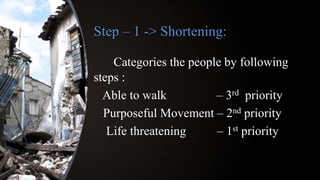
Step – 1 -> Shortening:
Categories the people by following
steps :
Able to walk – 3rd priority
Purposeful Movement – 2nd priority
Life threatening – 1st priority
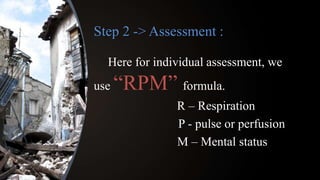
Step 2 -> Assessment :
Here for individual assessment, we
use “RPM” formula.
R – Respiration
P - pulse or perfusion
M – Mental status
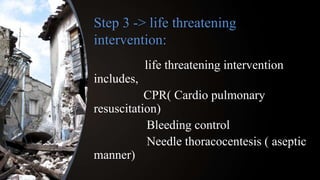
Step 3 -> life threatening
intervention:
life threatening intervention
includes,
CPR( Cardio pulmonary
resuscitation)
Bleeding control
Needle thoracocentesis ( aseptic
manner)
Step 4 -> TRANSPORT :
Transport the patient from the
out hospital or disaster area to to definite
care…
It includes,
Air ambulance transport
Road way ambulance.
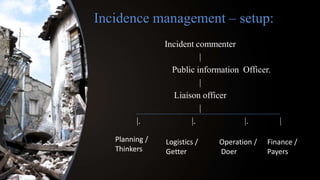
Incidence management – setup:
Incident commenter
|
Public information Officer.
|
Liaison officer
|
|. |. |. |
Planning /
Thinkers
Logistics /
Getter
Operation /
Doer
Finance /
Payers
In hospital disaster
In hospital disaster :
It occurs when the increased
number of peoples ( mass casualty)
admitted in hospital / more than
resources ( no. Of beds, equipments,
etc..)
causes :
1. Improper identification, triage
2. Lack of supplies
3. Poor communication network
Classes :
• Class A – No disturbance in routine
work
• Class B – Minor disturbance, need
some modifications
• Class C – Major disturbance of routine
work
MANAGEMENT
Management on,
1. Number of beds :
Here we increase the
capacity by car barking, warrant to wards
and ICUs….; Discharge the admitted
patient who don’t need emergent care in
hospital…
IHD – Management :
2. Next , Need of Medicines,
equipments, staffs:
>We can buy medication
and equipments in near by hospital/ near
by district health care facility, stack
hold…
> We can post the
temporary staffs to manage the staff
insufficiency
Hospital admission formula:
For occupancy :
No. of cases we have to treat/ hr = 3% of
total hospital beds
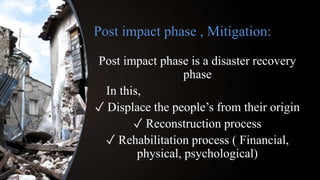
Post impact phase , Mitigation:
Post impact phase is a disaster recovery
phase
In this,
✓ Displace the people’s from their origin
✓ Reconstruction process
✓ Rehabilitation process ( Financial,
physical, psychological)
Mitigation :
Mitigation means reduce the risk of
disaster…..or prevention
Mitigation – Pneumonic:
“ PRE – DISASTER “
P – Planning and practice.
R – Resilience
E – Education
International agencies – Disaster management
• IAEM – Intervention association of emergency
manager’s
• Non – profit agencies:
• United nations
• Red cross
• World bank
• Europian union
DISASTER MANAGEMENT SIMPLIFIED TRIAGE

DISASTER MANAGEMENT SIMPLIFIED TRIAGE

  • 1.
    MRS.ARUNA MANO MSC (N),MEDICALSURGICAL NURSING LECTURER GANGA COLLEGE OF NURSING COIMBATORE
  • 2.
  • 3.
    OBJECTIVES: • Definition • Classification •Major disaster in India • Product B• Out hospital disaster & management • In hospital disaster & management • Disaster management in India • International agencies – Disaster management
  • 4.
  • 5.
    DISASTER The word comesfrom, Ancient Greek DUS - "bad“. and ASTER - "star“ --- The root of the word disaster ("bad star" in Greek) comes from an astrological sense of a calamity blamed on the position of planets.
  • 6.
    A disaster isan occurrence distributing the normal condition of existence and causing a level of suffering that exceeds the capacity of adjustment of the affected community… -WHO DEFINITION:
  • 7.
    Whenever our needis more than resources it’s called disaster…. Here, Resource indicates number of staffs, medical equipments, resuscitation things, etc… Need indicates number of affected peoples….
  • 8.
  • 9.
    Disaster classification basedon, 1. Causes : Natural disaster  Man – made disaster 2. Location : Out hospital disaster  In hospital disaster
  • 10.
    1. Based oncauses: Natural disaster Geophysical Hydrological Climatologically Biological
  • 11.
  • 12.
  • 13.
    Droughts Wild fire ExtremeTemperature C L I M A T O L O G I C A l
  • 14.
    Epidemic - DiseasesB I O L O G I C A l
  • 15.
    2. Man madedisaster : • Man made disaster or Man made crisis results from, ✓Human intent ✓ Negligence ✓ Error involving a failure of a man made system
  • 16.
  • 17.
  • 18.
    Major disaster inIndia: • 2019 Bihar floods • 2019 India alcohol poisoning • 2019 Indian floods • 2019 Karnataka floods • 2019 Kerala floods • 2019 Kullu bus accident • 2019 Mumbai foot over bridge collapse • 2019 Pune flood • 2019 Vadodara flood
  • 19.
    • 2019 Assamalcohol poisonings • 2019 Bandipur forest fires • 2019 Bihar encephalitis outbreak • 2019 Chennai water crisis • 2019 Delhi factory fire • Delhi hotel fire • Dharwad building collapse • Cyclone Fani • 2019 heat wave in India and Pakistan • 2019 Indian Air Force An-32 crash • Seemanchal Express derailment • 2019 Surat fire • Tiware dam failure • 2020 Uttarakhand forest fires.
  • 20.
  • 21.
    Out hospital disaster Management Disasterhappened at the out side of hospital….like flood, war, droughts, bio – terrorism Now, The management of disaster have 2 phases: ✓ 4 phase ✓ 6 phase
  • 22.
    4 phase -cycle
  • 24.
    6 phase -cycle
  • 26.
    STEPS Pre – preparedness: It’s a major and foremost step taken in disaster management phase…This intervention helps to prevent or Minimize the losses and damages of the disaster IT INCLUDES : ✓ Evaluation of risk ✓ Ensure all resources - ready and easy to mobilized ✓coordinate information with media
  • 27.
    ✓ Prepare healthcareworkers – In and out hospital ✓ prepare rescue team members ✓ shift the people’s who all are in major risk zone ✓ Public education ✓ Training and mock drills ✓ Disaster simulation exercises.
  • 28.
    Impact stage : Immediatereaction to disaster as the disaster is anticipated or soon after it begins in order to assess the needs reduce the suffering, limit the spread and consequences of the disaster, open up the way to rehabilitation….. By mass evacuation, search and rescue, Emergency medical services, securing food and water..
  • 29.
    Response and Rescue: Before starting a rescue and response operation ENSURE THE SAFETY TRIAD – RESCUE PHASE: Scene size up TriageTransport
  • 30.
    ✓ First andforemost step taken in disaster management ✓ Set the border around disaster happened area and restrict the unnecessary people’s entry ✓ Only health care professionals, Rescue team members, Ambulance…. Scene size up:
  • 31.
    Triage : TRIAGE wordderived from, TRIER ( French word ) Meaning – To short. Triage defined as a shortening Of peoples based on their severity and also our resources..
  • 32.
    ✓In disaster area masscasualty is there…so we can’t do person by person assessment… ✓ so here we use simple ‘SALT’ triage system….
  • 33.
    SALT TRIAGE : S– shortening or global shortening A – assessment or initial assessment L – life threatening intervention T – Transport to definite care
  • 34.
    Step – 1-> Shortening: Categories the people by following steps : Able to walk – 3rd priority Purposeful Movement – 2nd priority Life threatening – 1st priority
  • 35.
    Step 2 ->Assessment : Here for individual assessment, we use “RPM” formula. R – Respiration P - pulse or perfusion M – Mental status
  • 37.
    Step 3 ->life threatening intervention: life threatening intervention includes, CPR( Cardio pulmonary resuscitation) Bleeding control Needle thoracocentesis ( aseptic manner)
  • 38.
    Step 4 ->TRANSPORT : Transport the patient from the out hospital or disaster area to to definite care… It includes, Air ambulance transport Road way ambulance.
  • 39.
    Incidence management –setup: Incident commenter | Public information Officer. | Liaison officer | |. |. |. | Planning / Thinkers Logistics / Getter Operation / Doer Finance / Payers
  • 40.
  • 41.
    In hospital disaster: It occurs when the increased number of peoples ( mass casualty) admitted in hospital / more than resources ( no. Of beds, equipments, etc..) causes : 1. Improper identification, triage 2. Lack of supplies 3. Poor communication network
  • 42.
    Classes : • ClassA – No disturbance in routine work • Class B – Minor disturbance, need some modifications • Class C – Major disturbance of routine work
  • 43.
    MANAGEMENT Management on, 1. Numberof beds : Here we increase the capacity by car barking, warrant to wards and ICUs….; Discharge the admitted patient who don’t need emergent care in hospital…
  • 44.
    IHD – Management: 2. Next , Need of Medicines, equipments, staffs: >We can buy medication and equipments in near by hospital/ near by district health care facility, stack hold… > We can post the temporary staffs to manage the staff insufficiency
  • 45.
    Hospital admission formula: Foroccupancy : No. of cases we have to treat/ hr = 3% of total hospital beds
  • 46.
    Post impact phase, Mitigation: Post impact phase is a disaster recovery phase In this, ✓ Displace the people’s from their origin ✓ Reconstruction process ✓ Rehabilitation process ( Financial, physical, psychological)
  • 47.
    Mitigation : Mitigation meansreduce the risk of disaster…..or prevention Mitigation – Pneumonic: “ PRE – DISASTER “ P – Planning and practice. R – Resilience E – Education
  • 48.
    International agencies –Disaster management
  • 49.
    • IAEM –Intervention association of emergency manager’s • Non – profit agencies: • United nations • Red cross • World bank • Europian union