Custom-Made orthoses
• Sufficient stability
• Individual to stand
• Ambulation requires crutches or similar aids,
together with well-coordinated use of the upper
trunk and U/L
• Some patients may not realize the extent of PCP
for ambulation
• Trial period is advisable using mass-produced
, adjustable, temporary orthoses
Craig-Scott KAFOS
• Pair of it May be prescribed for adults with paraplegia
• Includes shoe reinforced with transverse & longitudinal
plates and BiCAAL ankle jt set in slight dorsiflexion or a
plastic solid ankle section, as well as pretibial band, a
pawl lock with bail release, and a single thigh band.
• Enable pt stand with sufficient backward lean so prevent
hip, trunk flexion
• donot restrict hip motion, pt with SCI cannot flex the hip
voluntarily …… orthsis has not mechanism to aid single-leg
progression.
• Some individual perform two or four point gait by shifting
the trunk enough to allow the leg to swing forward in a
pendular manner.
• Walkabout orthosis:
pair of KAFOs with
hinge mechanism joining the medial uprights
of the two orthoses
Mechanism permits hip flexion & extension but
restricts abb. Add. Add & rot.
A pair of KAFOs with medial hip joint that is
linked to the ankle joint…………… walk with
greater cadence and velocity.
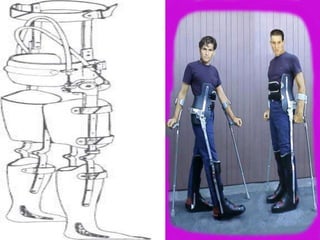
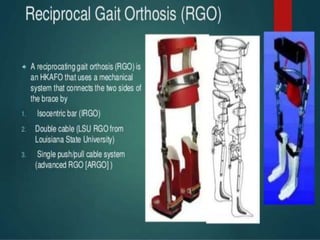
Reciprocating Gait orthoses (RGO)
Both children and adults can be fitted with RGO
THKAFO in which the hips are joined by one or
two metal cables or rods.
Knees stabilized …… knee locks, offset knee
joints or pretibial bands, and the feet are
encased in solid ankle orthoses.
To walk, the wearer uses a four-stage
procedure:
1) Shift weight to the right leg
• 2) tuck the pelvis by extending the upper thorax
• 3) press on the crutches
• 4) allow the left leg to swing through.
• The procedure is reversed for the next step.
• The steel cable or rods prevent inadvertent hip flexion
on the supporting leg.
• Reciprocal four or two point gait is stable, because
one foot is always on the floor, but the pace is slow.
• For sitting, the wearer releases the cable to enable
the hips to flex.
Externally Powered orthoses
• Orthoses combine with pneumatic foot control or
functional electrical stimulation (FES)….. Enable pt
achieve household, or in rare cases, community
ambulation.
• Technique….. Involve electrical current to produce
muscular contractions.
• Stimulation provided to quadriceps and gluteus
maximus.
• If ankle not supported by AFOs…… system includes
surface electrodes over the peroneal nerves to
initiate dorsiflexion, as well as reflex hip flexion.
Two conditions
• 1) full passive mobility in all joints
• 2) should be able to use a control system that
regulates timing & amount of current needed
to transfer from chair to standing position
and to walk in various directions.
FES is occasionally used to foster L/L exercise,
thereby maintaining muscle bulk and
reducing the risk of pressure ulcers.
nevertheless, the metabolic cost of
orthotically assisted ambulation is very high.

Custom made Orthoses

  • 1.
  • 2.
    • Sufficient stability •Individual to stand • Ambulation requires crutches or similar aids, together with well-coordinated use of the upper trunk and U/L • Some patients may not realize the extent of PCP for ambulation • Trial period is advisable using mass-produced , adjustable, temporary orthoses
  • 3.
    Craig-Scott KAFOS • Pairof it May be prescribed for adults with paraplegia • Includes shoe reinforced with transverse & longitudinal plates and BiCAAL ankle jt set in slight dorsiflexion or a plastic solid ankle section, as well as pretibial band, a pawl lock with bail release, and a single thigh band. • Enable pt stand with sufficient backward lean so prevent hip, trunk flexion • donot restrict hip motion, pt with SCI cannot flex the hip voluntarily …… orthsis has not mechanism to aid single-leg progression. • Some individual perform two or four point gait by shifting the trunk enough to allow the leg to swing forward in a pendular manner.
  • 4.
    • Walkabout orthosis: pairof KAFOs with hinge mechanism joining the medial uprights of the two orthoses Mechanism permits hip flexion & extension but restricts abb. Add. Add & rot. A pair of KAFOs with medial hip joint that is linked to the ankle joint…………… walk with greater cadence and velocity.
  • 5.
    Reciprocating Gait orthoses(RGO) Both children and adults can be fitted with RGO THKAFO in which the hips are joined by one or two metal cables or rods. Knees stabilized …… knee locks, offset knee joints or pretibial bands, and the feet are encased in solid ankle orthoses. To walk, the wearer uses a four-stage procedure: 1) Shift weight to the right leg
  • 6.
    • 2) tuckthe pelvis by extending the upper thorax • 3) press on the crutches • 4) allow the left leg to swing through. • The procedure is reversed for the next step. • The steel cable or rods prevent inadvertent hip flexion on the supporting leg. • Reciprocal four or two point gait is stable, because one foot is always on the floor, but the pace is slow. • For sitting, the wearer releases the cable to enable the hips to flex.
  • 9.
    Externally Powered orthoses •Orthoses combine with pneumatic foot control or functional electrical stimulation (FES)….. Enable pt achieve household, or in rare cases, community ambulation. • Technique….. Involve electrical current to produce muscular contractions. • Stimulation provided to quadriceps and gluteus maximus. • If ankle not supported by AFOs…… system includes surface electrodes over the peroneal nerves to initiate dorsiflexion, as well as reflex hip flexion.
  • 10.
    Two conditions • 1)full passive mobility in all joints • 2) should be able to use a control system that regulates timing & amount of current needed to transfer from chair to standing position and to walk in various directions. FES is occasionally used to foster L/L exercise, thereby maintaining muscle bulk and reducing the risk of pressure ulcers. nevertheless, the metabolic cost of orthotically assisted ambulation is very high.