

Ministry of Higher Education and Scientific Research
University of Kerbala
College of Education for Human Sciences
Department of English
Sociolinguistics
By :
Zahra Aamir Kamil.
Supervised by :
Dr.Hamid Gittan Jewad.
20th Feb. 2023 / 3rd lecture.
Sociolinguistics
Out line
Standard language
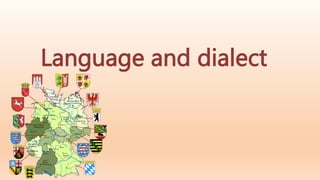
Language and dialect
Standard language
A dialect, or some closely similar group of dialects enjoying prestige as the
speech of educated people of the capital city or of some other socially
respected group, is often designated 'the standard language( Robins 1964:57).
“It is a variety of a language that contains more items than what is
there in a dialect”. "Standard" is still a dialect, but is based more
on social class rather than on region. (Hudson 1996:32)
 Standard language
Standard language as the variety of a language treated as the ofcial
language and used in public broadcasting, publishing and education.
(Yule , 2010 : 295 )
Standard (language, variety) is usually identified as a relatively uniform
variety of a language which does not show regional variation, and which
is used in a wide range of communicative functions
(e.g. official language, medium of instruction, literary language, scientific
language, etc.)
Standard languages are the result of a direct and deliberate
intervention by society.
This intervention, called “standardization”
Is the word of “Standard” a precise notion ?
The notion 'standard language' is somewhat imprecise, but a
typical standard language will have passed through the
following processes
1) Selection
2) Codification
3) Elaboration of function.
4) Acceptance .
1) Selection
Somehow or other a particular variety must have been selected as the one to be
developed into a standard language. It may be an existing variety, such as the one
used in an important political or commercial Centre, but it could be an amalgam
of various varieties. The choice is a matter of great social and political importance,
as the chosen variety necessarily gains prestige and so the people who already
speak it share in this prestige. However, in some cases the chosen variety has been
one with no native speakers at all for instance, Classical Hebrew in Israel and the
two modern standards for Norwegian (Hudson ,1996:33).
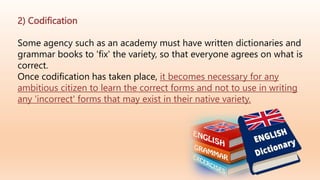
2) Codification
Some agency such as an academy must have written dictionaries and
grammar books to 'fix' the variety, so that everyone agrees on what is
correct.
Once codification has taken place, it becomes necessary for any
ambitious citizen to learn the correct forms and not to use in writing
any 'incorrect' forms that may exist in their native variety.
3) Elaboration of function
It must be possible to use the selected variety in all the functions
associated with central government and with writing: for example, in
parliament and law courts, in bureaucratic, educational and scientific
documents of all kinds and, of course, in various forms of literature.
4) Acceptance
The variety has to be accepted by the relevant population as the
variety of the community . usually, in fact, as the national language.
Once this has happened, the standard language serves as a strong
unifying force for the state, as a symbol of its independence of other
states (assuming that its standard is unique and not
shared with others), and as a marker of its difference from other
states.
Language and dialect
 What does it mean to say that some variety is a
language?
This is first of all a question about popular usage: what do ordinary people mean when
they say that some variety is a language? Having answered the question in this form,
we may or may not wish to take 'language' as a technical term, and say how we
propose to use it in sociolinguistics.
- If we find that popular usage reflects some kind of reality to which we should like to
refer in sociolinguistics, but if we come to the conclusion that popular usage reflects no
such reality, then there will be no point in defining 'language' more explicitly in order
to use it as a technical term
 The most widely recognized types of language variety: 'language', 'dialect' and
'register'. All three types are extremely problematic, both from the point of view
of:
1- Finding a general definition for each one which will distinguish it from the
others.
2- From the point of view of finding criteria for delimiting varieties.
The difference between dialect and language
 Yule (2010:241) distinguished between two different dialects of the
same language (whose speakers can usually understand each other)
and two different languages (whose speakers can’t usually
understand each other).
What then is the difference, for English speakers, between a language and a dialect?
There are two separate ways of distinguishing them, and this ambiguity is a source of great
confusion. The reason for the ambiguity, and the resulting confusion, is precisely the fact that
'dialect' was borrowed from Greek, where the same ambiguity existed.)
There is a difference of size, because a language is larger than a dialect. That is, a variety
called a language contains more items than one called a dialect. This is the sense in which we
may refer to English as a language, containing the sum total of all the terms in all its dialects,
with 'Standard English' as one dialect among many others
(Yorkshire English, Indian English, etc.). Hence the greater 'size' of the language English.
The other contrast between 'language' and 'dialect' is a question of prestige, a
language having prestige which a dialect lacks. If we apply the terms in this sense,
Standard English is not a dialect at all, but a language, whereas the varieties which
are not used in formal writing are dialects. Whether some variety is called a language
or a dialect depends on how much prestige one thinks it has, and for most people this
is a clear-cut matter, which depends on whether it is used in formal writing.
Accordingly, people in Britain habitually refer to languages which are unwritten
(or which they think are unwritten)
There are no universal accepted criteria for distinguishing between them
as dialects are subparts of languages, the difference might be :
Dialect is a local, non-prestigious variety having some features of grammar and
vocabulary of which language do have a prestige. (Hudson, 1996)
 Standard Arabic is not a dialect but a prestigious language used formally, whereas
the Iraqi, Egyptian and Syrian are dialects being used informally.
- Language is larger than a dialect.
( language contains more items that one called a dialect which in turn have more
idiolects)
- Social and historical factors:
- Similar but considered to be separate, e.g. Hindi and Urdu
- Different but considered one, e.g. the different varieties of Chinese
Dialect is used for
1. Forms of speech that are different but mutually intelligible
without special training.
2. The forms of speech current within a politically unified area.
3. Forms of speech of speakers sharing a common writing
system
and set of written classics.
( Robins 1964:58)
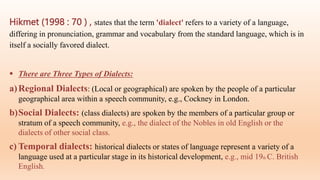
Hikmet (1998 : 70 ) , states that the term 'dialect' refers to a variety of a language,
differing in pronunciation, grammar and vocabulary from the standard language, which is in
itself a socially favored dialect.
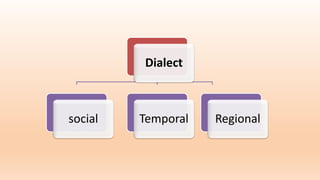
 There are Three Types of Dialects:
a)Regional Dialects: (Local or geographical) are spoken by the people of a particular
geographical area within a speech community, e.g., Cockney in London.
b)Social Dialects: (class dialects) are spoken by the members of a particular group or
stratum of a speech community, e.g., the dialect of the Nobles in old English or the
dialects of other social class.
c) Temporal dialects: historical dialects or states of language represent a variety of a
language used at a particular stage in its historical development, e.g., mid 19th C. British
English.
Dialect
social Temporal Regional
Kinds of dialect
 Regional dialect
 Social dialect
(It is possible in a given community, people speak more than one dialect)
Regional Dialect
It is very distinctive local varieties → regional dialect
1. It is reflected in the differences in pronunciation, in the choice and
forms of words, and in syntax.
2. Various pressures-political, social, cultural, and educational- serve to
harden current national boundaries an to make the linguistic
differences among states
3. Dialect geography used to describe attempts made to map the
distributions of various linguistic features .( Yule ,2010 :257)
 Social dialect originates from social groups and depend on a variety of
factors; social class, religion, and ethnicity.
 These factors like:
occupation, place of residence, education, income, racial or ethnic origin,
cultural background, caste, religion related to the way people speak
Standard language.

Standard language.

  • 1.
    Ministry of HigherEducation and Scientific Research University of Kerbala College of Education for Human Sciences Department of English Sociolinguistics By : Zahra Aamir Kamil. Supervised by : Dr.Hamid Gittan Jewad. 20th Feb. 2023 / 3rd lecture.
  • 2.
  • 3.
  • 4.
  • 5.
    A dialect, orsome closely similar group of dialects enjoying prestige as the speech of educated people of the capital city or of some other socially respected group, is often designated 'the standard language( Robins 1964:57). “It is a variety of a language that contains more items than what is there in a dialect”. "Standard" is still a dialect, but is based more on social class rather than on region. (Hudson 1996:32)  Standard language
  • 6.
    Standard language asthe variety of a language treated as the ofcial language and used in public broadcasting, publishing and education. (Yule , 2010 : 295 ) Standard (language, variety) is usually identified as a relatively uniform variety of a language which does not show regional variation, and which is used in a wide range of communicative functions (e.g. official language, medium of instruction, literary language, scientific language, etc.)
  • 7.
    Standard languages arethe result of a direct and deliberate intervention by society. This intervention, called “standardization”
  • 8.
    Is the wordof “Standard” a precise notion ?
  • 9.
    The notion 'standardlanguage' is somewhat imprecise, but a typical standard language will have passed through the following processes 1) Selection 2) Codification 3) Elaboration of function. 4) Acceptance .
  • 10.
    1) Selection Somehow orother a particular variety must have been selected as the one to be developed into a standard language. It may be an existing variety, such as the one used in an important political or commercial Centre, but it could be an amalgam of various varieties. The choice is a matter of great social and political importance, as the chosen variety necessarily gains prestige and so the people who already speak it share in this prestige. However, in some cases the chosen variety has been one with no native speakers at all for instance, Classical Hebrew in Israel and the two modern standards for Norwegian (Hudson ,1996:33).
  • 11.
    2) Codification Some agencysuch as an academy must have written dictionaries and grammar books to 'fix' the variety, so that everyone agrees on what is correct. Once codification has taken place, it becomes necessary for any ambitious citizen to learn the correct forms and not to use in writing any 'incorrect' forms that may exist in their native variety.
  • 12.
    3) Elaboration offunction It must be possible to use the selected variety in all the functions associated with central government and with writing: for example, in parliament and law courts, in bureaucratic, educational and scientific documents of all kinds and, of course, in various forms of literature.
  • 13.
    4) Acceptance The varietyhas to be accepted by the relevant population as the variety of the community . usually, in fact, as the national language. Once this has happened, the standard language serves as a strong unifying force for the state, as a symbol of its independence of other states (assuming that its standard is unique and not shared with others), and as a marker of its difference from other states.
  • 14.
  • 15.
     What doesit mean to say that some variety is a language? This is first of all a question about popular usage: what do ordinary people mean when they say that some variety is a language? Having answered the question in this form, we may or may not wish to take 'language' as a technical term, and say how we propose to use it in sociolinguistics. - If we find that popular usage reflects some kind of reality to which we should like to refer in sociolinguistics, but if we come to the conclusion that popular usage reflects no such reality, then there will be no point in defining 'language' more explicitly in order to use it as a technical term
  • 16.
     The mostwidely recognized types of language variety: 'language', 'dialect' and 'register'. All three types are extremely problematic, both from the point of view of: 1- Finding a general definition for each one which will distinguish it from the others. 2- From the point of view of finding criteria for delimiting varieties.
  • 17.
    The difference betweendialect and language  Yule (2010:241) distinguished between two different dialects of the same language (whose speakers can usually understand each other) and two different languages (whose speakers can’t usually understand each other).
  • 18.
    What then isthe difference, for English speakers, between a language and a dialect? There are two separate ways of distinguishing them, and this ambiguity is a source of great confusion. The reason for the ambiguity, and the resulting confusion, is precisely the fact that 'dialect' was borrowed from Greek, where the same ambiguity existed.) There is a difference of size, because a language is larger than a dialect. That is, a variety called a language contains more items than one called a dialect. This is the sense in which we may refer to English as a language, containing the sum total of all the terms in all its dialects, with 'Standard English' as one dialect among many others (Yorkshire English, Indian English, etc.). Hence the greater 'size' of the language English.
  • 19.
    The other contrastbetween 'language' and 'dialect' is a question of prestige, a language having prestige which a dialect lacks. If we apply the terms in this sense, Standard English is not a dialect at all, but a language, whereas the varieties which are not used in formal writing are dialects. Whether some variety is called a language or a dialect depends on how much prestige one thinks it has, and for most people this is a clear-cut matter, which depends on whether it is used in formal writing. Accordingly, people in Britain habitually refer to languages which are unwritten (or which they think are unwritten)
  • 20.
    There are nouniversal accepted criteria for distinguishing between them as dialects are subparts of languages, the difference might be : Dialect is a local, non-prestigious variety having some features of grammar and vocabulary of which language do have a prestige. (Hudson, 1996)  Standard Arabic is not a dialect but a prestigious language used formally, whereas the Iraqi, Egyptian and Syrian are dialects being used informally. - Language is larger than a dialect. ( language contains more items that one called a dialect which in turn have more idiolects) - Social and historical factors: - Similar but considered to be separate, e.g. Hindi and Urdu - Different but considered one, e.g. the different varieties of Chinese
  • 21.
    Dialect is usedfor 1. Forms of speech that are different but mutually intelligible without special training. 2. The forms of speech current within a politically unified area. 3. Forms of speech of speakers sharing a common writing system and set of written classics. ( Robins 1964:58)
  • 22.
    Hikmet (1998 :70 ) , states that the term 'dialect' refers to a variety of a language, differing in pronunciation, grammar and vocabulary from the standard language, which is in itself a socially favored dialect.  There are Three Types of Dialects: a)Regional Dialects: (Local or geographical) are spoken by the people of a particular geographical area within a speech community, e.g., Cockney in London. b)Social Dialects: (class dialects) are spoken by the members of a particular group or stratum of a speech community, e.g., the dialect of the Nobles in old English or the dialects of other social class. c) Temporal dialects: historical dialects or states of language represent a variety of a language used at a particular stage in its historical development, e.g., mid 19th C. British English.
  • 23.
  • 24.
    Kinds of dialect Regional dialect  Social dialect (It is possible in a given community, people speak more than one dialect)
  • 25.
    Regional Dialect It isvery distinctive local varieties → regional dialect 1. It is reflected in the differences in pronunciation, in the choice and forms of words, and in syntax. 2. Various pressures-political, social, cultural, and educational- serve to harden current national boundaries an to make the linguistic differences among states 3. Dialect geography used to describe attempts made to map the distributions of various linguistic features .( Yule ,2010 :257)
  • 26.
     Social dialectoriginates from social groups and depend on a variety of factors; social class, religion, and ethnicity.  These factors like: occupation, place of residence, education, income, racial or ethnic origin, cultural background, caste, religion related to the way people speak