IMAGE
STEGANOGRAPHY
Guided By:
Prof. Nikunj Gamit
Prepared By:
Nidhi Papaiyawala
201203100810041
(6th IT)
Content
 Definition of image steganography
 Advantages
 Limitations
 Application
 Block diagram of steganography
 Different techniques
 Introduction of LSB technique
 Merits and Demerits of LSB
 Introduction of DCT technique
 Application
 Error analysis
1
Image steganography
 Definition:
Steganography is the art of “concealed
writing” and it refers to techniques that hide
information inside objects known as “Cover
Objects”.
2
Advantages of steganography
 The secret message does not attract attention to
itself as an object of scrutiny.
 steganography is concerned with concealing a
secret message is being sent, as well as
concealing the contents of the message.
 Difficult to detect. Only receiver can detect.
 Provides better security for data sharing.
3
Limitations
 The confidentiality of information is maintained
by the algorithms, and if algorithms are known
then this technique is of no use.
 Password leakage may occur and it leads to the
unauthorized access of data.
4
Application
 several information sources like our private
banking information, some military secrets, can
be stored in a cover source.
 Steganography is used by some modern printers
and color laser printers.
 Steganography can be used for digital
watermarking.
5
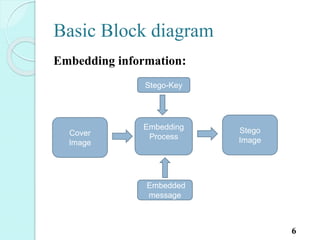
Basic Block diagram
Embedding information:
6
Embedding
Process
Stego-Key
Embedded
message
Cover
Image
Stego
Image
(cont.)
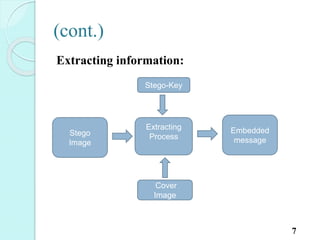
Extracting information:
7
Extracting
Process
Stego-Key
Cover
Image
Stego
Image
Embedded
message
Different Techniques[1]
There are two categories:
1)Spatial Domain:
which mainly includes LSB(Least
Significant Bit)
2)Frequency Domain:
which includes DCT(Discrete cosine
transform) and Wavelet Transform.
8
Least Significant Bit
 Simple approach to embedding information in
a cover image.
 It operates on principle that the human eye can
not differentiate between two shade separated by
only one bit.
Algorithm to embed the message:[1]
 Read the cover image and text message which is
to be hidden in the cover image.
 Convert the color image into grey image.
9
(cont.)
 Convert text message in binary.
 Calculate the LSB of each pixel of cover image.
 Replace LSB of cover image with each bit of
secret message one by one.
 Write stego image.
10
Algorithm to extracting message
 Read the stego image.
 Calculate the LSB of each pixel of stego image.
 Extract the bits and covert each 8 bit in to
character.
11
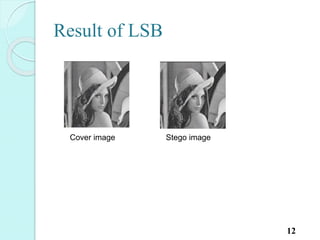
Result of LSB
12
Cover image Stego image
 Merits
1) Simple to
implement.
2) High payload
capacity.
3) Low complexity.
 Demerits:
1) Vulnerable
corruption.
2) Vulnerable to
detection.
13
DCT(Discrete cosine transform)
 The DCT transforms a signal or image from the
spatial domain to the frequency domain.
 Grouping the pixels into 8 × 8 pixel blocks and
transforming the pixel blocks into 64 DCT.
 DCT allows an image to be broken up into
different frequency bands namely the high,
middle and low frequency bands
14
Process of DCT based image
Steganography are as follow:[2]
Embedding information:
 Load cover image and secret image.
 Divide the cover image in to 8x8 blocks of
pixels.
 Transform the cover image from spatial domain
to frequency using two dimensional DCT .
 Quantize the DCT coefficients by dividing using
factor in to the rounded value. 15
(cont.)
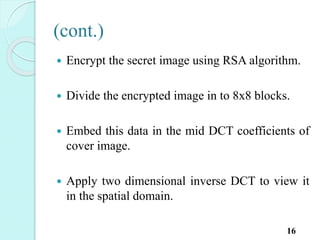
 Encrypt the secret image using RSA algorithm.
 Divide the encrypted image in to 8x8 blocks.
 Embed this data in the mid DCT coefficients of
cover image.
 Apply two dimensional inverse DCT to view it
in the spatial domain.
16
Block Diagram of DCT[2]
secret
message
17
Encryptio
n
Embeddi
ng
2D DCT
on each
block
8*8 block
preparatio
n
Cover
image
2D IDCT
on each
block
Stego
Embedding information:
Extracting information
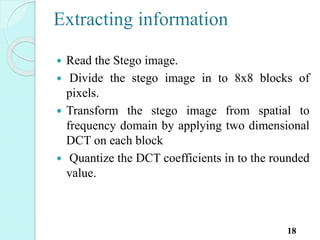
 Read the Stego image.
 Divide the stego image in to 8x8 blocks of
pixels.
 Transform the stego image from spatial to
frequency domain by applying two dimensional
DCT on each block
 Quantize the DCT coefficients in to the rounded
value.
18
(cont.)
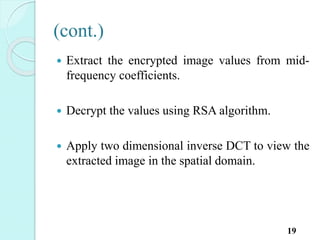
 Extract the encrypted image values from mid-
frequency coefficients.
 Decrypt the values using RSA algorithm.
 Apply two dimensional inverse DCT to view the
extracted image in the spatial domain.
19
Extracting information[2]
20
Stego
image
8*8 block
preparatio
n
2D DCT
on each
block
Extraction
2D IDCT
on each
block
Decryptio
n
Extracted
image
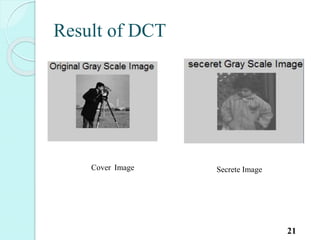
Result of DCT
21
Cover Image Secrete Image
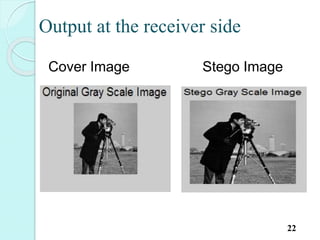
Output at the receiver side
Cover Image Stego Image
22
Advantages
 Energy compaction.
 High compression ratio,
 Small bit error rate
 Good information integration ability.
23
Application
 It is often used in image processing, especially
for lossy compression, because it has a strong
"energy compaction" property.
24
Error Analysis [2]
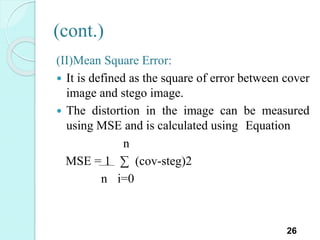
(I)Bit Error Rate(BER):
 For the successful recovery of the hidden
information the communication channel must be
ideal.
 for the real communication channel, there will
be error while retrieving hidden information and
this is measured by BER.
all pixel
BER= 1 ∑ |image cov -image steg |
|image cov| i=0
25
(cont.)
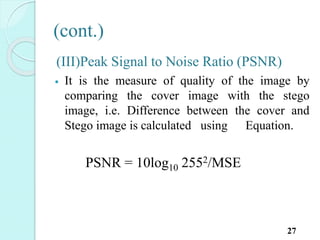
(II)Mean Square Error:
 It is defined as the square of error between cover
image and stego image.
 The distortion in the image can be measured
using MSE and is calculated using Equation
n
MSE = 1 ∑ (cov-steg)2
n i=0
26
(cont.)
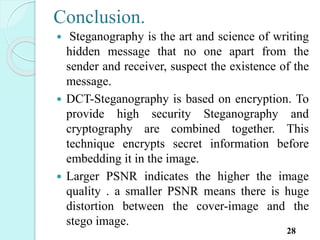
(III)Peak Signal to Noise Ratio (PSNR)
 It is the measure of quality of the image by
comparing the cover image with the stego
image, i.e. Difference between the cover and
Stego image is calculated using Equation.
PSNR = 10log10 2552/MSE
27
Conclusion.
 Steganography is the art and science of writing
hidden message that no one apart from the
sender and receiver, suspect the existence of the
message.
 DCT-Steganography is based on encryption. To
provide high security Steganography and
cryptography are combined together. This
technique encrypts secret information before
embedding it in the image.
 Larger PSNR indicates the higher the image
quality . a smaller PSNR means there is huge
distortion between the cover-image and the
stego image.
28
References
 Anil k Jain, “Fundamentals of digital image
processing", University of california-
davis,prentice hall.
 Proceeding of the 2006 International conference
on “Intelligent information hiding and
multimedia signal processing 2006 IEEE.
 K.B.Raja', C.R.Chowdary2, Venugopal K R3,
L.M.Patnaik , A Secure Image Steganography
using LSB, DCT and Compression Techniques
on Raw Images,2005 IEEE 29
THANK YOU
30

Image steganography

  • 1.
    IMAGE STEGANOGRAPHY Guided By: Prof. NikunjGamit Prepared By: Nidhi Papaiyawala 201203100810041 (6th IT)
  • 2.
    Content  Definition ofimage steganography  Advantages  Limitations  Application  Block diagram of steganography  Different techniques  Introduction of LSB technique  Merits and Demerits of LSB  Introduction of DCT technique  Application  Error analysis 1
  • 3.
    Image steganography  Definition: Steganographyis the art of “concealed writing” and it refers to techniques that hide information inside objects known as “Cover Objects”. 2
  • 4.
    Advantages of steganography The secret message does not attract attention to itself as an object of scrutiny.  steganography is concerned with concealing a secret message is being sent, as well as concealing the contents of the message.  Difficult to detect. Only receiver can detect.  Provides better security for data sharing. 3
  • 5.
    Limitations  The confidentialityof information is maintained by the algorithms, and if algorithms are known then this technique is of no use.  Password leakage may occur and it leads to the unauthorized access of data. 4
  • 6.
    Application  several informationsources like our private banking information, some military secrets, can be stored in a cover source.  Steganography is used by some modern printers and color laser printers.  Steganography can be used for digital watermarking. 5
  • 7.
    Basic Block diagram Embeddinginformation: 6 Embedding Process Stego-Key Embedded message Cover Image Stego Image
  • 8.
  • 9.
    Different Techniques[1] There aretwo categories: 1)Spatial Domain: which mainly includes LSB(Least Significant Bit) 2)Frequency Domain: which includes DCT(Discrete cosine transform) and Wavelet Transform. 8
  • 10.
    Least Significant Bit Simple approach to embedding information in a cover image.  It operates on principle that the human eye can not differentiate between two shade separated by only one bit. Algorithm to embed the message:[1]  Read the cover image and text message which is to be hidden in the cover image.  Convert the color image into grey image. 9
  • 11.
    (cont.)  Convert textmessage in binary.  Calculate the LSB of each pixel of cover image.  Replace LSB of cover image with each bit of secret message one by one.  Write stego image. 10
  • 12.
    Algorithm to extractingmessage  Read the stego image.  Calculate the LSB of each pixel of stego image.  Extract the bits and covert each 8 bit in to character. 11
  • 13.
    Result of LSB 12 Coverimage Stego image
  • 14.
     Merits 1) Simpleto implement. 2) High payload capacity. 3) Low complexity.  Demerits: 1) Vulnerable corruption. 2) Vulnerable to detection. 13
  • 15.
    DCT(Discrete cosine transform) The DCT transforms a signal or image from the spatial domain to the frequency domain.  Grouping the pixels into 8 × 8 pixel blocks and transforming the pixel blocks into 64 DCT.  DCT allows an image to be broken up into different frequency bands namely the high, middle and low frequency bands 14
  • 16.
    Process of DCTbased image Steganography are as follow:[2] Embedding information:  Load cover image and secret image.  Divide the cover image in to 8x8 blocks of pixels.  Transform the cover image from spatial domain to frequency using two dimensional DCT .  Quantize the DCT coefficients by dividing using factor in to the rounded value. 15
  • 17.
    (cont.)  Encrypt thesecret image using RSA algorithm.  Divide the encrypted image in to 8x8 blocks.  Embed this data in the mid DCT coefficients of cover image.  Apply two dimensional inverse DCT to view it in the spatial domain. 16
  • 18.
    Block Diagram ofDCT[2] secret message 17 Encryptio n Embeddi ng 2D DCT on each block 8*8 block preparatio n Cover image 2D IDCT on each block Stego Embedding information:
  • 19.
    Extracting information  Readthe Stego image.  Divide the stego image in to 8x8 blocks of pixels.  Transform the stego image from spatial to frequency domain by applying two dimensional DCT on each block  Quantize the DCT coefficients in to the rounded value. 18
  • 20.
    (cont.)  Extract theencrypted image values from mid- frequency coefficients.  Decrypt the values using RSA algorithm.  Apply two dimensional inverse DCT to view the extracted image in the spatial domain. 19
  • 21.
    Extracting information[2] 20 Stego image 8*8 block preparatio n 2DDCT on each block Extraction 2D IDCT on each block Decryptio n Extracted image
  • 22.
    Result of DCT 21 CoverImage Secrete Image
  • 23.
    Output at thereceiver side Cover Image Stego Image 22
  • 24.
    Advantages  Energy compaction. High compression ratio,  Small bit error rate  Good information integration ability. 23
  • 25.
    Application  It isoften used in image processing, especially for lossy compression, because it has a strong "energy compaction" property. 24
  • 26.
    Error Analysis [2] (I)BitError Rate(BER):  For the successful recovery of the hidden information the communication channel must be ideal.  for the real communication channel, there will be error while retrieving hidden information and this is measured by BER. all pixel BER= 1 ∑ |image cov -image steg | |image cov| i=0 25
  • 27.
    (cont.) (II)Mean Square Error: It is defined as the square of error between cover image and stego image.  The distortion in the image can be measured using MSE and is calculated using Equation n MSE = 1 ∑ (cov-steg)2 n i=0 26
  • 28.
    (cont.) (III)Peak Signal toNoise Ratio (PSNR)  It is the measure of quality of the image by comparing the cover image with the stego image, i.e. Difference between the cover and Stego image is calculated using Equation. PSNR = 10log10 2552/MSE 27
  • 29.
    Conclusion.  Steganography isthe art and science of writing hidden message that no one apart from the sender and receiver, suspect the existence of the message.  DCT-Steganography is based on encryption. To provide high security Steganography and cryptography are combined together. This technique encrypts secret information before embedding it in the image.  Larger PSNR indicates the higher the image quality . a smaller PSNR means there is huge distortion between the cover-image and the stego image. 28
  • 30.
    References  Anil kJain, “Fundamentals of digital image processing", University of california- davis,prentice hall.  Proceeding of the 2006 International conference on “Intelligent information hiding and multimedia signal processing 2006 IEEE.  K.B.Raja', C.R.Chowdary2, Venugopal K R3, L.M.Patnaik , A Secure Image Steganography using LSB, DCT and Compression Techniques on Raw Images,2005 IEEE 29
  • 31.