This document outlines the syllabus for a digital signal processing course. It includes the course information, objectives, policies and learning outcomes. It provides an overview of digital signal processing applications and why signal processing is important. It discusses the limitations of analog signal processing and highlights advantages of digital signal processing such as accuracy, repeatability and flexibility. Finally, it introduces some basic discrete-time signals and operations including sequences, sampling, reflection, delay and common signal types.




![Muhammad Majid (m.majid@uettaxila.edu.pk) Digital Signal Processing
Discrete-Time Signals:
Sequences
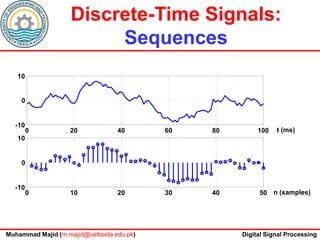
• Discrete-time signals are represented by sequence of
numbers
• The nth number in the sequence is represented
with x[n]
• Often times sequences are obtained by sampling of
continuous-time signals
• In this case x[n] is value of the analog signal at
xc(nT)
• Where T is the sampling period](https://image.slidesharecdn.com/dsplecture1-231119091115-76488c63/85/DSP-Lecture-1-pdf-15-320.jpg)


![Muhammad Majid (m.majid@uettaxila.edu.pk) Digital Signal Processing
Basic Operations
• Reflection (Folding) a sequence
• Delaying (Shifting) a sequence
]
n
n
[
x
]
n
[
y o
y[n]= x[-n]](https://image.slidesharecdn.com/dsplecture1-231119091115-76488c63/85/DSP-Lecture-1-pdf-25-320.jpg)
![Muhammad Majid (m.majid@uettaxila.edu.pk) Digital Signal Processing
Basic Sequences
• Unit sample (impulse) sequence
• Unit step sequence
• Exponential sequences
0
n
1
0
n
0
]
n
[
0
n
1
0
n
0
]
n
[
u
n
A
]
n
[
x
-10 -5 0 5 10
0
0.5
1
1.5
-10 -5 0 5 10
0
0.5
1
1.5
-10 -5 0 5 10
0
0.5
1](https://image.slidesharecdn.com/dsplecture1-231119091115-76488c63/85/DSP-Lecture-1-pdf-26-320.jpg)
![Muhammad Majid (m.majid@uettaxila.edu.pk) Digital Signal Processing
Basic Sequences
• Sinusoidal Sequence
• Important class of sequences
• An exponential sequence with complex
• x[n] is a sum of weighted sinusoids
n
cos
n
x o
j
j
e
A
A
and
e o
n
sin
A
j
n
cos
A
n
x
e
A
e
e
A
A
n
x
o
n
o
n
n
j
n
n
j
n
j
n o
o](https://image.slidesharecdn.com/dsplecture1-231119091115-76488c63/85/DSP-Lecture-1-pdf-27-320.jpg)